The longest day! Not quite the shortest list – but a close run thing! This is only the sixth time that I have actually carried out a June session in Red Lodge in 12 years. With more time available since I decided not to continue with the Lower Moor Farm CES, it was time for a session in Red Lodge. It has been more than a little hit and miss: last time was 2022, and we only caught five birds. The three June sessions in 2014, 2018 and 2020 showed a slow decline in catch size: 61, 41 and 36. The three since then have been much worse (2021 15, 2022 5, 2025: I will reveal later). The forecast was for it to be hot and dry but overcast with a negligible possibility of rain (<2%).
With just the two of us meeting at 6:00, we set the following nets:
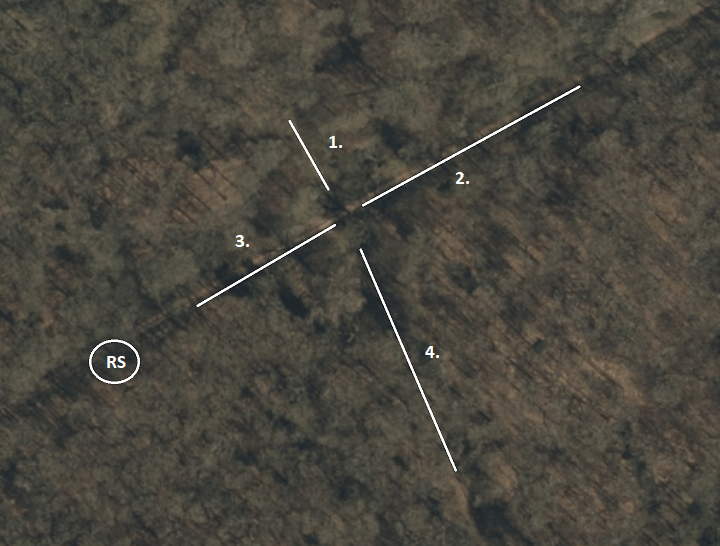

We had the nets open by 7:00 but, as we were finishing off , I felt a few spots of rain! We took two Robin out of the nets and then the rain started in earnest, so we shut the nets and processed the birds and then sat in the car for the next 90 minutes as the rain fell! We reopened the nets at 8:30 and then did our next round at 8:45. There were 6 birds in that round, including our second juvenile Marsh Tit of the year, taking our total of Marsh Tits ringed in the Braydon Forest to 13 so far. To put that into context, this is the most we have ever ringed in the first six months of the year. The previous best was nine in 2013. Excluding 2025, our average is 5.75 for the first six months, so this is very encouraging.
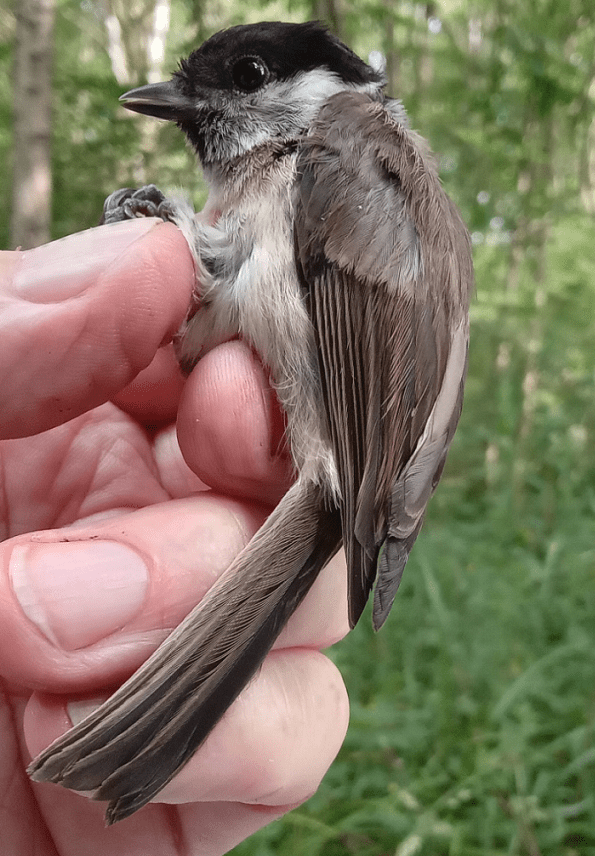
In these first two rounds, 95 minutes apart, we caught five juvenile Robins. They do seem to be having a good start to their breeding year.
Unfortunately, after that things went very quiet. Which is not to say that there were not highlights: no birds at the 9:00 round, two in the 9:15 round: a Nuthatch and this noisy beggar:

Our first of the year, beautifully showing the markings that make juvenile Song Thrushes easy to identify. You cannot see the tail from this angle but it was, equally diagnostically, with very pointy tips to the remiges.
That was followed by a break of 45 minutes until our next capture, and then another 30 minutes until we caught our second juvenile Song Thrush of the year. I had always planned to pack up at 11:00, before the heat settled in. We took a final Wren out, as I was taking in ride 2, which David processed whilst David’s dad and I continued taking down the rest of the nets and packing up. Between us we were finished and off site by 11:30. The list from the session was: Nuthatch 1; Great Tit [1]; Marsh Tit [1]; Wren 1[1](1); Robin [5]; Song Thrush [2]. Totals: 2 adults ringed from 2 species, 10 juveniles ringed from 5 species and 1 bird retrapped, making 13 birds processed from 6 species.
Following on from the fabulous Zebra jumping spider on Friday, I was rather pleased to find this little beastie, a long-horned beetle, crawling over my mobile phone case:


Usually found on nettles in woodlands and, it would appear, mobile phone cases! Apparently common but I have never seen one before. I really must take my macro lens with me next time: my 70 – 150 zoom had a bit of trouble getting it in focus, either auto or manual (and I picked up my new glasses on Thursday, so my eyesight is just fine, thank you).
 Ringing In The Braydon Forest & Beyond