This is turning into a very nice week for me, Lapwing yesterday, hopefully Barn Owls tomorrow: and this morning was pretty good for Laura and Miranda as well. We have seen a significant improvement in the Firs since it reopened after the Ash dieback remedial work and opening up of the canopy. The three of us met up at 6:30 and set the following nets:
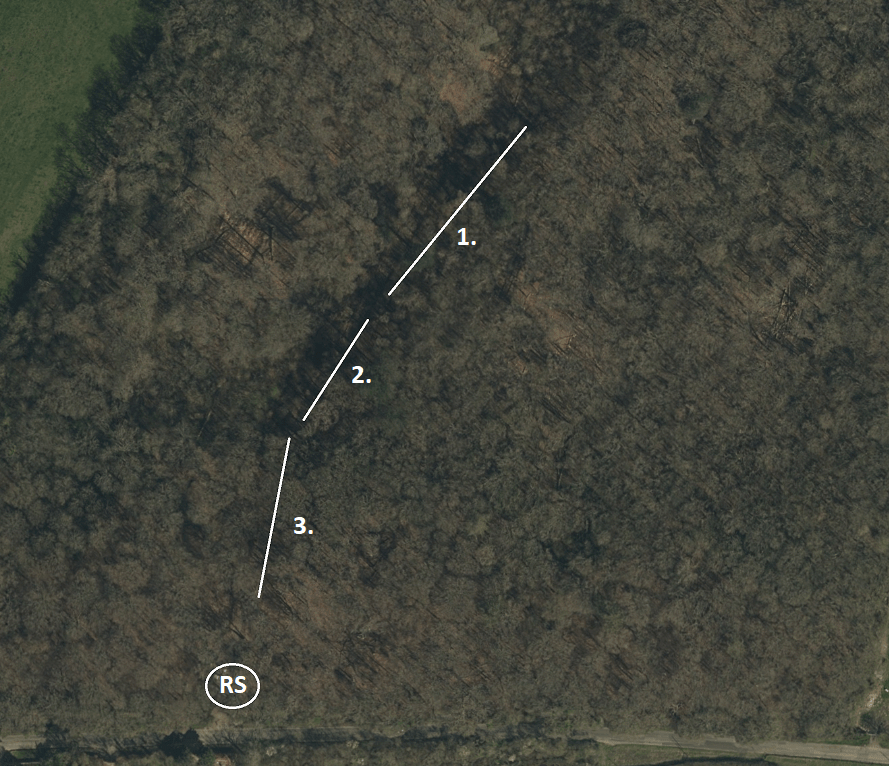
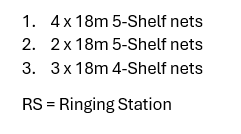
(One day the Ordnance Survey, Google Maps and Bing Maps will update their aerial views: this is OS and the best of the three.)
The wood is considerably more open since the Ash-dieback clearance in 2023 / 24. The Wildlife Trust had very helpfully mowed the central glade recently. Rides 1 and 2 are in the usual places for net setting in the Firs, ride 3 is on the slope down to the central glade / ponds area. Since the clearance the woodland on either side of the slope has developed a very decent understorey, including a bank of bramble down the eastern side, which is full of flowers, and I am hoping that will translate into a lot of blackberries in the autumn, and a significant catch of migrating birds, as happened in a similar habitat, with the same number of nets, at Lower Moor Farm in August 2014 (137 birds from 15 species). So I decided to set these three nets up to see how they went at this time. They performed better than I expected.
We had a few niggles with the nets and didn’t get them open until after 7:30. After taking the setting equipment back to the car, having a quick coffee to wake myself up, as the others did the same with their chosen poison, we did our first round. It was a good start: 17 birds from 8 species. Nobody was counting chickens, we have had reasonable starts recently that ended up with very little happening subsequently.
Once they had been processed we went off on round two: 19 birds from 9 species. Good grief: did this mean that we were going to end up with a decent haul? Well, yes. Over the next two hours we processed another 31 birds from 11 species. This is our best catch this year, and that includes catches inflated by the provision of feeding stations in the winter months. Out of 85 ringing trips to the Firs, since 8th September 2012, there have only been five bigger catches: each one fuelled by supplementary feeding.
Alongside the good number was an excellent variety, with lots of highlights. We ringed another three Marsh Tits, bringing the annual total for the Braydon Forest 16! Looks like it is going to be a bumper year for this red-listed species in the Braydon Forest.
However, the outstanding catch of the session was this beauty:

The story of ringing Spotted Flycatchers in the Braydon Forest is quite an interesting one. They have bred in the Ravensroost complex on and off for a long time: I saw my first ones, adults feeding young, in 2005 and have seen them on and off ever since. The Trust have put up nest boxes for them and we know they breed there. On several occasions, whilst Jonny was still training with me, we would watch them hawking insects, occasionally landing on the path 20m or so away from where we were sat ringing birds. To be fair, since the group came into its current structure at the beginning of 2013, we have actually only caught 12, until today. Of those, eight had been caught in the Braydon Forest, which is why it was such a pleasure to catch another today. Given that the Firs is the smallest of our woodlands, its record in Spotted Flycatchers is surprising.

As you can see from this graphic, the Firs is a tiny fraction of the woodlands we cover with our ringing activities.
Anyway, the first Spotted Flycatcher ringed in the Braydon Forest was a juvenile caught in the Firs on the 3rd August 2016: the first bird out of the nets in that session. Ironically, the second was the last bird out of the nets in that same session. That was followed by another juvenile in Red Lodge on the 21st of that month. The next was a juvenile caught at Somerford Common in July 2017, then a juvenile in Ravensroost Wood in August 2018.
Perhaps the most exciting find for me, because these juveniles caught could all have been on autumn migration, was in June 2019 when we caught another two in the Firs: a male and a female, both in full breeding condition. That was followed by a juvenile caught in a net triangle set for Meadow Pipits on the Blakehill Farm plateau, and then today’s catch!
So, to sum up, of the 13 Spotted Flycatchers caught by the West Wilts Ringing Group since 2103, nine have been caught in the Braydon Forest and five of those in the smallest site: the Firs! Because neither Laura nor Miranda have ever ringed a Spotted Flycatcher, I decided that they would draw lots for the privilege: Miranda won. Laura did the release.
Anyway, enough rambling, the list for the session was: Great Spotted Woodpecker (1); Nuthatch 3; Blue Tit [14]; Great Tit [2]; Coal Tit [1]; Marsh Tit [3]; Long-tailed Tit [1]; Wren [5](1); Dunnock [1](2); Spotted Flycatcher 1; Robin 1[4]; Blackbird [1](3); Blackcap 6[7]; Garden Warbler [1]; Chiffchaff 2[4](1); Chaffinch 1[1]. Totals: 14 adults ringed from 6 species, 45 juveniles from 13 species and 8 birds retrapped from 5 species, making 67 birds processed from 16 species.
We did the last round and closed the nets at 11:30, taking the last three birds out of the net, processed them, and then took down the nets and packed away, leaving site by 12:30, after a very satisfactory morning.
 Ringing In The Braydon Forest & Beyond