After another car problem (see last post) I had to cancel Sunday’s visit to Ravensroost Wood, so I could check that the car issue had been resolved. It has, fortunately, and I got permission to run a session this morning at Ravensroost Wood but, unfortunately, none of my team could make it. I have to check these days as the Trust have employed a contractor to reduce the population of Roe Deer and Muntjac, in an effort to enable the understorey to regrow following Ash die-back remediation work, that also coincided with 25 year coppicing of a large part of the northern end of the wood. I am just hopeful that it will give the Bird’s Nest Orchids and the Violet Helleborines a chance to expand their somewhat tenuous status in the wood. It is not their usual habitat, which makes them being there even more special.
I arrived on site at 6:30 and set the usual nets: 3 x 18m nets in R 28 and 4 x 18m + 1 x 12m nets in R38. I had them open and the ringing station all set up by just after 7:30 and started catching at 8:00. I had only one round with a good number of birds, the third, with nine birds from six species at 8:30. Because of the heat, I did far more rounds, with less time in between, than I normally would: twelve rounds in three and a half hours. Fortunately, the net rides were properly sheltered from the sun, and I also managed to put the ringing station into the shade, so it was actually a very pleasant session and it didn’t get really sweaty until I started the take down (I am sure you all needed to know that).
The highlight of the morning for me was this:
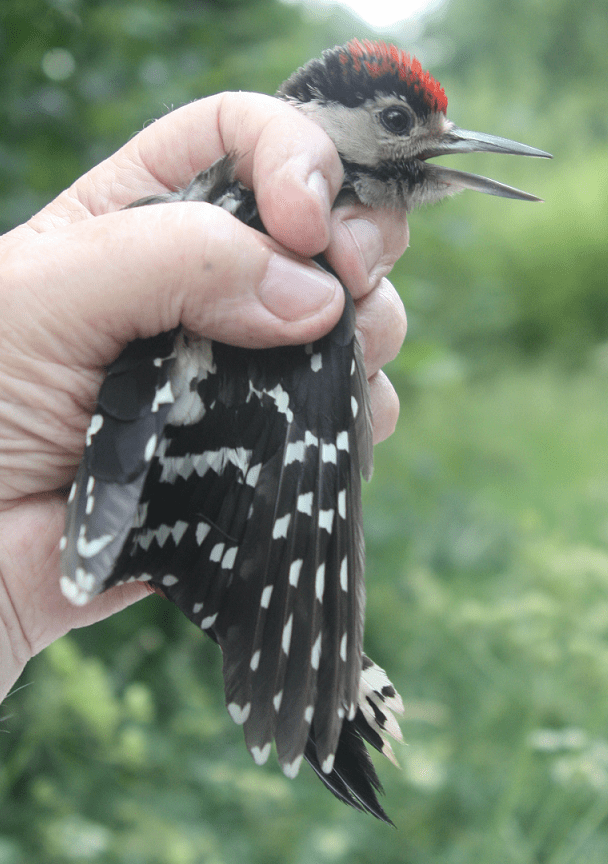
We have had one visiting our garden for the last week or so, and Laura did ring one in her garden when we ran a session there earlier this month, but that was just outside Cirencester and very much in Gloucestershire. This is the first for the year by anyone in our Wiltshire ringing group.
The list for the morning was: Great Spotted Woodpecker [1]; Great Tit [1]; Wren [4](1); Dunnock 1; Robin 1[6]; Song Thrush 2; Blackbird [1]; Blackcap 2[4]; Garden Warbler [1]; Chiffchaff 1[3](2). Totals: 7 adults ringed from 5 species, 21 juveniles ringed from 8 species and 3 birds retrapped from 2 species, making 31 birds processed from 10 species.
It is clearly a good year for Robins: we have ringed 22 in the Braydon Forest so far: 21 in June and one in May. This table shows just how variable the breeding efforts of Robins are in the first six months of the year within the Braydon Forest:

Essentially, this is an above average year. Goodness knows what happened in 2014! Of course, the plague year was the best of them all proportionately. It is quite surprising how good the catches were that year, given the restrictions.
Anyway, it was a lovely morning. Lots of people out passing through almost all stopping to chat. Even the dog owners were keeping their pets on their leads. I think it is the first time ever that I have seen 100% compliance.
As I was working solo I did my usual takedown routine of: one set at a time, extract any birds and close, leaving the other rides open. Process birds, take down nets, repeat for each net set.
I had planned to be away by midday but with so many people wanting to chat about how things are going this year, on the birds, and what’s happening with the butterflies from the peeps with the big cameras. Answers: Silver-washed Fritillaries plenty, White Admirals noticeabel by their absence, Ringlets plenty, other common species doing well, Brown Hairstreak about on the edge of the woods, Purple Hairstreak not really showing yet. The big one, because it is so new to the area: Purple Emperor, possibly a couple seen so far.
In the end I got away from site just after 13:00 after a nicely satisfying session (and not a Blue Tit to be seen).
 Ringing In The Braydon Forest & Beyond