The following blog was written by the newest member of my ringing team, Ellie L. As I now have three Ellies in my ringing life, I think I had better start distinguishing which is which. Ellie J was the second trainee that I took on, and is now an A-permit holder. Ellie P. is a key contact of mine at the Wiltshire Wildlife Trust and helps keep an eye on nesting Swallows at their properties and rings them with me when we get the chance. Ellie L is the one who is now a regular trainee with the team and proving to be very helpful and skilled at what she is expected to do (and is making me ever so slightly jealous!).
Her blog:
To introduce myself, I’m a new (ish) member of West Wilts Ringing Group and have been training with Simon and team since March.
The opportunity recently came up to join a trip to Portugal to ring European storm-petrels and, having spent the year studying their vocalisations at university, it seemed about time to see some in the wild.
The ringing trip takes place each June and contributes data to a >30-year-long project run by Dr Rob Thomas from Cardiff University and the A ROCHA Portugal Field Centre. Most birds are caught on their migration route past Portugal on their way north to breeding grounds in the UK, Faroe Islands and the Republic of Ireland, but some may come from more local Mediterranean breeding populations.

European storm-petrel Hydrobates pelagicus (Photo by Ben Porter, June 2024)

Close-up showing ‘tube nose’
The ringing process:
Storm-petrels are caught at night on a wave-cut platform on the south coast of Portugal by playing a tape lure of a colony on a (very!) loud speaker.

Wave-cut platform where ringing takes place
The usual biometric data is collected as well as information on the condition of the birds’ feet (storm-petrels often lose feet due to entanglement in fishing gear or attack from predators, or even fish, as they hover over the sea surface to feed). Faecal and vomit samples are collected for dietary analysis and weather-related data (wind speed and direction, SST, air temperature, cloud cover) is collected hourly. This data collection allows for long-term changes in catch rates, foraging behaviours, weight etc. to be studied.
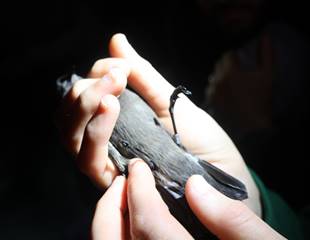
A one-footed storm-petrel (Photo by Kayleigh Bargus)
Ringing has to be carried out under white light in this area, as red light is used as a signal by drug smugglers here, meaning birds can become slightly disorientated as it takes a while for their eyes to re-adjust to darkness. As a result, releasing the birds involves sitting with them near the edge of the cliff and making sure they fly off in the right direction or bringing them safely away from the cliff if they go too near the edge before beginning to fly.
Overall, just over 100 storm-petrels were caught this year, two of which were re-traps which had been previously ringed at breeding colonies (one of these was confirmed to be from West Wales). The number of storm-petrels caught was lower than in recent years which seems to be part of a longer-term decline in catch rate at this site since 1993 – this could be due to a decline in storm-petrel populations but could also be due to changes in migration routes/timings or foraging behaviours.
There were a few bonus extras caught including a desert locust (which flew in from the seaward side of the net!) and a couple of these:
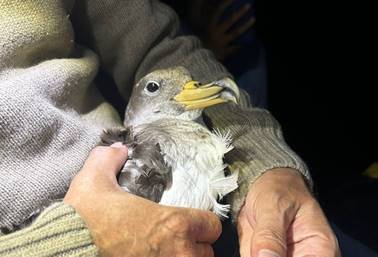
Cory’s shearwater Calonectris borealis (Photo courtesy of Beth Rawles)
Overall, it was an incredible experience, storm-petrels are lovely birds to ring and it was worth staying up through the nights to do so!
 Ringing In The Braydon Forest & Beyond