After a very frustrating time trying to get out for a ringing session, the weekend was abysmal, Monday to Wednesday weren’t too bad – but they were forecast to be wet in the morning. They weren’t, but I can’t take chances as Ellie has to come from Cheltenham and I would hate to waste her time (and fuel). We finally managed to get out this morning. The rest of the team are on holiday, so it was just me and Ellie.
We met at 6:30 and set the nets: just the usual CES nets along the Heronry Ride and the first two arms of the Wildlife Refuge: I am deliberately not putting a photo up because I want something rather more special to adorn the social media posts. You can check in earlier posts if you wish to find out where they are set.
After a couple of irritating net issues, we had the nets open by 7:30 and started catching almost immediately. The first round was a Blackcap and a Robin: pretty much to be expected. However, the next ride produced five Blackbirds: two juveniles and three adults. As was par for the morning: all of the retrapped birds were adults, all of the ringed birds were juveniles! However, the sixth bird of that round was our first Lesser Whitethroat caught at the site since 2020, when three were caught. The sad thing is that, until 2019, we could regularly catch double-figures of the species.
The rest of the session was spent showing lots of people birds, just a couple each round, but the people enjoyed it. At 11:00 I went to check the Heronry Ride nets. I thought there were lots of birds in the nets, but they weren’t, they were leaves of different sizes. However, as I did the proper thing and walked along the net to check it all, I saw a biggish bird in there and, next to it, a very bright blue bird.
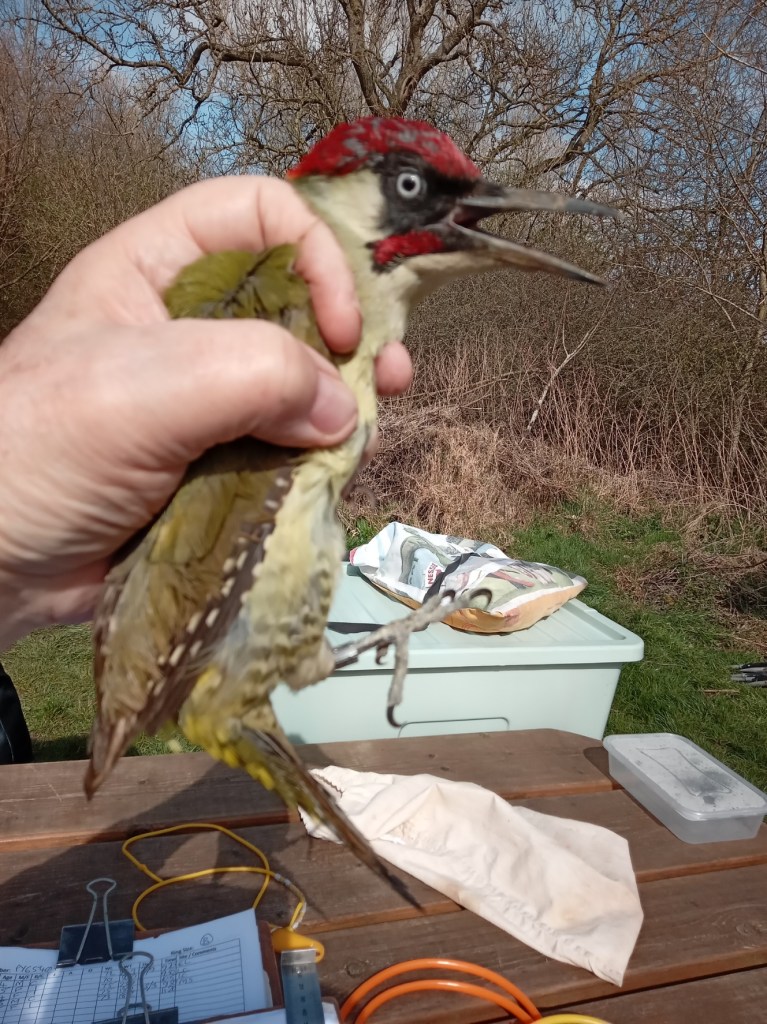
We usually catch Green Woodpeckers in the Wildlife Refuge, as the field there is full of ants’ nests. This was only the third caught in this net, and the first since July 2017.
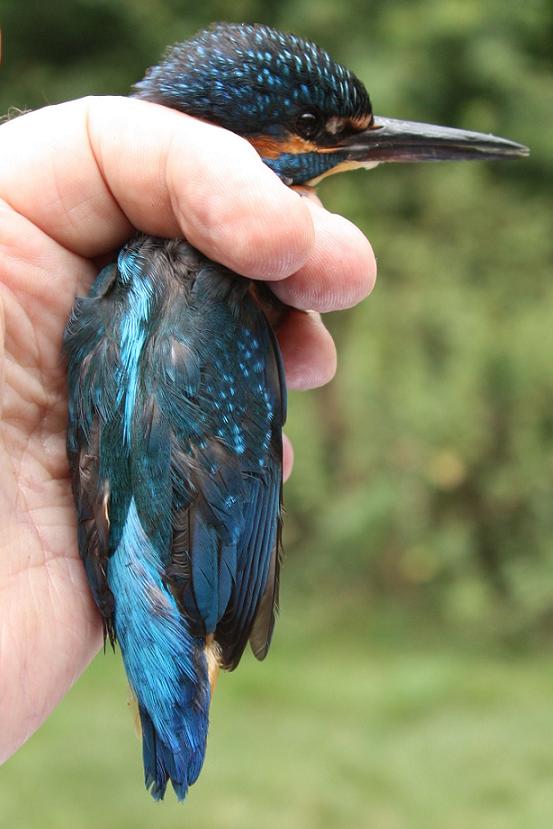
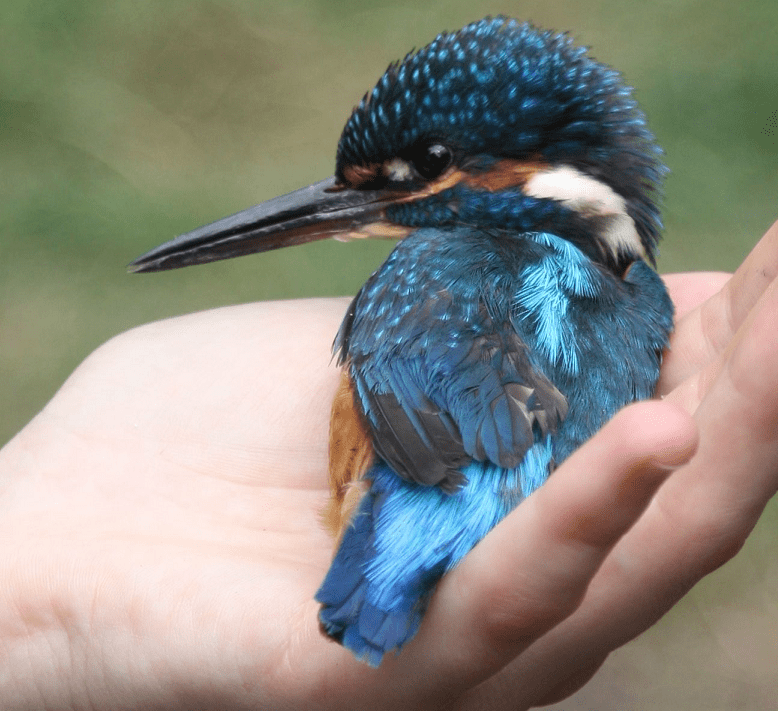
Next door to this was the first Kingfisher that we have caught at Lower Moor for two years:
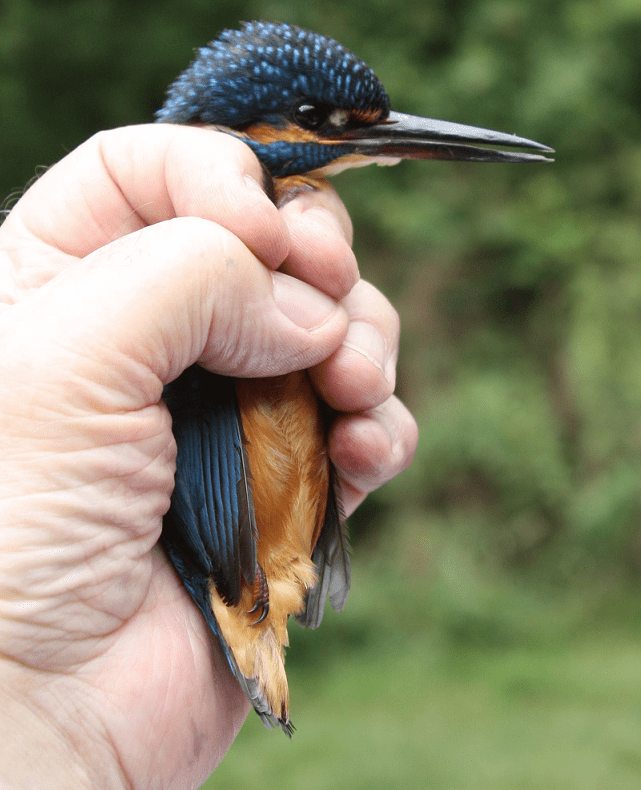
if you look at the foot you can see that the top skin is brown, this is diagnostic of a juvenile
We decided to shut the nets at 11:30, starting with the Heronry Ride, which was empty. Unusually, it was actually our most productive ride this morning. Normally am debating with myself whether to bother setting it. I am so pleased that I decided to stick with the usual setup. Then we went and checked the Wildlife Refuge rides and found a few more birds, so we processed them and went to shut the rest of the nets, taking a couple more birds out as we did so.
The list for the session was: Kingfisher 1; Green Woodpecker 1; Great Tit 3; Wren 5; Dunnock 1(1); Robin 3(1); Song Thrush 1; Blackbird 2(3); Blackcap 2(2); Garden Warbler (1); Lesser Whitethroat 1; Chiffchaff 1. Totals 21 juveniles ringed from 11 species and 8 adults retrapped from 5 species, making 29 birds processed from 12 species.
A lovely morning, with a reasonable size catch, but three stunning birds in the mix, for different reasons. I let Ellie process every bird caught, because that’s the sort of trainer I am. One of the nice things about a catch like today’s is that there was plenty of time to focus on training on some of the less common elements, in this case, moult scores. It is only really available for training in the few months after the breeding season ends. Most of the adults were undergoing some form of moult, be it a female’s breast refeathering as she had finished breeding, to primary feather and tail scores.
Anyway, with everything packed away we were ready to go by 12:30. Very satisfying session.
One last highlight of the morning: we were showing some birds to a family having a walk around the reserve, dog on lead, very pleasant, chatty people. Their daughter suddenly blanked everything and everyone out. I immediately thought that she must be a teenager: in fact, she was trying to focus in and get a decent photo of a Great Crested Grebe on the other side of Mallard Lake. This was special: the adult had two humbugs on its back. I have been going there for 15 years and have regularly seen an adult pair. I have seen them carrying out their courtship displays but, in all that time, I have never seen them with chicks, until today! Just lovely! I hope they survive.
 Ringing In The Braydon Forest & Beyond