With so few Barn Owls processed on Salisbury Plain so far this year we set out hopeful but not confident. The boxes we were checking today had previously been noted to have at least a pair of adults, a couple had eggs, and we were hoping that they might produce results.
The first good thing that happened was a good sized flock of Swifts flying around the camp. They have been nesting there in a good number of boxes installed by the Defence Infrastructure Organisation (DIO). My friends, Ian, Andy and Jack, have been monitoring and ringing some of the chicks, and Ian confirmed that the last batch he ringed, a week ago, were close to fledging. It looks very much like it has been a successful year for them at this site.
The team today was Dick, Jon, Justine and me. We set off at 8:30 as usual and headed off for our checks. The plan was twofold, besides the Barn Owl checks we had three Kestrel boxes that needed assessment for maintenance and replacement. In the end, we left one box where it was in an Ash tree. Primarily because although, like so many Ash trees in the UK, the tree is dying from the Chalara die-back disease, none of the others in the location were actually any better. Another was moved from a very exposed position to a sheltered position on the edge of a copse. For the third we had to remove an old and dilapidated box and replace it with a nice new, all mod-cons Kestrel box. (For “we” read “Jon”, he did all the hard work, the rest of us just had fun breaking up the old one so it could be safely disposed of.)

A des-res that any Kestrel will be proud to occupy!
The good thing about today was that we actually managed to get some Barn Owl chicks ringed. In fact, we also ringed a couple of adults, more of which anon.
Driving over the Plain to our various sites I could not believe how many hundreds of Linnet there were to be seen alongside the tracks, over the landscape. Given how their numbers have decreased on farmland, this just shows that we should be able to increase their numbers again, by subtle changes to farming methods. This land is farmed but not intensively. I am pretty confident that it is not regularly sprayed with pesticides and herbicides.
Approaching our first Barn Owl encounter, in a barn on Wilsford Hill, driving up the track was phenomenal. As previously mentioned, so many Linnets but, also, five Wheatear flying up the track in front of us, and them I noticed a couple of Stonechat also flying from bush to bush along the track. We got to the barn and, thanks to plugging the entrance / exit hole managed to catch two juveniles. At first we thought that they could be adults but, on checking the plumage, they were definitely juvenile. Apart from the freshness of the wings and tail, the heads retained quite a lot of fluffy juvenile feathers. It was clear that they had been out hunting: there was blood in the creases of the skin around the talons. They were also, clearly, a male and a female:
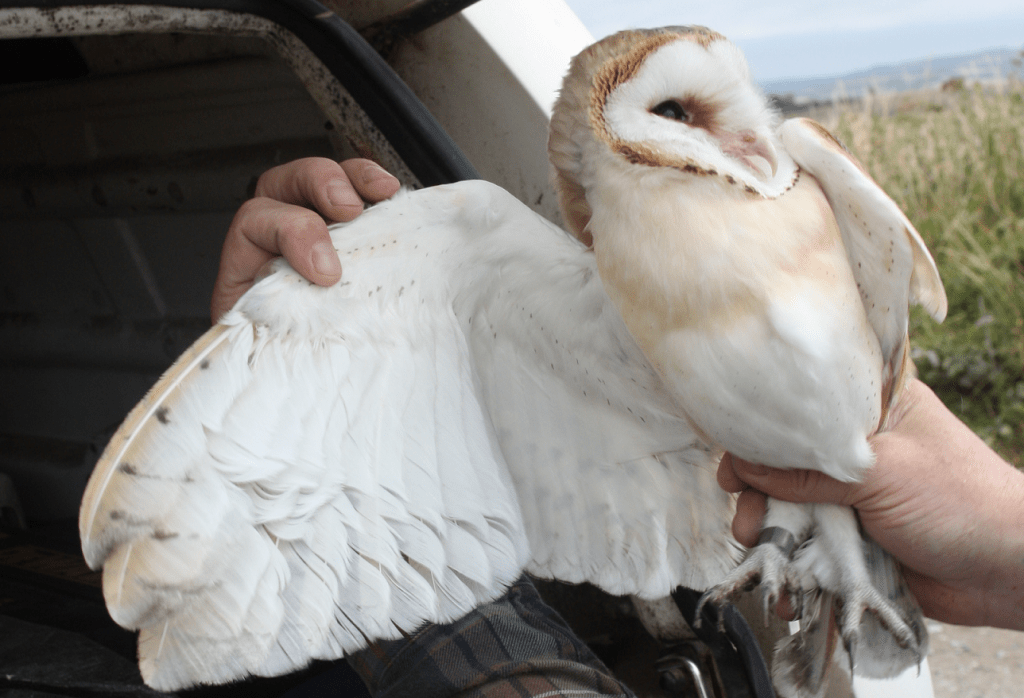
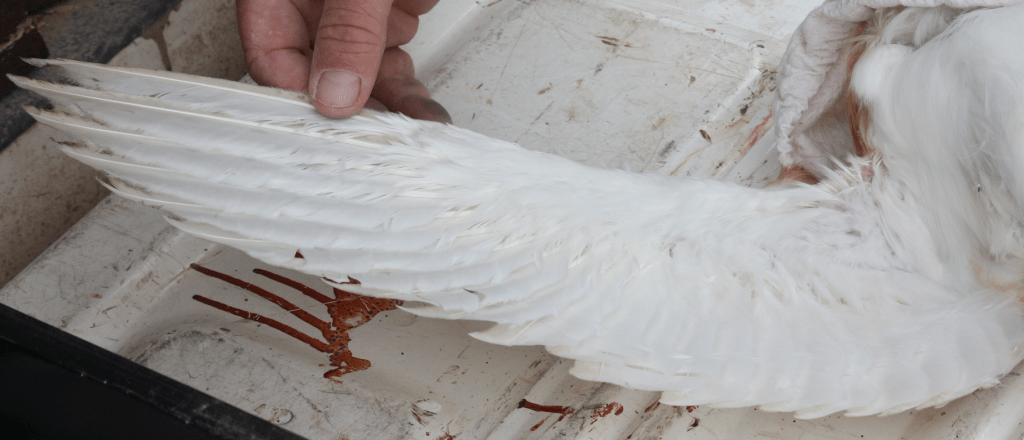
The absence or otherwise of spotting on the underside of the wing and sometimes on the side of the breast is diagnostic, although males may occasionally have the odd one or two, but not as many.
The next box that we checked that contained owls contained two adults. One of the adults was unringed, but the other was already ringed. This bird, a female, had been ringed with a size F ring. The BTO approve the use of both F and G rings for ringing Barn Owls, dependent upon the projected size of the bird. It is found that Barn Owls in the Cornwall and Devon and west Wales tend to be smaller than those elsewhere in the country so, as a general rule, in those areas they fit F-rings and in most other areas they use G-rings. Nearly every ringer involved in ringing Barn Owl in Wiltshire uses G-rings, because we are not in those extreme areas. You are supposed to decide on which ring to use based upon tarsus width, although finding the exact width data is difficult. However. it was clear that this F-ring was too small for this particular bird:
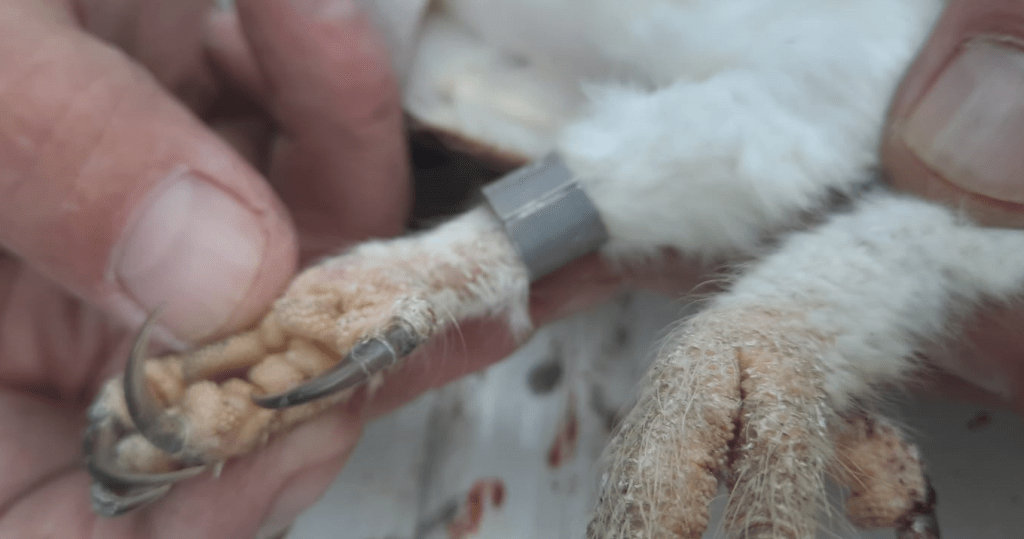
If you look at the leg with the ring on it you can see that the feathers have been rubbed away, especially when you compare it to the unringed leg. Also, this ring has been shaped into a capital D. This meant that the ring could move up and down the ring, hence the feather removal, but not rotate, causing rubbing that exacerbates the defeathering. We removed the offending ring and replaced it with properly fitted G-ring and have informed the BTO of what we did and why. This is the second incidence of this problem being found within the last few weeks. I also have photographic evidence of that as well. That we needed to change these rings will, almost certainly, be investigated by the BTO. Hopefully they will identify the root of the problem and get the individuals to change their methods. Apart from that, the bird was fine.
Unfortunately, both were in moult and with no sign of breeding. They probably won’t this year now.
At the next box we checked a male flew off as we approached but we did catch an adult female in the next box. She also was already ringed, not with one of our rings though. I have just heard back from the ringing team that did it, she was ringed near Collingbourne Kingston as a pullus in June 2019, it has travelled about 6 miles West-South-West away from its natal area.
And then to the highlight of the day: a brood of four fat and healthy Barn Owl chicks, looking well fed and growing nicely:

The final box we checked as ever, the male flew off as we approached, but the female stayed hunkered down on the nest, so Jon simply shut the box door again and we left her in peace. The fact that she stayed down and didn’t move is a strong sign that she is on eggs. Hopefully another check in a six weeks or so will prove fruitful.
All of the Kestrels seem to have now fledged and their breeding season is over. We found evidence that the adults are moulting, with feathers around the base of boxes, like these:

We finished about 14:30 and headed back to base. Just over the road was a lot of smoke: it seemed that a farmer out working his field has somehow managed to spark a fire in the stubble. To his credit, he got out of the tractor and managed to stamp it out. Long gone, I hope, are the days when stubble burning was an acceptable practice.
Anyway, a good session, some Barn Owls ringed, and numbers are slowly climbing for this year. I am out checking a few of my boxes up north tomorrow, and have at least one brood to ring and am hopeful I will find some more.
 Ringing In The Braydon Forest & Beyond