I was joined this morning by Ellie and Sarah. Sarah’s first outing for a while but she picked up from where she left off: as competent as ever. Ellie just keeps improving. We met at 6:30 and set the same nets as last time: once more netting the hill incline. There is a superb collection of blackberries along the ride and I am hopeful that they will prove suitably attractive during the autumn. The nets were open by 7:30 and we gave them 20 minutes to allow for the first catch to arrive.
Looking down the slope, we could see it was already quite busy and, with five birds taken from the lower nets and fourteen from the slope, we were highly enthused for a big catch. Hopes are only raised to be cruelly dashed, and so it proved as the next round produced just two birds. It then went 2,0,0, 1, 1, 0, 3, 3, 2, ending up on 31 birds by the end of the session at 11:30.
It would be churlish to complain too much. With some of my catches recently I would have been satisfied with that number, but with that excellent start I had thought we would be on to a 50+ haul.
The catch for the session was: Great Spotted Woodpecker 1; Blue Tit 2; Great Tit 5(1); Long-tailed Tit 1; Wren 2; Dunnock 1; Robin 2(1); Blackcap 10; Garden Warbler (1); Chiffchaff 3; Goldcrest 1. Totals: 28 birds ringed from 10 species and 3 birds retrapped from 3 species, making 31 birds processed from 11 species. All birds processed, except the retrapped Garden Warbler, were juveniles.
It was a toss up as to which was our favourite bird of the session. The Great Spotted Woodpecker was a very juvenile bird.

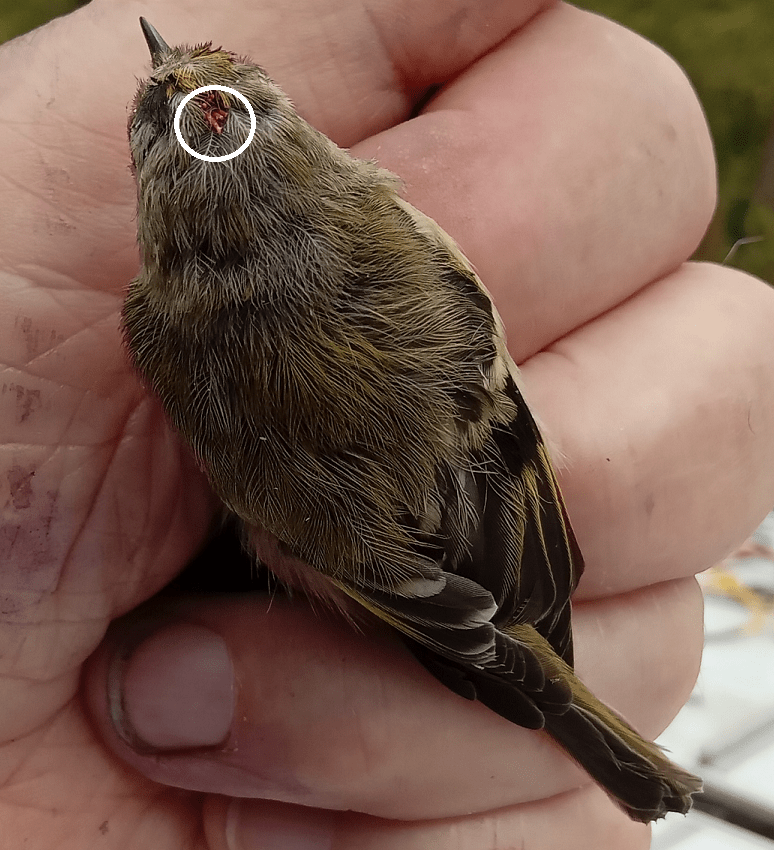
However, the cutest had to be the rather tatty juvenile Goldcrest:

As you can see from this photo, it was just beginning to grow its crest. At first we thought female, but a little blow on the top showed the tiniest splash of orange:
Life isn’t easy being a bird, particularly for youngsters, and it doesn’t help when you are carrying a host of parasites:

Both sides of its head were equally badly infested. Underneath the ticks you can see were others hidden by the bigger ones. There had to be well over 100 ticks on this bird’s head. Some ringers are opposed to tick removal: “interfering with nature”. The BTO are happy either way, provided that you are competent to remove them. I spent quite a long time cleaning off the ticks from this bird. Am I competent? Not a single bleed was left after removal: I think that is competence. It is highly unlikely that I got them all, but the burden has been much reduced.
Footnote: I have just been advised by the BTO that some interfering individual, who, it seems, would have been happy to see this Great Tit suffer this tick infestation, and possibly die from potential infections, has contacted them and they have advised me that they have added another layer of bureaucracy into the ringing scheme. To quote their new position: “While removal of ticks for the purpose of enhancing bird welfare does not require a Home Office licence under ASPA (Animals (Scientific Procedures) Act 1986), there is a risk to the bird if mouthparts are left in situ, and artificially improving the health of the bird compromises the monitoring remit of ringing activities. Ringers should therefore not attempt to remove ticks from birds caught unless collecting them for a specific study, which would require an ASPA licence from the Home Office as it wouldn’t be considered as for welfare reasons.”
I did ask for when this became a part of the rule book but, instead of getting an answer, I was shown a statement made back in 2012, which talks about being “trained” to do it, so you don’t leave mouthparts embedded in the host.
As someone who started their working career in stock management on a number of farms back in 1974, if your animals are picking up ticks I was trained to remove them. Apparently, “trained” is now being interpreted as having been trained as a vet! Perhaps the ringing scheme management no longer thinks that general animal welfare, outside of our ringing activities, is any longer a priority. I don’t agree but I won’t mention it in public any more.
We closed the nets at 11:30 and took down, packed away and off site just after 12:30. If the birds had been spread over the session we would have been happier than we were, but it was still an enjoyable session.
 Ringing In The Braydon Forest & Beyond