I had promised myself that the next calm day I would get out onto the plateau at Blakehill Farm. Reports are that autumn migration has started already and this is our best site for catching birds on migration. The other reason is that I wanted to know if the Meadow Pipits had arrived on site yet, as there is usually a large over-wintering population there, as anyone who has read these blogs over the years will know. The forecast for today was for it to be more or less flat calm, 2 to 4mph, with gusts to 5mph early, growing to 10mph by 11:00, but still with a low basal wind speed.
Ellie, Laura, Adam and Daniel joined me at the Chelworth Industrial Estate side of Blakehill Farm. From there we have access to the plateau area where we set our nets. They are set by the bushes that form a semi-circle along the line of the mooring points for what was once a huge radio mast when the area was a World War 2 airfield. It is the place from which Canadian troops were despatched to the ill-fated Arnhem expedition “Monty’s Folly” as it is known. There is a memorial to their sacrifice there.
I say the session was short and sweet. Short, because we were on site from 6:30 until midday, but were really only active between 8:00 and 11:00, and the birds were only active between 8:00 and 10:00. This is possibly because the wind gusts became considerably stronger and more frequent than forecast. Sweet, we will get to that soon. It could also be that, with Laura toddling off at 9:45 to pick up their rabbit from his holiday camp, and Ellie having to leave to get to work, they weren’t interested in entertaining the males left behind.
Recently the perimeter hedge was cut back and properly laid, to improve it as a habitat in the future. It has meant, being the first summer since the part of it adjacent to our ringing area was cut, that the hedge does not look particularly inviting as a ringing site. We decided to try it out anyway, using a couple of 18m two-shelf nets. Despite some movement along the hedgerow the nets didn’t catch anything. We did have one bird hit the net and bounce off, but that was all. It will improve.
This is what we set:
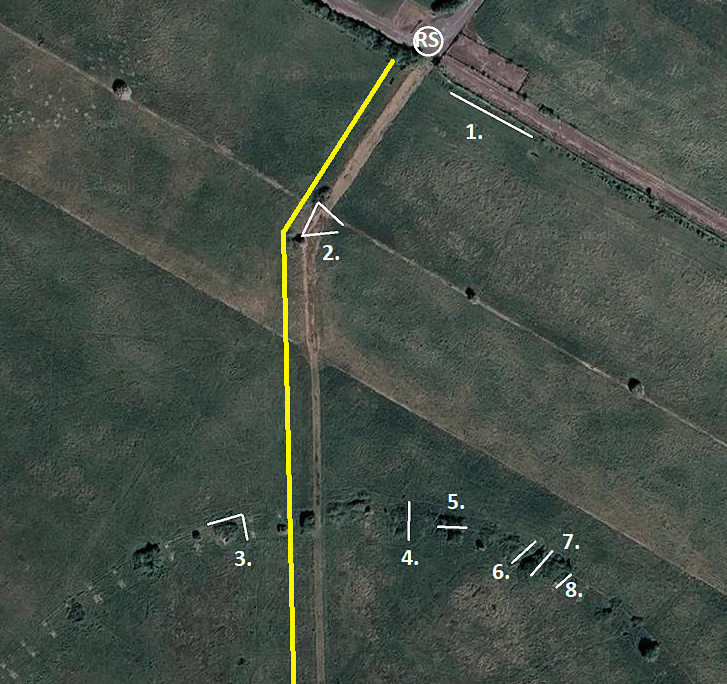
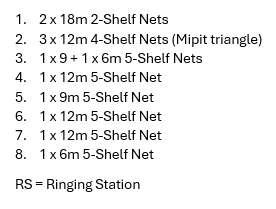
I am not sure why it took us so long to get the nets open, we had two teams going. We actually set the nets in reverse order so, having done the outer nets we went to set up the Mipit triangle. Prior to the session, I had been in touch with Jonathan, the farmer, and established that the cattle would be grazing away from were we would set our nets. Arriving on site we could see them on the far side of the plateau. However, when we started on the Mipit nets there was a stampede of cattle heading our way: and I mean fast running cattle heading our way. I panicked and phoned Jonathan and, good man that he is, he hopped on his quad bike to come and shepherd them away. As he was heading over, before he got to us, the cattle came to a grinding halt, literally a few metres from where we were. Younger members of the team heard some high pitched noise, which I didn’t. This is the new GPS technology, linking to the management collars, that are being used instead of traditional electric fencing. The yellow line shows where their boundary is. We had just net 3 within the boundary and I decided I was prepared to risk it. Fortunately, I needn’t have worried.
So to the sweet bit, the catching, the first round produced nine birds: four Whitethroat, two Lesser Whitethroat, two Stonechat and a Willow Warbler. What a nice start to the proceedings. This was followed thirty minutes later by another seven birds: another four Whitethroat, another Stonechat, Lesser Whitethroat and Willow Warbler. That was the end of the multiples. We had an empty round before catching another Whitethroat, and then nothing until we decided to take down, whereupon we got another Lesser Whitethroat and two Wrens!
So, in total, the catch was: Wren [1](1); Stonechat 1[2]; Whitethroat 1[8]; Lesser Whitethroat 1[3]; Willow Warbler [2]. Totals: 3 adults ringed from 3 species, 16 juveniles ringed from 5 species and 1 retrap, making 20 birds processed from 5 species.
Catching nine Whitethroat in a single session is our second best ever catch of the species. The largest was 10 in Ravensroost Meadows on the 10th July 2020. Guess where we are going to be working on Wednesday?
Three Stonechat are not unusual in the autumn but, prior to this, we had only caught two singles: both in August 2020. It is the first time that we have caught three in August. Most catches are in September and October. However, I was having a real problem deciding on the age of this particular Stonechat:
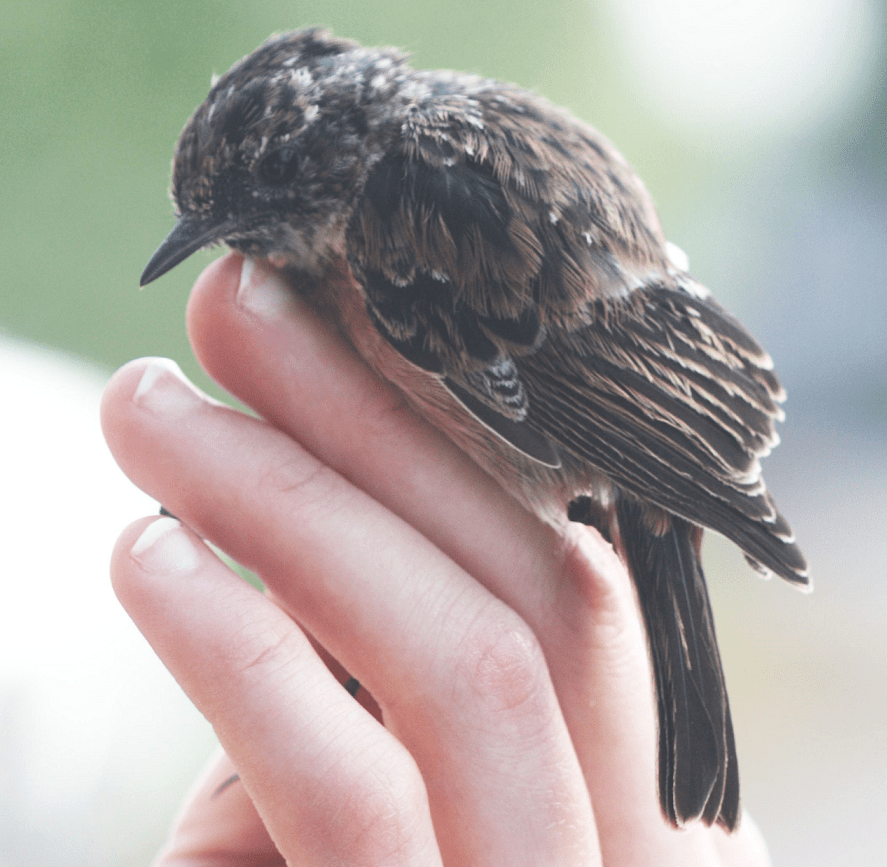
I was 100% sure of species but not of age. After inspecting the wing plumage, nice and fresh, and the fact that it had feathers in pin all over the body, I decided juvenile Stonechat! We did have a very nice adult male to compare it with. It hadn’t even started its post-breeding moult yet, and this one was well into its post-fledging moult cycle.
The Mipit triangle was a complete failure today: no birds in it at all. Ironically, as we were sitting at the ringing station, after another no bird round, I noticed two birds settle onto the wooden fence of the pen opposite: Meadow Pipits! Frustrating, but also comical.
Anyway, as mentioned, we started taking down at 11:15, processed the last three birds, and were packed away and off site by 12:15, very happy with a small, but perfectly formed, catch.
 Ringing In The Braydon Forest & Beyond