Our plan for today was to go for a large catch, hoping for a few early migrant species. I intended to put nets along the entire field margin, as well as the usual positions around the pond area. On Tuesday I did a recce to check that the access was going to be okay. I was delighted to see that the farm crew had mown the path down to our ringing area, and that the hay had been cropped and removed from the field. I had a look in the two fields in which the Belted Galloways have over-summered, and checked our field, where they haven’t been seen at all. No sign of them: all good stuff. So I loaded the car with all my long nets, and the short nets for the pond area, plus the appropriate number of poles, guys and spikes (i.e. virtually everything). Arriving on site at 6:15 I drove onto the field. Pretty much straight away a large black head poked around the corner of a hedgerow opening from the far side of the field. That was followed immediately by a dozen Beltie bullocks. It was a little race for me to get to the ringing area, open the gate and get the car backed in and out of the way before they reached me. Just managed it. I have made the mistake of leaving the car out in the field with the Belties before: it took two goes through a car wash to get their dried slobber off it! Never again! I wandered over to the gate into the field to warn the others to park outside. I hadn’t realised that all of the gates between the fields, apart from one pen-forming complex, have been removed. Not sure when, as we have run several sessions in the pond area this year, with nets out in the field, without a visit from the Belties.
Obviously, that put paid to my grandiose plans, so we set the usual nets in the pond area plus two extras. I was joined for the morning by Miranda, Laura, Adam and Ellie.
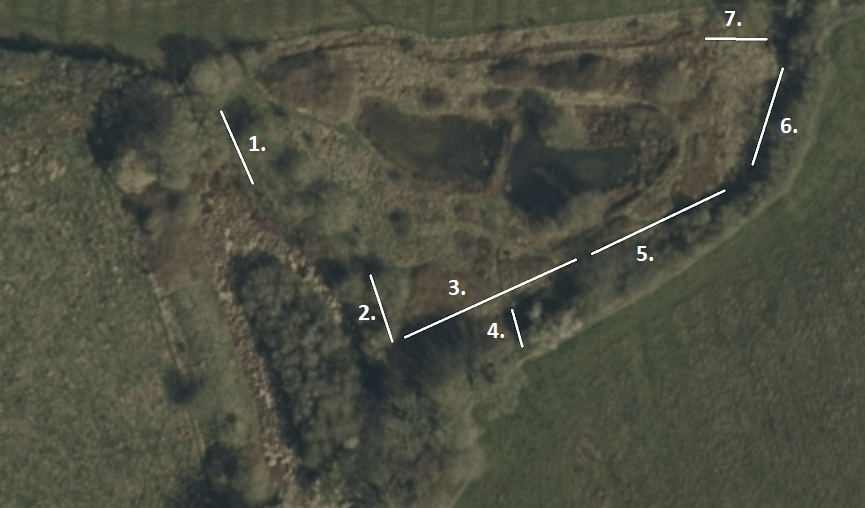
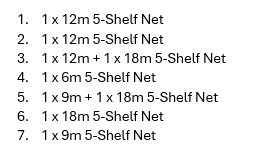
We had the nets open by 7:30 and started catching straight away. The first round produced two Whitethroat: a juvenile and an adult female ringed back in our last session at this site. It was one of those mornings where we would have birds, empty, birds, empty, etc as the rounds progressed. Not quite that bad but near to.
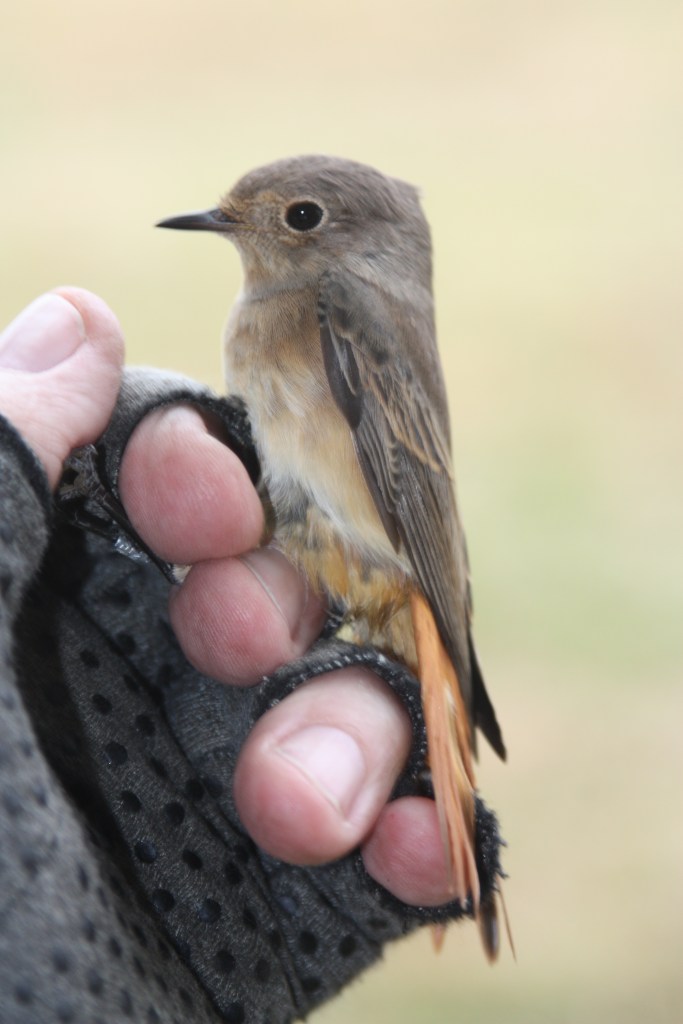
Our second round produced four birds: two Blackcap, a Lesser Whitethroat and our first ever Redstart for the site. Since the start of 2013 we had caught just 11 in both the Braydon Forest and Lower Moor Farm, nine at Blakehill Farm and two at Lower Moor Farm. Adam had extracted his first back at Blakehill Farm last year. He didn’t get to ring it so, today, having extracted his second, he got to ring his first!
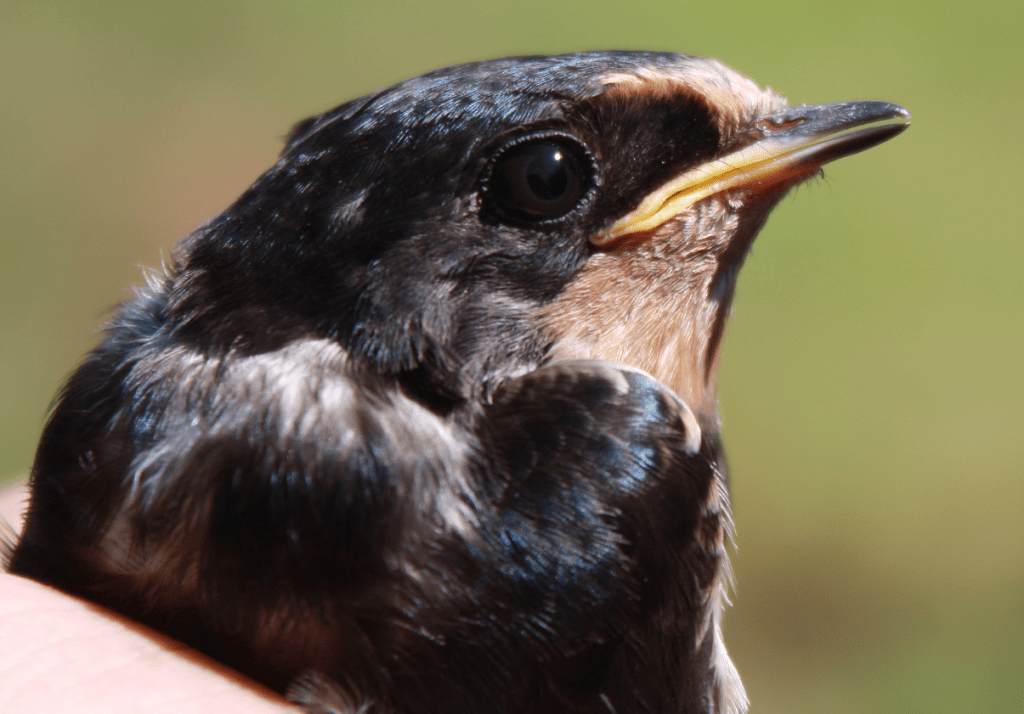
Our next successful round produced our biggest catch of the morning: eight birds, but a very nice little group, three Wrens were a bit humdrum, but we also had a Blackcap, Whitethroat, Lesser Whitethroat, Goldcrest and Miranda coming back with a secretive smile on her face. She had extracted her first ever Swallow, and got to ring her first ever Swallow. This Swallow is the first we have caught at this site for four years, so a very welcome catch. Between 2015 and 2017 inclusive, we would regularly catch 25 Swallows in a session. Unfortunately, due to the ponds becoming overgrown with Reed Mace and rushes, and the causeway becoming choked with blackthorn scrub, the nice open track through the two ponds, over the causeway, became blocked. I am delighted to say that the Trust have designated budget for the restoration of the whole area, and have allowed me to advise on the changes to be made, and I have volunteered to help.
It was becoming a really pleasant morning. That was helped by the weather. Despite the forecast being for bright sun and high temperatures in line with the current heatwave, throughout the morning, until we were packing up, the sun did not put in an appearance. We had very low cloud cover and some very refreshing mizzle. Nobody complained.
The next round produced another seven birds: Blackbird, Blackcap, Robin and Bullfinch plus, astonishingly, another two Redstart! Ellie got to ring her first and Laura her second. To have gone from none for just about 12 years to three in one session is lovely.
After those two rounds things died right off, with just a Blue Tit and a Willow Warbler in one and a Chiffchaff in the last. The Willow Warbler was stunningly coloured: very bright yellows, a lovely bird.
The total catch for the morning was: Swallow [1]; Blue Tit [1]; Wren 1[2]; Redstart 1[2]; Robin [1]; Blackbird 1; Blackcap [5](1); Whitethroat [2](1); Lesser Whitethroat [2]; Chiffchaff [1]; Willow Warbler [1]; Goldcrest [1]; Bullfinch [1]. Totals: 3 adults ringed from 3 species, 20 juveniles ringed from 12 species and 2 birds retrapped from 2 species, making 25 birds processed from 13 species.
It might be passé to some but to get 13 species in just 25 birds is remarkable to me. With a reasonable size team out I was a bit worried about whether there would be enough to keep them happy. The fact that every one of them got to ring a species special to them, and for three of them, a first for their ringing careers, ensured they were happy. We started packing up at 11:15, as things had died away so much, extracted the one last bird, the Chiffchaff, which Adam and I processed whilst the others continued taking down. The team is working well together, as everybody gets more experienced, and everything was cleared away for us to be off-site before midday.
 Ringing In The Braydon Forest & Beyond