Introduction and the Birds
Rosie and I have been trying to get this bio-blitz done for a couple of months now but something always seemed to get in the way: unavailability of volunteers, wind or rain (yes, rain) and thunderstorms. Last night Rosie and I went and set up the moth trap to run overnight.
Driving onto the site, following the track down to the Whitworth Building, I had the delight of seeing a Brown Hare sitting on the plateau, no more than 3m from my car window. It looked at me as I slowed down, before taking off across the plateau to get away. Unfortunately no camera to hand!
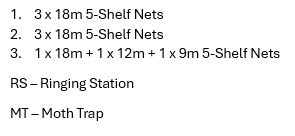
The ringing team and Rosie met up at 6:30 by the Whitworth Building, to get the nets set up. My team was David, Laura and Adam, with Mark coming along to help with the set up. We set the following nets:

Rosie’s blitz team were arriving at 8:00, they were Andy, Tracie, Pete and Chris.
The first thing that Rosie and I did on arriving was to switch off the moth trap: it was covered with Hornets, and inside the trap were a whole load more. Perhaps even more surprising, the white sheet upon which the trap was set was absolutely covered in small Back Swimmers, Lesser Water boatmen, family Corixidae. There was, however, a lovely collection of moths. We left everything in situ, ready for the blitz team, and got on with setting the nets. I am pleased to say that the Hornets were 1) native and 2) didn’t sting anyone, although we are pretty sure that they ate a few moths, as there were some wings unattached to bodies in the trap, particularly that of a Dusky Thorn, Ennomos fuscantaria.
The first bird into the nets flew in just as we finished opening them: a Wren. It did its usual: flew in span around in the net and crawled through to the other side of the pocket. Wrens have one purpose in this world: to torture trainees. I let one of the team have a go for a short while before rescuing them from torment.
The session got underway quite nicely after that: with birds coming in during every round. I left the team to carry out all of the extractions and processing, relegating myself to scribe for the session. In between, I became the de facto moth expert, helping identify the species, as far as was possible. One thing that was a great help is an app known as ObsIdentify. I am pretty good at macro moths but plenty of the micros are difficult. It did a decent job of most of them, but went a bit awry on several occasions. I will come back to the moths and other insects in the next post.
It was quite a steady catch, a few birds at a time, until 11:00, when we caught a small flock of titmice and then back to steady. Our usual catch when solely netting in this field is around the 20 to 25 bird mark, so we were happy to know that we were going to exceed that.
The list for the session was: Treecreeper [1]; Blue Tit [9](1); Great Tit [4]; Long-tailed Tit 3(1); Wren [2]; Robin [5]; Blackcap [5]; Whitethroat [1]; Lesser Whitethroat [2]; Chiffchaff [5]; Goldfinch [3]. Totals: 3 unaged from 1 species, 37 juveniles ringed from 10 species and 2 birds retrapped from 2 species, making 42 birds processed from 11 species. This is our best catch in this single field. However, disappointingly, no House Sparrows. The 9m net that runs from the farmyard gate to T-junction with the 12m and 18m nets is usually an absolute dead cert for this species. We could hear them, just didn’t catch any.
Significant in the catch was another two Lesser Whitethroat, taking our annual total to 11, the best for five years, nearly three times the size of the catch last year with the bulk of the autumn migration to come. When one looks at the figures for the Braydon Forest component of our catch, 10 of them, that is our second best catch ever, with 11 in 2017 being the best. Hopefully we will match, or pass, that this year.

Our Braydon Forest Whitethroat catch, with 19 ringed, is the best since 2019 and 2020, when both also had 19, and we need to ring another eight to match the best year, 2017. In fact, the Braydon Forest is the only area in which we have caught them this year. My other main area, Lower Moor Farm, has been devoid of them, but their numbers there have been declining since 2020, with just one last year, none in 2023 and three in 2022.
We did see some significantly large flocks of Goldfinch flying around, but they were all at tree top height. They are not a regular catch at this side of Blakehill Farm, best catch was on the Chelworth side, on the 20th September 2015, with 69! In three weeks that year we caught and ringed 102 of them in three sessions. However, we were pleased to get three this session:

These three were very much late brood birds. One of them hadn’t started its post-fledging moult, and the other two had a small amount of pin, no sign of facial mask development.
As well as the birds caught and processed, we observed quite a few additional species flying around the site. The sighting list was: Cormorant, Buzzard, Kestrel, Woodpigeon, Swallow, Carrion Crow, Rook, Jackdaw, Magpie.
We closed the nets at midday, and the blitz team mucked in to help us to get everything taken down and packed away, so it didn’t take long. The ringing team headed off, as did I, after a chat with the others as they tried to eat their lunch, and then I left them to do part 2.
I will blog about the other flora and fauna once Rosie has managed to work her way through all of the other records.
 Ringing In The Braydon Forest & Beyond