It is 13 months since my last session in the northern part of Ravensroost Wood. The key reason for that is the amount of forestry work that has been, and is being, carried out in that area. There is more significant work scheduled for this winter. I went that last time to see what impact the work might have had. In that session we caught and ringed 15 birds from six species: Blue Tit 1: Great Tit 2; Wren 3; Robin 4; Blackcap 2; Chiffchaff 3. Today I thought I would have a look to see if things had changed.
With the weather forecast to be likely to start raining at about 11:00 we agreed to meet at 6:00 so we could get a few hours in before then. I was joined by Miranda and Ellie, which in itself is slightly unusual, their being my midweek stalwarts of recent times. We set the following nets:

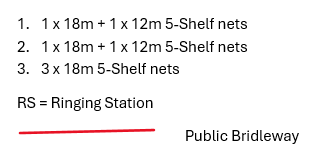
It was very slow to start with: we got very few birds in each round, and it was weird: three Wrens in one, four Robins in another. What was fun, though, was that we had several families come through, happily when we actually had a few birds to hand. The first family had four children, two of whom were willing and pleased to be able to learn how to safely hold and release a bird, both Robins.
So, we were slowly accumulating a couple of birds, with a few dead rounds in between. We did our second family education set at about 10:15, this time with two slightly older girls, Mum and Dad all getting to learn the trade. They were a little luckier than the first group in that we had the Robin and Wren combo, but we also had a lovely juvenile male Goldcrest. They went off for a wander, promising to come back within the half hour to see if we had any more to show.
The unluckiest person this morning was Ellie. She knew she had to leave a bit early to get home to Cheltenham because she was working from lunchtime. She left at about 10:00 to give herself plenty of time. The family had returned from their walk and, as we were “apologising” for not having any birds to show them, a bird hit the end of ride 3, nearest to us. This was only the second bird that whole net set caught in the session, the first being a Wren, the first out of the net in our session. Miranda went to retrieve it and came back with this:


Had it arrived before Ellie had left, she would have ringed her first ever Firecrest, as Miranda did her first in October last year, at Red Lodge. This is a significant bird for the site: only the second ever recorded on the site, let alone ringed. The first was caught and ringed (and subsequently seen by a few local birders there) in the eight-year coppice area, nearly 10 years ago! (November 2015, by Jonny Cooper in his first year as a ringing trainee, lucky beggar!). We have only caught and processed five in total in the Braydon Forest. However, with this one, the last three have been caught in the last 10 months, neatly shared between Red Lodge, Somerford Common and Ravensroost Wood – just Webb’s Wood and the Firs to go!
The Firecrest was quickly followed by a Treecreeper: another treat for our very pleasant and enthusiastic audience. With no birds in rounds at 11:00 and 11:15, we closed the nets and took down, with the pack up completed by midday.
The list for the session was: Treecreeper 1; Wren 2(1); Robin 7; Blackcap 1; Willow Warbler 1; Goldcrest 1; Firecrest 1. Totals: 14 birds ringed from 7 species and 1 bird retrapped, making 15 birds processed from 7 species. All birds ringed were juveniles. So, the same number as last visit, but a much better variety / quality of catch.
Lovely though the Firecrest, Goldcrest and Willow Warbler were, to have 50% of the birds ringed to be juvenile Robins is remarkable. Not our biggest catch of them, but the absolute highest proportion of them in any catch in Ravensroost Wood, and on track to produce our largest catch of Robin juveniles in the Ravensroost complex: currently standing at 18 birds, with 26 in 2017 being the target.
I suspect it will be at least another year before I try out this part of Ravensroost Wood again, however, I will be carrying out a session further down the track, adjacent to the ponds at the north of the wood, before the end of the year.
 Ringing In The Braydon Forest & Beyond