For issues that might become public in the near future, depending upon a couple of responses I am waiting on, got me back onto my favourite hobby horse: the Marsh Tit population of the Braydon Forest.
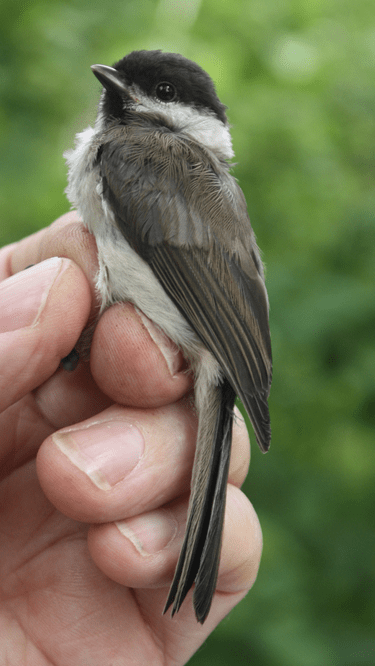
We have had a good year so far. Some recent correspondence got me thinking, once again, about the actual status of the Marsh Tit in the Braydon Forest and how that compares with both a local and a national profile. Having been studying them since I started ringing in the whole of the Braydon Forest in late 2012, it is rather important to me. Having persuaded Forestry England to make the Marsh Tit their priority bird species for management of their areas in the Forest, it is doubly so. So I had a look at the available records both locally and nationally. Unfortunately, we are still waiting on the 2024 ringing records to be published, so I have focused on the data published up to the end of 2023. Nationally, the BTO do not publish the number of retrapped birds, so I cannot do a national or Wiltshire analysis of individual birds, but I have done so for the Braydon Forest. I can tell you that 2024 was on a par with previous years in the Braydon Forest, and that 2025 is looking to be significantly better, but I don’t have the comparison for 2024 yet, although it should be published soon, given that the 2023 figures were published in September 2024. Obviously, we have another just under four months to go for 2025 data collection, but October and November are usually our best months for the species.
The first thing I did when analysing this was to look at the woodland make up of Wiltshire and then, for what I initially thought would be a bit of a joke, how that looks on a national scale. I was pleased and surprised to find how readily available those figures are from the Forest Research group. I took my figures from their latest paper for 2025. Of course, it is impossible to actually identify what proportion of any of the woodlands are suitable Marsh Tit habitat, but that applies across the whole of the UK, Wiltshire and the Braydon Forest itself, plenty of which is still farmed for conifer, parts of which, like Ravensroost Wood, are managed on coppice cycles. For example, Ravensroost Wood is a 40ha wood, approximately 10ha is 8-year coppice, some 15ha is 25 year coppice and 15ha is “ancient woodland”. So, by taking the figures as a whole, carries the same magnitude of error across the board. As Christopher Perrins noted in his esteemed volume on British Tits, Marsh Tit are almost exclusively a broad-leafed woodland species. Fortunately, I was able to separate broad-leaved woodland from conifer thanks to publicly available data from Forest Research. All area measurements are in hectares.
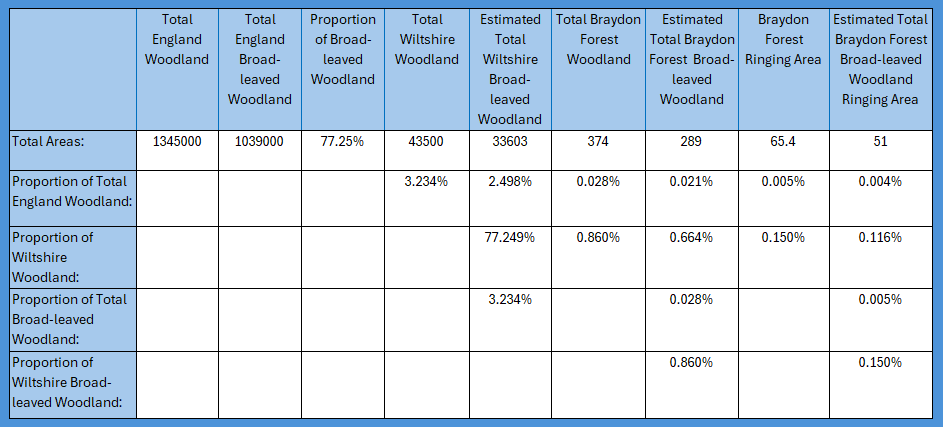
So the Marsh Tits found in the Braydon Forest are actually recorded in an area of 0.15% of the entire broad-leaved woodland of Wiltshire, and less than 0.005% of England’s broad-leaved woodland. Bearing in mind that Marsh Tits are the least mobile of the four Paridae species now found in the Braydon Forest, I think that we can be reasonably confident that what we find is genuinely representative of the local population.
The next thing I looked at was how the population of the Braydon Forest compared with Wiltshire and England as a whole:
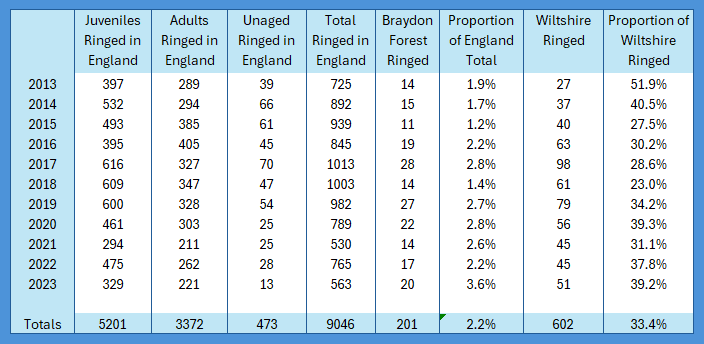
To put that into perspective: over the 11 year period of my study to date, 33.4% of all Marsh Tits ringed in Wiltshire are ringed in 0.15% of the woodland covered by my ringing activities. More importantly, 2.2% of the national population ringed is ringed in less than 0.004% of the national woodland cover, and less than 0.005% of what might be considered suitable habitat. That is quite astonishing in my view. Unfortunately, whereas the Forest Service paper does breakdown the difference between coniferous and broad-leaved woodland, I cannot find a definitive breakdown for the whole of Wiltshire. This table, that I have lifted from that paper, does show the following:
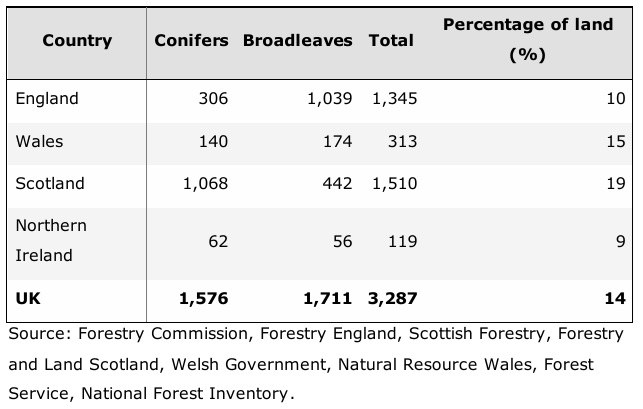
My calculations are, therefore, based on those woodland proportions for England and applied to the woodland profile of Wiltshire, so bear that in mind,
Moving on from the population versus occupied area statistics used above, I thought I should have a further look at the population trend for the Braydon Forest against the whole of England.
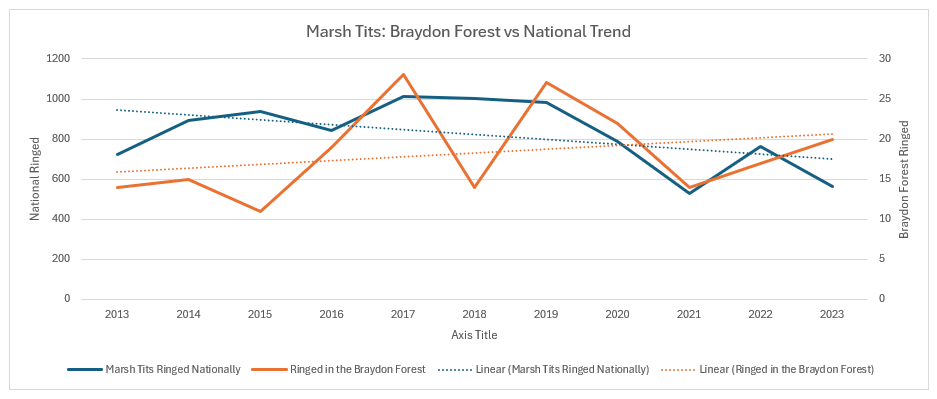
The trend is clear: whilst the national trend is downwards, the Braydon Forest trend is upwards, but the numbers in the Braydon Forest are not large enough to affect the overall trend. Not only is it upward but it shows a five point increase over the period. However, when you look at the figures on a proportionate basis, the trend against the England totals is identical, but against the rest of Wiltshire, it is somewhat downward:
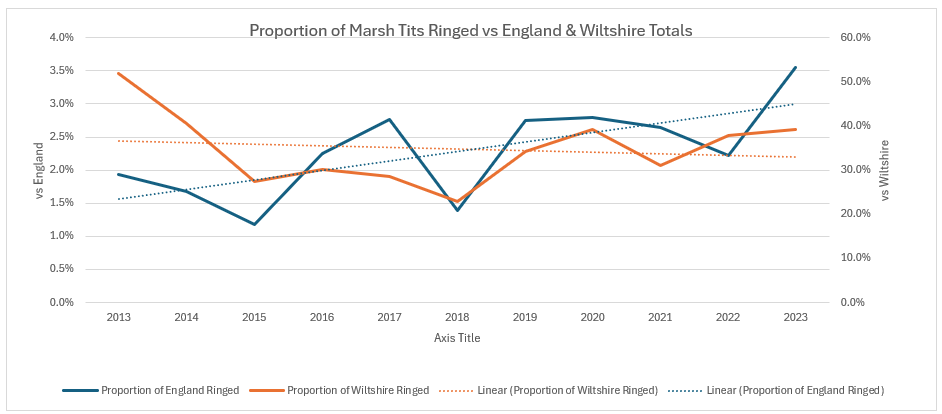
What this shows is how proportionality in a relatively small cohort can distort the overall picture: 2013 to 2015 inclusive had low ringing rates for the species in Wiltshire, and slightly lower than average ringing rates in the Braydon Forest, producing higher proportions in the Braydon Forest for those years, so I excluded them and redid the graph:
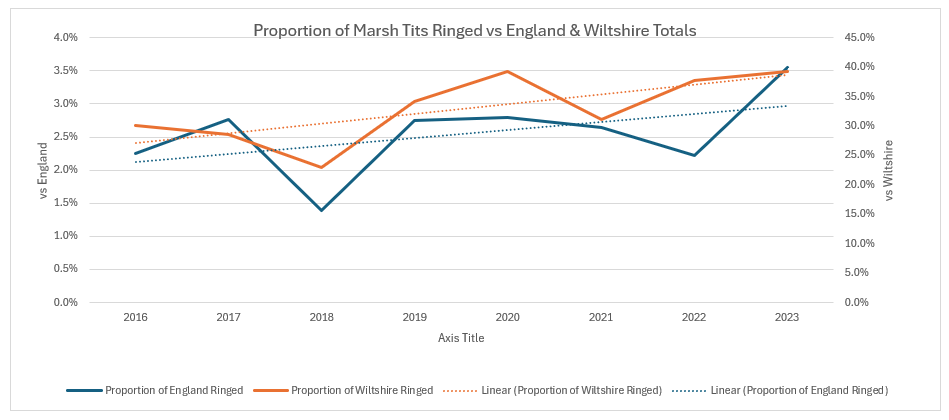
It’s okay: I am not trying to con anyone, I leave that to some of the less scrupulous academics. My cherry-picker has been too busy picking plums, apples and quince!
I fully expect the addition of the 2024 and 2025 data to correct the initial imbalance shown in fig 2 and omitted from fig 3. Expect more in the not too distant future. In conclusion: I contend that the population of Marsh Tits in the Braydon Forest is a significant proportion of the Wiltshire population, and is a small, but significant, part of the England population, given that it is reversing the negative trend across the country, and that the woodland management of the Braydon Forest is an important indicator of how the population’s position within England could be improved.
Citation: Robinson, R.A., Leech, D.I. & Clark, J.A. (2024) The Online Demography Report: Bird ringing and nest recording in Britain & Ireland in 2023. BTO, Thetford (http://www.bto.org/ringing-report, created on 4-September-2024)
Forest Research: Provisional Woodland Statistics 2025, 26 June 2025
Perrins, C. M. 1979: British Tits, The New Naturalist Series, William Collins & Sons & Co, Glasgow
An update: the BTO has just released the 2024 ringing totals for the UK. In the insignificant population of Marsh Tits in the Braydon Forest we ringed 19 birds out of 44 ringed in Wiltshire, or 43.2% of the total. There were 633 fledged Marsh Tits ringed in the UK this year, making our contribution 3% to the national average. To put that in perspective: that is 3% in 0.005% of the suitable habitat for the species in England, and 43.2% in 0.15% of the suitable habitat in Wiltshire. I would like to know, however, what percentage of Wiltshire and England’s broadleaved woodlands are covered by bird ringing.
 Ringing In The Braydon Forest & Beyond