After yesterday’s excellent session at the Firs, today was our standard scheduled session, with Lower Moor Farm next on the agenda. I was quite happy that we would not be setting a lot of net and was not expecting a huge catch. So far this year, the largest catch has been 29 and the average catch size was just 21 birds.
I was joined for the session by Laura and Ellie again, plus Miranda from my team. We were also playing host to Mariana, for the Zoological Society of London, continuing her sample collection for the investigation of mosquito-borne diseases from migratory birds, primarily Blackcap and Chiffchaff.
We met at 7:00 and set the usual nets:

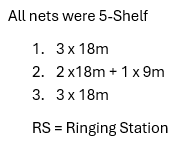
We had the nets open by just past 8:30 and started catching almost immediately. At 8:45 we took a nice introductory catch of eight birds from five species. Not a bad start compared to our usual recent sessions there. We were not expecting what happened next. At 10:30 on our net check we found 32 birds from seven species. Key to the size of this catch were two components: 11 Long-tailed Tits and 10 Blackcaps. There were also four each of Blue Tit and Chiffchaff.
This catch coincided with the arrival of several of the children and helpers / teachers from the care farm. We were so busy processing these birds, and swamping Mariana with samples to take, that we didn’t have a lot of time to spend with them at first. As we got further through the catch, we did take some time out to let the children get more involved, appreciated by them, as ever.
The next couple of rounds were a lot quieter, until we decided that we would make the 11:15 round our last, whereupon we caught another 10 birds from five species.
The list for the session was: Treecreeper 1; Blue Tit 5(2); Great Tit 1; Long-tailed Tit 8(4); Wren 1; Dunnock 1; Robin 1(2); Blackbird 1; Blackcap 22; Chiffchaff 14; Goldcrest 3. Totals: 58 birds ringed from 11 species and 8 birds retrapped from 3 species, making 66 birds processed from 11 species.
Of those both ringed and retrapped, those we could age, only one of the Blackcaps ringed, and the Treecreeper and one of the retrapped Robins were adults. All of the Long-tailed Tits had completed their moult, with just a couple still having a little bit of body-moult, so it is now impossible to differentiate between adults and juveniles in the hand at this time of the year.
It has been far and away our best catch at Lower Moor Farm since 25th September 2021! Mind, when you compare it with the best ever catch there: 157 birds from 16 species, that’s pretty poor, but that is far and away the best I have ever had. The reason for raising this is that all of those birds were caught in the three nets that comprise ride 1. Today, only one of the birds was caught in that ride: the Wren! What I would give to be able to have that ride returned to its former glory! It would take a lot of work to bring it back to that state: a lot of tree thinning and topping for a start.
Just to wind it up even further, this was the list from that session: Kingfisher 1; Blue Tit 20; Great Tit 20; Long-tailed Tit 21; Dunnock 1; Robin 4; Song Thrush 1; Reed Warbler 2; Blackcap 36; Garden Warbler 8; Whitethroat 2; Lesser Whitethroat 7; Chiffchaff 26; Willow Warbler 5; Bullfinch 1.
Anyway, with the nets closed today just after 11:45, we cracked on and got everything packed away by 12:15 and off site soon after. A very good session: two in a row. Let’s hope that Saturday’s session for the Malmesbury Natural History Group goes as well as these last two.
One thing I do need to mention: last time we were having a session at Lower Moor Farm I was eulogising over seeing the Great Crested Grebe humbugs for the first time ever. Now, for the first time, I saw the youngsters swimming for themselves, still hassling their parents for food. It was wonderful.
 Ringing In The Braydon Forest & Beyond