Today we were scheduled to carry out a ringing demonstration for the Swindon Wildlife Group at Blakehill Farm. This was a rescheduling of the previously postponed session scheduled for the 5th October. That was postponed because of wet and windy weather. We turned up at 7:00 ready to set up only to find that the wind was blowing hard across the plateau, so we had no choice but to cancel that session. I contacted Mark Clayborough, the Swindon Wildlife Group contact for today. At least it gave plenty of time for them to contact the potential attendees and save them wasted journeys, as they were not due to arrive until 8:30.
As we were already up and out, I had a chat with the team, and we decided that we would try out Somerford Common, to see if the woodland would provide better protection. Laura, Adam, David and I headed off – I had to make a detour to home to pick up the 18m nets. It was still blowy, so we were restricted as to which nets we could set. In the end we just set up seven nets:
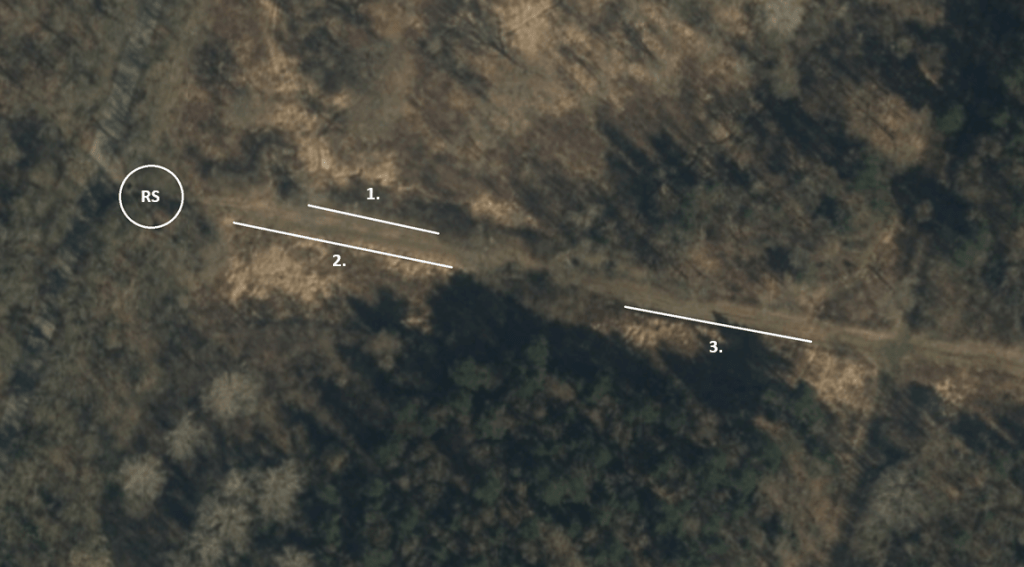

We had the nets open just after 8:00 and sat and looked at empty nets for 20 minutes, but then we started to catch. The first catch comprised of one each of Blue Tit, Chiffchaff and Goldcrest. We didn’t really do rounds today because we could see along the nets. Mind you, we had to identify the birds from the leaves: looking for a little bit of voluntary movement! Every time a bird was identified one of the team would go off and extract it. We did have a couple of multi-bird rounds: two of five, three of three and two of two. However, we did have 16 catch events during the session. Catching was between 8:30 and 11:45, closing the nets in stages: ride 3 at 11:15 (removing two birds from that ride that flew in as it was being closed) and then rides 1 and 2 at 11:30 (again, removing a Blue Tit that flew in as the nets were being closed).
It was a satisfying, if not busy, session. Given that we had a late start, and the lures were set up for a session on agricultural grassland and hedgerows, I was happy with a catch that comprised: Blue Tit 4(1); Great Tit 4(1); Long-tailed Tit 3(1); Dunnock 1; Robin (2); Blackcap 1; Chiffchaff 6; Goldcrest 8. Totals: 27 birds ringed from 7 species and 5 birds ringed from 4 species, making 32 birds processed from 8 species.
Obviously, I would have preferred that we had managed to go ahead with the ringing demonstration. I couldn’t invite them to join us at Somerford Common for two reasons: firstly, we didn’t know whether we would find enough cover to set up there, nor what sort of catch we would make, and I would have hated to waste their time; secondly, there wouldn’t have been enough parking available.
 Ringing In The Braydon Forest & Beyond