Oh good grief: a quite astonishing session at Red Lodge this morning. I hadn’t been able to get out before this this week: Monday to Wednesday my car was in having its bodywork repaired (I won’t ever try driving after taking Tramadol again – a lesson that cost me £780 to learn!), Thursday was too wet and windy. Today was forecast to be dry but breezy. My usual midweek team was otherwise occupied, but David, normally only available at weekends, was available today but, in keeping with the flow of things, is not available for the weekend.
It was windier than I was expecting, so we restricted ourselves to just four nets: around the feeding stations, as they are pretty well sheltered from the wind. These were the nets we set:
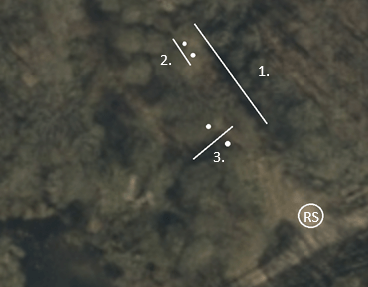
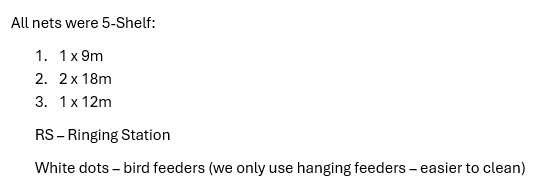
As I only got around to setting up the feeding station on Tuesday. Arriving on site at 7:15 the first thing I did was check the feeders: the peanut feeder nearest the ringing station was empty, the seed feeder still two-thirds full. Both feeders at the far end of the ride looked untouched. I expected that would mean that we would have a Titmouse heavy catch: I didn’t expect it to be quite as heavy as it was. Even before we had started to open the nets we caught five Great Tits and a Blue Tit in the closed nets. Ironically, they were all in ride two up by the untouched feeders! That ride was the busiest all morning: I doubt those feeders will be full for long.
We processed those birds and went to check the opened nets, and extracted another 20+ birds: that included another four Marsh Tits to be ringed! Our biggest ever catch of them in Red Lodge! That takes us to 36 in our Braydon Forest woodlands – a total of 44 fledged Marsh Tits were ringed in the whole of Wiltshire in 2024! Have I mentioned that someone described the population of Marsh Tits in the Braydon Forest as “insignificant”, because it puts a big spoke in his theory that supplementary and garden feeding is helping drive their extinction?
As we were processing these birds, we had a chat with Paul, a local birder and photographer that I usually meet at Lower Moor Farm. He was looking for signs of the Goshawk that has been reported in the area. Although I did see one of my first ever in Red Lodge in winter 2013 / 2014, as I was topping up the feeders, and saw what I thought was a big Sparrowhawk, until I noticed that the two birds chasing it were Carrion Crows and they were smaller! They are becoming a feature in the Braydon Forest: I have seen them in three of my sites, and had reports of another in a fourth. Anyway, before he headed off he told us that there looked to be about 20 birds in our nets. If only: we had 70+ birds in the nets. It was damned hard work, but we cracked on and got them all out, shutting the nets as we went. I was thinking we might reopen them once we had finished extracting but, in the event, the wind became so strong that I decided we would leave them closed and take down once we had finished processing the birds we had extracted: just as well, because we were very busy for the next couple of hours processing those birds we had extracted. Bear in mind that is less than 2 minutes per bird, with age, moult, sex, where applicable and all biometrics taken and recorded, no ringing and flinging! Efficient or what?
Paul came back as we were processing this lot, he was quite astonished at how much we had to do. He had been lucky: found the Goshawk nest and a roosting Woodcock. He left us to it, as were a tad busy!
The list for the session was: Nuthatch 1; Blue Tit 66(3); Great Tit 18; Coal Tit 1; Marsh Tit 4; Long-tailed Tit 8; Goldcrest 1; Chaffinch 1. Totals: 100 birds ringed from 8 species and 3 birds retrapped from 1 species, making 103 birds processed from 8 species.
It is far and away the biggest catch of Blue Tits to ring in the Braydon Forest and our absolute biggest total catch of them, passing the 67 we had in the Firs just 13 days ago. Until today, that was our biggest ever haul of Blue Tits, at 67, but only 45 of those were birds to be ringed. This is our biggest ever ringing haul, and our biggest ever haul of ringed and retrapped Blue Tits.
After we finished processing the birds and taking down the nets and packing away, it was 13:30! A long morning, hard work, but very satisfying in lots of ways.
 Ringing In The Braydon Forest & Beyond