This was our first visit to this site since the 8th November. Since then there has been a significant amount of forestry management taking place in the northern end of the wood and the site has been out of bounds to the general public since then, and still is. However, the Trust gave me permission to run a session there, I think anticipating that the work would be completed (good joke!!!). I was contacted by the reserve manager earlier in this week telling me that I could work in the southern end of the wood but that the northern end was too dangerous for us to work there. It was also going to be all done using horse drawn logging. Funny horses: they must have had very large wheels and left huge great trenches in the path.
Prior to the session I planned to go along a couple of days before to set up the two feeding stations I have used before. Unfortunately, Thursday was washed out with absolutely torrential rain, so I didn’t get there until Friday morning, where I met the big green “horse”: with a large bucket on the front and a grabber on the rear and a very large trailer. As my 13-year old trainee put it “are you sure it wasn’t a deer named John”! In your own time: he’s a bit young for Dad jokes. Fortunately, he was removing the remaining logs from the car park, so when we turned up this morning there was plenty of space for parking for the team. We agreed to meet at 7:30. I turned up 10 minutes early to find that the place was still out of bounds to the general public and all locked up. That meant we could have a session without being worried by dog walkers or disapproving members of the public: I have a key for the outer gates and the code for the inner padlock.
I was joined for the morning by David, Laura, Adam and Pete for the ringing, and Daniel and Mark to help set up. Daniel was off at 10:00, Mark giving him a lift to Kemble station before returning to help take down. We set the usual nets, only the feeding station had to be moved to the north of the track, as the entire quadrant where we had it before has been coppiced and all of the undergrowth cleared:
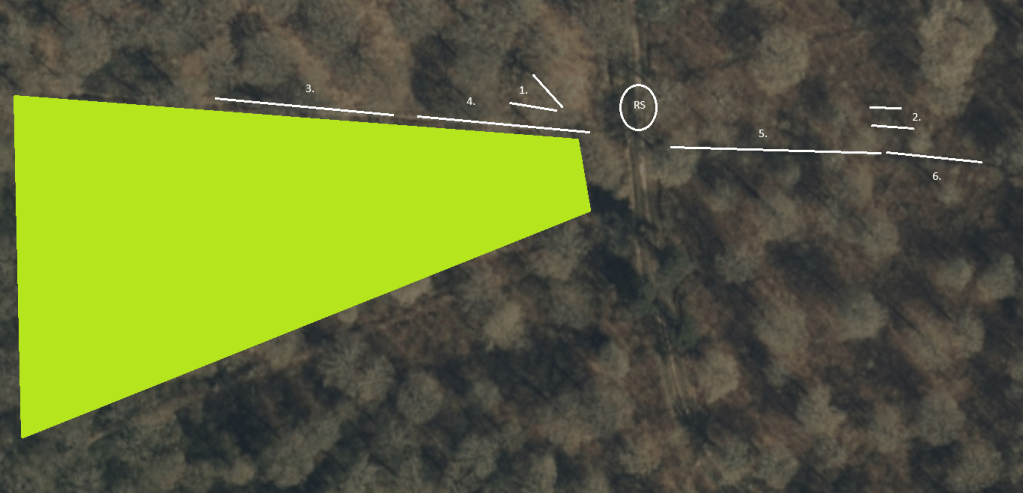
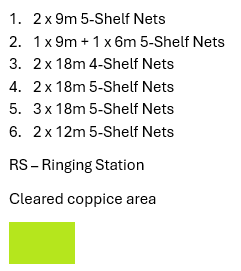
The feeding stations, comprising one peanut feeder and one seed feeder, were positioned between net sets 1 and 2.
We had the nets open by 8:45 and took our first Blue Tit out of the nets before they were actually opened! It wasn’t as busy as I would have liked. Not having had the feeding station operational whilst the woods were closed to us, nor being able to get it set up until yesterday morning, I had hoped that the disturbance from the forestry works would have driven the birds into this area of the wood.
The catches were small but regular. To be fair, after the very busy last few sessions, it was quite nice to take it a bit easier. Our list for the session was as follows: Blue Tit 11(4); Great Tit 6(1); Coal Tit (3); Marsh Tit (2); Wren 1; Dunnock (1); Goldcrest 2(2). Totals: 20 birds ringed from 4 species and 13 birds retrapped from 6 species, making 33 birds processed from 7 species.
We closed the nets and took down at 11:30, after a somewhat more relaxed session in recent times, and were away from site by 12:15.
I was disappointed that we didn’t catch a new Marsh Tit. It is one of our key sites for the species in most years, only it is somewhat lagging behind the others this year. We did retrap a couple but I suspect the majority are in the north end of the wood, where the older woodland is found.
As I have been banging on about for a while, Marsh Tits are having a good year in the Braydon Forest. In fact they are having a good year across our group, with 51 ringed, compared with the 44 in the whole of Wiltshire last year. It has been our best year for individuals caught as well: 52 in the Braydon Forest and 66 across the group.
However, it seems that Blue Tits are also having a good year. We have ringed 586 so far this year! Last year was 353 and the previous best year was 575 in 2013. It has clearly been an excellent breeding season for them: with 358 juveniles ringed, compared with 89 in 2022, 94 in 2023 and 96 in 2024. Across the group it has also been a phenomenal year for them, with 2159 ringed across all sites, compared with 1694 in 2024 and 1,440 in 2023. Those are the best three years for this species. In terms of juvenile ringed there has been a significant increase: 1,264, compared to 568 in 2024.
I would love to know what has caused this spike in numbers for both Blue and Marsh Tits! Anecdotally, it has been a good year for insects, and I wonder if this is the reason for the increased success of these small insectivorous birds?
Interestingly, Great Tits in the Braydon Forest have not shown the same increase: a 25% increase on last year (213 vs 159) but only a 10% increase on 2023 (191). That said, the number of juveniles ringed (111) is the highest since 2019 (120). 2021 (73), 2022 (53) and 2024 (48) were particularly poor for juvenile Great Tits, with 2020 and 2023 having 90+ juveniles ringed. Looking at the West Wilts catches as a whole, however, it seems the other woods further south in the county have had a much better showing, with 844 ringed this year, compared with 799 in 2024 and 677 in 2023. The increase in juveniles across the group is also significant, with 2025 being the best year ever for ringing juveniles, at 513, compared with 354 in 2024.
If I have a concern about any of the titmice species it is Coal Tit in the Braydon Forest. The numbers ringed are higher than for Marsh Tit, but not much more. Their numbers have declined over the 13 years that I have been monitoring these woodlands. That said, they are a bird of least concern across their range and green-listed in the UK, so perhaps it is just our habitats that are not suitable. On average we ring 57 per annum: this year it was 55, so close to average. That said, we ringed 30 juveniles this year, our best since we ringed 50 in 2019. Last year we only ringed 10 juveniles in the whole year. Mind, if it is a concern for the Braydon Forest, it is more so for the rest of the group, with 62% of this year’s catch ringed being caught in the Braydon Forest. The average catch ringed across the 13 years is 89, so across the period, the Braydon Forest provides some 64% of all Coal Tits ringed by our group. When it comes to juveniles, the group have ringed a total of 48 this year, so it looks as though the ringing proportions for this year are pretty much identical, at 62.5%. Overall, the Braydon Forest produces 66% of the Group’s juvenile Coal Tits.
 Ringing In The Braydon Forest & Beyond