It has been quite an astonishing year for two species of titmice within our ringing group. I intend to cover all four species. I started with Blue Tits but will now continue with my obsession, the Marsh Tit, Poecile palustris. The first thing that I noticed was that we were ringing far more individuals in the Braydon Forest sites than we had ever done before. So I had a look at the results for the rest of the group. They were rather surprising. A big thank you to Bridget Griffin at the BTO who gave me the preliminary 2025 figures for Marsh Tits ringed in Wiltshire and England as a whole.
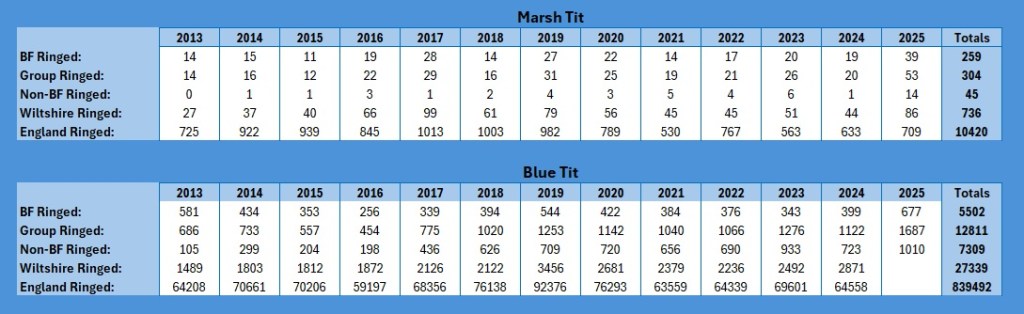
Let’s start with the basic figures: I cannot do individual numbers for Wiltshire and England, as the BTO don’t issue figures for retrapped birds, and certainly not individual ring number histories, unless the owners of the raw data agree to share it. They will release it for a specific academic study on a non-commercial basis, and I am not ready to do that (yet!).
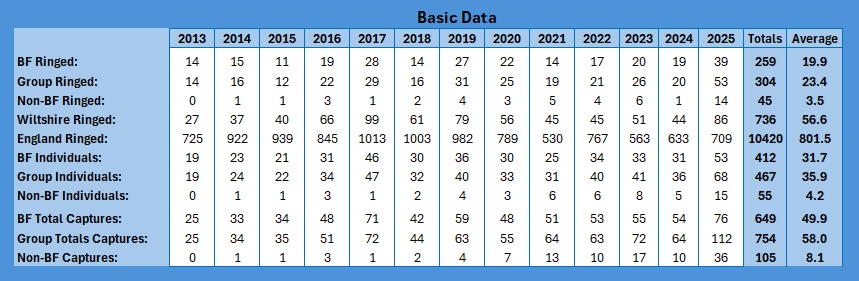
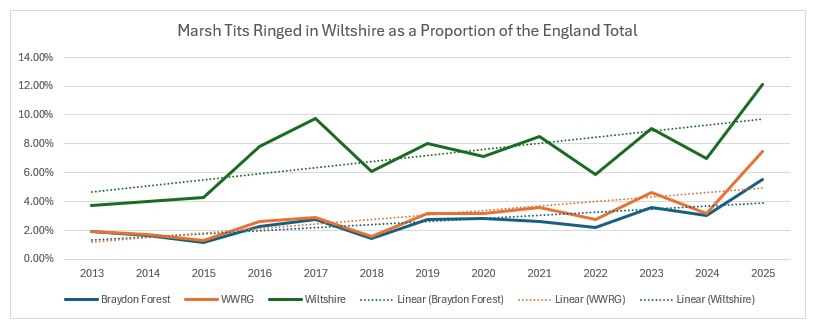
As you can see, more were ringed in 2017 and 2019, but the England total was much higher and, in 2017, the Wiltshire total was higher. When you look at the catch as a proportion of the overall catches it looks like this:

When you graph that, the trend becomes encouraging for the species in Wiltshire:
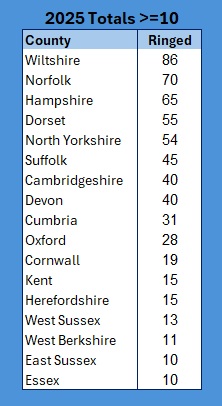
Interestingly, Wiltshire did have the highest number of Marsh Tits ringed in England this year. I have restricted the table to show counties that have caught and ringed more than 10 of them:
When you look at the West Wilts Ringing Group results and, within that, the Braydon Forest subset, you get the following:

As you can see, in the last two years the group has produced over 60% of the Marsh Tits ringed in Wiltshire. Of course, percentages can be misleading: according to that, despite ringing over twice as many as last year, it is a considerably lower proportion of the catch compared to 2024, although it is our best ever annual catch.
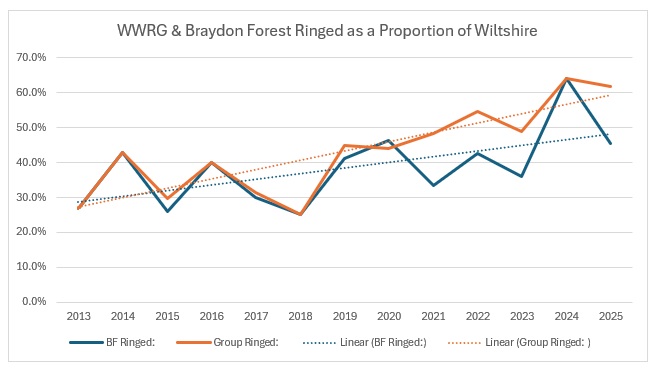
Still, the overall trends are going in the right direction.
Unfortunately, I don’t have the breakdown for 2025 between adults and juveniles for the rest of England or Wiltshire but the breakdowns up to and including 2024, plus 2025 for the West Wilts Group and the Braydon Forest are worthy of looking at. To be as accurate as possible, there are always a few birds that are impossible to age accurately. I have decided to include them in the adult figures and focus only on those that are definitely juveniles.

Looking at the figures graphed up to 2024 is quite illuminating:
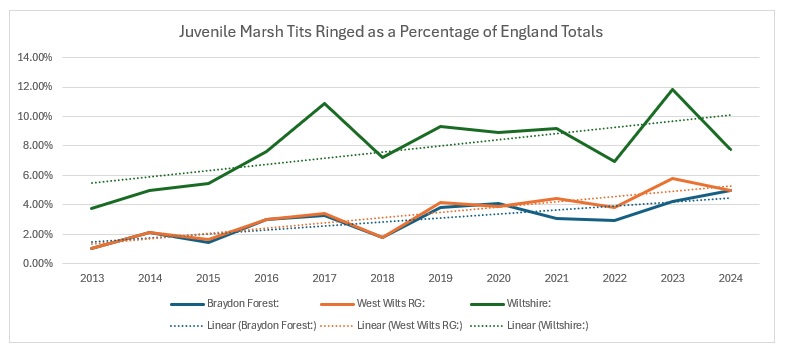
As you can see, there is an upward trend across all three data sets and, given the results this year, with 67% of the Braydon Forest catch being juveniles and 47% of the group catch being juveniles, it is looking promising again.
When I compare the group’s activity against the total for Wiltshire it looks like this:

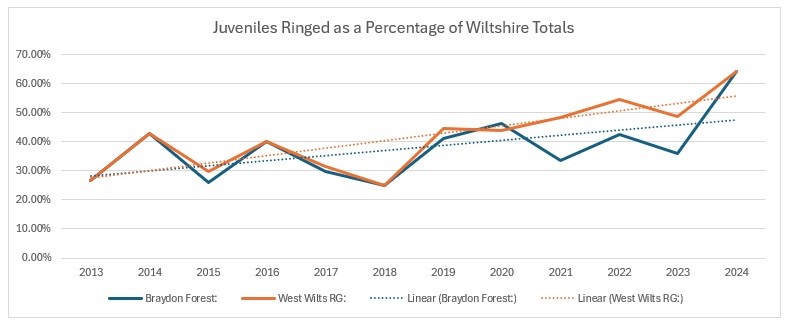
Things are looking hopeful for the Marsh Tit in Wiltshire and a large part of that is down to the catch in the Braydon Forest. As I have said before, the broadleaved woodland area of the Braydon Forest is 0.86% of the Wiltshire total and 0.028% of the England total. Given how Marsh Tit is the most sedentary of the Titmice that I encounter, it is appropriate to look at the size of the broadleaved woodlands in which we set our nets. That is 0.15% of the Wiltshire total and just 0.005% of the England total. To put that into perspective: the 5.5% of this year’s total of Marsh Tits ringed was ringed in 0.005% of the available broadleaved woodland in England!
As I have said in my previous analysis on Blue Tits, my theory is that the reason that Marsh Tits are stable in the Braydon Forest is because we have virtually no Titmouse nest boxes in the woodlands, and very few other boxes, except bat boxes. As a result our local Blue Tit population is stable but with a slight decline. Interestingly, given that the increase in Blue Tits is being blamed as a factor in the decline of Marsh Tits by some academics, the BTO Garden Birdwatch Scheme, of which I am a long term member, has registered long term stability in the reporting rate of Blue Tit numbers across England. In the last 10 years, up until the end of2025, there has been a small decline.
Anyway, as a footnote, here is a series of figures and graphs showing the ringing trends for Blue Tit vs Marsh Tit. The data for Blue Tits for Wiltshire and England only go as far as 2024, so those two graphs, and the trends, only go up to that year.
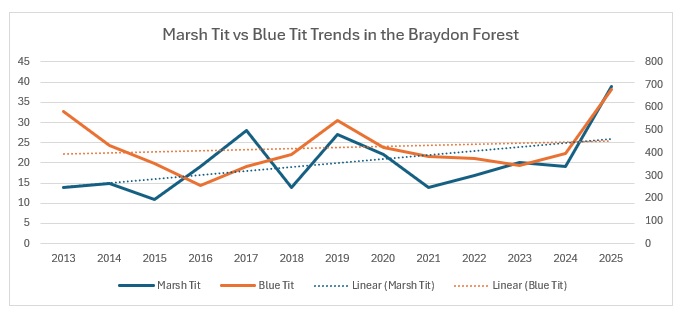
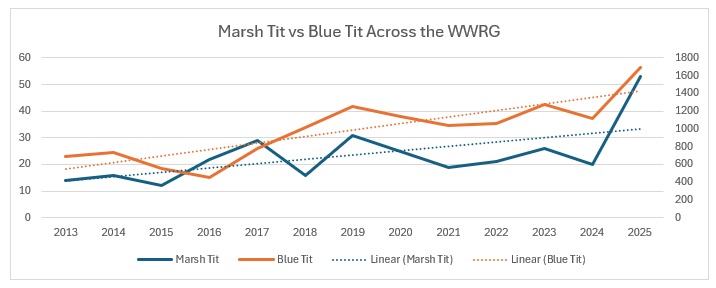

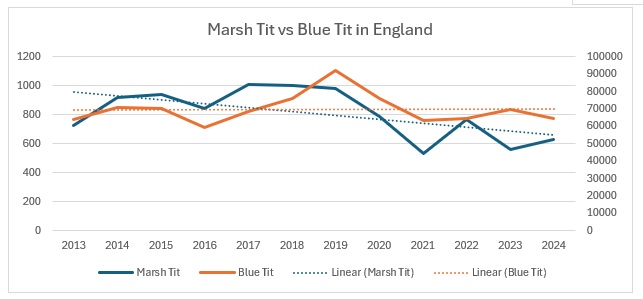
As you can tell, the trend of Marsh Tit growth in the Braydon Forest is positive, and has overtaken the trend in Blue Tits over the 12 years of my ringing team working there. The trend across the West Wilts Group shows that populations of both are increasing, but the Marsh Tits not as rapidly as the Blue Tits, but increasing.
Across Wiltshire the Blue Tit population is increasing, whilst the Marsh Tit population is stable. However, the trend for England shows that, whilst the Blue Tit numbers are stable, Marsh Tit numbers are falling, as we all know.
So, what is the difference between the Braydon Forest and elsewhere? I suggest the lack of nest boxes but am open to other suggestions. It probably goes without saying but there are villages and hamlets and single houses dotted around the Braydon Forest which feed the birds in their gardens and, as I have stated multiple times, I feed my ringing sites between October and mid-March depending upon the onset of cold weather.
As a final note, things are already looking quite good for 2026: Matt Prior of the North Wilts group actually ringed 12 Marsh Tits in a session on the 10th January, and in my first two sessions of this year I have ringed two and retrapped another eight individuals.
 Ringing In The Braydon Forest & Beyond