Following on from the analysis of Blue and Marsh Tit numbers, I have had a look at the same data for the Great Tit: another species that, along with Blue Tits, are supposed to be being advantaged by garden and supplementary feeding in the winter to the detriment of other species. How do the statistics stand up to scrutiny on that?
As with the Blue Tits, I only have data up to the end of 2024 for the entirety of England and Wiltshire, but have comparative data for my Braydon Forest sites against the entirety of the West Wilts Ringing Group. These are the basic figures:
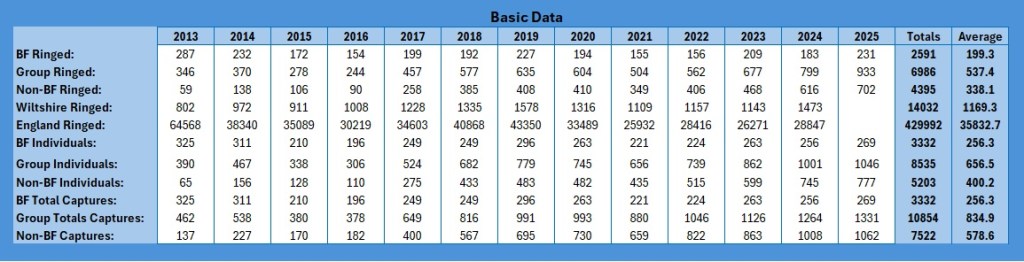
It is interesting to see how small a proportion of the Great Tit catch is found in the Braydon Forest:
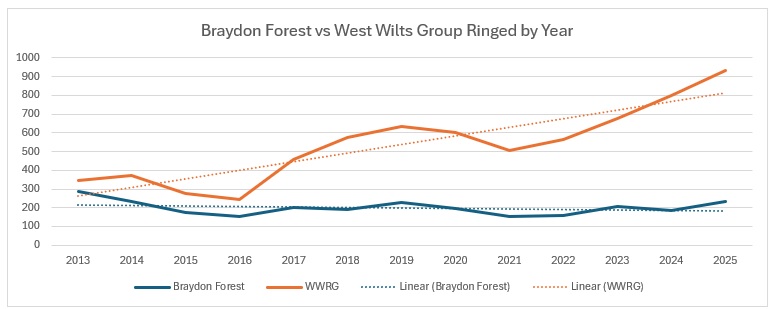
The long term trend within the Braydon Forest is a long slow decline: ironically mirroring the trend in Blue Tits. The highs and lows within the Forest are quite smooth, but the growth in the rest of the Group’s activity is significantly different to what is happening there.
How do they stack up against the rest of Wiltshire:
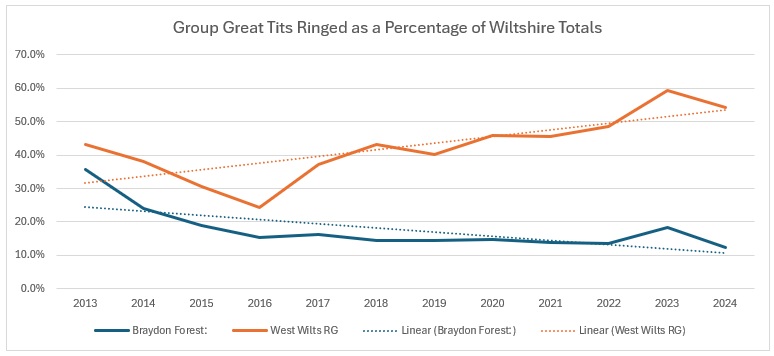
Obviously, only going as far as 2024 does not reflect the rather large hike in the Group numbers in 2025, however, the downward trend in the Braydon Forest is even more pronounced.
When we compare the Wiltshire trends across the whole of England, the Wiltshire and Group trends are showing a definite increase and the Braydon Forest is neutral.
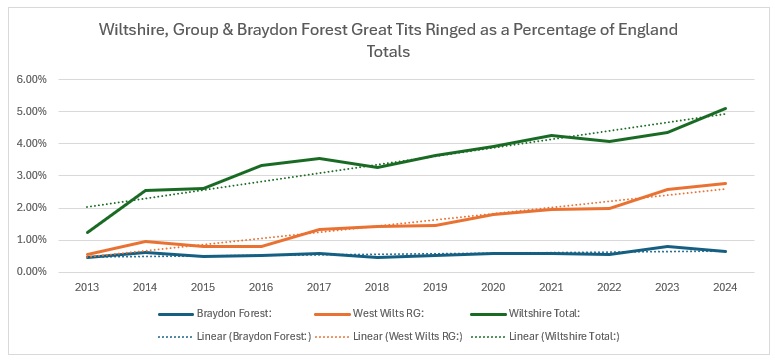
The explanation for that is shown if you graph the actual figures:
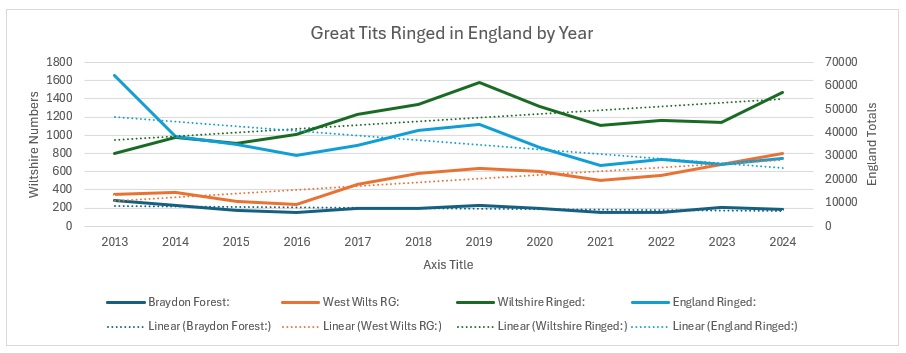
As you can see from this, there is a pronounced downward trend of the number ringed across England, even more so than in the Braydon Forest. So it seems that Wiltshire is actually bucking the national trend, with little help from my sites.
As with the other species, I cannot analyse individuals caught for the whole of Wiltshire and England, as that data is not readily available from the BTO (and I would not want to have to work my way through so much data, it is bad enough doing it for our group). I have looked to see if these overall trends are anything to do with juvenile recruitment. As with the Blue and Marsh Tit pieces, the juvenile analysis does not include pulli ringed as within our group only one of the team monitors titmouse nest boxes, and there are none for me to monitor in the Braydon Forest either. So juveniles ringed are birds ringed post-fledging.

As you can see, the Braydon Forest averages just under one-sixth of the Wiltshire total, the Group as a whole just under half of the Wiltshire total, but when looked at the England total juvenile recruitment, as much as one can extrapolate from ringed birds, the Braydon Forest is producing, on average, 0.51% of the England total, the Group contribution is 1.44% and the whole Wiltshire contribution is just 3.34%.

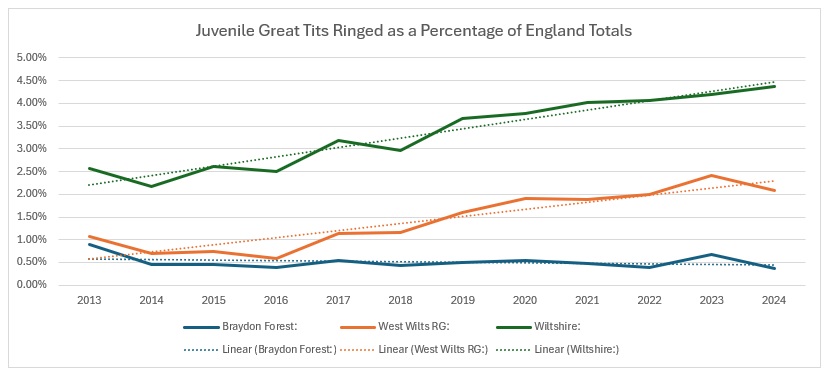
Again, a slight reducing trend within the Braydon Forest, but significant increases with the rest of the group and Wiltshire as a whole.

That reduction is more obvious when you look at the Braydon Forest against the Group and the rest of Wiltshire in graphical form.
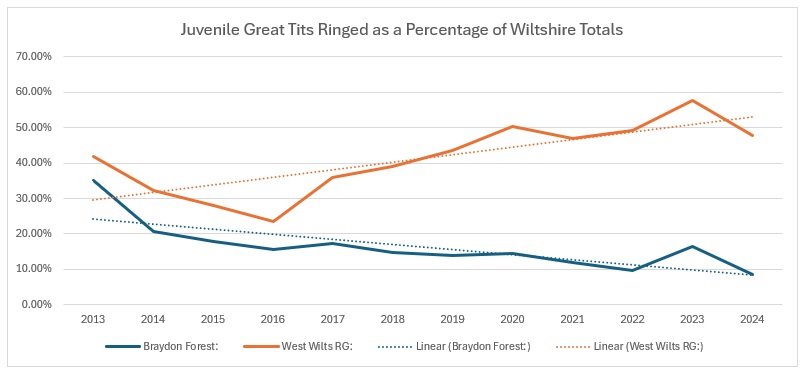
There was a slight spike for the Braydon Forest in 2023, but it clearly had little impact on the overall trend.
So, the point of all of this: within the Braydon Forest Marsh Tits are definitely increasing, whereas Blue and Great Tit numbers within it are in decline. There are a number of factors but I think key is the absence of titmouse nest boxes.
 Ringing In The Braydon Forest & Beyond