Having covered off the true titmice, family Paridae, I am now going to assess the situation with the Aegithalidae, the Long-tailed Tit, Aegithalos caudatus. They are the only one of the eleven species of the family found in the UK.
Long-tailed Tit, along with House Sparrow and Nuthatch, are the three species we catch that, when the juveniles moult post-fledging, they moult into full adult plumage.
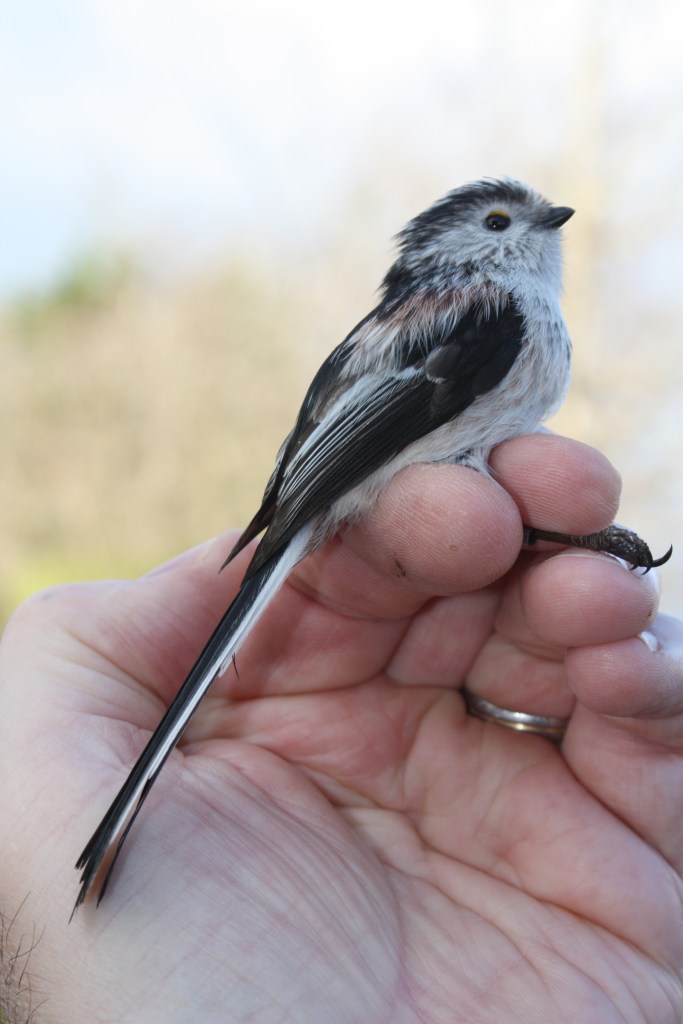
This is a juvenile:
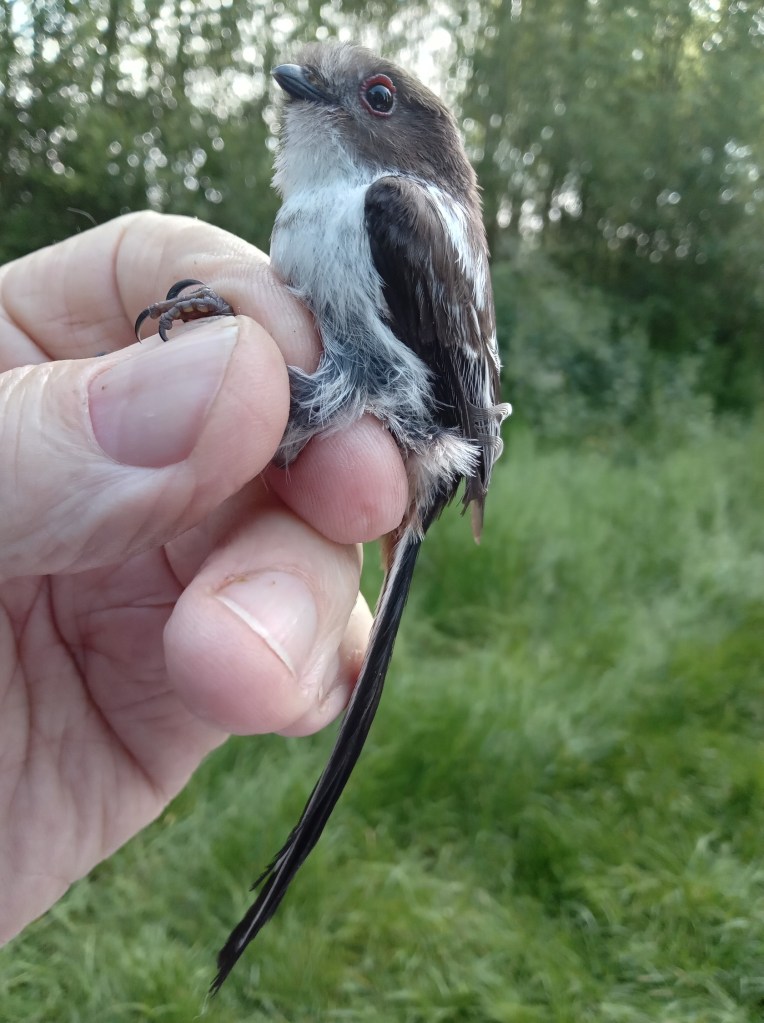
With Long-tailed Tit being one of the earliest small Passerines to nest, it can be difficult to age them as early as the beginning of September, so trying to build up a picture of recruitment is nearly impossible. If you look at the table below of birds ringed it looks terrible for breeding statistics:
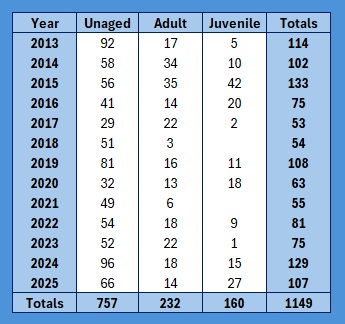
It looks as if they can have terrible breeding seasons. However, when I graph it up, it looks a bit better than that:
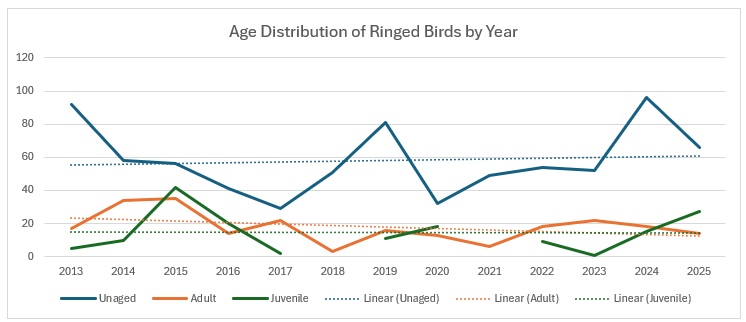
As you can see, the trend of birds ringed by year is positive, those identifiable as juveniles is static, those unable to be aged accurately is positive and those identifiable as adults shows a slight decline. The overall trends in the population have, therefore, been calculated ignoring age classification.
Looking at the annual catch rate, both in total and individuals caught, i.e. multiple recaptures of the same bird, compared with the number of individual birds caught in the year:

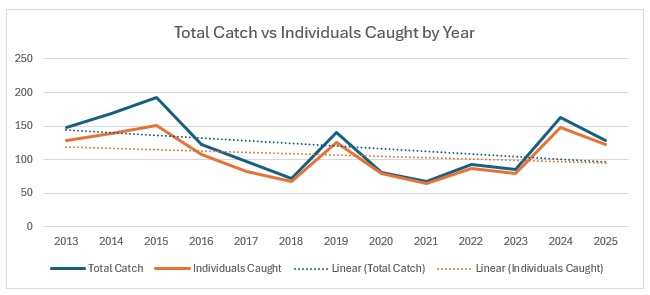
Although we average 106 individuals each year, in an average catch of 120 per year in the Braydon Forest, there is an overall decline in the catch size, but less of one where the individual birds are concerned. So we are, clearly, retrapping the same birds less frequently than we once did. That said, there are definite peaks and troughs on the annual catch, with 2024 being the latest peak.
As table 1 shows, the number ringed each year is more than a bit erratic, as this graph shows:
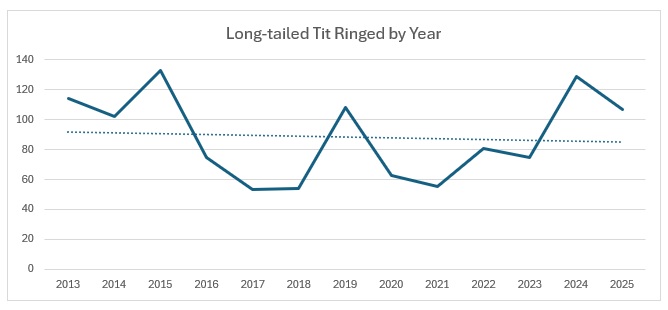
Again, peaks and troughs but the overall effect is rather less of a decline than that of the overall catch.
The next part relates to the population as it relates to the whole of Wiltshire and England. Because the 2025 values won’t be issued until the end of next Autumn, I have looked at data up to and including 2024. As previously mentioned, I haven’t done an age analysis, just overall numbers ringed.
To start with, the comparative numbers:
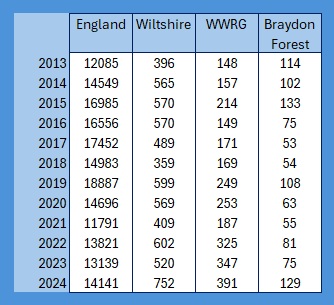
It is clear that the Wiltshire population ringed is a low proportion of the total ringed in England. When it is graphed up it looks like this:
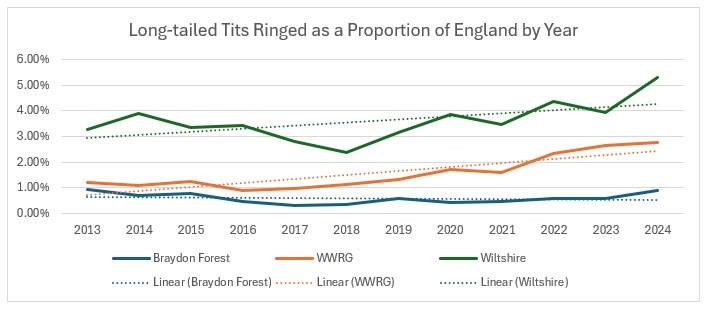
So the overall trend in Wiltshire is upward, rising by approximately 1.2% over the 12 years of available data. That of the West Wilts group as a whole is rising at a slightly better rate of 1.6% over that period despite a a decline in the Braydon Forest catch of 0.3%.
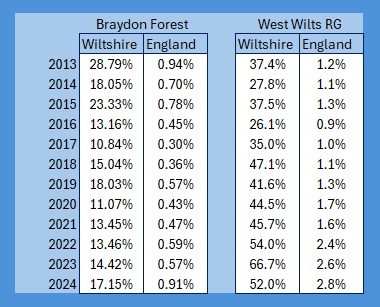
When looking at how the proportion compares against the catch in Wiltshire we get:
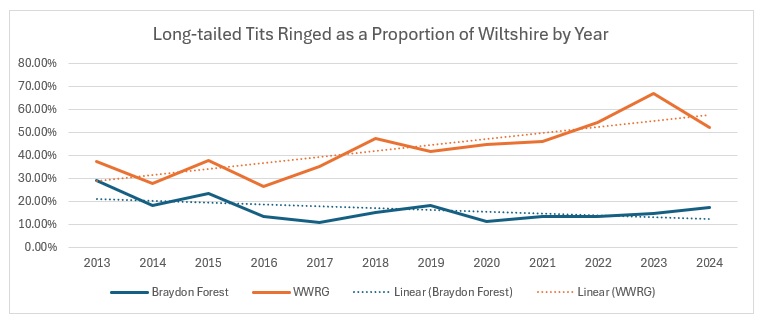
Again, the growth in the West Wilts group contribution to the Wiltshire total is significant: from 29% to 58%, despite the decline in the Braydon Forest from 21% to 12% of the Wiltshire ringing catch.
I am intrigued to know what is causing the decline in the species in the Braydon Forest. The numbers were good up until 2016, when they fell dramatically. As in my previous posts, the same thing happened to Blue Tits in 2016, but they have recovered much better. Ever since then the numbers have been low, with a number spike in 2018, but not as strong as the spike in the group, but better than the decline in Wiltshire overall. Then, again, in 2024, a rise to 129, which is the best return as a proportion of the England catch we have had since 2013, at 0.91%. 2013 was 0.94% of the England total. The Group total in 2024 was the best we have had, at 2.8%, but this is in line with the way the population has increased proportionately over the years.
 Ringing In The Braydon Forest & Beyond