Having realised how early it is getting fully light now, I made the reluctant decision to meet up at 6:30 this morning. I am delighted to say that the Trust have replaced the horrendous padlock that took me half-an-hour to open last session. This one allowed you to enter the code easily, and opened straight away. We set the usual nets for this time of year, as per the previous reports.
I went out Friday morning to top up the feeding stations. Walking back to the car I heard the distinctive drumming of a Lesser Spotted Woodpecker! Unlike last week’s fabulous double Lesser treat, yesterday morning I had remembered to take my binoculars with me and I got some decent views of the bird as it flew between four of the tallest trees in the south end of the wood (compartments X and Y on the map). Today we had the pleasure of that bird drumming alongside our ringing station, on and off, all morning. Unfortunately, as well as forgetting to take my mobile phone with me, I forgot my binoculars. It would have been nice to catch one, but it was not to be. We had to make do with three of its larger brethren instead.
The weather was damp and dull all morning: it didn’t rain but it was just moist and the sun didn’t break through once. It is actually good weather for ringing, as the nets are much less visible.
We knew that the catch would be titmouse heavy: one of the peanut feeders topped up at 11:00 yesterday morning was already empty. As soon as the nets were open, about 7:30, we started catching and, as expected, lots of Blue and Great Tits. There were a number of fairly small, regular catches until 9:30 when we caught over 50% of the session’s total. It also produced the best variety of species caught. I was particularly pleased when I ringed our tenth Marsh Tit of 2026 and our 25th retrap of the year! In terms of retrapped birds, that is nearly 50% of what we retrapped last year, and a lot more than 50% of every previous year.
The list for the session was: Great Spotted Woodpecker 1(2); Nuthatch 2; Blue Tit 20(12); Great Tit 7(9); Coal Tit (2); Marsh Tit 1(3); Long-tailed Tit (1); Wren 2(1); Dunnock (1); Robin 3 (1); Song Thrush 1; Blackbird (1); Siskin 1. Totals: 38 birds ringed from 9 species and 33 birds retrapped from 10 species, making 71 birds processed from 13 species.
Having forgotten my phone, I did not have a camera to take photos but, happily, Mark arrived halfway through the morning in time to take this photo and the video. The real highlight was our first Siskin of the year: in fact, our first Siskin of the winter!
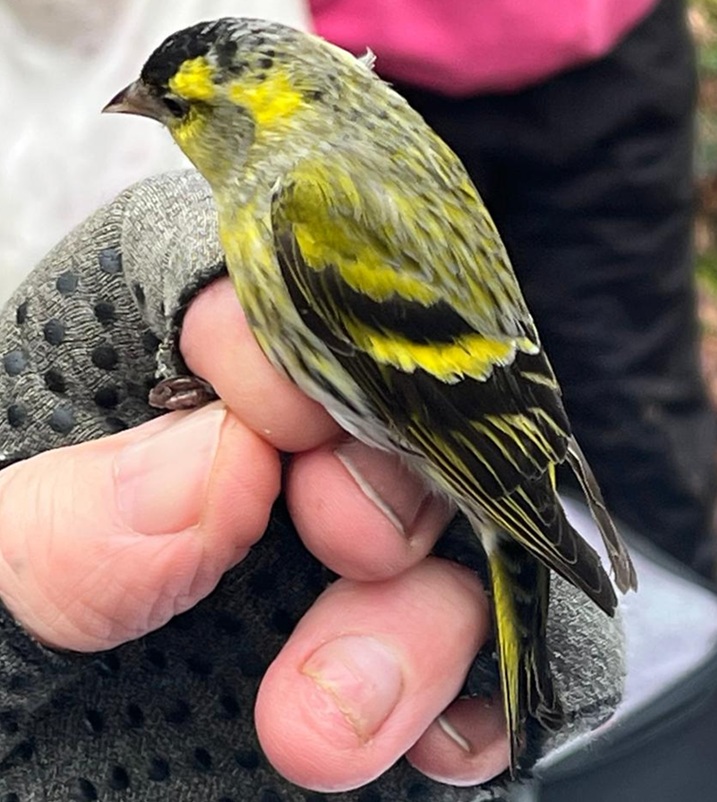
We had a very pleasant morning, lots of interested passers-by. Unfortunately for them, their stopping to chat always coincided with the break between finishing processing and going for the next round. One couple did get to see the Great Spotted Woodpecker that Adam ringed, but only because I sent him down to meet them as they were walking up the hill, having been very interested in what we were doing when they passed us on their way into the reserve.
The cutest moment of the morning was this:
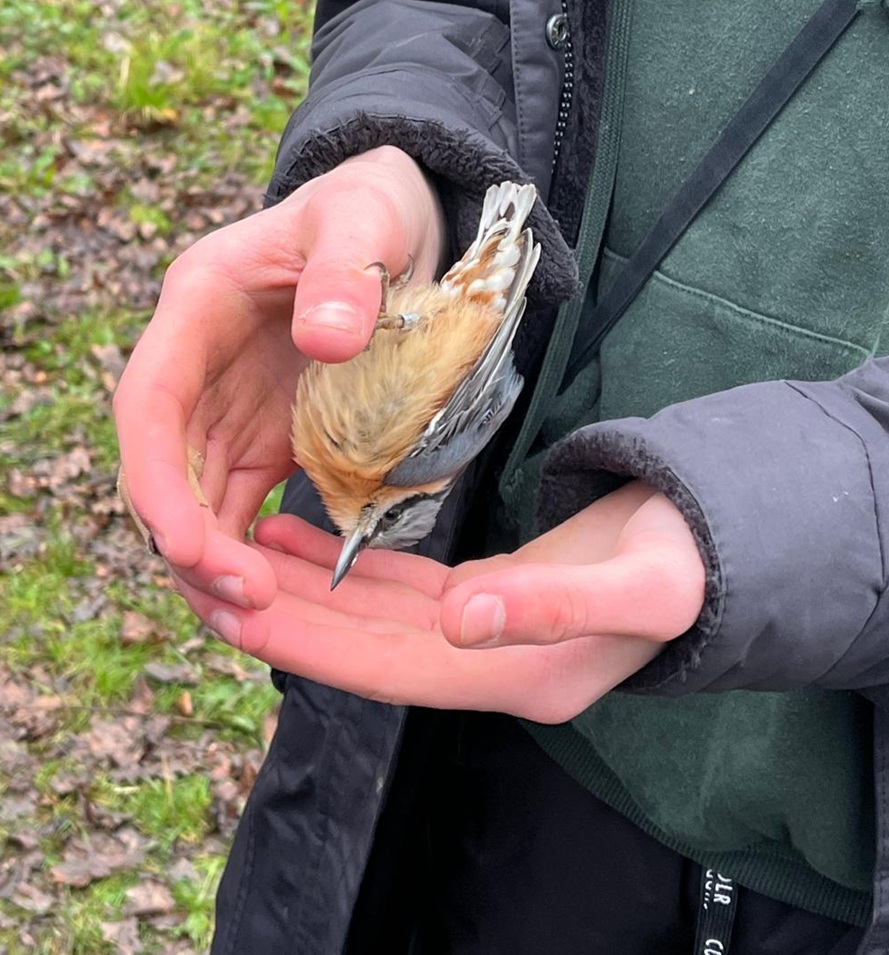
Adam processed both Nuthatch: a male and a female. The female was clearly attached to him, she would not let go! Actually, I think she found him tasty: as well as holding on to him, she gave him a good pecking! For the absence of doubt, she flew away strongly when he eventually managed to persuade her to stop holding on and pecking him. Actually, he took quite a lot of pecking from the female Great Spotted Woodpecker he extracted and ringed as well: I think we can say that he was well and truly hen-pecked this morning!
We closed the nets at 11:00 and processed the last few birds before taking down and packing away. With just the 12 nets to take down, we were off site by 12:15.
One footnote: when I arrived to top up the feeders yesterday I noticed this:
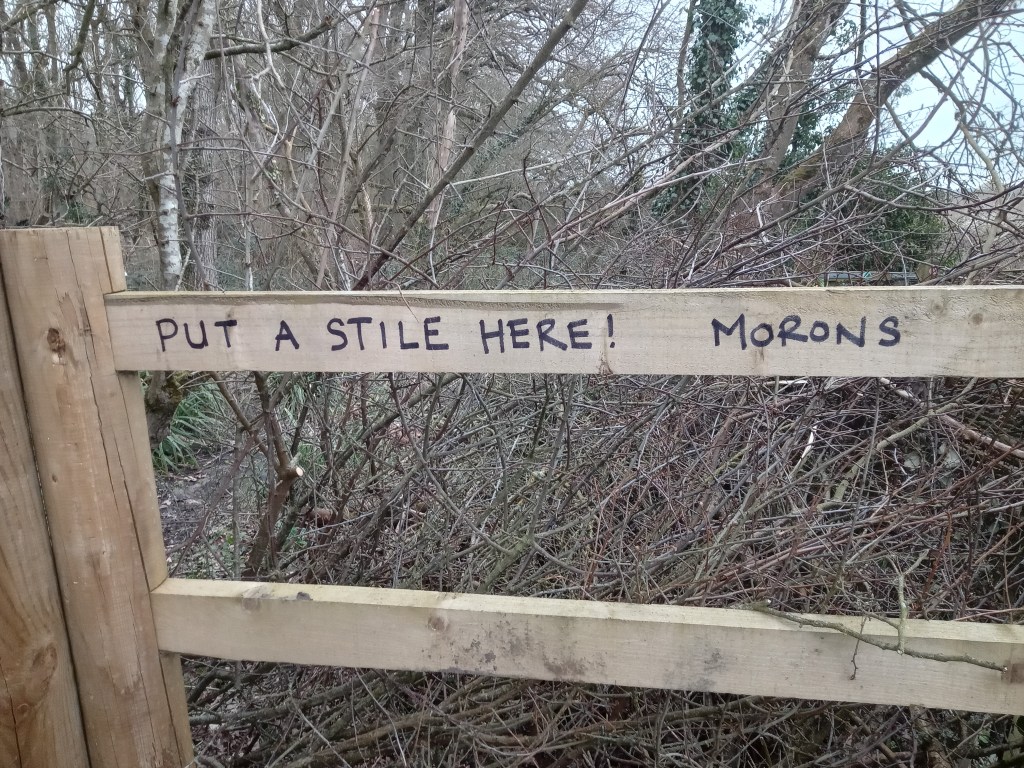
I believe the only “moron” in this episode is the person who wrote that: less than 3m from the gate, before you get into the reserve is a stile that leads directly to the path they wanted to access! It is hard to understand the thought processes of someone who thinks that a nature reserve is managed for the benefit of anything other than the plants and the wildlife.
Anyway, with the Trust’s permission, that top bar is now a lovely shade of black!
 Ringing In The Braydon Forest & Beyond