We do two ringing demonstrations each year for the Swindon Wildlife Group: one in late Winter / early Spring and one during the Autumn migration season. Today was our early session scheduled for the Firs. Our over-winter catches in the Firs have been remarkable this Winter, averaging over 70 birds per session. I enjoy these sessions, particularly when there are children attending, as their enthusiasm is infectious. Today was exactly as I hoped. One other benefit: I get to do quite a lot of actual ringing, as I demonstrate what it is all about, plus ageing and sexing of different species. Usually, when I have more than one trainee with me, I just scribe and oversee the aging, sexing etc.
As mentioned from our last session at the Firs, we heard Lesser Spotted Woodpecker drumming again: this time in the north end of the wood. Conveniently, the Great Spotted Woodpeckers very helpfully started drumming as well, allowing us to compare the two species, to ensure our assessment was accurate.
I was joined today by Laura, David, Ellie and Pete. We met at 6:30 and set the usual nets down the main central glade. Our first round at 7:15, unfortunately for the attendees who were joining us for 8:30, probably had the best variety of the morning: eight species, including our first Chiffchaff and only our second and third Treecreepers of the year.
Robin, the organiser, arrived just after 8:00, missing out on the Lesser Spotted Woodpecker drumming: something that he hasn’t heard for four years or seen for a decade. If only he had been with me last Friday! He is the volunteer warden for the Ravensroost complex . We had a chat last Saturday when we were ringing at Ravensroost and I mentioned that I had seen the LSW the day before and that we had already heard it that morning he was more than a little surprised. Ironically, they stopped drumming whilst he was with us and only started up again after he had left! Same again today.
I started with my usual introductory remarks about the point of the ringing scheme: what we do and why we do it, and illustrate it with some of the things that we have found out from ringing. I am always delighted to share the story of Goldcrest JPP007. Ringed in Ravensroost Wood on the 22nd November 2015 and retrapped on St Mary’s in the Isles of Scilly on the 8th March 2021. That beat the previous record by 2 months and 2 days. That previous bird was ringed and recaptured on the same site on several occasions, whereas ours had been making the return flight up and down the west coast for all that time. What an absolute champion bird!
Things did go well for the attendees, as we caught a decent number of birds from a reasonable number of species, including two of these favourites, the noisiest birds we extract. They scream the place down, as if being murdered:
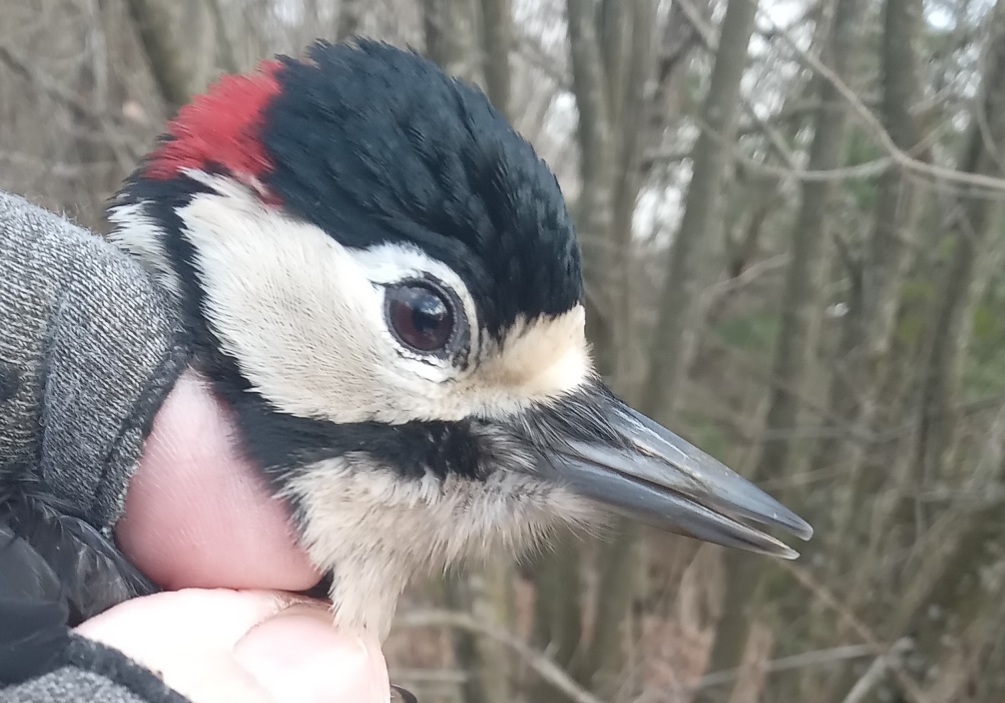
Ellie had the pleasure of extracting the first and found out how strong and sharp their claws are, and how hard that beak can peck! Several sticking plasters later she continued.
As ever, I showed those who were interested how to safely hold a bird and how to release it, to ensure it flew away without mishap. I use my usual introductory question “Who would like to be pecked by a Blue Tit?” There were plenty of volunteers. I train them in the ringer’s grip and then they release the birds. You can tell the success of the session: a few left at 11:00 but most stayed, including the two young girls who were our most enthusiastic attendees, until midday.
Our catch for the morning was: Great Spotted Woodpecker 1(1); Treecreeper 1(1); Blue Tit 10(15); Great Tit 3(10); Coal Tit (1); Marsh Tit (2); Long-tailed Tit 3(1); Wren (1); Dunnock (2); Robin (1); Chiffchaff 1; Chaffinch 1(1). Totals: 20 birds ringed from 7 species and 36 birds from 11 species, making 56 birds processed from 12 species.
It was a lovely session and everybody left happy. We had several other birds around, which we didn’t manage to catch: male Sparrowhawk, who bounced off the net, and Nuthatch calling all over the reserve, but not one in the net. At the equivalent session last year we ringed three and retrapped one. In our last session here, on the 25th February, we ringed two and retrapped another two. Needless to say, no Lesser Spotted Woodpecker to go with the two Great Spotted!
The catch has become smaller since the start of the year. Most notably, the number of Blue Tits this morning was much lower than recent times. The other thing of note: 36 recaptures against 20 ringed. The numbers caught at any one time in this session lend support to that idea: they were being caught in ones and twos, the Long-tailed Tits were both males and caught individually. Perhaps the females are already on eggs! It is a bit early, BTO’s BirdFacts puts the earliest laying date as 24th March, but everything seems a bit early this year. I suspect that the winter feeding flocks have now broken up as the need to breed has taken over!
Overhead in the beautiful, cloudless blue sky, we were treated to a couple of Buzzard soaring in the thermals. They were stunning, fabulous plumage. We also had Raven flying over and calling. I am certain that they are breeding in Webb’s Wood. Our next demonstration for the Swindon Wildlife Group will be at Blakehill Farm on 26th September: book now to avoid disappointment!
David’s dad, Trevor, arrived at midday and helped us get cleared away. With so many bodies it didn’t take long. However, when I went to start my car nothing! Fortunately, Laura had jump leads and Trevor’s car was suitable for jump starting (apparently EVs are unable to do so, at least, Pete’s Tesla is unable to do so) so I managed to get away and was home by 12:45.
A huge thank you to my team: I was struggling with a bad back, and about three hours sleep the night before, so they did all of the hard work while I sat and drank tea and coffee and ate biscuits!
 Ringing In The Braydon Forest & Beyond