Box Checking: Salisbury Plain; Saturday, 31st May 2025

After one of the most frustrating end to the month of my bird ringing career it was great to be able to get out again. My last session was on 22nd May at the Firs: just 19 birds, but some good catches including the first juvenile Chaffinches of the year. On the 23rd, whilst box checking in the Braydon Forest with Ellie, my car decided to recreate the same fault as it had the week before, with the clutch pedal falling to the floor. So I contacted Green Flag: same fault so £150 to recover me – until I told them where I was. They then added another £300 to the cost because, being in the middle of a field, they would need to send “specialist equipment”: which equated to a 4×4 with winch to pull me out of the field so it could be put on the recovery lorry. I pointed out that, in the heat, this field was a harder surface than most asphalt, but they were insistent, so I contacted a local lad, Quick Time Solutions if you are in the area in need of assistance, who did the whole recovery for the £150, no fuss, no bother. My local mechanic came out and topped up the fluid reservoir, bled the system and went off. Saturday morning I went out to test it: pedal straight to the floor! This time it required a new gear box and all the trimmings: the cost more than the residual value of the car! So I now had to hire a car and go shopping for a new one: which I will pick up on Monday. Fortunately, my frustration was mitigated by the simple fact that the weather was far too windy for me to set any nets, so I wouldn’t have got out ringing anyway. Which brings us to Saturday.

I was scheduled to spend the day on Salisbury Plain with Dick and Jon of the Salisbury Plain Raptor Group as part of the training requirement for the T-permit holders in the group. Their trainee had to drop out so there was a spare place in the vehicle so, alongside the three of us, we were joined by Ellie from my team. She hasn’t been ringing long and certainly has no experience of handling birds of prey, let alone climbing high ladders up to trees etc. An opportunity for a fairly steep learning curve.

Ellie and I left my place at 7:15 to get to Westdown Camp for 8:30, and arrived about 50 minutes later. I really must get the timing right. Anyway we were all packed up and ready to head off bang on time, to check a load of boxes to see what was happening. It is an incredibly late start to the breeding season for both Barn Owls and, somewhat less affected, Kestrels. There is one good thing about that: most Jackdaws will have fledged their one brood by the end of this month, so some boxes can be cleaned out and available for Barn Owls and Kestrels to get on with their breeding season. The issue is reportedly the lack of availability of voles due to the hot weather and a lack of growth of the grass that voles and mice need to provide them with nesting space and to hide from predators. From what we were seeing, that is pretty much how it is everywhere at the moment. Even the short period of rain doesn’t seem to have helped with that.

We visited 25 boxes yesterday. That included a temporary Tawny Owl box in the training village that Jon works in. It is a good story: he found a Tawny Owl chick on the ground outside one of the barns in the village. He put the bird on the roof of a shed inside the barn, for mum to come and find him. For those that don’t know, once Tawny Owls get to a certain stage they do a thing called “branching”. Essentially, they leave the nest and go for a wander, which was almost certainly what this had done. When Jon found it, its belly was empty, so he went off to find some roadkill to give it to eat. It just shows how scarce food has become: he couldn’t find any, so went to the local butcher’s shop and bought the bird some steak! He also put up a temporary owl box for it roost in, whilst waiting for it to be found. It was fed for four or five days by Jon and is doing well. So we went to ring it, only to find it had branched out again. We went searching and Jon eventually found it sitting in a shady nook behind a steel girder in the barn. We could hear mum calling from just outside the barn, and there is evidence that she has found it and is now bringing food! That’s a relief.

Tawny Owl chick, Strix aluco. Photo courtesy of Jon.

This chick is actually the first one we found and it became the first Tawny Owl that Ellie has ever ringed. Jon was extremely good at showing Ellie how to hold it in the right position for ringing, what measurements to take, and the current state of development of the primary and secondary wing feathers. This first Tawny was actually found in a Barn Owl box, which is a little unusual, but the side inspection panel on this box had come open which might have had an influence on the parent’s choice. The hatch was left open so we didn’t confuse the parents returning with food.

Over the course of the day we checked 11 Barn Owl boxes: 2 had Barn Owl pairs, plus one with a roosting male. Hopefully that means there is a female nearby. As well as all of that, there were two BO boxes with Jackdaw nests, if you can call the absolute stacks of sticks a nest. Both had chicks, both were so stuffed with sticks that the chicks, who look like they will fledge in the next week or so, couldn’t actually stand upright. Jon removed a couple of layers so that they could be a bit more comfortable in the box. In one of those boxes, which had three chicks, he also found two cold eggs. He made the mistake of opening them to find out what stage they had failed at. Suffice to say, the smell of hydrogen sulphide was pungent and much hand cleaning was required.

We also found three Grey Squirrel drays in BO boxes. They were removed and the nest box cleaned out, hopefully for use later on in the season. Two of them held Stock Doves. Both were a bit sad, actually, one was tragic. One had two cold, almost certainly infertile, eggs. The eggs were left in place, just in case they have only just finished laying and the female hasn’t started brooding them yet. Both parents had flown off from the box before we approached it. The other one was tragic: there was a dead adult in the box and the eggs had been cracked open and eaten. The nature of the predation suggests Stoat or Weasel.

We also checked 13 Kestrel boxes: three with Kestrel pairs, one with three chicks that we ringed. Again, Ellie got her first experience of handling and ringing Kestrel chicks. Jon helped her with how to hold and manage the birds for ringing. She was rather lucky in that they were at the stage where they are easy to handle. Give it another week or so and they will be all beak and claws!
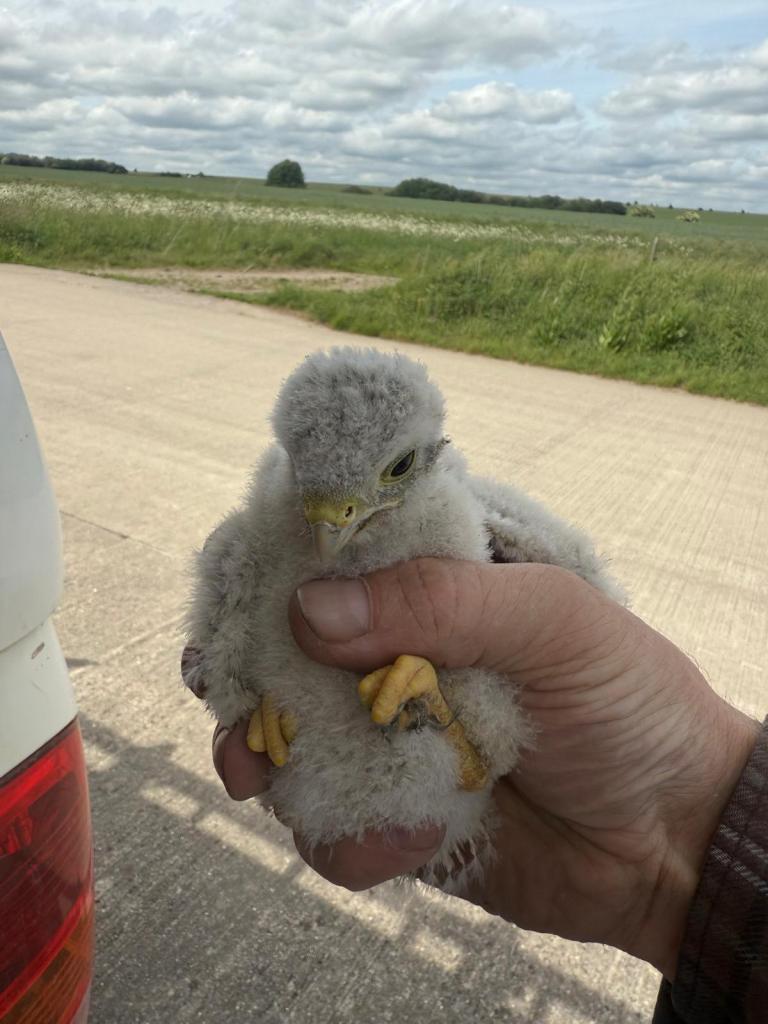
Kestrel chick, Falco tinnunculus, Photo courtesy of Jon

One of the Kestrel boxes was quite unusual. Kestrels usually create a scrape into which they lay their eggs. In one of the boxes Jon found this:

Kestrel eggs in a nest, Photo courtesy of Jon

Jon and Dick tell me, as they have so much more experience of nesting Kestrel than I do, that this is unusual, to find something as well defined as this.

In terms of the struggle to find food, we did find the remains of birds in the nest and a number of Kestrel pellets. This first set of feathers is pretty obvious, the second, not quite so:

Goldfinch, Carduelis carduelis
Skylark, Alauda arvensis

I got the latter identification from the excellent book “Raptor Prey Remains” by the renowned Peregrine expert: Ed Drewitt, published by Pelagic Publishing in 2020 (no, I am not being paid for this advert).

The pellets were also pretty interesting. Primarily consisting of fur from multiple sources, they also contained a number of beetle elytra, mainly Violet Ground-Beetle, Carabus vilolaceus, as far as I could tell.

One Kestrel box had Jackdaw sticks in it but no sign of a breeding attempt. Another one had a Stock Dove inside, with no evidence of breeding.

We covered a lot of ground during the day, met up with Justine and Mark, who I am out with on Tuesday to check the Lower Wylye Valley boxes, who were parked up photographing House Martins collecting mud for their nests, from the only puddle we saw all day on the Plain. Apparently it is normally a pond!

We packed up and were back to Westdown Camp by 15:30, back to mine by 16:15. I am looking forward to the next session: I will be out with the SPRRG again on the 14th June.
Started Okay, Ended Badly: the Firs+, Thursday, 22nd May 2025

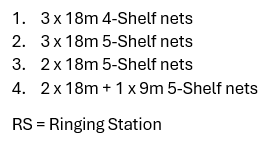
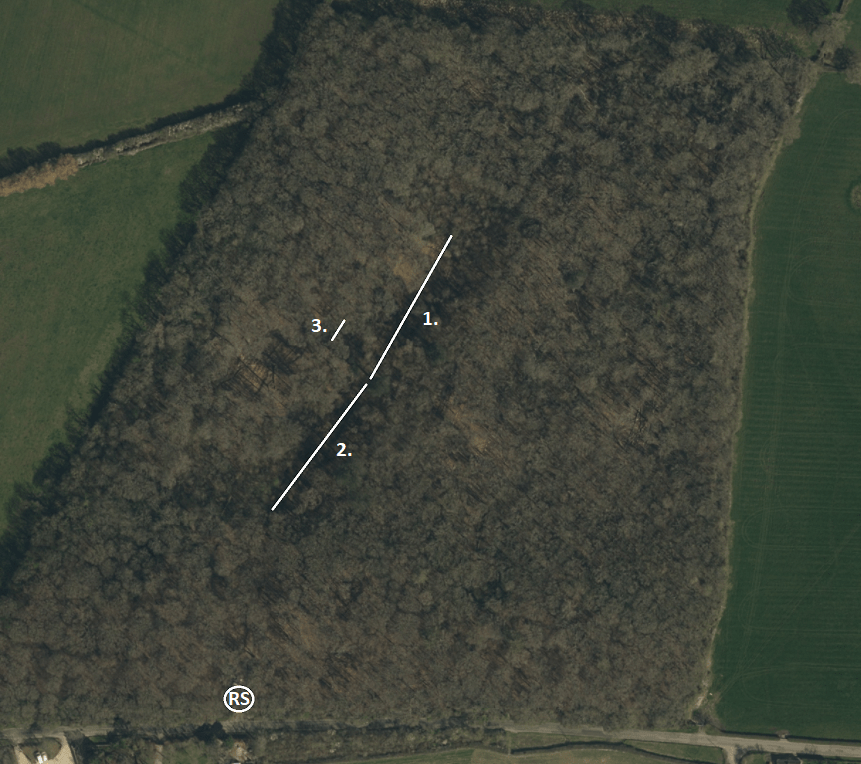
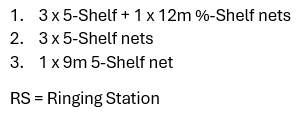
After Wednesday’s rain, Laura, Ellie and I met at the Firs at 6:00 and set the following nets:

It was a quiet morning catch wise, but it was very, very loud with birdsong. In particular, we started with one male Chaffinch singing away, after about 30 minutes, a second joined in. Another hour and a third joined the party and 30 minutes later, a fourth decided he needed to establish his presence.

As ever, we listened to the two Green Woodpeckers, who have territories either side of the wood, but never get close to the nets, laughing at us! Song Thrush, Chiffchaff, Raven and lots more heard throughout the morning.

The highest number of birds extracted on a single round was just four. However, it was a nice variety in the catch: the first bird out of the net was a Garden Warbler: only the fifth for the wood, following on from last year’s three (a male, a female and a fledgling), the first being in 2019. This was a female in full breeding condition. Hopeful that this species could become established as a regular breeder in this wood.

The next round, the “big round” comprised three Chiffchaff and a Blackcap. After the next two rounds, with just one bird in each, I decided that we didn’t all need to slog up and down the hill at the Firs, which is a surprisingly steep 200m, that we would each take it in turns to do a round, and call for help if needed. It wasn’t! The only round that had more than two birds, the last that I did, delivered three birds. That was one on my way down and two flew in whilst I was carrying out what our team (thanks Justine) refer to as a “Wren survey”.

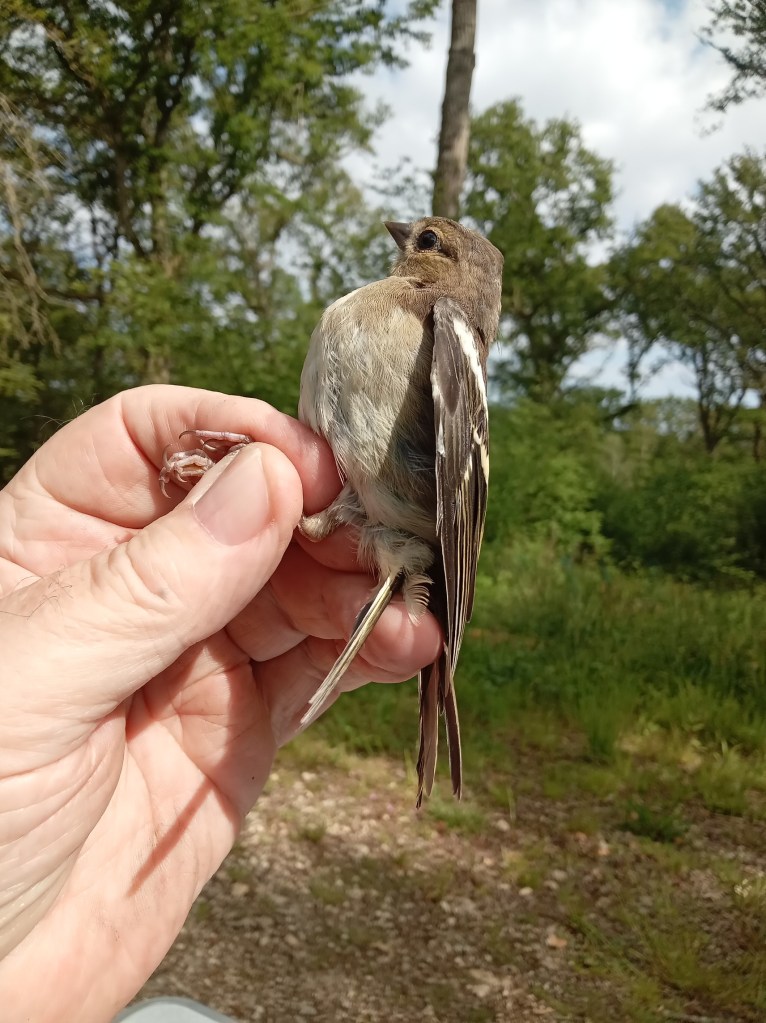
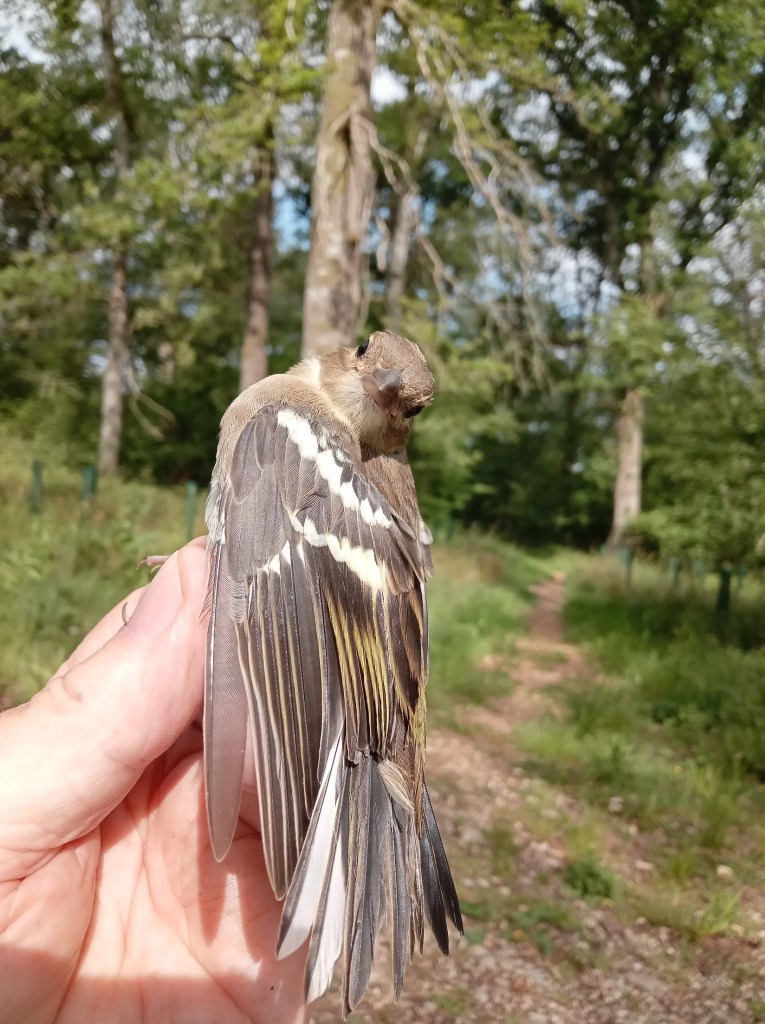
There was another catch of Blackbirds, two second calendar year males with very brown primaries and an unmoulted alula. However, the absolute highlight of the morning arrived at 10:10. At first it was camera shy:

Juvenile Chaffinch, Fringilla coelebs

And then it was “Who are you looking at?”

With all of those males singing, admittedly in the trees up by the ringing station, it was lovely to catch our first recently fledged Chaffinch of the year. Then, on our last round at 11:40, we caught another. This one had started its post-fledging moult, whereas the first hadn’t.

The list for the day was: Great Tit 1; Wren 1; Blackbird 2; Blackcap 2(2); Garden Warbler 1; Chiffchaff 2(3); Willow Warbler (1); Goldcrest (1); Chaffinch [2]. Totals: 9 adult birds ringed from 6 species, 2 juveniles ringed from 1 species and 7 birds retrapped from 4 species, making 18 birds processed from 9 species.

It would always be nice to have a few more birds but I liked the catch. However, my absolute favourite moment of the morning was a Spotted Flycatcher hunting in some trees just down from the ringing station. I noticed it fly on to a perch, sitting in its typical upright manner, then flying out after an insect and returning to its post, then doing it again. There was also a lovely time with a Treecreeper running up the Oak tree adjacent to us, showing really well, before flying to the next tree over, and continuing its ascent.

With everything packed away we were off-site by 12:15. Ellie came back to my place to have lunch before we set off to carry out some owl box checks in the afternoon. This is where it all went bad. I should taken heed when my roof rack decided it had shrunk and didn’t want to fit the car! We got it sorted eventually and headed off. First box was at Lower Pavenhill Farm: we had to negotiate a field full of horses with their foals. They aren’t a problem other than that they do love to nibble and rub against the car. However, Ellie managed to keep them at bay whilst I checked the box – which was empty. Our next stop was Ravensroost Meadow where the first gate padlock was seized solid. So we went to the second gate: one padlock was also seized but there was a secondary one, which was blocked with fur from the Belted Galloways in the field. Belties are docile and safe, so we drove in and were immediately concerned when the eight Belties came haring towards the car. It was dangerous, for them, so we did a quick reverse ferret and got out of there. I will have to get them moved into the field next door before trying again. Not much of a start then. We then headed to the big barn at Somerford Farm. This box produced a brood for the first time last year, so I am hopeful. I climbed up and opened the box only to find it absolutely stuffed full of sticks and a bit of nesting material and over in the corner was this:

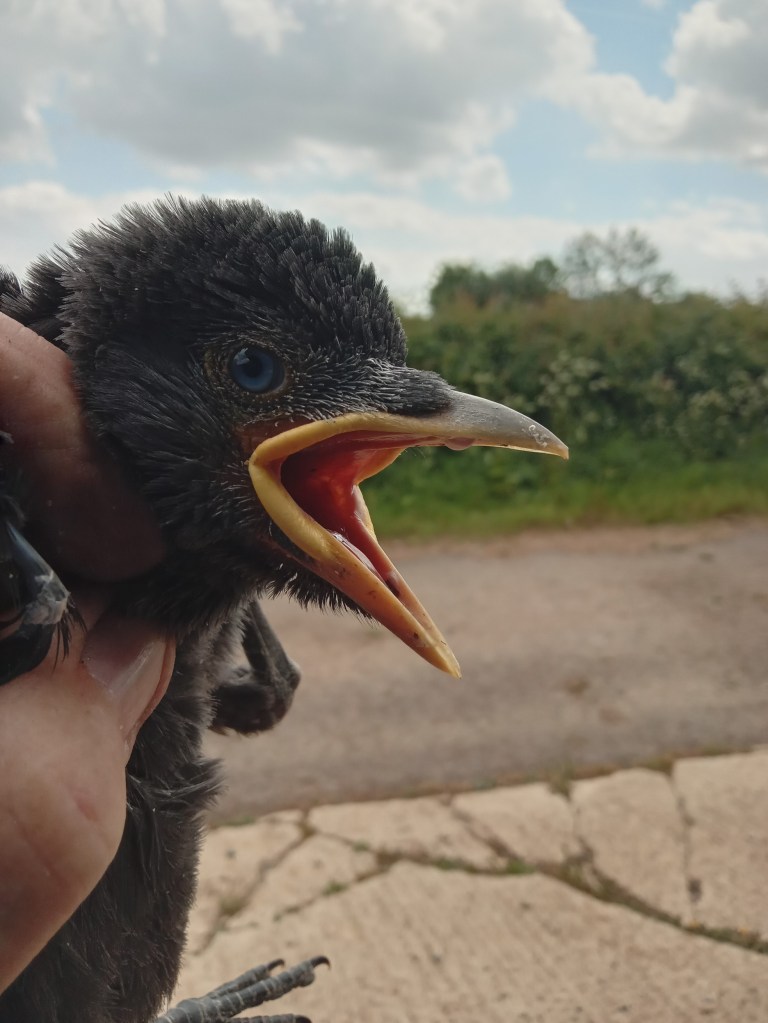
Nestling Jackdaw, Coloeus monedula

It’s primary and secondary feathers were between one third and two thirds grown, feathers medium, to give it the BTO reporting term. We went from there to another part of the farm, a field with a Little Owl box in it. It has not yet produced anything and this year is no different: I cleared out a squirrel drey. I am going to suggest we move it into the farmyard.

This is when it all went to hell in a handcart. I pressed the clutch down to start the car and the pedal fell straight to the floor! Not only that but the brake pedal would not depress. I got onto Green Flag and explained the situation. They said it was the same fault as last time, I said it wasn’t, they said prove it: like I carry that paperwork around with me. Then they advised that it would cost me £150 to recover the vehicle. That’s not too bad but, when I described where I was, they put me on hold and came back with a revised price, because they would have to bring “specialist equipment”, of £450. Apparently, they would need to bring a 4×4 with a winch to get me off the field so they could then get it onto the recovery truck! I explained that the field was like concrete and that wasn’t necessary but they insisted, so I called a local recovery guy who I had used before I took out roadside assistance. He quoted the £150, I explained exactly where we were and he wasn’t phased at all. It took him over an hour to arrive, but he had been finishing a recovery in Newbury. Anyway, he got me home and we got the car off the truck and out of the way on my drive. I am waiting for an engineer to arrive today, Friday, to advise on whether it is worth repairing or scrapping but I have decided I need a new car.

I felt sorry for Ellie, she is still finish off her Masters at Cardiff University and had set off from Cardiff at 4:00 in the morning and didn’t get away until 18:00 Thursday afternoon. That’s a long day! The compensation was ringing her first juvenile Chaffinch and her first nestling Jackdaw.

A Bit Like the Old Days: Ravensroost Wood, Saturday, 18th May 2025

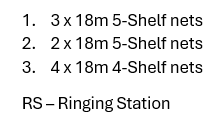
It is a long time since we have had a really strong catch in Ravensroost Wood. This morning I was keen to increase the catch size, so I decided to set some additional nets. I was joined by David, Laura, Adam and Mark at 6:00 and we set the following nets:

Not as many nets as I had planned but the ride along which number 1 was set was very overgrown. Mark and Adam did a great job of clearing enough to set the three nets but we decided that was enough. I will get in with my strimmer before the next session. Why ” a bit like the old days”? In the last five years the largest May catch we have had in Ravensroost was 28 and the smallest full session was 11. Prior to then our May catches were regularly larger than this: up to 52 in 2019. Today’s catch was 56, our largest ever in May. We have had larger catches: but they were all when the feeding stations were in operation.

We had a decent start, with two Willow Warblers in the nets almost as soon as they were opened. The catch started well, peaked at 9:35 and then fell away until we started packing up at 11:00.

The peak was boosted by an amazing catch of 23 Long-tailed Tits! Our largest May catch in the whole Ravensroost complex prior to this was six: ten years ago! We had none in May between 2017 (2) and 2021 (1). Then there were 3 in 2022, 2 in 2023 and none in 2024 (which isn’t surprising, as we didn’t manage a session in May 2024). We have only caught juveniles in May in Ravensroost on three previous occasions: 2015 (4); 2016 (3) and 2022 (2). Today we ringed 15 juveniles, we also ringed two adults and retrapped six adults.

Particularly pleasing for me was to extract two of one of my favourite birds: the Garden Warbler. One was a female in breeding condition and, right next to her in the net was our first juvenile of the year. Unfortunately, neither of my photos are good enough to put on the blog. It is our first ever May juvenile: the earliest I have ever caught at any of my sites. I am a little concerned at how early it is, as they don’t usually lay until early to mid-May, but the flanks and belly were bald and the armpit was also somewhat naked. The plumage was pristine: there is no way that bird had flown all of the way from the Congo rainforest, following the rains, without showing some kind of feather wear. It does mean that the egg must have been laid in early April. If it had been a month later I wouldn’t question it. However, the record was accepted by the BTO without query. We went on to catch another two in the session. It is the best number ringed for just under eight years: July 2017 was the last time. 2017 was our best ever year for the species: hopefully a portent of things to come!

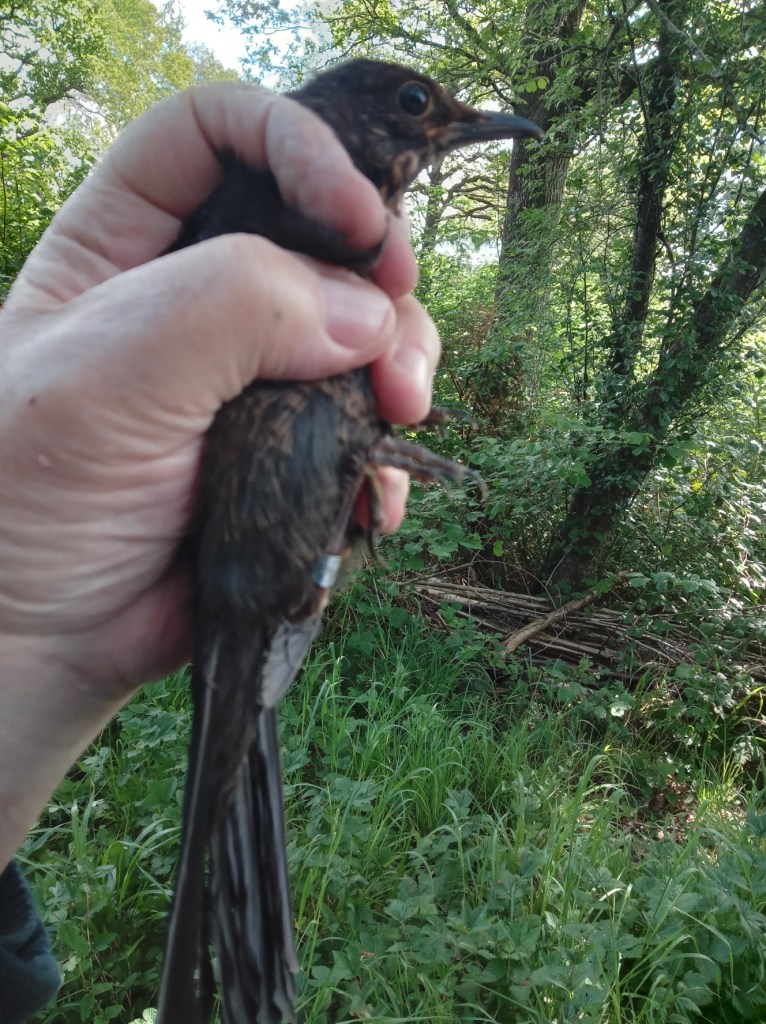
It was another red letter day for Blackbirds: we caught seven: five ringed and two retraps. This is our best ever catch of the species. Prior to that you have to back to January 2013 for a catch of six, our previous highest total. However, those were all ringed, whereas today was five ringed and two retraps. To put that into perspective though: January 2013 was only the fourth session in the wood under my ringing regimen. Today’s catch included our first juvenile of the year:

Juvenile Blackbird, Turdus merula (my Garden Warbler photo was even worse than this)

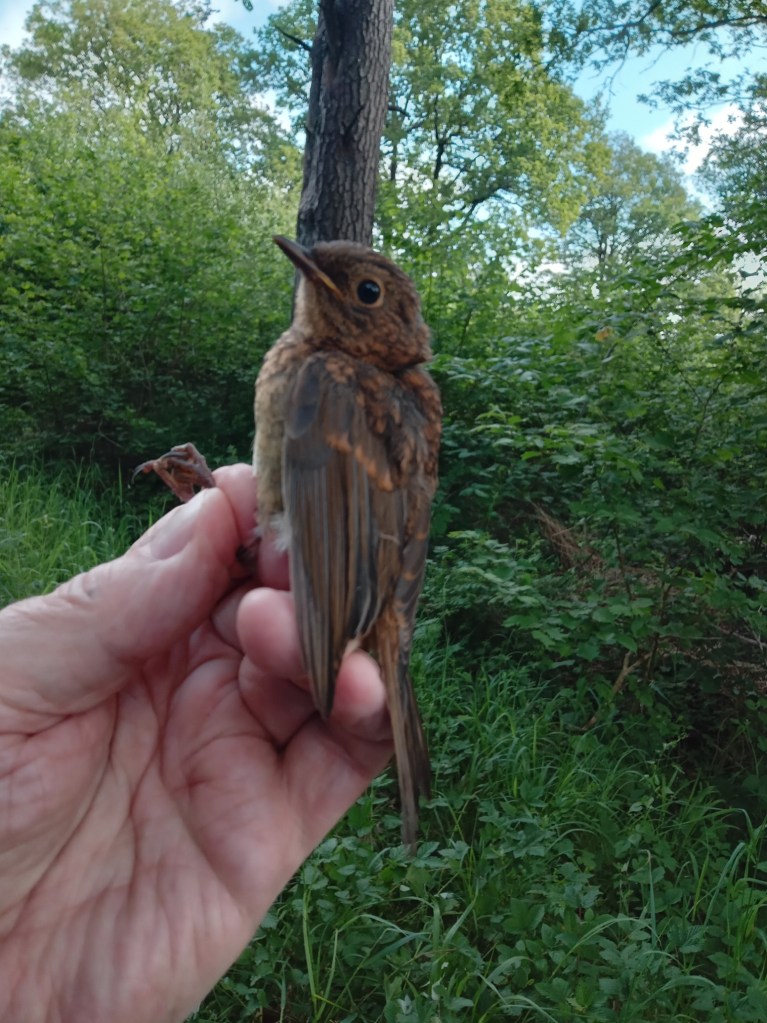
To complete the list of first juveniles for the year, we had our first Bobble:

Juvenile Robin, Erithacus rubecula

So, the list for the session was: Blue Tit 2(2); Great Tit (1); Long-tailed Tit 17(6); Wren 1; Robin 3; Blackbird 5(2); Blackcap 4(1); Garden Warbler 4; Chiffchaff 1(2); Willow Warbler 5. Totals: 42 birds ringed from 9 species and 14 birds retrapped from 6 species, making 56 birds processed from 10 species.

It was a good number of Willow Warbler: our second highest catch in the complex but our best catch inside the woodland. We mainly catch them in the Meadow Pond area.

So, after a thoroughly enjoyable session, we started taking down in stages at 11:00, were packed up by 11:45 and off site by midday.

Nest Box Checking: Salisbury Plain, Saturday, 17th May 2025

I spent today out on the Salisbury Plain Training Area with the Salisbury Plain Raptor Group. I met with Dick and Jon, stalwarts of the group, with one of our new trainees, Mark, at Westdown Camp, on the edge of SPTA. A civilised start, at 8:15.

We mounted up in the 4×4 pickup and headed off to see what we could find. To be honest, everything is running late, but we were hopeful of finding signs of breeding. The decision was made not to disturb any Barn Owls that were not on nest when Dick and Jon did their previous check on these boxes in mid-April. Like my own boxes in the north of the county, there are signs of occupancy but no signs of egg-laying. The plan was to check those Barn Owl boxes that had been on the nest then, to see how far they had come.

We were also going to be checking some Tawny Owl and Kestrel boxes, to see how they were faring. Tawny Owls, in particular, breed earlier than most other raptors. In the event the only ringing we did today was of a single Tawny Owl chick:

Tawny Owl chick, Strix aluco (photo by Mark)

Despite being still very downy, its feathers are developing quickly, its primary wing feathers are at medium length, and it is likely to leave the nest box quite soon. Its sibling has already left the nest and was moving around in the tree above the box. Mum was also in attendance, showing her displeasure. Another Tawny Owl box showed signs that it had been occupied but that the young have already fledged and left the nest.

The rest was a mixed bag of results. Two of the boxes, one Barn and one Kestrel, were occupied by Jackdaws. One of them had five eggs and the other had three chicks. A couple of the other boxes showed that Jackdaws had been in occupancy: so they was cleaned out for Barn Owls and Kestrels to have a chance to breed later in the season. Another Barn Owl box held a pair of Stock Doves. Or, at least, a pair flew out as we drew up in the car. We didn’t disturb their nest.

A couple of the Barn Owl boxes did have adults in them, but not breeding yet, and three others had clutches of eggs in them: one of three and two of five.

We then found six active Kestrel boxes, five had eggs and one had young that was only a few days out of the egg. Interestingly though, you could hear the young making little high-pitched calls through the shells of the eggs in three of the clutches.

One box had lost its front and bottom when the branch it was resting on broke off from the tree. Jon spent fifteen minutes rebuilding it and ensuring that it was firmly fixed to the tree, without relying on any branch.

That was pretty much the end of the session: 18 boxes checked and one repaired in 5 hours driving around SPTA. What it told me is that Barn Owl breeding, in particular, is several weeks behind last year. It seems that this very dry May is preventing the grass from growing and vole numbers are well down. That ties in with the few of my boxes that I have checked so far this year: two pairs of Barn Owls occupying boxes but showing no sign of breeding yet.

New Life: Lower Moor Farm, Wednesday, 14th May 2025

I always look forward to our first juvenile birds of the year and today was the day! Miranda, Laura and I met at Lower Moor Farm for 6:00 to set our nets. We were joined for the morning by Mariana. Mariana is from ZSL and is collecting samples from several species of migratory bird. These are being investigated for signs of exotic mosquito borne viruses, such as West Nile Fever and, the scourge of Blackbirds, Usutu virus, which has had such a huge effect on the population in London. Thankfully, I have seen no sign of it locally. These viruses are spreading north, no doubt due to climate change. Hence the need to monitor susceptible species to find out if or when these and other diseases arrive on these shores. Humans are also susceptible to West Nile Fever and it causes a wide range of unpleasant symptoms. She helped us get set up, provided cookies and savouries during the session, and helped us take down at the end: she is welcome to return any time she likes!

We set the following nets:

It was clear and cold, with a breeze coming in from a north-easterly direction. We hoped that the nets would be shielded for most of the morning and, for most of the time, it was okay. There was a period at about 9:30 when I considered shutting the nets because it was blowing hard but, fortunately, it didn’t last too long (and we didn’t catch any birds in that period).

We caught slowly, as seems to be the case at the moment, until at 8:45 we had the catch that prompted the title: it was a lovely family group of these beauties:

Juvenile Long-tailed Tit, Aegithalos caudatus

We took two adults and nine juveniles out of the nets: all close together. The one in the photo was the first bird processed and definitely the least well-developed: its wing length was 2mm below the BTO expected length for a fully grown bird. Anyway, as we processed each bird we put them back into their bag so that we could release them all together, which we did and they could all fly off in their family group. The first of many, I hope.

The rest of the morning after that was a wash out, with just two further birds caught, and we started closing nets at just after 10:00. Without the Long-tailed Tits it would have been a very poor catch. The list for the session was: Great Tit (1); Dunnock (1); Robin (2); Long-tailed Tit 10(2); Blackcap 2(1); Chiffchaff 2(1). 14 birds ringed from 3 species and 8 birds retrapped from 6 species, making 22 birds processed from 6 species.

Not a huge catch but in three sessions there in May 2024 we caught 17, 17 and 25, with the 25 being at the end of the month, so perhaps I should be grateful. Mariana got six samples from the Blackcaps and Chiffchaffs, which she was happy with, and will be coming out with us again.

There were a lot of other things going on. The Mute Swans have three cygnets that are at a good size now. I don’t know how many they started with but I am pretty sure that our last session at Lower Moor Farm, almost exactly one month ago, they did not have any on the water with them.

An unusual sighting was three pairs of Greylag Goose. We get the odd one or two in the winter but I have never seen more than two at Lower Moor Farm before. They flew in as a six and then split into three groups of two, hence my assumption that they were pairs. Naturally, the male Mute Swan had to go and show then who is boss! Lots of wing arching and spreading, neck stretching and running across the water towards them. He settled down again when they moved to the other side of the lake.

As the air warmed up the damselflies put in an appearance: lots of Common Blue and Large Red, several already copulating. There was a decent show of dragonflies as well. From the early emergence, i.e. mid-May, they are almost certainly the Hairy Dragonfly, Brachytron pratense.

Female Hairy Dragonfly, Brachytron pratense. Photo by Laura – who rescued it from a net

There was a lovely interlude when Miranda’s son arrived with her eight month old puppy, Percy. He was taking him for his walk and, when he saw Miranda, he became incredibly excited, clearly very surprised and not understanding why she was there. It was a very enjoyable 10 minutes.

Anyway, we took the nets down in stages, packed away and left by 11:00. It was better than it could have been, thanks to the Long-tailed Tits, but not as good as I would have liked. Ride one produced just two birds: the retrapped Robins, so I think I am going to give it a miss for a while and move further into the wildlife refuge area, beyond where we have been setting the nets to date.

Webb’s Wood: Saturday, 10th May 2025

Quiet time: no lures now to attract the birds. All on territories, some migrants still to arrive but plenty in the country, plenty having established their territories, singing away, and plenty already ready to breed, if they haven’t started already. So it is a case of setting the nets and hoping they find their way in.

It is also time to get up early. I have to admit, I have no roost sites and I am quite pleased that I do not have to get up before dawn to get everything set up to catch them leaving. Today David, Ellie and I met at Webb’s Wood at 6:00 and set the following nets:

Whilst we were setting the nets the sheer volume of birdsong was lovely. The most prominent in the mix was Willow Warbler. Somerford Common is usually our best bet for this species, and has started out well this year, but really nice to hear them in Webb’s Wood. Plenty of Chiffchaff and Blackcap calling as well, and a completely tuneless Song Thrush. Also, all morning we had Jackdaws jacking, Ravens cronking and Carrion Crows croaking!

We had a Blackbird get into the nets in ride 1 before they had been opened and round one produced six birds: a false sense of optimism ensued! After that we had small catches most rounds, and finished on a nice round 20. Given that our last session at Webb’s, with lures galore, produced 28 birds from 11 species, 20 isn’t too bad, given the lack of lures and the small number of nets.

There was an usual element to our catch: we caught and ringed four adult Blackbirds in one session. I have caught four before, but not for five years and never before in Webb’s Wood. We also caught only our second ever Garden Warbler for Webb’s Wood: the first one was caught there 11 years ago.

The list for the morning was: Blue Tit 1(1); Wren 3(2); Robin (1); Blackbird 4; Blackcap 4; Garden Warbler 1; Chiffchaff 2; Willow Warbler (1). Totals: 15 birds ringed from 6 species and 5 birds retrapped from 4 species, making 20 birds processed from 8 species.

Thirty percent of the catch was female. They were all showing well-developed brood patches. Two of the Blackcap were female and had finished defeathering their brood patches (stage 2 in the BTO recording system). Also, two of the Blackbirds were female, as was the recaptured Blue Tit and one of the Chiffchaff, and their brood patches were engorged with blood vessels (stage 3), indicating that they were actively brooding either eggs or chicks.

It was sunny and warm but, unfortunately, there was also an annoying breeze that seemed to swirl all around the nets, which might have had an impact on the catch size, making the nets more visible. Fortunately, when affecting rides 1 and 2 it wasn’t affecting ride 3, and vice versa, so it was manageable and, more importantly, safe for the birds. Anyway, after a couple of empty rounds, we shut the nets at 11:30 and took down. With David’s Dad’s help, we had the nets down and everything packed away before midday, and were off site quickly. A quiet but very pleasant session.

Blue Tit Movements In, Out & Around the Braydon Forest to Date

I have threatened to do this post for a long time, so it is time I pulled my finger out and got on with it. One of the good things about Blue and Great Tits for ringing is the volume of data it provides. The downside is the volume of data it provides or, to put it another way, just how many pecks one endures whilst extracting and processing them, particularly from Blue Tits: the most feisty birds you can find. This first part is focussed on Blue Tits: the most data and the most retraps to evaluate.

This is the Braydon Forest, with my sites identified:

These are the Braydon Forest sites:

  1. Blakehill Farm
  2. Red Lodge
  3. Ravensroost Wood
  4. Somerford Common West
  5. Somerford Common
  6. The Firs
  7. Webb’s Wood
  8. Purton (home)

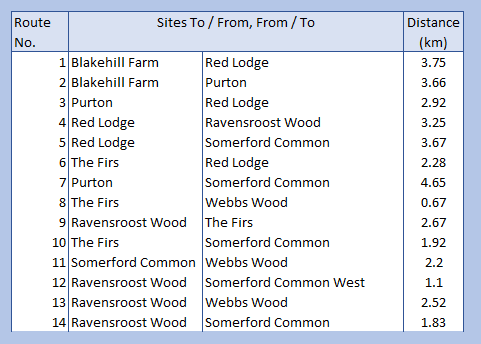
These are the distances between the sites:

Since I took over ringing in the Braydon Forest, in August 2012, I and, later, my team had ringed 4,955 Blue Tits up to the end of 2024. We have recaptured birds on 2,086 occasions. i.e. 42% retrap rate. In all of that time we have recaptured just 91 birds in sites other than that at which they were ringed. Putting that another way, of 4,955 Blue Tits ringed only 1.8% have been caught moving site.

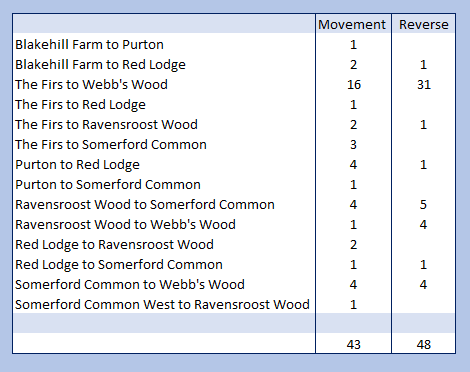
The following table shows the number of recaptures for each of the routes identified:

As is clear to see, the vast majority of movements, 51.6%, are less than 6o0m. There is only one movement of over 4km. Hardly the wide-ranging species some would have us believe. I would love to see other people’s data, to see if this is unique to this area.

In addition to these movements, we have had some movements into the Forest from elsewhere, that we have recaptured, plus others that have moved out of the Forest and been recovered elsewhere:

Only four birds ringed within the Braydon Forest have been recaptured or, in the case of the Echo Lodge bird, reported as dead. The key inward recovery was AVF6109, ringed in Fort Augustus in the Highlands: the second longest known movement within the UK. Putting it into perspective: we have recaptured just three birds that have moved more than 50km into the Braydon Forest (o.14% of the birds recaptured).

None of the birds that have been recovered having been ringed in the Braydon Forest has moved more than 10km from their ringing site.

West Wilts Ringing Group Results: April 2025

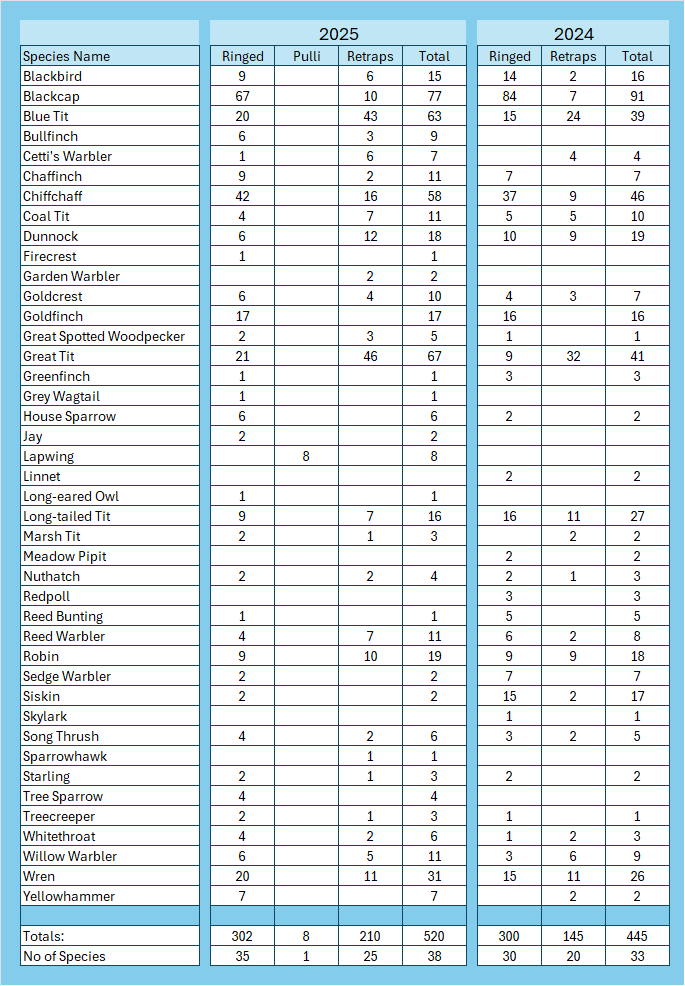
A very decent month for us.  It is our largest April catch to date!  I think everybody had something to be pleased with: from Andy’s Long-eared Owl; Johnny and Aurora kicking off their Lapwing monitoring for 2025 with several broods ringed and I am never going to be unhappy when we manage to ring a Firecrest! 

We did have five more species at each category: ringed, retrapped and in total. 

Added to the catch this year were Bullfinch, Firecrest, Garden Warbler, Grey Wagtail, Jay, Lapwing, Long-eared Owl, Sparrowhawk and Tree Sparrow.  Missing from the list this year was Linnet, Meadow Pipit, Redpoll and Skylark. 

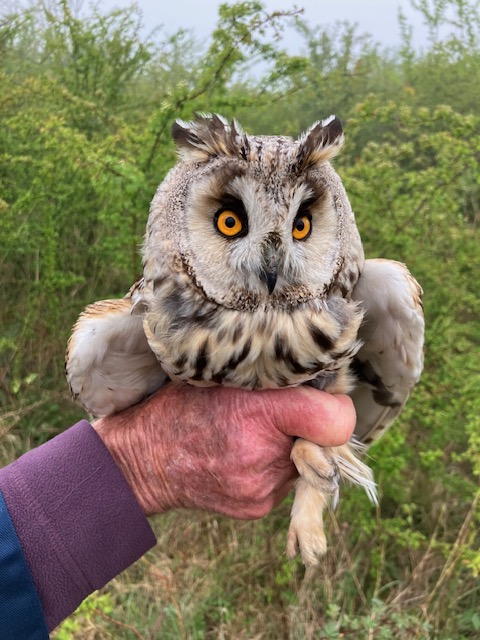
The outright highlight has to be the Long-eared Owl.  This is only the second that the Group has caught: four and a half years after Ian and Andy caught the first: at their Imber Ranges site.  This was caught in pretty much the same place at the same site. 

Long-eared Owl, Asio otus (Photo courtesy of Ian Grier)

Very much a great start to the Peewit Project for this year. Four broods with eight chicks ringed. There have been 15 previous captures of Lapwing chicks since 2013, 10 were done a decade ago. Andy has done three of them, most of which were processed on or around Salisbury Plain, and Jonny and Aurora ringed one each at the onset of the Peewit Project in May of last year. Those two, like these April ones, are significant because have been processed in the north of the county.

Lapwing chick being weighed, Vanellus vanellus (Photo courtesy of Jonny Cooper)
(Photo courtesy of Aurora Gonzalo-Tarodo)

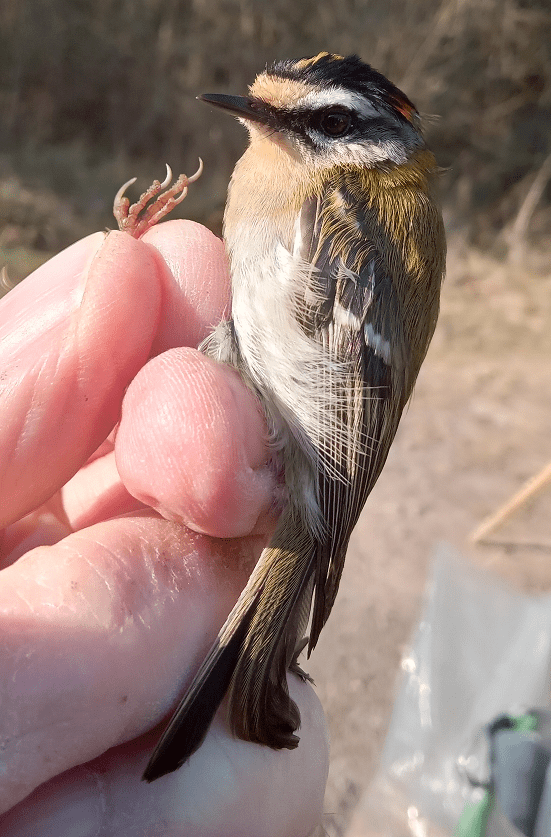
As for the Firecrest, it is the fourth that we have caught in the Braydon Forest: the first was in Ravensroost Wood, the next two were in Red Lodge, and the most recent at Somerford Common West.  I don’t want to be smug but, of the 12 Firecrest we have ringed, my little group have ringed eight of them, Jonny has done one at Biss Wood and Andy has ringed the other three at one of his Warminster sites.

Firecrest Male, Regulus ignicapiila

Chiffchaff numbers were up but Blackcap were down.

One major difference is the significant increase in the number of birds retrapped.  I have no idea why that should be the case.  A key part was the significant increase in the numbers of Blue Tit and Great Tit recaptured. It is hard to understand what the driver for that was: feeding stations have been taken down long since.  It was our largest ever April retrap of both species.  That said, they make up just over 50% of the increase in retraps so there were plenty of other contributions.  

We have had a couple of nice recoveries this month: a Chiffchaff ringed in Kent in September of last year recovered by Andy at one of his Warminster sites 238km west of where it was ringed, and a Great Tit ringed in Surrey in June 2023 and recaptured by Jonny, having moved 110km west to one of his sites near East Tytherton. A Sedge Warbler that Jonny ringed at Langford Lakes in August 2022 was recovered by the Teifi RG, in Teifi, Ceradigian, 214km West North-West on the 22nd April.

Red Lodge: Wednesday, 30th April 2025

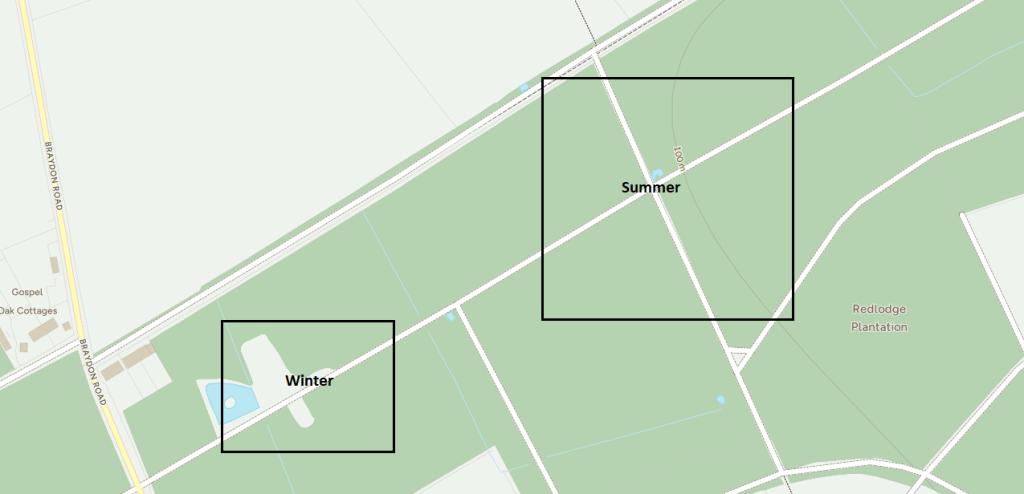
To Red Lodge this morning, having moved from our winter station to our summer station:

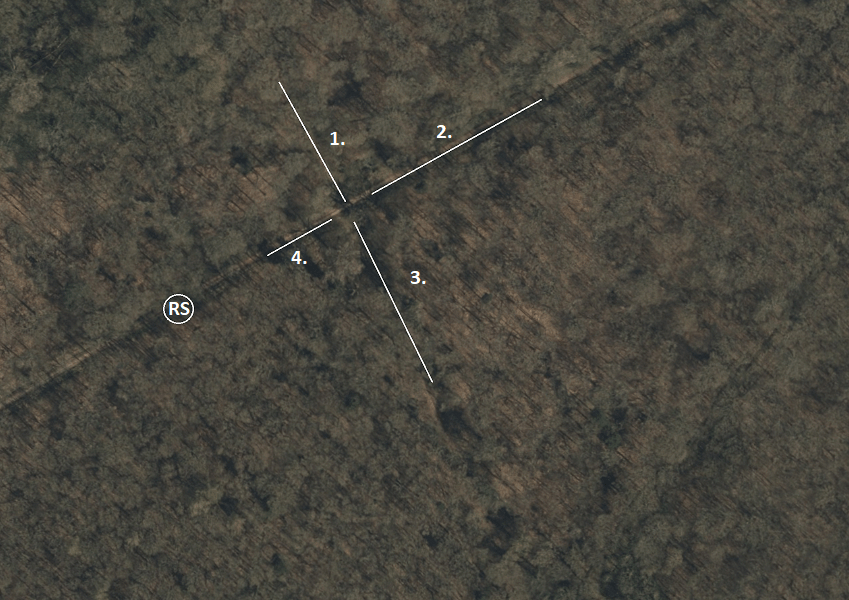
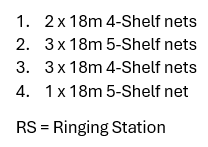
I was joined by Miranda and Ellie at 6:30 and we set the following nets:

It isn’t our most productive April site by a long way, averaging 18.6 birds per session in the wood. However, it was next on the schedule, and it would be churlish to ignore it.

There was a lot of birdsong, but they were clearly staying up in the trees, declaring their territories. We actually didn’t catch anything until 8:45, when we caught a Blackcap, a Blackbird and a Wren. The next time we caught anything was at 9:30, and we were encouraged, as we had nine birds from five species. Then we were disappointed as we didn’t catch anything again until 10:30, whereupon we caught another six birds. That was it: the end of the catch. We gave it three more goes but, when the third, at 11:30, was also empty, we closed the nets and took down.

The list for the morning was: Nuthatch (1); Treecreeper 1; Blue Tit 2(4); Great Tit (2); Wren 2; Robin 1; Blackbird 1; Blackcap 2; Chiffchaff 2. Totals: 11 birds ringed from 7 species and 7 birds retrapped from 3 species, making 18 birds processed from 9 species. So: bang on average for the site in April! It would have been 20, but we had two escape the net before they could be extracted.

Finally, sexing the Blue Tits has become a lot easier: the females have well developed brood patches. One was actually showing the blood vessel engorgement associated with brooding eggs and, later, young. In fact, all of the sexually monomorphic species were easily sexed today.

To be fair, it was a lovely morning. We were sheltered from the direct sunlight and could sit and listen to so much bird song. The absolute highlight was my first Cuckoo of the year. He spent the entire morning circling around the wood calling out his name!

Having packed up we were away from site by 12:30: quiet but pleasant (and a lot better than our session just over the road at Gospel Oak Farm a couple of sessions ago!).

Variety is the Spice of Life: the Firs, Thursday, 24th April 2025

With just Ellie and myself available for this morning and, with Ellie so early in her ringing career, I decided not to overdo the number of nets, so we set just two rides of nets down the central glade: a total of 120m of netting.

We met at 6:30 and had the nets open by 7:15: pretty good timing for us. For once, all of the nets came out of the bags okay, no twists, no snags, no horrible “who the (bleep) did this?” moments! The first three birds hit the nets as we walked back to the ringing station: a Blackcap, Wren and Willow Warbler.

The weather was excellent: not breezy, sunny but not too hot and we just spent a very pleasant morning extracting and processing birds. To put that into context: I did a few birds when we had a busy second round with 10 birds to process, but I got Ellie to process the vast majority of what we caught. Vast is a bit over the top, given how many we actually caught, but it gave her the chance to get familiar with the key things we are looking for at this time of year.

For example, some species are able to be aged, but they are not obvious: Dunnock, for example. We caught two today: an adult and a second calendar year bird. The other key issue at present is the sexing of sexually monomorphic species: back to Dunnock. One is looking for two key things: for the females it is the development of a brood patch. There are five stages: defeathering; fully defeathered and blood vessels emerging; blood vessels engorged; blood vessels emptied and wrinkled; refeathering. Currently, we are seeing stage one on newly arrived migrants and some later breeding resident species and, just in the last week, plenty at stage two. I cannot say that we have seen any at stage three yet, but a couple of the birds we caught, particularly a female Blue Tit, weighed in so heavily that they had to be carrying eggs ready to start laying.

For males one is looking for a cloacal protuberance (CP). In the breeding season, the female cloaca slants downwards along the tail line, the male cloaca is perpendicular to the body wall. This astonishingly easy with Dunnocks: for size / proportion, the males have a very large, very obvious, CP. That is not the same for all but, generally, if you blow on the males belly the CP will wink at you! It gets difficult with those species where the male will also take part in brooding the eggs and young. In some small sexually monomorphic passerines, particularly with my two favourite warblers: the Lesser Whitethroat and the Garden Warbler, the males develop very decent sized brood patches, and being able to correctly identify the CP is key to accurate sexing.

We were active until 11:00, but the catch had died off significantly by then, with just one bird in the last round, so we shut the nets at 11:15 ready to take down.

The list for the session was: Treecreeper 1; Blue Tit 2(1); Long-tailed Tit 1; Wren 1(1); Dunnock (2); Song Thrush 1; Blackbird 1; Blackcap 7(1); Chiffchaff (1); Willow Warbler 2; Bullfinch 1. Totals: 17 birds ringed from 9 species and 6 birds retrapped from 5 species, making 23 birds processed from 11 species.

So not the biggest catch, but a decent variety, particularly for Ellie who could add her first Bullfinch, Treecreeper and Willow Warblers to her fledgling ringing career! For such a small wood it delivers a good variety and comparatively good numbers when compared with the other four woodlands that are so much bigger.

There was a lot of bird song there all morning. Both Nuthatch and Great Spotted Woodpecker were both busy, singing away in the former, drumming away, and the occasional yelp, with the latter. One of the more frustrating birds at the Firs is Green Woodpecker. There are always two males calling away either side of the wood, but not coming near. Hopefully, with the newly widened central glade, we might some ants colonising the area and attracting them in. In the meantime, I suspect that they are exploiting the two fields that flank the Firs.

With not a lot to pack away, we were off-site by 11:45, and I was home in time for an early lunch and snooker!