A bit of Shakespeare to start this blog piece: “Oh what a tangled web we weave when first we practice to deceive!”
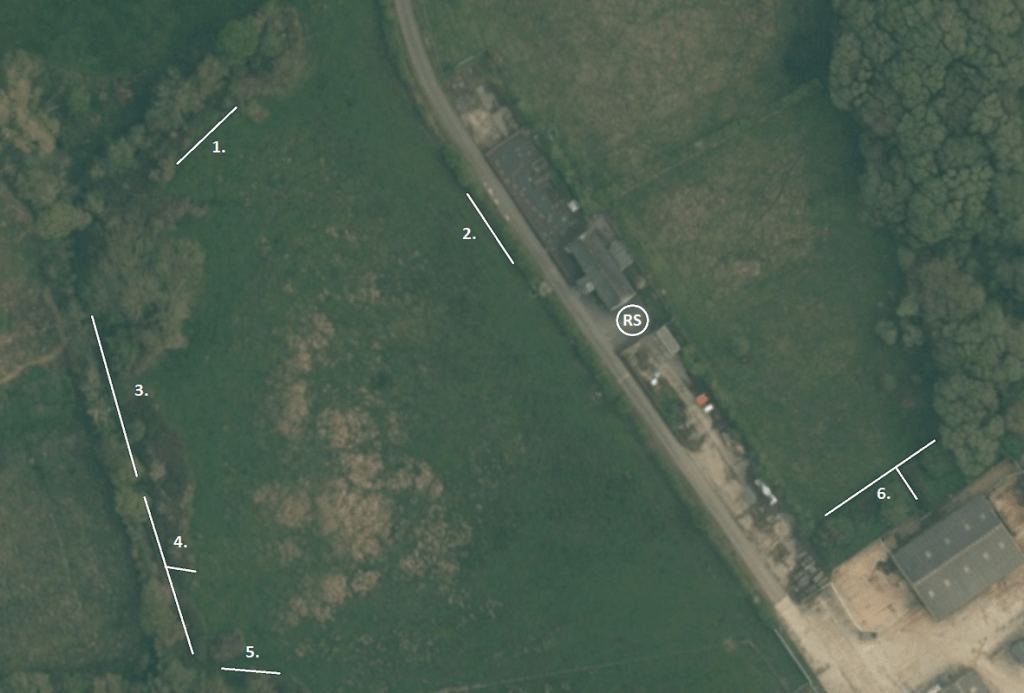
I was joined by Laura and Ellie for this morning’s session at Blakehill Farm. The last couple of hundred metres of hedgerow that I would usually set nets along has just been laid. It was desperately in need of doing – but it certainly won’t be hosting too many birds in the next few months. Because of that, we decided just to set nets on the plateau.
I arrived a bit early and drove out onto the plateau with the nets and poles ready to set up. I had fantastic views of two Hares running away from me as I crawled along the track. Once I had parked up, I had nice views of a Curlew flying across the centre of the plateau, calling as it went. We heard that call a lot this morning. I also had a Raven kronking away overhead. When joined by Laura and Ellie, we had superb views of a Barn Owl quartering the ground for the next ten minutes or so. The plateau was alive with Skylarks: with them chasing each other all over and then catching the escalator up to sing their songs.
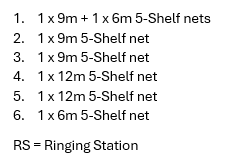
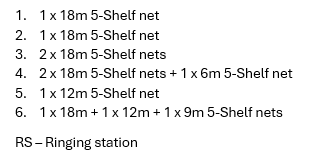
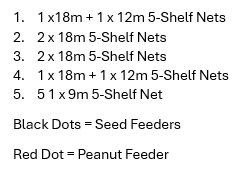
We set the following nets:
We had the nets open by just before 8:00, and did our first round at quarter past. It was an excellent first round: five Linnet, three Reed Bunting and a Dunnock. So, why the Shakespeare quotation at the start? Because, with the exception of a Willow Warbler at 9:20, that was it! The total list for the day was: Dunnock (1); Willow Warbler 1; Linnet 5; Reed Bunting 1(2). Totals: 7 birds ringed from 3 species and 3 birds retrapped from 2 species, making 10 birds processed from 4 species.
So, we had a lovely time, with excellent weather and lots of wildlife to see: we just didn’t catch them! However, it was pretty rewarding to catch our first Reed Buntings, Linnets and Willow Warbler of the year. Blakehill Farm, on the Chelworth Industrial Estate side, is my most regular site for Reed Bunting and it was one of my target species for the morning.
The Linnets were a lovely catch. Since 2019 we have annual totals of 5, 2, 2, 2 and 2 Linnets across the farm. To catch five in one session in March is remarkable.
Male Linnet, Linaria cannabina
If you look, you can see the pink blush on the chest. It is a clear indicator that it is a male. There are other indicators that you can use with birds in the hand. One involves looking at the wings, much easier is looking at its cloaca: this bird had a very obvious cloacal protuberance, i.e. it is a male coming into breeding condition.
As for the Willow Warbler, we don’t catch many on the plateau, or in that hedgerow, come to that! We have had a total of 17 since we started working at Blakehill in 2015. This is only our second Spring catch there: the first being in April 2019. 2020 was our best year for them: five caught in June, so probably breeding, and three caught in August, possibly on autumn migration. Take those eight away and you can see how scarce the are at this site. It is the earliest catch my team has ever had for this species at any of our sites, by four days. The only others were two caught at Lower Moor Farm on 30th March last year. Looking at the group records as a whole, there were only another two caught in March: one at Langford Lakes on 30th March 2023 and, the earliest of the lot, at a farm just outside the village of Alderton on the 21st March 2024. So very uncommon in March.
Willow Warbler, Phylloscopus trochilus
It was a feisty critter and didn’t want to pose for photographs, hence just a controlled head shot of today’s bird.
Having had no birds in three separate rounds, we decided to call it a day and closed the nets and took down. We left site by 11:30. It would have been nice to have had more birds, but it was still a lovely session.
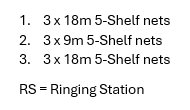
After a couple of cancellations, we finally managed to provide another session for the Swindon Adult Wellbeing Group, run by the Wiltshire Wildlife Trust. We managed to persuade them to get to site for 10:30. However, Miranda and I agreed to meet at 6:30. After waking up earlier than I wanted, I was on site for 6:00 and started setting the nets:
Miranda arrived on time and we had the nets open just after 7:00, and started catching pretty much straight away. However, it was slow! Slow – but interesting. I don’t think that I have ever previously had a session at Lower Moor Farm where we didn’t catch a single Blue Tit.
Fortunately, when the Wellbeing group arrived at about 10:45 we did have some lovely birds to show them. It started with a Goldcrest and a Treecreeper, then a Chiffchaff and a couple of Great Tit. That was over the next 45 minutes, together with lots of explanation of the ringing scheme, demonstration of the processing and photograph opportunities. However, having had two empty rounds and time cracking on, the moved off to the next stage of their day whilst Miranda and I went to take down ride 1.
Returning 10 minutes later we found three Redpoll in ride 2 and this beauty in ride 3:
Second Calendar Year Male Green Woodpecker, Picus viridis
I did try to get hold of the group: phone call, text and even took a drive around the reserve, all to no avail! So I am afraid that they missed out on the highlights of the day. To be fair, when I did manage to get in contact with the organiser later this afternoon she did say that, regardless, the attendees had loved every minute of it and were very happy at what they had seen.
Not only is this our first Green Woodpecker this year but the first we have caught since we caught two at Blakehill Farm West in August 2023. If anyone is in any doubt what these beauties eat, this bird had ant carcasses all around his mouth and face: a really messy eater.
The three Redpoll were also our first for this year: taking our total for this winter to 11. Last winter (October to March) we had 54!
The list for the session was: Green Woodpecker 1; Treecreeper (4); Great Tit 2(1); Wren 1(2); Robin (2); Chiffchaff 2; Goldcrest (3); Redpoll 3; Bullfinch 1(1). Totals: 10 birds ringed from 6 species and 13 birds retrapped from 6 species, making 23 birds processed from 9 species.
This is only the second time that we have ever caught four Treecreeper. The previous time was at Somerford Common in October 2019. That is, at least, a woodland, as opposed to reclaimed quarries and farmland lined by trees.
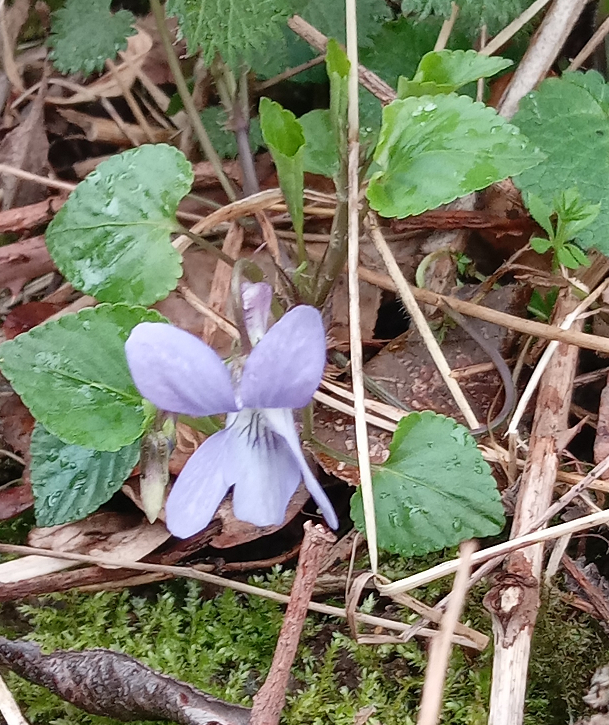
Ride 1 was incredibly poor today: it delivered just one of the Treecreepers. It is early days: it has just been cleared out, the trees have been thinned and some have been topped, so there is far more light and space available. For the first time in years Miranda found a couple of Dog Violet:
Common Dog Violet, Viola riviniana
Close by, and exposed by the clearance, was a wide spread of Scarlet Elf Cup:
Scarlet Elf Cup, Sarcoscypha coccinea
Again, a common species elsewhere, just the first time we have seen them in this particular area.
With the last few birds extracted we shut the nets before processing them. We then processed them before taking the final nets down, and we left the site at about 12:45. Not a huge catch, but we have had so few Redpoll this winter and our first Green Woodpecker for ages were stand out birds.
After posting the link to the piece onto BlueSky, I was having a browse and found a repost by Alex Lees. It was a video showing a Chaffinch floundering around in a garden, under some feeders, with its legs missing, due to Fringilla papillomavirus. This disease, of course, he attributed to being spread at feeding stations. Firstly, Fringilla papillomavirus was first discovered in Chaffinch populations of the UK in the 1960’s, long before the exponential boom in garden bird feeding. Secondly, it is widespread across the world and across species, despite the fact that garden bird feeding is much less prevalent outside of the UK, although garden feeding is certainly increasing in western Europe.
I find this hard to understand. Chaffinches are not particularly prolific users of gardens, according to the data from the BTO’s Garden Birdwatch scheme, my own GBW observations and my own ringing activities. Also, the disease is widespread across Europe and beyond: in those countries where bird-feeding is not as concentrated as it is in the UK. Yet they still have Chaffinch suffering from the disease.
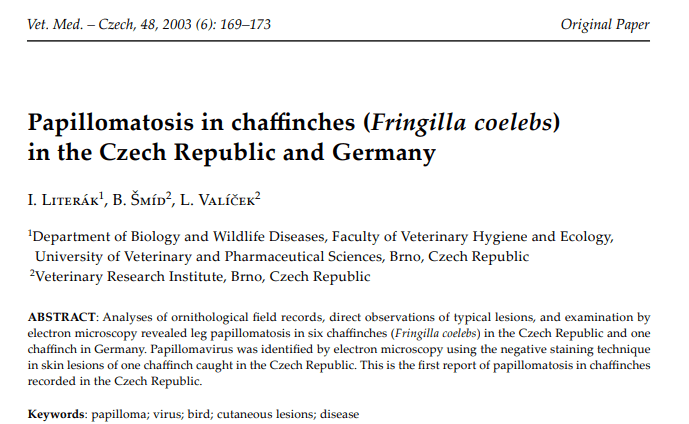
Not every scientific group is as desperate to blame its spread on garden bird feeding as those in the UK. This paper, for example:
It is open access and good reading, with some extremely graphic photographs. The last phrase of their paper states: “The mode of transmission, current prevalence of papillomavirus infections in chaffinches, bramblings, and other wild bird species, and effects of the infection on the fitness of the affected subpopulations are unknown and deserve continuing attention.”.
From a variety of other sources I have learned that Papillomaviruses infect a number of other species: Chaffinch, Greenfinch, Canary, Brambling, Northern Fulmar, African Grey Parrot, Yellow-throated Francolin, Mallard and Adélie Penguin. I don’t remember seeing too many of the last five at my feeding stations!
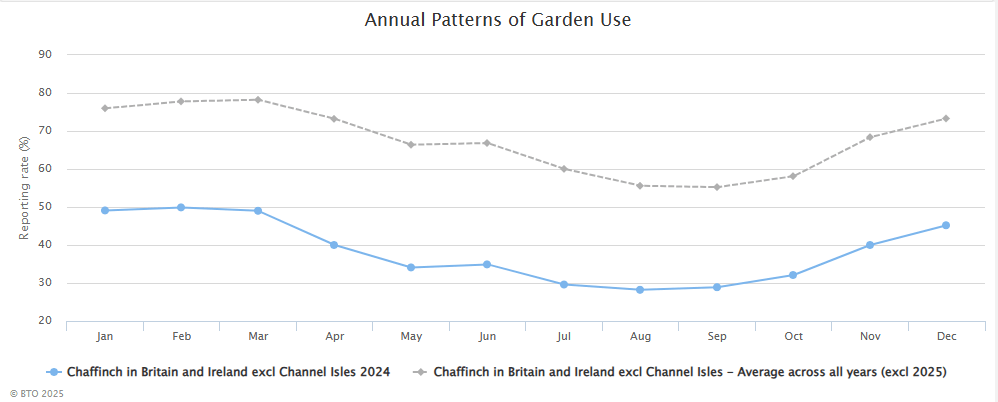
Average numbers of Chaffinch reported from UK gardensAverage frequency of Chaffinch reported in UK gardens
These graphs have been taken from the BTO’s Garden Birdwatch data: hundreds of thousands of records from thousands of observers and, even at the heights of their population maximum counts were between two and four in each garden. Since the population crash (I will discuss Trichomoniasis in a separate post) you can see the numbers and frequency have halved, making close interactions and, therefore, virus transmission somewhat less likely.
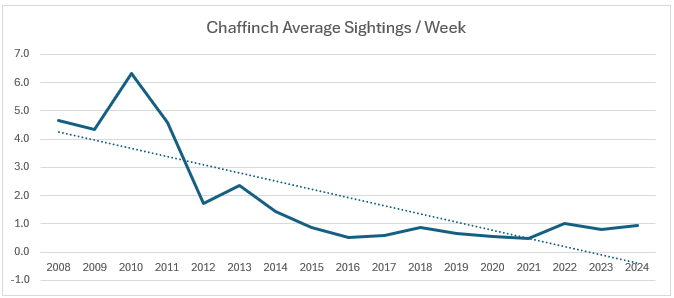
When I look at the number of Chaffinch that I have ringed in my garden, it averages out at three per year. However, when I look at the sightings that I have reported to the Garden Birdwatch Scheme, I get the following graph:
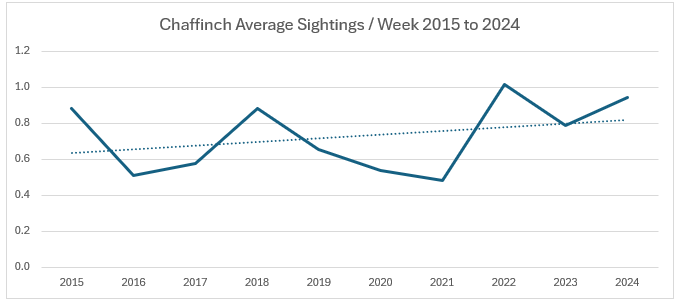
As you can see, there was a huge drop off after 2010. Presumably the results of Trichomoniasis. Such a steep decline, which rather distorts the reality of how it is today. However, the highest weekly average was 6.3 in 2010 and the lowest was 2016, 2020 and 2021. If I graph the data from 2015 onwards it shows a rather different story:
The highest is 1.0, in 2022. I can honestly say that I have not seen a Chaffinch with FPV in my garden for at least five years. However, away from the garden, in my Braydon Forest sites, I would estimate that one in five Chaffinch we catch has to be released because it has either developed FPV or shows signs that it might be: usually, the legs are showing some sort of greenish colouration. This is not to be confused with the white socks of a Cnemidocoptes mite infection. We did have a Chaffinch with the mite infection visit the garden between 2021 and 2023, but I haven’t seen it for a long while. Of course, as soon as I saw it in the garden I would disinfect the feeder it had accessed. That said, I am not sure how much it could have spread that disease at my feeding station as I have never seen any sign of it in any other Chaffinches: either in my garden or at my ringing sites.
Alex describes his position:
I’m here for the evidence. Increased competition may be a significant factor in Marsh Tit declines. Increased competition and predation is likely the most significant factor in Willow Tit declines. Diseases mostly spread at feeding stations underpin declines in Chaffinches and Greenfinches.
Where is the evidence? There is zero evidence for that last sentence: this is his belief, his faith, his religion. I suggested an alternative. How are viruses spread? The Human papillomavirus is spread through intimate contact, i.e. it is contagious. How is influenza spread? Through exhalation of infected droplets. How likely are Chaffinches to come into those sorts of direct contact with their conspecifics at feeding stations if the maximum number recorded at any one time is four across all year’s data, but fewer than two at any one time in the last year?
This quotation from the Lawson, Robinson et al paper cited below:
“However, it is not possible with the available data to evaluate the relative importance of risk factors for occurrence of finch leg lesions, and the extent to which supplementary feeding may alter their occurrence.”
It is worth reading: they do suggest the possibility of transmission at feeding stations but, significantly, they do not put the emphasis on it in the same way that the anti-feeding cohort continue to do.
I suggested an alternative: in Wiltshire ringing activities find large flocks of Chaffinch on farmland in the winter. They take advantage of game cover, winter stubbles, etc. Bearing in mind that one never gets to ring 100% of what is there, when you are getting catches that can be in excess of 60 individuals in one session, it shows that they are large flocks. Large flocks that roost together, large flocks that will huddle together for warmth. According to Dr Lees “Roosts don’t provide as suitable conditions for transmission for either disease nor in fact same pairwise opportunities for transfer as on/below feeders given substrates.” My answer would be “why not?”. I am pretty sure that if you took a large group of humans, several of whom are suffering from influenza, and put them in close proximity for eight or so hours, huddling together to keep warm, there would be several uninfected members of that group that would become infected.
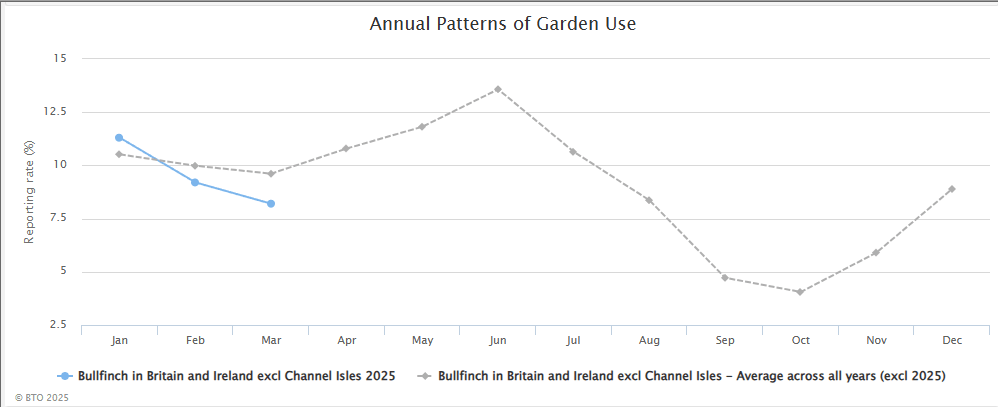
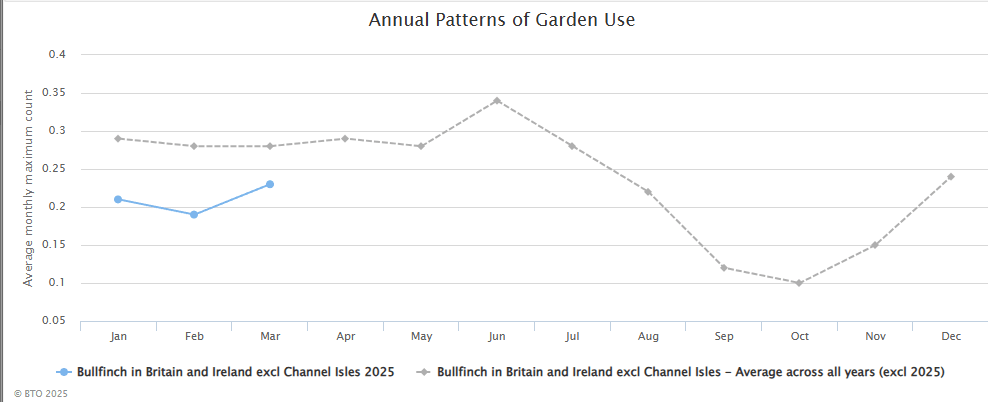
Mentioned in the first two papers cited below is the incidence of FPV in Bullfinch. Anecdotally, when out ringing we find a similar proportion of Bullfinch with FPV to that which we find in Chaffinch. I find it interesting for two reasons: the extremely low frequency of Bullfinch visiting garden feeding stations and the small numbers that visit gardens:
Frequency with which Bullfinch are reported in UK gardensAverage numbers of Bullfinch reported from UK gardens
I have only ever ringed a single Bullfinch in my garden and the averages recorded under GBW are negligible: since 2008 I have only recorded Bullfinch in 8 years, the rest have had an average of two per annum, and I haven’t recorded any since one in 2018.
For the absence of doubt: I do not deny that garden feeding stations can be a terrible source of disease for birds. Infections caused by Salmonella, E.coli and Suttonella (hadn’t heard of that until I started looking into this) are clearly easily spread from dirty bird feeders. For that reason, I scrapped the bird tables from my garden, I use hanging feeders, clean and disinfect them regularly, swap them out and rest them in between fills. I do not want to be responsible for spreading disease within our local bird populations.
Citations:
Lawson, B., Robinson, R.A., Fernandez, J.RR. et al. Spatio-temporal dynamics and aetiology of proliferative leg skin lesions in wild British finches. Sci Rep8, 14670 (2018). https://doi.org/10.1038/s41598-018-32255-y
Hugh J. Hanmer, Andrew A. Cunningham, Shinto K. John, Shaheed K. Magregor, RobertA. Robinson, Katharina Seilern‑Moy, Gavin M. Siriwardena1 & Becki Lawson: Habitat‑use infuences severe disease‑mediated population declines in two of the most common garden bird species in Great Britain. Nature Scientific Reports | (2022) 12:15055 | https://doi.org/10.1038/s41598-022-18880-8
I. Literak; B. Smid; L. Valicek: Papillomatosis in chaffinches (Fringilla coelebs) in the Czech Republic and Germany. Vet. Med. – Czech, 48, 2003 (6): 169–173
With the weather forecast from every source saying that there would be a low breeze, with some gusting, coming from the south-east, I decided to go to the western side of Blakehill Farm, by the Whitworth building. When I say every source, I mean: weather.com; MeteoBlue; xcweather and the Met Office: they all forecast the same thing. I was joined by David, Ellie, Laura, Adam and Mark. We met at 6:30 and set the following nets, knowing that they would be sheltered from the prevailing wind by hedgerows, trees and buildings:
The breeze didn’t get up until after we had the nets open by 7:30: and then it came from the north! Net 5 blew out straight away, so we shut it after round two, as the billowing completely opened out the pockets. Fortunately, the other nets were a bit better protected and we managed to keep going for a couple of hours before the wind got up too much and we decided to wind up the session: hence the punning title to this piece.
Unfortunately, the wind made the nets visible and the catch was low, but there was a decent variety: Blue Tit 2; Wren (1); Dunnock 2(1); Robin 3; Redwing 1; Song Thrush 1; Blackbird 2; Chiffchaff 3(1); Goldcrest 1; House Sparrow 2. Totals: 20 birds ringed from 9 species and 3 birds retrapped from 3 species, making 20 birds processed from 10 species.
It was a pleasant enough session but, after a couple of empty rounds, and the wind showing no signs of changing, we shut the nets and took down at about 10:30.
It was good to catch our first two House Sparrow of the year. They are regular in my garden – but equally regular in avoiding my nets! Blakehill Farm is the only site that I have caught them at with any regularity. This is my first session there this year, and we caught two: a male and a female. Our fourth Redwing and third Song Thrush of 2025 were also nice to haves. Prior to this morning’s session we had caught three Chiffchaff, so another four was also good to have. The retrapped Chiffchaff was originally ringed at Blakehill last April.
On Wednesday we will be trying for a session on the plateau at Blakehill – hoping for a few early migrants. Fingers crossed!
I am pretty happy with the responses to my post “When Science Imitates Religion”. There are some follow ups to do though, so, I am sorry but there will be a few more blogs on this topic.
The first reply I got was from one of my ringing team: David Williams. David is a recent graduate from Aberystwyth University. He graduated with a first-class honours degree in Zoology, and won a University prize for being top of his cohort. He has been ringing with me since he was a teenager, back in 2017. This is his analysis:
I’ve read the blog piece , and the below quote, which I think every academic should have displayed prominently in his or her office, comes to mind:
“In general, we look for a new law by the following process. First, we guess it. Then, we compute – well, don’t laugh, that’s really true. Then we compute the consequences of the guess, to see what, if this is right, if this law that we guessed is right, we see what it would imply. And then we compare those computation results to nature. Or we say, compare to experiment or experience. Compare it directly with observation, to see if it works.
If it disagrees with experiment, it’s wrong. And that simple statement is the key to science. It doesn’t make any difference how beautiful your guess is, it doesn’t make any difference how smart you are, who made the guess, or what his name is. If it disagrees with experiment, it’s wrong. That’s all there is to it.”
— Richard Feynman, “Seeking New Laws”, The Character of Physical Law, lecture series, Cornell University, 1964
As I understand it, the Broughton–Lees–Shutt hypothesis is that a) feeding birds in your garden causes the populations of Blue and Great Tits to increase (because these species take full advantage of bird feeders), and b) this leads to the subsequent decline of Marsh and Willow Tits (because they’re outcompeted, for both food and nest sites, by the increasing Blue and Great Tits).
As you pointed out in the blog piece, it would be almost impossible to test this by controlled experiment (like most things in vertebrate ecology!), so we have to make the best we can of observational data…
There’s probably a good dissertation (or maybe even a PhD thesis) in this, but, as I see it, the most salient points are:
a) Feeding birds in your garden causes the populations of Blue and Great Tits to increase
Sadly, there doesn’t appear to be any publicly accessible data on bird feeding rates; we know people have fed birds in this country since late Victorian times, but the only data I can find is a study by Plummer et al. (2019), who estimated the size of the British bird food industry by looking at the amount of advertising for bird food in Birds magazine! Their results suggest that bird feeding has increased exponentially since the 1980s:
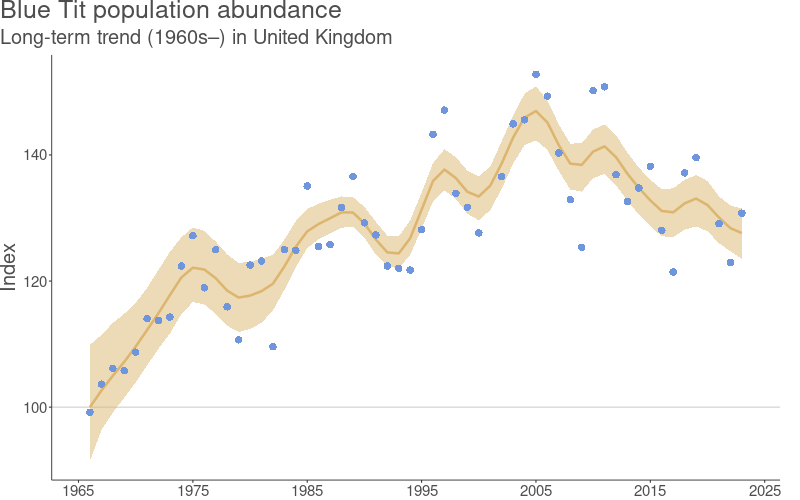
How does this tie in with Blue and Great Tit populations? According to the BTO’s BirdTrends report (BTO, 2024), both Blue and Great Tits increased steadily, with occasional dips, from “the dawn of time” (ca. 1960s) to the late 2000s, but have since declined slightly:
So, the increase in Blue and Great Tits had started at least fifteen years before the bird food boom…
b) The increase of Blue and Great Tits leads to the decline of Marsh and Willow Tits
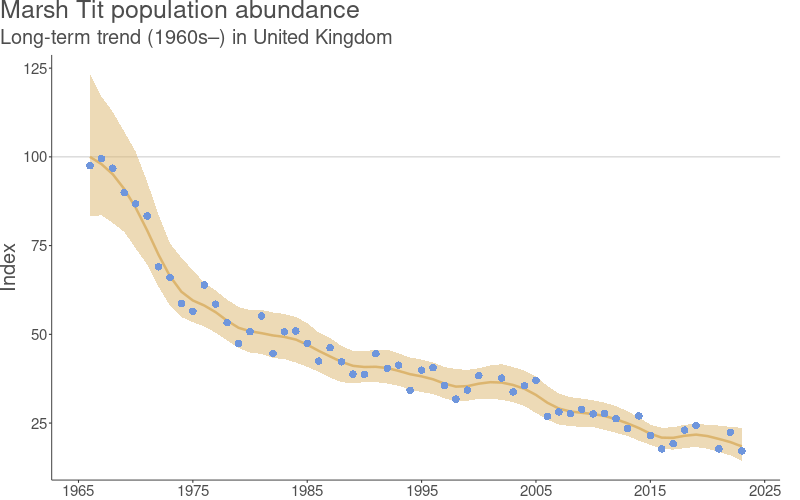
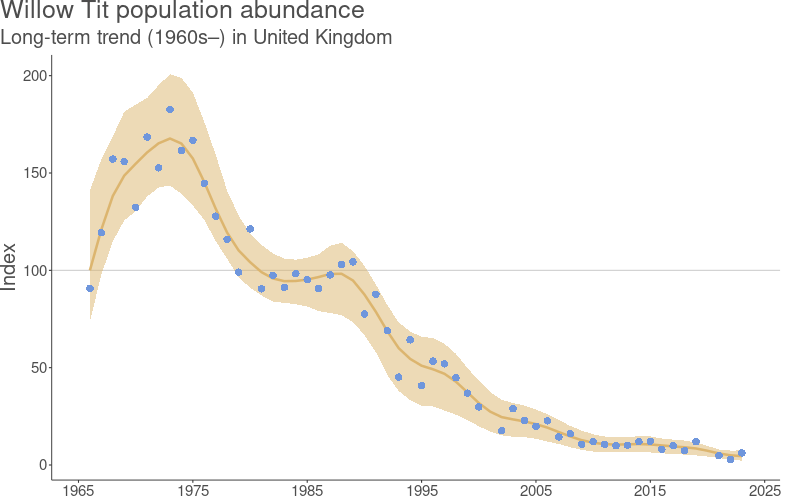
Again, referring to BirdTrends, Marsh Tits have declined steadily, while Willow Tits were actually increasing until the mid-70s, before their cataclysmic decline:
We’d need to look back into “prehistory” (from the BTO’s point of view!) to ascertain what’s really going on here, but I can see two things which don’t support the Broughton–Lees–Shutt hypothesis:
For about ten years (1965–75), Willow Tits were actually increasing at the same time as Blue and Great Tits!
The populations of Marsh and Willow Tits haven’t rebounded in response to the recent decline in Blue and Great Tits – while this doesn’t rule out a role for Blues and Greats in Marsh and Willow decline, it does suggest that something else (almost certainly habitat destruction) is the major limiting factor for Marsh and Willow Tit populations.
Why are some people so prejudiced against bird feeding? I just don’t understand…
Back to me: I love David’s approach to this. I note that he didn’t mention the recent declines in both Blue and Great Tit numbers shown by the BTO BirdTrends graphs. It seems that they both hit a peak about 2005 and have been steadily declining ever since. That is something that is also supported by the data for the Braydon Forest.
In my next piece I am going to look at the attempts to blame the spread of Trichomoniasis in Greenfinch and Chaffinch on garden bird feeding. As a taster: are you aware that signs of Trichomonas infection have been found in Tyrannosaurs? Let’s face it: birds are modern day Saurischian dinosaurs! Tyrannosaurus was a Saurischian dinosaur. I do love a link!
A funny session this morning, as in “funny peculiar” not “funny ha-ha”. I was joined by Miranda and Ellie at 6:30am and we set the following nets:
With Ellie not yet started on extracting I didn’t set all of the nets I might usually do, but did add the 6m net to the 18m on the main path. In anticipation of today’s session, I had dropped in on Monday afternoon to top up the feeders. When we arrived this morning both feeders adjacent to ride 3 were empty and the seed feeder adjacent to ride 2 was empty but the peanut feeder was still three-quarters full.
When ringing this site with the seed feeders in place, we almost always take 70% of our catch in ride 3, 20% in ride 2, with the rest spread between 1, 4 and (missing today) 5. So, the first oddity today was that, despite the feeders having been emptied, we didn’t catch a single bird in ride 3 until our penultimate round at 10:50. In fact, ride 1 caught the majority of the birds. That led to the second oddity: because we could see everything that was going on in ride 1 we didn’t really do net rounds as such. When a bird hit the net we would go and extract it, just checking on the other nets as we went, so some of our “rounds” were 10 minutes apart, often just with one bird. We were wondering what could have caused the drop off in ride 3. Miranda’s suggestion was that perhaps a Sparrowhawk has added the ride to its hunting corridors. What gave that some credence was that we recovered a Blue Tit that, although it was alive and feisty, had clearly been attacked by something recently. Its head was scarred and feathers matted with dried blood, there was also dried blood on the tail and one of the thighs. Apart from its obvious recent ill fortune, it was still in good condition and very mobile, so I chose to ring it. Hopefully we will retrap it next time we are there and check on its progress. If it has been a sick bird I would not have ringed it but, having survived an attack from an external source, and still acting as every other Blue Tit does when being handled, I thought it worth the 26p ring!
The third oddity actually concerned the ubiquitous Blue Tits! Firstly, they were not the largest part of the catch, that was Great Tit! Not only that, we had twice as many Great as Blue Tits. The numbers weren’t huge: six and 12 but, surprisingly, the Blue Tits were all unringed birds, whereas the Great Tits were seven unringed and five retraps. Our normal ratio is 66:34 Blue Tit to Great Tit.
The list for the day was: Nuthatch (1); Blue Tit 6; Great Tit 7(5); Coal Tit 1(1); Marsh Tit (1); Long-tailed Tit 1; Wren 2; Dunnock (1); Chiffchaff 1; Chaffinch 2. Totals: 20 birds ringed from 7 species and 9 birds retrapped from 5 species, making 29 birds processed from 10 species.
With Miranda needing to leave by 11:30, we closed the nets at 11:10, took down and packed away, Miranda leaving when she needed to and Ellie and I cleared the site by 11:45. It was an interesting morning. Not being rushed gave Ellie a chance to ring and process birds without any pressure, and time for me to spend time showing her about extracting. There were some seriously tangled birds this morning: but I don’t think they put her off. I haven’t dumped her into the bitey hell that is extracting Blue Tits just yet. I am hoping we will have some friendlier species for her to start on in the near future: Blackcaps in particular. Great birds for introducing new trainees to extracting!
This post is somewhat different to my usual stuff. A little contentious, perhaps, but it shouldn’t be.
I graduated with a BSc (Hons) 2:1 in Zoology from Reading University in 1982. Unfortunately, with a wife and two children, and my then wife telling me that, if I went to Liverpool to carry out the PhD I had been offered, I would be doing so on my own, that was the end of my academic career. Instead, I spent the next 38 years working in IT, the last seven years of my working life being shared with professional wildlife survey work, alongside all of the voluntary stuff I was already doing. Much of my IT life was involved in software management, reporting and analytics: which is why I am now a bit of a data nerd.
Since I started bird ringing I have had plenty of opportunity to indulge my nerdiness, alongside my passion for wildlife. I have been lucky enough to have had a dozen or so articles published in the Wiltshire Ornithological Society’s WOS News, a couple in their science journal, Hobby, and a couple published in the Wiltshire Wildlife Trust magazine. Not claiming any sort of major academic achievement, just some stuff gleaned from my ringing data that other people found interesting. And, of course, I have been writing my blog since 2014.
As a student I was led to understand that science is about providing the best explanation of any phenomenon according to the best data available at the time. I read Karl Popper’s “The Logic of Scientific Discovery” and the contention that the true hallmark of a scientific theory is falsifiability. It still has pride of place on my bookshelves. To me that means that any hypothesis must be able to be tested to establish whether it is accurate or not. If it is, it adds to the sum of knowledge, whether positively or negatively. If it cannot be tested it is not science, in my opinion any such “hypothesis” claimed as truth is better defined as “faith” or “religion”.
When the first discussions about the negative impact of bird feeding started, they were all to do with the spread of disease. It was stated that the decline of some bird species was down to dirty feeders enabling infectious bacteria, viruses and parasites to be spread within populations. Testable, verifiable, falsifiable.
As a result, I hope that everybody has got the message that cleanliness is essential for the well-being of the birds using our feeders. Certainly, after catastrophic declines, the numbers of Greenfinch and Chaffinch in my garden have grown considerably over the last few years. That is supported both by observational data provided to the BTO Garden Birdwatch Scheme and my ringing data. My feeders have always been kept clean and regularly disinfected and rested between refills. Given the increases, it looks as though the message has got through to the neighbours as well. Mind, there is still the unanswered question of why some species have clearly experienced reductions in numbers but some have expanded their numbers, despite the expansion being in the most regular users of bird feeders and, therefore, more exposed to the potential for contracting disease. I am thinking particularly of Blue Tit, Great Tit and Goldfinch.
More recently a proposition has been put that bird feeding is enabling certain prolific species to out-compete other less prolific or aggressive species and, taking it to an extreme, helping to drive the extinction of the Marsh Tit and Willow Tit, and that we should stop feeding the birds in our garden. Certainly, if we stop feeding birds in our gardens we will see far fewer birds. Whether it would translate into population declines I have no idea. The idea that feeding birds in your garden is adding to the competitive pressure on species that don’t take advantage of it is, in my opinion, an hypothesis, but one that is virtually untestable. One would have to persuade a huge number of people to stop feeding birds in their garden for years to establish the population impacts. That is not going to happen.
I could suggest an alternative proposition: that by Blue and Great Tits taking advantage of easy food available in our gardens they are leaving more of the wild natural food for those species that don’t take advantage. Far from having a negative effect, it could be a positive. Why is that any less viable than their hypothesis?
Those promoting this idea do not make definitive claims, but it is often referred to as if it is fact, hidden behind “could” and “might”, et cetera, as a cover for it being an untested hypothesis. I have found no evidence, let alone any peer-reviewed science, to back up their “theory”. In science, instead of it being “acting on faith”, it becomes “acting on the precautionary principle”, i.e. we can’t test it, can’t prove it, but we would like others to believe it and act accordingly. That is surely what religion is based upon?
I first became aware of the suggestion in October of 2021, when I read a paper, published by Shutt et al, on the movements of Blue Tits. Their movements were monitored by the provision of peanuts that had their DNA bar-coded, and the recovery of faecal samples from nest boxes at known distances from the food sources for DNA analysis. The ideas in this article interested me, so I had a look at the Blue Tits and their movements in my main ringing area, the Braydon Forest, based on my ringing recoveries. What I found was that I could not replicate their findings of significant numbers of movements with my ringing data. You can find references to titmice movements in some of my other blog posts. I will provide an updated analysis of movements in a future post. Needless to say, with some 10 years worth of ringing data to analyse, I was pretty confident in what I found. As I said at the time: “Of those 1,523 recaptures only 4 of them were ringed in my garden and recovered elsewhere, and only 2 of the 3,430 birds ringed elsewhere have been recaptured in my garden.” This was data up to the time that I wrote my October blog piece in response: “Feeding Blue Tits in Your Garden: a Good or a Bad Thing”.
Throughout my original piece I reiterated that I was not querying their results, just saying that I could not replicate them. The one thing that I did say, though, was that they had not allowed for the impact of providing the nest boxes they needed to be able to collect their samples. Also, they did not differentiate in their paper how many times individual birds returned to the feeders and where they subsequently flew off to, i.e. were birds exploiting one food source multiple times, using them as a central feeding station, and then flying distances to the same box or different, or were they individuals “just passing through”, or a mixture of both. This is something that ringing data and / or PIT tags can give you. The Edward Gray Institute in Oxford have studied Blue Tit movements and feeding site frequency in their sites for many years using those techniques.
Although the Shutt study states that they carried out the study under a BTO ringing licence, there is no reference in their work to individual birds, frequency of capture, etc that I can find. If I have overlooked it, and I have read it more than once, I am happy to be pointed in the right direction. The analysis of my data was all based on individually identifiable birds and continues to be so.
Then, in January 2022 the following article appeared in British Birds: “Rethinking bird feeding” by Richard Broughton, Alex Lees and Jack Shutt (of the previously mentioned paper). They are part of a cohort of academics that I think are agitating for the reduction / end of supplementary feeding of birds in both gardens and woodlands. I hope I haven’t misrepresented their position and am happy to be corrected if I have, or if it is more nuanced than that. In the article they suggested that feeding the likes of Blue Tits, Great Tits and Great Spotted Woodpeckers in your garden was increasing their populations, which was helping to drive the extinction of Willow Tits and Marsh Tits in the UK. This was my first full exposure to this untested, almost certainly untestable, hypothesis. It was touched upon in the Shutt paper, but this was a much more definitive assertion. To illustrate the inter-specific competition, they put a photograph up captioned “Marsh Tit chased from a bird table by a Blue Tit”. It shows no such thing: it shows a Marsh Tit feeding on seed scattered on a tree stump used as a bird table and a Blue Tit on the opposite side of the stump but not actually on the feeding area. The Marsh Tit is paying no attention to the Blue Tit, just feeding. Perhaps if they had waited a few seconds they might have got what they wanted but, having watched Marsh Tits and Blue Tits sharing both peanut and seed feeders, I think the authors were seeing what they wanted to see. Given that it was the Marsh Tit stood there feeding, one could actually reverse the caption. You will have to look it up: I am not sure of the copyright rules.
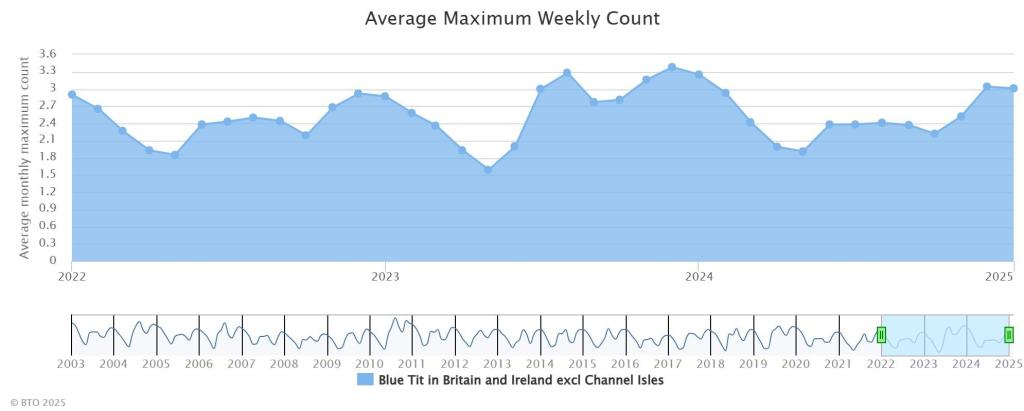
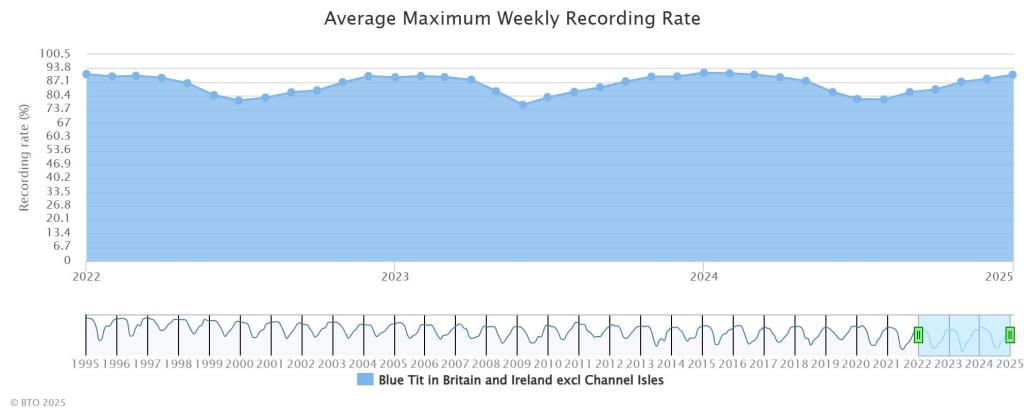
One thing that would be important in their hypothesis would be significant increases in the numbers and frequency of those species using gardens. I have had a look at the BTO Garden Birdwatch (GBW) figures for Blue Tit garden usage and reproduce their images, graphed from millions of records, below:
In this graph we are looking at maximum weekly counts of between one-and-a-half and three-and-a-half Blue Tits visiting each garden in which they are recorded. I know from my ringing data that it is an under estimate, but it is relatively consistent. In 98 sessions in my garden when we caught Blue Tits, the average catch is 4.4 per session. That said, I do catch them far less often than I see them in my Garden Birdwatch counts. Since I got my C-permit, 11 full years have elapsed: i.e. 572 sessions, less 30 weeks for when we have been away on holiday. Garden ringing sessions in the same period is 178, and I have caught Blue Tits on only 98 of those occasions.
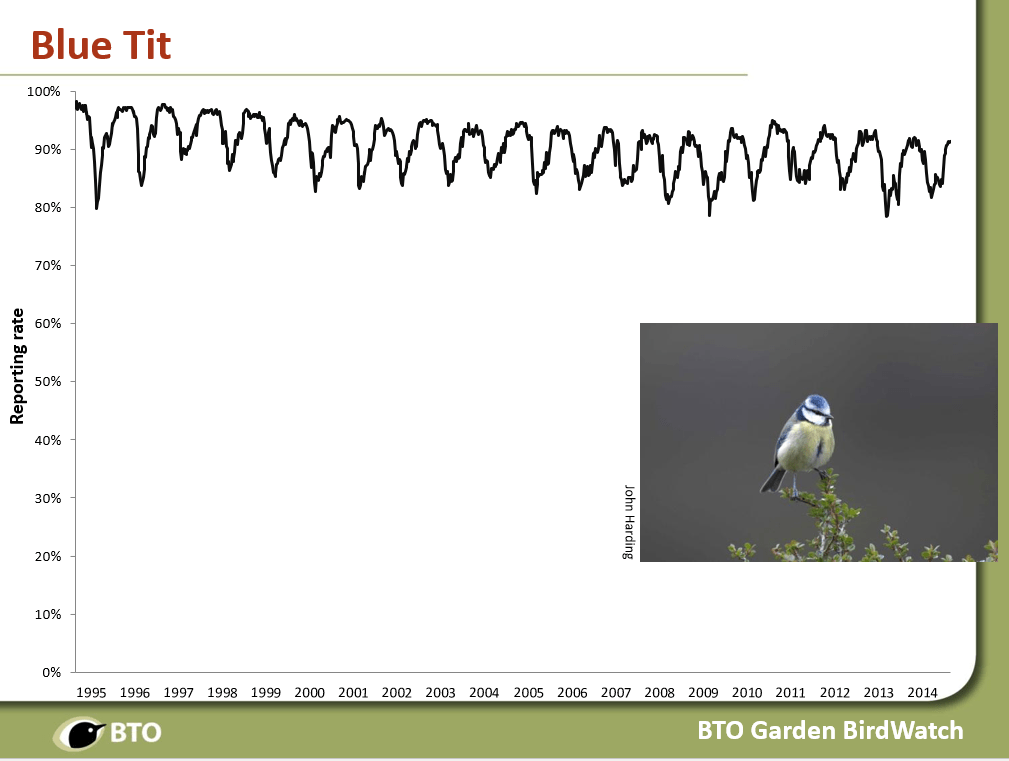
To me, the graph shows the last three years are up and down, but the bottom image showing 24 years of data shows no obvious growth in the numbers of Blue Tits using our gardens. In fact, during my time as a BTO Garden Birdwatch Ambassador I was given a number of PowerPoint slides to use to illustrate talks, including this one on the frequency of Blue Tit recorded in gardens between 1995 and 2014:
As you can see, the usage is high, but the trend in that data is very definitely downwards, i.e. a reduction in usage of our gardens by Blue Tits. Ironically, if there is a small peak, it is in the three years following their article. If you look at the most up to date reporting rate of Blue Tits in the garden, the trend is very definitely downward, using the data at the bottom of the image spanning 1995 to the end of 2024:
The trend shown by GBW data for Great Tits is that, over the same period, their usage and maximum observed counts are stable but lower than the figures for Blue Tits. Essentially, the increase in garden feeding of these species is not supported by the evidence.
When someone raised the issues from the British Birds article on Twitter, and said that, as a result, he would cease feeding birds in his garden, I joined the conversation, using the data from my ringing activities and my previous blog post. They show that our local Blue and Great Tit populations have been stable, with slight declines, since I started my Braydon Forest project in late 2012. It also shows that our Marsh Tit population is absolutely stable, increasing slightly and slowly. Cue a few very negative responses from the academics, one was quite angry, despite the fact that all I was doing was reporting on the data from my own area, and stressed that I wasn’t querying anyone else’s results. The most unfortunate outcome though was that, because my data didn’t fit the hypothesis, Dr Broughton claimed that the population of Marsh Tit in the Braydon Forest was insignificant. Personally I think that all data is important.
What prompted this post was that last week a friend messaged me to ask about the impact of supplementary feeding, having seen Richard Broughton’s author interview with NHBS about his new Poyser book on Marsh and Willow Tits. In that interview he said:
“It’s also important to realise how we can unintentionally make things harder for Marsh Tits and Willow Tits when we do favours for their competitors. There is growing evidence that increasing numbers of Blue Tits and Great Tits could be harming Marsh Tits and Willow Tits by taking over their nests and dominating their foraging space. The vast scale of bird-feeding in gardens, woodlands and nature reserves is changing our woodland bird communities, and it really boosts the dominant species, which can then put extra pressure on Marsh Tits and Willow Tits. For this reason, it’s important to consider the unintended negative impacts of well-meaning interventions, such as bird-feeding and nestboxes, on more vulnerable species like these.
My concern regarding the piece is the repetition, quietly though it is made, that feeding birds in your garden is detrimental to other species. He says there is evidence: where is the evidence? I have written previously about the fallacy of Correlation = Causation. It should be anathema to science.
As the GBW charts show, there hasn’t been a massive increase in the utilisation of gardens by Blue Tits in the last 30 years, yet the Marsh Tit numbers have continued to decline. In my opinion, the difference between my Braydon Forest sites and many others is the absence of nesting boxes for titmice. There have been no new titmouse boxes installed in any of the five sites in over 20 years. One or two wrecked old boxes can be seen in Ravensroost Wood, but the only boxes erected within the wood have been some bat boxes and a few open-fronted boxes for Spotted Flycatcher. The only other wood with any number of nest boxes was Webb’s Wood. These were Dormouse boxes, with the entrance adjacent to the tree trunk, but these have been removed now. Observers did find the odd Blue Tit roosting in them, but not many. The thing is that this is a testable hypothesis: that the provision of titmouse nest boxes is leading to local increases of Blue Tits. The Braydon Forest could be a nice control area for the hypothesis. How you would then tie that directly to the decline of Marsh Tits is a different question.
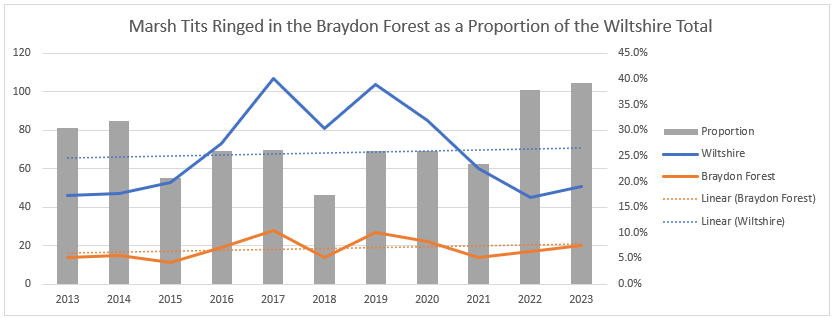
Having had the population of Marsh Tits in the Braydon Forest described as “insignificant” prompted me to have a look at the data to see just how insignificant it is. I have looked at the years 2013 to 2023 inclusive. 2013 was the first full year that I had data for the five sites I survey in the Braydon Forest (Firs Wood, Ravensroost Wood, Red Lodge, Somerford Common and Webb’s Wood) and 2023 is the most recently published ringing totals from the BTO. When I compare the numbers ringed for the Braydon Forest against the numbers ringed across the whole of Wiltshire, I get the following:
When I graph that up:
The trend lines are positive for both the entirety of Wiltshire and the Braydon Forest. It could be argued that the 2017 and 2019 spikes distort the picture, but those spikes are much less prominent within the Forest and 2018 was a significantly poor year. If I remove those three years from the chart the trend line is even more positive for Marsh Tits in the Braydon Forest.
Just for fun, I had a look at what proportion of the entire woodland of Wiltshire is covered by my five sites:
So, 26.7% of the Marsh Tits ringed in Wiltshire comes from just 0.86% of the available woodlands! Now, obviously, I am being facetious: not every woodland is covered by the ringing scheme and not every woodland is suitable for Marsh Tits. That said, at least 50% of Somerford Common is unsuitable for Marsh Tit, being conifer plantation, and I only cover about 25% of Ravensroost Wood, 10% of Red Lodge, 20% of Somerford Common and 10% of Webb’s Wood. If I take that into account, then 0.15% of the Wiltshire woodland produces 26.7% of all Marsh Tits ringed.
Thanks in part to my feedback to Forestry England, they have made the Marsh Tit their priority bird species for the Braydon Forest, and recently thinned out a huge amount of the beech, and removed much of the non-native conifers, from Webb’s Wood, and the catch of Marsh Tit, along with several other species, has improved as new understorey has generated and, quite possibly, improved feeding options.
I am not claiming that we have a huge population: I ring on average 20 new birds and process 35 individual birds per year in the five main woodlands I work in the Forest. I do claim that, in ringing terms, it is a significant Wiltshire population, especially when you consider the other woodlands it is up against: the northern parts of the New Forest and Savernake Forest and its surrounding woodlands. Savernake Forest alone, at 1,821 hectares, could swallow the Braydon Forest almost five times over! I know for a fact that bird ringing takes place in these sites, plus many more woodland sites in the north of the county, particularly around Swindon east and south, Devizes and Trowbridge.
My data shows that the Marsh Tit population is stable, that populations of Blue and Great Tits show a slight decline and Coal Tits are the ones to worry about.
I am certain that the decline of the Marsh Tit is primarily down to woodland fragmentation and management, rather as outlined in Dr Broughton’s DPhil submission referenced below. It is highly likely that nest box provision is an exacerbating factor. It is a well known fact that Marsh Tits are highly sedentary: with less than 5% of them moving more than 1km from where they were hatched, so fragmentation and deforestation will clearly have a significant impact. The five woodlands that I catch Marsh Tits in are relatively close to each other: the longest distance between my ringing sites is between Red Lodge and Somerford Common West, at 3.8km. The shortest distance is between Webb’s Wood and the Firs, at 568m. Of the 220 Marsh Tits ringed between 1st January 2013 and 31st December 2024, 121 have been retrapped at least once. Of those, only two have been caught more than 1km from where they were ringed. D983277 was ringed in Webb’s Wood on the 13th June 2014 and recovered in Red Lodge on the 24th January 2016: a distance of 3.16km. This looked like a juvenile dispersal. The other was AAL0191, ringed on 21st January 2020, and recovered in Somerford Common on the 22nd November 2023: a distance of 2.1km. More interestingly, this bird was retrapped in the Firs on the 9th October 2023 before being recovered at Somerford Common. In between, significant forestry works started in the Firs, removing all of the Ash and a large quantity of Oak (as part payment for the Ash removal) and I wonder if it moved because of the disruption.
If anybody can provide me with a link to a project, and subsequent peer-reviewed papers, which show a genuine link between feeding birds in your garden and the decline of the Marsh Tit, I will change my opinion and bird feeding behaviour, because that’s what you do when new testable, replicable data comes along!
References:
Robinson, R.A., Leech, E.I. & Clark, J.A. (2024) The Online Demography Report: bird ringing and nest recording in Britain & Ireland in 2023. BTO, Thetford (http://www.bto.org/ringing-report, created on 17-October-2024)
It has been a difficult week: a scheduled Tuesday session for the Swindon Wellbeing team had to be cancelled because of high winds, the Wednesday session for my team at Webb’s Wood cancelled due to rain, sleet and snow, Thursday because I wasn’t well and I finally got out on Friday, to Webb’s Wood. I would have been better off staying in bed: just nine birds in two-and-a-half hours of the nets being open. At least I was flying solo there and not wasting anybody else’s time. However, the distance between my ringing station in Webb’s and our ringing area in the Firs is under 650m! Both had feeding stations set up: but the Webb’s one has been up for six weeks and, although it had been emptied between topping it up on Monday afternoon, clearly the birds had disappeared. There wasn’t much birdsong either: two male Chaffinch establishing their territories, a couple of Great Tit doing the same and a Raven cronking overhead. My concern was would I find the same situation in the Firs? Essentially they are the same wood, split by Wood Lane.
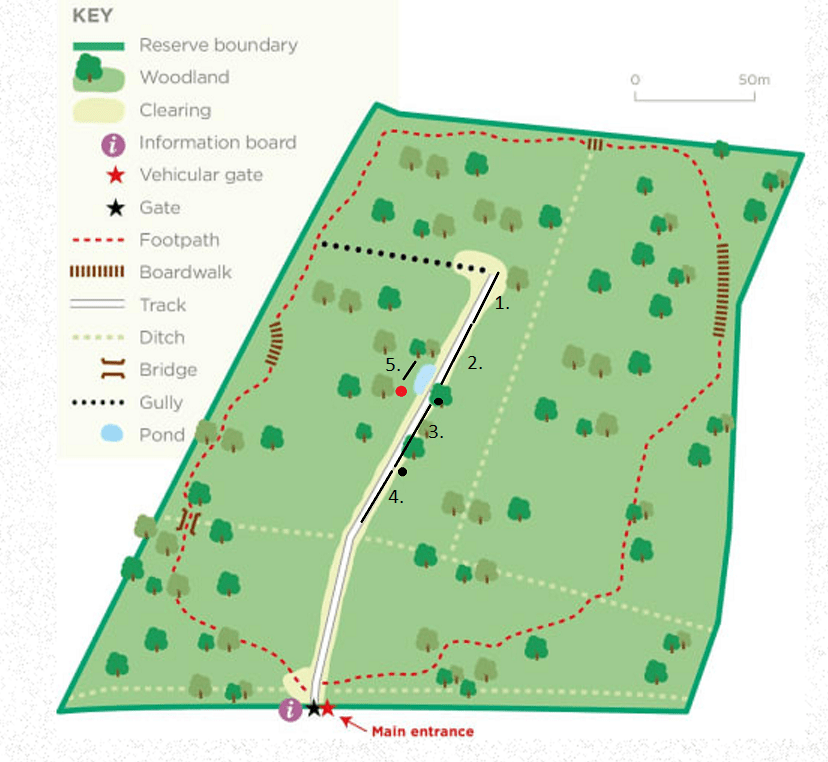
I had taken down the feeding station at the Firs six weeks or so ago, because positioning it at the top of the hill hadn’t worked: after a week of sitting there a few peanuts had gone and no seed. To try and encourage some birds in for the scheduled ringing demonstration I set three feeders in the central glade down by the two ponds on Monday. Topping those up on my way back from Webb’s Wood yesterday, I was pleased to see that the peanut and one of the seed feeders had been emptied, and the other seed feeder was half empty. That looked promising only, since I was last there the Trust have cleared a huge amount of the bramble scrub and straggly trees down the left side of the glade to open up the area around the ponds. This has opened the glade by another 1.5m. I realised that I would have to change my net layouts to accommodate those changes and the feeders.
I was joined for the session by David, Laura, Adam and Ellie and we set the following nets:
Map from the Wiltshire Wildlife Trust website
We arrived on site at 6:30 and set the nets and then set up the ringing station in the area just inside the woodland by the main entrance. Robin Griffiths, the organiser arrived just before 8:00 and the attendees were all on site by the agreed starting time of 8:30. Fortunately, we had birds already waiting for them from the second net round. Generally, ringing demonstrations are a question of me demonstrating, with my team doing all of the grunt work, extracting the birds and bringing them back to me at the ringing station. Fortunately, we managed to get a few birds in before the start, so they did get to ring a couple before the demo started. Later on in the session we had more than enough birds for me to demonstrate and for the team to get some more ringing done.
As ever, the demo was a sell out, with 20 attendees, scheduled but one was a late drop out. The weather was, on the whole, pretty good: intermittent sunshine and very little wind. It did get cold when the sun went behind the clouds, but very warm when it came out again. The attendees were a lovely bunch, very enthusiastic, all up for the challenge of being bitten by Blue Tits! (I told them I would put that into the blog.) It was great that we could provide them with a decent range and number of birds. As ever, I started by explaining about the ringing scheme, what we do, why we do it. Then I spent the time showing them birds of different species, ageing, explaining the age codes, sexing and breeding condition, weighing and wing measuring.
We had birds coming in on every round, so there was no lull in the process. What is more, apart from the obligatory Blue Tits, we were catching different species on a regular basis. The team got to process a bird that has been scarce for us so far this winter: we caught three Redwing in net ride 2. They were processed by Laura, Adam and Ellie: the first for Adam and Ellie. We catch very few of them in the Firs: just 19 in the last 10 years prior to these three, which is why I gave them to the team to process.
The list for the session was: Great Spotted Woodpecker 1; Nuthatch 3(1); Blue Tit 13(3); Great Tit 1(2); Coal Tit 2; Marsh Tit (2); Long-tailed Tit 1; Dunnock 2; Robin (1); Redwing 3; Blackbird 2; Goldcrest 2(1); Chaffinch 2. Totals: 32 birds ringed from 11 species and 10 birds retrapped from 6 species, making 42 birds processed from 13 species.
The attendees enjoyed all of the birds but the first “wow!” moment for them was the first Nuthatch. That turned into four of them, and that is exciting for me because we have only ever caught more than that in the Firs on two occasions in 13 years! The Long-tailed Tit and Marsh Tits were also audience favourites: all topped off with a beautiful, if incredibly noisy, male Great Spotted Woodpecker.
There was some excellent birding as well. First we had a Red Kite skimming the tops of the trees for a good 10 minutes or so, later that was followed by a trio of Ravens flying overhead, then we had a couple of Red Kites and Buzzards soaring in a thermal and then Red Kites, Buzzards, Ravens and at least 50 Jackdaws soaring so high up it became hard to make them out even with binoculars. We were rather surprised that there was such a strong thermal: it just didn’t feel that warm at ground level.
The session was scheduled to finish at 11:30 and the birds played ball: I sent the team off to do a last round and close up the nets and they came back empty handed. We said our goodbyes to a very appreciative audience, most of whom were asking when the next demo would be (5th October at Blakehill Farm) and we then started to take down and pack away. It didn’t take long and we were off site by 12:15. I would like to thank the Swindon Wildlife Group for their continuing interest and support.
I was joined for the morning by David, Laura, Adam, Mark and the second of my new recruits, Emma. We met at 7:00 but, I have warned them, we will have to be starting at 6:00 very soon, as we were out setting up in full daylight.
Back when I started my personal ringing in Ravensroost, in August 2102, I would catch 700 to 900 birds a year. Between 2017 and 2020 inclusive, it fell to 500 to 600 per annum. Since then it has fallen to between 200 and 300. We have had some very disappointing sessions there since 2020, with the exception of a near solo session in October 2022. This winter we have had four full visits prior to today and, despite the feeding station being in place, have averaged only 28 birds per session: 20 ringed and eight retrapped.
In an effort to improve the catch, on Tuesday of this week I moved the feeding station from Ravens Retreat into the wood proper, to set up the following net rides:
With two teams net setting, we had the nets open by 8:00 and started catching immediately. As expected, the catch was dominated by Blue and Great Tits. However, it was a much more interesting catch than that would imply.
In the blog on the Red Lodge session for the 27th February I was commenting on how we had a good start to the year with ringing Marsh Tits. Today it got better: we ringed two more and processed two additional retraps. When I look at the Q1 statistics for our catches in each year so far, we have already exceeded the best total ringed in the Braydon Forest in Q1 for any year, we are only four retraps away from matching the best total of recaptured birds in that period and we have already exceeded the biggest total of ringed and retrapped Marsh Tits for Q1, with another 23 days, probably four woodland sessions, to go!
It has also turned out to be a pretty decent Q1 for Nuthatch:
Our best Q1 total since 2020, although we have to catch and ring another three to match the best Q1 for ringing, in 2023. Who knows? At Webb’s Wood next Wednesday and the Firs the following Saturday, could enable us to match or pass that total ringed.
The catch today was: Great Spotted Woodpecker 1; Nuthatch 2(2); Blue Tit 14(7); Great Tit 9(12); Coal Tit (3); Marsh Tit 2(2); Dunnock (2); Robin 1(1); Chiffchaff 1; Goldcrest 1; Chaffinch 1. Totals: 32 birds ringed from 9 species and 29 birds retrapped from 7 species, making 61 birds processed from 11 species.
There should have been 33 birds ringed from 10 species, 62 birds processed from 12 species, but one of the team, who will remain anonymous to spare their blushes, but who daren’t take their top off until the scars from the flogging have healed, managed to let the only Redpoll we have caught this year go, without ringing or processing it. The last catch was five at Somerford Common back on the 14th December. I start every session since then with “hopefully we will catch some Siskin and Redpoll” and finish disappointed!
The most surprising thing was the Great Spotted Woodpecker. Every ringer knows that they scream the place down, as if they are being murdered, when you try to extract them, ring them and measure them. This bird, a female, did not make a peep at any stage. She was feisty enough, pecked Adam continually whilst he was measuring her, and flew off strongly on release. I have never come across such a quiet Great Spotted Woodpecker. Can one get mute birds (don’t, just don’t)?
Emma started her ringing career this session and, impressively, was spot on with measuring the wing-lengths of the Nuthatch, Great and Blue Tits that she processed. Not that easy when a Blue Tit is biting your fingers at every opportunity. It usually takes people a few sessions to get that accurate, but I checked each bird and didn’t have to change a single measurement record.
The catch dropped off at 10:30, with just a couple of birds for the next few rounds so, at 11:15, we started closing the nets, leaving the feeding station nets until the end, and processed a couple more birds, so finally got everything packed away and ready to leave by 12:15.
We did have one interesting interlude, which I missed: a female dog walker shouted at Laura, Mark and Adam, something like: “I see the bird catchers are here again, I hope you are happy!”. Apparently, from her tone, they didn’t think she really meant it! If she’s reading this: yes, we were!
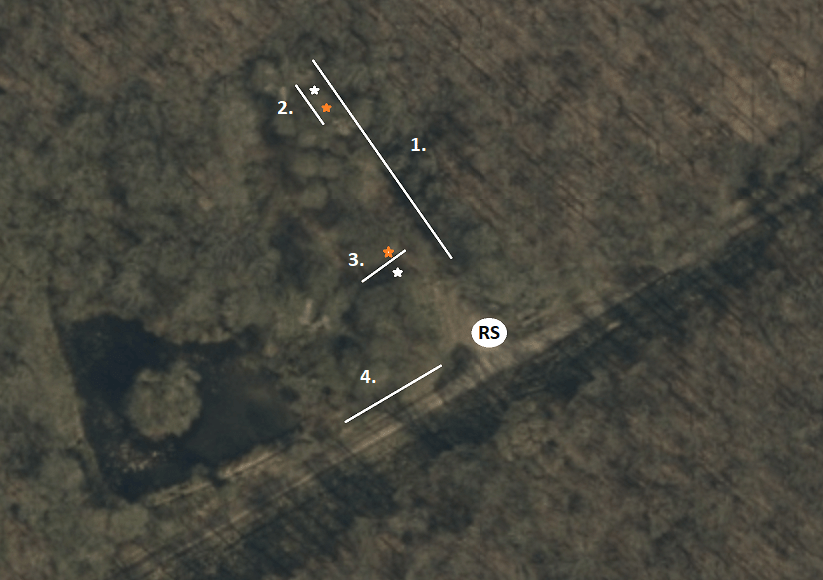
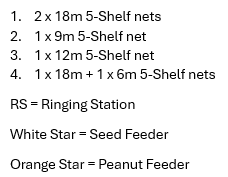
I was joined for this morning’s session by Laura, Miranda and, for her second session, Ellie, my newest trainee. It was very cold when we arrived on site, not sub-zero but, unlike some of the sub-zero days that I have been out, it felt colder. I had hoped to get to Blakehill Farm but, although the forecast was for the day to warm up, it also said the wind would gust up to 20 mph, so I had to decide on a woodland site. The Firs is next on the list but the Braydon Bog is just too wet and muddy for me at the moment, so Somerford Common West was next after that on the list. We met at 7:00 and set the following nets:
The white dot in the middle of ride 2 is the feeding station: one 1l peanut feeder and one 1.5l seed feeder.
The birds started arriving as soon as the nets were open. For the first two hours Laura and Miranda processed the birds. To get Ellie comfortable, each bird was handed to her after processing, so that she could release them. Miranda had to leave at 9:30 so I took the decision to start Ellie’s training in processing birds: species identification, ringing or reading already ringed birds, ageing, sexing, including assessing breeding condition at this time of year, maximum chord wing length and weighing. The first bird she ringed was a Nuthatch.
It was a pretty predictable catch: mainly Blue and Great Tits. To be honest, my main motivation for going to this site is that it is where I had my last decent haul of Siskin. That was in March 2022, so I was hoping we might get the odd one. Unfortunately, we didn’t get any. The one finch we did catch was a lovely male Chaffinch. Only we couldn’t ring it. Although its legs looked clean, the back of the legs showed signs of insipient Fringilla papillomavirus: a dull off-white layer. I wasn’t prepared to take the risk, and also thoroughly disinfected my hands once it was released: no cross-contamination.
It wasn’t a busy catch, which worked well for enabling Ellie to work without the pressure of numbers and for me to spend some time with her. In total we caught and processed the following: Nuthatch 2(1); Blue Tit 6(2); Great Tit 3(2); Coal Tit 1(2); Long-tailed Tit 2; Robin 1(1); Goldcrest 2. Totals: 17 birds ringed from 7 species and 8 birds retrapped from 5 species, making 25 birds processed from 7 species. Unfortunately, no Great Spotted Woodpeckers: although there was plenty of drumming going on. We had a Blackbird bounce off the nets as well.
The catch fell away after 10:30 and we decided to start packing up at 11:00. A few more birds got caught whilst we were taking down, so we didn’t get finished packing away and off-site until 12:30.






 , and the below quote, which I think every academic should have displayed prominently in his or her office, comes to mind:






 Ringing In The Braydon Forest & Beyond