Some Extra Thoughts on the Wiltshire Redwing Record

The following information has been provided to me by Rob Turner, retired Bird Recorder for Wiltshire and a senior member of the West Wilts Group and Phil Deacon, Wiltshire Ornithological Society committee member and senior member of the North Wilts Group.

Rob sent me the following: “Having been intrigued by Jonny’s record, I thought I’d have a quick trawl through the literature and the web.

The extreme dates for Wiltshire are 5 at Devizes 21 August 2018 and a single at Fyfield, 21 May 1978. (Hobby 48 , Wilts Bird Report 2021 p79.)
The ‘Birds of Wiltshire’ p575, final paragraph records a probable but unconfirmed breeding record at Coate Water area sometime between 1868-77. It does say: ‘Although no other British nesting records are known before the 1920’s the now regular population in Scotland and the odd instances of breeding in English Counties in the last 3 decades of the 20th century lends support to the account.’

Current BTO estimates are 50-100 pairs mostly restricted to Scottish Highlands and as far north as Shetland and a few as far south as Kent. As always with extreme records of migrants its always difficult to surmise which way the bird is going, is it a late departure of a wintering bird or an early arrival of a failed breeder!”

Phil noted: Nearest ringing record I have is one at Potterne on 13 May 1986. This bird was ringed at Spurn Point on the 11th October 1985. We get very few Redwing retraps: of our catch of just under 3,500 Redwing, there have only been seven retraps, but four of them were retrapped in the same winter after ringing. Only one of our records is from a bird retrapped at the same site in a subsequent winter. This was RL61400: ringed in Ravensroost Wood on the 28th December 2016 and retrapped at the same site, in the same net, on the 6th January 2018.

He also noted about Jonny’s photo of the bird: “An outstanding record, I have seen the photo, no CP or BP so a non-breeder, may not have been fit enough for the return migration.”

Andrew Harris, an experienced ringer from Kent, did remark upon the body weight of the bird: considerably more than the normal ranges for the species. The BTO’s BirdFacts has the weight range as being 55g to 84g. Our own records have a dozen Redwing weighing in at 80+g but this is the first with a weight of over 90g. Jonny has checked his records from the session and is 100% confident that the weight entered is accurate. It wasn’t challenged by the online data entry system, which has built-in extreme parameters. If it falls outside of the ranges it prompts you to confirm the value, with a comment to justify it. It didn’t do that because, if it had, the comment would be attached to the record.

I have to mention that Jonny also has another Redwing record: the longest known movement of a Redwing retrapped in the UK. On the 2nd November 2022 he retrapped a juvenile Redwing that had been ringed in the nest at a place called Rautalampi, Pohjois-Savo, Kuopio, Finland. It had flown 2,126km to land at a farm just outside Chippenham! There are longer movements of birds ringed in the UK and recovered elsewhere (usually shot by some ne’er-do-well with no respect for wildlife).

A Remarkable Redwing: Langford Lakes, Wednesday, 12th June 2024

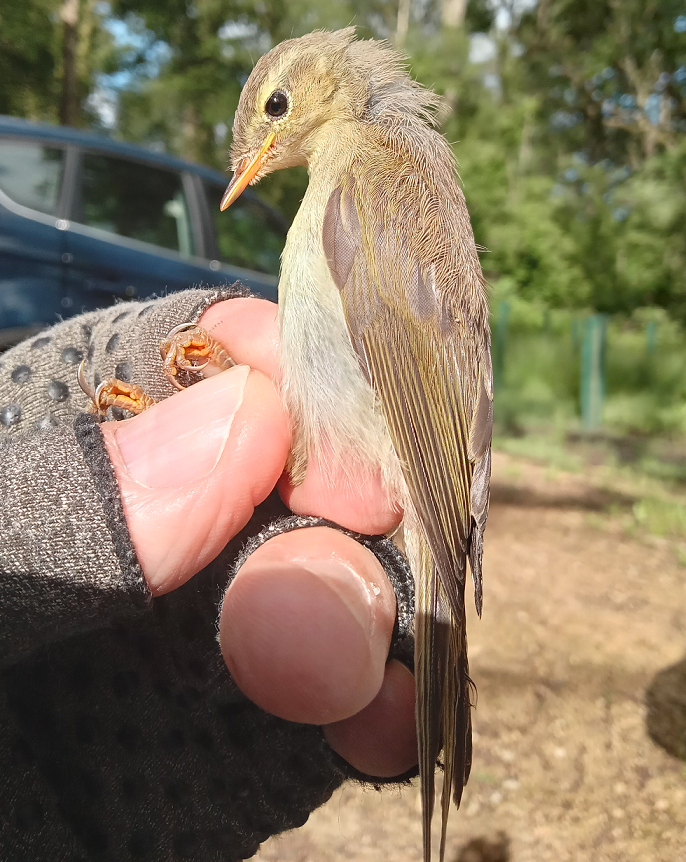
Jonny Cooper was carrying out a ringing session at the Wiltshire Wildlife Trust reserve at Langford Lakes this morning. Checking the nets he came across this in one of his nets:

Redwing, Turdus iliacus

This winter visitor seems to have failed to make the move northwards. I have checked the group records and we have recorded 3,475 encounters with Redwing since the year 2000. Prior to Jonny’s catch today the latest record we had for an encounter with a Redwing was on the 28th March 2019, by me, at Tedworth House.

This bird is a second year bird, i.e. fledged in 2023. It had wing length of 117mm and weighed in at 97.9g. Both are well within normal ranges for this species. Unsurprisingly, it showed no sign of breeding condition. One can only speculate on the reasons for this bird having failed to migrate. Perhaps it failed to put on enough weight over the latter months of the winter, who knows?

This really is a remarkable record. I would love to know if there are any later records for England or, indeed, any confirmed records of over-summering Redwing in England.

Ravensroost Marsh: Wednesday, 12th June 2024

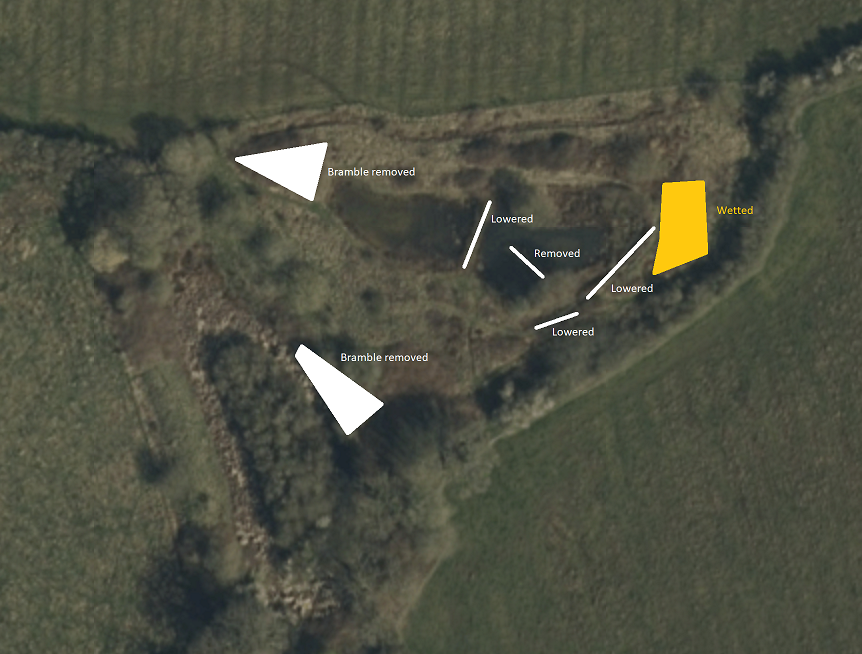
This time last year I would have titled this “Ravensroost Pond” or “Ravensroost Meadow Pond” but someone (I haven’t established who yet: the Ravensroost volunteers, the Wildlife Trust staff or contractors) has carried out a phenomenal amount of work at the site. They have removed bunds, moved paths, removed a massive overgrowth of bramble, expanded the main pond, lowered the causeway, removed the spit, and created several additional wet areas adjacent to the pond.

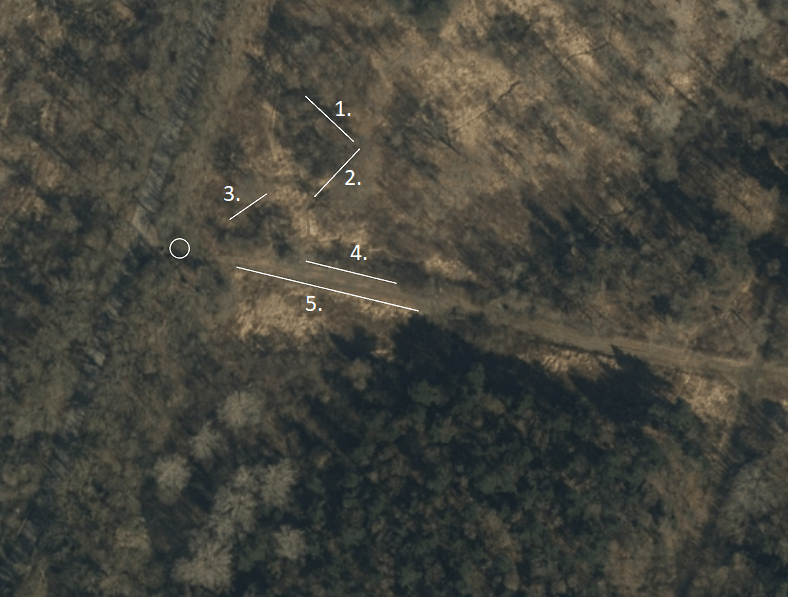
The change is stunning and, I am pretty sure, for the better. However, I am going to have to rethink my net positions to take advantage. Today I used some fairly standard positions – but I think the changes have had an adverse effect on them. Not a complaint, the changes were necessary (and overdue) but an observation, and something that I am happy to sort out, just not at 5:00 in the morning before I have had any coffee and needing to get the nets open anyway.

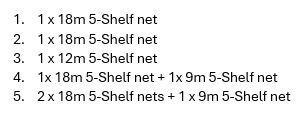
Bearing in mind the changes mentioned are not reflected on the aerial photograph yet, these were the net positions used today:

I was joined for the morning at 5:30 by Laura and Teresa. We had the nets set by 6:30 and the first birds were caught at 7:00. It was a very slow morning, with just one or two birds caught during most rounds. However, it was a decent variety within the catch: only 16 birds caught but from 10 species. The list for the morning was: Blue Tit 1; Great Tit [1]; Wren (1); Dunnock 2; Robin (1); Blackbird 1; Blackcap [2]; Whitethroat 1; Chiffchaff 1[4]; Willow Warbler 1. Totals: 7 adults ringed from 6 species, 7 juveniles from 3 species and 2 birds retrapped from 2 species.

The Blue Tit had clearly finished her parental duties: her brood patch had just started to feather over and she had started wing moult: seven retained primaries and then one each at stages 1, 2 and 3. The Willow Warbler was also female and, whilst still showing a strongly veined brood patch, had also started wing moult: eight retained primaries and then one each at stages 1 and 2.

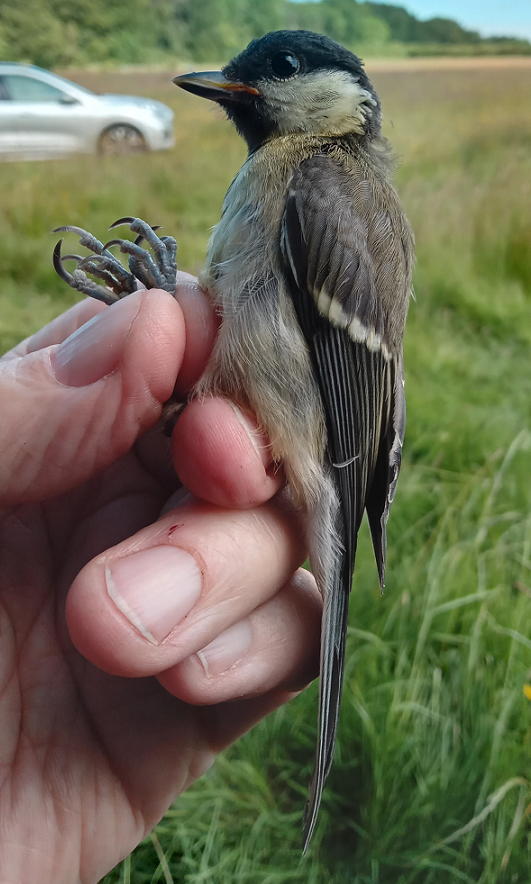
We caught our first juvenile Great Tit of the year:

Great Tit, Parus major

In amongst the juvenile Chiffchaff was this one:

Chiffchaff, Phylloscopus collybita

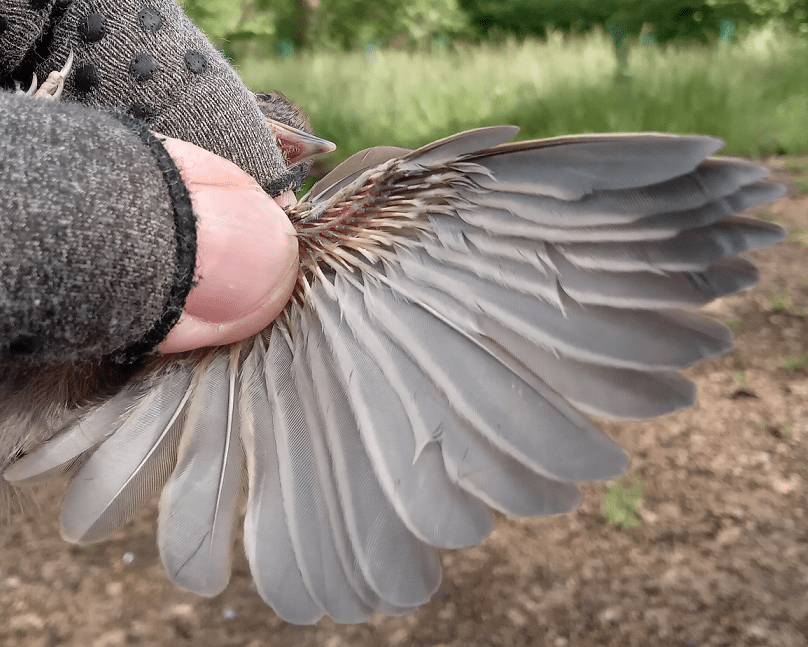
Biometrics, wing structure and wing formula were all 100% f0r Chiffchaff but I cannot say that I have ever seen such muted markings on a recently fledged juvenile.

The place was alive with insects, so it was a little surprising that we didn’t catch more insectivorous birds. I think that this was my favourite insect of the morning though:

Swollen-thighed Beetle, Oedemera nobilis, on Ox-Eye Daisy, Leucanthemum vulgare

There was a lot of birdsong and a few other birds flying around: a solitary Swallow made an appearance over the adjacent meadow. The most interesting interaction of the morning was a Buzzard being mobbed by a solitary Jackdaw until the Buzzard decided it had had enough, executed a pretty acrobatic wheel to get behind the Jackdaw and give it a hard tine until they both disappeared into the wood.

However, the best sighting of the morning belonged to Laura. On her way back from a check on the nets she came across a Grass Snake. Unfortunately, they move very fast and it had disappeared by the time she managed to get the camera app on her phone loaded. Shame!

The weather stayed fine throughout. Forecast showers for 10:00 did not materialise, although we did have a very large, very black, cloud move slowly overhead at about that time, but it did not drop a drop.

We shut the nets after the last round at 11:30, took down and left site by 12:20. A quiet but reasonably satisfying session.

Short But Sweet: Somerford Common; Saturday, 8th June 2024

With the forecast being for it to be a bit breezy I decided to try something a bit different at Somerford Common. I warned the crew that it might not work, but David, Laura, Adam and Daniel joined me regardless. We met at 5:30 and went to the winter feeding station / CES area and put up a rather different set of nets:

We had the nets open quickly and then waited for some birds to arrive. The first birds hit the nets at 6:45: two Chiffchaff and a Willow Warbler. The next round produced another three birds: two Willow Warblers and our first Garden Warbler at Somerford Common for three years at this site. Whilst we were processing these, the moisture that had made its way into the air turned into a fairly heavy rain shower, so we shut the nets and sat in the cars until it stopped.

Once we reopened the nets the birds had really just disappeared: plenty of song, not a lot of movement. Between 8:15, when we reopened the nets and 10:00, when we shut them again, we only caught another six birds. The list from the day was: Garden Warbler 1; Chiffchaff 4; Willow Warbler 5(2). Totals: 10 birds ringed from 3 species and 2 birds retrapped from one species, making 12 birds processed from 3 species.

What was pleasing about this small catch was that three of the Willow Warblers were females: looking forward to finding some youngsters in due course. Unfortunately, just before 10:00 the rain started to fall again. This time it was heavier and the sky overhead was looking threatening so we decided to shut the nets and take down. Naturally, there were a final couple of birds in the nets, so they were processed by Adam and Daniel, whilst Laura and David started taking in the nets.

The last bird out of the net, LXL255, is a Willow Warbler male but, not on our rings. It will be interesting to see where it was originally ringed.

We were off-site by 10:30: just as the rain stopped, the clouds broke and the sun came out again. Too late!

Nest Checking: Thursday, 6th June 2024

A bit of variety today. It started at 8:30 this morning at Clattinger Farm. I met up with Rosie and we checked on progress to date. All of the nest checking and bird ringing that I do is under licence from the British Trust for Ornithology. The Barn Owl checking I do has an additional schedule 1 licence issued by the BTO on behalf of Natural England and DEFRA.

Last year was a successful first year checking at Clattinger: we had seven Swallow nests in the old stables and woodshed. Two were predated, one was abandoned, but the other four successfully produced twelve fledglings. We also had two successful Blackbird nests, with seven young fledged, one House Sparrow nest that successfully fledged three young and one Robin nest that also successfully fledged three young (it made its nest in a plastic box in the tool shed that used to hold screws).

This year has been a little slower: we checked on one Blackbird nest that was empty and two Wren nests that were also empty. As all nests were intact with no signs of damage, so we are pretty confident that they are first broods that have fledged.

The number of Swallows, so far, and, therefore, the nests, is currently much lower than last year: just three nests established so far. One had two young which were large enough to ring. Another nest had four warm eggs and the third had three young that are too small to ring yet. We will do them in a week’s time.

There does now seem to be far more Swallows flying around the site than the number of nests represent. Hopefully, when we come back in a week, they will have started to nest. Whilst watching what was going on we saw a Great Spotted Woodpecker trying to get at the House Sparrow nests. I suspect it will find it hard, as they are nesting in holes in the building walls. The building is very old but I am still not sure that a Great Spotted Woodpecker bill is designed to be a masonry drill.

We finished up at just after 9:15, so Rosie and her sidekick, Ellie, could get on with their paid work for the Wildlife Trust!

I spent the rest of the morning with one of my new raptor trainees, Justine, helping her get to grips with the online data entry system, DemOn. Once we finished that, we headed off to Waterhay to the farms there to check on the Barn Owl boxes there.

There were three boxes on site and every year between 2019 (when I took over checking the boxes) and 2022, two of those boxes would successfully produce Barn Owl young. In 2022 we put up a fourth box and then in 2023 we had no Barn Owl broods at all, but one Jackdaw brood ringed and the two other original boxes had clearly had Jackdaws nesting there. So I was little trepidacious as to what we would find.

The Chancel box had some nesting material in it, a few Barn Owl feathers as well, but no sign of anything nesting, and the lack of pellets suggest that it is not being used as a roost by them. The next box, in the fields to the south west of the farm, was much more encouraging. When visiting a box, one of us will hold a large hand net over the entrance and exit hole, just in case there is an adult in the box. We were lucky: a female Barn Owl flew out and straight into the net. She had not been ringed, so we ringed her, weighed and measured her, and she flew off around the field before landing in a tree close by. We weren’t by the nest for long: there were three small downy chicks and one warm egg in the box. I will revisit in three to four weeks to check on progress and ring the chicks.

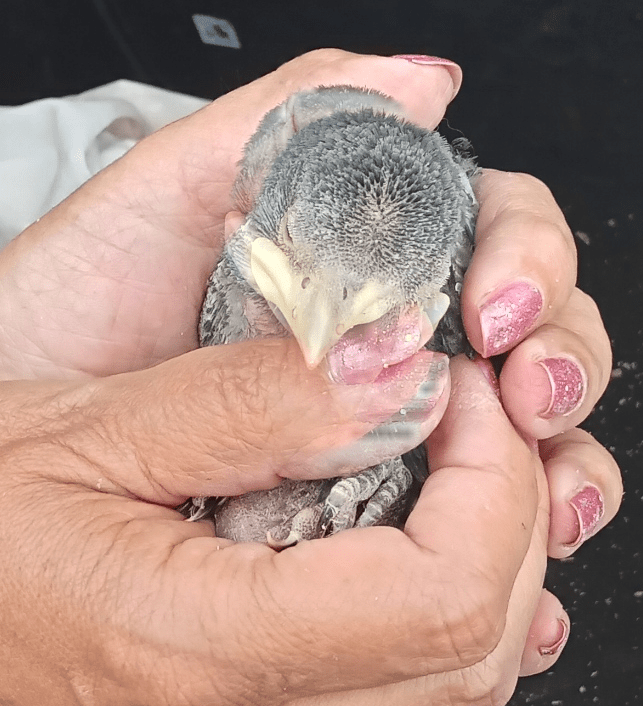
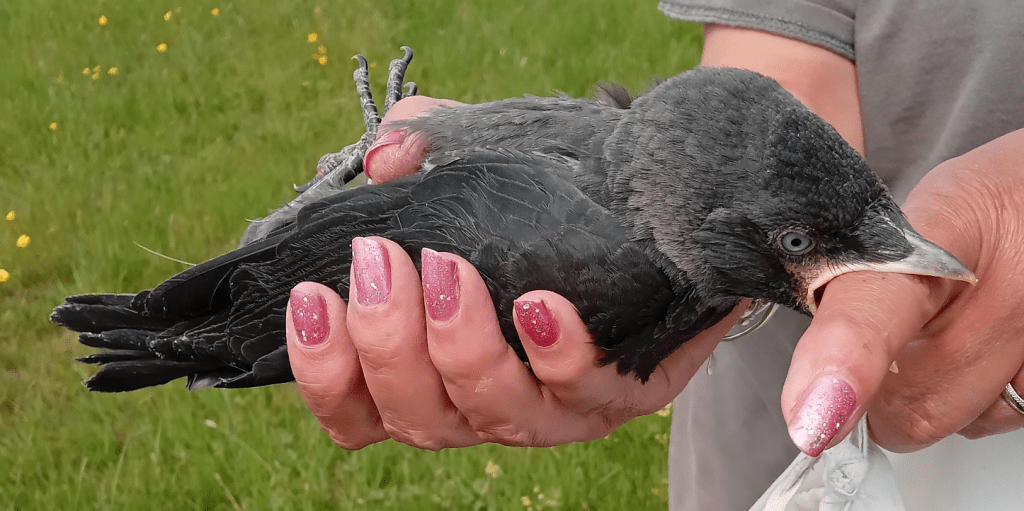
As we approached the next box an adult Jackdaw flew out and, needless to say, inside the box were three Jackdaw chicks. At this age, no matter what the species, the young tend to remain sleepy; if not being fed then why waste energy:

Jackdaw pullus, Coloeus monedula

The last box we checked lies to the east of the farm. This one also had Jackdaw chicks in it. These are much further advanced:

As you can see, it was delighted to get its bit of bling. These will fledge in the next week or so. After they have fledged I will clean out the box and hope that it will be used for second brood Barn Owls.

These four were all that I planned to do for today and I am pretty happy with the results so far. The best thing about this afternoon, apart from the Barn Owl brood, was that the fields have dried out sufficiently for my car to access them. It might be a 4×4 but it is most definitely not an off-roader. No more route marches with all of the equipment and the ladder to get to the boxes! Hooray!

Lower Moor Farm CES 4: Wednesday, 5th June 2024

On site for 5:50 this morning. I had Andy to help me set up and Teresa to help me with extracting and processing the birds. We set the usual CES nets but left it at that as there was only the two of us. Although we are in June the weather was cold. Even when the sun came out there was a cold breeze blowing through the site. Not breezy enough to bother the nets but cold enough for me to keep my fleece on all morning! (What a wimp!)

The catch was slow all morning: possibly because it was so cool. The most we had was three birds in a round, but we did get at least one bird in every round. First bird out of the nets was a juvenile Robin but then it very quickly became Blackcap town. Of the 24 birds caught, 11 were Blackcaps. Although we did see small groups of Blue and Great Tit around the area, not one ended up in our nets! The actual list for the morning was: Treecreeper (1); Wren (1); Dunnock [1](2); Robin 1[1](1); Song Thrush 1; Blackcap 3[5](3); Chiffchaff [2]; Willow Warbler 1(1). Totals: 6 adults ringed from 4 species, 9 juveniles ringed from 4 species and 9 birds retrapped from 6 species, making 24 birds processed from 8 species.

Compared to last year’s result of 29 birds from 13 species, the reduction in diversity is quite marked: Green Woodpecker 1; Great Tit 1(2); Long-tailed Tit 4[3](1); Wren 2; Dunnock (1); Robin [2]; Blackbird (1); Cetti’s Warbler (1); Blackcap 1(1); Chiffchaff 1[1](3); Bullfinch 1; Reed Bunting 1. Totals: 12 adults ringed from 8 species, 6 juveniles ringed from 3 species and 11 birds retrapped from 7 species, making 29 birds processed from 13 species. However, the proportional number of juvenile birds is somewhat lower. It will be interesting to see how things compare in the next session (7 adults ringed from 6 species, 22 juveniles ringed from 7 species and 9 birds retrapped from 6 species, making 38 birds processed from 12 species). Most of the juveniles in that session were either Blue Tits (8), Great Tits (3), Long-tailed Tits (5) and Robins (3) – all of which, bar Robin juveniles, were missing from our catch today!

Andy returned at 11:30 to help us pack away. We closed the nets at 12:00 and took down, with everything done by 12:30.

Ravensroost Wood: Saturday, 1st June 2024

With the weather forecast to be dry but breezy, I decided to head to what is normally my most reliably wind-proof site, Ravensroost Wood. I was joined by Ellie and David plus, before heading off to work with the children in the Wildlife Trust’s Watch Group, Rosie and her ne trainee, Ellie. We set our normal nets: 3 x 18m nets to the left of the main path and 5 x 18m + 1 x 9m nets to the right of the main path. Even before we had the nets open, the nets to the right of the path caught a Wren and a Chiffchaff! Unfortunately, in terms of the rest of the session, they were the only birds that counted from that ride. A couple of our other catches did decide to fly straight back into those nets once processed. However, the wind got very fierce, very quickly and that ride was particularly affected, so we had to shut the nets to ensure that no injury befell any of the birds. It was somewhat frustrating as that ride was alive with birdsong.

The nets to the left of the main track were not affected in the same way and it was safe to leave them open. We didn’t have a spectacular catch, on a par with recent sessions in this wood, but what was unusual about it was that, after we had so many newly fledged birds from a good number of species in the Firs on Wednesday, the only young bird we caught was a juvenile Robin. It was a varied, if small, catch. Rosie got to ring a few birds before heading of to work with her Ellie, which made a nice change for her.

The first two birds out of the nets, once fully opened, were a pair of Bullfinch. In the same net, close together, almost certainly a pair, confirmed by the fact that we held them back to be released together after processing (a few seconds, as they were processed simultaneously) and they flew off in the same direction. The female flew straight back into one of the nets, and the male stayed close by waiting for her until she was released (released immediately, I might add).

We weren’t exactly rushed off our feet, so we had lots of time to look at other things. I one thing we did see was that there were plenty of birds flying around both net ride areas. Probably more on the side where we had to shut the nets. There were some very attractive insects around, but no butterflies! There was this rather lovely longhorn moth:

Nemophora degeerella (photo courtesy of Rosie Wilson)

The antennae are astonishingly long – proportionately the longest, as a percentage of body length, in the UK’s moth fauna.

The list for the day was: Blue Tit 1(2); Wren (1); Dunnock 1; Robin 2(1); Blackbird 1(1); Blackcap 3(2); Chiffchaff 1; Chaffinch 1; Bullfinch 2. Totals: 12 birds ringed from 8 species and 7 birds retrapped from 5 species, making 19 birds processed from 9 species.

As we had closed the nets on the right-hand side, we could take them down whilst still monitoring the open nets. We closed the final nets at 11:30 and were off-site by before midday. Not a great session but good company, good chat and some nice birds.

West Wilts Ringing Group Results: May 2024

Quite an astonishing month. Last year was our best May to date, thanks to Jonny’s new found enthusiasm for monitoring nest boxes, besides Barn Owl boxes. This May dwarfed last, primarily because of the phenomenal work that Jonny continues to carry out, alongside his full time job.

image.png

The numbers, once you exclude the pulli, are fairly evenly matched, although in fewer sessions.  Added to the list of non-pulli this year are Barn Owls, Coal Tit, Grey Wagtail, Kingfisher, Spotted Flycatcher, Stock Dove and Woodpigeon.  Missing from last year were Dipper, Magpie, Mistle Thrush, Nuthatch, Rook, Skylark, Swallow and Swift.  However, the Magpies, Rooks and Swifts were all ringed at the RSPCA Oak & Furrows Rehabilitation Centre, rather than wild caught.  

It is always interesting to compare numbers year on year. In terms of summer visitors, Blackcap and Chiffchaff numbers were significantly up, whereas Garden, Reed and Sedge Warbler numbers were significantly down.  

Looking at the pulli numbers, the most astonishing increase is in the number of Blue (286 to 82) and Great Tit (105 to 21) chicks ringed.  Added in to the list are the Tree Sparrow nests that Jonny has taken over from the previous ringer, not part of our group, plus two Lapwing chicks, identified through the Project Peewit monitoring scheme that he is managing through his job at the Wiltshire & Swindon Biological Records Centre.  The second ringed was by Aurora near Shalbourne. She is working with Jonny at the WSBRC: image.png

Missing from the nestling list this year are Swallow chicks.  They do seem to have arrived later this year, in fewer numbers and, whilst Rosie is keeping an eye on their progress at Clattinger Farm, they are still either nest building or are still at the egg stage.  Hopefully things will perk up in June.  We have had a reasonable start to the Barn Owl nesting season, with our first brood ringed and three adults captured: one ringed, one retrapped in close proximity to where it nested last year and a control male that we think is the mate of the retrapped female.  There are a number of clutches to be ringed in June plus two broods of Jackdaw, so far.  Getting to some of the boxes has been a challenge as, due to the weather, many fields are impassable, so route marches are the order of the day.

Barn Owls in the Braydon Forest: Part 2

Two more sessions checking on our owl boxes in the Braydon Forest: the first on the 24th May, the second a week later, on the 31st May. As always, these visits are carried out under a Schedule 1 licence issued by the BTO, on behalf of Natural England and DEFRA. I also have an endorsement on my licence that allows me and my team, when with me, to process any adults we catch whilst carrying out these checks.

Friday, 24th I was joined by Miranda. We were on a two hour deadline, as Miranda was scheduled to be setting up Longworth live mammal traps for a survey in her local area in the afternoon. The morning started well, but there was a slight issue. Our first box is situated in an oak tree that overhangs Woodbridge Brook, adjacent to Home Farm outside of Brinkworth. On approaching the box both adults flew off. The owners of the site are totally invested in what is happening with their Barn Owls. Whenever I arrive on site I get a breakdown of the parents’ activity levels over their fields in recent weeks. They know the constraints and do not disturb the box at all. We were pretty confident that they would be breeding in the box, as they have every year since I started monitoring them. As we approached the box, I could see that the access hatch was slightly open. The catch, which was simply a bent metal pin, had corroded and broken off. Andy, one of the owners, disappeared off to make a new catch for the hatch. We tried to simply replace it with another bent pin, but it proved impossible as the broken part of the original pin was blocking the access point.. He ended up providing a small wooden bar that we screwed into the wall of the box to hold the access flap in place. Upon looking into the box I found five owlets and one remaining egg. They were not big enough to ring yet: another two to three weeks before that will be done. Unfortunately, as is always the way when you have a time constraint, we took far more time there than intended, which meant we had to curtail our activity.

Next stop was Gospel Oak Farm where we have two boxes. Both boxes last year were taken over by Grey Squirrels, much to our disappointment. The site’s owner had cleared out all of the squirrel materiel over the winter, hoping that they would not be back this year. The first box, which has previously had both Barn Owls and Jackdaws, in different years, had a lot of soft nesting material in it, but no sign of any breeding yet from any species. A lot of preparation but no result yet. The second box, which is usually the roosting site for the adult Barn Owls, held a brood of three Jackdaw chicks. They will be ready for ringing in a couple of weeks.

Our last port of call was White Lodge Farm. We only had time to visit the one box: the easiest of the four visited today. Unfortunately, the fields are so wet that we are having to park away from the boxes and carry all of our kit to them. This was the one box I could drive straight to, as it is in an oak tree in a hedgerow that lines one of the farm tracks: and a proper hard core track at that. Like box two at Gospel Oak, this box had two Jackdaw chicks in situ: both about a week behind the birds over the way from them.

So, of four boxes checked we had one looking good for Barn Owls, two with Jackdaw broods and one in development.

Friday, 31st May, was a late afternoon session so that Ellie and Jonny could join me: both being extremely busy with work. Jonny was my first ever trainee, and Ellie was my second, Jonny now has his A-permit, Ellie has her C-permit and I will put her forward for her A-permit whenever she decides that she wants to. As much as I love working with my current trainees, it is special when the three of us manage to get together. We didn’t plan to do too many boxes and started at Lower Pavenhill. This was a new box that I put up over two years ago. In year one it didn’t attract any interest. In year two I found a couple of Barn Owl feathers in the box, but no pellets or poop, so I was a little concerned about whether it was in the right place. We had the fun of a herd of some thirty horses, including a number of foals and some frisky yearlings, who were intensely interested in what we were doing. It is a good job that three of us are not bothered by large livestock as they became our entourage. Anyway, we got to the box and Jonny put his large hand net over the box, covering the entrance hole. He tapped on the box to persuade any adult to leave. When nothing happened in response, he removed the net and an owl flew out! Ellie suggested that he try again, he went to get his net when a second owl flew out! When Jonny opened the box there were three very small youngsters and an additional egg in there. Hopefully we will be ringing a brood in a month or so! It is nice to see a completely new site come online.

Our next stop was the Plain Farm / Drill Farm complex. The Plain Farm box was accessed through a field of heifers, followed by a field of milkers! Lots of cow pats to avoid, not to mention lots of very large bodies to pass through. When we reached the box, Jonny wielded his hand net to good effect: catching the adult female as she came off the nest. She was ringed by us last June, in the Drill Farm box, along with three youngsters. This year she has five youngsters and there was one unhatched egg in the Plain Farm box. As these chicks were all ready for ringing, it is likely that the egg is infertile. We did ring the brood.

Our final stop was the Drill Farm box. Again, we caught an adult as it left the box. It was a male. Our supposition is that it is probably the partner of the female at Plain Farm. More interestingly, its ring number, GY63202, is not one of ours. It will be interesting to find out where it has arrived from.

I decided that we had done enough for one evening: lots of walking over uneven terrain and an arthritic right ankle do not play well together! The season is shaping up pretty well: eight broods in eleven boxes, with another dozen boxes left to check. Let’s hope that the others are as initially successful as these first few, and that the initial success translates into fledging success!

Fledging Firs: Wednesday, 29th May 2024

With the weather forecast saying that it would be raining until at least 5:30, I arranged for us to meet at the Firs at 6:00. Unfortunately, I still woke up at 4:30 and, by 5:00, was up and ready to go. Fortunately, it had stopped raining, so I went early to site. Just as well that I did and, equally, just as well that I took my brush cutter too. The grass and bramble have shot up and across the glade, so I spent the next thirty minutes ensuring we had some room to set our nets.

At 6:00 I was joined by Rosie (doing her usual, helping set up, ring a couple of birds, go to work), Miranda, Sarah, Teresa and Andy (Andy helped with the initial setup, until the rest of the crew arrived, but then went off to work, and then came back to help pack up at 11:30). We had the nets open before 7:00 and had our first birds out almost straight away.

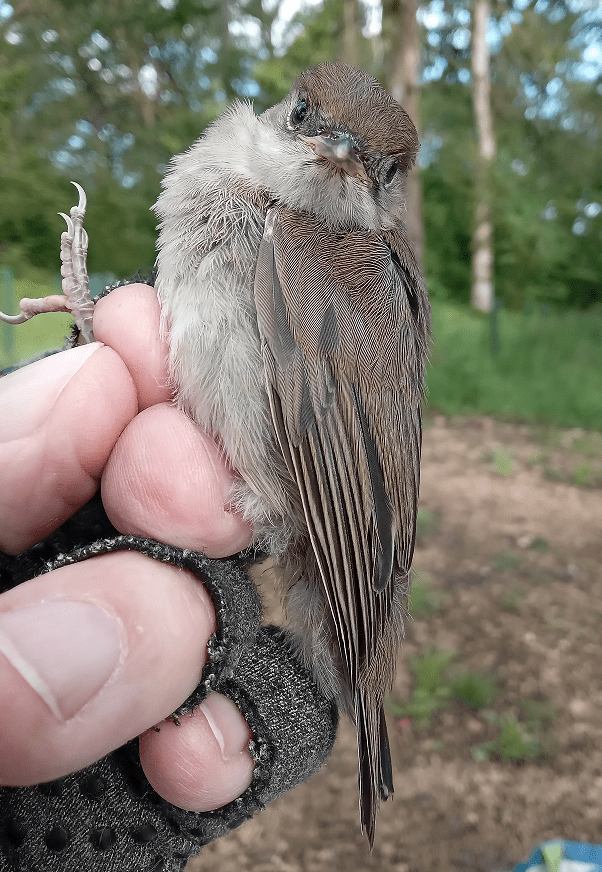
Numbers-wise, it was a reasonable session for this time of year in the local woodlands. However, in many ways it was a remarkable session. The first indicator of how the session was going to go was our third round at 8:00 when we took a juvenile Robin and our first juvenile Blackcap of the year:

Juvenile Blackcap, Sylvia atricapilla

It was a very young bird, it seemed too young to be out of the nest. Its wings were still showing a lot of pin:

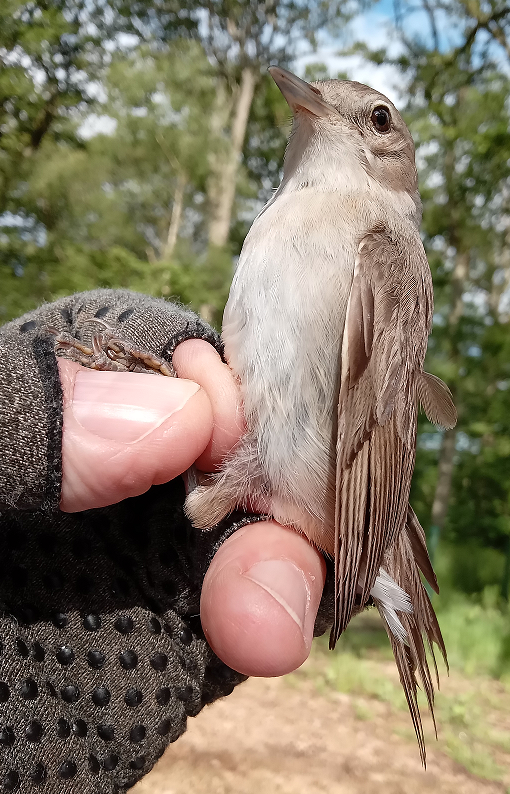
This was then followed a couple of rounds later by this:

Garden Warbler, Sylvia borin

This was only the second Garden Warbler ever caught in the Firs. The first was in June 2019. A couple of rounds later we caught another in the same net as the first. The first was a male, the second was a female with a fully developed brood patch. Hopefully there will be young this year. Their presence could be a result of two things: previous work by the volunteer group and the Ash clearance has opened the wood up somewhat and the understorey has reached that height that I think of as being optimal Garden Warbler habitat.

We then caught our first juvenile Chiffchaffs of the year:

Juvenile Chiffchaff, Phylloscopus collybita

We did have a pretty big, probably family group, of Chiffchaffs flying around the nets. We left the vicinity, to give them a chance to drop into the net. Unfortunately, only one of that group did. We might have passed the forty mark if they had all dropped in. Hard on the heels of these was our first juvenile Marsh Tit of the year. That was the one species that I was concerned might have been affected by the works that took place at the Firs over the winter of 2022 / 2023.

The list structure is: ringed [juvenile ringed] (retraps). Today’s catch was: Jay 1; Blue Tit 2; Great Tit 1; Marsh Tit [1]; Long-tailed Tit 1; Wren 1; Dunnock [1]; Robin [4](1); Song Thrush 2(1); Blackbird 1(2); Blackcap 3[2](1); Garden Warbler 2; Chiffchaff 2[6]; Goldcrest 1. Totals: 17 adults ringed from 11 species, 14 juveniles ringed from 5 species and 5 birds retrapped from 4 species, making 36 birds processed from 14 species. That is an excellent catch variety in such a small woodland.

Teresa was delighted to extract and ring her first Jay. What is more, she did it with minimal damage to herself! When she processed it I remembered to give it a pen to hold on to, to keep its feet occupied, and we kept the bag over its head to keep its beak out of harming way. If only I had remembered all of that when I ringed the Jay at Lower Moor Farm on the 15th May!

We carried out the last round at 11:20, shutting the nets as we went. It delivered a single bird. With five of us taking down we were done very quickly and off site by midday.