Ravensroost Wood: Wednesday, 21st June 2023

With reports from reliable sources of Spotted Flycatcher being seen around our usual ringing rides, I decided it was time to have another session in Ravensroost Wood. I have been reluctant of late, mainly because the catches have been rather poor, but this was inducement enough for me to arrange the session.

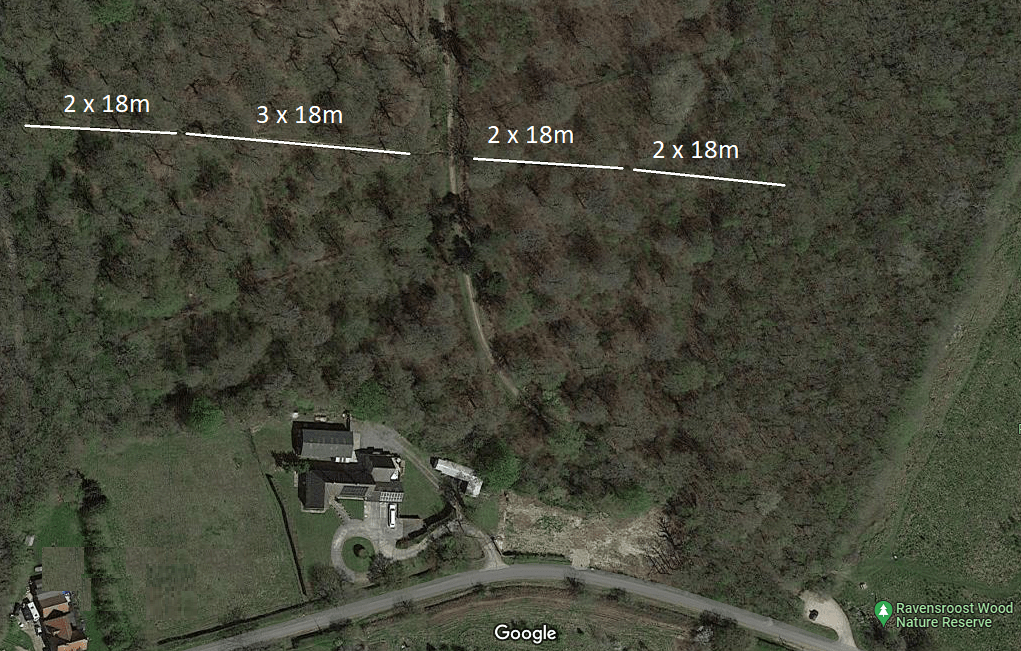
Miranda and I met at 5:30 and we set 9 x 18m nets:
First out of the nets were three Wrens: one of which was an absolute nightmare. Miranda very kindly passed it on to me (it is my own fault: the key rule I give my trainees is that, if a bird is proving too difficult for them, call me, don’t persevere and risk the health of the bird). I do rather like the difficult birds to arrive after my first coffee of the morning! We also extracted a juvenile Robin.

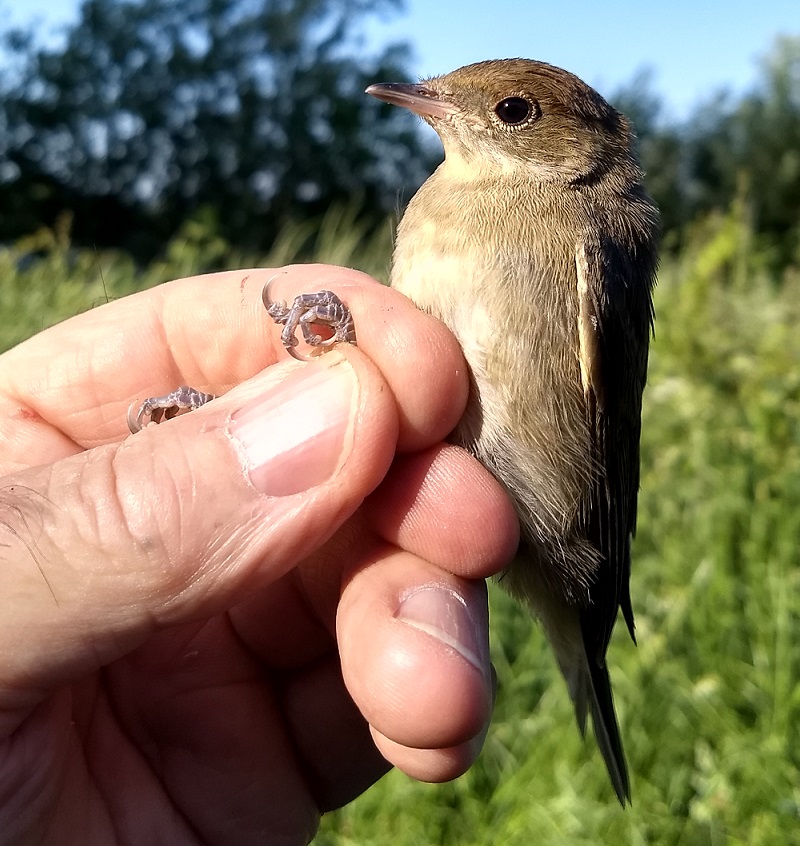
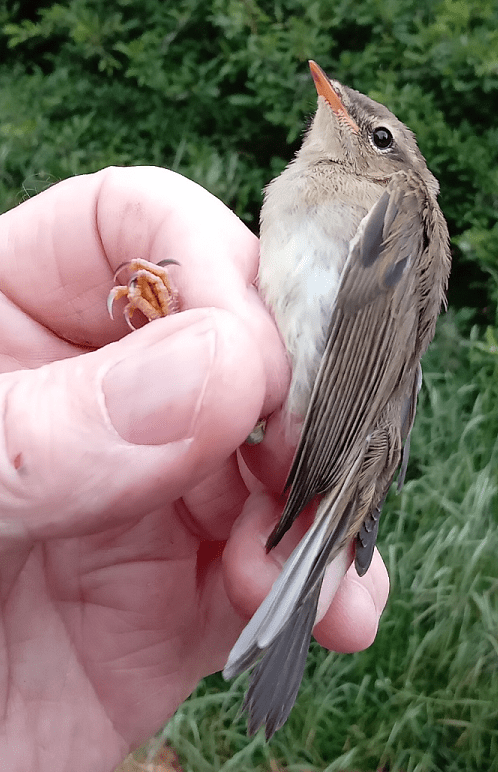
As all of our sessions seem to go, we had one good round with plenty of empties and low numbers. That is not to say that it wasn’t enjoyable, because we had some very pleasing results in amongst our catch. Following on from the first juvenile Blackcap a week ago at the Meadow Pond, this morning we caught another three and another couple of juvenile Chiffchaff. However, our first juvenile Marsh Tit of the year was a bonus:

Marsh Tit photo courtesy of Miranda. With the catch having died down, at 10:45 I did the usual “if there are no birds next round we will shut the nets” so, naturally, we took four more birds out of the nets. This included our first juvenile Chaffinch of the year:

I love the “Oi! What are you looking at?” attitude. During the same round we also extracted this Great Tit, showing just exactly how harrowing trying to raise a brood can be:

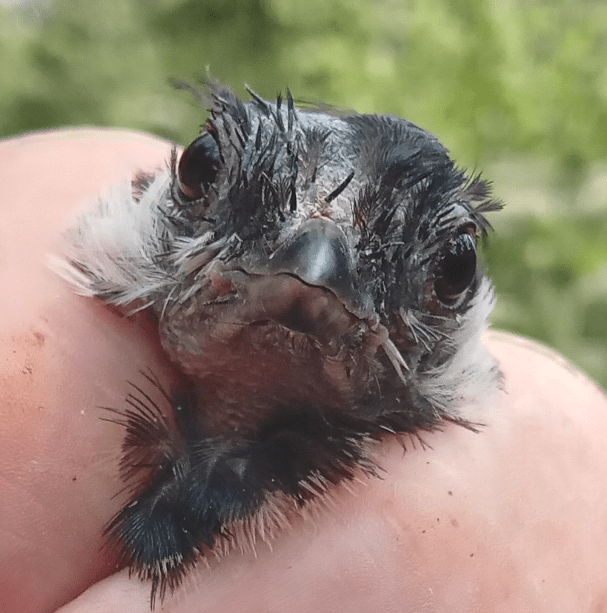
Of course the difference between a Great Tit and a similarly follically challenged male human is that the Great Tit’s head covering will grow back naturally.

One other interesting plumage seen this morning was a second calendar year male Blackbird:

Although in the field male birds of this age generally look black, that is probably because of the impact of their body and tail feathers. As you can see from this photograph, the wings are still very substantially brown. It has three retained greater coverts from the set that it had when it fledged.

The list for the day was: Nuthatch 1(1); Blue Tit [1]; Great Tit 1; Marsh Tit [1](1); Wren 1(2); Robin 1[4](1); Blackbird 1(1); Blackcap [3](2); Chiffchaff [2]; Chaffinch [1]; Bullfinch 1. Totals: 6 adults ringed from 6 species, 12 juveniles ringed from 6 species and 8 birds retrapped from 6 species, making 26 birds processed from 11 species.

As well as the birds caught and processed, we were surrounded by several other species that did evade the nets. These included Willow Warbler, Song Thrush and Great Spotted Woodpecker (but not the Goldcrest that Miranda’s app said was singing close by. I might be old but I can still hear Goldcrest singing and calling, and there were none in the vicinity). There were a few butterflies about: particularly Red Admiral and Speckled Wood, plus an unidentified Skipper. One of the passers by who stopped to chat had mentioned that there was a White Admiral up near the entrance to the reserve and I am pleased to say that I did see it as I was locking the gate upon leaving.

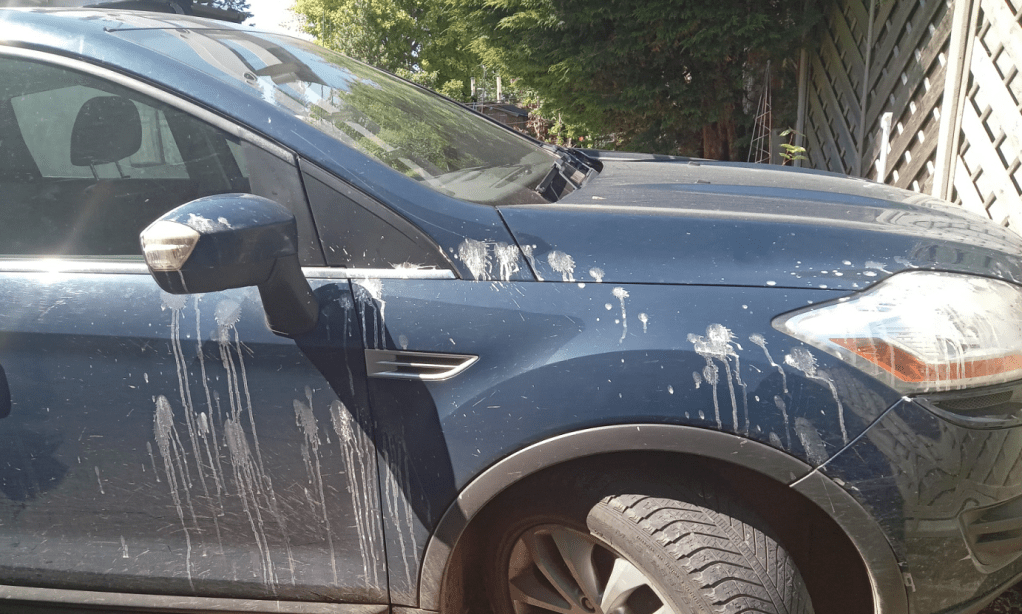
We did finally shut the nets at 11:45 and were away from site at 12:15. My car had been sounding a bit rough this morning (and for a few mornings before that, if truth be told) and there was a bit of a smell of something burning, as Miranda mentioned, but it got me home. Unfortunately for my wife, when she took the car into Wootton Bassett afterwards, it got her there okay but didn’t want to bring her home. Our friendly mobile mechanic got her started and sorted enough to get them both home. He called me and suggested I look under the bonnet, which I did:

I think that explains the roughness of the engine, the smell and the failure to start! Hopefully he will have fixed it by the weekend, otherwise I will have to have a lie-in rather than the pleasure of getting up at 5:00!

One final thought: no sign of the Spotted Flycatcher!

Ringing Demonstration: Lower Moor Farm, Saturday, 17th June 2023

With the way that catches have been going at Lower Moor Farm recently: small catches, the bulk of them early in the morning, and then just the odd bird thereafter, I was more than a little concerned about the likelihood of a successful ringing demonstration today, particularly as it had a 9:00 start time. I was running it in conjunction with our Constant Effort Site session 5, so we were on site before 5:30, with the first nets open by then. In order to try and increase the catch we did set up an extra net set. In the event, it picked up just a single bird: the last of the session and worth the effort. More of that later.

After a week of high temperatures and dry weather the Met Office and Meteo / BBC were forecasting similar temperatures to Friday (26oC) and less than a 5% chance of rain. I took a large garden umbrella to give us protection from the forecast hot sun. As I arrived on site I noticed a few rain spots on my windscreen. I didn’t panic.

I was joined by Rosie, Miranda, David, Laura and Adam. A special shout out to Laura and Adam for coming to site at 5:30 knowing that they would not be able to stay once the demonstration started (as ever, it was already sold out). Adam first, and then Laura, did me the great favour of cutting a new net ride for the extra nets that I wanted to put up. As he had played his part, Adam got to ring several birds this morning before they wandered off just before 8:00 – and just before the heavens opened. Throughout the morning there had been a few short, very light showers, which didn’t require us to shut the nets. But at 8:00 we had a downpour! We shut the nets and huddled under the umbrella waiting for it to stop. At 8:30 Robin Griffiths, from the Swindon Wildlife Group, on whose behalf we were running the demonstration, arrived, swathed in waterproofs and looking seriously concerned. Robin had to go back to the car park to meet with the attendees arriving for 9:00. As it was still chucking it down, at 8:55 I decided to go over to them and cancel the event (no mobile phone signal on the site). As I was walking over, the rain began to ease and, by the time I had got there, it had stopped! Whilst we chatted and agreed to give it a go, the sun came out, which was a clincher.

Between opening the nets and the start of the demonstration, we had a decent haul of birds: massively helped by a family group of three newly fledged Great Tits and a larger family group of Dad Blue Tit plus seven of his offspring. A nice early surprise was our first juvenile Wren of the year! In fact, by the start of the demonstration we had processed more birds than in any one of the previous four sessions! Obviously I was worried about the usual falling away of the numbers, but I need not have worried as we continued to catch throughout the morning.

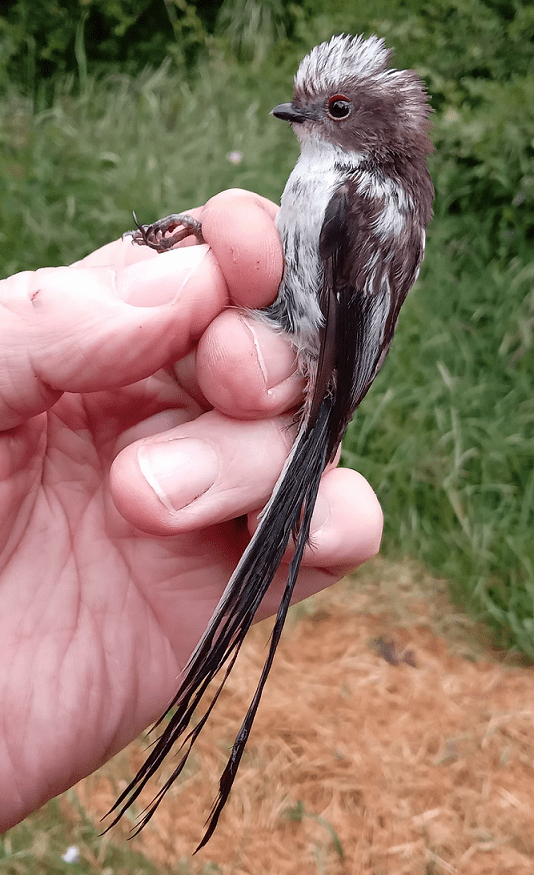
The attendees were treated to a procession of different species: Wren, Blackbird, Long-tailed Tit, Dunnock, Robin, Garden Warbler and, finally:

The star bird of the morning! Thanks to Robin Griffiths for the photo, I was a bit busy holding on to her! A female, as you can tell from the completely black malar stripe. She also had a well-developed, well-veined brood patch which also showed a few small eczema type patches. Hopefully that won’t compromise her brooding ability! Another lovely bird to catch was our first Garden Warbler juvenile of the year.

The list for the session was: Green Woodpecker 1; Blue Tit 1[8]; Great Tit [3]; Long-tailed Tit [5]; Wren 2[1](2); Dunnock 1[1](1); Robin [3]; Song Thrush (2); Blackbird 1(1); Cetti’s Warbler (1); Blackcap 1(2); Garden Warbler [1]. Totals: 7 adults ringed from 6 species, 22 juveniles ringed from 7 species and 9 birds retrapped from 7 species, making 38 birds processed from 12 species.

If I am surprised at all, it was that there were no Chiffchaff in the catch whatsoever: we could hear them pretty much everywhere but they never hit the nets. Anyway, we ran the session until midday before closing the nets and taking down.

I got a lot of thanks from the audience as they left, which is always gratifying, but I did make a point of asking them to thank the team who did all of the grunt work that made the demonstration possible. From me, a big thanks to my entire team for their help today. They did all of the processing before the demonstration began, but very little more than monitor the nets and extract birds for the rest of the morning. Then, also with thanks to David’s dad, Trevor, we got the nets down and everything packed away just before 13:00.

A Few Youngsters: Wednesday, 14th June 2023

I would like to say that I love this time of year but it is hard to be enthusiastic at 3:30 in the morning! One of the problems is that your thought processes are not quite in gear: why else would I have decided to wear shorts to a site that is rife with stinging nettles? Anyway, I was on site by 3:50 and started putting up the nets. Rosie had offered to join me at 4:00 but, as she has to come over from the Forest of Dean area, I told her to have a lie-in and get there for 4:30 (I am all heart), which she did!

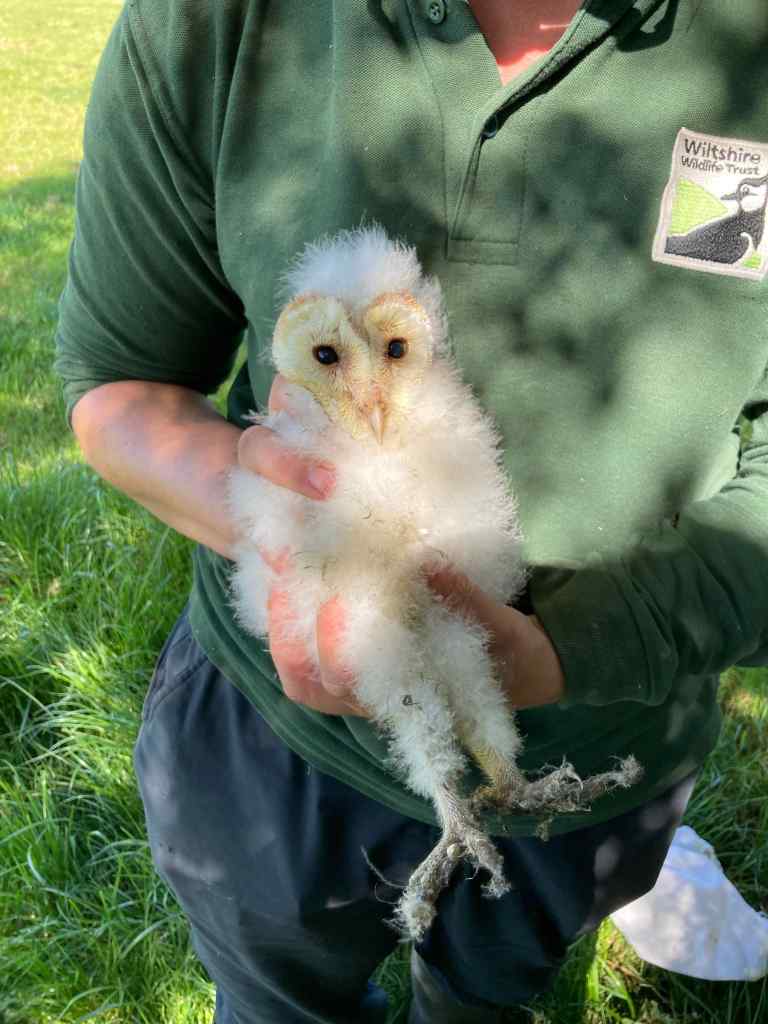
We had the nets open by 5:45, but before embarking on our mist netting exercise, we had a Barn Owl box to check. I had first checked it on the 1st June and found four nestlings which were too small to ring at the time. Rosie climbed the ladder and opened the box, only to find that our four had become two! We can only assume that during the ensuing two weeks food had become scarce and sibling cannibalism came into effect: the reason why Barn Owls start brooding eggs as soon as they are laid, to stagger the hatching and the growth of their young. Oddly, there was a vole in the owl box. However, we did watch one of the parent birds quartering the field looking for more prey in broad daylight. That is not usually a good sign for prey availability. Anyway, we ringed our first Barn Owl nestlings of the year.

Unfortunately, between the start of the netting session and when Rosie had to leave at 8:00, to go and shear some sheep, we caught only nine birds. As a “thank you” for her efforts, I let Rosie process all of the birds netted until she had to leave. Between 8:00 and 9:25, I caught only three birds, and then nothing until 11:00, when I decided to shut the nets and pack up. Of course, that meant that I found another seven birds in the nets! By way of improving the outcome of the session, these included my first Blue Tit and Blackcap fledglings of the year:

The list for the morning was: Barn Owl {2}; Blue Tit [3]; Great Tit 1(1); Wren 1(1); Dunnock (2); Robin [3]; Blackbird (1); Blackcap [1]; Chiffchaff [2](1). Totals: 2 adults ringed from 2 species, 9 fledglings ringed from 4 species, 2 pulli ringed from 1 species and 6 birds retrapped from 5 species, making 19 birds processed from 9 species.

Given how poor the catches have been recently, and that these Passerines are all insectivorous, it was surprising to see the sheer volume of insects that were flying around the site and the adjacent meadows. Not quite clouds of butterflies yet but certainly getting there. Alongside that, there were plenty of day flying moths, and around the pond, plenty of gnats and small flies: it doesn’t seem as though a shortage of food is the key issue.

Although today was dry and warm, hot by the time I had packed away the nets, it was breezy on and off all morning. In fact, wind seems to have been the key feature of our weather. I was going to say “recently” but it does seem to have been the case for the last year or more, which does tie in with the reduction in my catches. Anyway, I was packed up and off-site by 12:30.

A Long Good Wednesday: 7th June 2023

With the weather forecast to be windy on Wednesday I decided to head into one of my woodland sites. Webb’s Wood was next on the list and, given the forecast wind direction, would be the most suitable. I knew that Rosie wouldn’t be able to make the early shift, having been out mothing until 1:00 in the morning, but was joined by Miranda for 5:30. We set up 9 x 18m nets in the most sheltered areas around the ringing station:

It wasn’t the busiest session we have ever run: on a par with most of our recent sessions. The list for the day was: Nuthatch 1(1); Treecreeper 1; Blue Tit 1; Great Tit 1(2); Long-tailed Tit 2[1](1); Wren 2; Robin (1); Blackbird 1; Blackcap 3; Chiffchaff [1](1); Willow Warbler 1. Totals: 13 adults ringed from 9 species, 2 juveniles ringed from 2 species and 6 birds retrapped from 5 species, making 21 birds processed from 11 species.

We caught a small flock of Long-tailed Tits, all close together in one net. I was fully expecting one or two adults and a couple of juveniles and was somewhat surprised to find that there was only the one youngster. The retrapped Long-tailed Tit was ringed as age unknown in October 2019, so at least a fourth year bird. Not bad for a bird that has a typical lifespan of 2 years (BTO BirdFacts) and a maximum age from date of ringing of 8 years and 11 months.

There was another juvenile Chiffchaff in the catch. Apart from that, the best part of the catch was a pair of Nuthatch: a male and a female caught close together in the same net.

There were a few nice flowers around: the Cinquefoil, Potentilla reptans, was just coming into bloom:

Most of its flowers were still in bud. There was also this rather lovely blue flower which I didn’t know, but on further research is known as the Skullcap, Scutellaria galericulata:

Having caught just 10 birds between 6:00 and 11:00 we decided to pack up. Naturally, next round we caught 6 birds and in the following round another 4, as we were closing up the nets. We were off site at about 12:45.

I had arranged with Rosie that we would go and check some Barn Owl boxes after she finished work Wednesday afternoon. I have the appropriate licences issued by the BTO on behalf of Natural England, as this is a Schedule 1 species, to allow me to do this. She and I headed off to check on the boxes around Webb’s Wood. These boxes are all on private sites, so I will not be identifying the exact locations. As we approached the first box to be checked, to the west of Webb’s Wood, the adults flew off from the box. Inside we found four downy chicks. One of them was reasonably large, but the others were too small to be ringed. We will revisit them in a week or so, by which time they should all be big enough for ringing.

The next box was completely empty: no sign of it even being used for roosting. It has been used previously, both for roosting and for breeding. Our third box also had both adults within. As we tapped on the box to alert any occupants that they were about to have visitors, the adults decided to leave. The second to leave left me with a lovely present:

They would make great dive bombers! Anyway, we did find one newly hatched chick and four other warm eggs. We will pay them a visit again in a couple of weeks. Our fourth box has been vandalised by squirrels: they have ripped open the bottom corner of the box and built a nest inside. At least, without further evidence, that is our current opinion. It is certainly unlike any bird’s nest that either Rosie or I have seen before. We didn’t get to look at the planned last box: someone had kindly parked across the entrance to that part of the farmyard we needed access to. I tried phoning the farmer but it was going to voicemail so, as it was already approaching 20:00, we decided to call time on the session. It is very pleasing that we have a 50% occupancy by Barn Owls of the boxes checked.

We will be doing a lot more box checking over the next week and then on throughout the summer. A long day but a successful one.

Lower Moor Farm, CES 4: Saturday, 3rd June 2023

Finally, a session that produced more than the same session last year: even if it is just one bird more! It was a very enjoyable session for so many reasons. To start with, I wasn’t working solo. I was on site by 4:45, with David joining me at the agreed time of 05:00. We had all of the nets open by 5:30, but didn’t catch the first bird until 6:15. It was a second year male Bullfinch in stunning plumage.

As has been the case with most sessions recently, the bulk of the birds arrived early, with 18 of the 29 birds caught being before 8:00. Following on from the male Bullfinch, we caught our first recently fledged Chiffchaff of the year:

The key to the size of the catch being 13 birds extracted at the 7:25 net round. This was mainly due to the arrival of a small group of Long-tailed Tits, including three recently fledged juveniles:

Lovely birds: envious of the hair style! Like the Chiffchaff, our first juveniles of this species this year.

Soon after this catch we were joined by family C: Laura, Mark, Adam & Daniel plus, soon after that, family H: Claire, Nick, Zara and Samuel. Laura is beginning to get the idea that she is the one jinxing the numbers, because they fall away after she arrives, but as we are still having an issue with the midweek sessions, I don’t think I can blame it on her. She helpfully took over scribing duties, allowing me to get on and process some birds.

About 8:30 we were joined by Sarah Binnie. I, and several other ringers running CES projects, were asked by the BTO if we would allow her to join us at one of our sessions. As I understand it, she is a PhD student investigating insect abundance on CES sites. So she joined us and set up a number of pitfall traps, frass collection plates (frass is caterpillar poo) and other assorted insect paraphernalia. Unlike us, she will be active until 18:00 this evening. I am looking forward to finding out what her results are. Goodness knows what she will find but the place was alive with both dragonflies and damselflies. As usual, there was an abundance of Common Blue, Enallagma cyathigerum, and Azure, Coenagrion puella, damselflies. I was delighted to see, for the second time (the first being the previous CES session) a Red-eyed Damselfly, Erythromma najas:

Unfortunately, my phone has taken out the red eye! They were a very deep red. In addition, there was a plethora of Dragonflies: so many emerging, expanding their wings and drying off. However, speciation will be difficult for a while: they all seemed to be green, with little or no colour variation.

I understand that their pigmentation will develop over the next few days so, perhaps by the time of the next CES session (and ringing demonstration) on the 17th, they might be more easily identifiable. This one was almost ready to fly and is probably a female Black-tailed Skimmer, Orthetrum cancellatum:

(Thanks to Rob Turner for giving me the heads up on the Dragonfly ID.)

The bird list for the day was: Green Woodpecker 1; Treecreeper (1); Great Tit 1(2); Long-tailed Tit 4[3](1); Wren 2; Dunnock (1); Robin [2]; Blackbird (1); Cetti’s Warbler (1); Blackcap 1(1); Chiffchaff 1[1](3); Bullfinch 1; Reed Bunting 1. Totals: 12 adults ringed from 8 species, 6 juveniles ringed from 3 species and 11 birds retrapped from 8 species, making 29 birds processed from 13 species.

It is always great to catch a Green Woodpecker. Of the 16 ringed by my team, all bar two have been caught at Lower Moor Farm. Specifically, all bar one of those has been caught in the wildlife refuge area. This area is absolutely covered with ants’ nests, hence why it is favoured by this species.

Another interesting catch was the retrapped Cetti’s Warbler. When it was ringed on the 24th May it weighed in at 16.5g, upon recapture today it weighed 4g less. I can only think that when ringed it was carrying eggs, either that or it has been wearing itself out finding food for youngsters!

Throughout the morning there was so much going on: bird-wise we just missed out on a Sparrowhawk that flashed through and just past the net chasing after a female Blackbird, that escaped into the safety of a thick bush. We also had a nicely marked Buzzard circling around over the site for a large part of the morning. It had large white patches on the underside of the secondaries.

We also had some excellent views of other flying creatures, well, machines actually. Clearly something is being planned to commemorate the 79th anniversary of D-Day as we were treated to the sight of a Bristol Blenheim light bomber, with full invasion markings on wings and fuselage fly through, and sighting of a Westland Lysander, used for reconnaissance and dropping spies in behind enemy lines in World War 2, that flew around several times. We didn’t get to see the Supermarine Spitfire that Trevor (David’s dad) told us was seen flying over Swindon, as well as the Blenheim and the Lysander.

At midday we closed the nets and, with the help of family C and Trevor, got packed away quickly and easily. Big thanks to Laura for providing me with the photos of the dragonflies and allowing me to post them on the blog.

West Wilts Ringing Group Results: May 2023

A pretty interesting month (despite my continuing concerns about the small numbers being found on my sites this year) with some good changes and additions to our activity.

The biggest change is clearly the increase in the number of pulli processed.  As is often the case with the group these days, most of this change has been driven by Jonny (with a little help from yours truly).  He asked me to help him get his pullus endorsement for Passerine / near-Passerine closed nest pulli.  We spent an interesting period checking out nest boxes in Biss Wood, hence the huge increase in the number of pulli ringed this month.  I am pleased to say that he has now been given that endorsement, so he can deal with, not only the huge number of nest boxes currently in Biss Wood (both for titmice and dormice), but also the additional 40 dormouse nest boxes going up in there, plus another 40 in Green Lane Wood, which will no doubt be commandeered by Blue and Great Tits at every opportunity.  Thanks to Matt Callaway of the Wiltshire Wildlife Trust for attending so we could look at the Dormouse nest boxes.  We found no Dormice but several Blue Tit nests.

I have also benefited from my collaboration with RSPCA Oak & Furrows, getting the opportunity to ring a couple of Swift prior to their release, plus the opportunity to ring pulli of the following species: Rook, Magpie and Mistle Thrush.  Of course, that opportunity also gave me the opportunity to find out that one of the Swifts ringed had a collision in my village, which resulted in it being euthanised by our local vet.  In addition, the farm buildings at Clattinger Farm are busy with birds this year.  Rosie and I ringed a brood each of Blackbird, Robin, House Sparrow and Swallow.  The Robin chicks were in an open plastic container of the sort provided when buying screws in bulk:

We have several other broods to ring in the next week or so.  June is looking busy already for ringing pulli.  Outside of ringing pulli, we caught juveniles of Blackbird, Blackcap, Blue Tit, Dunnock, Long-tailed Tit, Starling and Treecreeper.

Excluding pulli, the number of birds processed is larger than last year but, with fewer sessions carried out in 2022, the average catch in 2023 is lower. I cannot help thinking that this is entirely my fault as my catches have been down this year!!  We have had an impressive number of species ringed, 39 compared to 31.  Added to the list this year are Dipper, Goldcrest, Jay, Marsh Tit, Mistle Thrush, Rook, Swift, Tawny Owl, Treecreeper and Yellowhammer.  Missing this year are Barn Owl, Grey Wagtail and Sparrowhawk.  Pulli missing this year are Jackdaw, Stock Dove and Stone Curlew (Miranda and I ringed 3 Jackdaw chicks yesterday!).

In terms of increases in numbers clearly the number of Starlings stands out: entirely down to Andy’s catching in (I think) his back garden and surrounds.  There was a somewhat surprising increase in the number of Blackbirds ringed (34 vs 17) whilst the numbers retrapped were 17 vs 18.   Chiffchaff numbers were much increased, but that was due to a large increase in the number of retrapped birds.  However, obviously birds can be caught multiple times, so I looked at the number of individuals represented in those figures.  In 2022 it was 26 birds, this year it was 41 individuals.  Similarly with the increased number of Willow Warblers: the 12 birds processed represent 12 individuals and in 2022 the 5 caught were all individuals, so there is over a doubling of the numbers caught.

Ravensroost Meadows Pond: Saturday, 27th May 2023

Working solo at weekends seems to be becoming a thing! Midweek I have Miranda and Rosie to help but it just seems that nobody is available at weekends. What is happening to work patterns these days? It is hard work for an old man, having to start at least 30 minutes earlier than if there was someone else to help, to get the nets open at a reasonable time, not to mention having to carry all of the equipment, make the holes and rig the guys ready for action. This morning I was up at 4:00, out of the door and on site by 4:30. Nets open by 5:30, first bird at 6:00. As mentioned in the last post about this site, I tried some different net positions to try and take advantage of the work carried out by the Trust over winter:

I was joined later in the morning by Laura and Mark with their children, Adam and Daniel. As usual, they stayed and helped me pack away at the end of the session: Adam and Daniel got to ring a few birds. Adam also got to fly his drone over the meadows: a long way away from the ringing site.

The weather was a disappointment. I had decided upon the pond area because the forecast was for sunshine, warmth and very low wind. The site is very open, not as much as Blakehill Farm, but also susceptible to the wind. Whilst setting the nets it was very cold compared to recent temperatures, but the breeze was very low. Unfortunately, almost as soon as I got the nets open, it remained cold but the breeze began to pick up. It remained like that until the sun finally broke through at just after 9:00, whereupon the breeze dropped somewhat and the whole experience became much more pleasant.

It started with a reasonable first round, as seems to be the way recently, and then died off, as is also the way recently! The final catch total was typical of recent sessions: just 17 birds caught from 9 species. First bird out this morning was a Whitethroat ringed at the last session. I was prepared: I had brought the book I am currently reading (“The Long Call” by Ann Cleeves (author of the Vera and Shetland crime novels)) but I was never reduced to reading, particularly not after Laura & Co. arrived!

The initial catch comprised one each of Whitethroat, Willow Warbler, Garden Warbler and Great Tit plus two Chiffchaff. Nice variety and a reasonable number. Unfortunately, thereafter it was just one or two birds until the sun came out and we had four birds at 9:30, before it died off again.

The list for the day was: Blue Tit 3; Great Tit 1; Long-tailed Tit 1; Dunnock 1(2); Blackbird 1; Garden Warbler (2); Whitethroat 1(1); Chiffchaff 1(1); Willow Warbler 2. Totals: 11 birds ringed from 8 species and 6 birds retrapped from 4 species, making 17 birds processed from 9 species.

There was one interesting bird in the catch: Garden Warbler, S859426, ringed as an adult in June 2017. As such, it must have made the journey to and from the Congo at least once before, so at least 7 years at 8,200 miles per annum: at least 57,400 miles in its lifetime: so far for a bird with a 76mm wing length and a weight of less than 20g! This was only the second time that the bird has been caught after ringing: the first retrap was just last May.

In between net rounds we had some excellent views of other wildlife. For a good 20 minutes there was a group of four Red Kites and a single Buzzard taking advantage of the thermals (when the place finally warmed up) over Ravensroost Wood. We also had a male Kestrel hunting over the meadow giving extremely good views of its hovering and swooping technique.

There were clouds of Common blue damselflies in the Ravens Retreat area and, around the pond, a goodly selection of both damselflies but, especially, dragonflies, including: Emperor, Broad Bodied Chaser and Black-tailed Skimmer. There were a few beetles about: particularly Whirligigs on the pond and a male Swollen-thighed Beetle, a beautiful metallic green and with well-swollen thighs, living up to its name. Quite common on the site are the Black & Red Froghopper: lots of those around. My favourite of the morning was this:

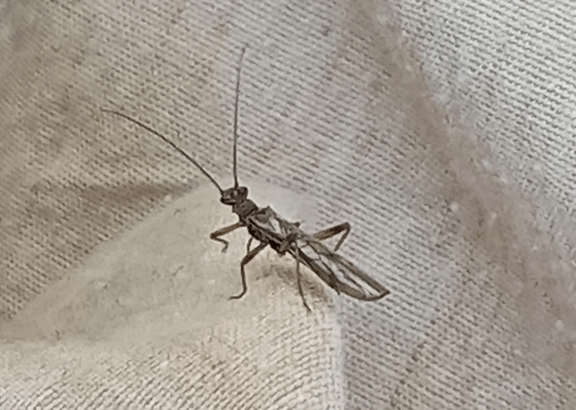
I have no idea what it is, have ploughed through several field guides without success, but will endeavour to find out. If anyone knows, please let me know!

At 11:00 we decided to shut the nets and clear away. With the help from family Childs, it was all done and cleared away quite quickly, and we were off site by midday.

Lower Moor Farm, CES 3: Wednesday, 24th May 2023

After a couple of disappointing early CES sessions I was hopeful that we might see an upturn today. Rosie, Miranda and I met at 5:00 and had the first nets open by 5:20 and the rest by 6:00. We started catching straight away but, just like in Ravensroost last week, the early catches flattered to deceive. It is not to say that it wasn’t a very pleasant session: good weather, lots of bird song and some very pleasant conversations – and a few good birds.

Because the catch was front-loaded it did mean that Rosie got the opportunity to actually process a decent number of birds before heading off to work. One of the first birds out of the net was our first new Cetti’s Warbler of the year. There are so many male Cetti’s singing at the site I am hopeful that we will have a decent catch of their youngsters in the next few weeks. By the same token, there are so many Chiffchaff contact calls in the area and, although we only caught one retrap today, there should be a decent number of youngsters coming through imminently.

What did turn up this morning were:

Our first juvenile Dunnock of the year and:

Our first juvenile Treecreeper of the year. Like our Robins last week, this bird’s wings were still growing. I am wondering whether they are being flushed from their nests by potential predators.

The list for the session was: Treecreeper [1]; Blue Tit 1(1); Dunnock 1[2](1); Robin [2](3); Blackbird 1(1); Cetti’s Warbler 1; Blackcap 1(4); Chiffchaff (1). Totals: 5 adults from 5 species, 5 juveniles from 3 species and 11 birds retrapped from 6 species, making 21 birds processed from 8 species. Of the retrapped Robins, two were juveniles ringed during CES2.

The juvenile Treecreeper was the last bird caught at 10:50. Actually, we caught two birds: a Whitethroat as well as the Treecreeper, only Mr Incompetent managed to let it escape out of the bag instead of processing it! What is worse is that we had not actually caught a single bird between 8:50 and 10:50! I did have good views of a Hobby as it flew across Mallard Lake and Swallow Pool, heading north-west.

Miranda and I took down the nets at 11:15 and were off site just after midday.

Ravensroost Wood: Saturday, 20th May 2023

I remember the days when I used to catch 30, 40 or even 50 birds in a session. These days I would be grateful to catch 20! Since stopping feeding the sites at the end of March I have carried out 13 sessions across my sites, of which only three have delivered more than 20 birds.

Today I headed to Ravensroost Wood for the first time since mid-April. It was more successful than that previous session, as that only delivered seven birds: but that was a session badly affected by wind, and we closed it after just a couple of hours to protect the birds.

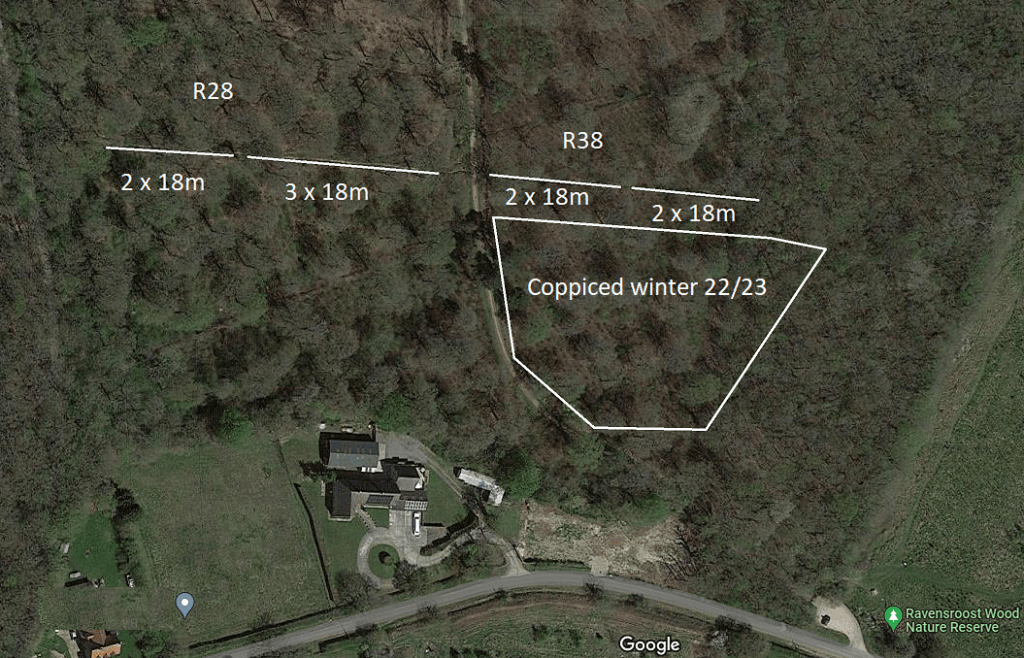
This morning David and I met up there at 5:30, and we set nine nets along rides R28 and R38.

The entire southern end of the wood is coppiced on an 8 year cycle: a quarter coppiced every 2 years. This winter it was the turn of the section identified on the diagram. That ride 38 has always been our best catching area, so it is not surprising that it did not deliver massively this session.

We were joined at 6:30 by Teresa and Andy and then at 7:30, Laura and Adam.

The first couple of rounds flattered to deceive, just like Thursday’s session at the Ravensroost Meadow Pond. We had 14 birds in the first hour – and just four more until I called a halt at 10:00, with nothing caught between 9:00 and 10:00. To be fair to the site, the breeze did get up at 8:30, making the nets along R38 billow and stand out more than one would like. At the same time, the sun came out and added to making the nets more visible. It did not affect the nets in R28 as they were nicely enclosed by the vegetation.

The list for the morning was: Blue Tit (1); Great Tit 1; Marsh Tit 1; Wren (2); Song Thrush 2; Blackbird 1(1); Blackcap 6(1); Willow Warbler 1(1). Totals: 12 birds ringed from 6 species and 6 birds retrapped from 5 species, making 18 birds processed from 8 species.

There were highlights: the Blackcaps missing from the Meadow Pond were found in the Wood; the first Marsh Tit of the year for the wood (much missed at this site last year, with just three ringed in 2022) and a returning Willow Warbler were all good finds.

It isn’t often that I get home in time for elevenses, but I was today! However, before I left I did have an opportunistic meeting with the owners of Distillery Farm, who have just put up their first Barn Owl box, and have agreed for me to monitor it for them in the future under my schedule 1 licence.

Ravensroost Meadows: Thursday, 18th May 2023

This morning’s session was the first that I have done in the Meadow Pond area this year and is exactly one year to the day since the first session there in 2022. Unfortunately, as seems to be the case this Spring, the catch was not as good as last year’s. However, it was much better than the same time in 2021.

I took my strimmer, and got there early (as if 5:00 isn’t “early”) in case I needed to do a bit of ride clearance. However, when I turned up I found that the Trust have done a great job of improving the site. It was becoming overgrown with bramble bushes, closing off rides and encroaching into any open spaces as this picture shows:

The white shapes outline the overgrown areas of the site. They have been cut back to open up space, whilst leaving areas thick enough to provide plenty of nesting cover, except for area 4, which was always thin and not a nesting area but simply blocked the ride. Also, one thing that I had suggested that I would do previously, but I never got around to it, was to put a ride through the middle of the large patch of bramble, area 3 which, as well as thinning it significantly, the Trust have also provided the requested ride. I set my nets where I would usually do, plus one through my nice new ride:

With all of the changes I will have to rethink my net ride positions, as they are no longer optimal. That isn’t an excuse for a smaller than hoped for catch. Although the catch was down on the same day last year, it is quite variable in May, up and down on alternate years.

I was joined by Miranda and her son Elliot for the morning, so had lots of help setting up and taking down. Whilst we were setting up, Miranda opined that in the area of the new ride there was a Garden Warbler singing. She said that she had been learning their song so she could clearly differentiate it from Blackcap. So it was rather nice that, when we did the first round, the first bird we took out of that net was a Garden Warbler. We were rather lulled into a false sense of security when the first round delivered three birds and the second six: four of which came from the nice new ride through the bramble.

Unfortunately, things then died a death and we took one or two birds out every other round for the rest of the morning. We had plenty of time to chat!

The list for the morning was: Blue Tit (1); Long-tailed Tit 1; Dunnock 2; Robin 1; Blackbird 2(1); Garden Warbler 1; Whitethroat 2(2); Chiffchaff 2; Willow Warbler 2; Reed Bunting 1. Totals: 14 birds ringed from 9 species and 4 birds retrapped from 3 species, making 18 birds processed from 10 species.

There were two surprises: the complete absence of both Blackcap and Lesser Whitethroat, and goes a long way to explaining the reduced catch size.. Even if just passing through I have always caught them in May at this site. The number of Whitethroat were on a par with previous months. One of them, ADY0068, was ringed at this site on exactly this date last year!

We closed the nets at 11:15, took down and were away from the site by midday. It was fun regardless of the lack of birds.