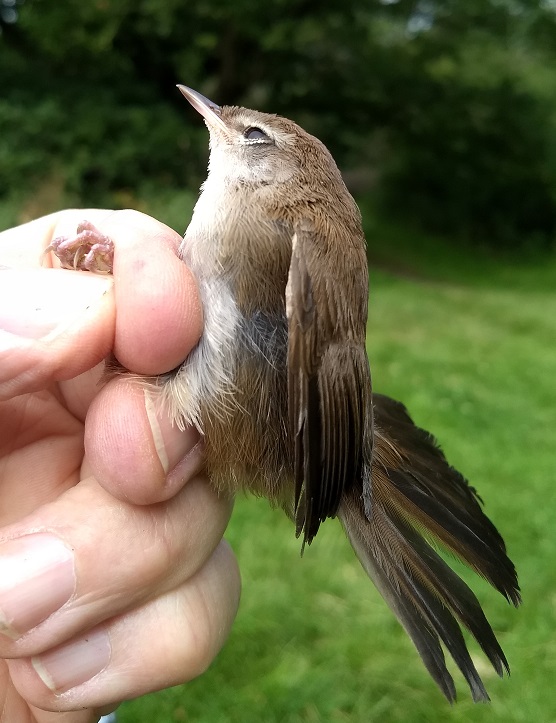
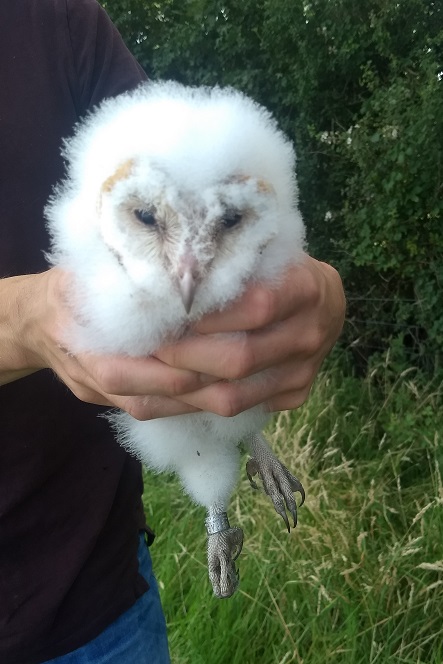
Somerford Common: Saturday, 1st August 2020

Delighted to have Steph and Lillie join me for a session at Somerford Common this morning for the first time since lockdown. This is how we set up today:
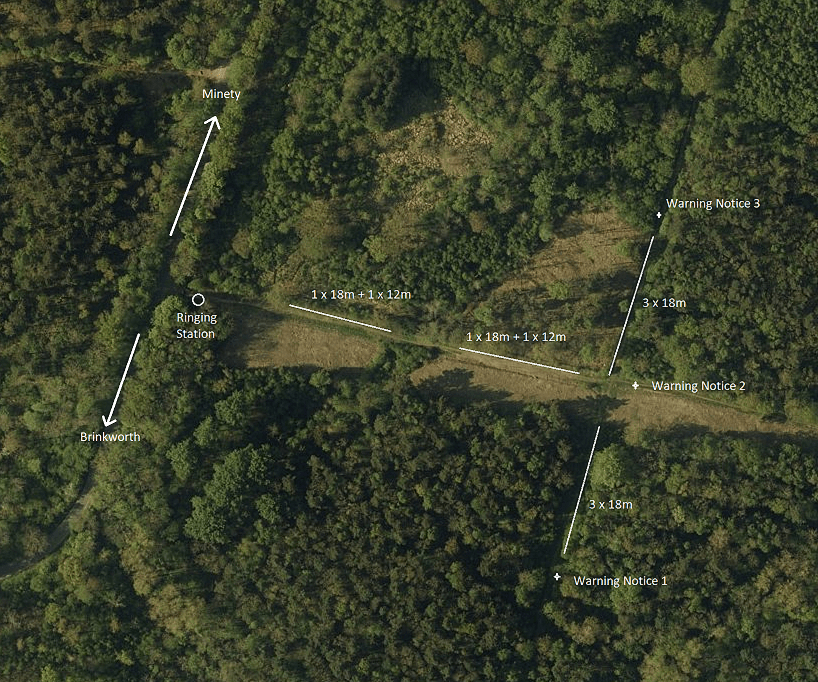
It was rather pleasing that the first birds into the nets this morning were in the nets nearest the ringing station and were a couple of Bullfinch: a female and our first juvenile of the year:

This was followed by a bit of a deluge of Robins, providing exactly one-third of our total catch, with 11 (10 ringed and one retrapped). The session was never busy, a few birds in every round, but it built up into a reasonable total in the end.

The catch was: Blue Tit 2(2); Great Tit 1; Wren 3; Dunnock 1; Robin 10(1); Blackbird 3(1); Blackcap 4; Garden Warbler 1; Willow Warbler 1; Goldcrest 1; Bullfinch 2. Totals: 29 birds ringed from 11 species, 4 birds retrapped from 3 species, making 33 birds processed from 11 species.

Again, there was a significant proportion of juvenile birds in the catch: Blue Tit 2; Great Tit 1; Wren 3; Dunnock 1; Robin 11; Blackcap 3; Garden Warbler 1; Goldcrest 1; Willow Warbler 1; Bullfinch 1. 25 of the birds processed from 10 species were juveniles. Surprisingly, given how many of them have been turning up in my catches this year, the only species for which we didn’t catch a juvenile in this session was the Blackbird.

The two juvenile Blue Tits were in the middle of moulting out their greater coverts. All of the covert feathers had been dropped and had the replacement feathers in the early stages of regrowth. Both had wings of 65mm, which probably means that they are males. One thing I have noticed is that the bulk of the juvenile birds that retain any greater coverts into their second summer have wing lengths of 63mm or less, suggesting that retention is a female trait.

As at Red Lodge recently, my most difficult extraction of the day was an Emperor Dragonfly:
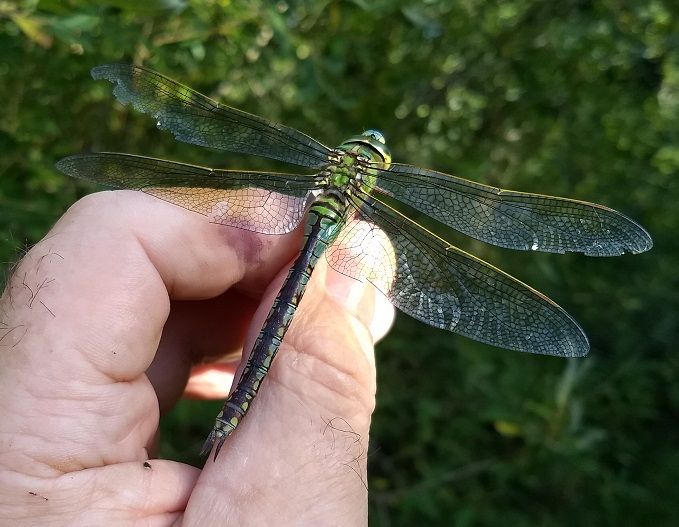
There is something very satisfying about successfully extracting these beauties from your nets. They do have a pretty good bite on them.

We had a very pleasant discussion with an elderly lady and her photographer grandson (We are British, we don’t bother with names!). It turned out that the lady and her late husband had both been bird ringers themselves. Small world.

With the BBC, Met Office, Meteo and xcweather all giving different weather forecasts (the first two saying it was going to be raining from 10:00; the last two saying there was unlikely to be rain before midday) we did keep a close eye on the weather. In the event, there was a brief shower as we were completing our take down at 11:30, so we didn’t get too wet, and were away from site by noon.
Langford Lakes, Wessex Water Reed Beds: Thursday, 30th July 2020

With other ringers up and down the country reporting that migration is now well underway, I thought a session at the reed bed at Langford Lakes was in order. (I know, it feels life summer has barely begun and the birds are already leaving). Langford Lakes is well positioned to attract all manner of migrant birds, being a wetland beacon in an otherwise quite dry area of the county. This is most notable in the array of interesting waders that regularly turn up on passage, but many passerines also pass through the site.

As always with Langford an early start was required to get onto site and make sure the nets are ready to go at first light. As it was, it seemed that almost every net was tangled in some way and setting up took longer than anticipated. Thankfully, the morning was rather cool, so the birds took a while to start moving.

The catch for the day was as follows: Blue Tit 1; Great Tit 3; Long-tailed Tit 10; Wren 10(1); Dunnock 4; Robin 1; Blackbird 1; Reed Warbler 28(8); Sedge Warbler 11; Blackcap 4; Whitethroat 1; Chiffchaff 3; Willow Warbler 8; Reed Bunting 2(1). Totals: 87 birds ringed from 14 species and 10 birds retrapped from 3 species, making 97 birds processed from 14 species.

Of these the following were juvenile birds: Blue Tit 1; Great Tit 2; Wren 9; Dunnock 4; Robin 1; Reed Warbler 26; Sedge Warbler 10; Blackcap 4; Whitethroat 1; Chiffchaff 2; Willow Warbler 7. 67 juveniles processed from 11 species.

Unsurprisingly Reed Warbler continued to dominate the catch, however there were also good numbers of Sedge and Willow Warblers. As you can see, many of these were juveniles, likely to be moving southwards. Over the coming weeks it will be interesting to see how migration unfolds at this site.

Meadow Farm: Wednesday, 29th July 2020

The following blog is by Jonny Cooper:

With the weather forecast to be calm and clear I decided to undertake a session at Meadow Farm. I try to carry out two sessions a month at the site across the year, to monitor how the bird life changes. Last year the sessions showed that many species that breed on site had a very good year. If today’s session is anything to go by then 2020 is repeating this breeding success.

For clarity the list of birds processed is set out in two lists: the first list is species ringed and retrapped; the second list is the number of juveniles processed per species.

Ringed and Retrapped: Kingfisher 3; Great Spotted Woodpecker (1); Blue Tit 24(18); Great Tit 5(10); Long-tailed Tit 4(4); Wren 1; Dunnock 1(1); Robin 1(2); Song Thrush 1; Reed Warbler 3(1); Blackcap (1); Whitethroat 2(2); Chiffchaff 13; Chaffinch 3; Goldfinch 6; Greenfinch 10; Bullfinch 1. Totals: 78 birds ringed from 15 species and 40 birds retrapped from 9 species, making 118 birds processed from 17 species.

Juveniles Processed: Kingfisher 3; Blue Tit 35; Great Tit 14; Wren 1; Dunnock 2; Robin 2; Song Thrush 1; Reed Warbler 2; Whitethroat 1; Chiffchaff 12; Chaffinch 2; Goldfinch 5; Greenfinch 10. Total: 90 juvenile birds processed from 13 species.

To catch 3 more Kingfishers is quite exceptional. In the month of July, I have processed 12 individual birds (10 new and 2 retraps) with 7 of them being at Meadow Farm. Hopefully, as 6 of them were juvenile birds, this is a sign that they are doing well this year.

One interesting note is the lack of Blackcap, with only a single re-trapped bird. At this time of year, I would expect them to be coming though in good numbers. However, despite this, it was another very pleasing session for a site that continues to produce good varied catches.

Ravensroost Meadow Pond: Thursday, 30th July 2020

After the problem in the woodland last week I have agreed with the Trust to stay out of there until we can work as a team again. However, the pond area is easy to secure, with a single access gate. The herd of Belted Galloway steers that were occupying the field leading to the pond was additional security.

My last experience of the Belted Galloways left the car covered in cow spit: they just loved licking it. So I dumped all of my kit over the gate, and got the car out of the field again and used it as an additional barrier in front of the gate into the field.

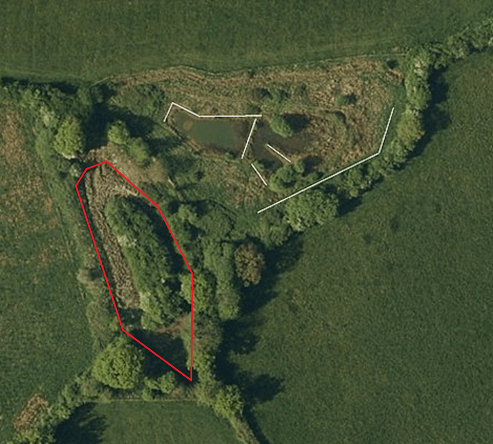
It wasn’t the biggest catch I have ever had, but it was enjoyable. My hope was that there might be a passage of Swallows and House Martins coming through the site and ending up in the pond nets (the white lines):

Unfortunately, only half-a-dozen Swallows came through, and none stopped to drink, so no catch. However, what I was lucky enough to have was a passage of Whitethroats. I have caught just 15 this year: 4 at my first session at the pond, 1 at my recent Brown’s Farm session, and 10 today!

The first bird out of the net was a juvenile Reed Warbler. One day I hope the large pond (the area outlined in red) will be restored, with a decent reedbed, instead of the massive growth of Typha that has taken over the site, and the brush expanding out from the middle of the pond, and we will see both Reed and Sedge Warbler breeding on the site with regularity. When I started birding at Ravensroost in 1998 I regularly heard and saw both species and Moorhens using this pond. Unfortunately, it has degraded over time and now needs significant work to make it productive again.

The second bird out of the nets was a female Jay. If anything shows up the stresses of rearing a brood of hungry young birds it is a Jay in post-breeding moult. This bird’s head was almost completely bald and she looked wretched. Mind, she was just as feisty and dangerous to my hands as any other Jay.

The rest of the morning was slow and steady, with just a couple of birds per round, but it all adds up. The whole catch was: Jay 1; Blue Tit 3; Great Tit (1); Wren 1; Robin (1); Song Thrush 1; Reed Warbler 2; Whitethroat 10; Chiffchaff 1(1); Willow Warbler 3. Totals: 22 birds ringed from 8 species, 3 birds retrapped from 3 species, making 25 birds processed from 10 species.

Of the 25 birds caught only the Jay, Great Tit, Song Thrush and one of the Whitethroats were adults, the remainder were juveniles. Coincidentally, three of those adult birds are resident species. 17 of the birds were summer visitors: possibly bred in the local area, but equally possibly on passage.

With the temperature rising the birds stopped moving and I took down at midday. When I wanted to load the car, fortunately the Belties were elsewhere, lying down out of the sun, so the car escaped unscathed for a second time.

Hail to the Emperor: Red Lodge, Tuesday, 28th July 2020

With the weather forecasting a light, gusting breeze for the morning I decided on a session at Red Lodge. As Forestry England have now allowed volunteers to work in pairs, I opened the session to the first of my team to say “Yes”. Entirely predictably, Andrew and I were on site for 5:30.

Why the headline, because of this beauty:

I am fairly certain that this is a female Emperor Dragonfly. However, the white edging to the last three abdominal segments is not an identification feature for that species. I am hoping to find out soon exactly what it is. When I extracted it from our net it was busily engaged in eating an immature Broad-bodied Chaser. There is something slightly macabre and disconcerting about watching one insect eating another, whilst the insect being eaten is still very obviously alive.

The weather turned out to be both colder and more blustery than had been forecast and that did impact on the catch. It started slowly, then we had a couple of busier rounds between 8:30 and 9:30, but the wind increased and we had to close 4 of our 7 nets, leaving just 2 x 18m nets and 1 x 12m net. Unfortunately, the 12m net caught just one bird – a same day retrap. It is unusual: this is normally one of the busiest nets.

The catch for the day was: Treecreeper 2; Blue Tit 2; Great Tit 3; Marsh Tit 1; Wren 3; Robin 7; Blackbird 5; Blackcap 4(1); Chiffchaff 1. 28 birds ringed from 9 species and one retrap. All of the birds were juveniles, with the exceptions of one of the Treecreepers and the retrapped Blackcap.

The highlight of the catch was the continuing capture of juvenile Wrens, Robins, and Blackbirds. They really do seem to have had a good year. All three species had recently fledged youngsters, i.e. those who had not yet started their post-juvenile moult. It was also good to catch our eleventh Braydon Forest Marsh Tit of the year:

If you are in the vicinity of Red Lodge and you see a Marsh Tit with a black ring above a pale blue ring on its lower right leg it is this bird.

As the wind was getting stronger we finished taking down and left site a bit early, by 11:00.

One personal footnote: the last bird I ringed today was my 15,999th fledged bird, from 103 species, since I started my ringing career in January 2009. The first bird I ringed was a Corn Bunting, at Ogborne St Andrew on the 10th January 2009. I am hopeful that my 16,000th bird ringed will be equally good. As I am at Ravensroost Meadows next, there is always the possibility of Swallow or House Martin. Fingers crossed.

Redstart Blues: Blakehill Farm, Friday, 24th July 2020

It is not often that I get more wasp stings than I do birds in a session. Let me explain:

The red line is where I usually set my nets. Today I thought that I would try out the area that underwent hedge laying a couple of years ago and has grown up nicely since then. You will notice that the yellow line of nets has a gap in it. As I was setting up for the net to go there I suddenly heard this storm of buzzing and then the pain started. It was at least a dozen stings in short order: the worst being a couple in my ear! Not a pleasant start to the morning.

After I finished setting those nets there was a solitary Goldfinch in the short net ride. At the second net round there was another Goldfinch, a Wren and a Dunnock. That was it for that entire net set for the morning.

To pass the time, while the birds avoided the nets, I took a run up to where I usually set my nets. It was fabulous: at least 6 Redstarts were flitting in and out of the hedgerow, popping across the path, chasing Gatekeeper butterflies. I had great views and the huge pang of regret! Never mind, I thought, I will just set a few more nets in that area, so I did. Needless to say the Redstarts moved away to a different area. I did see them again, specifically as I was about to pack up those nets for the morning. There were two of them: one flew into the hedgerow just to the east of the setup and the other into the hedgerow to the west of the setup. Still, I did manage to extract a Blackbird, Great Tit and Chiffchaff from there, so I ended up with 7 birds from 6 species and some lovely views of Redstart.

There was also a significant presence of both Swallows and House Martins flying over the plateau and the fields outside the reserve. Another week and I will be able to start using lures to attract them in.

So, the experiment was a failure, but the question is answered: where I usually set up is the best part of that side of the reserve to use. I was home in time for elevenses!

Lower Moor Farm & Care Farm Users: Wednesday 22nd July 2020

As the weekend weather is looking more than a bit unsettled, I decided to get in an extra session at Lower Moor Farm this week. My nets are in the wildlife refuge, away from the public, so I knew that I would not have any of the issues faced yesterday at Ravensroost Wood.

I used the same 6 net setup I have been using for the last couple of sessions, and it was another reasonable catch, with good variety. The highlight of my session was my first juvenile Cetti’s Warbler of the year. It has been a little frustrating: knowing there are 8 territories within my usual ringing site, but only 2 in the current restricted area. (Not a complaint, I am grateful to be able to get out and on site at all.) I have had a few (5) recaptures this year but all adults.

Let me mention it before anyone else moans to the BTO and they tell me to take it down: the bird was fine before, during and after the processing and the few seconds it took to take the photo. It was a bright sunny day and I have no doubt it was screwing up its eye a bit against the sun, as it was shining over my shoulder.

The catch for the day was: Treecreeper 1; Blue Tit 2; Wren 5; Dunnock 2; Robin 4; Blackbird 1; Garden Warbler 2; Lesser Whitethroat 1(1); Cetti’s Warbler 1(1); Blackcap 7(1); Chiffchaff 1(1); Willow Warbler 1. Totals: 28 birds ringed from 12 species and 4 birds retrapped from 4 species, making 32 birds processed from 12 species. All birds were this year’s birds except for the retrapped Blackcap and Cetti’s Warbler, one of the Chiffchaffs, both Garden Warblers and the Willow Warbler.

One of the key elements I have been focussing on this is post-breeding moult in adult birds. I am looking to capture the growth and replacement stages in the primary, secondary, tail and alula feathers. Primary feathers are moulted from the inside out, secondaries from the outside in, the tail from the inside out and the alula any which way it pleases. Sometimes the moult is not as sequential as expected. This was the case with one of the Garden Warblers:

The outer primary is at stage 4, i.e. nearly full grown, the next inner primary is an old feather, carried over from the wintering ground moult, the next one in is again at stage 4 and the remaining 7 primaries are at stage 5, fully grown new feathers.

I set up my ringing station just outside of the wildlife refuge. Now that the Trust have reopened the facilities at the site, the Care Farm is back in operation. I was asked if I could show the children some birds. It is something I really enjoy, even socially distanced. They are so interested and ask good questions. The downside of social distancing: I cannot teach them how to safely handle and release the birds. The only sad event of the morning: I had just finished packing my nets away when one of the Care Farm staff came through with another little lad. He was very upset that there were no more birds to see.

Ravensroost Wood: Tuesday, 21st July 2020

This was my first visit back to Ravensroost Wood since March: which turned out to be my last visit before lockdown. We have been holding off ringing on the site as it has become very busy since the easing of lockdown. There has been a big increase in footfall and also, apparently, it has been turned into something of a mountain bike track. After discussion with the Trust I decided to run a test session. It won’t be repeated until team working is allowed again.

On the whole, it was a pleasant session with lots of public interaction. Unfortunately, it was spoiled when two women joggers decided to ignore my sign and proceeded to rip a bird out of the net, causing significant damage to the net and goodness knows what damage to the bird. As this is now the subject of a police investigation I shall say no more about it for now. Unfortunately, I have decided that in future I will not be able to ring in public areas whilst working solo.

It wasn’t the biggest catch ever, but it was perked up by the ringing of our tenth Braydon Forest Marsh Tit of the year. If you see a Marsh Tit with an orange ring over a white ring on its right leg, that is the bird. It is a juvenile. There were several others around, as they were calling throughout the morning, and one was calling as I was extracting the youngster that I ringed.

The catch for the day was: Treecreeper 1; Blue Tit 2; Great Tit 1; Marsh Tit 1; Wren 3; Robin 5(1); Song Thrush 1; Blackbird 1. Totals: 15 birds ringed from 8 species and one retrap. The retrapped Robin, the Great Tit, Song Thrush, Blackbird and one of the Blue Tits were adult birds, the remainder were juveniles from this year.

It is not often that I can post photos of Treecreepers: their long down-curved bill and hunched shoulders can make them look so miserable. Fortunately, I managed to take a half-decent shot of this bird:

They are one of my favourite birds. Ageing them is quite easy. If you look at the primary coverts you will see that they are tear-drop shaped. When they moult into adult plumage the tear-drops are replaced by either small dots or no dots at all. After 10:30 the nets went quiet, so I took down an 11:00 and went home.

Barn Owl checking: Friday, 17th July 2020

Jonny Cooper and I finally managed to get out to check on our fist batch of Barn Owl boxes for the year. Having contacted all of the relevant landowners for permission on Thursday, we checked a total of 10 boxes: 3 on farmland in Upper Waterhay; 2 at Blakehill Farm; 1 each at Avis Meadows, Echo Lodge, Home Farm, Drill Farm and Plain Farm.

We started at the civilised hour of 9:15 at Upper Waterhay Farm. The first box checked is in a tree adjacent to the Chancel (which featured briefly in an episode of Poldark). Last year I ringed 3 chicks in this box in August. This time we disturbed 2 adults who were roosting in the box. Hopefully this is a precursor to another late nesting effort. However, we later visited the box behind the horse paddock at the farm. As we were walking the ladder over to the box a stunning male Redstart hopped out of the hedgerow and obligingly gave us a lovely view before flying off. In this box we found and ringed 2 youngsters at a relatively early stage of development: very downy and with little primary feather growth:

The question we had between us was whether these were the parent birds day roosting away from their young. The habitat close by was much more likely to be vole-rich than the paddock and the field where the box was, as they had both just been cropped for hay and gathered ready for baling and the fields near the Chancel were largely uncut. In between times we had checked the box in the fields behind the Chancel. That proved to be empty, whereas last year Andrew Bray and I ringed 3 chicks in that box.

After Upper Waterhay we made our way to Blakehill Farm. I have ringed Barn Owls there ever since I started this project. The Poucher’s Field box is usually productive. This time two free-flying, probably adult, birds emerged as we approached the box. We don’t know if they were keeping a look out, or if it was the sudden mini-stampede of the Dexter cattle and their calves that spooked them, but we were a good 20m distance away before they flew off. We checked the box and, whilst the signs of occupancy were there, lots of pellets and muck, unfortunately no sign of breeding (yet). After a brief chat with Ellie Jones, the Northern Reserves Manager (and one of my valued C-permit holders), who was doing a botanical survey at her site, we went off to check the other box, in the Allotment field. This was also devoid of Barn Owl activity but there was one sad, dead, desiccated Jackdaw chick in the box. It had started to grow its primary flight feathers but was pretty small: the runt of the clutch possibly?

From there we went to Avis Meadows, another Wildlife Trust site, adjacent to Ravensroost Woods & Meadows. The barn is about to be pulled down. In preparation they have removed the new Barn Owl box that was situated there but left the old, dilapidated one that always has something in it. The adults always seem to roost in the new box but rear their young in the old, falling apart, if it was a building it would be condemned, one. It is pretty much the same with the Chancel box, also dilapidated, but used every year. We had hoped to replace the Chancel box earlier this year but a combination of, firstly, bad weather and, secondly, coronavirus restrictions, has meant that it did not happen.

Since last year a chunk of wood has fallen from the back right corner of the Avis box, leaving a nice hole a small chick could fall through. Fortunately, there were no small chicks in there: there were 4, all of which were doing very well. Flight feathers were at medium length and the facial disk was well-defined and, whilst they have retained a fair amount of down, their body feathers are growing through strongly.

The boxes at Echo Lodge, Home and Drill Farms were empty. Somehow the back had come off the Drill Farm box, so Jonny reattached it. Hopefully we will have a brood there later in the year, as it does regularly produce. We were accompanied by a large group of Friesian heifers whilst visiting this box! They seemed to enjoy chasing after the car.

The final box was at Plain Farm. It is a swine to check because the tree it is is situated in sits in the middle of a bramble and blackthorn hedge. You have to get your ladder and equipment through the outer hedge layer into the ditch in the middle to get access to the box: definitely not shorts and T-shirt habitat: so we both got well scratched and bloodied. It was worth it. They were the most advanced nestlings of the morning and fully capable of flying off. However, Jonny managed to catch them before they could. We ringed them and returned them to the nest box and, once returned, they showed no inclination to move off to pastures new. We packed up at 13:00, with 10 boxes checked, 5 of which were occupied and 3 of which had a total of 8 chicks between them: 2 x 2 and 1 x 4. Very satisfying.

Lovely bird, nearly appropriate T-shirt! Photo courtesy of Jonny Cooper

Jonny Cooper’s “Big Weekender”: 11th to 13th July 2020

With life becoming increasingly busy, and a house move on the horizon, I thought I would take advantage of the calm weather over the weekend to get some ringing in before life gets too hectic. Below are the accounts of the sessions I undertook:

Part 1: Meadow Farm:

The weekend kicked off with a session at the ever-reliable Meadow Farm. The thermometer in the car read a balmy 6 degrees when I arrived on site. The cool morning meant that the session took a little while to get going, but once it warmed up the birds started moving and I started catching in good numbers. The totals for the session were as follows:

Kingfisher 3(1), Blue Tit 9(8), Great Tit 6(10), Long-tailed Tit 2, Wren 3(1), Dunnock 2(1), Robin 1(2), Cetti’s Warbler 1, Sedge Warbler 1(1), Reed Warbler 5(2), Blackcap 10(4), Whitethroat 5(2), Chiffchaff 6, Chaffinch 2(1), Greenfinch 8, and Goldfinch 3. Overall, 67 new and 33 re-trap: a total 100 birds processed from 16 species.

A good session all round but catching the third Cetti’s Warbler for the site was excellent. The bird was a male in post-breeding moult. I suspect it is the same bird I have heard calling on site over the past few months. It will be interesting to see if any juveniles turn up over the next few sessions. Catching 7 Whitethroats was also good. Numbers on our sites elsewhere in north Wiltshire seem to be down this year. However, the four Kingfishers stole the show, with 3 being caught next to each other in one net.

Part 2: Bailey’s Farm:

On Sunday it was the turn of Bailey’s Farm for a session. I have a soft spot for this site as it was my first solo ringing site (not counting the back garden). Previously I have focussed ringing on site to the winter months and the associated flocks of farmland birds. However, this year I am also carrying out sessions in the summer, to look at the birds breeding on site. There was a constant flow of birds across the morning, with each round producing 5 or so birds. The catch can be seen below: 

Blue Tit 4(4), Great Tit 4, Long-tailed Tit 1, Wren 7, Dunnock (1), Robin (1), Blackcap 2, Whitethroat 2, Chiffchaff 5, Starling 1, House Sparrow 7, Chaffinch 1, Greenfinch 2, and Goldfinch 2. Overall, 36 new and 6 re-trap: a total 42 birds processed from 14 species.

There isn’t really a standout bird from this session. but what is excellent to see is the variety of species that are breeding in the local area. It is becoming apparent that the farming techniques used on the land are good for supporting a variety of birds across the year, with tall thick hedgerows for breeding and areas of fields left to go to seed to provide food for them.

Part 3: Langford Lakes:

Monday saw me undertake the second session of my project to monitor the birds using the reed bed at Langford Lakes. The morning started with an auspicious sign: as I got out my car on site I was treated to a Curlew calling as it flew over.

The morning was once again a little cool to start and with birds were moving in small numbers. After the first 3 rounds I had processed 27 birds. Not masses but nice.  At about 6:30 the sun came out and the session really started to kick off with the next two rounds producing 50 birds between them. The catch for the day was as follows:

Kingfisher 2, Blue Tit 2, Long-tailed Tit 9, Wren 2(1), Song Thrush 1, Cetti’s Warbler 2(2), Sedge Warbler 9, Reed Warbler 23(9), Blackcap 3, Whitethroat 1, Willow Warbler 3, Chiffchaff 9 and Reed Bunting 7. Overall, 73 new and 12 re-trap: a total 85 birds processed from 13 species.

The catch was considerably more diverse than the June session; the majority of the birds were juveniles.  It was apparent that local breeders were also being joined by birds that had started their southwards migration. This reed bed is an area of very high-quality habitat used by breeding birds and attracting those on migration. To catch four Cetti’s Warbler was excellent but the standout birds are once again the Kingfishers: a juvenile and an adult caught together in a net.

Overall a fantastic end to what was a brilliant, if very tiring, weekend. I will probably spend the next 3-5 working days asleep.