My last three sessions at Lower Moor Farm have delivered 40 to 50 birds per session, so I was looking forward to a decent haul this morning. Arriving on site at 6:30 I set up my two usual net sets: 2 x 18m along the stream side and 3 x 18m along the lakeside. There is plenty of evidence of their activity around the site but this is only the second time I have seen one here.
As I was setting up the lakeside net ride I heard some very obvious and very loud tail slapping. Just down from me, close in to the side of Mallard Lake, was a Beaver, which had clearly decided I was a predator. It swam off and disappeared behind the Cormorant roost island.
With our current mini-obsession with Meadow Pipits, I set a Pipit triangle at the end of the lakeside net ride and put the lure on. The only previous time I had caught Meadow Pipits at Lower Moor Farm was at this time in 2014 when I caught 29. Unfortunately, the field where I caught them is currently playing host to a number of Belted Galloways and also has a public footpath across it and, as I have made clear, I am avoiding setting nets in public areas for the foreseeable future and will certainly not do so when working solo. It was not particularly productive. Over the course of the morning I saw just 3 Meadow Pipits and caught 1. You could call it a 33.33% success rate, which I would be very happy with if there were 300 Meadow Pipits flying around.
It was symptomatic of the whole session and, instead of the hoped for 40+ birds, I caught the princely total of 8 birds from 7 species. These were: Treecreeper (1); Blue Tit (1); Great Tit 1; Meadow Pipit 1; Robin (1); Blackbird 1; Blackcap 2.
I am sure that the issue was the cold! The north wind shall blow and we didn’t have snow because that would have warmed it up! It finally started to warm up at 10:00 but one of the rides stayed in shade and cold all morning. There were no insects flying around until about 10:30.
Not to say it wasn’t a very pleasant morning. Lots of people stopped by to see what was going on and came by for a chat. This included one of the lecturers in ecology and environmental studies from Oxford-Brookes University. He has spent some time with Matt Prior on his Tree Sparrow project and we will be arranging some sessions for him to bring students along to once life returns to normal.
Of all my sites Meadow Farm is the one I try to ring at consistently across the year. I aim to undertake 2 sessions each month, setting the nets in the same positions each time. This allows comparisons to be made across years, and has allowed a good picture of the bird life at the site during the two and a half years of ringing there.
On Tuesday I was due to undertake a session and I dutifully set up all the normal nets. The session itself was pretty typical, if a little quiet, for the site. Overall, 33 birds were caught, consisting of a mix of resident and migrant species. The catch for the day was as follows: Blue Tit 1(1), Great Tit 2(4), Wren 1(2), Dunnock 1(1), Meadow Pipit 2, Cetti’s Warbler (1), Blackcap 3, Chiffchaff 11, Greenfinch 2 and Goldfinch 1. A total of 24 birds ringed from 9 species and 9 re-traps from 4 species, making 33 birds processed from 11 species.
One thing I noticed was that part of the field had been turned over for re-seeding and there were good numbers of Meadow Pipit using the area. I was unprepared for catching them, as I had no lure and no Mipit triangle set up. However, two of them found their way into the nets, representing the first 2 Meadow Pipits caught at the site.
I packed up and left the site but couldn’t get the thought of coming back and trying for some Meadow Pipit out of my mind.
The next morning I returned armed with the Meadow Pipit lure we use when catching at Blakehill. I set up a Mipit triangle, put the lure on and waited. The first round produced 11 Meadow Pipit and a Grey Wagtail and from then until 10am each round yielded a few more Meadow Pipit. In total I caught 49 Meadow Pipit and 1 Grey Wagtail.
So across the 2 days, 83 birds from 12 species were processed. It was very satisfying to be able to try something new and for it to work. I will be trying it again.
This is a blog from our newest group member, one of my C-permit holders Alice Edney.
A long time ago (i.e. early 2020), in a land far far away (i.e. Wiltshire), I remember telling Simon that I would be disappearing for all of May to help monitor storm-petrels in the mid-Atlantic. Evidently, that did not happen. Fast-forward many months to the 12th August and there I was at Stansted airport about to board a plane to Terceira, Azores – to say I was excited would be an understatement.
The purpose of the trip was to assist Hannah Hereward, a PhD student at Cardiff University, with data collection for her PhD. Hannah is researching ‘The conservation implications of climatic and tropic drivers of population change in the Monteiro’s Storm-petrel and its sister species’, and to do so requires travelling to a remote islet in the Azores Archipelago where both species breed. As a brief background, two seasonally distinct breeding populations of Hydrobates storm-petrels have been known in the Azores since 1996; however, they were only formally recognised as separate species in the late 2000s (Bolton et al. 2008). The breeding period (from first egg laid to last chick fledged) of the hot season species, Monteiro’s storm-petrel Hydrobates monteiroi, is May to early October, compared to October to mid-April for the cold season species, Madeiran storm-petrel Hydrobates castro (Bolton et al. 2008). Our fieldwork would observe the end of the Monteiro’s breeding season and start of the Madeiran’s, with the primary aim of recording the fledging of the Monteiro’s chicks.
With this in mind, we started each day by conducting a nest check. The storm-petrels breed in natural crevices across the islet but also utilise artificial nests, which were installed to offer additional breeding sites and enable easier and more consistent monitoring. As a minimum, we checked the artificial nests containing a chick each day, although we also checked every artificial and known natural nest at least twice during our stay. We measured chick wing length, tarsus length and weight, which provided information on chick growth, and also took measurements of any adults found in the nests. Watching the chicks develop and change from tiny balls of floof (not dissimilar to the contents of a hoover bag) into sleek adult-like birds was wonderful, and I think we all felt a bit like proud parents whenever one fledged. Some of the chicks still had a fair bit of growing to do when we left the islet, but hopefully they will fledge over the coming weeks.
Searching for storm-petrels in natural burrows (‘grubbing’) was a personal highlight. Despite sometimes having to delve into dense vegetation and contort into all kinds of strange positions, it was very rewarding when you did find a storm-petrel!
Alongside the nest checks, we deployed internal and external cameras on some of the nests to better understand the behaviours and interactions of the birds. Storm-petrels are nocturnal and so, to really get an insight into their breeding life, we needed to be able to watch them at night. The cameras were a great success and allowed us to observe innumerable behaviours, including chick preening, feeding, and fledging. On occasion we found a Monteiro’s chick outside its nest during the day and then a Madeiran adult inside the nest. Watching a small number of ‘our’ chicks be evicted by the Madeiran adults was difficult, but we could not interfere with the course of nature. Thankfully, one chick that was found injured on several occasions (and became a personal favourite, #107) went on to successfully fledge.
Monteiro’s Storm-petrel chick
As mentioned, working with nocturnal species means there is only so much data you can gather during the day, and indeed the best time to observe the storm-petrels was at night. As the sun started to set in the evening, the storm-petrels would return from sea. The air became alive with magical, fairy-like creatures twisting and turning, this way and that, and their mysterious songs filled the gloom. The night work was definitely some of my favourite whilst on the islet.
We successfully deployed and retrieved two GPS tags over the course of four nights and spent a further four nights mist-netting.
The GPS work has been neatly summarised in the following video https://twitter.com/HannahHereward/status/1301162264309968896, so I will spare the detail here; however, the severe lack of sleep was worth it for the tracks we obtained. Mist netting allowed a bit more sleep, as we were normally done by midnight as opposed to 6 am, although it was far more active. Running up and down to extract birds from the net every few minutes was a good workout, especially when a Cory’s Shearwater went in and needed removing ASAP. Having ringed a good number of Manx Shearwater on Skokholm Island last summer, I was familiar with handling this group of birds, but a Cory’s was quite something. A bit like a Manx Shearwater on steroids, they were larger, stronger and had a very powerful bill, which left a nice bruise upon contact. Like the storm-petrels, they too breed on the islet, and there was even one nesting in a burrow about a metre from my tent. At first, sleeping in the tent was somewhat difficult – the Cory’s crazy calls made it sound like we were under alien attack – but I soon got used to it, or else became too tired for it to keep me awake. Other seabird species on the islet included Common Tern and at least one Sooty Tern, and on our penultimate night we were lucky enough to hear, and then see, a Barolo’s Shearwater! This species breeds on the islet over winter, so it was amazing to have one return so early.
Cory’s Shearwater at the end of my tent.
Overall, I had an incredible experience in the Azores, and am very grateful to have been able to do fieldwork in such an uncertain time, and with two amazing people. Hannah and Max (the other field assistant) were great fun and together we managed to achieve a lot in a fairly short time period. Coming back to the UK has been unsurprisingly disheartening, but I am looking forward to returning to Wiltshire soon and resuming ringing with Simon and the team.
Back on the mainland with all the kit! L:R Alice, Max, Hannah.
I started ringing at Blakehill Farm in 2014. In those days the central plateau was cut in late July, after any Curlew would have fledged, for hay or silage. Meadow Pipits were regularly caught in small numbers, but the largest catch we had in the years up to and including 2016 was 8 birds. In 2017 the regime changed and the plateau, whilst grazed by cattle in the growing season, is left uncut throughout the rest of the year. As a result, every autumn since there has been a huge irruption of insects, particularly crane flies. Since then September has been a key month for the species at this site. In 2017 we caught 45 birds in two sessions (28 and 17); in 2018 it was 112 (93 and 19); not so many in 2019: 79 (32 and 47). Today we caught 109 of them in our one session. This is the single largest catch since the group split at the beginning of 2013: it is also the second largest catch ever of the species by the group since 2000. The only larger catch was around the filter beds at the Marlborough Sewage Works back in December 2010. That site went with the North Wilts group.
Jonny Cooper and I started early, setting the nets adjacent to the plateau bushes from 5:30. We had them open by the time it got light. We then set up what is known in the trade as a Mipit triangle. This is three 12m nets set in a, surprise, surprise, open triangle. An MP3 player is set at the back of the triangle with Meadow Pipit call playing. It is a very effective catching method. However, if we caught all of the birds that come and sit on the top string of the nets we would probably triple the catch. It was very effective, although there were so many flying around that we caught them in all of our plateau nets.
The other significant catch was a single bird: a House Martin. The first we have caught there in 5 years. They have never been abundant at the site, where Swallows appear in great numbers. We had only caught 2 prior to this date: both in September, one in 2014 and the other in 2015, so this is a pretty special bird for us – it came to the same lure that we used at New Zealand Farm last Monday.
Last year was our first blank year for Whinchat since we caught them for the first time in 2015. We had 2 at the end of August, another 2 at the last session and 5 more today. Clearly they are still coming through on migration. Stonechat numbers are on a par with previous years. We also had a small fall of Chiffchaff, all juveniles.
The list for the session was: House Martin 1; Blue Tit 2; Meadow Pipit 109; Stonechat 3; Whinchat 5; Chiffchaff 9; Reed Bunting 7(1). Totals: 136 birds ringed from 7 species and 1 bird retrapped.
Even the retrap was of interest: it was a Reed Bunting, but not on our rings. Most often they have flown over from the Cotswold Water Park, but the details have not yet been entered into the online database. I shall look forward to finding out where it was ringed.
The forecast was for it to be breezy, ruling out any of the more exposed, migrant friendly sites, so we headed for Somerford Common. I managed to select enough sheltered net positions to get 10 nets up. It wasn’t the busiest session that we have had recently but any woodland session where Goldcrests equal the combined numbers of Blue and Great Tits is okay by me.
For a whole bunch of reasons (focusing on getting his first class honours degree and then the whole Covid-19 situation) it has been 9 months since David has managed to get out to a ringing session. Astonishingly, he picked up straight from where he left off. That is not easy for a trainee when the skills are still very much in the cerebrum and not the cerebellum.
The list for the morning was: Treecreeper 2; Blue Tit 1(3); Great Tit 3(1); Marsh Tit 1(1); Wren 1; Robin (3); Blackcap 3; Goldcrest 8; Bullfinch 3. Totals: 22 birds ringed from 8 species, 8 birds retrapped from 4 species, making 30 birds processed from 9 species.
There were highlights, alongside the Goldcrests, we caught and colour-ringed our 15th Marsh Tit of the year. Despite not yet being able to get back into Ravensroost Wood, usually the species stronghold in the Braydon Forest (back there soon – working on it with the Wildlife Trust), this is looking at being another very encouraging year for this red-listed species.
The three Bullfinch were all juveniles: a male, a female and one that had not progressed far enough in its moult to establish sex. This last one, unfortunately, was the first time I had seen avian pox in Bullfinch. It should recover: I have ringed Great Tits that have subsequently been caught with the disease and later still been caught again, having recovered, with some residual scarring.
I really must stop with the cheesy headlines. Well, when the birds stop writing them for me, I will do so.
This morning I was at the meadow pond area within the Ravensroost complex hoping for a chance to try out the new House Martin lure that worked so well at New Zealand Farm on Monday. Unfortunately, I didn’t see a single Hirundine all morning. I do not think that they have all gone through, it was just one of those troughs in the migratory flow.
For the first time since lockdown, I was joined by Tony Marsh this morning. I think that I got that a bit wrong: I agreed for him to arrive at 8:30, after the nets were set up, and he had to leave at noon, just before I started taking the nets down! That’s not why you have trainees: they are there to do the work while you relax! I set 3 x 9m; 2 x 12m and 3 x 18m nets: not a huge set up but it worked well until the breeze got up at 11:30 and I had to shut the nets.
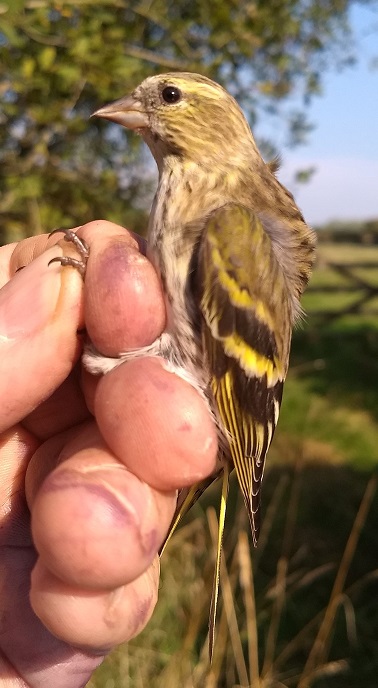
It was a good session, with one real bonus: our first ever Siskin for this site.
We have had a few in the woodland next door but this is our earliest autumnal catch of them in the Braydon Forest. Apart from one at Somerford Common in November 2013, all of our other catches in the Forest have been in the February to March period.
The catch had the staple of our migratory birds: mainly Blackcap and Chiffchaff but was completely missing our usual resident staples: no Blue or Great Tits. The list for the day was: Treecreeper 1; Wren 2; Dunnock 5; Meadow Pipit 1; Robin 4; Blackbird 2; Blackcap 10; Chiffchaff 8; Willow Warbler 1; Siskin 4.
38 birds ringed from 10 species.
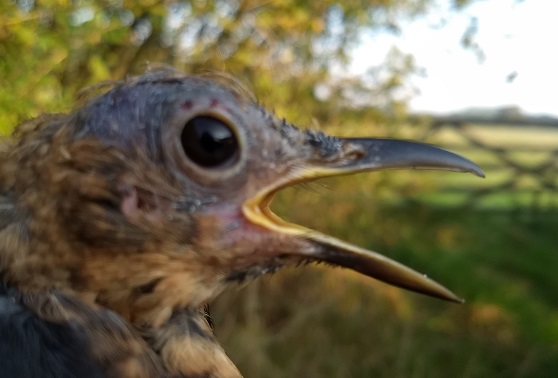
The first bird I took out of the net was a juvenile Blackbird undergoing a very scary head moult:
Whilst he is terribly bald, you can see the black feather tufts just beginning to poke through. Definitely a he: the tail was already black. I am sure he will soon look resplendent in his new plumage.
It was nice to catch another Meadow Pipit at the site. It is only the fifth for the meadow pond area, and our first since we had two in September 2017.
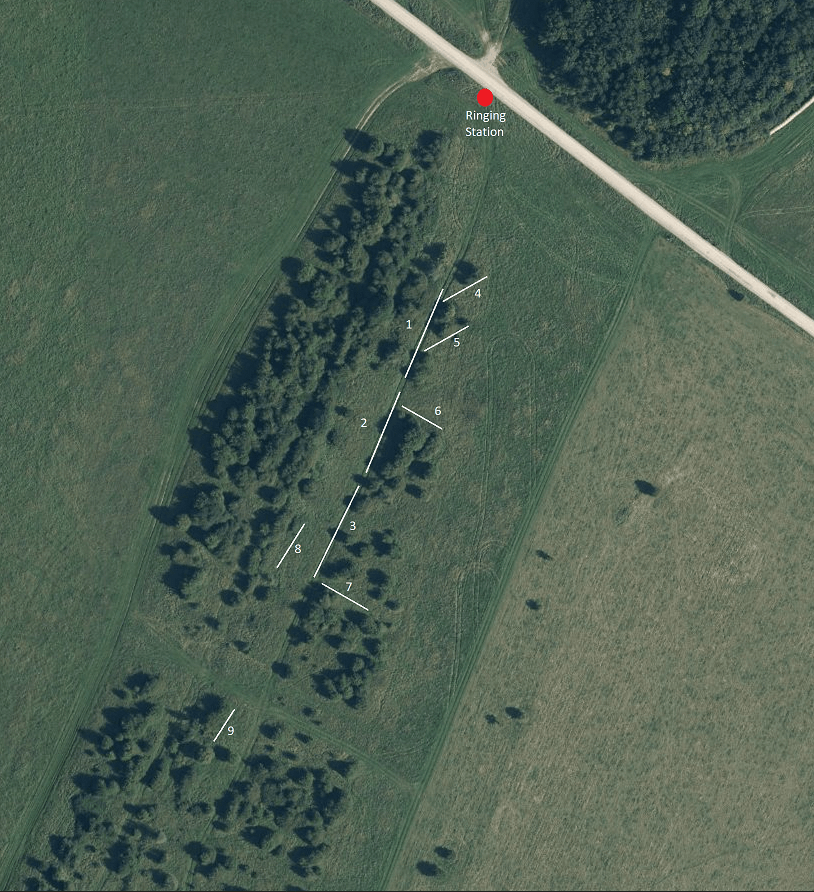
With migration in full swing I suggested to Andrew Bray that a team session at New Zealand Farm would be worthwhile. Because of its location, in the middle of the Salisbury Plain training area, he is only allowed access once per month. There are also army manoeuvres scheduled for the week, so we were rather pleased that Range Control allowed us access. We planned to be on site from 6:00 until midday and, with four of us available for the session (myself, Andrew, Ellie Jones and Jonny Cooper), we set rather more net than Andrew usually does:
Rides 1 to 3 comprised 2 x 18 m nets, rides 4 to 8 comprised single 18m nets, ride 9 comprised 1 x 12m net. Andrew would normally just set rides 1 to 3 for his solo sessions. He did a sterling job of strimming the rides yesterday to allow us to set all of these extra nets today.
Nets 7 and 8 were experimental – and the experiment did not work. I was playing a lure for Yellow Wagtail on ride 8 and House Martin on ride 7. Neither worked until we moved the House Martin lure to ride 6. Initially we put a Blackcap lure on ride 6 and another on ride 3, and they were extremely productive for the first two hours of the session. I had Whinchat on ride 2 and we had Meadow Pipit on ride 5. The Whinchat didn’t work but the Meadow Pipit pulled in a few.
We had an initial rush of birds between 7:30 and 9:00, heavily dominated by Blackcaps, and then everything went quiet. About 10:00 we noticed a build up of Swallows over the site and at 10:30 we caught a Swallow in ride 4 and a House Martin in ride 6. As a result we switched the lure on ride 3 to Swallow and, at Jonny Cooper’s suggestion, on ride 6 to House Martin. That proved to be inspired. We later moved the Swallow lure to net 8 and that also pulled in another couple of Swallows in. Next round we had 4 House Martin in ride 6, in the following round we had 5, and the following round 9 in ride 6 and 3 in ride 2. We had to pack up about midday, because of our agreement with Range Control, and the last round produced another 8. Had we carried on longer I am sure the catch would have been huge, because I have never seen so many House Martins in one place, spiralling around where we had our nets set. They only have short legs, so are not easily held for a full body shot – so you will have to make do with the head shot.
Photo courtesy of Jonny Cooper
The list for the day was: Swallow 3; House Martin 30; Blue Tit 3; Great Tit 1; Wren 1; Dunnock 2; Meadow Pipit 3; Robin 1; Song Thrush 1; Blackcap 42 (1); Whitethroat 6; Chiffchaff 8(1). Totals: 101 birds ringed from 12 species and 2 birds retrapped from 2 species, making 103 birds processed from 12 species. The retrapped birds and 2 of the Blue Tits were adults, the remainder were juveniles.
Both Ellie and Andrew ringed their first ever House Martins, which is always good for them. Andrew is having a bit of a good week: House Martin and Kestrel added to his experience in the last 4 days!
We cleared the site by about 12:45 but cannot wait for the opportunity to get back there. It is also looking good for some late autumn / winter sessions: the tree scrub is almost all Hawthorn and the trees were weighed down with berries: I see a Redwing / Fieldfare roost session or two might be required.
A lovely morning at Lower Moor Farm. You cannot complain when the first experience of the morning is a family of four Otters on Mallard Lake! Mum and three kits one would have thought.
I had decided to start slightly later, emerging from my pit at 6:00 and getting to site for 6:30. It proved a good decision: some light overnight rain had just stopped when I walked out of the door.
I set my usual 2 x 18m and 3 x 18m net rides: the 2 nets along the stream side, the 3 nets along the lake side. It was a very pleasant morning with birds occurring regularly, ending with a total catch of 38. What was surprising is that 31 of those 38 birds were Blackcaps. I appreciate that, particularly at this time of year, Blackcap numbers are high as the autumn migration is in full swing but contrast that with Thursday’s session at Blakehill Farm, my main autumn migration site, where we had good haul of Chiffchaff (19), which were completely missing from today’s catch (although I did hear plenty of contact calling around the site) but just one Blackcap. They were coming to a lure, and they do respond well to that, but I had the same lure playing at Blakehill on Thursday.
(For those who might be wondering about the “Death on the Plateau”, Jonathan, the farm manager, found the source of the smell: a deceased adult male Roe Deer, the head of which is now elsewhere to finish rotting off so Jonathan can get his hands on the antlers. Probably a casualty of the rut, which has just finished for this species.)
The list for the day was: Treecreeper 1; Wren 1; Dunnock 1; Robin (3); Blackcap 31; Bullfinch 1. Totals: 35 bird ringed from 5 species; 3 retraps from 1 species, making 38 birds processed from 6 species. All of these birds were juveniles except for the Wren, which was a female still re-feathering her brood patch.
The juvenile Bullfinch was moulting into his pink male plumage:
I love how haughty they look.
I had several ad hoc ringing demonstrations during the morning. In particular, at 10:00 I was joined by Ellie Jones, the Wildlife Trust’s northern reserves manager (and one of my most experienced C-permit holders, and all round nice person) with her brother and his family. They loved the opportunity to get close to the birds, and the children were absolutely fascinated by the whole process.
The catch died off at 11:00, so I packed up and went home, thoroughly satisfied with a lovely morning at one of my favourite places. I have to say, though, I have never had such a single species focus at the site before, and never such a small spread of species.
Now I have got your attention! No birds were harmed during our session, but something was very clearly dead.
Andrew Bray and I went off to Blakehill Farm this morning. Meeting at 5:30, we started to erect our nets around the bushes on the edge of the plateau. When we got to net position three the stench of a rotting carcass assaulted our nostrils. It was rank. At 5:45 in the morning it seems even worse. Throughout the morning, it seemed, we carried that stench with us everywhere we went. We both searched to see if we could find the source but whatever it was had clearly crawled deep into the adjacent bush to die. There’s a cheery start. Later in the morning Jonathan, the farm manager, came by and we mentioned the smell. He will be investigating: rather him than me.
To be honest we did find ourselves questioning why we were there on several occasions this morning. We caught our first bird at 6:30, a Robin. Then we setup our nets along the perimeter track. Having had a bit of a brain fade, I had forgotten to pack my furling sticks so, while Andrew went off to do a net round I popped home to get them (10 minutes each way). When I got back he was waiting empty handed. So, in the first hour and a half since opening our nets we had caught precisely 1 bird. Not a great start. It was cold and there was little insect movement at that time.
At 8:00 we did another net round. The peri track nets produced a single bird: a Woodpigeon. The plateau nets 2 Reed Bunting, another Robin and an adult male Whitethroat. It was nice to catch a male with such a clear grey cap. At 8:30 we began to think the tide had turned: 5 Chiffchaff and a Great Tit from the peri track nets – but nothing from the plateau.
That was it until 9:50! Not another bird disturbed the nets until then. However, the weather was beginning to warm up, the crane flies and other insects were beginning to appear, so we stayed to see what might happen. And then at 9:50 we had a lovely catch of Redstart, Lesser Whitethroat, Swallow, Blue Tit and 4 Chiffchaff, 4 Reed Bunting and 3 Whinchat.
That was it for another hour, whereupon we had another little spurt. It was becoming very clear that we were having a pretty varied catch. This was the catch of the day:
Adult Male Kestrel
I am not sure why I am so good to my trainees. I have only ringed 2 adult and one nestling Kestrel in my ringing career but, as Andrew had never done one, I gave him the bird to process. No good deed goes unpunished! In trying to help Andrew to get the bird in the correct position to ring and measure it I got my fingers a little too close to that beak.
They use that beak to rip flesh: it did exactly that!
We didn’t get a repeat of the large round but kept catching birds from different species, with Linnet and Greenfinch making an appearance at the end of the session.
Our list for the day was: Woodpigeon 1; Kestrel 1; Swallow 1; Blue Tit 2; Great Tit 3; Meadow Pipit 1; Whinchat 2(1); Redstart 1; Robin 4; Blackcap 1; Whitethroat 1; Lesser Whitethroat 1; Chiffchaff 19; Greenfinch 1; Linnet 2; Reed Bunting 4(2). Totals: 45 birds ringed from 16 species, 3 birds retrapped from 2 species, making 48 birds processed from 16 species. All of the birds were juveniles except for the Kestrel and the Whitethroat, one each of the Blue Tit and Robin and two of the Reed Bunting.
We closed the nets at 12:30 and left site by 13:30 at the end of a very different sort of session, with added aroma!
My last trip to Brown’s Farm was back on the 12th July and, to be honest, I might have been better staying in bed and catching up on some sleep. Just 11 birds caught: the 3 Yellowhammer ameliorated my otherwise potentially foul mood. So today, with a weather forecast of virtually no wind until lunchtime, Andrew Bray and I headed out to the farm to see what might be around.
We set nets along hedgerows, as shown in red below:
The blue cross is where we put our ringing station.
I came hoping to get some farmland birds in our catch, and we were rewarded with Yellowhammer (2), Linnet (3) and Dunnock (9). There was a large flock of Yellowhammer put up by a tractor going down to the farmyard. Unfortunately they circled round and back into the unharvested grain in front of the hedgerow, where our nets were lurking behind! Hopefully that grain is not scheduled to be harvested and is being left as game cover / food over the winter. If the latter, I would love to put a few two-shelf nets along the tramlines to see what we can catch.
Surprisingly, the largest catch we had today was Blue Tit: a couple of recaptures ringed as juveniles on the farm last year, but also another 15 of them ringed today, 12 of which were juvenile birds. Those are the sort of figures I expect in a wood with a feeding station set up, not traversing the hedgerows on a mixed beef / arable / horse farm.
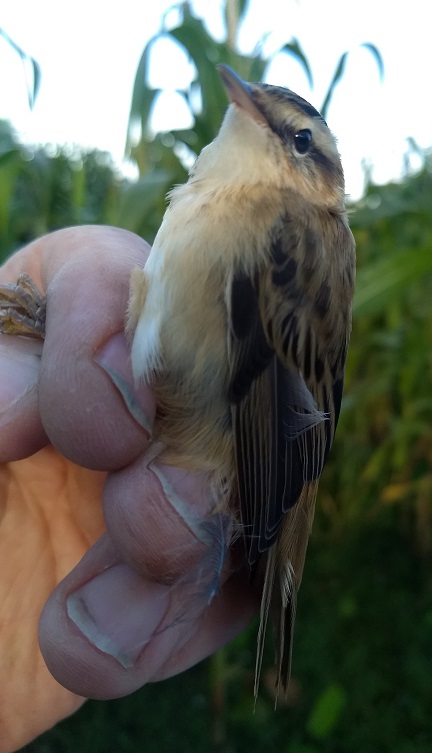
However, we were also hopeful of there being a few summer visitors around, either that bred locally or were heading south on autumn passage, and we weren’t disappointed. A single juvenile Whitethroat and Willow Warbler was backed up by two Chiffchaff, 5 Blackcap and, best of all, and new for the site, 3 each of Reed Warbler and Sedge Warbler.
Reed WarblerSedge Warbler
As well as these we saw, but did not catch, a few other migrants, notably a good number of Swallow flying around the fields and a Wheatear flying across from where we had our nets along the hedgerow by the newly sown crop across to the track, and a few Yellow Wagtail were heard but not seen. We were also visited by a female Sparrowhawk, who made a spectacular crossing of the maize field, and twisted up and soared away right in front of me when she noticed our ringing station. I would have loved to have had that in the net! Bad for your fingers though.
The total list from the day was: Blue Tit 15(2); Great Tit 1; Wren 3; Dunnock 9; Robin 1; Reed Warbler 3; Sedge Warbler 3; Blackcap 5; Whitethroat 1; Chiffchaff 2; Willow Warbler 1; Linnet 3; House Sparrow 3; Yellowhammer 2. Totals: 52 birds ringed from 14 species and 2 birds retrapped from 1 species, making 54 birds processed from 14 species.
That is a decent variety of species, and to have two firsts for the site on the same day is brilliant. To put that catch into perspective: I have a wetland site on the edge of the Cotswold Water Park and so far this year I have processed 4 Sedge Warblers and 4 Reed Warblers there. These are clearly birds on passage but a great find. We had juveniles of every species caught. 42 of them were juveniles and just 12 adults.
So we had a really enjoyable session with a decent haul but, unfortunately, the wind got up early, at 10:30 and we had to close the nets.




 Ringing In The Braydon Forest & Beyond