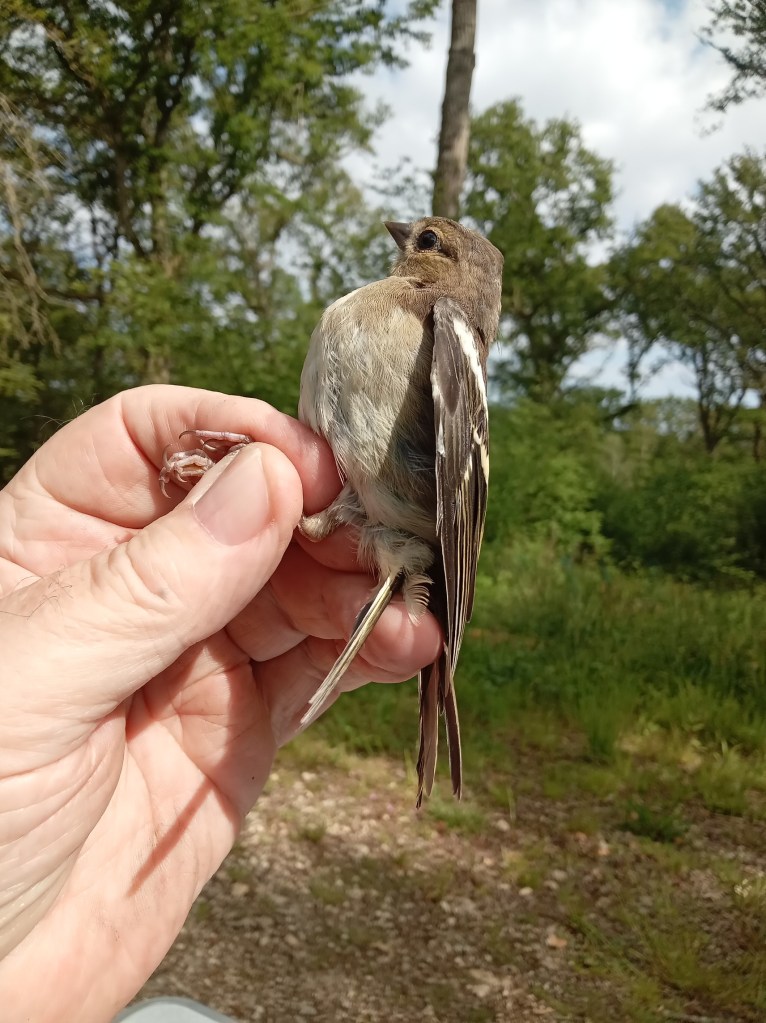
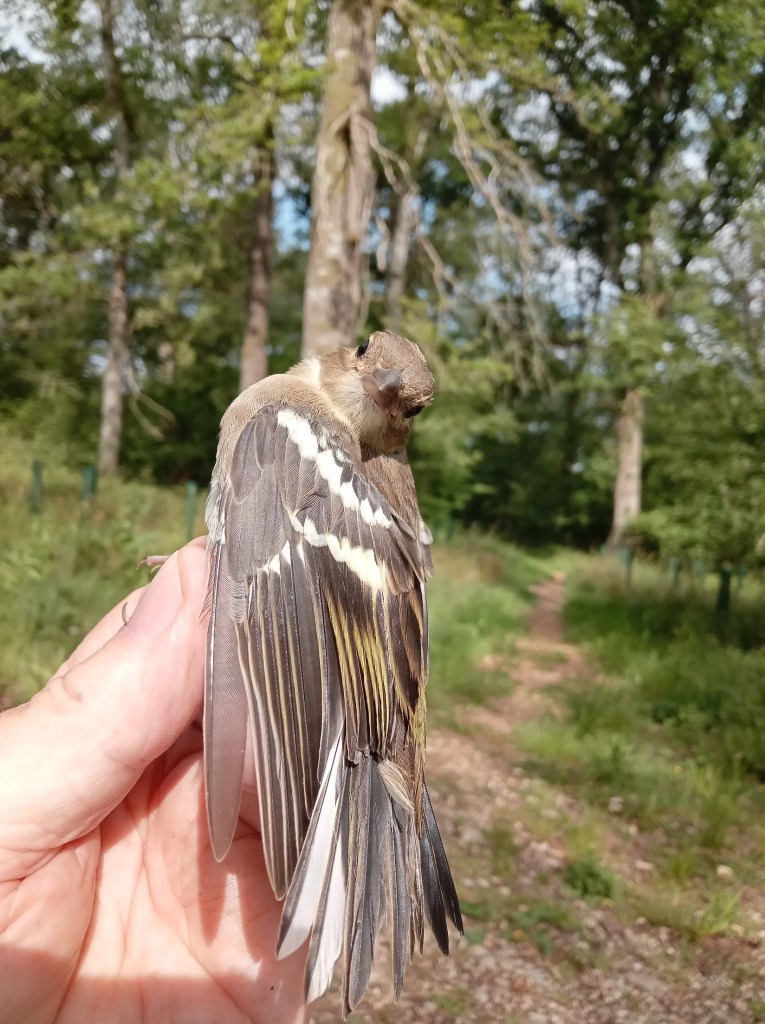
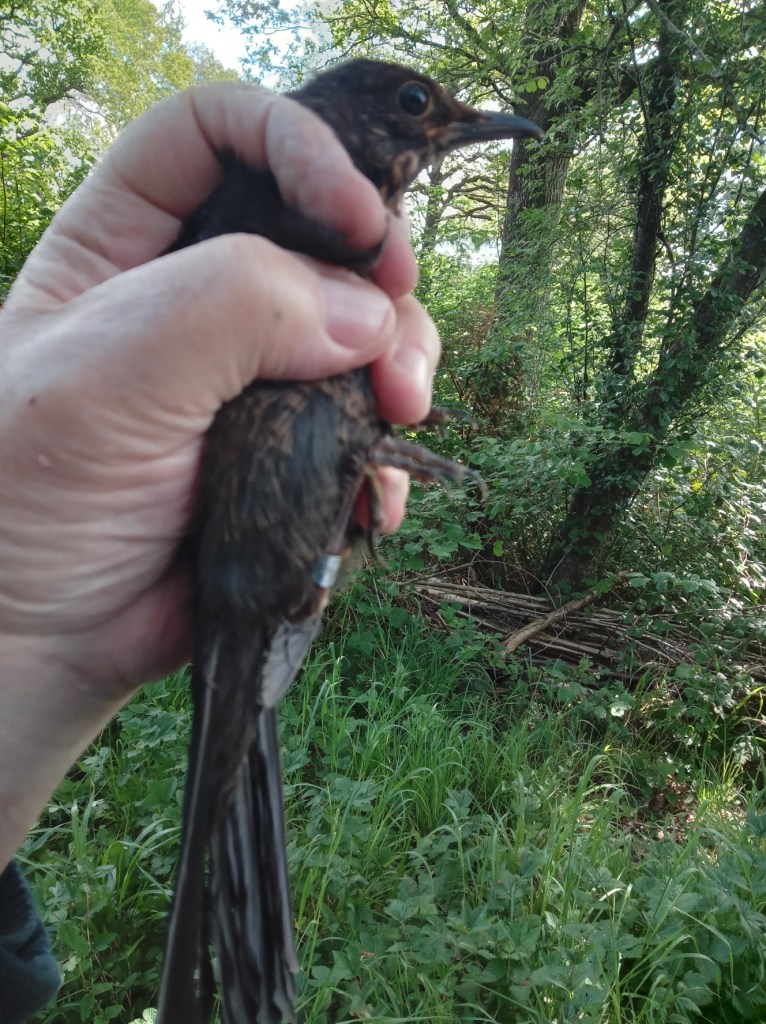
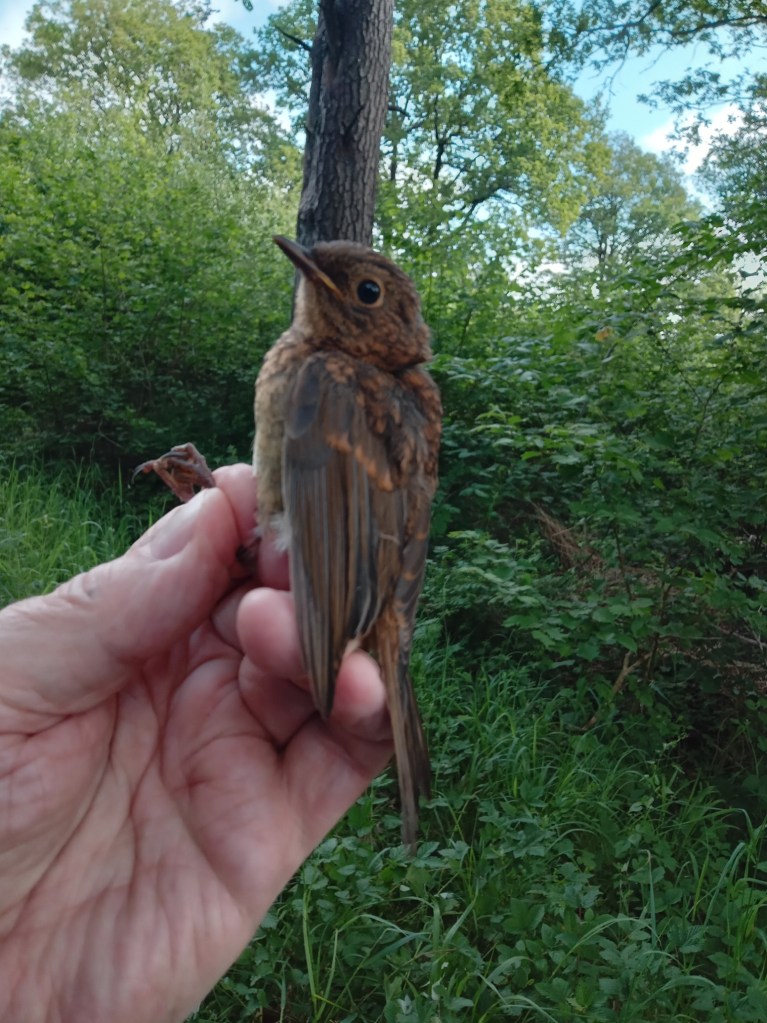
During our ringing session at Webb’s Wood today we caught this Blue Tit:
Blue Tit, Cyanistes caeruleus
As you can see from the blue primary coverts, this is an adult bird. It should have moulted last autumn after breeding. The state of its primary feathers and tail make it look as if it failed to moult. I am pretty certain that the discolouration would not be the result of a mite infection, but happy to be corrected.
It is a female, and had a developing brood patch. Will it make it through the breeding season? It’s weight was decent: 12.1g, so it seems to be feeding okay.
We were scheduled to go to Ravensroost Meadows this morning but the weather forecast was for there to be a gusting breeze from the north-east, getting stronger throughout the morning, until reaching 20mph by 10:00. That is far too windy for an open site like Ravensroost Meadows. Although it was next on the rota, it was with some trepidation that I decided to go to Webb’s Wood. My last visit to Webb’s Wood, on 14th March, was hugely disappointing. Despite having the feeding station still in operation, and all of the usual nets set up, in four hours I caught just nine birds: four new, five retraps and nothing overly exciting in the mix.
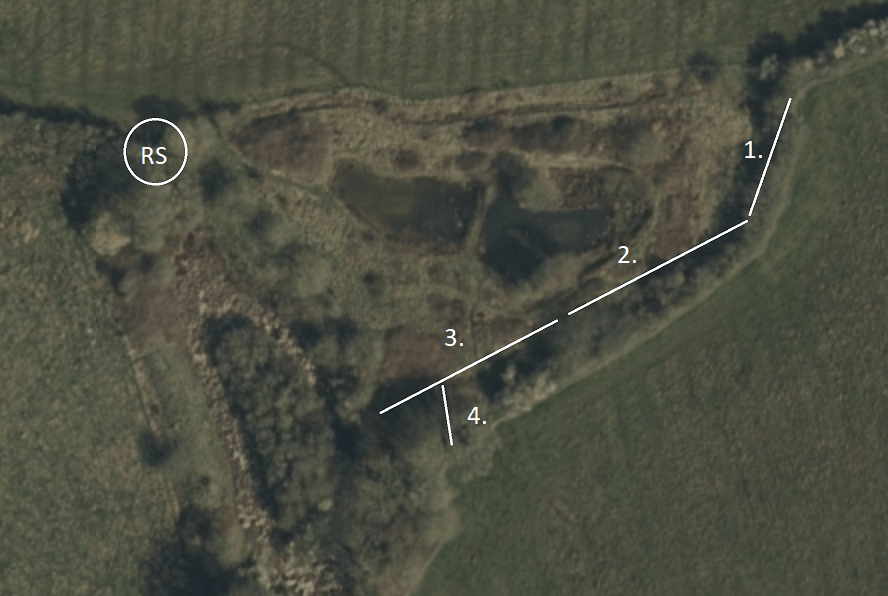
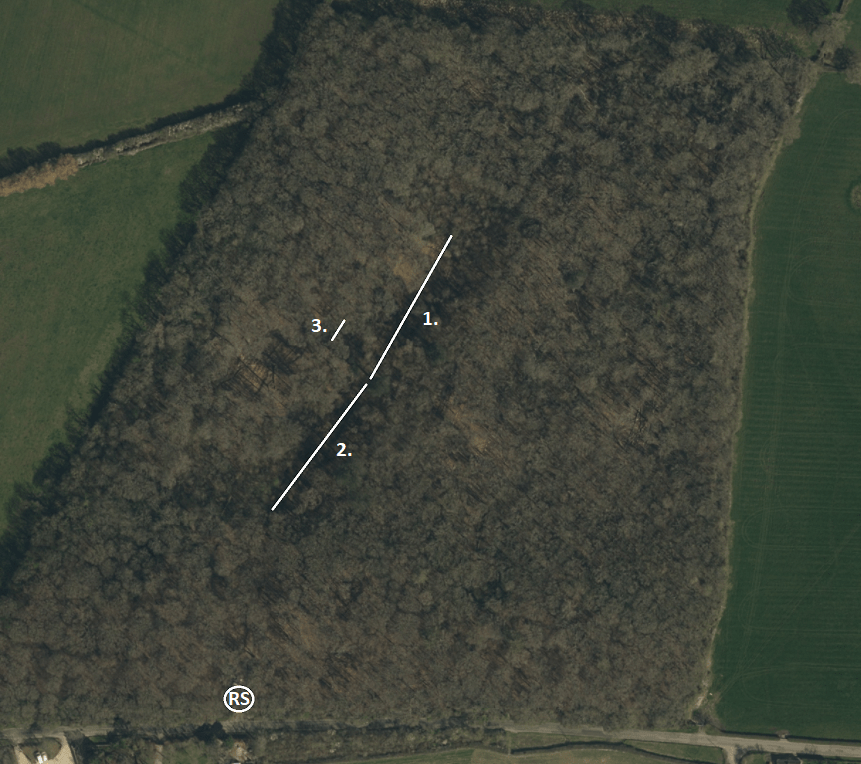
As I was being joined by Miranda, Laura and Ellie for the session, I was rather concerned that we didn’t have a similar poor result. I decided to take a chance and completely ignore our usual net rides and try out somewhere that I hadn’t tried for a long while. It was a bit of a gamble: our average April catch at Webb’s Wood in April is just 21 birds from 8 species. In the diagram below, the red circle is where we usually have our ringing station, the white one is where we set up today:
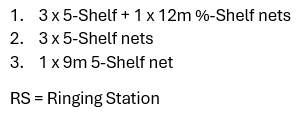
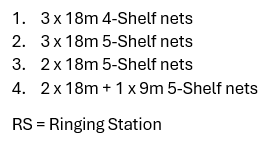
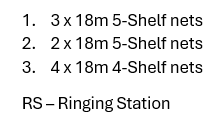
We met at 6:30 and set the following nets:
While Laura, Miranda and Ellie were setting rides 1 and 2, I was strimming down the border along which we then set net rides 3 and 4. It was a gamble we were taking but it started paying off straight away. It was never massively busy, but we caught regularly, with rides 3 and 4 being where we caught the five Blackcaps we had this morning, along with a number of other birds, so that certainly paid off. In fact, all four rides gave a reasonable return on our investment.
There were some good results, alongside the Blackcaps. We ringed our tenth Braydon Forest Marsh Tit of the year this morning: a second calendar year female. Given how poor Webb’s has been for the species in the past, it is encouraging to see how the population has grown since Forestry England thinned the beechwood and started removing the foreign conifers from the site. Across the Braydon Forest we rarely catch and ring more than one bird per month in the first four months of the year. Until this year, the average between 2014 and 2024 was just 3 Marsh Tits ringed in the first third of the year. We still have three weeks and several sessions to go to improve even further.
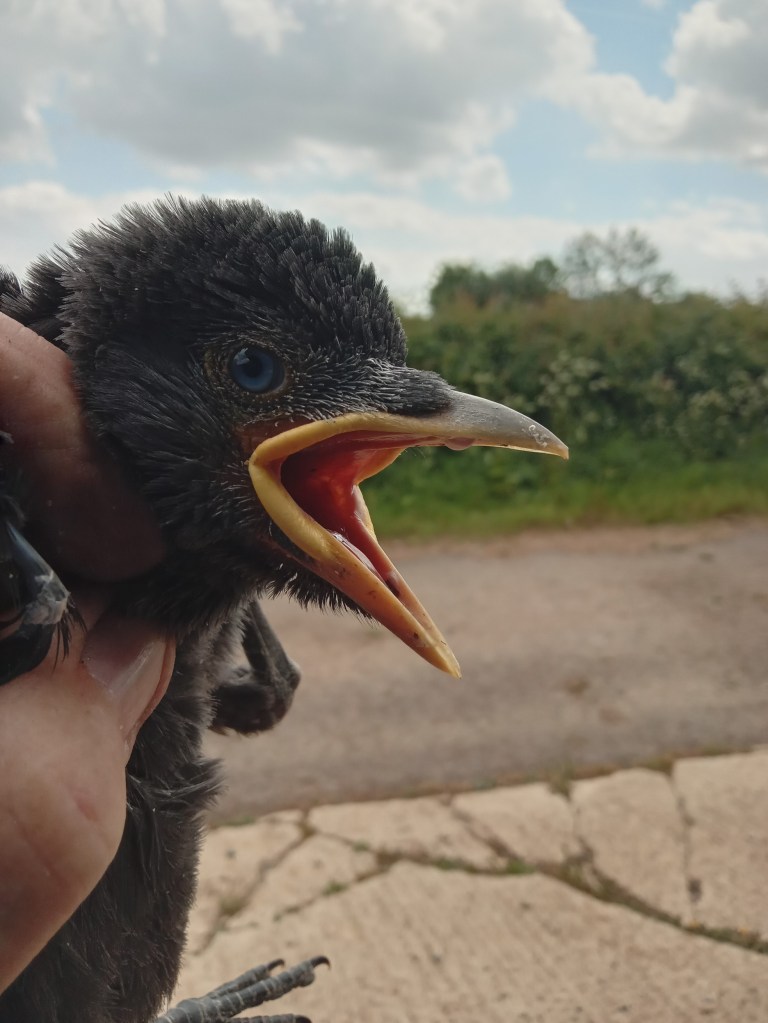
My favourite bird of the morning, though, was the last bird out of the nets:
Chiffchaff, Phylloscopus collybita
Looking at the head, above the beak, is a four-pronged pollen horn. A definite messy eater!
The catch for the session was: Nuthatch 1; Blue Tit 6(2); Great Tit 3; Coal Tit 2; Marsh Tit 1; Long-tailed Tit 2; Wren 4; Robin 1(2); Blackcap 5; Chiffchaff 2; Goldcrest 1. Totals: 28 birds ringed from 11 species and 4 birds retrapped from 2 species. So this catch was well above average for Webb’s Wood at this time of year.
The weather was good: sunny and bright. It warmed up quickly from a bracing 0oC when we got to the wood, until about 10:00, when it reached a balmy 14oC. The woodland managed to keep the worst of the wind off the nets until about 11:00, when the nets started to billow, so we closed them and took down at 11:15, taking a couple more birds out of the net as we did so. We had everything packed away and were off-site just before midday, after a much better session than usual for this site at this time of year.
It is the quiet time: the winter visitors have gone and the summer visitors have just started arriving. The feeding stations are down or, if not, largely ignored by the birds, as there is better food becoming available. I had actually left the feeders up in Ravensroost, topped up on Friday, primarily because I had a small amount of seed left over from the winter and I didn’t want to keep it until next autumn, nor waste it. With Saturday being very windy, even though it was dry and sunny, I scheduled the session for Sunday morning: same sunshine, much lower winds.
I was joined for the morning by David and Ellie at 6:30 and we set the following nets:
It took us a bit longer than usual to get the nets set up and open: mainly because I didn’t want us catching birds until we were good and ready to start extracting, so we kept the nets closed until the last one was set. That was primarily because Ellie has only just started her extracting and I didn’t want to have to stop net-setting to go and extract early birds, nor to leave them in the nets whilst we finished the setting. Once we had the nets fully open, just before 8:00, we soon started catching.
Unsurprisingly, adjacent to the feeding stations we caught Blue, Great and Coal Tits. However, what was good about this morning were the other birds caught. In the second round we caught a Dunnock and two Goldfinch. The Goldfinch are our first caught in the wood since September 2017! Seven-and-a-half years! Not only that, they are the first we have ever caught in April!
2nd Calendar Year Male Goldfinch, Carduelis carduelis
We had only actually caught 110 inside the wood in the previous 16 years, with 30 of those on one memorable day: 4th December 2011 (seared in my memory for reasons I will save for another day, but it involves a Lesser Spotted Woodpecker and the reason why I had to change trainer soon after), so any catch of them is very pleasing: even if I can do a couple of hundred every year in my back garden!
In that same round we also caught our first Blackcap of the year:
Female Blackcap, Sylvia atricapilla
I was somewhat surprised that it was a female. My expectation is that the males arrive first, establish territory and the females come along later and look for a mate! Two rounds later we did catch a male.
In that round we caught a retrapped Willow Warbler. It was ringed in this wood in April 2023, so clearly at least a second calendar year bird, recaptured on the 8th April 2024, and then again today. Clearly it likes Ravensroost Wood! In our penultimate round we caught another male Willow Warbler.
The last bird out of the nets was a female Goldcrest. Unlike every other bird caught today, she wasn’t yet showing signs of coming into breeding condition.
The list for today was: Blue Tit 4(5); Great Tit 3(4); Coal Tit (1); Dunnock 1; Robin (2); Blackbird 1; Blackcap 2; Chiffchaff 1; Willow Warbler 1(1); Goldcrest 1; Goldfinch 2. Totals: 16 birds ringed from 9 species and 13 birds retrapped from 5 species, making 29 birds processed from 11 species. So, although 29 birds is not a huge catch, it is actually better than our average catch at Ravensroost Wood in April: over 20 sessions in the wood, in this month of the year, the average catch is 24.95.
As well as a nice catch of birds there was a lot else to see. Flowers in bloom were Wood Anemone, Lesser Celandine and some early Bluebells! There were a lot of insects about as well: including my first Orange Tip butterfly of the year, and one of my favourite insects: the Bee Fly.
We decided to close the nets and take down just before midday, as the breeze had finally strengthened and the nets were billowing more than is acceptable. With David’s dad, Trevor’s, help, it didn’t take long and we were away from site soon after 12:30.
With the forecast being for the weather to be bright but breezy, I decided to head for one of the thicker woodlands: Somerford Common West. We set up the same nets as we have done all winter, and I had left the feeding station in place, as I have some seed I want to use up, rather than keeping it to go stale over the summer. I was joined for the morning by Miranda and Ellie, meeting up at 6:30. We had the nets open quite quickly but we didn’t start catching until 8:30, but we didn’t mind: look at what was the first bird out of the nets:
Male Firecrest, Regulus ignicapillus
This is only the twelfth Firecrest that we have ringed in the West Wilts group since it came into its current structure on 1st January 2013. i.e. One every year on average. So for Ellie, who got to ring a Firecrest on only her seventh ringing session, that was more than a little special! It did help my decision that Miranda got to ring one back in October and I have ringed three of the twelve, and I am ever such a decent chap as a trainer, so I share out the uncommon birds to my trainees.
Also in that first round we had a couple of Chiffchaff and a couple of Marsh Tit: one new, our ninth of the year so far, and one retrap, plus three Great Tit. The Marsh Tit numbers continue to be encouraging: since the start of the year we have ringed nine. The norm for the first four months of the year is between three and five, so this is exceptional.
One of the key parts of the processing of the birds now, and for the next few months, is identifying sex and breeding condition. This is usually easy for species such as Great Tit, which are sexually dimorphic (actually, second calendar year Great Tits can be difficult, with considerable variety in the degree of pigmentation of the black stripe down the breast), but difficult for sexually monomorphic species like the Marsh Tit. In that case, one blows on the belly and chest to see if the bird is developing a brood patch (female, some males) or developing a cloacal protuberance that sticks out from the body wall (male) or points down the tail (female). I have no idea why but we rather got the idea that this Marsh Tit was a male when we popped him in the weighing pot:
Male? Marsh Tit, Poecile palustris
We weren’t catching a lot but we were getting a decent variety of species. Unfortunately, soon after 9:30 the wind really got up and, despite the tree cover, the nets started to billow and blow out the pockets. It was a strong wind, not a breeze with some gusting. Not wanting to potentially compromise the safety of any birds, as shear forces can cause damage, we closed the nets and took down.
The list for the session was: Great Tit 3(3); Coal Tit 1; Marsh Tit 1(1); Wren 1; Song Thrush 1; Chiffchaff 2; Goldcrest 1; Firecrest 1; Chaffinch 1. Totals: 12 birds ringed from 9 species and 4 birds retrapped from 2 species, making 16 birds processed from 9 species.
So, a lovely little catch, with one very obvious and real highlight and we were home in time for coffee!!
A pretty typical March: catch sizes have fallen off as the winter visitors have mainly departed, summer visitors have just started arriving and the resident species feeding flocks have largely dispersed as they get territorial and are seeking a mate! We did get in a good number of sessions as the weather improved significantly on February. I even managed to do three sessions in walking, not Wellington, boots!
In keeping with the latest BTO guidance, I will be lumping Redpoll together for all future reports. The only three Redpoll we caught this month were all at Lower Moor Farm: the latest I have ever caught them at that site. Last year’s were all in the same place: but in Coulston, south-west of Devizes.
Added to the list, compared with last year, are Bullfinch, Green Woodpecker, Jay and Redwing. Missing from the list are Blackcap, Firecrest, Grey Wagtail, Mute Swan, Siskin and Stock Dove.
The Bullfinches were all caught at Lower Moor Farm: two in the wildlife refuge and one in the garden of the farmhouse. The Green Woodpeckers were caught at Lower Moor Farm and Andy’s new site just outside Warminster. Ours at Lower Moor Farm was absolutely covered in ant carapaces. It had clearly been rolling in them: I have never seen anything like it before. Unfortunately, it, along with the Lesser Redpoll, were all caught just after the Swindon Adult Wellbeing Group had departed to their next activity!
The Redwing were a bit of a surprise, given how few my team have caught up north this winter. One in a small catch at Blakehill Farm, the other three in the Firs. With the exception of winter 2014 / 15, I catch very few Redwing in the Firs. Apart from one in 2014, I have not caught them there in March. In fact, with that exception, I have never caught them in Q1 of any other year in the Firs.
Of the birds missing this year, Firecrest and Mute Swan are not really a surprise omission, given that we have caught only ringed one and retrapped one Mute Swan and, given we have caught and ringed 11 Firecrest, in over 12 years, it would have been a surprise if we had.
Missing Blackcap is more of a surprise, but we don’t catch a lot of them in March. Presumably the over-wintering birds from Central Europe have headed back to their breeding grounds and our summer visitors are still in north Africa / southern Spain.
Siskin are more of a surprise: March is usually one of our better months for the species. In the north they are migrants, but they are resident in the Warminster area and are usually nailed on from Andy’s activities. April is also another good month for the species so, hopefully, we will catch a few to make up for March’s shortfall. One of Andy’s other Warminster sites is also a fairly regular catch site for Grey Wagtail, and caught the three from March 2024, but none this year.
Stock Dove are usually caught in Barn Owl boxes during the breeding season. Only four of the 28 ringed, including this one, have been caught in mist nets: two of them in March.
I think the most surprising catches this month were Nuthatch and Treecreeper. Of the Nuthatches, eight were ringed in the Braydon Forest and two ringed in one of Andy’s Warminster sites, seven retrapped in the Braydon Forest, one in Green Lane Wood and the other at the Warminster site. It is our largest ever monthly catch, second largest number ringed in a month.
When it comes to Treecreepers, we had our best ever March catch of them: the previous best was 7. The only better catch was in August 2016: i.e. towards the end of the breeding season. 11 of those Treecreepers were new birds. The five retraps were four at Lower Moor Farm and one at Biss Wood.
So more birds caught but from more sessions and fewer species compared to last March.
Bjork time as in “It’s oh so quiet!”: it seems that the feeding flocks of resident birds have dispersed, presumably to focus on setting up breeding territories and attract a mate; the winter visitors have left, heading north to their summer breeding grounds, and our summer visitors are arriving, but not in any great numbers. The bird feeders are still up but clearly not as attractive as they were! I topped up the feeders at Somerford Common on Thursday morning: the peanut feeder was half emptied but the seed feeder had barely been touched. Clearly no longer needed so they will all be down by the end of next week.
Anyway, I was joined by Rosie, Laura, Adam and Ellie at 6:30. It was great that Rosie could stay for the whole session this morning. We set the usual nets, plus I tried one additional net in front of a stand of conifers:
Unlike Wednesday, when we started with nine birds in the first round, raising our expectations before dashing them, this one started as it intended to go on: just three birds. All Great Tits: two new and a retrap.
Thereafter, every round produced only a couple of birds. There were some nice surprises: a male and female Goldcrest caught adjacent to each other in the net. We wondered if they were a pair, so we released them after processing, and they flew off together, so quite possibly a pair.
Having spent the second part of our recent ringing demonstration at the Firs muttering about wanting to catch Treecreepers, and failing to do so, two Treecreepers caught adjacent to each other in the nets this morning was satisfying for me. They turned out to be two males, not a pair, but nice to have.
A five year-old Marsh Tit was a real surprise. However, looking up his number, that is the twelfth time we have actually caught this individual! With the exception of the year it was ringed and 2022, it has been caught at least three times every year.
Having said “it’s oh so quiet” that was actually overturned on our last two rounds: at 9:30 we took a male Great Spotted Woodpecker out of the nets! There is no louder bird in the woodlands than one of these. We then didn’t catch anything for an hour, whereupon we caught a second! Every bit as loud and shrieking as the first.
Laura had to leave at 10:00, as she is playing in a concert in Malmesbury this evening, and the rest of the morning and afternoon were scheduled for final practice / rehearsal. Mark arrived to chauffeur Adam home at the end of the session.
Despite not catching any this morning, there were a few Blackcap singing in the surrounding woodland, and plenty of Chiffchaffs claiming their territories. Hopefully we will get a few of each in our future catches.
The list for the session was: Great Spotted Woodpecker 2; Treecreeper 2; Great Tit 6(2); Marsh Tit (1); Chiffchaff 2; Goldcrest 2. Totals: 14 birds ringed from 5 species and 3 birds retrapped from 2 species, making 17 birds processed from 6 species.
One thing to note: this is the first time that I can remember that we have run three full session without catching a single Blue Tit!
With nothing caught in the next couple of rounds after the Great Spotted Woodpeckers, we took down and were packed away and off-site soon after 11:15.
A bit of Shakespeare to start this blog piece: “Oh what a tangled web we weave when first we practice to deceive!”
I was joined by Laura and Ellie for this morning’s session at Blakehill Farm. The last couple of hundred metres of hedgerow that I would usually set nets along has just been laid. It was desperately in need of doing – but it certainly won’t be hosting too many birds in the next few months. Because of that, we decided just to set nets on the plateau.
I arrived a bit early and drove out onto the plateau with the nets and poles ready to set up. I had fantastic views of two Hares running away from me as I crawled along the track. Once I had parked up, I had nice views of a Curlew flying across the centre of the plateau, calling as it went. We heard that call a lot this morning. I also had a Raven kronking away overhead. When joined by Laura and Ellie, we had superb views of a Barn Owl quartering the ground for the next ten minutes or so. The plateau was alive with Skylarks: with them chasing each other all over and then catching the escalator up to sing their songs.
We set the following nets:
We had the nets open by just before 8:00, and did our first round at quarter past. It was an excellent first round: five Linnet, three Reed Bunting and a Dunnock. So, why the Shakespeare quotation at the start? Because, with the exception of a Willow Warbler at 9:20, that was it! The total list for the day was: Dunnock (1); Willow Warbler 1; Linnet 5; Reed Bunting 1(2). Totals: 7 birds ringed from 3 species and 3 birds retrapped from 2 species, making 10 birds processed from 4 species.
So, we had a lovely time, with excellent weather and lots of wildlife to see: we just didn’t catch them! However, it was pretty rewarding to catch our first Reed Buntings, Linnets and Willow Warbler of the year. Blakehill Farm, on the Chelworth Industrial Estate side, is my most regular site for Reed Bunting and it was one of my target species for the morning.
The Linnets were a lovely catch. Since 2019 we have annual totals of 5, 2, 2, 2 and 2 Linnets across the farm. To catch five in one session in March is remarkable.
Male Linnet, Linaria cannabina
If you look, you can see the pink blush on the chest. It is a clear indicator that it is a male. There are other indicators that you can use with birds in the hand. One involves looking at the wings, much easier is looking at its cloaca: this bird had a very obvious cloacal protuberance, i.e. it is a male coming into breeding condition.
As for the Willow Warbler, we don’t catch many on the plateau, or in that hedgerow, come to that! We have had a total of 17 since we started working at Blakehill in 2015. This is only our second Spring catch there: the first being in April 2019. 2020 was our best year for them: five caught in June, so probably breeding, and three caught in August, possibly on autumn migration. Take those eight away and you can see how scarce the are at this site. It is the earliest catch my team has ever had for this species at any of our sites, by four days. The only others were two caught at Lower Moor Farm on 30th March last year. Looking at the group records as a whole, there were only another two caught in March: one at Langford Lakes on 30th March 2023 and, the earliest of the lot, at a farm just outside the village of Alderton on the 21st March 2024. So very uncommon in March.
Willow Warbler, Phylloscopus trochilus
It was a feisty critter and didn’t want to pose for photographs, hence just a controlled head shot of today’s bird.
Having had no birds in three separate rounds, we decided to call it a day and closed the nets and took down. We left site by 11:30. It would have been nice to have had more birds, but it was still a lovely session.
After a couple of cancellations, we finally managed to provide another session for the Swindon Adult Wellbeing Group, run by the Wiltshire Wildlife Trust. We managed to persuade them to get to site for 10:30. However, Miranda and I agreed to meet at 6:30. After waking up earlier than I wanted, I was on site for 6:00 and started setting the nets:
Miranda arrived on time and we had the nets open just after 7:00, and started catching pretty much straight away. However, it was slow! Slow – but interesting. I don’t think that I have ever previously had a session at Lower Moor Farm where we didn’t catch a single Blue Tit.
Fortunately, when the Wellbeing group arrived at about 10:45 we did have some lovely birds to show them. It started with a Goldcrest and a Treecreeper, then a Chiffchaff and a couple of Great Tit. That was over the next 45 minutes, together with lots of explanation of the ringing scheme, demonstration of the processing and photograph opportunities. However, having had two empty rounds and time cracking on, the moved off to the next stage of their day whilst Miranda and I went to take down ride 1.
Returning 10 minutes later we found three Redpoll in ride 2 and this beauty in ride 3:
Second Calendar Year Male Green Woodpecker, Picus viridis
I did try to get hold of the group: phone call, text and even took a drive around the reserve, all to no avail! So I am afraid that they missed out on the highlights of the day. To be fair, when I did manage to get in contact with the organiser later this afternoon she did say that, regardless, the attendees had loved every minute of it and were very happy at what they had seen.
Not only is this our first Green Woodpecker this year but the first we have caught since we caught two at Blakehill Farm West in August 2023. If anyone is in any doubt what these beauties eat, this bird had ant carcasses all around his mouth and face: a really messy eater.
The three Redpoll were also our first for this year: taking our total for this winter to 11. Last winter (October to March) we had 54!
The list for the session was: Green Woodpecker 1; Treecreeper (4); Great Tit 2(1); Wren 1(2); Robin (2); Chiffchaff 2; Goldcrest (3); Redpoll 3; Bullfinch 1(1). Totals: 10 birds ringed from 6 species and 13 birds retrapped from 6 species, making 23 birds processed from 9 species.
This is only the second time that we have ever caught four Treecreeper. The previous time was at Somerford Common in October 2019. That is, at least, a woodland, as opposed to reclaimed quarries and farmland lined by trees.
Ride 1 was incredibly poor today: it delivered just one of the Treecreepers. It is early days: it has just been cleared out, the trees have been thinned and some have been topped, so there is far more light and space available. For the first time in years Miranda found a couple of Dog Violet:
Common Dog Violet, Viola riviniana
Close by, and exposed by the clearance, was a wide spread of Scarlet Elf Cup:
Scarlet Elf Cup, Sarcoscypha coccinea
Again, a common species elsewhere, just the first time we have seen them in this particular area.
With the last few birds extracted we shut the nets before processing them. We then processed them before taking the final nets down, and we left the site at about 12:45. Not a huge catch, but we have had so few Redpoll this winter and our first Green Woodpecker for ages were stand out birds.
After posting the link to the piece onto BlueSky, I was having a browse and found a repost by Alex Lees. It was a video showing a Chaffinch floundering around in a garden, under some feeders, with its legs missing, due to Fringilla papillomavirus. This disease, of course, he attributed to being spread at feeding stations. Firstly, Fringilla papillomavirus was first discovered in Chaffinch populations of the UK in the 1960’s, long before the exponential boom in garden bird feeding. Secondly, it is widespread across the world and across species, despite the fact that garden bird feeding is much less prevalent outside of the UK, although garden feeding is certainly increasing in western Europe.
I find this hard to understand. Chaffinches are not particularly prolific users of gardens, according to the data from the BTO’s Garden Birdwatch scheme, my own GBW observations and my own ringing activities. Also, the disease is widespread across Europe and beyond: in those countries where bird-feeding is not as concentrated as it is in the UK. Yet they still have Chaffinch suffering from the disease.
Not every scientific group is as desperate to blame its spread on garden bird feeding as those in the UK. This paper, for example:
It is open access and good reading, with some extremely graphic photographs. The last phrase of their paper states: “The mode of transmission, current prevalence of papillomavirus infections in chaffinches, bramblings, and other wild bird species, and effects of the infection on the fitness of the affected subpopulations are unknown and deserve continuing attention.”.
From a variety of other sources I have learned that Papillomaviruses infect a number of other species: Chaffinch, Greenfinch, Canary, Brambling, Northern Fulmar, African Grey Parrot, Yellow-throated Francolin, Mallard and Adélie Penguin. I don’t remember seeing too many of the last five at my feeding stations!
Average numbers of Chaffinch reported from UK gardensAverage frequency of Chaffinch reported in UK gardens
These graphs have been taken from the BTO’s Garden Birdwatch data: hundreds of thousands of records from thousands of observers and, even at the heights of their population maximum counts were between two and four in each garden. Since the population crash (I will discuss Trichomoniasis in a separate post) you can see the numbers and frequency have halved, making close interactions and, therefore, virus transmission somewhat less likely.
When I look at the number of Chaffinch that I have ringed in my garden, it averages out at three per year. However, when I look at the sightings that I have reported to the Garden Birdwatch Scheme, I get the following graph:
As you can see, there was a huge drop off after 2010. Presumably the results of Trichomoniasis. Such a steep decline, which rather distorts the reality of how it is today. However, the highest weekly average was 6.3 in 2010 and the lowest was 2016, 2020 and 2021. If I graph the data from 2015 onwards it shows a rather different story:
The highest is 1.0, in 2022. I can honestly say that I have not seen a Chaffinch with FPV in my garden for at least five years. However, away from the garden, in my Braydon Forest sites, I would estimate that one in five Chaffinch we catch has to be released because it has either developed FPV or shows signs that it might be: usually, the legs are showing some sort of greenish colouration. This is not to be confused with the white socks of a Cnemidocoptes mite infection. We did have a Chaffinch with the mite infection visit the garden between 2021 and 2023, but I haven’t seen it for a long while. Of course, as soon as I saw it in the garden I would disinfect the feeder it had accessed. That said, I am not sure how much it could have spread that disease at my feeding station as I have never seen any sign of it in any other Chaffinches: either in my garden or at my ringing sites.
Alex describes his position:
I’m here for the evidence. Increased competition may be a significant factor in Marsh Tit declines. Increased competition and predation is likely the most significant factor in Willow Tit declines. Diseases mostly spread at feeding stations underpin declines in Chaffinches and Greenfinches.
Where is the evidence? There is zero evidence for that last sentence: this is his belief, his faith, his religion. I suggested an alternative. How are viruses spread? The Human papillomavirus is spread through intimate contact, i.e. it is contagious. How is influenza spread? Through exhalation of infected droplets. How likely are Chaffinches to come into those sorts of direct contact with their conspecifics at feeding stations if the maximum number recorded at any one time is four across all year’s data, but fewer than two at any one time in the last year?
This quotation from the Lawson, Robinson et al paper cited below:
“However, it is not possible with the available data to evaluate the relative importance of risk factors for occurrence of finch leg lesions, and the extent to which supplementary feeding may alter their occurrence.”
It is worth reading: they do suggest the possibility of transmission at feeding stations but, significantly, they do not put the emphasis on it in the same way that the anti-feeding cohort continue to do.
I suggested an alternative: in Wiltshire ringing activities find large flocks of Chaffinch on farmland in the winter. They take advantage of game cover, winter stubbles, etc. Bearing in mind that one never gets to ring 100% of what is there, when you are getting catches that can be in excess of 60 individuals in one session, it shows that they are large flocks. Large flocks that roost together, large flocks that will huddle together for warmth. According to Dr Lees “Roosts don’t provide as suitable conditions for transmission for either disease nor in fact same pairwise opportunities for transfer as on/below feeders given substrates.” My answer would be “why not?”. I am pretty sure that if you took a large group of humans, several of whom are suffering from influenza, and put them in close proximity for eight or so hours, huddling together to keep warm, there would be several uninfected members of that group that would become infected.
Mentioned in the first two papers cited below is the incidence of FPV in Bullfinch. Anecdotally, when out ringing we find a similar proportion of Bullfinch with FPV to that which we find in Chaffinch. I find it interesting for two reasons: the extremely low frequency of Bullfinch visiting garden feeding stations and the small numbers that visit gardens:
Frequency with which Bullfinch are reported in UK gardensAverage numbers of Bullfinch reported from UK gardens
I have only ever ringed a single Bullfinch in my garden and the averages recorded under GBW are negligible: since 2008 I have only recorded Bullfinch in 8 years, the rest have had an average of two per annum, and I haven’t recorded any since one in 2018.
For the absence of doubt: I do not deny that garden feeding stations can be a terrible source of disease for birds. Infections caused by Salmonella, E.coli and Suttonella (hadn’t heard of that until I started looking into this) are clearly easily spread from dirty bird feeders. For that reason, I scrapped the bird tables from my garden, I use hanging feeders, clean and disinfect them regularly, swap them out and rest them in between fills. I do not want to be responsible for spreading disease within our local bird populations.
Citations:
Lawson, B., Robinson, R.A., Fernandez, J.RR. et al. Spatio-temporal dynamics and aetiology of proliferative leg skin lesions in wild British finches. Sci Rep8, 14670 (2018). https://doi.org/10.1038/s41598-018-32255-y
Hugh J. Hanmer, Andrew A. Cunningham, Shinto K. John, Shaheed K. Magregor, RobertA. Robinson, Katharina Seilern‑Moy, Gavin M. Siriwardena1 & Becki Lawson: Habitat‑use infuences severe disease‑mediated population declines in two of the most common garden bird species in Great Britain. Nature Scientific Reports | (2022) 12:15055 | https://doi.org/10.1038/s41598-022-18880-8
I. Literak; B. Smid; L. Valicek: Papillomatosis in chaffinches (Fringilla coelebs) in the Czech Republic and Germany. Vet. Med. – Czech, 48, 2003 (6): 169–173
With the weather forecast from every source saying that there would be a low breeze, with some gusting, coming from the south-east, I decided to go to the western side of Blakehill Farm, by the Whitworth building. When I say every source, I mean: weather.com; MeteoBlue; xcweather and the Met Office: they all forecast the same thing. I was joined by David, Ellie, Laura, Adam and Mark. We met at 6:30 and set the following nets, knowing that they would be sheltered from the prevailing wind by hedgerows, trees and buildings:
The breeze didn’t get up until after we had the nets open by 7:30: and then it came from the north! Net 5 blew out straight away, so we shut it after round two, as the billowing completely opened out the pockets. Fortunately, the other nets were a bit better protected and we managed to keep going for a couple of hours before the wind got up too much and we decided to wind up the session: hence the punning title to this piece.
Unfortunately, the wind made the nets visible and the catch was low, but there was a decent variety: Blue Tit 2; Wren (1); Dunnock 2(1); Robin 3; Redwing 1; Song Thrush 1; Blackbird 2; Chiffchaff 3(1); Goldcrest 1; House Sparrow 2. Totals: 20 birds ringed from 9 species and 3 birds retrapped from 3 species, making 20 birds processed from 10 species.
It was a pleasant enough session but, after a couple of empty rounds, and the wind showing no signs of changing, we shut the nets and took down at about 10:30.
It was good to catch our first two House Sparrow of the year. They are regular in my garden – but equally regular in avoiding my nets! Blakehill Farm is the only site that I have caught them at with any regularity. This is my first session there this year, and we caught two: a male and a female. Our fourth Redwing and third Song Thrush of 2025 were also nice to haves. Prior to this morning’s session we had caught three Chiffchaff, so another four was also good to have. The retrapped Chiffchaff was originally ringed at Blakehill last April.
On Wednesday we will be trying for a session on the plateau at Blakehill – hoping for a few early migrants. Fingers crossed!