Webb’s Wood: Sunday, 16th February 2025

With the mini “Beast from the East” forecast for this weekend, rain all day Saturday, Sunday was the only possibility. It was the reverse of Thursday, not as windy as forecast when we arrived on site. Kick off time was 7:00 and I was joined by David, Laura, Adam, Emma and Rosie. Rosie had to leave for work at 8:00 – she was going to be running a workshop for a local Scout troop at Lower Moor Farm and needed time to get set up. Thankfully, we managed to get her one bird to process before she left, even though it was yet another Blue Tit. Emma is our newest member of the team and is still getting comfortable with handling the birds, so is not processing or extracting the birds yet, but is making herself very useful helping with everything else and is keen to learn.

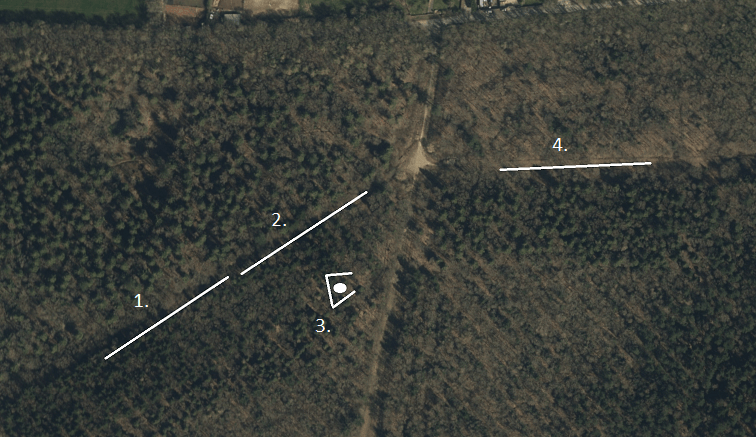
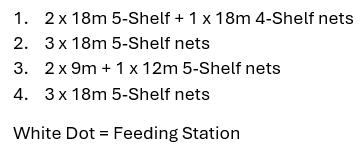
We set the following nets:

I only set the feeding station up last Wednesday. Last year the feeders were stolen from the site, so I held back from setting one up until now. Both feeders were empty this morning, so we replenished them first thing. Funnily enough, the majority of the birds caught were not caught at the feeding station but in the other nets.

It wasn’t a hugely busy session: we caught regularly throughout the morning, three or four birds at a time. As expected, it was Blue Tit heavy, but there was a reasonable spread of birds. The highlight for me was another two Marsh Tits to colour ring. This is the first time since I started the Marsh Tit project that we have ringed five Marsh Tits in the first two months of the year – and we still have another three Braydon Forest sessions to go before the end of the month. We usually catch the bulk of them in July and August, once the youngsters have fledged.

The list for the session was: Nuthatch 1; Blue Tit 15(5); Great Tit 5; Coal Tit 2(6); Marsh Tit 2; Wren 1; Robin 1; Goldcrest (1). Totals: 27 birds ringed from 7 species and 12 birds retrapped from 3 species, making 39 birds processed from 8 species.

By 11:00 the wind had begun to get up and it was a bitterly cold easterly, so we decided to end the session and take down. With the five of us to take nets down and pack away, it only took just over 30 minutes to get ready to leave site.

Yet again, I was disappointed that there just seems to be no sign of Lesser Redpoll or Siskin at the sites that are usually our regular catching areas. Hopefully there will be some sight of them before the end of the winter!
Brief Encounter: Thursday, 13th February 2025

The plan for Thursday was a session at Miranda’s property: our new Cleverton site. I left home at just after 7:00 and headed off for the session. Arriving at about 7:20, getting out of the car I was very disappointed to find that the forecast slight breeze was actually quite a stiff breeze blowing directly through where we wanted to set the nets. Not only that, the easterly breeze was horribly cold. It is quite open with nowhere to put the nets where they would be sheltered from the wind. Disappointed, but we both agreed that it wasn’t possible to set the nets and ensure safety for the birds. We will reschedule for the next calm day.

I returned home, via Ravensroost Wood to set up a new feeding station for the Swindon Wellbeing Team meeting on Tuesday. Surprisingly, back at home there was virtually no wind. We have had plenty of birds in the garden recently: good numbers of Goldfinch and Greenfinch, Jackdaw and Starling, Woodpigeon, Stock Dove and Collared Dove, Robin, Dunnock, Blackbird, Magpie and Wren, Blue and Great Tits. So, rather than have a completely empty day, I put up two 6m nets in an open triangle around our two feeding stations and baited two Potter traps with mealworms, hoping to have at least a few birds to process.

Naturally, all of those birds decided to be a no-show, and nothing much happened for ages. Then a couple of Goldfinch arrived, followed by two Starling and a Dunnock. I did catch a third Goldfinch but, for the first time in my experience, its legs were white, wearing mite socks!

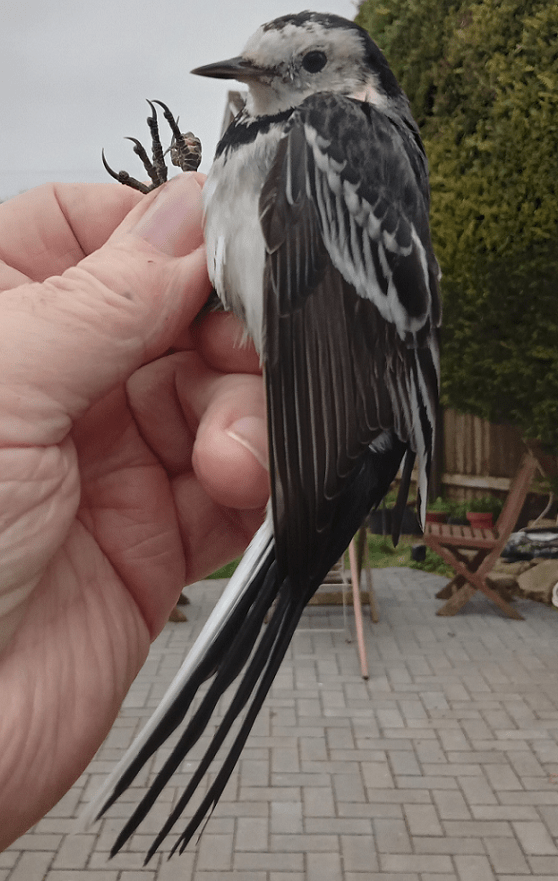
By this time the wind that had prevented the scheduled session arrived in Purton. As I went to shut the nets I was delighted to find this sitting there:

1st Winter Pied Wagtail, Motacilla alba yarrellii

As a trainee I was lucky enough to ring a goodly number of these beauties, 29 0f them, mainly at Marlborough Sewage Works. Not only that, I was lucky enough to ring 13 White Wagtails that over-wintered at that site.

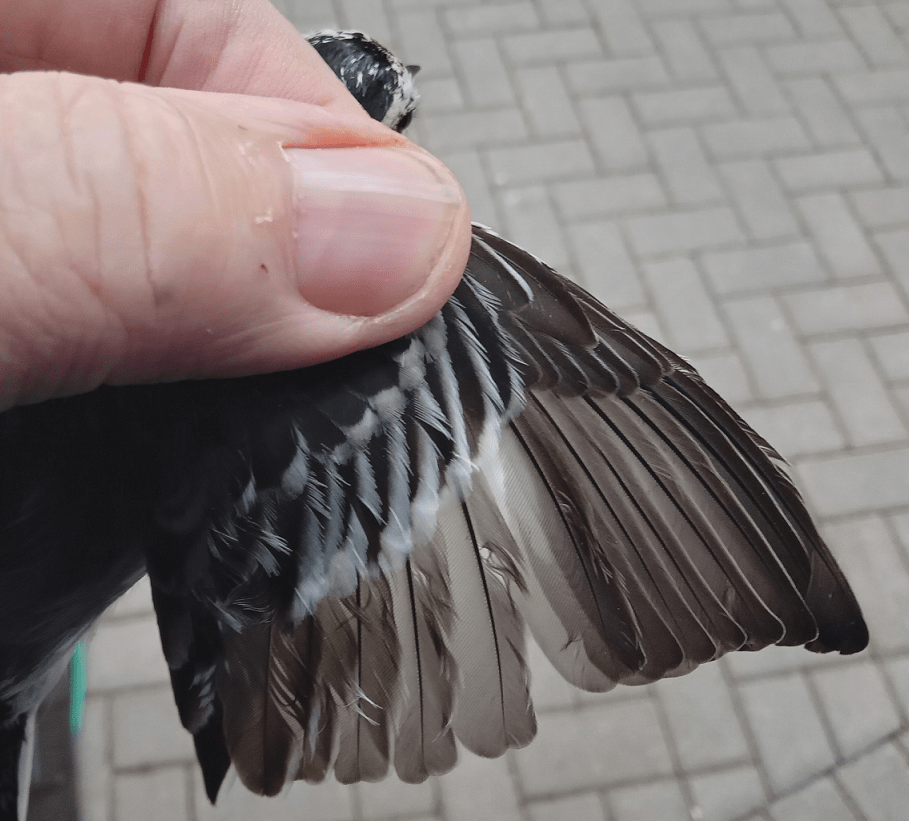
Since then I have not had a site that has areas attractive to the species. I have been lucky enough to catch two at Blakehill Farm, adjacent to the farm yard. Then, in January 2021, I caught one in my back garden, and this Thursday I caught my second for the garden. It is a first winter bird: the black bib has not developed yet and there were allow tinges on the white areas on the head and the wings were dull and not strikingly black.

According to the bible: Moult and Ageing of European Passerines by Jenni & Winkler, this wing condition is indicative of a first year male, but I would like to recapture it later in the year before sexing it.

Anyway, after a blow out first thing, and then all of the birds disappearing from the garden, it ended up being a sweet, if short, bit of garden ringing. I must do more!

Ravensroost Wood: Tuesday, 11th February 2025

What happens when you put the wrong date in your diary? The Swindon Wellbeing group, run by the Wiltshire Wildlife Trust, meets on a Tuesday. Having entertained them at Somerford Common on the 15th January, I was asked if I could arrange some other Tuesday sessions and opted for Ravensroost Wood in February and Lower Moor Farm in March. Unfortunately, I transposed the dates and went to Ravensroost Wood this morning, expecting them to turn up. It was only when the expected arrival time passed and there was no sign of them that I checked my emails to find I had got there a week early! Oh well: I will be back there next Tuesday, but will choose a different part of the wood: a part I have been meaning to try out for some time but haven’t got around to.

I was joined for the morning by Laura and we set a variant of the usual nets for the feeding station area, as there was just the two of us:

It was a fairly predictable session: lots of Blue Tits, a few Great Tits and not a lot else. One of the interesting things about Blue Tits in our last couple of catches has been ratio of adult to first winter birds ringed. Prior to this month there has been quite a lot of discussion amongst ringers on the closed Facebook group about how different the adult to first winter ratio had become compared to what we are used to. Normally one expects the number of first winter birds to far exceed the number of adults but it certainly wasn’t the case for a lot of ringers. Many reporting that adults were outnumbering juveniles. It wasn’t quite so drastic in the Braydon Forest woodlands. Between the 1st November and the 31st January we ringed 124 Blue Tits of which 43 were adult and 81 were first winter: one third adult to two-thirds first winter birds. However, come February and things have certainly changed significantly: we have ringed 42 Blue Tits, 8 adults and 34 first winter birds. Under one-fifth are adults.

It really has been a winter without finches in the woodlands: we had five Lesser Redpoll before Christmas but none so far this year, nor have we had any Siskin either before or since Christmas. Even Chaffinch we have only had six this winter. Last winter we had 35, and the average over the last 12 winters is 39 of them. Perhaps we will get 33 in the next six weeks! It is most unusual.

We were joined for a couple of hours by Rob. He came along to a few taster sessions in 2022 but work got in the way and he couldn’t take it any further. With a little more time on his hands nowadays, he has managed to fit in a couple of visits, and today ringed a bird: the only Robin we managed to catch today.

Today’s list was: Blue Tit 13(3); Great Tit 3(3); Coal Tit (1); Marsh Tit (1); Robin 1; Song Thrush 1; Goldcrest 1. Totals: 19 birds ringed from 5 species and 8 birds retrapped from 4 species, making 27 birds processed from 7 species.

It wasn’t the most exciting session we have had, but it was enjoyable nevertheless. There were quite a few people dog walking today, and every single one had their pooches on leads. Astonishing! I suspect they were just trying to keep them out of the mud, which was horrendous.

At 11:00 a cloud rather decided to drop in on our ringing station, and it got a bit damp, so we closed the nets, extracted and processed the last few birds, and then took down, leaving site at about 12:15. Absent from our list this morning was Nuthatch: one of which was flying around our ringing area, calling for all it was worth, whist we were taking the nets down. I think it was taunting us!

Red Lodge: Sunday, 9th February 2025

This week’s session was planned for Red Lodge. I set up a feeding station there on Tuesday morning for the first time this winter. Our last session at Red Lodge, without a feeding station, produced just 21 birds from six species, with just four Blue Tits and two Great Tits. It rather begged the question: is it the feeding station that is attracting those two species into the catching area? So, today could provide an indication of the impact.

With Saturday forecast to be drizzly and miserable, but Sunday looking dry and miserable, we decided to be miserable on Sunday! Unfortunately, that meant that several of the team couldn’t make it. However, Rosie joined us for an hour-and-a-half before heading off to work, and I had the family Childs with me for the whole session.

On arrival at the site, at 7:30, it was damp, misty and cold. However, there was very little wind to disturb the nets. We set the following:

The two seed feeders and one of the two peanut feeders, the one adjacent to ride 3, had been emptied, and the other peanut feeder, adjacent to ride 1, was half full still.

One of the nice things about Red Lodge: for the first time for what seems like an age, we were not wading through mud. The tracks in Red Lodge are all pretty solid, with either chalk or rubble bases under a top layer of soil and vegetation. It does make a bit more of an effort to get the holes in place for the poles, but it is worth it! Another nice thing about it: with the feeding stations in place it is a compact area we work in, the nets are all easily visible and we can go and extract birds as they arrive, rather than having regimented rounds that may, or may not, produce any birds!

We started catching straight away, which meant that Rosie got to process a few birds before heading off to work, and the first round was reasonably varied: Blue Tit, Chaffinch, Coal Tit, Dunnock, Great Tit and Marsh Tit. However, thereafter it was Blue Tit city, interspersed with a few additional species, mainly Great Tit, but it was a decent haul and an enjoyable session. We caught regularly all morning.

The list for the session was: Nuthatch (1); Blue Tit 22(3); Great Tit 8(1); Coal Tit 3; Marsh Tit (1); Long-tailed Tit 1(1); Dunnock 1; Robin (1); Chaffinch 2. Totals: 37 birds ringed from 6 species and 8 birds retrapped from 6 species, making 45 birds processed from 9 species.

So, clearly, if we take this as able to be extrapolated to all sessions, the feeders are a big attractant to the Blue and Great Tits, but also improve diversity by attracting in other species.

Nice to catch a couple of Chaffinch that we could put a ring on. Unfortunately, we also had one that we couldn’t ring due to the beginnings of Fringilla papillomavirus on its legs. It seems to me that it is becoming less common in our local Chaffinch population. Hopefully that is the case.

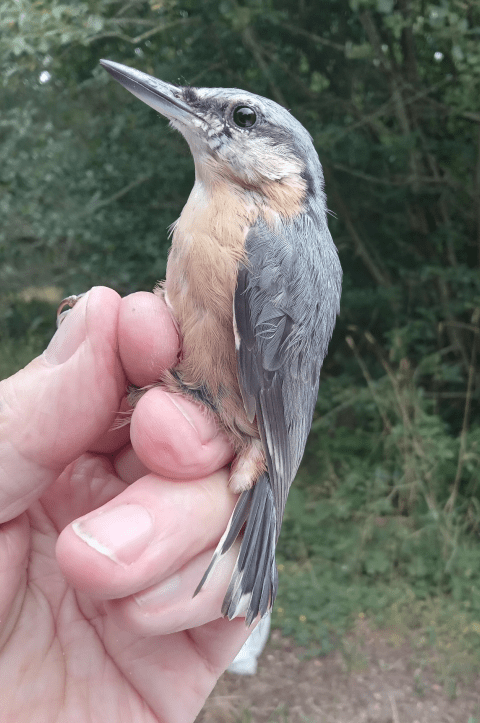
It is always nice to catch a bird that has exceeded the typical lifespan for the species. That was the case with the female Nuthatch that we retrapped. It was five years since she was ringed as a bird of unknown age. According to the BTO’s BirdFacts, based on masses of survey data, their typical lifespan is just two years, although the oldest known from ringing recoveries is a couple of days over 11 years!

Female Nuthatch, Sitta europaea

With us all getting quite cold I announced we would shut the nets and start taking down at 11:30 so, naturally, we took another 11 birds out of the net whilst trying to get them shut. I swear that if I announced after each round that the next would be the last before we packed up, I would end up with much larger catches! Anyway, we started packing away just before midday and left site by 12:30 after a cold but enjoyable session.

West Wilts RG Results 2024: Ringing Recoveries

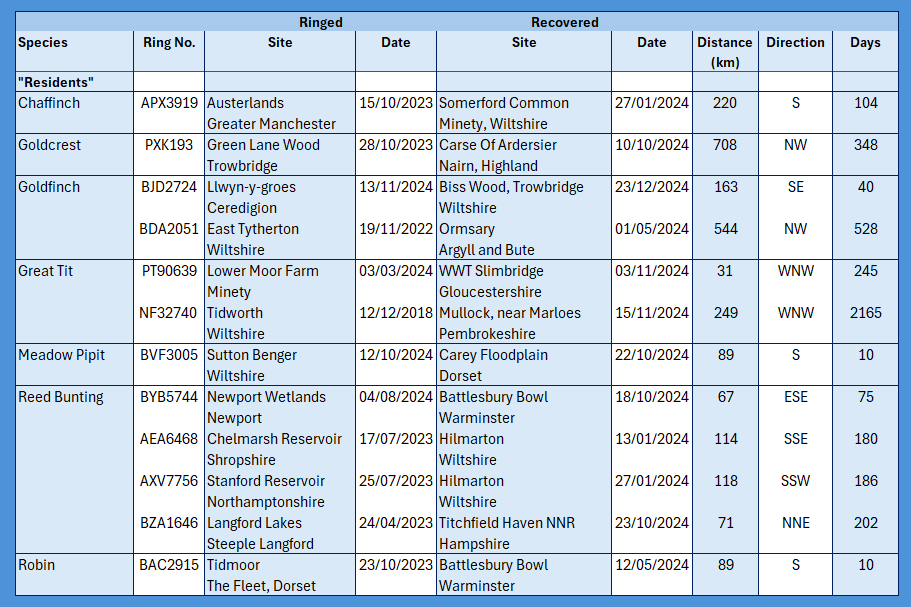
This report covers those movements of birds either from previous years but not received until 2024, plus recoveries reported for 2024. Those recoveries have, generally, moved over 50km and have either not been ringed by us, or have been ringed by us but recaptured by others.

We had a decent number of recoveries in 2024, including first long distance recoveries for Chaffinch, Great Tit and Reed Bunting. The maps and tables have been updated in the appropriate pages: “Residents” and “Warblers”.

The summary tables of last year’s recoveries are:

A huge “Thank you” to Jonny Cooper for putting the map and table updates together. The relevant maps and tables have been updated on the appropriate pages.

Somerford Common: Wednesday, 5th February 2025

It seems that we share Somerford Common with some rather unsavoury characters. We continually find shotgun cartridges all over the site. Nobody has a licence to shoot wildlife on the site, outside of the deer management team. Whilst topping up the bird feeders yesterday I was approached by a local resident who asked if I knew anything about the tree felling going on. There is none scheduled, so this is clearly illegal. She explained that she had seen lights and the sound of chainsaws at night time over the weekend. When she went to check the next morning, she found several stumps and someone cutting up some of the wood. He got aggressive when asked why he was cutting down Forestry Commission wood. His response was that he was removing dead wood, but it isn’t, it is green oak wood. The presence of his chainsaw and his manner made her decide not to pursue it. She chose not to call the police, presumably worried as she is very local to the site, and they were nowhere to be seen today.

In recent years I have found several Fox carcasses dumped adjacent to our ringing site, and a dead Buzzard outside the stable just over the other side of Queen Street, that runs along the north edge of the wood. This morning, whilst carrying out our session at Somerford Common, I was approached by a young man out walking his lurcher and black Labrador. He asked if I was aware of the dumped Foxes and Buzzards along the by-way that runs through the western part of Somerford Common. They must have been there a while, as he told me that the bodies are now too decomposed for meaningful examination. He forwarded me some photos of one of the dead birds:

He said Buzzard but, with that colouration, it could equally be Red Kite. I did go to try and find the dump site after we had finished our ringing session, to confirm, but was unable to find it. I know that things die of natural causes, but rarely do they do so in a communal area. They look to have been killed elsewhere and then dumped. That looks to me like foul play.

Anyway, onto nicer things. I was joined for the morning session by Laura and Miranda. We met at 7:30 and set the usual nets. We started catching birds as we were opening the nets and, although it wasn’t the biggest of catches, it was certainly interesting.

The first bird out of the net was a retrapped Marsh Tit, the first of four recaptured this morning. The rest of the morning panned out pretty much as expected, although a haul of eight Robins was the best we have had since 28th May 2017, when 10 Robins were part of a catch of 47 birds. Mind, that catch was boosted by the addition of three newly fledged juveniles.

Apart from the Robins, the catch was primarily Paridae. Unfortunately, no sign of any finches! Hopefully we will get some Goldfinch, Chaffinch, Lesser Redpoll and Siskin and, if we are very lucky, some Brambling in the next couple of sessions.

The list for the session was: Nuthatch 1(1); Blue Tit 7(1); Great Tit 3(4); Coal Tit 1(4); Marsh Tit (4); Dunnock (1); Robin 2(6); Blackbird (1). Totals: 14 birds ringed from 5 species and 22 birds retrapped from 8 species, making 36 birds processed from 8 species.

We started closing up and taking down at 11:30, stopping to process the four birds that insisted on dropping in as we were trying to get things packed away. Things were finished by 12:30 and I went off to try and find some corpses.

Lower Moor Farm: Saturday, 1st February 2025

I have seen enough mud to last me a lifetime so today I decided to have a session at Lower Moor Farm, knowing that it would be firm underfoot. Having spent the week with a stinking cold and a sick car, I was pleased to be able to get out: cold has more or less cleared and the car, with its new starter motor, is back on the road again. Mind, on my way to site, it was nearly off the road again, as I misjudged an S-bend, got into a mud skid and just managed to keep it out of the ditch. Not an auspicious start!

David joined me for the session. We met at 7:30 and set the following nets:

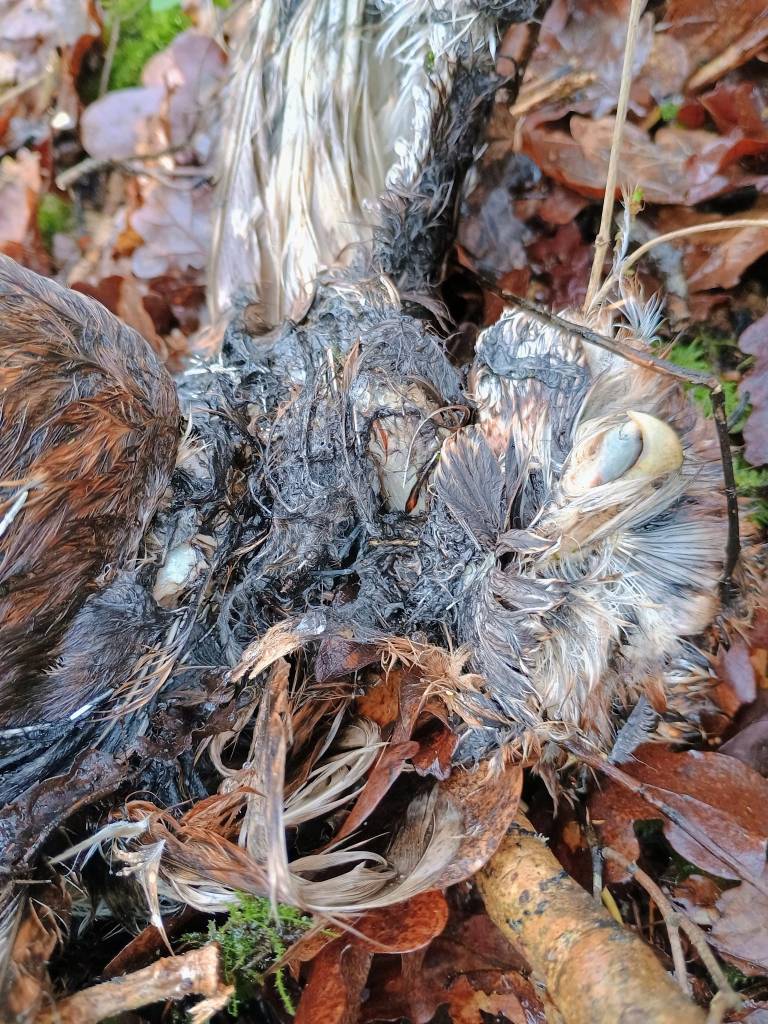
It was a slightly unusual session, starting with finding this when setting up ride 3:

Lots of fur, and this:
An Ex-Roe Deer, Capreolus capreolus

We couldn’t think of what might have killed the deer. It is a long way from any roads, I suppose it could have died from illness or old age. Regardless, it has been stripped by the scavengers in the area. I contacted Jonathan, the farm manager, to find out if he knew anything about it. He was aware of it but had no idea how it had ended up, ironically, in the Wildlife Refuge! Nobody has noticed any White-tailed Eagles flying around!

Anyway, we did manage to catch a reasonable number of birds adjacent to the carcass: including our first two February Nuthatch at Lower Moor Farm. In over 10 years of ringing there we had only ringed eight at this site, and those were all caught in ride 1, adjacent to the woodland.

It wasn’t our biggest ever catch by a long way, but we seemed to be active constantly. A lot of it came from the fact that each round produced at least a couple of birds. We also had a lot of visitors interested in what we were doing, so I spent quite a lot of time explaining about ringing, why we do it, how we do it and the results and feedback we get from our activities.

The catch for the morning was: Great Spotted Woodpecker 1; Nuthatch 2; Blue Tit (1); Great Tit 4; Long-tailed Tit 1(3); Wren 2; Dunnock 1; Robin 1; Redwing 1; Goldcrest 1(1). Totals: 14 birds ringed from 9 species and 5 birds retrapped from 3 species, making 19 birds processed from 10 species. Not bad variety for just 19 birds.

The Redwing was the first that we have caught since 19th November: a very long time between catches for this species in the winter.

We have only caught seven Great Spotted Woodpeckers at this site before: the last in 2021, so it was good to catch another one. We should have caught more: I even noted an occupied nest site last breeding season. That was because you could hear the youngsters demanding to be fed. I might have tried to ring them if the nest hole hadn’t been facing over the stream that runs through the reserve.

Anyway, it was a nice, relaxed session. We closed the nets at 11:30, processing the last few birds, then took down and were off site just before 12:30.

West Wilts RG Results: January 2025

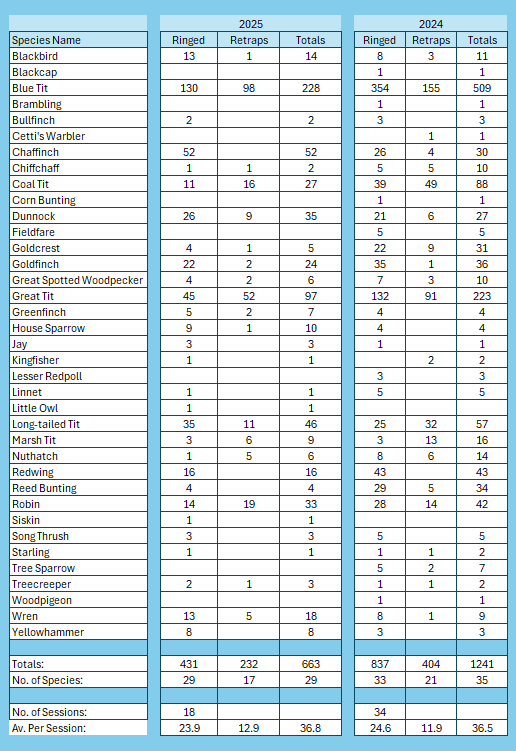
On the face of it, compared to last January it was a disappointing month but, considering the weather and the impacts on bird life, and the fact that it is comparable with previous years prior to 2024, no real concerns about the result. Indeed, the key difference between the two months is in the number of full sessions we were able to fit in. There were just over half as many full sessions as last January, so the numbers caught per session were just about equal. Another factor from my catches was, quite simply, I did not manage to set up my usual feeding stations at all of my winter feeding sites: Red Lodge, because I need to find time to clear the winter rides; the Firs, because I did set a feeding station but in three weeks the only feeder found was the peanut feeder destroyed by squirrels and Webb’s Wood, because last year the feeders were stolen from the site and I haven’t found a position that I think would be safe from such people. The impact is quite marked. Last January my Braydon Forest team processed 436 birds in six sessions, this January it was just 168 birds in four sessions.

Missing from our catch this January when compared to last were: Blackcap; Brambling; Cetti’s Warbler; Corn Bunting; Lesser Redpoll; Tree Sparrow and Woodpigeon. Added to the catch were just Siskin and this beauty:

Little Owl, Athene noctua (photo courtesy of Dr Ian Grier)

Ian and Andy have been trialling a new site and, although the catch at their session wasn’t huge, to catch our first adult Little Owl is very exciting, especially given that their UK population has declined by 82% between 1967 and 2022.

I am not going to do the usual increases / decreases analysis, as the difference in the number of sessions renders it meaningless. Let’s hope for better weather in February!

Swamped: Somerford Common West, Saturday, 25th January 2025

With the forecast being for there to be a lot of wind this morning I decided that we needed to head for one of the woodland sites. Having not been to Somerford Common West for a long time, I decided we would head there. The thing about the western side of Somerford Common is that, unlike the usual area, this is the commercial forestry part of the complex. Our ringing site is on the edge of the plantation area. As a result, it is usually a good site for Coal Tit and Goldcrest. It is also one of the sites where I do sometimes catch Siskin. All in all, it is often worth a visit. There is a feeding station there, and has been since the beginning of December. Having been away on family duties at the beginning of the week, and Storm Eowyn hitting hard subsequently, I didn’t get out to top up my feeding stations until Friday.

I was joined by Ellie, David, Laura, Adam and Rosie. Rosie coming along to help set up before heading off to work at the Wildlife Trust. Fortunately this morning she actually got to ring some birds before heading off to Vincienne’s Wood. Ellie helped with the training element of the morning, as I was scribing as well as supervising the processing, and she actually processed just the one bird. We set the following nets:

The two rides holding nets 1, 2 and 3 were unbelievably wet and muddy, particularly the area around net ride 2. There was a potential for sucking welly boots off at every step, and a walking / furling stick was needed to prevent falling (f0r me, if not others). Fortunately, we all managed to get through the session without mishap.

The first thing that I noticed when we arrived was that the peanut feeder was three-quarters empty and the seed feeder had barely been touched. That was indicative of how the catch panned out: just one finch in the entire catch, a female Chaffinch. The rest were primarily those happy with peanuts.

Our first round was the biggest of the session: 11 birds. Interestingly, only one of those was a Blue Tit! Three each of Coal Tit and Great Tit, plus a retrapped Marsh Tit and a new Great Spotted Woodpecker were all caught by the feeding station. Two Goldcrest were caught in net ride 1: up into the coniferous area.

There were some highlights: two Great Spotted Woodpeckers to ring, plus one retrap. We have ringed four of them so far this year. To be fair, we did actually ring 6 in January 2024, but only ringed 10 in the whole of the year. It will be interesting to see how this year pans out.

We ringed our second and third Marsh Tits of the year: equalling our best January catch for the species, with at least one more session to go.

The catch for the session was as follows: Great Spotted Woodpecker 2(1); Blue Tit 13(5); Great Tit 5(3); Coal Tit 3(2); Marsh Tit 2(1); Long-tailed Tit 1; Robin 1(1); Blackbird 1; Goldcrest 3; Chaffinch 1. Totals: 32 birds ringed from 10 species and 13 birds retrapped from 6 species, making 45 birds processed from 10 species.

We did have three strange captures: a female Great Tit and a female Blue Tit already defeathering their brood patch. I don’t mean that they had just started: it was a toss up as to whether I recorded them as at stage 1 or stage 2, they were that close to being fully defeathered. There was also a male Blue Tit that had a very obvious cloacal protuberance (for the less anatomically informed, or just plain smutty, the equivalent of his willy). Flitting around in the bushes adjacent to the ringing station was a pair of Great Tit: very much foraging together within the underbrush.

We started packing away at 11:30 in a staggered fashion, removing ride 4, doing a round and processing the birds in the remaining nets. Then removing ride 1, checking the remaining nets, and processing the birds extracted. Finally emptying and taking down rides 2 and 3, processing the birds that we took from those nets, and completing our packing away. We then left site at 12:45 after a decent session, even if we did fail to catch any Siskin or Lesser Redpoll.

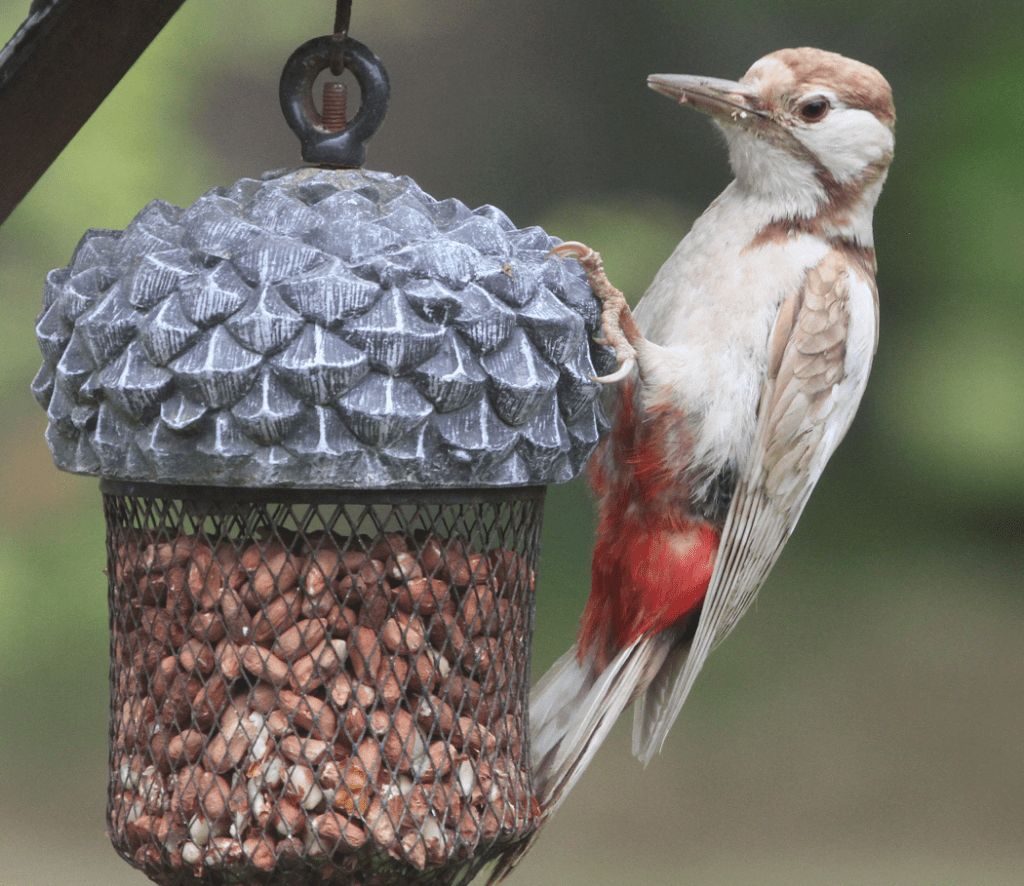
As a side note: whilst topping up the bird feeders in Ravensroost Wood on Friday I met a couple out having a walk. They were interested in what I was doing and why, so I invited them to come along this morning. When they arrived this morning Rosie was just processing the first of the Great Spotted Woodpeckers. They mentioned that they had an unusual looking woodpecker in their garden, and then showed me this:

Leucistic Great Spotted Woodpecker, Dendrocopos major (photo courtesy of Steven Rawlings)

Empty Woodlands: The Firs; Saturday, 18th January 2025

Ten days ago, to help with the bitter weather that had moved in, I set up a feeding station in the Firs: two one litre seed feeders and a one litre peanut feeder. On Tuesday I stopped off to top up the feeders, only to find that the peanut feeder was half empty and the seed feeders had not been touched. I assumed that this was simply a case of adjusting to them being there / finding the feeders. I was joined by David, Mark, Adam, Daniel and Emma. Laura did come to help us set up before heading off for a day of French Horn playing!

The first thing I did was to check the feeders: the peanut feeder had been wrecked, no doubt by an irate Grey Squirrel. Just the lid and its hanger remaining. Despite looking all around, no sign of the cage and the base. It brought to mind an image of a squirrel running around with it stuck around its head and body. One of the seed feeders contents had been reduced by about two inches, the other hadn’t been touched. I did wonder if we would actually catch any birds.

We set the following nets:

As we walked down the hill there was just one bird in ride 1 and nothing in ride 2. However, while Adam extracted the first Blue Tit of the morning, as we watched, a small flock flew into the furthest away net in ride 2: five Blue Tits. Having extracted them, we found a few more birds had flown into the nets: a Dunnock, Long-tailed Tit, Blackbird and a Wren. Ten birds proved to be the best catch of the session. Thereafter it was just one or two birds each round.

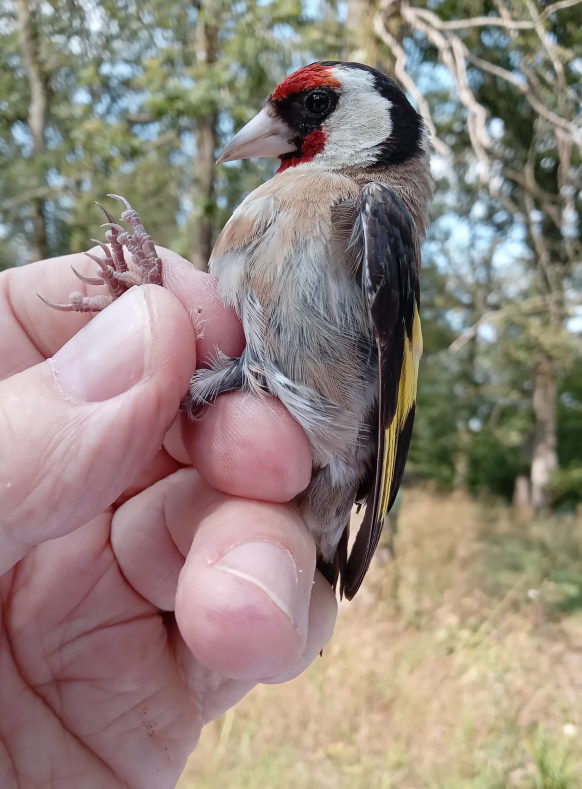
It really was a quiet morning. The only highlight was our sixth Goldfinch at the site. The first three were caught in a session in December 2013. After that, there was one in March 2017, one in August 2024 and this today:

Juvenile Female Goldfinch, Carduelis carduelis

The list from this morning was: Blue Tit 9(1); Great Tit 2; Long-tailed Tit (1); Wren 1(1); Dunnock (1); Blackbird (1); Goldfinch 1. Totals: 13 birds ringed from 4 species and 5 birds retrapped from 5 species, making 18 birds processed from 7 species. This is our worst January catch in the Firs ever. The previous worst was 32 back in 2019.

We kept the nets open until we all decided we were too cold to continue. Mind, that was at midday. There was quite a lot of Great Spotted Woodpecker drumming going on all morning: they were too busy with their territorial percussion to come down to the nets.

One actual bonus: David’s dad, Trevor, was clearing out his loft (roof repairs going on) and found a rather fine, solid four-seater picnic table. Surplus to their requirements, so we tried it out as a ringing table and it is perfect!