A Memorable Session in the Firs: Saturday, 17th August 2024

With most of my team away or otherwise engaged, David, Rosie and I went to the Firs this morning, meeting at 7:00. Rosie had to leave for work at 9:00, so the rest of the session would be just myself and David.

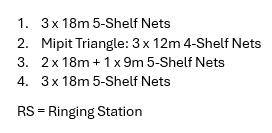
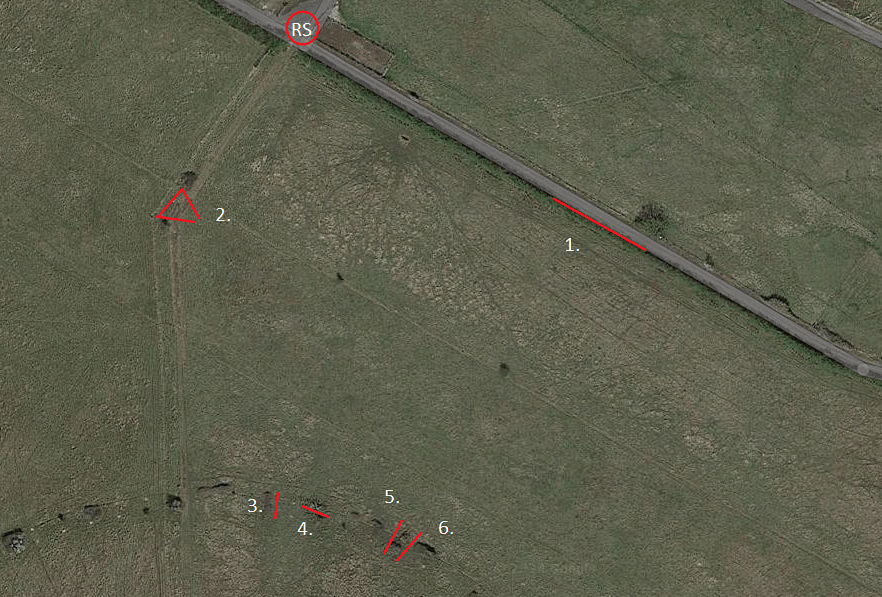
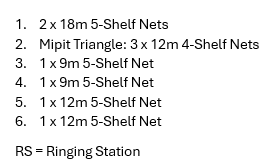
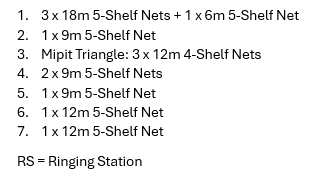
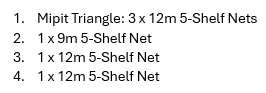
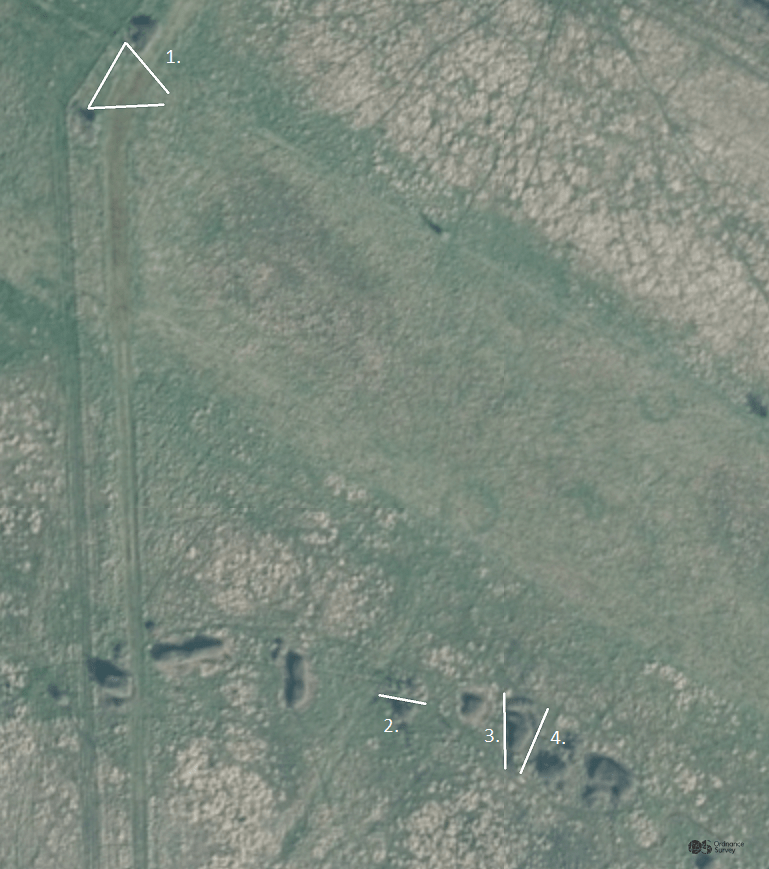
Rosie and her team have done a great job opening up the central glade, following on from the Chalara Ash Die-Back remediation work. We had an encouraging session last time we went: 55 birds from 11 species and I was hopeful that we would have something of a repeat. This time I added two new nets, to take advantage of some of the new opened areas. I kept it to two because I knew we had only a small team out and I like to ensure we are in control. Next time I have a large team out I will try a few more net positions. This is what we set:

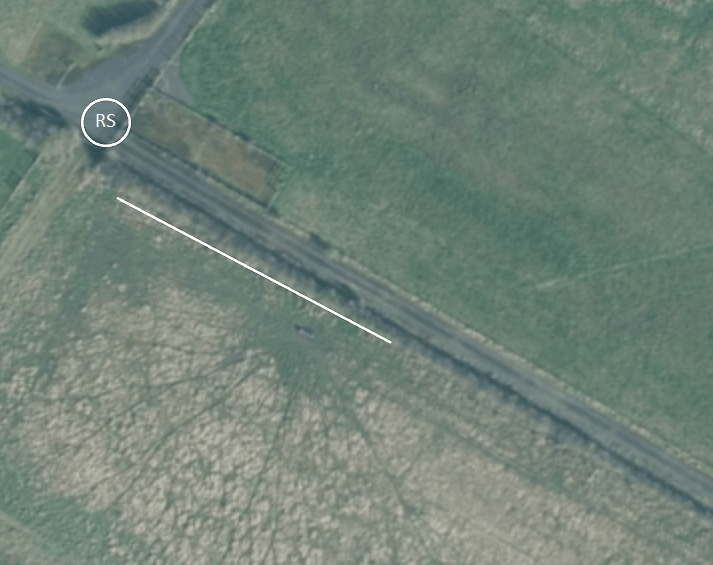
This map is courtesy of the Wiltshire Wildlife Trust. Net ride 3 was the test net set.

We had the nets open by 8:00, extracting a Robin that flew in as we were opening up. I put on lures for migrant birds: Blackcap, Chiffchaff, Willow Warbler, Spotted Flycatcher and Redstart. We missed out on the last two.

Our first round proper produced a decent haul of 27 birds from 10 species. We processed them and then Rosie had to leave to set up her work party at Blakehill Farm. The next round was a bit smaller, 11 birds from 7 species. We kept extracting and processing until 11:00. When we went to do the penultimate round we found the nets were very full: 45 birds from 13 species. I decided that we would shut the nets as we emptied them, as this would give us more than enough for one session. This last round was when we had the biggest fall of Blue and Long-tailed Tits. We had extracted a number up to that point but this time was significant 15 Blue Tits and 10 Long-tailed Tits.
The catch for the morning was: Nuthatch 3(1); Treecreeper 1; Blue Tit 9[18](5); Great Tit 4[6](1); Marsh Tit (2); Long-tailed Tit 1[11](1); Wren 2[2](2); Dunnock [1]; Robin [9](1); Song Thrush [1]; Blackbird [1]; Blackcap [6](2); Chiffchaff [3]; Willow Warbler [3]; Goldcrest [1]; Chaffinch [1]; Goldfinch 1. Totals: 21 adults ringed from 7 species, 63 juveniles ringed from 13 species and 15 birds retrapped from 8 species, making 99 birds processed from 17 species. Of the retrapped birds 9 were also juveniles ringed in the Firs.

Why is this so memorable? The first thing is that this is the second largest catch my team have ever had in one of our woodlands. The largest was in November 2013 (103 birds from 11 species), but that was with a feeding station set up, this was purely down to the natural attraction of the site. I think the key attractant was the abundance of blackberries: large, juicy and plenty of them. This seems to be the result of the works that have been carried out in thinning the wood and strimming of the central glade. They have certainly never been that abundant in my memory.

The Goldfinch was the first that we have caught at the site since March 2017, and only the fifth for the Firs:

Goldfinch, Carduelis carduelis

That was lovely but alongside that we caught three Willow Warblers. Prior to this session we had only caught two in the Firs: a juvenile in September 2019 and an adult in April 2021. One of our Willow Warblers caught today had dark legs, so often I hear “It’s a Chiffchaff, it has dark legs”, life just isn’t that easy:

Willow Warbler, Phylloscopus trochilus

After the processing of the 45 birds in that last round we were ready to pack up and head home. With the help of David’s dad Trevor, it didn’t take long, apart from the fact that I managed to drop a part of a net I was taking in onto a few of the left overs from the strimming of the bramble. The brambles at the Firs are particularly vicious, for every prickle you have on a standard bramble these things have six, closely packed together. Still, I took down two nets and they took down all of the others: swings and roundabouts!

The new net ride did well, producing two Nuthatch and the Treecreeper, along with its fair share of Blue Tits and Robins.

So, it was a really good session. I was particularly pleased with the variety: 17 species. However, it was hard work when there was just the two of us.
Reddy, Set, Start: Lower Moor Farm, CES 11, Thursday, 15th August 2024

With the rain scheduled for Wednesday morning actually arriving, and lasting longer than forecast, I had no option but to move the session to Thursday. The forecast was for it to be dry but with some breeze from the south-west. Our nets are fairly well sheltered from a breeze from that direction. I was on site for 6:30 (couldn’t sleep) and got the first nets open by the time the rest of the crew arrived at 7:00, the agreed start time. I was joined for the session by Miranda, Rosie and Sarah. We had all of the nets open by 7:30 and Rosie stayed until she had to leave for work. She was starting out from the other side of Lower Moor Farm, so could stay a bit longer than usual.

It was quiet until 8:40, when we had our first decent round of the day. The following round, at 9:10 was also reasonable in number, but also had the star bird of the day. Prior to that and after it was very quiet. A lot of that is almost certainly down to the weather: at 9:50 the breeze became much stronger, would last for a minute and then drop for ten or more minutes before repeating. Come 11:00, the breeze became a very strong wind, with no respite, so we had no choice but to shut the nets, to ensure the safety of any birds that might get caught. We did catch one last bird in the final net set when Miranda went to close them down.

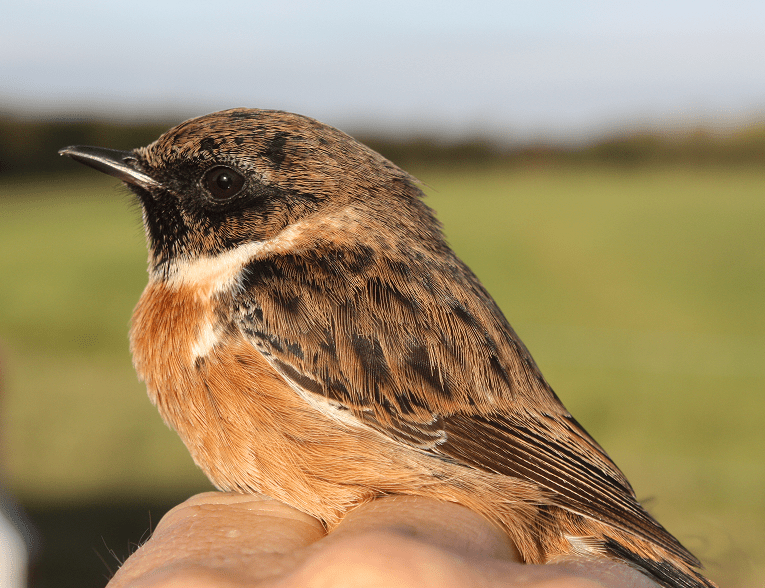
The reason for the silly title: today we caught our third Redstart in a month. We have caught three on autumn migration before, in 2020. Hopefully, with a few sessions to come at Blakehill Farm, we will be able to exceed that number this year. What is particularly nice about this year is that all three have been at different sites, including a first for the Whitworth building side of the Blakehill site, plus we have had an adult female in breeding condition, a juvenile and today we caught this:

First Year Male Redstart, Phoenicurus phoenicurus, freshly completed moult.

A few minutes after Miranda had processed it and released it we were joined by a friendly photographer. When I asked him what he was looking for he replied “male Redstart”! If only! He was actually looking for an adult male that had been seen on the site earlier in the week.

Our catch for the day was: Treecreeper (1); Blue Tit [4](1); Great Tit (1); Long-tailed Tit 1; Wren (2); Dunnock [1](1); Redstart [1]; Robin (1); Song Thrush 1; Blackbird [3]; Blackcap [1]. Totals: 2 adults ringed from 2 species, 10 juveniles ringed from 5 species and 7 birds retrapped from 6 species, making 19 birds processed from 11 species.

Not the biggest catch but, given how the weather played out, plus only the second ever Redstart for the site, we were all pretty satisfied with our shortened morning’s work.

Upper Waterhay Farm: Monday, 12th August 2024

With a couple of successful Jackdaw nests confirmed on the 1st July and, tragically, finding that our Barn Owl nest had been predated with the chicks at a very early stage on that visit, I wanted to find out if the Barn Owls were going to try again. I also wanted to check on what the Swallows have been doing: recognising that I have left it a bit late in the season to find chicks to ring. I was joined by Sarah for the session. We also planned to see if, post-Jackdaws, Gospel Oak Farm’s boxes were going to have Barn Owls breeding.
We started at Upper Waterhay Farm first. The first box we checked, the Chancel box, had clear signs of roosting Barn Owl, as did the West box where the young were predated back in July. The North box, which successfully fledged Jackdaws, was hosting a resting Jackdaw, which flew off as we approached. Going to our fourth box, the Paddock box, as I stopped the car and got out, a female Barn Owl flew out and deposited the complimentary and, seemingly obligatory, guano spray on the rear of the car.

We took that as a good sign! When I checked the box there were four eggs in there. Hopefully we will have some success in this box. I have ringed Barn Owl broods as late as the 12th September: two broods in 2019, one at Upper Waterhay Farm, the other at Echo Lodge Farm.

In between the first three and the fourth Barn Owl box, we stopped off at the farm yard to let Richard, the farmer, know what we had found so far and to check on the Swallow nests. As I expected, most had already fledged, and they were flying in and around the outhouses that we were checking. Sarah noticed that under some peeled back roof insulation there was a nest with a couple of heads peeking over the side. I climbed up to find four chicks, feathers medium, ready for ringing and a week or two off fledging. Sarah got to ring her first Swallow pulli.

Moving the ladder to check on a couple of other nests, I found this on a shelf a couple of feet below an old nest:

Swallow, Hirundo rustica, pullus skeleton

Swallows simply do not recognise a chick that is not in the nest. This must have fallen out of the nest and simply starved to death. The skeleton is completely intact, so there is no hint of predation.

We had planned to check the boxes at Gospel Oak Farm but, as we were putting the ladder away at the Paddock box we could hear thunder rumbling in the background, and then I saw a spectacular lightning strike two fields over from where we were. As it wasn’t raining, and the sky looked pretty clear, we headed off to Gospel Oak Farm. Arriving on site, we drove down to the first box, just in time for the heavens to open. Not wishing to be climbing a ladder, up against a tree, in a thunderstorm, I decided to call it a session and we headed home.

Nice to have some Swallows for Sarah to ring, and encouraging that there is the possibility of a Barn Owl brood, so a good use of a morning.

Not Planned, But Not Bad: Saturday, 10th August 2024

As it was just David and myself available this morning I planned to go to Ravensroost Wood and just set up in our usual two ride structure. I arrived on site to find that the main gate was locked with signs saying that the reserve was open, but the carpark wasn’t. That is because it was full of extracted wood. To make sure everybody understands: this was wood cut last winter, nobody has been carrying out disturbing forestry operations on the reserve during the breeding season.

The access was okay for me: I have the key for the outer gates and the combination for the inner gate padlock and have permission to take my car onto the reserve. However, I wasn’t prepared for how overgrown the rides have become in the last few weeks. It is going to take a good few hours to sort them out, so I decided to give it up as a bad job and head for Somerford Common. I met David and his Dad, Trevor, on the way out and appraised them of the situation and we headed off.

Unfortunately, the breeze was a lot stronger than forecast, so we were restricted as to what nets we could set, trying to minimise exposure to the wind:

We had the nets open by 7:45 and started catching straight away: with our first Robin of the morning. Robin became our biggest catch of the day, with five of them in total, all juveniles.

Weather wise, it was a strange morning: it was cold, then it was warm, then cold, then warm. At 9:00 we had a period of very light rain: that mizzle that soaks you without you noticing it, then it stopped, then just after 10:00 it started again, and lasted until 10:30 and stayed stopped. It did mean that we had some hiatus between rounds, and spent some time processing birds under the car’s tailgate. However, it really was a lovely session. Most rounds were just one or two birds but, with just two of us processing, that was fine. Two of the rounds, at 8:45 and 10:00, gave us six each and the 10:00 round was my favourite: three juvenile Marsh Tits in net 2. These are our first juveniles of the species this year:

Juvenile Marsh Tit, Poecile palustris, looking about as comfortable with the weather as I was!

We didn’t have a huge catch and, similar to Wednesday’s catch, mainly juveniles plus a single recapture. The list for the session was: Treecreeper [1]; Blue Tit [1]; Great Tit [1]; Marsh Tit [3](1); Wren 1[2]; Robin [5]; Blackbird 2; Blackcap 1[1]; Garden Warbler [1]; Chiffchaff [2]; Willow Warbler [2]; Goldcrest [1]; Bullfinch 1. Totals: 5 adults ringed from 4 species, 20 juveniles ringed from 11 species and 1 retrap, making 26 birds processed from 13 species.

Our one retrap, Marsh Tit AKP6754, was ringed in December 2020 and has been caught on another ten occasions. Mainly it has been caught at the feeding station in the winter. This is the first time we have caught it in the early autumn. Interestingly, it was caught in the same net as the three juveniles. I wonder if they were related.

We are having a decent catch of juvenile Willow Warbler this year. Lots of very yellow individuals coming through. Unfortunately, the camera phone doesn’t do its colouration justice.

Juvenile Willow Warbler, Phylloscopus trochilus

I am pretty happy that in a restricted session, affected by the wind, not so much the rain, that we got a reasonable catch of birds but from an excellent variety of species. Ironically, the one species that we didn’t catch, but which made its present felt all morning, was Nuthatch. If they weren’t calling to each other then we had that slow steady knocking as they seek for food (or is it their Morse code?).

We did spend a lot of time watching birds flying over the top of the nets. I think I might have to try putting an extension on the nets, to raise them by another metre or so, and see if that makes a difference.

We started packing up at 11:15, stopping off to process a couple of birds that came into the nets whilst we were doing so. With Trevor’s help, we had everything down and packed away soon after midday.

Webb’s Wood: Wednesday, 7th August 2024

Looking for a decent woodland session for this morning, because the forecast was for it to be a bit windy, I did a quick analysis of the average catch sizes in each of the Braydon Forest woodlands during August, excluding the Firs, because we ringed there just a couple of weeks ago. The results were interesting: Somerford Common 42.9; Red Lodge 49.3; Ravensroost complex 35.9 and Webb’s Wood at 49.2. As our last foray into Red Lodge yielded a very disappointing six birds, I decided it had to be Webb’s Wood.

With a 6:30 start, I was joined first thing by Rosie and a few minutes later by Steph and daughter Bea (6 years old, cute and great fun to have around). We set the following nets:

With the nets open by 7:30 it didn’t take long for us to start catching birds. The first was a juvenile Robin: and we caught at least one in each of the first five rounds to a total of seven.

It was quite remarkable in several ways: firstly, despite our regular forays into this woodland, we did not catch a single previously ringed bird. Also, all of the birds that we caught, bar one, were juveniles.

There were a few firsts for the year: our first juvenile Coal Tit of the year (in fact, only our third catch of this species this year):

Juvenile Coal Tit, Periparus ater

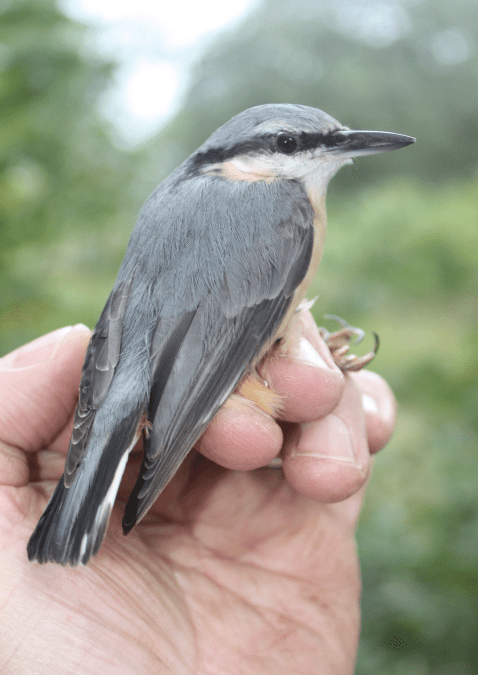
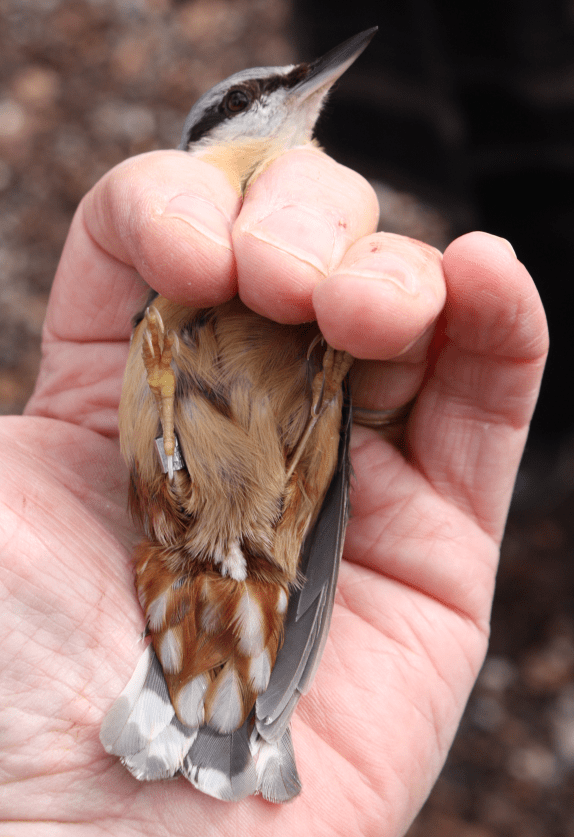
We also caught our third and fourth Nuthatch of the year: and our first two juveniles, both females:

Juvenile female Nuthatch, Sitta europaea

Both of these females had nearly completed their post-fledging moult. Another couple of months and they will be impossible to distinguish from adults, as both age groups will have the same plumage.

We also caught three juvenile Goldcrests, again, firsts for the year. Two had almost completed their post-fledging moult and could be sexed (both male) but the third has to be the cutest juvenile of the day (probably of the year to date):

Juvenile Goldcrest, Regulus regulus

The list for the session was: Nuthatch [2]; Blue Tit 1[11]; Great Tit [3]; Coal Tit [1]; Wren [3]; Dunnock [1]; Robin [7]; Blackcap [1]; Chiffchaff [3]; Willow Warbler [1]; Goldcrest [3]. Totals: 1 adult ringed and 36 juveniles ringed from 11 species.

There were a couple of incidents involving Hornets. The first was the horrible sight of a Hornet stinging a Chiffchaff in net ride 1 before Steph could get it away from the bird. I am pleased to say that, after extraction, the Chiffchaff flew off. It was a bit wobbly in its flight, but it was flying, and stayed up in the trees. We didn’t ring it, regardless.

The second was finding a Hornet in the same net ride eating a wasp of indeterminate species. Unfortunately, this Hornet had got the net wrapped around its abdomen: it was never coming out in one piece. Mind you, it did get a sting in on me as I tried to extract it.

The third was in ride 3: fortunately I managed to extract that one without damage to either party!

Rosie had to leave at just after 8:30 to go to work, having ringed half-a-dozen birds. We worked on until the wind got up at about 10:45. By 11:00 we had to shut the nets, because the pockets were billowing out, and the conditions were just wrong for bird ringing. We had the nets shut and everything packed away about an hour earlier than I had hoped, at 11:45.

Lower Moor Farm: Saturday, 3rd & Sunday, 4th August 2024

I was asked by Rosie to help with the Wiltshire Wildlife Trust’s children’s Watch Group on Saturday night by carrying out a moth trapping session at Lower Moor’s Care Farm area. With the weather forecast showing that it would be raining Saturday morning, scuppering my opportunity to carry out CES 10, but dry overnight and the following morning, I decided to move CES 10 to Sunday. Given that I am not keen on having a late night, followed by an early morning, I decided we would start Sunday’s session at 7:00, instead of 6:00.

Saturday I woke up to a dry morning, but probably too windy for ringing regardless and, according to my local sources (Ellie), it was actually raining at Lower Moor Farm for a couple of hours Saturday morning. Rosie and I met up at the Care Farm site at just after 8:00 that evening. I set up the moth trap while Rosie got the necessary together to start up their fire pit. The children that were coming along were going to spend an hour or so walking around bat detecting, returning to toast some marshmallows on the fire, and then have a look at the moths. Whilst they were off doing their thing, I kept an eye on the fire, to make sure it didn’t go out, and did a bit of birding. There were some very interesting sounds coming from the lake: heavy splashes and quiet silky plops. I like to think Beaver for the former and Otter for the latter. The children came back at about 9:30, just as the moths started to arrive in good numbers.

The most prolific moths in numbers were Ringed China-mark, Paraponyx stratiotata, of which there had to be at least 100 flying around and into the trap, reasonably closely followed by Dingy Footman, Eilema griseola, with 50+. Once the big boys started to arrive the children became somewhat more excited:

Elephant Hawkmoth, Deilephila elpenor (one of my stock photos, last night’s specimen was a little worn)

Polar Hawkmoth, Laothoe populi

It was an excellent catch. We left the trap on overnight, and Rosie collected it up early Sunday morning and brought it over to the CES site, so we could identify the rest of the moths. I spent this afternoon trawling through photographs and finalising the list. This was the list of species:

I was very pleased, as I added five species to my life list, taking it to exactly 500. Everybody with a garden should try mothing: in my medium sized garden in Purton I have caught moths from over 460 species! Those added to my list Saturday night were: Willow Ermine, Yponomeuta rorella; Anania crocoealis; Purple Bar, Cosmorhoe ocellata; Alder Kitten, Furcula bicuspis; and Small Rufous, Coenobia rufa.

I was joined for the CES session by Justine and Rosie. Justine’s husband, Lee, came along, and about 8:30 we were joined by a family from Saturday night who were excited to see the rest of the catch and who wanted to see the birds as well. As usual, I taught the girls how to properly hold and release a small bird, and introduced them to the pleasures of Blue Tit pecks!

It wasn’t the biggest catch we have ever had but, as with the last couple of sessions, larger than the equivalent session last year. CES 10 last year produced just 18 birds: Treecreeper [1]; Blue Tit 1(3); Great Tit [1]; Wren 1[3]; Dunnock [2](1); Robin [2]; Cetti’s Warbler [1]; Blackcap [2]. Totals: 2 adults ringed from 2 species, 12 juveniles ringed from 7 species and 4 birds retrapped from 2 species, making 18 birds processed from 8 species. Of the retrapped birds, 3 were also juveniles, so 3 adults and 15 juveniles processed.

Sunday’s catch was: Blue Tit [3](1); Great Tit [1]; Long-tailed Tit (1); Wren [3](1); Robin (1); Song Thrush (1); Blackbird 2[1]; Cetti’s Warbler (1); Blackcap [2](2); Chiffchaff 1; Chaffinch 1. Totals: 4 adults ringed from 3 species, 10 juveniles ringed from 5 species and 8 birds retrapped from 7 species, making 22 birds processed from 11 species. Of the retrapped birds 5 were juveniles, so 7 adults and 15 juveniles processed.

It was a very pleasant morning, even if the moth catch did outshine the bird catch, with a lot of positive interaction with the public. Start late, finish late: we shut the nets after six hours, at 13:00 and left site by 13:45. I was knackered! So I spent Monday sorting through all of the moth photos and getting the moth list together, which is why I am publishing this on Tuesday!

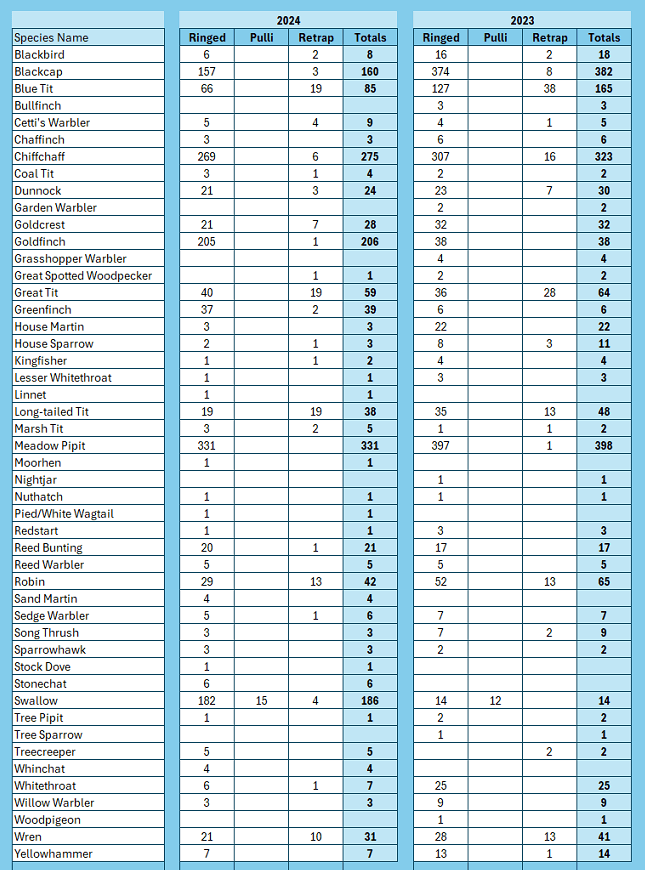
West Wilts Ringing Group Results: July 2024

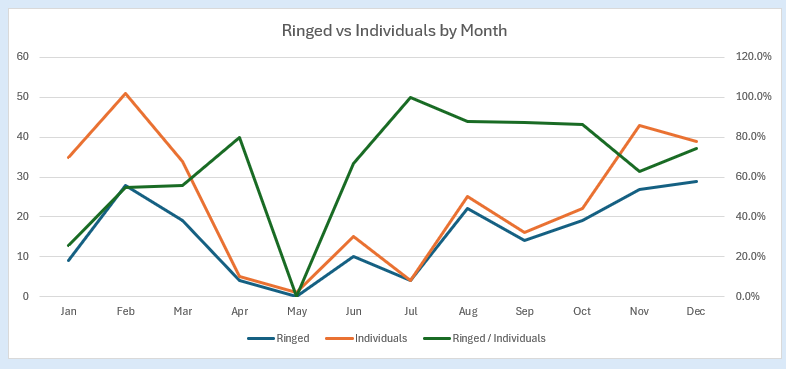
A good month: just five birds shy of our best ever July figure (1,182 in 2020, coming out of lockdown!  Are our gardens really that productive?).  

We didn’t manage as many species as last July, but there were some notable additions.  Firstly, I was delighted to catch only the second Yellow Wagtail for the group. Like the first, in May 2021, this was at Brown’s Farm. Unlike the first, a stonkingly attractive adult male, this was a juvenile. I know that they are doing well on the Marlborough Downs and that this could be one of their progeny starting their journey south for the winter, but it would be lovely to think that they might have spread their breeding range to the southern outskirts of Marlborough.

20240730 Browns Farm.jpg

This was my personal bird of the month, and thanks to all of my team for not being able to make the session, so I could ring it with a clear conscience. 

Mind, it was a close run thing: on the 17th of this month I ringed my seventh ever Redstart and the first ever at the Whitworth Building side of Blakehill Farm.  Then, on the 28th of July we caught another one on the opposite side of Blakehill, which Laura pulled rank on Adam to ring (Mothers are allowed to do that to sons).  I have never caught two in the same month before.  Hopefully we will get a few more over the autumn migration.

image.png
image.png

As well as those catches, we had an early Meadow Pipit and Whinchat.  This is only the third Meadow Pipit that we have caught in July and they have all been caught in the Imber Valley area of SPTA.   Similarly, the only Whinchat that have been caught in July are in the same area.  This is only the sixth: one in 2017 and four in 2021.  One tends to presume early migrants, although this one was also a juvenile.  I cannot think of a reason why they wouldn’t be nesting on the Plain, so I contacted Jack Daw.  He spends his summers monitoring nests on Salisbury Plain, and has been doing so for decades.  He has confirmed to me that, although he doesn’t find huge numbers, he does regularly find nests out there.  Nice to know.

Missing from the catch this month were: Canada Goose, Corn Bunting, Jackdaw, Nuthatch, Tawny Owl, Tree Pipit and  Woodpigeon.  I am never going to miss not catching Canada Geese! The Tawny Owl doesn’t really count either, as it was an Oak & Furrows rescue.  As for the Nuthatch: I cannot understand how we didn’t manage to catch any in the Firs yesterday: they were all over the place.  Last year’s singleton was caught in Red Lodge, but we didn’t actually get a decent session in at Red Lodge last month. After rain in the morning put us off, we did try an evening session but, apart from great company, we only had six birds, with no sign of a Nuthatch. 

There were some significant increases in a number of species: Andy’s back garden continues to produce huge numbers of Starling!  Of the 83 caught, 77 were caught by Andy from the comfort of his own home.  Three from my garden and three at Blakehill on Sunday.  I might have got more from my garden but having a rat problem at the moment, so not wanting to leave food out.  It was good to see a large increase in the number of Long-tailed Tits.  It was our best catch since 2020 and well distributed across our sites.  The 2020 number was rather boosted by my catching 21 of them in one session in my garden, just as lockdown was ending.  It was one of the most memorable catches I have ever had, with them flying into the nets whilst I am stood there taking them out!  

There was a welcome increase in the numbers of both Blackcap and Garden Warbler, even if of different orders of magnitude.  Similarly, we had a nice increase in Willow Warblers: last year four were also from the Imber Valley, this year Langford Lakes was the primary site, with six, but they were well spread across the group’s sites.

A good catch of Chaffinch: mainly down to a big catch at Jonny’s East Tytherton site.  At the same site last year there were just two!  Again, they were spread across all of our sites.

Jonny also had the most surprising catch of the month.  At one of the sites where he is monitoring nest boxes, he was contacted by the farmer: a Buzzard chick had fallen from its nest.  Having checked it over and ascertained that it was uninjured, he ringed it and they put it back in the nest!  The first Buzzard chick any of us have ringed within the group since before the split: the previous one being ringed in June 2007!

Jonny has continued with this cracking work on nest boxes and Swallows. My month for checking boxes and Swallow nests was rather scuppered by a back problem, so all of the Swallow chicks were done by Jonny. I was able to get out, with the help of my team, to ring the Barn Owl chicks. Well, they ringed the chicks, I just “supervised”.

Anyway, a good month: it is beginning to get interesting with migrants beginning to arrive: we even had a decent catch in a woodland yesterday!  Here’s for many more.

The Firs: Wednesday, 31st July 2024

With it scheduled to be hot again today I decided that it would be best to head into some woodlands this morning. Our woodland catches have not been great recently, so I had a look at the history of the woodland sites in July and worked out the average catch sizes. This showed that the Firs and Somerford Common average 34 birds per session in July, Ravensroost Wood produces 24 birds per session and Red Lodge and Webb’s Wood average just 23 birds per session in July. Because of that, I decided to have a go at the Firs for only the third time since it was reopened to ringing.

I was joined at 6:00 by Rosie, Laura, Adam and Sarah for the morning, with Rosie heading off at 9:45, getting a bit more time today. We set the usual nets down the central glade: 3 x 18m 5-Shelf nets from the bottom of the hill to a spot adjacent to the pond furthest from the road; then 3 x 18m + 1 x 12m nets on the opposite side of the glade, from adjacent to the ponds to as far as they stretched. Everything was set up just before 7:00 and we did our first round soon after. The first round was indicative of what we were in for. It comprised Chiffchaff, Blackcap, Wren and two Blue Tit.

Whilst waiting for the next round we were treated to a Nuthatch show. Sarah first noticed one climbing up a nearby dead tree. We watched as it flew to another tree, where it was joined by another. Then two flew off, but there were still two there. Another two then flew off in a different direction, and there were still two there. It really was excellent: we heard them calling and doing their slow drumming pretty much all morning.

The next round delivered another four Blackcap, a couple of Dunnock and a retrapped Great Tit. Having processed these, we had a few minutes to be entertained by a Treecreeper working its way around the trees just a few feet away from our ringing station.

Each round was different, the biggest catch being 15 at 9:35. As with my session at Brown’s Farm yesterday, I planned to shut the nets at 11:00, before the heat became too oppressive. This is exactly what we did after a much better session than we have been used to in the woodlands recently. This was the catch: Blue Tit 2[15](1); Great Tit (1); Marsh Tit [1](1); Wren 1[4]; Dunnock 1[1]; Robin [3]; Blackbird [3]; Blackcap 2[11]; Garden Warbler [1]; Chiffchaff [4]; Chaffinch 1[2]. Totals: 7 adults ringed from 5 species, 45 juveniles ringed from 10 species and 3 birds retrapped from 3 species, making 55 birds processed from 11 species.

There was a lot to enjoy in today’s catch: a new Marsh Tit colour ringed, an adult female Chaffinch with two juveniles all from the same net but, mainly, constantly active with reasonable catches for each net check round, from first to last.

As scheduled, we shut the nets at 11:00 and took down, leaving site by 11:30. After a busy few days, and a twist of my weak right ankle to boot, I plan to do very little now until Sunday. Saturday morning is going to be wet, so that suits me, although Saturday evening I am helping out at the Care Farm at Lower Moro Farm, running my moth trap and bat detecting for the children who use the Care Farm.

More Firsts for the Year: Brown’s Farm, Tuesday, 30th July 2024

The first “first” is that this was my first ringing visit to the farm this year. It is at the top of Postern Hill, south of Marlborough, with views for miles around and nothing to “break the wind”, so to speak. Our local weather has become far windier over the last few years, making my visits to Brown’s Farm much more infrequent than I would like. With the wind scheduled to be just one mile per hour, with no gusting until gone 10:00, it seemed a perfect day to go to Brown’s. What a shame that none of my team was available to take advantage of it! The benefits of being retired! It is also the first solo session I have run outside of my garden this year.

With the weather forecast to hit 30oC, I decided that I would pack up at 11:00 or when the shade temperature reached 25oC. I arrived on site at 5:45 and set just seven nets:

Brown’s Farm is my most reliable site for both Yellowhammer (my only site) and Linnet. In fact, the only other site of mine at which I have caught Yellowhammer is Blakehill Farm: back in October 2016!

This morning started with a Whitethroat in the nets at 6:30 and then, at 7:00, I caught my second bird of the session and a first for me this year:

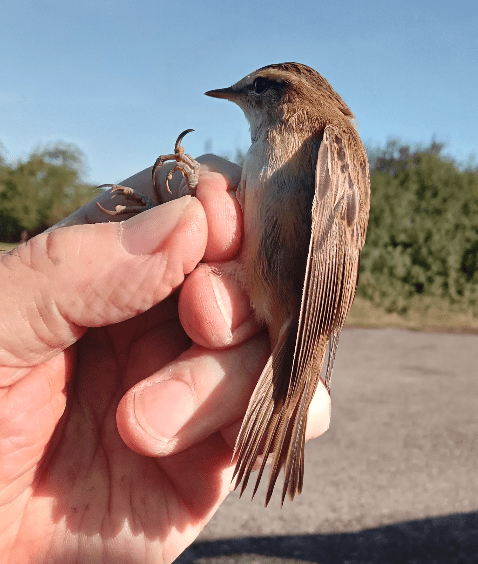
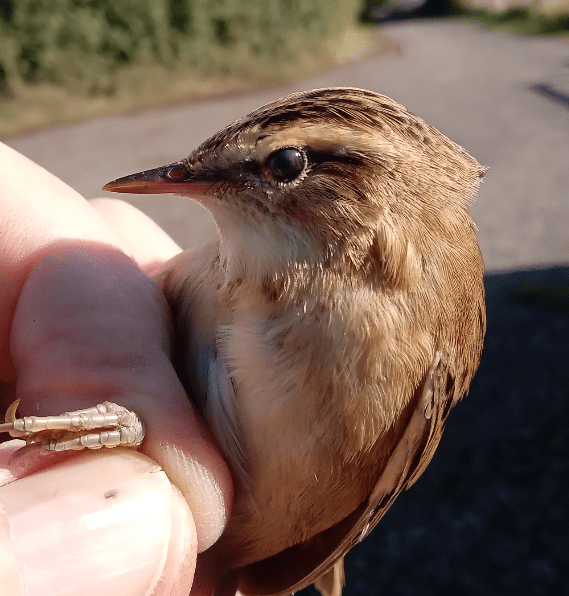
Juvenile Sedge Warbler, Acrocephalus schoenobaenus

This was followed by two Linnets, one of my reasons for being there. Unlike on Sunday at Blakehill, the three Linnets captured today were all female: two adults and one juvenile:

Adult female Linnet. Linaria cannabina

It took a little longer for the next target species to arrive:

Adult male Yellowhammer, Emberiza citrinella

Keeping on with the “firsts” trend, I also had my first juvenile House Sparrow of the year (and only my second of the species this year):

Juvenile House Sparrow, Passer domesticus

And then, the icing on the cake:

Juvenile Yellow Wagtail, Motacilla flava

This is only the second Yellow Wagtail that I have ever caught and ringed on my rings. I was lucky enough to have ringed five as a trainee at the Icklesham site in East Sussex, then nothing until we caught an adult male in May 2021 at Brown’s Farm. I am aware that numbers have increased on the Marlborough Downs to the north: perhaps they are starting to expand to the south or perhaps the former was on Spring migration and this one is on an early Autumn migration (there’s a lot of it about). Needless to say, another first for the year.

The catch for the session was quite remarkable: 29 birds caught from 14 species! Not huge numbers, plenty enough for me though, and an excellent variety. There were no retrapped birds at all: Blue Tit 1[1]; Dunnock 1[7]; Yellow Wagtail [1]; Robin 2; Song Thrush [1]; Blackbird 1; Sedge Warbler [1]; Blackcap 1; Whitethroat 1[1]; Chiffchaff 1[2]; Willow Warbler 1; House Sparrow [1]; Linnet 2[1]; Yellowhammer 1[1]. Totals: 13 adults ringed from 10 species and 16 juveniles ringed from 10 species, making 29 birds ringed from 14 species. That variety is just astonishing for this farmland site.

The Dunnocks were interesting: one adult and seven youngsters. Four of those youngsters were caught in the same net and had not started their post-fledging moult yet: very likely second, or even, possibly, third brood young. My two favourite BTO codes for birds species are DUNNO for Dunnock and NUTHA for Nuthatch. One of my DUNNO’s was a right NUTHA! I caught it, ringed it, released it in the opposite direction to the nets. Next net check it was back in the net. I extracted it and released in the direction from which it had entered the net, so it could continue its journey. It immediately flew straight back into the net. After extracting it again I took it right away from the nets and released it, whereupon it flew straight back and into the nets. Twice more it did the same thing only on the final time it actually extracted itself and flew off, not to be seen again today!

The farm has fabulous hedgerows, primarily Hawthorn and Blackthorn, interwoven with Dog Rose. Alongside the tracks and between the fields there are no large trees. They are confined to the edges where the fields touch woodland and copses. The hedgerows were planted by the previous tenant farmer over 20 years ago. They have been kept in superb condition, particularly by the current tenant. His management of them keeps them thick and not at all straggly, with a height of just under 2.5m: the height of my nets. When the Crown Estate sold the land off to the current owner, the tenancy passed to the farmer who had the next farm over to the west of Brown’s Farm. Both farms were beef and arable, and the new tenant consolidated the beef production onto his own farm site, so Brown’s is primarily an arable farm now. The cattle sheds were converted to stables and are rented out to a number of horse owners. He has converted a couple of fields into horse paddocks but, unlike so many horse deserts, he minimised the amount of land lost to the horses, established a number of wildflower rich horse tracks around the farm, for the owners to exercise their horses. As well as that, he runs a small scale pheasant / red-legged partridge shoot, and provides supplementary feeding, plus large areas of game cover around the site. It is so small scale that the only pheasants that you see out of season are a pair of Reeve’s and a pair of White-eared pheasants, plus a small flock of Helmeted Guineafowl, that have been there as long as I have been working the site (firstly for the Breeding Bird Survey and, subsequently, bird ringing). Anyway, the point is that, he has kept an excellent variety of wildlife on the site. This morning I saw several Hares, a Fox and a couple of Roe Deer. It compares very favourably with Blakehill Farm for numbers of Skylark territories. Over the time I have ringed there we have processed birds from 36 species.

Anyway, the shade temperature reached 25oC at 10:30, so I started taking down the nets, starting with ride 3, as it had been the least productive: just one each of Whitethroat and Dunnock. Then ride 1 as, although it started strongly, it had dropped right away. I then got held up taking down ride 2 because first time I found a Dunnock had flown in. After I processed that and went to shut them, I found a Blackbird in there. Third time unlucky: it had a Song Thrush in it. This time I shut the nets before processing the Song Thrush, and so managed to get everything down by 11:15. I was off-site by 11:30 after a thoroughly enjoyable session.

Two First for Year: Blakehill Farm, Sunday, 28th July 2024

I don’t usually ring on the Blakehill Farm plateau until mid to late August. However, with reports of early migrants passing through Wiltshire at the moment, I decided to try a session in the hope that we might snaggle an interesting catch. It helped that the weather forecast was for virtually zero wind and a clear, sunny day. The British weather has turned decidedly windy since 2020 and I really have to grab every opportunity to get to this exposed site. Since I started ringing at Blakehill in early 2014 I have only once previously ringed there in July. That was on the 24th July 2020 and I only caught seven birds: Great Tit 1; Wren 1; Dunnock 1; Blackbird (1); Chiffchaff 1; Goldfinch 2. The singles ringed were juveniles, the Goldfinches and retrapped Blackbird were adults. To be honest, it is a good job I didn’t look at that, it might have given me second thoughts.

Anyway, I was joined for the session by David, Sara and the Childs family: Laura, Mark, Daniel and Adam. We set a decent number of nets:

I put on a few lures for migrant species: nets one and three had Redstart and Wheatear, net set four had Meadow Pipit and net sets five and between eight and nine had lures for Whinchat and Stonechat. They were all a bit of a punt on the off chance: one worked. Certainly I was being very optimistic with the Meadow Pipits: we have never had them arrive any earlier than September in all the time we have been catching them at Blakehill Farm.

We met at 6:00 and had all of those nets open by 7:15. I really need to get a second hole maker and hammer, particularly when we are looking to put up a relatively large number of nets. I did try out a hand augur this morning: complete waste of time, as it was a woodworking augur. I gave it to Mark to go with his hobby carpentry. The first birds arrived straight away: a trio of Wren, Reed Bunting and our first Lesser Whitethroat of the year! We never catch lots but they really have been few and far between since our last good catch of 16 in 2020. Since then they have been in single figures each year.

Adult male Lesser Whitethroat, Curruca curruca

The rounds were all very light: either one, two or three birds per round and a total of only 18 birds. However, the catch was a really pleasant and different selection. The breakdown was as follows: Wren [2]; Redstart [1]; Whitethroat 1[1]; Lesser Whitethroat 1[1]; Chiffchaff [2]; Starling [3]; Linnet 1; Reed Bunting 1[4]. Totals: 4 adults ringed from 4 species and 14 juveniles ringed from 7 species, making 18 birds processed from 8 species.
Our fifth productive round produced our second Redstart in two Blakehill sessions, the previous one being on the opposite side of the site:

Juvenile female Redstart, Phoenicurus phoenicurus

A little later in the session we caught our second Lesser Whitethroat of the day. This time it was a juvenile and, after processing he decided to hang around for a bit:

I took it out of the weighing pot and opened my hand to release it and it sat on my thumb. It must have sat there for well over a minute and it was only when Adam reached over to see if it would hop onto him that it decided to go, flying off strongly along the hedgerow.

Early on, Adam noticed five birds on the bush at net 6. Being young and enthusiastic, he ran over to that bush, as one of those birds had ended up in the net!

Juvenile Starling, Sturnus vulgaris

Having run all that way, and made a good job of extracting the bird, it would have been harsh not to let him process it, so he did. As luck would have it, on the penultimate round we caught another two. Their moult was progressing nicely:

According to the ringer’s bible for Passerines: “Identification Guide to European Passerines” by Lars Svensson, this is a male bird.

With the wind picking up at 11:15, we shut the nets at 11:45, not without getting another cracking bird: our first Linnet of the year! Had I been able to get to Brown’s Farm this side of the New Year, I would no doubt have got a fair few more, but this was a real bonus:

Adult male Linnet, Linaria cannabina

I pulled rank on this one: the only bird I processed all morning. All of the bird photos, except the adult male Lesser Whitethroat, were taken by Sarah Emery and are reproduced with her permission.
We started to take down about 12:15. Mark, who had disappeared to find something to drink, returned with ice lollies for the whole team. What a really kind gesture, and very welcome in that heat. That, I am pleased to say, is what it is like with my team: we do the job, we have a good laugh, and can fill the time comfortably when there aren’t many birds around.

With eight of us to take down (David’s Dad Trevor had arrived and joined in the clear up) it really didn’t take long to get everything put away. I had a few things to put in the case before leaving, so sent everyone away as there was nothing left for them to do. Unfortunately, in between Mark returning with the ice creams and them reaching the gate, someone with a key had decided to lock us in. I know it wasn’t Nobby, the other landowner, because we had discussed it earlier and agreed that I would lock up on leaving. Besides, if he had done so, Mark would not have escaped the site for his drink, so it has to be a Wildlife Trust employee and there is only one who lives nearby! I shall have words! It was only a minor hold up for them but irritating nonetheless.