Ravensroost Wood: Thursday, 4th July 2024

Being election day, I was hoping for a large turnout in the bird electorate. I had a quorum of helpers: Rosie, Miranda and Laura, joining me for the session. After some discussion on how quiet the wood has been this year with Robin Griffiths, the Ravensroost warden and organiser of wildlife surveys for the site, I have decided to try sessions in different areas of the wood, to see whether there has been a significant change. To give some background, over the last couple of winters there have been some significant forestry operations within Ravensroost: the volunteers have carried out their usual coppicing activities in section X of the woodland. Alongside that, there has been considerable Ash dieback mitigation work in the wood plus the coppicing of the 25 year coppice cycle in the north of the wood. I know that, following significant forestry operations at both Red Lodge and Webb’s Wood, catches can die right off before making significant recoveries often, as is certainly the case at Webb’s Wood, with a change to the species profile.

The first surprise I had was turning up to find that the site has a newly resurfaced carpark, gates at the entrance to the car park so it can be completely closed off, and new gates at the entrance of the reserve itself. All looks very good, and so much easier to open the new gate than having to drag the old one across on its dropped hinges.

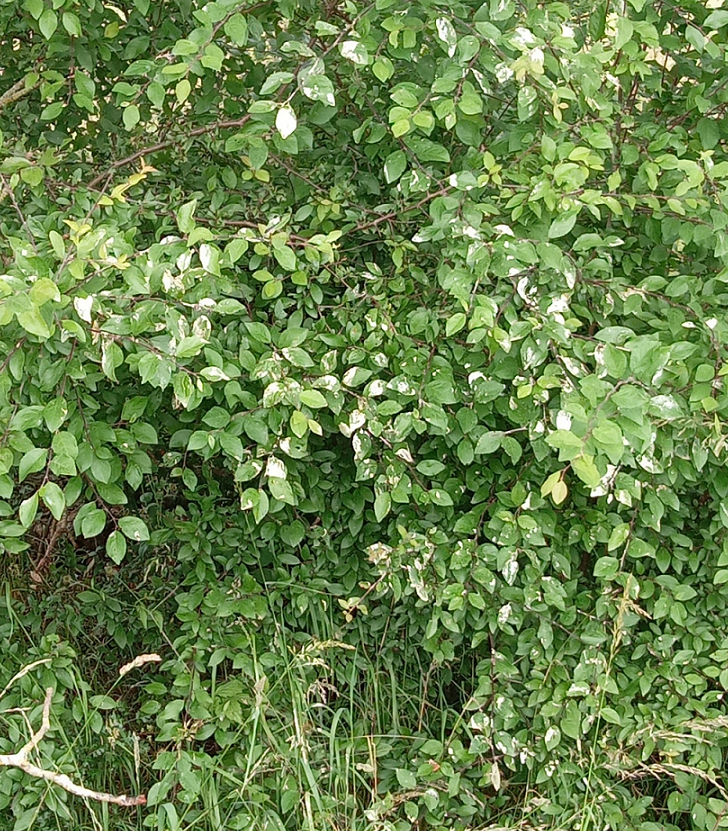
Today we set our nets in this area of the wood:

and we set the following nets:

The weather was strange: despite the sun it was very cold. That was almost entirely down to a cold breeze blowing through the site. The breeze did strengthen over the course of the morning and, by the time we were ready to pack up, was beginning to make the nets billow.

Unfortunately, the catch was slow and low. Over the course of the morning all we caught were 15 birds from six species. There were no retrapped birds and the list was: Blue Tit [1]; Great Tit [2]; Wren [3]; Robin 1[3]; Blackcap [2]; Chiffchaff 2[1]. Totals: 3 adults ringed from 2 species and 12 juveniles ringed from 6 species, making 15 birds processed from 6 species.

It was very quiet, with very little birdsong: what we caught was what we heard, with the exception of the Nuthatch that spent time calling above our heads at the ringing station, and the small flock of Long-tailed Tits that, again, were circling around our heads but never got near the nets.

There was a good number of butterflies around. In the majority were Ringlet, but they were accompanied by Speckled Wood and Meadow Brown and, somewhat more spectacularly, some Silver-washed Fritillary and a couple of White Admiral. However, this was probably the star of the show:

Immature male Southern Hawker dragonfly, Aeshna cyanea

It was flying around, near the long line of nets, nearly all morning. We packed up at 11:30 and were off site fairly soon after midday.

A brief Barn Owl update. Rosie, Ellie and I checked on the boxes at Upper Waterhay Farm on Friday. The two Jackdaw broods have successfully fledged but the Barn Owl brood, which we had planned to ring, has been predated. There were a couple of fresh pellets in the box but no sign of the youngsters that were there three weeks ago. We had a first visit to Swillbrook Farm and checked three boxes: we ringed two good sized young in one box, another had clearly been occupied by Jackdaw and the third, despite the ancient barn it is in having collapsed, with just the roof remaining intact, was still showing signs of the adults roosting there. Finally, we went to check on the box in Allotment Field at Blakehill Farm. Last time we looked we caught and ringed the male on the box and there were a couple of eggs there. This time there were four young: three were large enough for us to ring and the fourth looked like it might end up as food for its siblings, so we left it unringed.

West Wilts Ringing Groups Results: June 2024

An interesting month for the group:

Added to the list compared to last year were: Canada Goose, Kestrel, Linnet, Magpie, Redwing and Siskin. Missing from last year’s list were Collared Dove, Green Woodpecker, Jay, Kingfisher and Marsh Tit. The lack of Marsh Tit is almost certainly down to the simple fact that I did no woodland ringing this month.

Andy has had an absolute monopoly of the Starlings this month: all 53 were caught in what it, essentially, his back garden!  I might have been able to add a few but it has been too windy “up north” for me to open the nets in my garden.  Not only that but he caught the Siskin there as well. 

Jonny and I were both very lucky this month and got to ring a brood of Kestrels each.  It took my haul of pullus Kestrels ringed from one, as a trainee back in June 2010, to six.  It took Jonny’s from none to six in two months!  

image1 (2).jpeg

A civilised way to ring Kestrel chicks: in the garden with tea and biscuits to follow, for me, Dad brought the chicks a vole soon after they were returned to the nest.

It was a good month for Barn Owl and Swallow chicks being ringed. The Barn Owls look as though they are in for a good year: nearly every box with young chicks in had a larder of mice and voles.  We ringed another five today!  Given how virtually everyone has remarked upon how low Swallow numbers appear to be, there were a lot ringed last month, and I am hopeful that we will get good numbers for July as well.

Migrant warbler numbers were interesting: Blackcap, Chiffchaff, Lesser Whitethroat, Sedge Warbler and Willow Warbler numbers were up, Reed Warbler numbers were down and Garden Warbler and Whitethroat numbers were on a par with last year. 

And now to the bird of the month: the Redwing that Jonny caught at Langford Lakes on the 12th of the month.  Either the latest leaver, or the earliest returner ever recorded in the county.  Not only that: the fattest ever recorded as well. There have been a number of 80+g birds recorded but, out of the 3,475 previous records, none have been heavier than 86g.  This porker weighed in at 97.8g. It clearly fits within acceptable parameters in DemOn, as the weight wasn’t queried, besides Jonny is scrupulous in his accuracy of recording. Perhaps that’s why it didn’t get very far on migration!

As part of my having taken on the C-permit holders of the Salisbury Plain Ringing Group, I spent sessions on Salisbury Plain with the new head honcho, Richard Clayton, and one of my new crew, Jon Pepper. Then, later in the month, I went out with another of the C’s, Jon Keepen, at the Cumberwell Park Golf Club.  It was absolutely fascinating watching them work.  The three that I have seen at work are all very competent in their handling of even the most feisty, close to fledging, raptor chicks. Not only that but I got to ring my first ever Little Owl:

LO1.jpg

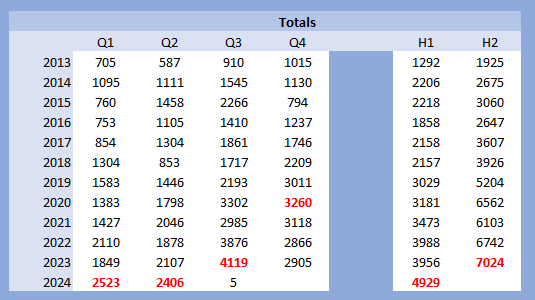
In terms of our overall figures, this year is turning out to be our best yet. 

Nearly 1,000 more birds ringed in the first half of this year than any before.  That is not all down to the expanded activity with nest recording and ringing, but it is a sizeable chunk.  What is clear is that we are doing well in species variety.  The following table shows the number of species caught for the first six months of each years since 1st January 2013.

Given that we are a land-locked county and have just one site on the edge of the Cotswold Water Park, Lower Moor Farm, plus Langford Lakes in the Warminster area, and we don’t target waterfowl at either, the variety is rather pleasing.

Some Unusual Findings: Lower Moor Farm, CES6: Saturday, 29th June 2024

Having been laid up all week, since my visit to Cumberwell Park Golf Club last Sunday, where I got to ring my first ever Little Owl, I was very pleased to be able to get out for CES6 this morning. Suffering from severe muscle problems in my back, and being dosed up to the eyeballs on painkillers and anti-inflammatory pills to enable me to cope, I was delighted that Rosie and the entire Childs family: Laura, Mark, Daniel and Adam, could join me for the session. Not only that, but they insisted on doing all of the setup and pack away work, and for me to take it easy and do nothing. I must milk this for as much as possible, as long as possible!

It was a reasonably good session but, it was only when I returned home and checked, I didn’t realise how good it was compared to 2023: last year’s session produced just eight birds from four species! To be fair to last year, the weather turned bad and we had to close the nets after four hours at 10:00. No such issues today: the weather was calm, once the early morning cloud cover dispersed it was a lovely blue sky and a warm sun: not too hot.

We had the first birds in the nets by 6:20 and then every round produced two or three birds per round. There were several highlights:

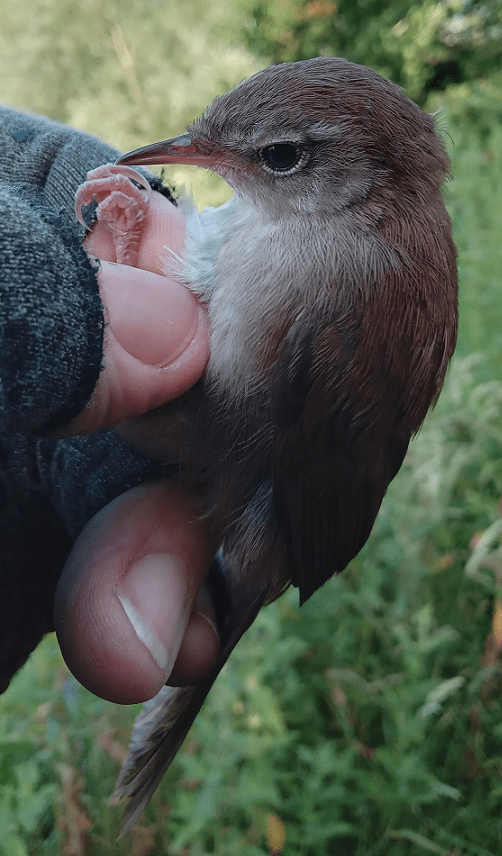
Juvenile Cetti’s Warbler, Cettia cetti, our first juvenile of this species this year.

This was followed by a male Reed Warbler: our first caught at Lower Moor Farm in June. We have caught them annually on passage both on the way in (May) and on the way out (August and September) but there are no significant reed beds on the site to support breeding:

Reed Warbler, Acrocephalus scirpaceus (photo courtesy of Mark Childs)

There was also something rather unusual: we found a female Blackcap with a tumour over the right eye:

Blackcap, Sylvia atricapilla. As well as the tumour over the eye there is another growth appearing at the base of the top of the beak. We also had a juvenile Blackcap which showed that life has been hard at times for the earlier broods:

As you can see, there are multiple fault bars on this birds tail. They represent interruptions in the availability of food.

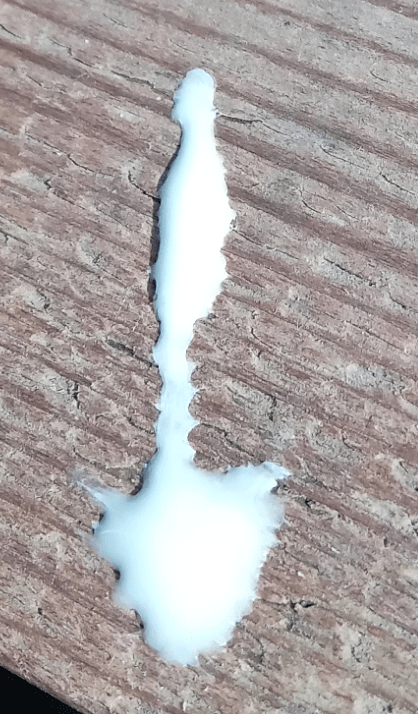
Finally, we retrapped two Blackbirds, a male and a female. Laura was a little concerned at the state of the male’s cloacal protuberance. When she passed it to me to see what she meant, it did look rather red and sore, and then it deposited this on the ringing table:

I am not an expert but I have the strongest impression that I know exactly what that is and that he was excited rather than sore!

This was the list for the session: Blue Tit (1); Great Tit [1](1); Wren [3]; Dunnock (1); Robin [2](2); Blackbird (2); Garden Warbler [1]; Cetti’s Warbler [1](2); Reed Warbler 1; Blackcap 2[7](3); Chiffchaff [2](1); Bullfinch 1. Totals: 4 adults ringed from 3 species, 17 juveniles ringed from 7 species and 13 birds retrapped from 8 species, making 34 birds processed from 12 species.

We had everything packed up and were leaving site by 12:30.

There were quite a few photographers around this morning: hunting for Norfolk Hawker dragonflies. We had really good views of one: but I thought it was a Brown Hawker: however there were no blue spots along the abdomen and it is (just) too early for its flight season. I wish that I had taken a photograph for evidence. According to the creature’s name and the map in the “Field Guide to the Dragonflies and Damselflies of Great Britain and Ireland” by Steve Brooks, illustrated by the wonderful Richard Lewington (who kindly signed my copy) they are only found on the east coast of Norfolk but, apparently, they have spread westwards over the last 20 years, reaching as far west as Devon.

Looking Positive for Braydon Forest Barn Owls: 24th June 2024

Barn Owl checking in the Braydon Forest was carried out for a very long time by a stalwart volunteer of the Wiltshire Wildlife Trust, Paul Darby, and his team. I joined his team in 2015 and, when Paul retired from monitoring them, I took over the job. Unfortunately, his entire team retired at the same time. It took a while to build it up again. The key differences were that Paul did not have a schedule 1 licence, so could only check and clean boxes in the winter months, and isn’t a bird ringer. Whereas not only do I have my schedule 1 licence but, thanks to work I had done with my first trainer, Matt Prior, and then with experienced ringers of raptors, Simon Lane and Rob Hayden, the BTO added raptor pullus and adult endorsements to my ringing licence. However, I didn’t really get started until I got my A-permit and trainer’s endorsement, and it is amazing how many people will offer to help when they have the chance of putting a ring on a Barn Owl. The first two years were quiet, as I was feeling my way into it, primarily looking at the Wiltshire Wildlife Trust boxes at my ringing sites. In 2017 we ringed eight chicks and in 2018 we ringed six chicks and one adult.

Thereafter, we branched out to the other sites in the north of the county, boosting the catches. From 2021 on, we ringed 27, 22 and 20 Barn Owls respectively. 2021 was a stellar year, last year was awful: we ringed 20, but lost three to probable intra-brood cannibalism. This was almost certainly down to it being a poor vole year. We didn’t find any boxes with a larder: a cache of voles for the lean times, as we had done previously and, I am pleased to say, as we are finding regularly this year.

2024 has started excellently: my trip to the lower Wylye valley, back in May, was encouraging as a portent of what might be to come. What I found back in the Braydon Forest was that we were at least two to three weeks behind the broods further south. My early visits this year indicated that we are going to have a good year. Up to yesterday, we had ringed 17 youngsters from four nests: three broods of five and one of two. As of now, we have ringed 23 from six nests, because this morning we ringed another brood of three at Somerford Farm and this afternoon I ringed a brood of three at Lower Pavenhill Farm. The first four broods ringed this year were all from boxes that failed last year.

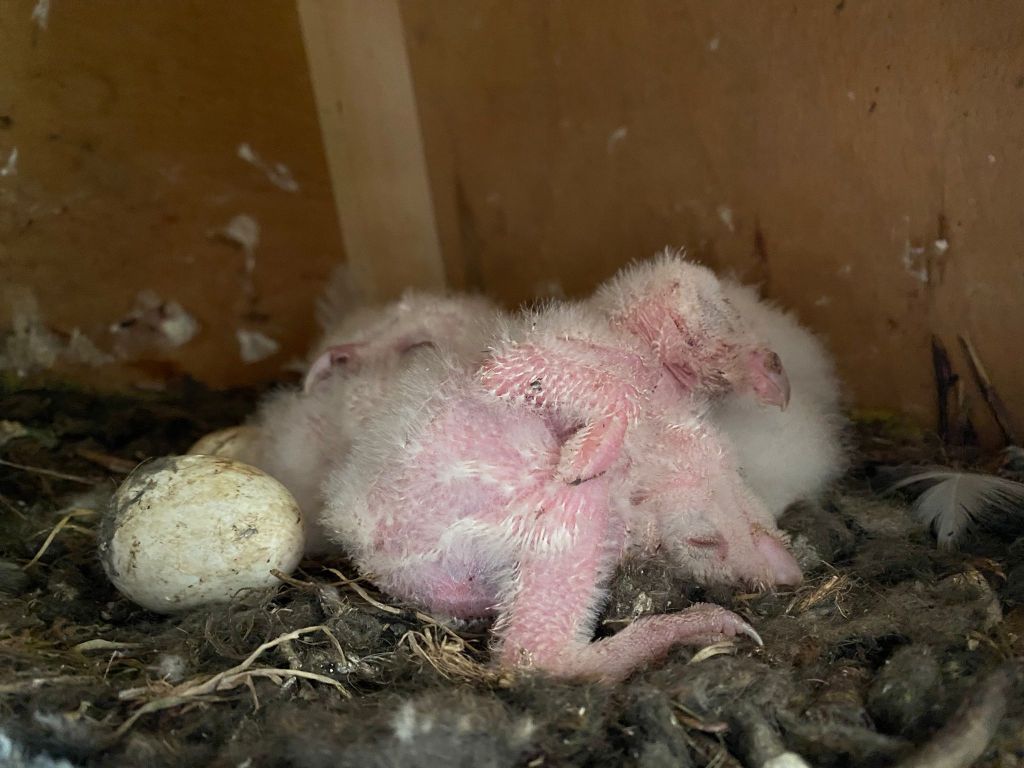
What is pleasing about today’s catch is that Somerford Farm box failed last year and the box I checked this afternoon has been up for two previous breeding seasons, but has never been occupied. It was only last winter that I found any sign that any Barn Owl had been near the box. I know of another three boxes that have young that will be ready for ringing in a week or two. One of those boxes, in a barn at Somerford Farm, has been up for five years and has never seen any owl activity in all that time, until this year. When I checked it on the 9th May there were three eggs laid. On checking it today we saw both parents leave the box as we approached and inside we found these:

I have to be honest, I had rather expected them to have been somewhat more developed than this. There are five hatchlings and two warm eggs, plus a few stashed voles. On the floor, underneath the box, was a pellet. I chose not to take a photo (although I am considering going back and doing so): it is the first pellet I have ever seen with a rodent’s tail sticking out of one end. It looked bizarre and slightly disturbing.

Alongside these broods ringed and the three ear-marked for later, I still have another twenty or so boxes to check. Talking of which, whilst checking this last box we were approached by a local farmer who is very interested in putting up a couple of boxes, and who is aware of another local farmer who is also keen to promote owls on their land. At our first stop we were approached by a man who runs a local stables / riding school who expressed his disappointment at not having managed to attract any Barn Owls to his boxes: so disappointed that he took them down! Anyway, I have offered to go and have a look at his site and make some suggestions about possible positioning for the boxes that might give them some success.

Things are looking rather good for wildlife in and around the Braydon Forest. Apart from the significant quantities of land owned and managed by the Wiltshire Wildlife Trust and Forestry England, so many of the farmers are on board with encouraging nature. With Jonny Cooper getting farmers focused on providing suitable habitat for both Curlew and Lapwing in this area, things are looking encouraging.

Cumberwell Park Golf Club: Sunday, 23rd June 2024

Today I met up with Jon Keepen, another of the C-permit holders from the Salisbury Plain Ringing Group, that I have taken on since the retirement of Nigel Lewis. Jon’s role at the golf club, in addition to the usual groundskeeper duties, is as Conservation Manager of the club. In that regard, his duties include the monitoring, cleaning and maintenance of the nest boxes found around the various courses. It was as a part of those duties that he became involved with the ringing of the birds on the estate.

I met Jon and his friend, Keith Wright, also heavily involved with owls and other raptors, rather given away by his Hawk Conservancy Trust polo shirt! Jon’s plan was to visit two Barn Owl boxes and one each of Little Owl and Kestrel boxes, which should have birds ready to ring. He also planned to check on the progress of one Kestrel box where the previous visit had two very young chicks and two eggs, to check on progress, rather than planning to ring them.

The first box we checked was a Kestrel box: it had four healthy chicks, which we ringed, weighed and measured the wing projection on the seventh primary feather. This last is some thing that I personally haven’t done, but I know that the SPRG do it as a matter of course. I restrict myself to describing the entire wing: feathers in pin; feathers short (out of pin, up to one-third emerged), feathers medium (more than one-third emerged, up to two-thirds emerged) and feathers long (more than two-thirds emerged up to fully emerged). Perhaps this is a method of quantifying those statuses. I plan to find out: never to late to learn!

This is Jon processing one of the Kestrel chicks:

Processing a juvenile Kestrel: watch out for those feet (video courtesy of Keith)

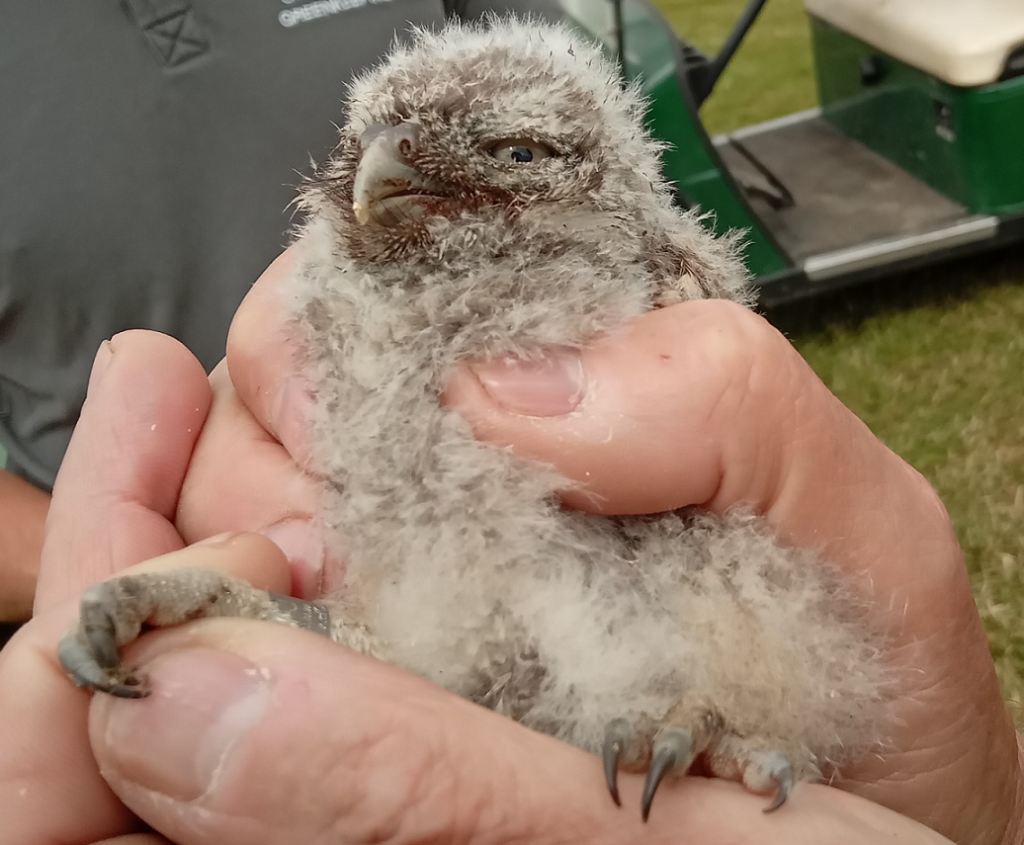
Our second stop was a bird with a Barn Owl box on one side of the tree and a Little Owl box on the opposite side. The Little Owl box is something to behold: it is around about 30 years old and is made from old wooden map cases which Nigel Lewis liberated (with permission) from the army way back when. There had been four eggs in the Little Owl box when last checked. Unfortunately, there were only two chicks this time. I was delighted to get to ring my first ever Little Owl:

Little Owl pullus, Athene noctua, looking somewhat suspiciously at my phone!

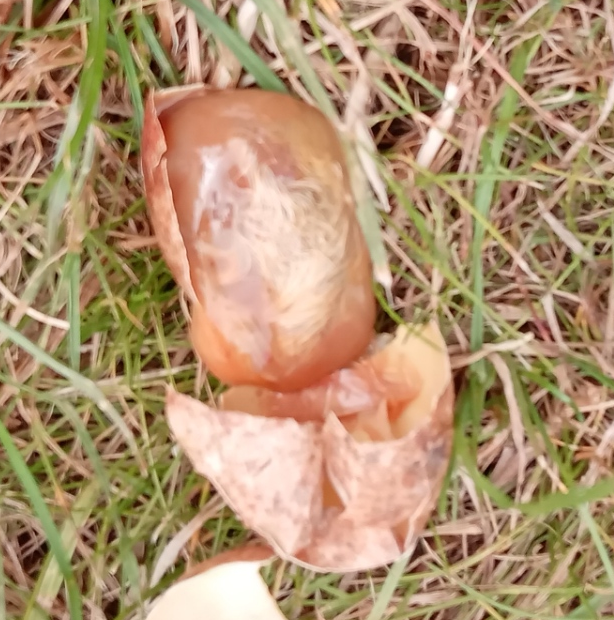
Next door, in the Barn Owl box, we were lucky to catch the female on the nest, giving Jon a rare opportunity to catch and ring an adult. His permit doesn’t cover adult raptors but mine does and, as I am now his trainer, he could ring it under my supervision. I got the opportunity to actually do a bit of training: showing him the “cuddle” method for ringing and measuring the wings on a large bird with sharp, strong claws and a beak designed for inflicting pain. As well as Mum, we ringed, weighed and measured four chicks. All are developing well but are a fair way off fledging: four, possibly five, weeks before they do. We also recovered one unhatched egg. Muggins knocked it against a tree to open it to check whether there was any sign of development. It just exploded and my hands were covered by an evil smelling residue. Fortunately, Jon had some very handy wet wipes in his bag!

Our next box was the bonus box: a Kestrel box which Jon thought the occupants would be too young to ring yet. It was quite obvious that there was activity in the box, as the photo of the bush underneath the box can attest:

Clearly the parents have shown them the right toilet etiquette: better out than in.

The young were, in fact, surprisingly well developed. In the box were four young, with feathers medium, and two cold eggs. This time, rather more carefully than me, Jon opened both eggs. One was, as the Little Owl egg, rancid, runny and very smelly. Sadly, the other contained a dead embryo. Those of a sensitive disposition might like to avoid this next photograph:

Kestrel embryo, Falco tinnunculus

There is no indication of why it failed to continue to develop and then hatch. We know that birds of prey stagger hatching, but this embryo had definitely stopped developing weeks ago and was certainly not viable.

Our final box was a Barn Owl box. We were expecting two youngsters but in fact found three. They were very advanced and cannot be more than a couple of weeks, possibly less, from fledging:

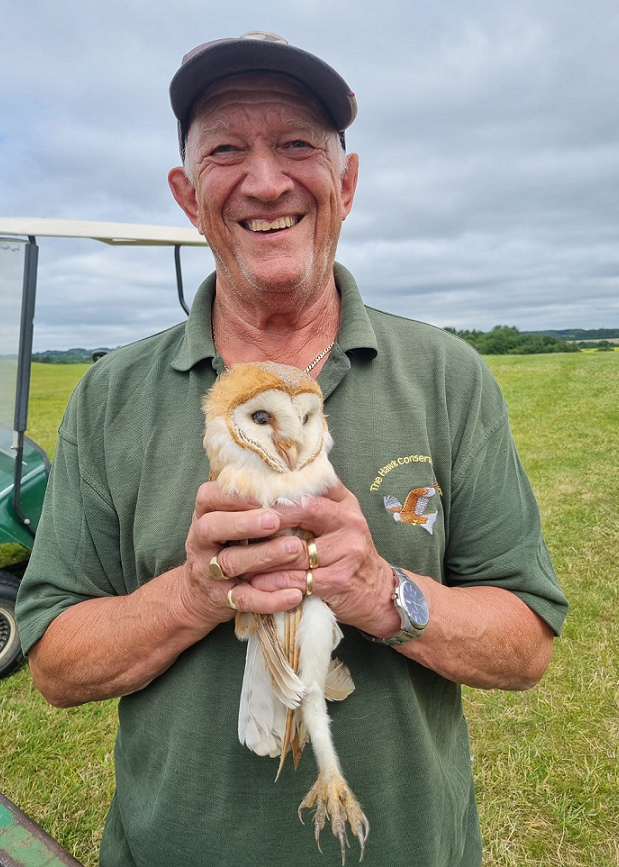
Keith holding a Barn Owl, Tyto alba, definitely close to fledging. If you look at the head (the owl’s not Keith’s), it is just growing the final juvenile plumage.

So, we spent some three hours visiting five nest boxes and processing eight Kestrel chicks, two Little Owl chicks, one Barn Owl adult and seven Barn Owl chicks. Very pleasant.

This golf club is part of a larger estate, and has a lot of varied habitats. The owls and Kestrels seem to be doing particularly well: the first Barn Owl box had a well-stocked larder. The birds in the second were so big that they must be scoffing everything that parents can catch. There are huge expanses of rough, with a wide variety of flowers and grasses. Lots of habitat for prey species, lots of hunting habitat for the predatory species.

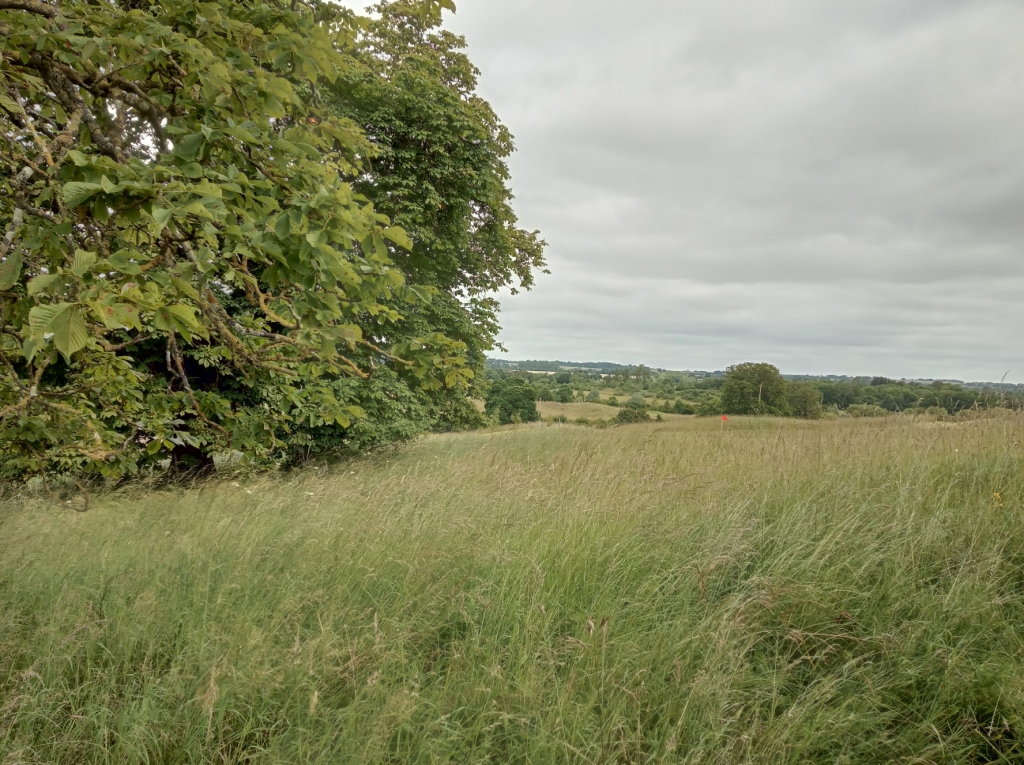
The view immediately adjacent to the second Kestrel box.

Jon has a total of 3 x Kestrel boxes, 3 x Barn Owls and 1 x Little Owl box on the site. Prior to today their biggest haul had been 17 birds. Today we processed 18. What is good about that is that every box produced what it was supposed to and, from a personal perspective, that takes my UK species tally to 111.

Hedgehog Wars: Thursday, 20th June 2024

A departure today: our ringing session never got started. Despite a forecast that the day would be dry after overnight rain, I decided to start later than normal to ensure it had cleared. When I left home the rain had cleared and I arrived on site: David and Sarah arrived – and so did the rain. We waited for 30 minutes, it didn’t clear, so we went home. It eventually brightened up two hours later. So, instead, this is a longer video I cobbled together, from a number of very short videos my trail camera took, on Thursday night. It is a bit jerky as a result but it shows pretty well the interaction. I have done a factory reset and hope it will sort it out!

Hedgehog Wars!

That’s Better: Lower Moor Farm CES5; Wednesday 19th June 2024

I had planned to run this session last Sunday. The weather forecast was fine: a dry day, low winds and sunshine. So we arrived on site for our 5:30 start, only as I pulled into the site it started raining. Laura and her boys pulled in alongside me and we waited to see what would happen. At 6:00, with the rain still falling, we decided that going home and back to bed was a better bet. With other commitments, today was the last available within the timeframe for CES session 5. I was joined for the session by Miranda and Rosie. Rosie did her usual of helping set up and process some birds before heading off to work for the Wildlife Trust. Today she had to leave at 8:00 but, fortunately, we had a decent early catch and she managed to process 15 birds before heading off to work. For once I was able to help pay her back for some of her efforts, by taking 20 minutes out to help her load a new picnic table / bench combination for the new Great Wood complex onto the trailer being used to transport it. It was very heavy: there is no way that she could have done that on her own.

Given that the forecast for today was for it to be sunny all day with some light winds, it was dull, overcast and much blowier than expected when we arrived. Fortunately, although it took a fair while for the clouds to break and allow the sun through, there was no rain and our nets are in sheltered enough positions to allow us to work with the way the winds were blowing. The sun eventually broke through at about 10:00, the wind dropped right down, and the weather became very pleasant.

We had the nets open pretty quickly, but didn’t get our first birds until 6:45. It was nice to have females of both Garden Warbler and Cetti’s Warbler in that first catch. Nothing else was caught until 7:30, whereupon we had a mixed fall of 22 birds: mainly Long-tailed Tits, but Chiffchaffs, Blackcaps and Blue Tits as well – and our first juvenile Wren of the year:

Recently Fledged Wren, Troglodytes troglodytes

By recently fledged I mean that it has clearly left the nest, but hasn’t yet started its post-fledging moult, whereby it grows body feathers on the belly, along the flanks and under the wings.

There are lots of things I like about Wrens, starting with their torturing of trainee ringers learning to extract them. Unlike Blue Tits, they are not feisty but they are superb at crawling through the mesh of the net, taking lots of it with them and “double pocketing”. Perhaps their commonest trick is twisting the net: they can take a piece of net and spin twenty, thirty or more times within it, making it look impossible to extract them. It isn’t: it just takes patience.

Their binomial is pretty good: double cave-dweller! One thing that this photo shows very clearly is the way that the dark and light edging on the primary feathers line up so neatly. This is a key identifier for first year birds and for second year birds until they go through their first post-breeding moult. They line up nicely because in the young bird all of the primary wing feathers grow simultaneously. When the adults and second year birds moult their primaries post-breeding, they do it ascendantly. What that means is that the moult starts from the primary nearest the body and each feather is replaced in turn, leading to the outer edge of the wing. As a result, the edge never lines up in such a neat way again.

It was a lovely session: we finally had a halfway decent catch: Blue Tit [8]; Great Tit [2]; Long-tailed Tit 1[7](6); Wren 1[2](1); Dunnock [2](1); Robin [5]; Blackbird (1); Cetti’s Warbler (1); Blackcap 1[4](3); Garden Warbler 1; Chiffchaff [7](1). Totals: 4 adults ringed from 4 species, 37 juveniles ringed from 8 species and 14 birds retrapped from 11 species.

When compared to CES 5 last year this is a big improvement: that was 7 adults ringed from 6 species, 22 juveniles ringed from 7 species and 9 birds retrapped from 6 species, making 38 birds processed from 12 species.

It is our biggest catch at any of my sites since the 16th February this year, but that was promoted by the supplementary winter feeding that I stopped at the end of that month.

It was a very pleasant morning, with some excellent experiences. Perhaps the best was when Rosie and Miranda noticed a very direct line moving across Mallard Lake. This line suddenly became a hairy backside emerging from the water, then under again and up again. We had a good ten minutes watching the Otter as he chased, caught, and then proceeded to munch his way through his breakfast! He had his breakfast long before we did.

Next on the agenda was what Miranda originally thought was a cow imitating a Bittern, which actually was a Bittern booming! I have been lucky enough to see Bittern flying over the reserve on a couple of occasions, and we know that they breed elsewhere in the Water Park. However, there are currently no suitable reedbeds at Lower Moor Farm, so perhaps it was prospecting or fishing.

Finally, a late male Cuckoo calling as we were packing away. Miranda and I closed the nets at midday and took down. We were away from site around about 13:00.

Barn Owls AM / Kestrels PM: Monday, 17th June 2024

I needed to recheck some of the Barn Owl boxes we visited on the 9th May. The boxes ear-marked for checking this morning were the three Wiltshire Wildlife Trust boxes. I was joined by Rosie for these checks, helping before she had to head off for work with the Trust. We found the following:

Poucher’s Field: on the first visit we discovered two warm eggs and five naked and blind youngsters. Today we found that the five youngsters have grown well, but there was no sign of the eggs. Perhaps they were food for the others during one of the many wet spells we have had. The youngsters that were left we ringed and weighed: all weighed in at decent weights. The smallest was 350g, the heaviest were two of them weighing in at 415g. There were mice / voles inside the box: it is clearly a good year for small rodents and, therefore, Barn Owls.

Allotment Field: there were just three warm eggs in the box back in May. This morning we caught a second year male on the nest. Rosie got to ring her first adult Barn Owl. Inside the box we then found five small, nearly naked, but growing down, chicks. Their wing feathers were just starting to develop: fully in pin. We will revisit in three weeks or so to ring those chicks.

Ravensroost Meadows: this was slightly disappointing. Back in May we found four small chicks and two warm eggs. This morning we found two rather large chicks, primary feathers were two-thirds grown and they weighed in at around 380g each. There was also one dead chick in the box. Distasteful as it might be to human tastes, we left the dead chick in the nest as a potential snack for the others if prey becomes a bit scarce.

Barn Owl chicks, Tyto alba

Once we had completed ringing and weighing these two we called a halt, as Rosie had to get off to work. And so to the afternoon!

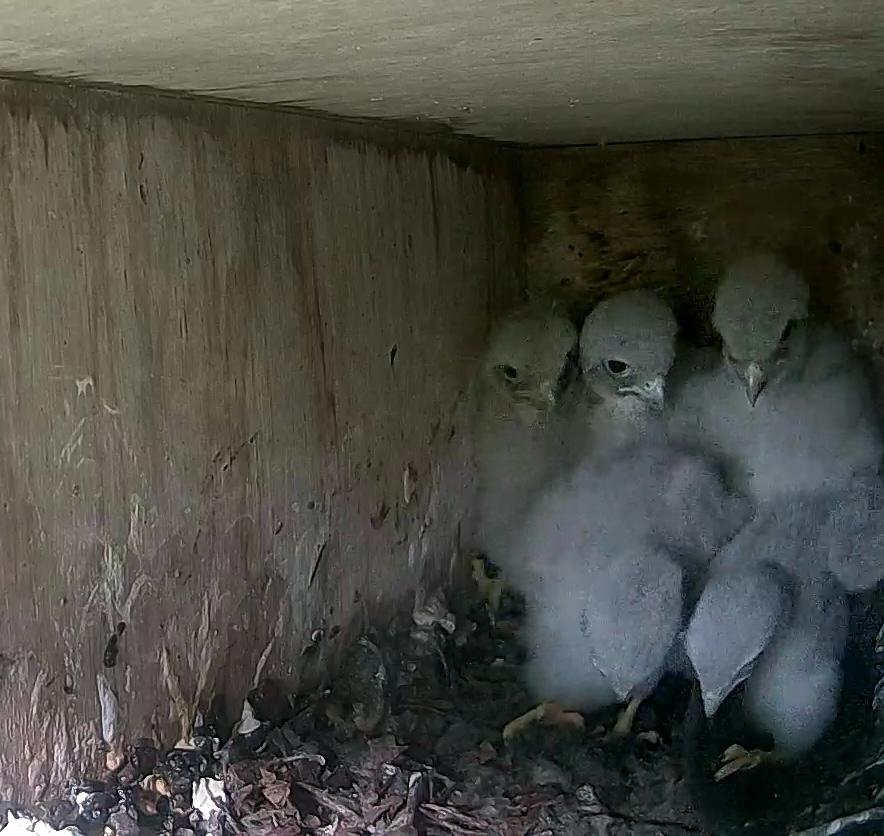
Justine had been approached through the local RSPB group about ringing some Kestrel chicks in a box in a back garden on the way into Amesbury. She was sent a photo of the chicks and determined that she would be away on the Isle of Mull for the ideal two week period for ringing them, so she asked me to do it for her. I made contact with the owner of the garden and arranged to visit today to ring the chicks. He has a nest-cam set up and he sent me a video of the five of them, from which this still was taken:

Kestrel chicks, Falco tinnunculus

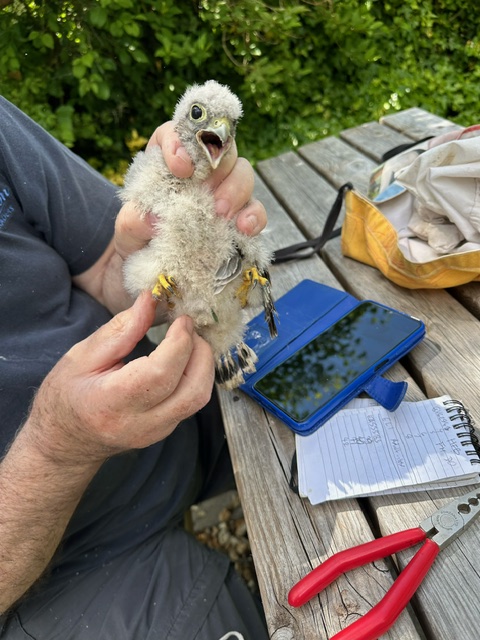
Nice, little bundles of fluff. Only he didn’t say when that was taken. I arrived on site at 14:30 and, with some help from the owners with a ladder and cups of tea, I managed to get the chicks bagged up and ready for ringing. They were considerably more developed than I was expecting. As you can see from the following photo, their feet and talons are very well developed:

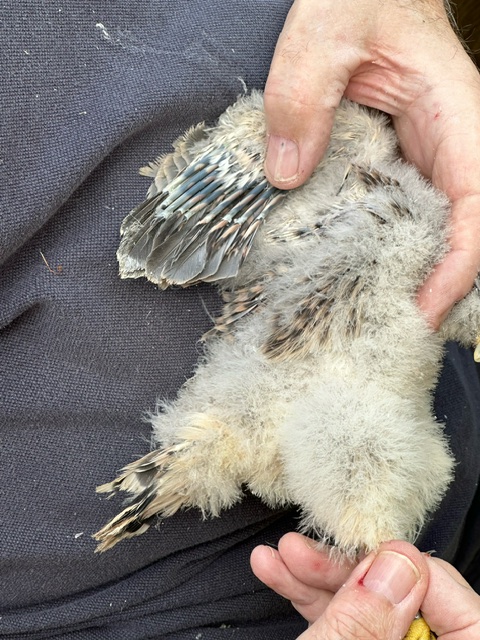
When you are putting your hands into a box, blindly reaching for the chicks, those feet are quite a painful method of finding where they were sitting. These birds are growing nicely and the wings and tail are developing:

As soon as they were processed I put them back in the box and we retreated a safe distance for tea and biscuits. One of the queries that we often get is whether or not ringing the nestlings could cause the parents to desert their brood. I was sent the following video of the adult male delivering food to the chicks about 10 minutes after I had left site:

Dad feeding the young!

Salisbury Plain Raptors: Saturday, 15th June 2024

As some of you will know, when the icon that is Nigel Lewis retired from bird ringing he left four C-permit holders without a trainer. Like Nigel, they were all part of the Salisbury Plain Ringing Group (SPRG). Since Nigel stepped back the group has been steered by Dick Clayton, and they have an organised working regime. However, Dick is not a trainer, so he could not take responsibility for their licences: a C-permit is still a training permit. As I am a trainer, and they would not be any sort of burden, I offered to become their nominated trainer. As their trainer, I needed to meet up and see how they work. They only have to see me once a year and it seemed sensible to get to see them early on. I have already had the pleasure of working with Justine as, prior to Nigel’s retirement, she had already started working with me to expand her ringing skills to include Passerines and near Passerines.

Today I was invited by Dick to join him and Jon Pepper checking Barn Owl and Kestrel boxes on Salisbury Plain. We arranged to meet at West Down Camp at 8:15. I thought I would aim for 8:00, to give a bit of leeway. Last time I went through Devizes there were horrendous roadworks, so I gave myself an extra 20 minutes to get there. So I arrived in Tilshead, just down the road, at 7:30. Time for a large Costa Americano!

I booked in at the camp with the two very friendly ladies manning the entrance barrier, chatted about what we were going to be doing and showed them some photos from previous sessions. Dick arrived and I followed him on to the site. We parked up, Jon arrived and booked in with Range Control, and we set off in the SPRG 4-wheel drive. Virtually the whole time was spent on military land.

We worked through until 16:00 and ringed 15 Kestrel chicks from 4 broods and 9 Barn Owl chicks from 3 broods. Two adult Barn Owls were caught at different boxes: one retrap and one to be ringed. Jon was a trooper: doing all of the driving, ladder carrying, chick handling and nest box cleaning. He is also responsible for all of the photos of live birds and the bees. Mine are the birds as food, the orchids and the beetle.

Not everything was rosy, particularly for the Barn Owls. The first unfortunate finding was particularly sad:

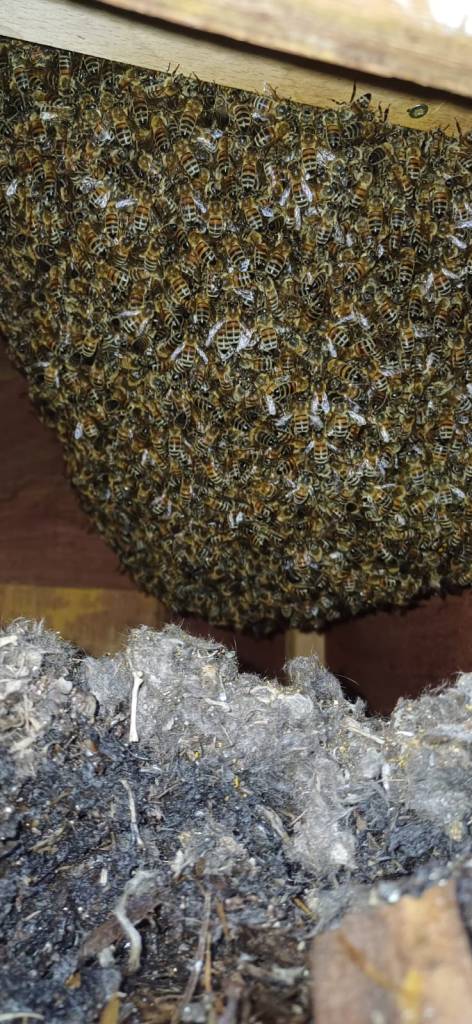
Normally I would love to find a wild bee’s nest. Unfortunately, this bee’s nest inside the owl box had tragic results. We found three dead, emaciated chicks in the nest. There was food there, but too big for the chicks at that age. They need the adults to rip up the voles and feed them directly. Unfortunately, the bees had built their nest across the access to the nesting area: preventing the adults from getting to their young, so they starved to death.

In another box we found that Jackdaws had built their nest on top of the Barn Owl nest. The Barn Owl nest contained three cold eggs. Those eggs had embryos at an early stage of development. This is something that happens reasonably regularly, particularly with Tawny Owls. Fortunately, despite finding plenty of Jackdaws in my nest boxes, I haven’t found this issue in my north Wiltshire boxes. It is possible that this is because our Barn Owls start breeding later than further south in the county. Certainly that was the impression I got when I did the session in the Wylye valley and some of my northern boxes in the same week.

The final, third, sad finding was in a somewhat unusual box structure: a Kestrel box, next door to a Barn Owl box, on the same platform. We caught the adult female in one of the boxes, the other was empty, but on the floor under the box were the feather remains of a reasonably well advanced Barn Owl chick. There were no bones or other remains, but wing feathers at the two-thirds grown stage and some fully adult body feathers.

I don’t want to give the impression that it was all doom and gloom: it was a really enjoyable and productive day, as the following images will show. It starts with Kestrels:

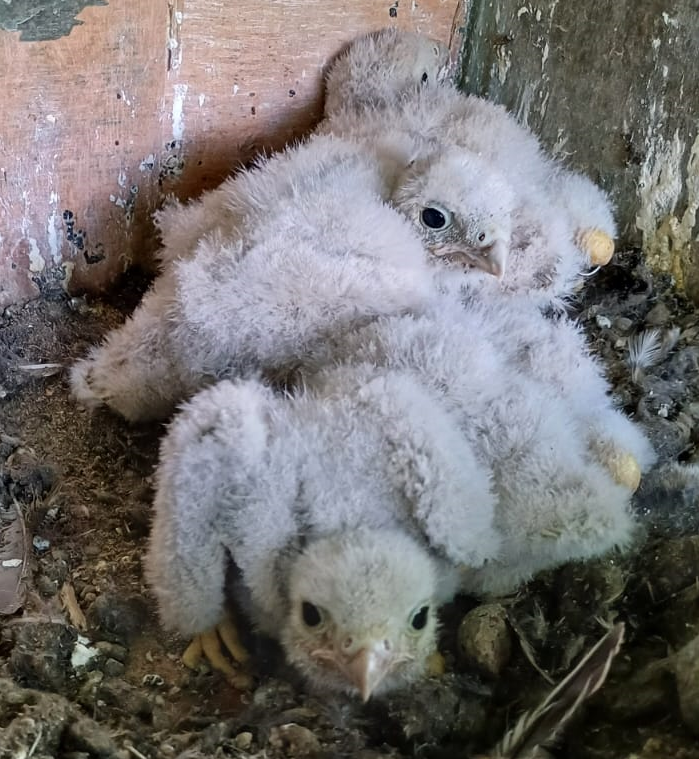
Recently-hatched chicks – too small to ring

Chicks ready for ringing

Developing well

Ringed and ready to fledge.

Barn Owls:

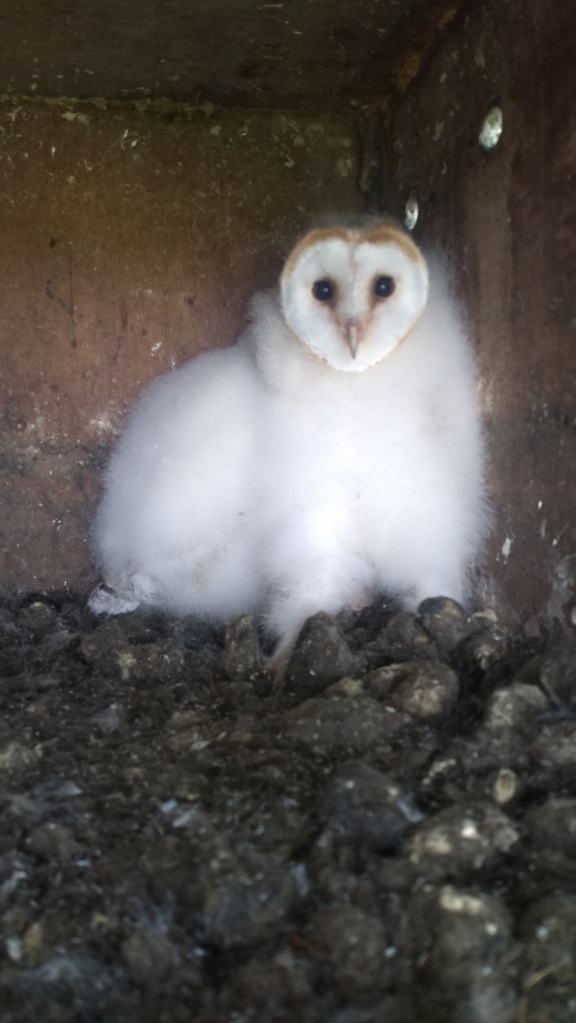
Recently hatched: too small to ring. With Barn Owls the legs and feet grow slowly, so they are usually ringed when at a larger, more advanced stage than in the Kestrels.

Growing well, ready for ringing

A few more weeks before fledging. The wings are one-third grown. If you look at the underwing coverts you can see several black spots. This indicates that this bird is a female.

Now, the traditional picture of Barn Owls is them hunting over open fields looking for small rodents. However, that is not always the case. The biggest chicks that we found seemed to have had a rather different diet:

When Jon cleaned the box out the extent of the predation on Starlings was quite astonishing. I do know that they do predate on Starlings: I found a pair of wings in one of my boxes at Upper Waterhay Farm, but it was how many the parents must have caught. Clearly they found a decent local Starling roost.

Whilst driving around I was delighted with how much other birdlife is being supported on the Plain. Buzzards and Red Kites were plentiful but the totality of “little brown jobs” was amazing: Linnets and Skylarks, Whitethroats and Corn Buntings – absolutely delightful.

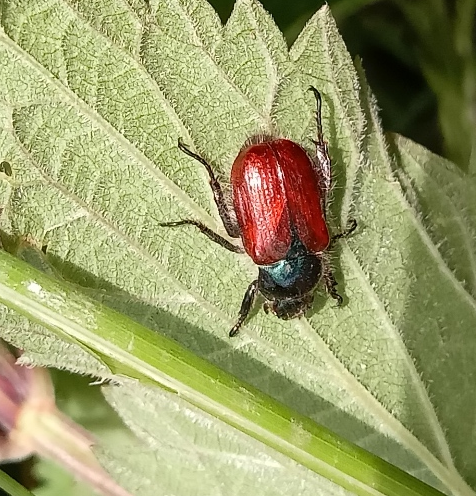
The Plain is alive with insects including this beautifully marked Garden Chafer:

Garden Chafer, Phyllopertha horticola

There were some fabulous flowers out at the moment: plenty of Meadow Cranesbill, Buttercups galore, Cow Parsley reaching to heights of over 2.5m, Vipers Bugloss reaching 1m tall, and then these orchids:

I am no expert but I think that the majority are Fragrant Orchid, Gymnadenia conopsis, and the solitary small, compact flower, Pyramidal Orchid, Anacamptis pyramidalis. I am happy to be corrected.

After what was a busy and fulfilling day, and I am mightily impressed with my new trainee, we arrived back at West Down camp at just after 16:00 and headed for home. I will be out on Monday to ring some of the Barn Owls in my local area.

Some Extra Thoughts on the Wiltshire Redwing Record

The following information has been provided to me by Rob Turner, retired Bird Recorder for Wiltshire and a senior member of the West Wilts Group and Phil Deacon, Wiltshire Ornithological Society committee member and senior member of the North Wilts Group.

Rob sent me the following: “Having been intrigued by Jonny’s record, I thought I’d have a quick trawl through the literature and the web.

The extreme dates for Wiltshire are 5 at Devizes 21 August 2018 and a single at Fyfield, 21 May 1978. (Hobby 48 , Wilts Bird Report 2021 p79.)
The ‘Birds of Wiltshire’ p575, final paragraph records a probable but unconfirmed breeding record at Coate Water area sometime between 1868-77. It does say: ‘Although no other British nesting records are known before the 1920’s the now regular population in Scotland and the odd instances of breeding in English Counties in the last 3 decades of the 20th century lends support to the account.’

Current BTO estimates are 50-100 pairs mostly restricted to Scottish Highlands and as far north as Shetland and a few as far south as Kent. As always with extreme records of migrants its always difficult to surmise which way the bird is going, is it a late departure of a wintering bird or an early arrival of a failed breeder!”

Phil noted: Nearest ringing record I have is one at Potterne on 13 May 1986. This bird was ringed at Spurn Point on the 11th October 1985. We get very few Redwing retraps: of our catch of just under 3,500 Redwing, there have only been seven retraps, but four of them were retrapped in the same winter after ringing. Only one of our records is from a bird retrapped at the same site in a subsequent winter. This was RL61400: ringed in Ravensroost Wood on the 28th December 2016 and retrapped at the same site, in the same net, on the 6th January 2018.

He also noted about Jonny’s photo of the bird: “An outstanding record, I have seen the photo, no CP or BP so a non-breeder, may not have been fit enough for the return migration.”

Andrew Harris, an experienced ringer from Kent, did remark upon the body weight of the bird: considerably more than the normal ranges for the species. The BTO’s BirdFacts has the weight range as being 55g to 84g. Our own records have a dozen Redwing weighing in at 80+g but this is the first with a weight of over 90g. Jonny has checked his records from the session and is 100% confident that the weight entered is accurate. It wasn’t challenged by the online data entry system, which has built-in extreme parameters. If it falls outside of the ranges it prompts you to confirm the value, with a comment to justify it. It didn’t do that because, if it had, the comment would be attached to the record.

I have to mention that Jonny also has another Redwing record: the longest known movement of a Redwing retrapped in the UK. On the 2nd November 2022 he retrapped a juvenile Redwing that had been ringed in the nest at a place called Rautalampi, Pohjois-Savo, Kuopio, Finland. It had flown 2,126km to land at a farm just outside Chippenham! There are longer movements of birds ringed in the UK and recovered elsewhere (usually shot by some ne’er-do-well with no respect for wildlife).