I have been moth trapping in my garden since 2011. The advent of digital photography has revolutionised the study of moths: trays of record specimens, killed and pinned to boards, have largely been replaced by hundreds (thousands?) of photographs. I have never felt the need to “collect” specimens in that way, anyway.
Over the years I have had some wonderful catches, including a first for Wiltshire:
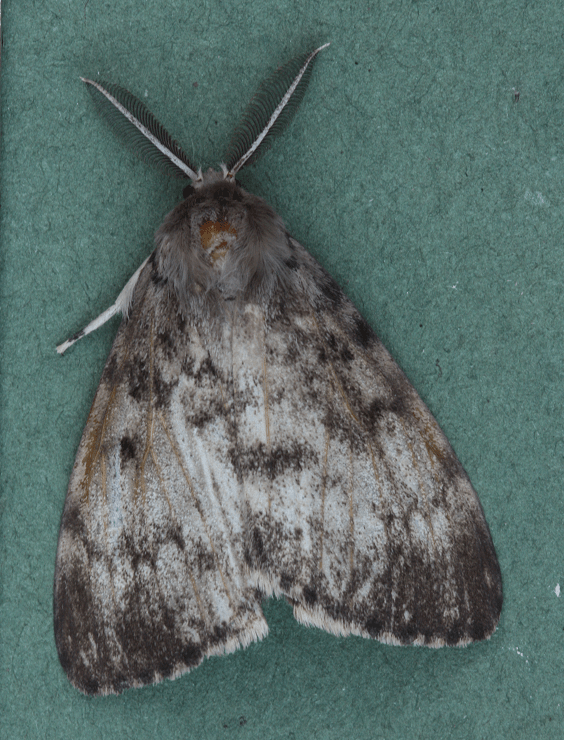
Gypsy Moth, Lymantria dispar
It became extinct in the early 1900’s and was apparently accidentally reintroduced, probably through the port of London in about 1969. Numbers have increased and are regularly reported in Wiltshire these days.
Anyway, since I started I have recorded over 450 species of moth in my garden. 150 species of micro moth and 300 species of macro, not including aggregates. I refuse to extract genitalia to distinguish between, for example, Dark Dagger and Grey Dagger. I have managed to distinguish them because I have found caterpillars of both in my garden and they are clearly different.
Anyway, last night I set my Mercury Vapour, Robinson trap in the garden to see what might be found. The list for the night was an encouraging early catch:
Micros: Light Brown Apple Moth 2; Eudonia angustea 1.
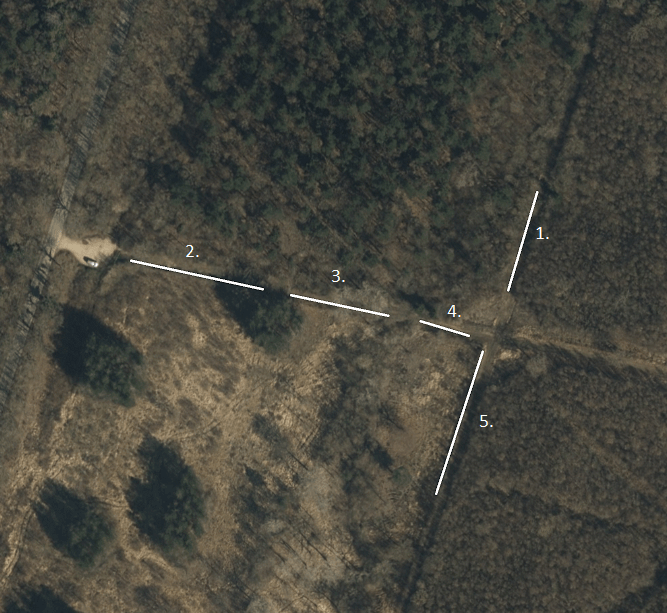
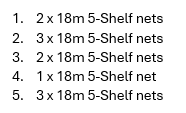
Star Wars day did not turn out to be starry, but we avoided any wars – apart from one of our number taking a tumble in the wet and muddy conditions and getting “in the wars”. I was joined for the day by David, Laura, Daniel and Claire, and later on by Laura’s hubby, Mark. We met at 6:00: a reasonable start time; we will be hitting 5:30 from Wednesday for the next few weeks, before another reduction in the start time. The following nets were set:
The ringing station was set up in the car park. This photograph makes it look fairly benign but the recent rain, coupled with the deep dip between rides 3 and 4, made the conditions underfoot, as previously alluded to, treacherous. I, for one, was using a furling stick more as a walking support than something to lower or push up the nets.
Unfortunately, the catch was identical in size, if not in make-up, to Wednesday’s catch at Lower Moor Farm. The seventeen birds comprised: Marsh Tit (1); Robin 1(2); Blackcap 1; Chiffchaff 3(1); Willow Warbler 5(3). Totals: 10 birds ringed from 4 species and 7 birds retrapped from 4 species, making 17 birds processed from 5 species.
It was a good catch of Willow Warblers. Somerford Common is far and away our best site for this species, with 102 ringed on the site since 2013 and 19 retrapped birds. Most of those are caught in the Spring and Summer: we see far fewer on Autumn migration.
Of the three retrapped Willow Warblers, LEV498, was originally ringed as an adult in June 2020. Their typical lifespan, according to BTO BirdFacts, is two years, so the bird is doing well. When an 8g bird flies to and from the Ivory Coast / Ghana on an annual basis, survival of five years or more is impressive. That the longevity record is ten years and eight months from date of ringing is quite astonishing.
It was a slow morning but, fortunately, we had plenty to chat about to fill the time. However, at 11:15 we closed the nets and took down. With the six of us it didn’t take long and we were off site at just after midday. Let’s hope that we get some dry weather, some sun, and that the numbers improve, along with the access to the sites, before too long.
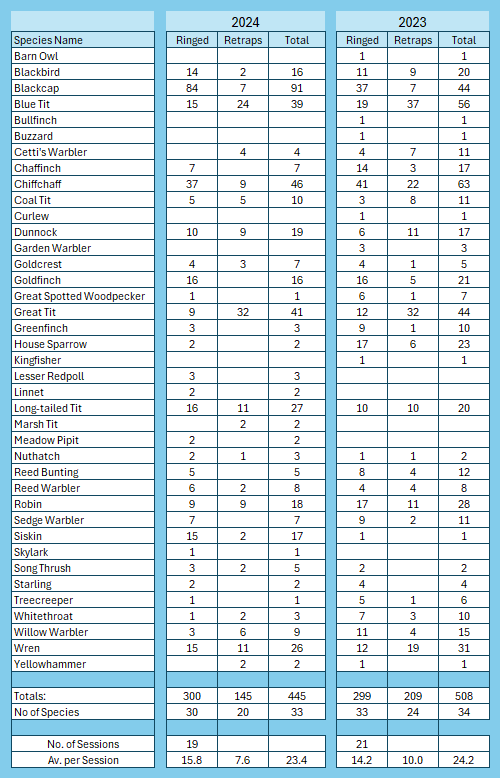
Despite the awful weather we did manage to get 19 full sessions in during the month. I was particularly affected, only making four of eight scheduled sessions and only 102 birds processed by my team. Last year I managed seven April sessions. Fortunately, others took up the slack so we ended up with the 19 full sessions, compared to 21 in April 2023.
The session numbers were reasonably similar, the main differences being in the number of birds retrapped: 2.5 more per session last year that this and the fact that we ringed more birds than last year, albeit from fewer species.
Although it shows that there was one species more processed last April, two of those species, Barn Owl and Buzzard, were processed at the RSPCA Oak & Furrows Rehab Centre, so weren’t wild caught.
Caught this April but not last were: Lesser Redpoll, Linnet, Marsh Tit, Meadow Pipit and Skylark. Missing from last year, apart for the rehab birds, were Bullfinch and Garden Warbler.
The star bird surely has to be the Skylark: the twelfth that we have caught since 2019 but, prior to that, we hadn’t caught any since the group split at the beginning of 2013. Most seem to be shared between Andy’s Imber Ranges site or Jonny’s East Tytherton site. The Meadow Pipits were also caught on Andy’s Imber site. Spring catches are unusual for us with this species: this is only the third April catch we have had: two birds in 2021 at Imber and four in 2015 at Blakehill Farm. I need to mention the three Nuthatches processed: one was in the Wildlife Trust reserve at Green Lane Wood, the other was at Lower Moor Farm. This is only the sixth Nuthatch caught there. It is not surprising, it is not a woodland, but reconstructed gravel extraction pits.
Interestingly, whilst Blackcap numbers were over double the figures reached last April, all of the other summer visitor numbers were down on last year. The slowness of arrival of summer migrants this year has been flagged up on the BTO’s BirdTrack reports: particularly Wheatear and Swallow, although we do seem to have plenty of them around in the Cotswold Water Park and environs.
One final event in April: I took on five more trainees. They are all C-permit holders from the Salisbury Plain Raptor Study Group. Their permits are restricted to ringing the pulli of Barn Owl, Tawny Owl, Little Owl and Kestrel, and they have all of the appropriate permissions from the BTO and Natural England.. They were the trainees of the legend that is Nigel Lewis. At the age of 88 (88! – I do not expect to be climbing ladders at age 80, let alone any older) he has retired from the world of bird ringing, leaving a massive legacy and huge body of work, but also leaving a team without a trainer. There are a number of other A-ringers in the group but no trainers, so I have stepped up and taken them on so they can continue to carry out their excellent work. I don’t expect to do much work with them, as I have plenty to do up north in the county, but will enjoy the odd trip out on Salisbury Plain.
Let’s hope that we have better weather this month and can get some good sessions in!
Over the last few years I have become increasingly disillusioned with the Constant Effort Site (CES) catches we have been getting, as the number and variety of catches have declined significantly across the reserve. From the first full year, 2014/15, until 2019/20, we averaged just under 52 birds processed each session across the full year. The average between 2020/21 and 2023/24 has consistently declined to 31.1, with the last year 1st April 2023 to 31st March 2024 averaging just 26.9 birds per session. The decline is almost entirely down to the reduction in catches in the CES sessions. Last year also recorded our lowest ever number of species, at 23. In 2022/23 we recorded 25 species but, prior to that, we averaged exactly 30 species per annum. I decided that if the pre-CES sessions were very low I would possibly retire the CES. I wouldn’t give up working at Lower Moor Farm: how could you give up the site that delivered a Yellow-browed Warbler, the second ringed in Wiltshire; an acredula Willow Warbler, the first ringed in Wiltshire (as far as I can ascertain) and a Firecrest. Instead I would expand the activity to different parts of the reserve to see whether the birds had relocated elsewhere away from the wildlife refuges. Our session at the end of March produced 30 birds and the one on the 17th April produced 36 birds. These are about average for this time of year, with winter visitors disappearing and summer visitors just beginning to arrive, so I decided to give the CES another year.
We have had discussion with the Wildlife Trust about the issues potentially affecting the suitability of the habitat and agreed on plans of action. Some has been carried out: the trees along ride 4 have been thinned and some have been topped out. There is more to do to both ride 2 and ride 4 but, of course, work cannot continue until after the breeding season, and the Trust has many differing priorities and limited resources. I am grateful for what has been done so far. The saddest loss to me is the absence of Lesser Whitethroat: we haven’t caught a single one at the site for over three years. Until 2019/20 we could reliably catch 10 of them each year: most of which were juveniles almost certainly reared on the site.
A final push to continuing with the CES this year was a request for help , last year we played host to Sarah Binnie, a PhD student at UEA, carrying out her PhD looking at the relationship between the prevalence of insect life and the number of juvenile birds being produced at CES sites. This year we have been asked to help her studies by deploying sticky traps alongside one of our net rides: just one trap per session and then send her photographs of the results. I put the trap in a tree along ride 4:
I was joined for the morning by Rosie, Miranda and Teresa. We were on site and had nets open by 6:30 and caught the first bird at 7:00. Just before Rosie had to leave for work we were joined by her new trainee, Ellie. It is great to see that the Trust are taking on some new staff. Hopefully more will follow.
Unfortunately the session was nowhere near as good as the previous one. It was quite remarkable in one way: over 70% of the catch were retrapped birds. That sounds grand, but we had just 12 retraps and 5 new birds in the catch over a six hour period. It is a good job we had plenty of other things to keep us occupied!
The list for the day was: Wren 1; Dunnock 1(2); Robin (2); Song Thrush 1; Cetti’s Warbler (2); Blackcap 1(2); Garden Warbler (2); Chiffchaff 1; Goldcrest (2). Totals: 5 birds ringed from 5 species and 12 birds retrapped from 6 species, making 17 birds processed from 9 species.
One of the Garden Warblers, ACJ5243, was ringed as a juvenile in August 2019, so that is five journeys to and from the Congo rainforest: a mere 6,000 mile round trip, so just the 30,000 miles so far!
So, whilst we didn’t have a massive haul, there was a lot going on. There was plenty of birdsong: Blackcap, Garden Warbler, Chiffchaff and Willow Warbler, as expected, but we also heard our first Cuckoo of the year. Not only that but I was treated to not one but two Hobby flying over Mallard Lake! The Great Crested Grebes were still courting on the Lake. The funniest thing we saw this morning was a Cormorant trying to swallow a huge Rainbow Trout. It took a long time before it managed to swallow it down.
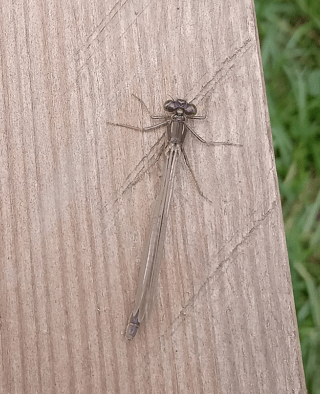
There was a very pronounced irruption of damselflies: all too dark and dull to identify yet (okay, I could get the book out, but I have a lot of other stuff to write once I have finished this blog!). This one came and sat by me on the bench:
We carried out the six hours allocated to the session, packed up and were off site by 13:00. As we were packing up I discussed the situation with Miranda, and decided that we will keep the CES core but add some extra nets away from the CES nets, to test whether the birds have simply moved away from the CES site to other parts of the reserve. i.e. make more work for ourselves!
The last time I had a ringing session in the Firs was on the 9th October 2022. Later that month the reserve was closed for Ash die-back mitigation work, carried out on the insistence of and by the preferred contractors of the site owners: the Hills Group. The site is managed on their behalf by the Wiltshire Wildlife Trust. It was originally going to be closed for six weeks whilst the contractors removed all of the Ash and a number of the mature Oak trees. The latter were by way of part payment for the work carried out. Unfortunately, the work dragged on, and the contractors left site, leaving the work unfinished and the site in an unsafe condition. As this was unexpected, the Trust had not budgeted for making the site safe, as it was not expected that they would have to do so. With the Trust having so many other projects on the go, the reserve was left in an unsafe condition and, therefore, remained closed. To date the reserve remains closed to the public. However, last Friday I got permission to restart ringing sessions in the Firs.
So, old friend? It was the first Braydon Forest site that I was given access to after achieving my C-permit. The Firs has been my most regular site for seeing Lesser Spotted Woodpecker, not that I have managed to catch any to put a ring on, but seeing them is special. The Firs was the first site in the Braydon Forest where we caught Spotted Flycatcher: two juveniles in August 2016 and a potential breeding pair in June 2019. Subsequently we have caught them in all of the Braydon Forest sites except Webb’s Wood. Any site that allows me to work with stunning birds like that is definitely a friend!
Why foe? It is known as the Braydon Bog: the wettest site for the longest time in most years. However, the real issue is the hill! It seems like such a gentle slope, but it is deceptive. Working the Firs is absolutely the hardest work of any of my sites: a dozen trips up and down that slope, at 500m per round trip, is hard work for someone of my advanced years and arthritic ankle!
Anyway, despite those drawbacks it is a reliable site and I live in hope of a Lesser Spotted Woodpecker ending up in my nets one day! So this morning I was joined by Miranda, Teresa and Andy for a session. We met at 6:00 and set 5 x 18m 5-Shelf nets and 2 x 12m 5-Shelf nets along the central glade, in 2 rides from the bottom of the hill. No photographic diagram: neither Ordnance Survey nor Google Maps show the current state of the wood.
We started catching as soon as the nets were open and caught fairly regularly throughout the morning. We did have to call a halt to proceedings due to a passing shower between 10:00 and 10:30, so missed out on one round. However, there were no birds in the nets in the round after the shower, so no harm done.
The catch for the day was: Blue Tit 2(1); Great Tit 2; Coal Tit 2; Long-tailed Tit 3; Wren 3; Dunnock 1; Robin 2(1); Song Thrush 2; Blackbird 1(1); Blackcap 6; Chiffchaff 5. Totals 29 birds ringed from 11 species and 3 birds retrapped from 3 species, making 32 species processed from 11 species.
For comparison, the average catch size in this wood during April is 22.4 and the highest was 33 back in 2016. Interestingly, that session comprised 30 ringed and 3 retrapped from 11 species. We were one bird off: the Blackbird that disentangled itself before Miranda could get to it!
After a satisfactory session, we closed the nets and took down at 11:30 and left site by midday.
Taking a break from writing up my annual reports for the Wiltshire Wildlife Trust and Forestry England, I was pleased to see that the wind was forecast to drop to a level that would enable the team to get out. With the incoming summer migrants I wanted to go to a site where I knew there was a good chance of catching some, so I chose Lower Moor Farm. One thing about the wind: it was forecast to come from the North / North-West: it certainly did, it was a very cold wind. Rosie actually had to scrape ice off her windscreen! Mind, that was at 5:00 when leaving home to join us. We met at 6:00: Rosie, Teresa, Andy and myself. Rosie left for work before 9:00.
We set the CES nets plus a couple of additions to see how they fared:
Whilst we were setting up there was a lot of birdsong. In the shrubby area to the east of ride 1 there were at least three Willow Warbler singing, Chiffchaff were also making their presence felt but the absolute, overpowering, star of the morning symphony (cacophony?) were the Cetti’s Warblers. There were at least four singing males in our small area. To think that the first was only caught in 2015 (I checked with the ringer who had worked the site for the longest time before I took it over: he had never heard Cetti’s on site, let alone caught and ringed any) and now they have territories all along the main path and the bushes that line the stream that forms the border between Wiltshire and Gloucestershire.
Things started with a nice catch of nine birds: including two of the Willow Warblers adjacent to ride 1 plus a retrapped Cetti’s Warbler. The next two rounds were similar, but then the breeze started to get up and the nets became more visible and the catch dropped away. By 10:30 the nets were billowing and I decided to close the nets and take down.
The list for the session was: Nuthatch 1(1); Treecreeper 1; Blue Tit 1(1); Great Tit 1(4); Long-tailed Tit 1(1); Wren 1(1); Dunnock (1); Robin 1(1); Cetti’s Warbler (2); Blackcap 9(2); Chiffchaff 1(2); Willow Warbler 1(1); Goldcrest 1. Totals: 19 birds ringed from 11 species and 17 birds retrapped from 11 species, making 36 birds processed from 13 species.
My only disappointment: Miranda on a visit to the reserve last weekend had seen both Blackcap and Garden Warbler. She did say that the Blackcap was being particularly belligerent towards the Garden Warbler, perhaps they have driven them away? I do know that if I want to lure for Garden Warbler I don’t need to lure for Blackcap, as they will come to investigate whether that particular antagonist is in the vicinity. It is an interesting antipathy: whilst there is some habitat crossover, Blackcap prefer taller vegetation than Garden Warbler.
The Cetti’s are resident and, within that, incredibly site faithful: AAL0354 was ringed in May 2020 and has been recaptured at least once every year since in the same location. The other recapture, BPA 2585, was only ringed in May last year and this is the third time it has been recaptured since, again, in the same location.
Cetti’s Warbler, Cettia cetti, AAL0354 on the day it was ringed
There was some good birding this morning, as well as the trout, that Mallard Lake is stocked with by the fishing syndicate who lease the rights from the Trust, doing their leap and splash antics. Some of them are absolutely huge.
My favourite birds of the morning (outside of those we caught), were a pair of Gadwall: I cannot remember seeing Gadwall at Lower Moor Farm before. The Grey Herons have got young now: and there was a fabulous racket going on from them. We had a Sparrowhawk doing its wing flutter display flight overhead and, as I was leaving site, a male took off from the ground where the Willow Warblers had been singing, and flew up the path in front of me. Lovely views for a few hundred metres.
The Mute Swans were very active on the lake: with a lot of aggression and posturing. For once it was focused on other swans and not on the Canada Geese.
Mid-session a couple of Swallow made an appearance over Mallard Lake. They didn’t stay long. Rosie said that on Monday, when the weather was at its worst, there was a large mixed flock of hirundines hawking over that same lake. I am looking forward to, hopefully, ringing a few: it has been a while.
We were all away from site before midday after a pleasant, if cold, morning.
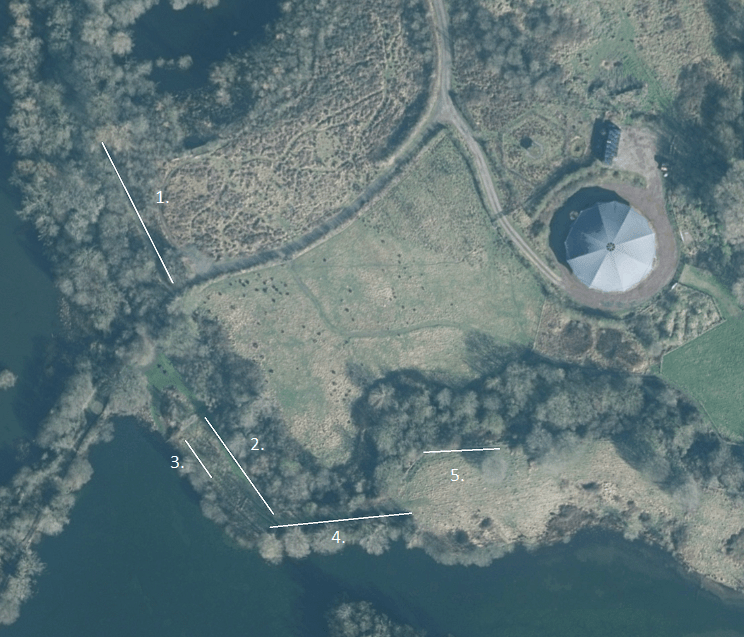
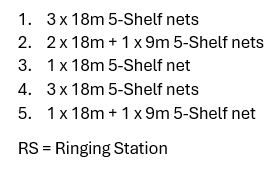
David, Laura, Adam and I met up at the Whitworth Building, on the western side of Blakehill Farm, this morning at 6:30 (Bjork wasn’t available!). There was a light breeze forecast, coming from the South or South South West over the course of the morning, picking up as midday approached. We set the following nets:
Our ringing station was adjacent to the Whitworth Building: where the white car can be seen on the photo. I set the two-shelf nets along the hedgerow where we caught the Meadow Pipits last time on site. Unfortunately, they caught absolutely nothing today.
We set the main nets in reverse order to the way I have numbered them on the diagram. Net 6 is always a bit of a disappointment, but I keep hoping, and this morning, before we had even finished tying off the net, a Chiffchaff flew in: our first bird of the morning. However, after that it did catch two more birds, but they were same day retraps and we don’t process a bird more than once in a session.
Unfortunately, as the title says, it was a very quiet session. Quite remarkably: not one Blue or Great Tit. I cannot remember the last time that happened here. The key issue was the wind. Because the breeze was forecast to come from behind the bushes, we set them building side of the bushes (I didn’t fancy extracting all those nets from what are, primarily, bramble bushes): the breeze got up, much higher than was forecast, quite quickly. Whilst the nets did not billow to the point where the pockets were blowing out, or that it became dangerous for the birds, they were too obvious and easy for the birds to avoid. Had I known it would be like that I would have chosen a woodland site.
It was a very pleasant session despite the lack of birds, and we had lots of time to chat, especially after 9:00 when Laura’s partner Mark and their other son, Daniel, arrived: the pair having been to see the Zutons in Bristol Friday night and still buzzing about it: Daniel sporting his tour T-shirt. Their contribution in helping pack stuff away at the end was much appreciated.
Back to the birds: we had mainly Chiffchaff, with Wren and Long-tailed Tit being the next most frequent. In fact, all of the birds caught, until we caught three Blackcap at 9:55, were birds that took the smallest, AA rings. Two B-ring Dunnocks were the only other ring sizes needed.
Our bird of the morning was our first Whitethroat of the year: the earliest that I have ever caught by 10 days.
The list for the session was: Long-tailed Tit 2(2); Wren 1(3); Dunnock 2; Blackcap 3; Whitethroat (1); Chiffchaff 5. Totals: 13 birds ringed from 5 species and 6 bird retrapped from 3 species, making 19 birds processed from 6 species.
It was a pretty good morning for birding as well. A Red Kite spent a long time following a Jackdaw, occasionally swooping at it, always staying above and just behind it. I am pretty sure it was trying to drive the Jackdaw into a position where it could seize it. We had another Red Kite circling over the plateau later in the morning. Apart from that, we were treated to Curlew displaying and making their bubbling call all morning. At one point a pair of them flew from Blakehill towards Purton / Red Lodge: both places where they are regularly seen foraging for food in the fields. The bushes were alive with bird song: mainly Chiffchaff and Willow Warbler. If the breeze had been less strong we might have had a much better catch. Net ride 2, in particular: I stood and watched birds flitting in and out of that hedgerow for 5 minutes without any of them hitting the net. The net was just too obvious.
We packed up at 11:15: all of the nets were empty as we were closing up. The team is getting very efficient and we were packed away and leaving site by midday. On my way out of the site I stopped to chat with one of the team at the Oak & Furrows centre, who was entering the site as I was leaving. She was on her way to pick up some more supplies as she is currently foster mother to a number of leverets! Oak & Furrows has had an almost complete turnover of staff and volunteers in the last 6 months, so it was nice to be told that they would still like my help going forward: just as well, having purchased a one metre rule for measuring Red Kite and Buzzard wings!
After eight days of wind and rain and impossible weather for ringing, I grasped the first opportunity to get out. There was still some breeze about, so I decided on Ravensroost Wood, as it tends to be reasonably sheltered. As I had several people also itching to get out bird ringing, I decided to set a few different nets:
All three rides comprised 3 x 18m 5-Shelf nets.
I arrived on site at 6:25 to find Miranda, Sarah, Teresa and Andy waiting for me. Rosie arrived a few minutes later (coming over from the Forest of Dean, with the mess that is the A417 roadworks, I am amazed she gets here at all, let alone on time and ready to help for a couple of hours before heading to work) and we set to getting the nets open. There was bird song everywhere: predominantly Chiffchaff and Willow Warbler, so I was hopeful that we would catch a few. Unfortunately, “few” was the operative word! Don’t get me wrong, it was a thoroughly enjoyable session, even without a preponderance of birds.
We only caught 15 birds, 12 new and three retraps. It started with a retrapped Blue Tit and a Chiffchaff at 7:30. That was the shape of things to come: between one and four birds every 25 minutes, mainly just one or two, sometimes none. The second round comprised two more Chiffchaff and a Blackcap. All three Chiffchaff were able to be sexed as males and the Blackcap was a female. The first of the year, the others caught at Lower Moor Farm on 30th March were all males.
Our next round was the biggest of the session: four birds. Retrapped Blue Tit and Willow Warbler plus new Great Tit and Wren. The next two rounds each produced a single Wren. That second round also produced a female Blackbird, with a very well-defined brood patch, plus the bird of the morning: a female Lesser Redpoll, also started developing a brood patch, but still defeathering. This is notable because, although Lesser Redpoll have historically bred in the Braydon Forest, particularly Somerford Common, recent evidence is very scant. I have to admit, I do not know whether a female bird planning to migrate northward would start preparing to breed before embarking in that journey. The only recoveries we have had of Lesser Redpoll have been one in Glasgow and another in Yorkshire, which rather indicates they head north in the Spring. The only juvenile Lesser Redpoll that we have caught in full juvenile plumage were at Ravensroost on the 6th August 2016. We were so surprised to see them that we initially misidentified them as Linnets! Why was it so surprising? Two reasons: the earliest anybody in the group has caught Lesser Redpoll is in October and the latest, until today, that anybody has caught them is the 6th April.
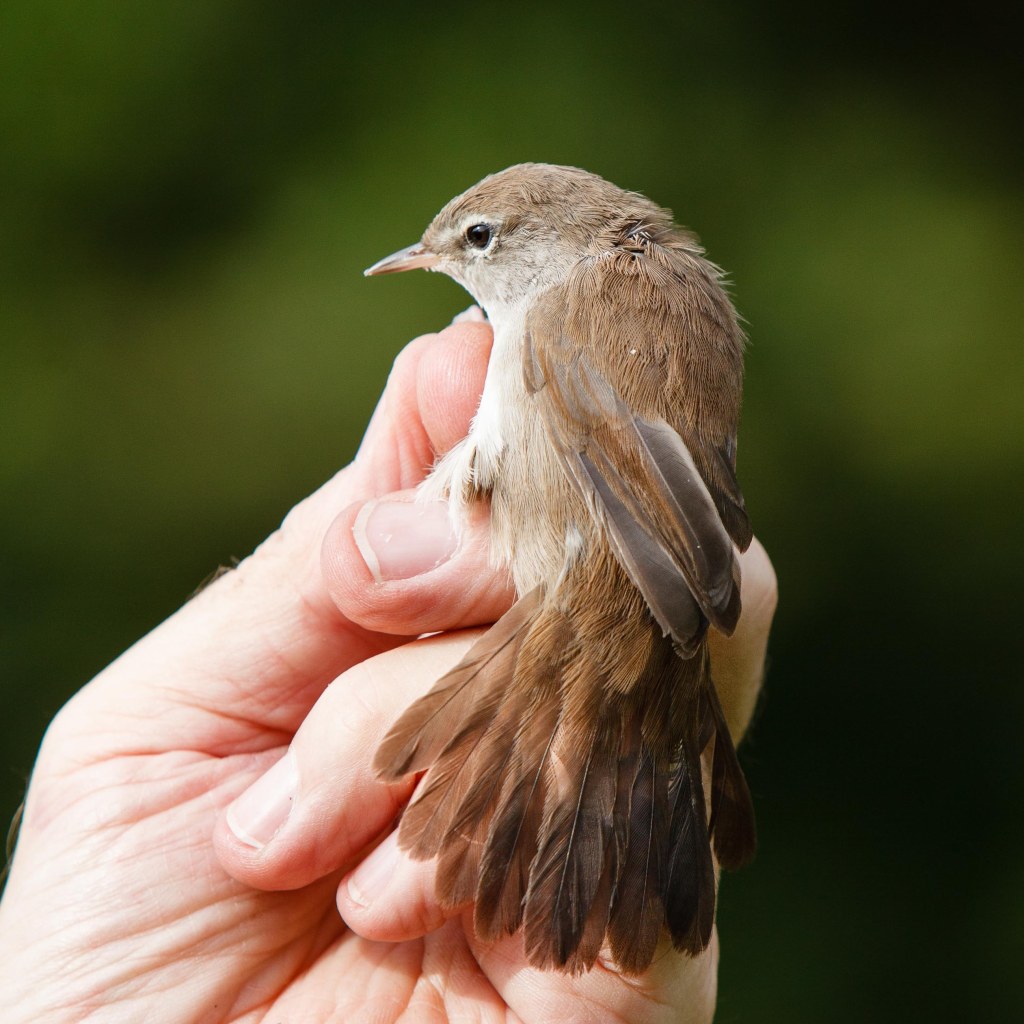
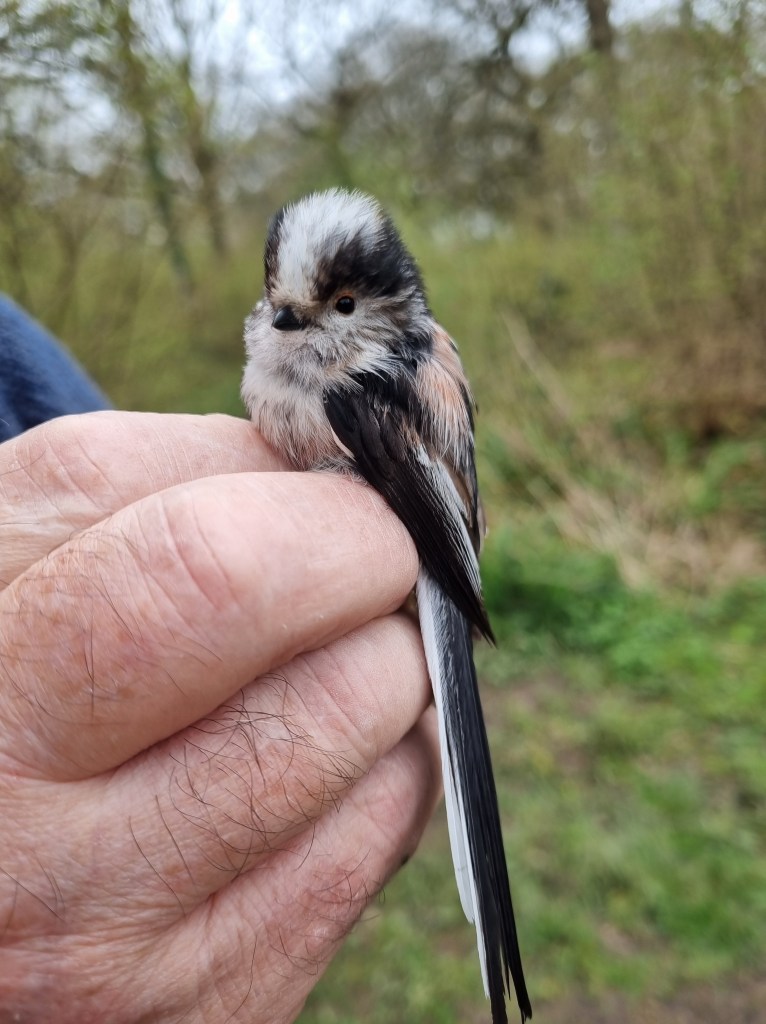
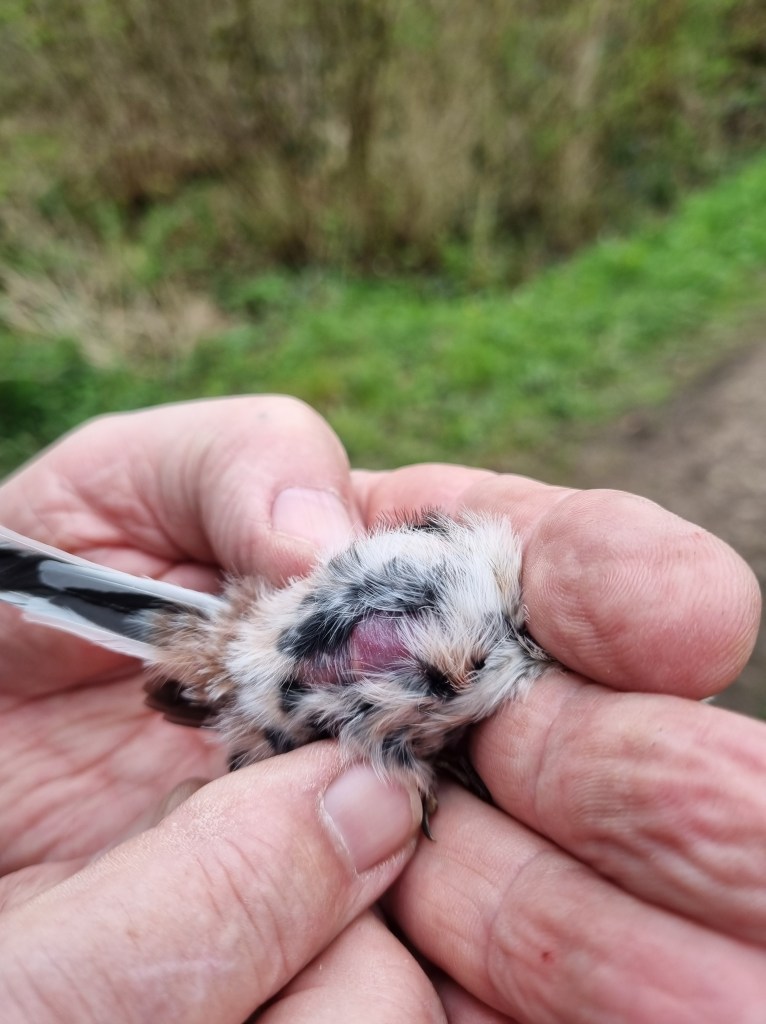
Much as we were enjoying the chat, without the birds we decided to pack up at 10:30. Needless to say, we did have one last bird hit the nets as we were taking the nets down. It was a Long-tailed Tit: a female with a very well-defined brood patch:
Long-tailed Tit, Aegithalos caudatus. Photo 2 showing the well-developed brood patch. (Photos courtesy of Sarah Emery)
For the absence of doubt, the portrait photo was taken after I had blown on her belly to show the brood patch. As you can see, the minor indignity of having her belly displayed didn’t disturb her undoubted good looks! Beautiful bird.
The list for the session was: Blue Tit (2); Great Tit 1; Long-tailed Tit 1; Wren 3; Blackbird 1; Blackcap 2; Chiffchaff 3; Willow Warbler (1); Lesser Redpoll 1. Totals: 12 birds ringed from 7 species and 3 birds retrapped from 2 species, making 15 birds processed from 9 species.
With everything packed away we left site by 11:30: quiet, but quietly satisfying!
I suppose the most notorious example of this in the birding world was Songbird Survival’s attempts to blame Sparrowhawks for the decline of songbirds, because their numbers were increasing whilst songbirds numbers were decreasing. However, Sparrowhawks were recovering from a catastrophic decline, due to organochlorine poisoning, primarily recognised in the 1960’s and 70’s, plus impacts of deforestation and persecution, whilst songbird numbers were declining, as they still are, due to myriad factors: primarily modern farming practices and habitat loss. Unfortunately, I find a lot of this when talking about supplementary bird feeding, particularly garden bird feeding: both in terms of spreading disease, reducing populations on the one hand, and artificially inflating populations of some species on the other.
I have a particular frustration with the discussions of whether or not we should feed birds in our back gardens. There are two “anti” arguments. The first is that feeding is spreading diseases which is leading to the decline of certain species. Secondly, is the contention that feeding birds in your garden is enabling those that take advantage to out-compete those that don’t, leading to those other species declining. The one thread that is never discussed: the educational benefit of involving humans, connecting them with wildlife, and raising their interest in what is happening to nature, balanced against those other considerations.
I have always fed the birds in my garden, wherever I have lived: urban, suburban and rural, and have always kept records of what I have seen. In 2003 I joined the BTO’s Garden Birdwatch scheme (GBW), as a way of providing data to a national database, outside of my personal interests. For six years, between 2015 to 2020 inclusive, I was a Garden Birdwatch Ambassador, doing 10 or so talks per year to groups as varied as the Women’s Institute, gardening clubs and U3A, to drum up interest in wildlife gardening and membership of the GBW scheme. During those talks I promoted the provision of feed, food plants and wildlife habitats in gardens, to encourage people to take an interest in what goes on and improve things for our wildlife. On every occasion, whilst encouraging people to feed the wildlife in their garden, I did stress the need for keeping excellent levels of hygiene at feeding stations. Most obviously bird feeders and, in the case of my garden, the hedgehog feeders. (Yes, I am lucky, alongside 60 species of bird recorded in my garden plus another half-a-dozen overflying, I also have fox, hedgehog, badger and wood mouse as regular mammalian visitors (unfortunately, I also have brown rat coming from under my neighbour’s decking, and their cats) and have recorded over 450 species of moth – including a first for the county.)
In 2009 I became a bird ringing trainee, gaining my C-permit in 2012 and my A-permit / trainer’s endorsement in 2015. Once I got my C-permit, which allowed me to ring without the supervision of my trainer, whilst he remained responsible for my activities, I started to catch and ring birds in my garden. I also got permission to ring birds in the Forestry England sites of Red Lodge (about 1km from my garden), Webb’s Wood and Somerford Common. Also, the Wiltshire Wildlife Trust gave me permission to ring in the Ravensroost complex, the Firs and Blakehill Farm. All of these sites, including my back garden, were once part of the medieval Braydon Forest hunting ground.
I have been aware of the fluctuations in numbers of some species and, particularly, the catastrophic decline in the numbers of Greenfinch visiting the garden between 2003 and 2015. This is primarily attributed to a Protozoan parasite, Trichomonosis gallinae. It is believed to have been passed through Columbidae to other species, and particularly Greenfinch. Collared Dove are the most affected member of the Columbidae, and their numbers have clearly increased significantly over the decades, almost certainly helping to spread the parasite. There is a view that it is spread at feeding stations. One would have thought, certainly with the preponderance of supplementary feeding in the UK, that someone would actually have devised methods of testing this and its subsequent transmission. That hasn’t happened. However, what you tend to see in the scientific press is conjecture: the correlation = causation conflation, as I call it. That is not to say that it isn’t true, but it is to say that it is an hypothesis in need of testing.
I have not seen a single incidence of trichomoniasis in any of my Greenfinch sightings or catches for over 7 years now. When it comes to my ringing catches, they are quite hit and miss, depending upon how many times I ring in my garden in a year, as that is where I mainly catch them. The numbers are: my garden: 127, the rest of the Braydon Forest: 6. I have seen a big increase coming to the feeders over the last few years, and this year we are regularly seeing 10 or more in or around the garden. This week I had some discussion on this with Alex Lees on Twitter. He is a senior lecturer at Manchester Metropolitan University, involved in lot of work on biodiversity and population dynamics, with lots of published papers to his name. He is one of the advocates that bird feeding is responsible for serious species declines through the spread of disease. While we were discussing something else, covered later in this post, he expressed the opinion that Trichomonosis parasites are being spread significantly through bird feeders. As evidence he provided a link to a paper that showed how the parasite could be kept alive in bird seed:
It is behind a paywall so this is their summary, which is freely available: “Trichomonas gallinae has emerged worldwide as a cause of mortality in songbirds (passerines). The congregation of numerous birds, including the reservoir hosts, pigeons and doves (columbids), at backyard feeding and watering sources has been suggested as a potential driver for the outbreaks. Evidence supporting a role for water in transmission has been established, but the role of birdseed in the transmission of trichomoniasis remained to be investigated. We assessed the survival of T. gallinae in three commercial birdseeds (mixed seed, black-oil sunflower seed, and niger seed) routinely used to attract passerine birds to local properties. Trichomonad suspensions were inoculated (low dose: 1 × 10³; high dose: 1 × 10⁵) into each of the three seed types in petri dishes, using both dry and moist (water-soaked) conditions, in triplicate. Petri dishes were incubated at 37 C and monitored for T. gallinae survival for 48 hr by wet-mount microscopy and by InPouch™ TF medium culture for 10 days. Surviving trichomonads were not detected in any of the dry birdseed treatments. In moist conditions, however, trichomonads were found to survive ≤24 hr in all three seed types and ≤48 hr in the mixed seed that contained organic debris. We demonstrate that T. gallinae has the ability to survive in moist birdseed, which suggests that public bird-feeding sites may play a significant role in the transmission of trichomoniasis.”
They state clearly that this study was done under laboratory conditions, in petri dishes, incubated at 37oC! I appreciate we live in a time of climate change / global warming, but that bears no resemblance to the reality in my garden, and I doubt whether it does in any UK garden. The only bird seed I use is sunflower hearts. I use small feeders, emptied every other day or so, the feed is never left wet and we provide clean water every day. Another person I regularly discuss things with, the estimable Alick Simmons, a well respected veterinarian, once chair of the Universities Federation for Animal Welfare (if you haven’t read his book “Treated Like Animals”, it is well worth reading, whatever your dietary proclivities) in supporting Alex, sent me a link, below, on bird feeder diseases. Alick has himself stopped feeding birds, to prevent the spread of disease from his feeding stations. I keep mine clean and disinfected, only use hanging feeders, as I find bird tables are just too difficult to keep clean, and keep a keen eye out for any signs of disease in the birds coming into my garden. If I see or suspect it, I stop feeding for a week and disinfect everything. That said, it is years since I have seen anything like that. I did have to take down and disinfect after a Chaffinch with Fringilla papillomavirus visited my garden a year or two ago, but that is not in the same category as trichomoniasis.
Interestingly, when you get to the entry on Trichomoniasis it says the following: “Unlike Salmonella, Trichomonas cannot survive for more than a few minutes outside its host.” To my mind that means that it is highly unlikely to survive to infect other birds under standard UK conditions, so I am not sure what the relevance of incubating them under laboratory conditions is, other than to reinforce a predetermined point of view. The fact is that they could have done this in a typical garden environment and got more meaningful, relevant, results.
I don’t doubt that poor feeder hygiene can lead to the spread of diseases: in particular Salmonellosis. Interestingly, that same paper says the following about this disease:
“Epidemiology: No surveys of the occurrence of outbreaks of this disease have been undertaken in the UK but it appears to be a common cause of epidemics in garden birds especially during the colder months from December through to April.”
That was the case when that was written in 2000. Subsequently there have been some studies, seemingly focused on the potential for spread from wild birds to humans through poor hygiene at feeding stations, rather than on the extent of infection of the birds involved. Apparently the key species are the poor old Greenfinch, Chaffinch and House Sparrow. (e.g. this from the BTO website, it links to the full paper: https://www.bto.org/our-science/publications/peer-reviewed-papers/epidemiological-evidence-garden-birds-are-source-human)
There have been surveys elsewhere around the world, and it seems that faecal contamination plays a large part in its spread. So, feeder hygiene is incredibly important. However, I want to point out the use of language: “appears to be”, “suggests”, “may play”. Time and again, and I have read every paper that Alex has linked me to, as much as I can, but many are hidden behind a pay wall and I don’t have the benefit of an academic institution to pay for my access, they use those sorts of phrases: not “we have data that shows that this is the case” but “we have data that shows that this might be the case”.
It seems that salmonellosis is far and away the most likely infection to be spread from dirty feeders. The thing about it, though, is that, unlike Trichomoniasis, it is not fussy about what species it might infect (as I can attest, having nearly been hospitalised from a bite from a Great Black-backed Gull). So why wouldn’t the commonest species coming to garden bird feeders be the biggest sufferers with Salmonellosis, and why doesn’t that lead to a reduction in their numbers? Why don’t we know this? Plenty of studies say that there is a level of infection within many bird populations, which can occasionally cause mass outbreaks and deaths, but is it because it is generally in the population and other stressors lead to those mass events or is it that there are occasional naturally occurring “blooms” of infection that lead to those events? Does anybody know? There must be a PhD or two in there somewhere. Given the extent of bird feeding in the UK, if this is genuinely causing severe disease problems, why hasn’t it been more intensively studied? Why don’t we have some better data? There are other diseases, like E.coli based infections, that also affect wild birds, just like they affect humans, but we know very little about how widespread they are and what impact they have on different bird populations. Almost all of the studies that I have found focus on the potential for humans to contract these diseases from wild birds.
I am not arguing with the idea that poor bird feeder hygiene is a major source of disease outbreaks: that is why I exercise the hygiene regime that I do. Also, I am pretty sure that not everybody feeding birds in their garden carries out the same levels of hygiene that I do. However, I would like to see some genuine quantification of the levels of infection in different species and some serious strategies for dealing with them.
If it is contentious when talking about disease, it is more so when talking about the impact of bird feeding on species biodiversity. I fully accept that the number of species coming to garden feeders is limited. Is that having an impact on birds in other habitats? As previously mentioned, I have registered 60 species of bird in GBW counts in my own garden, and ringed exactly 30 species. Compare that with the 67 species ringed across the Braydon Forest between 1st January 2013 and today. That is pretty decent biodiversity for a back garden!
Back in October 2021 I read and commented on the following paper:
“Faecal metabarcoding reveals pervasive long-distance impacts of garden bird feeding” by Shutt, Trivedi and Nicholls
It is a very interesting paper but there were two things about it that caused me to have a look at my own data on movements of Blue Tits, particularly around my key ringing area, the Braydon Forest. The difference between my analysis and theirs is that, because I was using ringing data, my data enabled me to identify the movements of individual birds, and my conclusions were different to theirs. Essentially the movements of the four species of Paridae that I ring are relatively small. Up until the end of 2023 my team has ringed over 4,500 Blue Tits in the Braydon Forest, and we have had just under 2,000 recoveries of those birds. Only 32 recoveries have moved further than 1km from where they were ringed. In that time, we have retrapped only 4 Blue Tits that were not ringed in the Forest: two from nearby Swindon, one from the West Midlands and our Scottish recapture, detailed in the paragraph below. Similarly with Great Tit: 2,180 ringed, 1,280 retraps, with only 23 of those retrapped birds moving more than 1km within the Braydon Forest, and only one moving in from outside, a distance of 2km and two moving out: both to the same place that we recovered that bird from: Waterhay in the Cotswold Water Park. So I had a few thoughts on why that might be, and a key difference between the two data sets, apart from our sheer volume of data, is that in the bar-coding study, in order to be able to collect their faecal samples, they set up Blue Tit nest boxes at known distances from the feeding station. However, there is no allowance in their conclusions for the potential impact of providing those nest boxes. In the Braydon Forest there have been no new titmouse nest boxes installed for nigh on 20 years, so nesting is all natural outside of the villages.
I do like irony: on the 9th January 2022 we retrapped a Blue Tit, AVF6109, that was ringed at Fort Augustus in Highland Scotland 3 years and 639km before: the second longest movement recorded for a Blue Tit in the UK. However, one movement like that does not negate the overwhelming evidence of restricted local movements being the norm.
But this brings me on to the second part of this story: in the January 2022 edition of British Birds (volume 115, pp 2-6) , there was an article written by Alex Lees, R. Schutt (of the faecal barcoding study) and Richard Broughton, who did his PhD thesis on Marsh Tits, and has been heavily involved in studying them ever since called “Rethinking Bird Feeding”. Their proposition was that feeding birds in your garden was detrimentally affecting species that didn’t make use of that feed, and was a driver in the decline of both Marsh and Willow Tit, suggesting it could be driving local extinctions. In my previous response to the Shutt et al paper, I had looked at the current state of my local Paridae populations: Blue and Great Tit were showing marginal declines, Coal Tit a somewhat stronger decline and the only species showing an increase was the Marsh Tit. When I raised these data in response to their article, Dr Shutt clearly didn’t read my piece, but felt the need to be angry about it anyway, despite the fact that my post took pains not to claim anything other than for the situation local to me and to not gainsay their findings. Richard Broughton, extrapolating from his single visits to Ravensroost Wood and Webb’s Wood, decided to say that the population of Marsh Tits in the Braydon Forest was so small that it couldn’t provide meaningful data, misrepresenting the number of Marsh Tit territories in Ravensroost Wood, and combining it with his “data” from Webb’s Wood to further weaken my data and “strengthen” his argument.
I pointed out that playing an MP3 of Marsh Tit call to count territories in two of the five woods on one occasion each, when not all of either wood was covered (I was with him at Ravensroost Wood, and know exactly how much of the wood we covered), no matter how accurate his technique is, it doesn’t really compare with the 11 years of ringing data, 24 years of birding the Ravensroost site, four years of studying all of the Braydon Forest woodlands for the BTO Bird Atlas between 2007 and 2011, plus the input from the volunteer warden and his team of observers, and their monthly breeding bird surveys of Ravensroost Wood, which showed a density of between 5 and 6 Marsh Tit territories in a 40 hectare wood, of which 30 hectares is suitable Marsh Tit habitat: rather better than the 1.4 territories per 10 hectares, Dr Broughton said were the basis for a good population. The other point to make is that there are five woodlands that I study in the Braydon Forest. For whatever reason, Webb’s Wood, primarily Beech and foreign conifer, is the least productive for Marsh Tit, and always has been. Not only that, but it had recently been subject to significant disturbance that impacted on the entire bird population: thinning of the Beech, removal of the non-native conifers, to replace them with native British species, to improve the habitat for a wide range of bird species, including the Marsh Tit, Forestry England’s priority species for the Braydon Forest. Had he gone to Red Lodge or Somerford Common and played his MP3s he might have got a completely different picture. His response was exactly as I expected and we no longer communicate. I thought the point of science was to change your theories to best fit the evidence, not ignore new or, in this case, more accurate, evidence that doesn’t support the hypothesis you are testing? The other point I have to make again, and again, as I made to Dr Shutt, is that I have never claimed that my local results are nationally applicable. Circumspection is always preferable to dogmatism. If you are interested in my data, I refer you to my blog post: Feeding Blue Tits in Your Garden: a Good or a Bad Thing?, which pre-dates their article.
Unfortunately, Willow Tit disappeared from the Braydon Forest back in 2008 / 2009. They are now only found in any numbers in the Savernake Forest area of northern Wiltshire. What the cause of its extinction was I don’t know, but I would suggest it was always marginal, with limited suitable habitat. The Birds of Wiltshire, published by the Wiltshire Ornithological Society (WOS), and using data from the various BTO atlases, plus additional surveys by members, shows low concentration of breeding territories in the summer but blank for abundance in both summer and winter. I am not sure how they hang together, but the last time I saw a Willow Tit in the Braydon Forest was on the 16th May 2008. The WOS website shows zero breeding abundance for the species in the entire county.
I have seen no empirical data that shows that feeding Blue Tits in your garden is forcing the decline, possibly extinction, of other species. As far as I can see, it is all speculation. To reiterate, my local Marsh Tit population is healthy and increasing (watch this space for future revelations), with it being a key species for Forestry England’s management of their Braydon Forest woodlands and with the Wiltshire Wildlife Trust’s sympathetic management of their Braydon Forest woodlands for this species, amongst many others. I have seen comments about “taking a precautionary approach” on a just in case basis – but that should not be the rationale for a scientific analysis.
What kicked it off again this week, and spawned this blog piece, was a post from Alex on Twitter, this time suggesting Great Spotted Woodpeckers are helping to drive the extinction of Willow Tits. I appreciate that he had reposted someone else’s tweet showing a photo of a Willow Tit nest hole under excavation, that had already attracted the attentions of a Great Spotted Woodpecker. I am not going to pretend that GSW are not a nest predator: I am sure many saw the film of them taking Treecreeper adults and young on Springwatch. Willow Tits are certainly a prey species of theirs but, with the parlous state of their population, it is hardly going to be fuelling the sustenance of the GSW population. However, a number of other species are also nest predators.
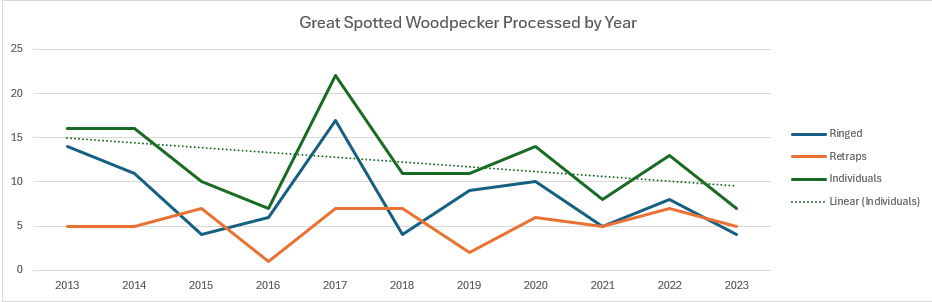
Immediately, though, it was suggested that the putative surge in GSW numbers, which Alex attributes to garden bird feeding, is helping to drive their extinction. It is a fact that garden use by Great Spotted Woodpecker has increased over time: as it has for many species. That doesn’t mean that garden bird feeding is responsible for the increase in their population overall. When I look at my ringing returns for the Braydon Forest, I get the following:
Graph 1: Great Spotted Woodpecker Processed by Year in the Braydon Forest
This shows clearly that there has been a 30% decrease in the number of individuals processed each year in the Braydon Forest. When I take out any effort bias from the results, by taking the number of individuals caught per year and dividing it by the number of sessions carried out per year, the results are very similar:
Graph 2: Great Spotted Woodpecker Processed by Session by Year in the Braydon Forest
This shows that the catch has declined by from 0.23 per session to 0.15 per session over the 11 years. Again, there is no massive increase. Perhaps it means that, after their increase from the mid-seventies, they have reached the carrying capacity of the environment? Indeed, one graph shared with me by Alex showed that nationally the GSW population has been stable, after growing during the 1970’s, due to the increased availability of insect food and nest sites as a result of Dutch Elm Disease. (Marchant et al, 2009). The BTO BirdFacts page also ascribes, amongst other things, the exploitation of garden feeding as having helped their expansion. However, looking at the trend chart for garden use by Great Spotted Woodpecker over the last 20 years, from the Garden Birdwatch data exploration site, there is variability throughout the year, with a peak in early autumn, but the overall trend peaked in 2011 and has slowly declined since. (https://www.bto.org/our-science/projects/gbw/results/long-term-patterns)
In this month’s British Birds there is a superb article: “The rapid extinction of Willow Tit in a post-industrial landscape” by Geoff Carr, Jeff Lunn and Sophie Pinder. British Birds, volume 117, pp 195-202.
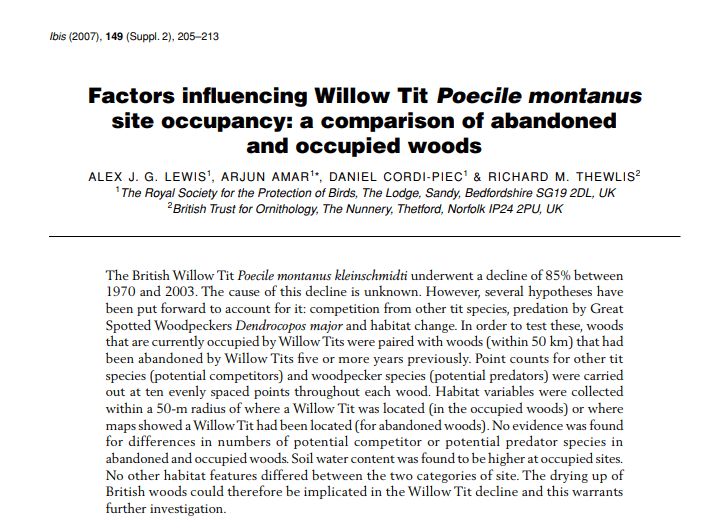
The element of uncertainty on the cause of the extinction they report on is well worth the read. However, pre-dating all of the speculation about causes is this paper from 2007:
This says quite clearly that there was no difference in competitor density or predator density, including GSW, between occupied woodland and woodland where they have become extinct – but there were significant habitat differences. This is an objective study using direct measurements and coming to a clear conclusion.
In my conclusion: on the one hand some academics are bemoaning garden bird feeding for killing birds by spreading infections and then, on the other hand, blaming it for increasing populations of some species of birds to the detriment of others. Some of them hold both positions at the same time. It is hard to know what the truth is without some very targetted studies, like the one referenced above.
I can think of better reasons for the increase in the number of Blue Tits in gardens: so many people now seem to be providing nest boxes. Not only do they have more secure places to breed, there is a handy supply of food nearby. However, as previously stated, my own data shows a slight decline in Blue Tit numbers ringed, retrapped and individuals over the last 11 years and very few movements of any significance. In fact, the same BTO GBW data that I have linked to regarding Great Spotted Woodpeckers shows a reduction in the use of gardens by Blue Tits over the last 20 years. It is hard to imagine that Blue Tits that show little inclination to move any great distance within the Braydon Forest can be severely impacting other species. What the truth is, I have no idea, which is why I am not being dogmatic about it: I am asking for better science, so we can understand what is going on, and take informed action to protect more vulnerable species.
A pretty good month, despite the rain. We managed to get out a lot more often this March than last, but the catches were considerably smaller overall. The main difference was in the number of retrapped birds: averaging at 9.2 per session this year and 14.4 last. However, we did catch seven more species than last March.
Added to the catch this March were: Cetti’s Warbler, Firecrest, Grey Wagtail, Kingfisher, Meadow Pipit, Mute Swan, Siskin and Yellowhammer. Missing from last year’s catch was Bullfinch.
Highlights for the month were: Andy had a particularly good month with a Firecrest and three Grey Wagtails on the same day at one of his sites near Warminster. Jonny had a close encounter with a Mute Swan, ringed in July 2015 and recaptured, eight and a half years later, a whole 4km from where it was ringed, at Langford Lakes. Jonny started at another new farmland site, south of Sherston, and had an excellent catch of 55 birds, which included 12 of the Linnets and all 17 of the Yellowhammers. It looks like another cracking site.
Whilst my garden did play host to a couple of Siskin it has just been too windy to set nets. That did not apply to Andy, with 16 of them being caught in his back garden. Ian and Ellie also each had singleton back garden catches and Jonny caught another at Langford Lakes. Ian also had the pleasure of the entirety of the Lesser Redpoll catch in his back garden.
My highlights for the month, as blogged about on Saturday, were the first Willow Warblers ever caught in March at Lower Moor Farm and the second earliest captures of Blackcap at that site (the earliest was on the 23rd March 2019).
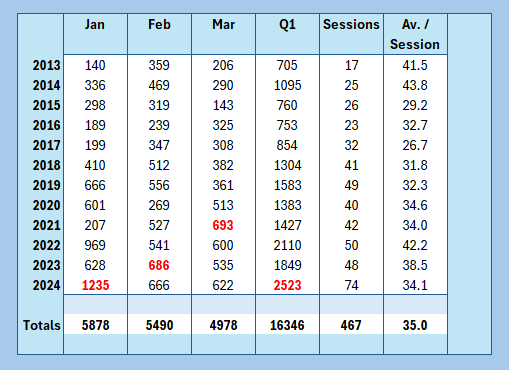
Apart from the individual month’s activity: Q1 2024 has been quite remarkable, despite what has seemed to be the wettest, windiest Q1 I can remember:
In absolute numbers it is far and away our best Q1 since the group came into its current structure. The foundation was clearly that remarkable January. However, the average is just below the overall average. When I graph the averages the trend line (the blue dotted line) is dead flat at 35 birds per session:
So our increased efforts have produced increased numbers over the years, but the catches are still evened out over that time.






 Ringing In The Braydon Forest & Beyond