Despite this month apparently being the wettest February on record, we did have a pretty decent month. For those who are religious or superstitious, look away now: we processed 666 birds: the number of the feathery beast!
So, despite the rain we did manage to fit in a couple more sessions than last year, and it was our second best February, with last year’s being our best. We ringed fewer birds from the same number of species as in 2023, and retrapped more birds from the same number of species than we did in 2023, but we managed to process two more species than we did in 2023. How did that work out? The following species were caught and processed this year but not in 2023: Jay, Meadow Pipit, Siskin, Skylark, Starling, Stonechat, Tree Sparrow and Yellowhammer. Missing from the catch this year were Barn Owl and Buzzard – but they were ringed in the Oak & Furrows Rehabilitation Centre, Blackcap, Kingfisher and Treecreeper.
Highlights of the month have to be the Skylark: Andy spent four hours at his new site and caught one bird: but it was a Skylark! I admire his patience: I packed up after seven birds in three hours on Wednesday! Mind, we weren’t catching anything as good as that and it did start to rain as I finished putting stuff in the car. I have just circulated the recovery report on Ian’s Lesser Redpoll recovery: a great garden find. I would love to catch eight Lesser Redpoll in my garden! In fact, I would love to catch one: I have caught Siskin but never Lesser Redpoll in my garden. My garden did deliver this month’s Starlings: one of which was a bird ringed as an adult six years ago. The real highlights for me this month was the session held at Blakehill Farm on the 10th of the month: 22 Meadow Pipit and 2 Stonechat. These are the only two Stonechat ever caught by the group in February. A nice catch of Yellowhammer: our second best ever February for them, the best being on 2018. Particularly nice about it is that the bulk of them came from three new sites.
This won’t take long! I shifted the start time to 6:30 for today, to get the nets at Somerford Common open before it got light (it is only six nets). I knew it would just be Teresa and me for the bulk of the session, with Rosie doing her usual of helping set up, and hoping to ring a couple of birds before heading off to work.
The forecast was for it to start raining at midday. Anyway, I had topped up the feeders on Friday. It is a big 4 litre seed feeder and a 1.5 litre peanut feeder, both were empty first thing, which we cleaned out, refilled, opened the nets and then waited for the birds to arrive – and waited, and waited some more. We caught two Blue Tits, that Rosie and Teresa ringed before Rosie had to leave. In the next hour-and-a-half we caught just another five birds: one at a time. At 10:15 I decided that “enough is enough” and we closed the nets and took down. Just as I finished stowing the equipment into the car it started to rain!
An entirely appropriate end to a rubbish session! We caught the following: Blue Tit 2(1); Great Tit 1; Coal Tit (2); Long-tailed Tit (1). Totals: 3 birds ringed from 2 species and 4 birds retrapped from 3 species, making 7 birds processed from 4 species (not the most difficult maths I have ever had to do!).
Actually, there was one genuine highlight: at 8:30 a Stoat ran across the path, just a few feet away from our ringing station! I have seen the Somerford Common Wallaby more times (3) than I have seen a Stoat there (1)! Fabulous creatures!
It has been nearly two months since I have been able to set the nets in my garden. On that day I could only keep the nets open for 45 minutes before it became untenable. Unfortunately, there is a bit of a wind tunnel formed by the gap between the house and the detached garage and any breeze over about 5mph makes opening the nets untenable. With the forecast for it be a low wind of between 2 and 3mph until mid-morning, I opened the nets at 7:30 and was able to keep them open until just after 10:00. It did start to get breezy at 9:30, which meant the birds were made aware of the nets and could avoid them, so I only caught a couple of birds in the last 45 minutes.
Anyway, the thing that has been missing from my woodland catches are finches, with the exception of Chaffinch. I have had no Siskin or Greenfinch and just two Goldfinch and Lesser Redpoll since the start of 2024. With the strong showing of Greenfinch in the garden, with a maximum of 17 on one memorable occasion at the beginning of February, and regular counts of seven to nine birds coming to the feeders, they were my target for this morning. One point I would like to make, I have not seen a single Greenfinch showing any signs of ill-health in my garden for over 5 years now. I am hopeful that I never will again.
I fully expected to catch a few Goldfinch as well, as they are perhaps the most regular visitors to our garden. They didn’t let me down. The first round produced four Goldfinch and two Starlings. Thereafter I caught mainly singles of the three species that I caught this morning: Greenfinch 3; Goldfinch 9; Starling 3(1). Totals: 15 birds ringed from 3 species and 1 retrap, making 16 birds processed from 3 species.
I think I am going to have to move the nets: it would seem that the birds have learnt not only the locations but the best way to avoid them when approaching the feeders. I did have a couple of escapes from the nets: a Woodpigeon, two Blackbirds and two Starlings. Apart from that, there were at least six Greenfinch that kept flying up to the nets and then turning away, a similar number of Goldfinch, plus a pair of Chaffinch, a pair of Great Tit and a couple of Blue Tits. They might have been a pair but, as I didn’t catch them and they are sexually monomorphic, I couldn’t sex them, whereas I have deliberately used the term “pair” for the Chaffinches and Great Tits. My first catch of Goldfinch actually comprised two each of males and females: who knows? The Jackdaws also stayed well away from the nets. Once I closed the nets they all dropped in to help themselves to the sunflower hearts, fat balls, peanuts, minced peanuts and lard and mealworms, almost immediately.
Although I only caught one retrapped bird: it was a female Starling, LJ52352, that I ringed as an adult on the 12th April 2018. That is a pretty good age. This is the second time she has been retrapped: the previous time was in May 2020. Mind, the longevity record for Starling is 17 years 7 months and 25 days – so she has a way to go before getting there!
So, whilst I haven’t been able to get the nets open as often as I would like, I have had the trail camera out fairly regularly. There has been a couple of fairly rubbish Fox photos, but some lovely film of Hedgehogs:
It would seem that our Hedgehogs have not actually hibernated this year. Their feeding area has been moved into a hedgehog house, as I am not keen on feeding the neighbourhood cats! Interestingly, we did also get badgers in the garden, but they seem to have disappeared in recent times. There has been no culling local to me, so I hope it is a temporary absence. I still have some lovely film though:
This morning was my regular winter ringing demonstration for the Swindon Wildlife Group (SWG). We do move it around: we have done it at both Somerford Common sites and at Lower Moor Farm over the years, but today’s was scheduled for Ravensroost Wood, where we originated these regular twice yearly demonstrations. The forecast had bounced around all week, with various degrees of rain forecast, until yesterday it dropped to between 5% and 20% over the hours scheduled for the event. Fortunately, whilst we did have half-an-hour of spitting rain, it cleared quickly. Something that surprised all of us: frost on our cars and a temperature starting out at -2oC first thing. Fortunately, it soon warmed up a bit.
I was joined at 7:00 by Ellie, Rosie, David, Adam and Laura, Teresa and Andy. The team were aware that their role would largely be to keep checking the nets and extracting the birds whilst I sat and ringed the birds and explained to the attendees what the ringing scheme involves and demonstrating the work. Andy and Laura helped out scribing for me when not off extracting birds. We set the following nets:
The attendees arrived for 8:30, my having persuaded the SWG that it would improve the experience for their members. We had a nice first round to get everybody’s interest, at 8:15: the obligatory Blue and Great Tits but, also, a Coal Tit, a Robin, a Wren and, to everybody’s delight, a Nuthatch.
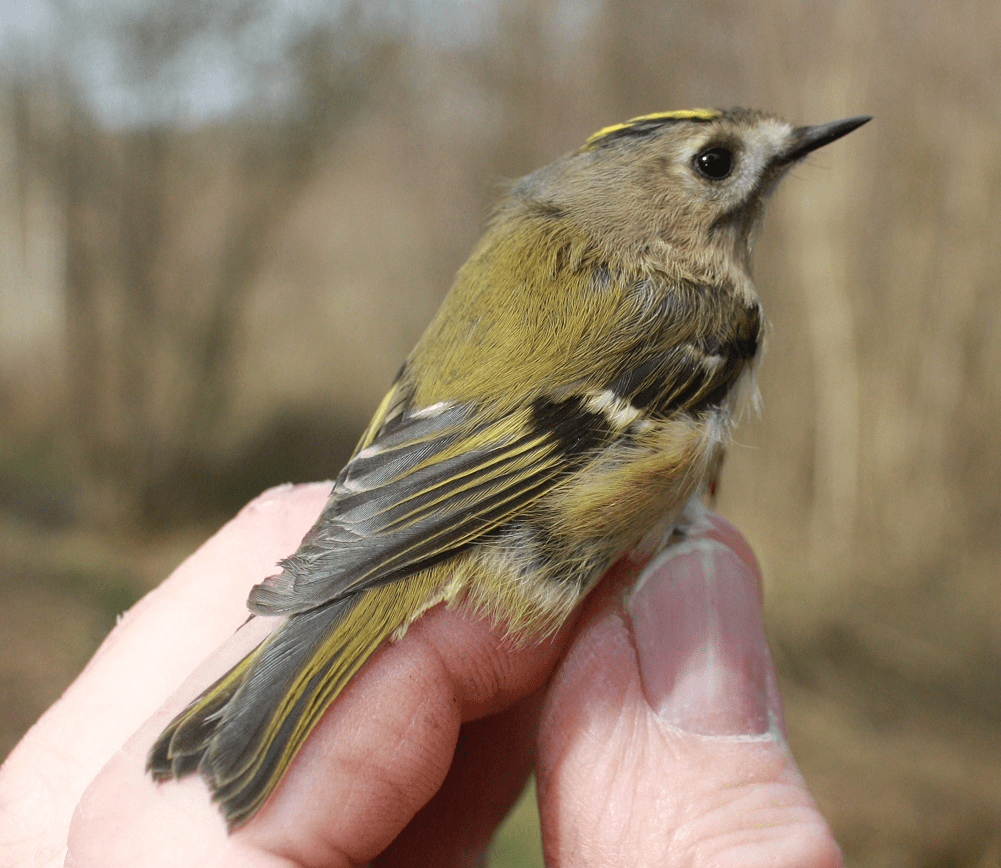
We carried out a further ten rounds over the next 2.5 hours and caught steadily throughout the morning. It wasn’t the most exciting catch, in that we didn’t catch a single finch. It seems that our usual Spring Lesser Redpoll and Siskin, plus our occasional Brambling, have already moved through, presumably in response to the awful weather we have been having. The bird that gave every attendee that “Aah!” moment was the single Goldcrest we caught in the session:
First winter, female Goldcrest, Regulus regulus
As usual with these demonstrations, I taught a few people, mainly the children, but some adults as well, how to safely hold and release a wild bird or, as I like to preface it, “Who wants to be bitten by a Blue Tit?”. If they are up for that then I will let them do the same with a less feisty species. I will also hold one example of each species for a few seconds after processing, so that people can get some photographs. It is never more than 30 seconds.
The list for the morning was: Nuthatch (2); Blue Tit 10(8); Great Tit 4(8); Coal Tit 2(2); Wren 1(1); Robin (2); Goldcrest 1. Totals: 18 birds ringed from 5 species and 23 birds retrapped from 6 species, making 41 birds processed from 7 species. I was a little disappointed not to have any Marsh Tit in the catch. It is unusual not to catch them at this site and Robin Griffiths, the SWG event organiser and volunteer warden for Ravensroost Wood, did say that he had seen several around in the last week or so, including a few who have not yet been ringed. That’s a target for me and the team, to get them on board.
Alongside the birds caught this morning, we did see a couple of Great Spotted Woodpecker flying around in the vicinity of the feeding station but they weren’t tempted down by the peanuts, for once, and stayed high up in the tree tops.
The best bird sighting though, by far, was a Sparrowhawk displaying over the woods, spiralling up and around in the sky, whilst being mobbed by a flock of irritated Jackdaws. It was a lovely spectacle.
Towards the end of the session, one of the attendees came across with this in her hands:
Scarlet Elf Cap, Sarcoscypha austriaca
Not my best ever photo, and it is a bit nibbled, but lovely to see.
It was quite a cold morning and, with children and some elderly people at the session, the attendees were getting chilled and started to leave at about 10:45. We closed the nets at 11:15 and took down, leaving the site by midday.
Epilogue:
They say that bad things come in threes and I hope that is correct because the following has happened to me in the last two days. Yesterday morning I went out to top up the bird feeders I have to provide supplementary feeding to the birds in my local woodlands. The first port of call was Webb’s Wood. On arrival I was met by one of the regular dog walkers, with whom I always have a chat. He told me that he hadn’t seen my feeders on his walk. They are fairly well hidden within the wood but not invisible. Sure enough, when I arrived they have been stolen. I have been feeding in these woods since winter 2009 / 2010 and this is only the second time that I have had feeders stolen. The previous time was at Somerford Common back in 2014. What possesses somebody to do that? Are they really that desperate?
We met this morning for the ringing demonstration, which will form the bulk of this post. However, we had three groups setting up the nets, and one of them decided it would be a really good idea to put their guy rope across the entrance to the main ride. Muggins here, not noticing, stepped backwards and was tripped and fell on my back into what can only be described as a marsh. I was soaked and totally covered in mud and seriously unamused. I knew I couldn’t stay like that for the morning but home is only just over 5 minutes away, so I left the team to finish setting up and drove home to change. Having changed, I pulled out of my drive to head back to site when a Porsche Cayenne, the 4X4 for people with too much money and no spatial awareness, smacked into my wing mirror, knocking off my indicator cover and displacing the structure. The only good thing is that his wing mirror was completely smashed off. Needless to say, he didn’t stop. Anyway, that is three things I could have well done without: let’s hope things take a turn for the better.
What has inspired this post are some comments made by reviewers of a paper, of which I am a co-author (essentially, I provided the data and Dr Will Jones the analysis), submitted for publication. The reviewers were generally positive but raised a few questions which we are addressing. However, this had me reviewing the data I have provided for the paper, and then looking beyond. This analysis is outside of the scope of our submitted paper, so there is no conflict with that potential publication.
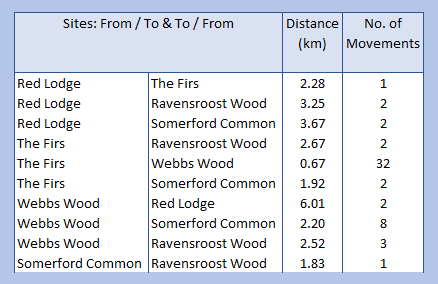
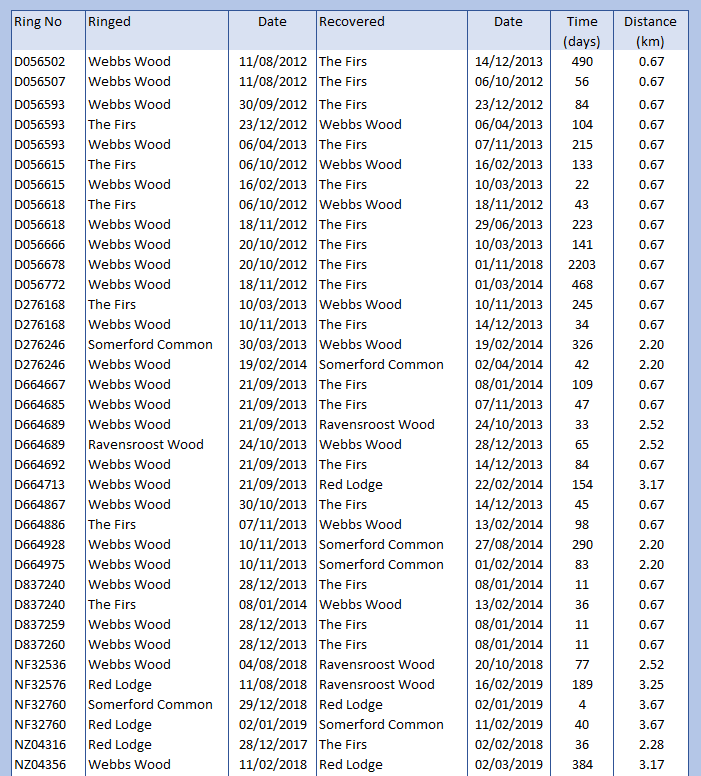
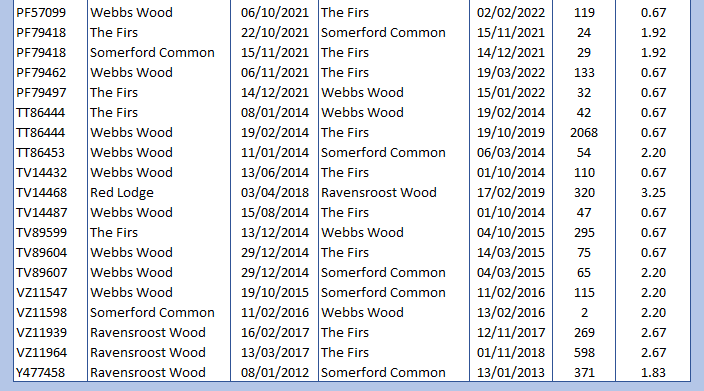
The first thing that struck me was that one reviewer picked up on the fact that my ringing team have the record for the second longest movement of a Blue Tit within the UK. This bird, ring number AVF6109, was ringed at Fort Augustus in Highland on the 31st December 2019 and recovered by us on the 9th January 2022 in Ravensroost Wood: a distance of 639km in 740 days. From this the reviewer questioned the frequency of movements of Blue Tits in and out of the Braydon Forest. To investigate this further, I have done an analysis of Blue Tits ringed in the Braydon Forest and retrapped in other parts of the Forest, to get an idea of the movements within the area. In addition, I have also analysed the movements into the Forest from outside, and from within the Forest out to other sites. Obviously the last of these is dependent on us receiving recovery reports of Blue Tits we have ringed being caught or found elsewhere. The vast majority of the movements are within the Braydon Forest. I have counted all movements, including several where the bird moved from one site to another and then back again. Between 1st January 2013 and 31st December 2023 there were 70 movements within the Forest, i.e. 6.3 movements per year. However, 56.5% of those were movements between the Firs and Webb’s Wood and vice versa: a distance of less than 1km between two woodlands separated by a road (Wood Lane).
Table 1: Summary of Blue Tit Movements in and around the Braydon Forest
Table 2: Detailed movements of Blue Tits in and around the Braydon Forest
In addition to these movements we have had, in 11 years, just three records of recoveries of birds that have been ringed in the Braydon Forest and recovered elsewhere: one at one of my other sites: Lower Moor Farm, one in the nearby village of Brinkworth, and the other at the nearby town of Royal Wootton Bassett:
Table 3: Detailed movements of Blue Tits out of the Braydon Forest
The Brinkworth bird is the only one that was recovered dead, the other two were retrapped by my team (Lower Moor Farm) and the North Wilts Group.
As for birds moving into the Braydon Forest: as well as the aforementioned Scottish bird, we have just three other records of birds that we have retrapped in our nets that were ringed outside of the Braydon Forest and recovered within it:
Table 4: Detailed movements of Blue Tits into the Braydon Forest
To put this into perspective: over this same period of 11 years we have ringed 4,787 Blue Tits. The number of recoveries within the Forest represent less that 1.5% of the total number of birds ringed within it, and less than 5.9% of all recaptured birds: i.e. 94.1% of retrapped birds are recaptured in the same part of the Forest as they were ringed in. If we look at movements greater than one kilometre the figures become even more reduced: less than 2.6% of all recaptured birds outside of those moving between the Firs and Webb’s Wood have been caught away from the site at which they were ringed. Those birds moving into or out of the Forest do not really warrant any sort of percentage allocation.
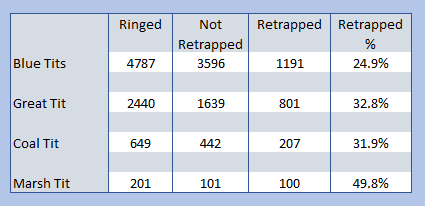
One other question that always arises is the validity of the recapture data that we have. I have calculated the number of birds ringed, the number of individuals that are not recaptured and the number of those individuals that are recaptured. This I have done for each of the four species of Paridae in the Forest:
Table 5: Numbers of Paridae Processed in the Braydon Forest
The retrapped proportion is the number of individual birds that have been retrapped, divided by the total number ringed. Each retrapped bird has been counted only once, no matter how many times it has been recaptured. I think that it is important to note the proposed mortalities of these species. The key example is the one with the most data, the Blue Tit. Do we recapture fewer Blue Tits because they move on elsewhere after ringing? We are getting virtually no evidence of this from ringing recoveries. Is it because so many of them are dying? According to the data accumulated and presented in the BTO’s BirdFacts analysis, first year mortality in Blue Tits is in the region of 62%, as is the case with Great Tits. Adult mortality in Blue Tits is typically 47% year on year: adult males have lower mortality at 49%, with adult females at 58%, so there is a considerable die-off which must impact on recapture rates.
Marsh Tits are known to be the most sedentary of the species, so the highest recapture rate is not surprising. What this data doesn’t tell us is what influences the level of the recaptures. There is not enough data on Coal Tits to be able to provide an estimate and Marsh Tits apparently have a first year mortality of rate of 81%! If that is the case, it is no wonder that they are a red-listed species. Anyway, the paper that we are working on is looking into mortality rates of the titmice in the Braydon Forest, so I will say no more about that in this blog.
What I will say is that I have carried out an evaluation of the movements of the other three species in and around the Braydon Forest. The Great Tit is the only other species that shows any significant movements:
Table 6: Summary of Great Tit Movements in and around the Braydon Forest
Just like the Blue Tits, the movements between the Firs and Webb’s Wood and the reverse are far and away the biggest proportion: 58.2% of all movements. The number of Great Tits moving more than once between sites is actually higher than in Blue Tits, with 10 of them doing so, compared to just three Blue Tits. One of them, D056593, is quite peripatetic: Webb’s Wood to the Firs to Webb’s Wood to the Firs.
Table 7: Detailed movements of Great Tits in and around the Braydon Forest
There were just two movements into the Forest:
Table 8: Detailed movements of Great Tits into the Braydon Forest
We have had just one reported recovery from outside of the Forest:
Table 9: Detailed movements of Great Tits out of the Braydon Forest
Coal Tit movements are very few and far between:
Table 10: Detailed movements of Coal Tits in and around the Braydon Forest
And, somewhat unsurprisingly, Marsh Tits have even fewer:
Table 11: Detailed movements of Marsh Tits in and around the Braydon Forest
We have absolutely no records of any movements into or out of the Braydon Forest for either of these two species.
As you can probably guess, I didn’t get out to do any ringing this weekend due to illness. I am not sure that this helped with the crippling headaches that kept hitting me, but it passed the time in between.
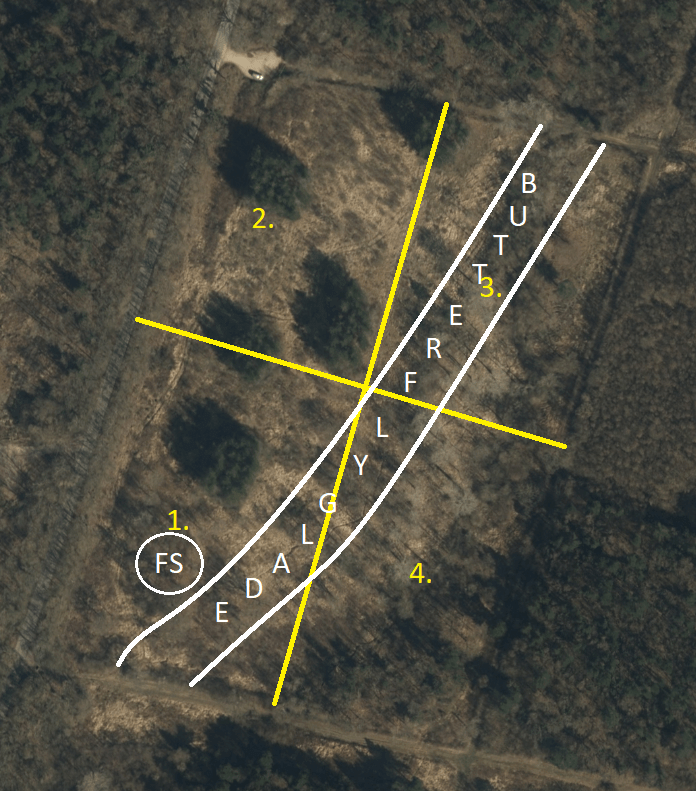
My winter ringing site at Somerford Common is set up in one quarter of a paddock area, a large chunk of which is being managed as a butterfly glade, in concert with Butterfly Conservation, for the benefit of the Marsh Fritillary butterfly (which ties in nicely with the Marsh Tit being their priority bird species in the Braydon Forest), and the area also happens to be an area where Brown Hairstreak butterflies are found and known to be breeding. The paddock is sub-divided into four sections, with one section having its brush mulched every other year on an eight year cycle.
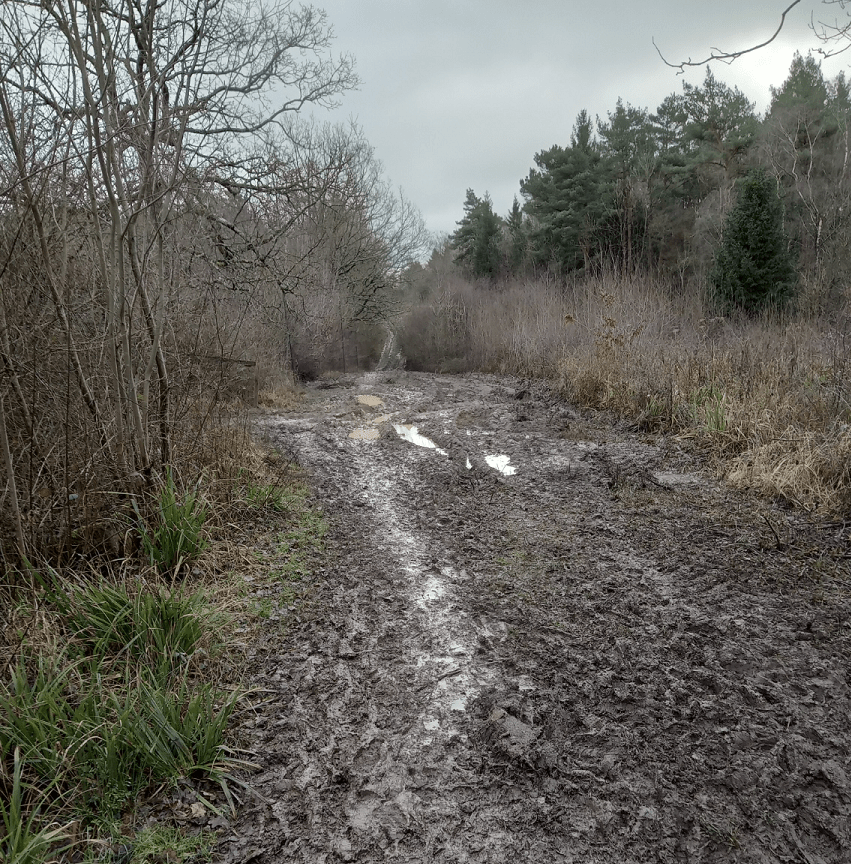
Section 1 is where our feeding station is set up during the winter months: it also happened to be the last section mulched two years ago. On Wednesday I went and topped up the feeding station and saw that section 2 was in the process of being mulched. The noise was significant, and I didn’t think it would be conducive to ringing there on Friday, as I had arranged. However, they did look like they were getting on with it, so I went back on Thursday and was pleased to find that they had finished. I went to check on the feeders and was rather less pleased to find the state of the main path: hence the reason for the punning title to this piece. They had clearly brought some very heavy machinery in through this end of the paddock to collect up the brush. I don’t quite understand why: there was an access point from the main carpark to the north of section 2. Whatever they brought through left astonishingly deep ruts and massive pools of mud and water, exacerbated by heavy overnight rain last night.
It doesn’t look too bad from here but:
The whole area was like that, apart from immediately around our feeding station and our ringing station. That was still pretty mucky but solid enough to set up the tables and chairs on. Anyway, I warned everybody to bring wellies and be prepared to get very mucky. I was joined by Rosie, Miranda, Teresa & Andy, Laura with Adam & Daniel and, coming for a taster session for the first time, Sarah. We met at 7:00 and set the usual six nets. Birds started arriving before we had the nets fully open: we are going to have to go to 6:30 starts from next week!
It was a good, regular catch. Unfortunately, not a lot of variety. As it is the time of year when we most often see and catch them, I had been hoping that we might see the odd Lesser Redpoll or Siskin, but we didn’t. Well, not until after we had closed the nets and taken down at the end of the session when a small flock of Siskin flew through! Next time!!! We did have a decent haul of Chaffinches and a Nuthatch but, apart from that, and a retrapped Robin as the last bird out of the nets, it was Paridae all the way!
The list for the day was: Nuthatch 1; Blue Tit 22(5); Great Tit 4(13); Coal Tit 3(1); Marsh Tit (3); Robin (1); Chaffinch 4(1). Totals: 34 birds ringed from 5 species and 24 birds retrapped from 6 species, making 58 birds processed from 7 species.
It was lovely to have five Chaffinches, with none showing any signs of disease of their legs, either mites or FPV. Four of the Chaffinch were males, with a solitary female.
Unfortunately, the breeze got up quite strongly at 10:30 and, in the interests of bird safety, we shut the nets and took down. Everything was cleared away and we were ready to leave site by 11:30. Sarah, Andy, Teresa and I started chatting and we finally left at just gone midday. It was a good session.
The ringing recovery maps and tables for birds moving further than 50km received last year have been updated on the relevant pages. I was going to say “from last year” but some were somewhat tardy in being entered up into the national database.
Pages updated were Resident Birds with Blackbird added plus additional movements for Blue Tit and Goldfinch. Warbler Recoveries for additional recoveries of Chiffchaff, Reed Warbler and Sedge Warbler. Wader movements were updated with the Curlew ringed at Blakehill in April and then spotted on the Exe estuary in the late autumn.
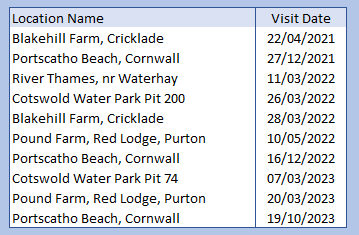
Not mapped on the Curlew map is the complete movement history of FJ18913. This is the table of its reported movements since it was ringed at Blakehill Farm on the 22nd April 2021:
It is clear that it is faithful to Blakehill Farm in the breeding season and Portscatho Beach for the winter.
The only time that this bird has been handled was when it was ringed: all of the other sightings have been made possible by the left leg flag it has with the letters EA visible through binoculars or a telescope.
One of the more labour intensive aspects of bird ringing is the Constant Effort Site project. This requires 12 sessions to be run, approximately 10 days apart, with the same number of nets, set in the same places, for the same length of time on each occasion. The report that you can read from the link below is the preliminary result of last year’s efforts across the country:
Having been confined to woodlands for the last few weeks, it was delightful to be able to get out to the wide open spaces of the plateau of Blakehill Farm! I was joined for the session by Justine and, delightfully, because I wasn’t expecting to see them Rosie arrived with Tanya. Tanya was a colleague of Rosie’s at the Wiltshire Wildlife Trust and came out ringing with me until she moved to a new job up in Shropshire. It was lovely to have her company again. They were with us from just after 7:00, but had to leave at 10:30 as they had other arrangements made. We met at the Chelworth Industrial Estate side of Blakehill Farm. The hedgerow on that side of the farm is currently undergoing a significant piece of maintenance: the hedge is being laid. It has just reached halfway through my usual ringing area and I will probably not make use of it there until there is a bit of regrowth. However, this work has been ongoing for a few years, until it was decided last year that it had to be completed by the end of 2024, which has sped up the process. That means that there is a considerable stretch that has been laid for a few years and I will spend some sessions this year looking at how that is being used by the local birdlife.
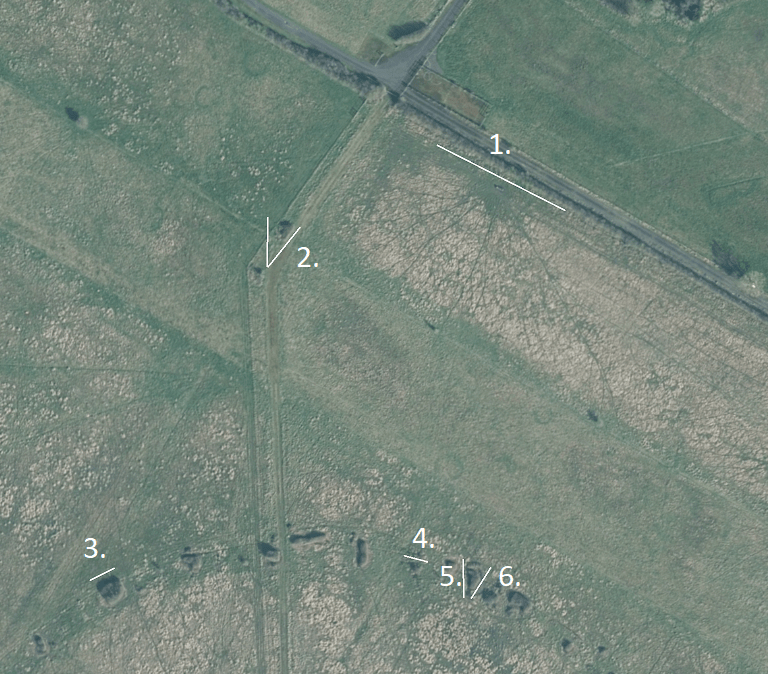
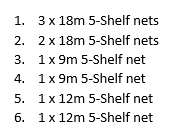
As of 10:00pm Friday night, the weather forecast was for it to be dry all day, with a breeze coming from the south-south-east as the morning progressed. Suffice to say, we had a few drops of rain whilst setting up the nets and until 8:00. To be fair, the forecast had changed overnight, but what is the point of a forecast which is, essentially, looking out the window and saying what you see. We set the following nets:
Net set 1. was set up along the plateau side of the hedgerow, on the basis of the forecast wind direction. More about this later!
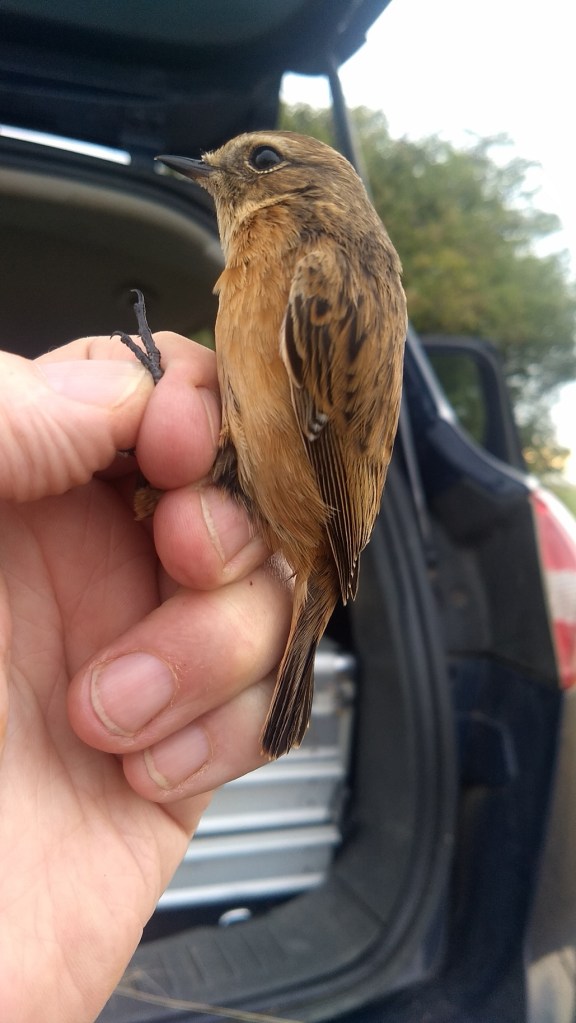
After the over-abundance of Blue and Great Tits in all of our recent woodland sessions, I did say to Justine that I would love a couple of Stonechat today and that I would happily pack up if we were that lucky. Well our first round produced: two Stonechat, adult male and female, a Meadow Pipit and two Reed Buntings! I am delighted with that catch. To put that into perspective: we had only caught and ringed 33 Stonechat before today and we have never caught them this side of Christmas: all bar one had been caught in the September to November period.
Male Stonechat, Saxicola rubicola
Female Stonechat, S. rubicola
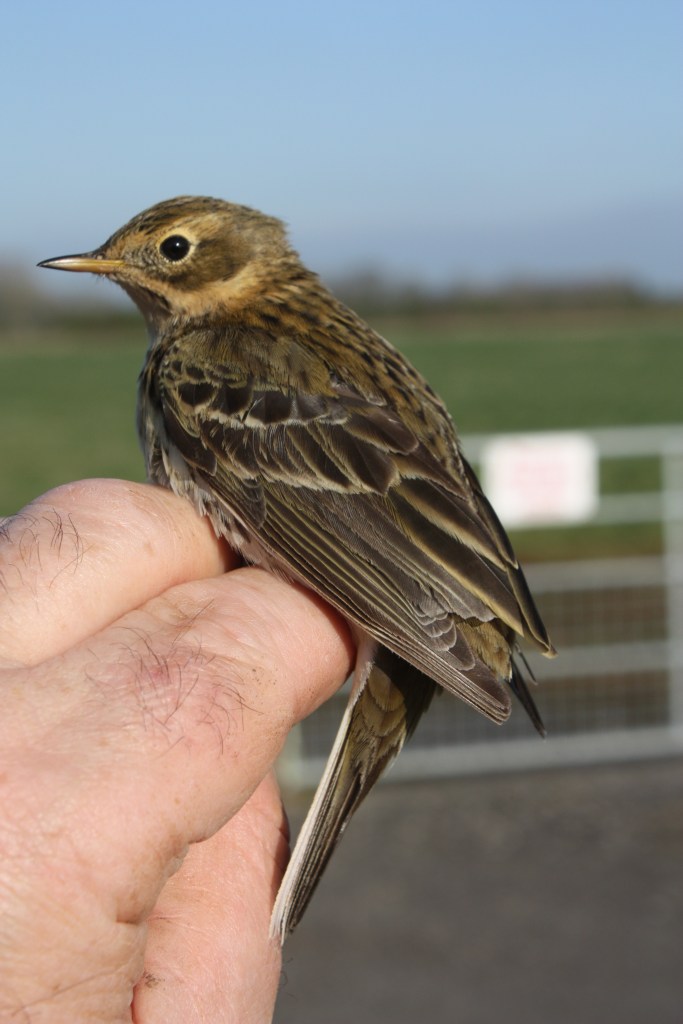
As for Meadow Pipits, we haven’t caught any in February since 2017, and that was two birds, so I was very pleasantly surprised to have this one.
Meadow Pipit, Anthus pratensis
Similarly, the last time we caught Reed Bunting in February was also back in 2017. Was this an auspicious start?
Well, the next four rounds produced another couple each of Meadow Pipit and Reed Bunting plus a Great Tit and a retrapped Wren. That was when Rosie and Tanya had to leave. They were both very happy: Rosie had her second ever Stonechat and Tanya her first. Tanya had her first Reed Bunting working with me, but she might have done a few with her current ringing group.
So, the next round after Tanya and Rosie left we were astonished: 17 birds. Our solitary Blue Tit of the day, another Reed Bunting and another 15 Meadow Pipits. That was astonishing: we have never had a catch of Meadow Pipit like that outside of the autumn passage. The breeze had started to get up and, disappointingly, it was a straight westerly wind: opposite to what was forecast. As a result, net ride 1 ended up with two of the three nets embedded in Blackthorn. The central net was absolutely the worst, and I had to cut the net out, taking a rather large number of off-cuts of Blackthorn with it. My good lady wife spent this afternoon going through that net, metre by metre, snipping out the Blackthorn twigs for me. That is love, whichever way you look at it!
We closed all of the nets at midday, extracting the last three Meadow Pipits of the day, ready to take down.
The list for the day was: Blue Tit 1; Great Tit 1; Wren (1); Meadow Pipit 21; Stonechat 2; Reed Bunting 4(1). Totals: 29 birds ringed from 5 species and 2 birds retrapped from 2 species, making 31 birds processed from 6 species.
Extracting net ride 1 took up a lot of time so, by the time we had extracted and packed up all of the nets and the ringing station, it was close to a 14:00 finish.
Whilst we were working we were treated to a number of excellent birding sites: we had a great catch of Meadow Pipits but there must have been well over 50 of them flying around. Alongside them, flying about on the plateau, were at least 30 Skylarks. When the sun came out the males were up and singing: you could almost believe it was Spring! But then, there were very large flocks of Starling flying around. As Justine described them “a murm” – not big enough to be a murmuration but still quite impressive (cue a morning of appalling puns between us). There were Fieldfare in evidence but no sign of Redwing. A Snipe flew through and we had both Red Kite and Buzzard flying around the site. All in all, it was a thoroughly enjoyable morning, despite the best endeavours of the weather forecasters and the Blackthorn, to sour my mood!










 Ringing In The Braydon Forest & Beyond