A Tale of Two Overseas Recoveries

Like many ringers we are excited by having our birds recovered elsewhere by other ringers: getting feedback on where they have gone and how long they have survived since we ringed / last retrapped them. The reports do not provide biometrics, so we cannot get an idea of condition. It is particularly interesting when those birds are recovered overseas. Naturally, the reverse is also true.

It is not something that we are lucky enough to get lots of reports of, so special when we do. Since 2013 we have had only two Chiffchaff recovered in foreign climes. They were: JAB143, ringed at Lower Moor Farm on the 27th July 2015, recovered 1,082 km and 80 days later on the 10th October 2015 at Laguna de Negrillas, Leon, Spain and NTR658, ringed at Bowerhill, Melksham on the 7th October 2021, recovered 1,601 km and 49 days later on the 25th November 2021 at Herdade dos Forninhos, Beja, Portugal.

Equally, we have had just two overseas recoveries of Reed Warbler ringed at one of our sites and recovered overseas. They were AFZ6828, ringed at Langford Lakes Nature Reserve on the 15th August 2022 and recovered 582 km and 13 days later at Etang de Mercanay, Larrey, France and AFZ6572, also ringed at Langford Lakes, on the 29th July 2022 and recovered 409 km and 380 days later at Noyant, Soulaire-et-Bourg, Maine-et-Loire, France.

On the 11th August 2023, at one of his farmland sites near Hilmarton, Jonny Cooper had a pretty decent session (when does he not have good sessions?). He caught and processed: Blue Tit 4(1); Great Tit 1; Wren 5; Dunnock 1; Robin 2; Reed Warbler 2; Sedge Warbler 2; Blackcap 1; Garden Warbler 1; Whitethroat 8; Lesser Whitethroat 3; Chiffchaff 14; Willow Warbler 5; Greenfinch 1; Goldfinch 2. Totals: 52 birds ringed from 15 species and 1 retrapped bird, making 53 birds processed from 15 species.

From that little group we have had three recovery reports: two for Chiffchaff and one for Reed Warbler. I am pretty sure that we haven’t ever had one session produce three recovery reports before. Of the three recoveries, two were overseas movements and one of the Chiffchaffs looks as though it did a reverse migration movement and spent the winter in the Midlands.

The possibly confused Chiffchaff, PRD121, was recaptured 69 km and 171 days later at Lower Moor Sewage Works (not to be confused with my Lower Moor Farm site) in Worcestershire on the 29th January 2024.

However, the stars of this report are Chiffchaff, PRD112, and Reed Warbler, BAC3964. The Chiffchaff was recovered 1519 km and 113 days later on the 2nd December 2023 at Quinta da Atalaia, Setubal, Portugal and the Reed Warbler was recovered 670 km and 18 days later at Chenal, Charente Maritime, France on the 29th August 2023. So, compared to what we have had in the past, this was a pretty special result. I am sure it would be old hat to the observatories and sites that are migration hot spots, but that doesn’t apply to our sites in north west Wiltshire.

Thanks to Google Earth for the base images.
A Moving Marsh Tit Story: AAL0191

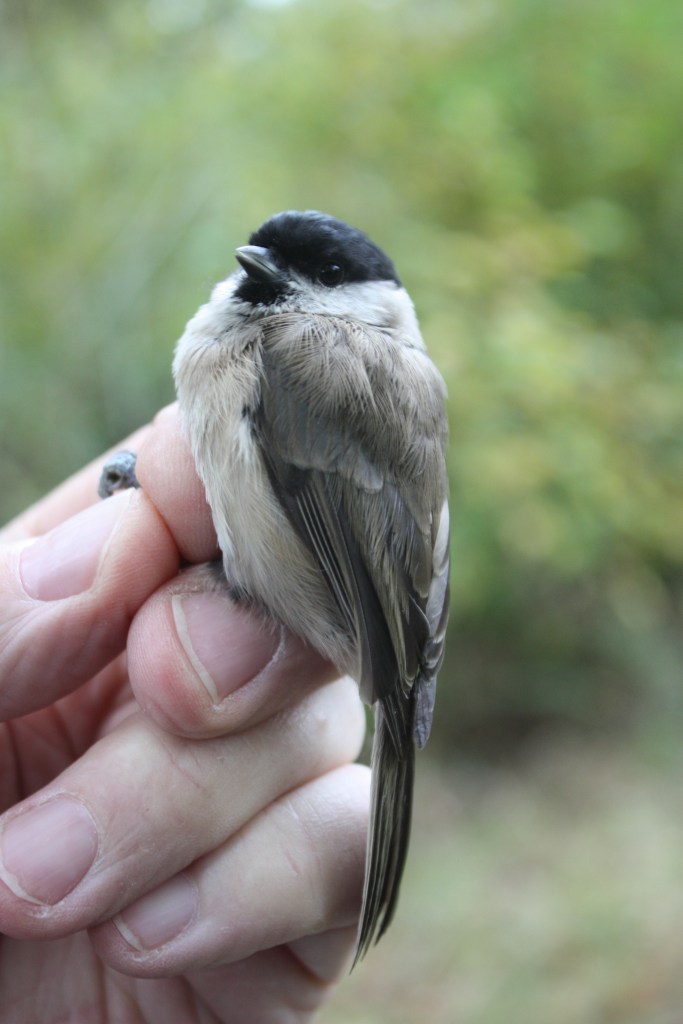
Marsh Tit, Poecile palustris

As regular readers will know, I have been carrying out a particular study on Marsh Tits in the Braydon Forest since August 2012. The species is red-listed because of the precipitous decline in the UK population. There are many suggested reasons for the decline but the key, undisputed reason, is the loss and fragmentation of UK woodlands. That is particularly significant for this species because Marsh Tits are renowned for being highly sedentary: with a statistic of fewer than 5% of them moving more than one kilometre from where they fledged, being quoted quite regularly. Thankfully, partly as a result of my reporting back to them, Forestry England have made the Marsh Tit their priority bird species for management of their holdings in the Braydon Forest.

My project has involved putting coloured plastic rings, alongside the unique metal ring, on birds when caught. Some people do get their knickers in a twist over colour ringing, but the point of it is to enable individual birds to be uniquely identified by observers, without the need to recapture them. The project is authorised by the British Trust for Ornithology, and they instruct the project manager, i.e. me, on the scheme to be used. In the case of my project, the lower left leg has a metal ring above a colour ring, and the right leg has two colour rings. The colour rings are made from very lightweight plastics that will hold their colour for the three years or so: longer than the usual life expectancy of an individual bird, given as 2 years on the BTO BirdFacts section. Mind, the longest known age of a Marsh Tit is 11 years and 3 months from the date of ringing. From a Wiltshire-centric point of view: the second longest known survival in the UK is a bird ringed in Clattinger Wood, nr Westbury, on the 24th June 1984, and recaptured 10 years 1 month and 6 days later on the 30th July 1994 in the same place. The longest gap I have in the Braydon Forest, between ringing and last recapture, is D056635, at 4 years 11 months and 10 days. The subject of this blog has the second longest gap between ringing and last sighting (in this case) of 3 years 11 months and 27 days.

I won’t pretend that I get hundreds of sightings reported but, when I do, I am extremely grateful and provide a full breakdown of the details I have on the bird to the observer reporting back to me. This Saturday, contacted through the blog, I was sent a sighting by Simon Gathercole, from Somerford Common. On the 8th March he saw a Marsh Tit with a silver ring over green on the left leg and orange over yellow on the right leg. In putting together the data for this bird I found out that it was ringed in the Firs nature reserve. So, bearing in mind the statistic quoted in paragraph one, this is an unusual situation for the species. When I enter recaptures the database doesn’t automatically show you the previous sites at which it has been ringed and / or recaptured. Looking back over my records, of the 215 Marsh Tits that I have ringed in the Braydon Forest only one other has moved over 1km from where it was fledged. In fact, only two others have actually moved away: D056930 moved to the Firs from Webb’s Wood and then back again, but that is a distance of less than 700m. The only other to have moved over 1km was D983277, which moved from Webb’s Wood to Red Lodge, a distance of just under 3km. This bird was probably a juvenile dispersal, as it was ringed as a juvenile in June 2014 and recaptured in January 2015 in Red Lodge.

So to the subject of this post: AAL0191. It was ringed in the Firs on the 21st February 2020 and over the next two years it was recaptured six times: with the last being on the 9th October 2022. It was also reported from a field observation on the 8th February 2022. Very much the epitome of a sedentary bird. However, the next time it was recaptured was on the 22nd November 2023 at Somerford Common, a distance of just under 2km. Not a big deal, unless it is a species that is as highly sedentary as the Marsh Tit. So, this was not a juvenile dispersal, so what prompted it?

The last time it was recaptured in the Firs, as noted, was 9th October 2022. That happens to be the last time that I was allowed to carry out a session at the Firs. Why? The site’s landowner is Hill’s Waste Solutions. It is managed on their behalf by the Wiltshire Wildlife Trust. In October 2022 the Trust were instructed by Hill’s to remove all of the Ash trees on the reserve, to mitigate the effects of the Chalara Ash dieback disease and remove any possibility of visitors being injured by trees / branches falling. Hill’s also recommended the contractors to be used. As a part payment for the work, the contractors were also allowed to remove a quantity of the mature Oak trees on the site. Without going into too much detail, after they completed the Ash and compensatory Oak removal, the site was left with the paths destroyed, something the contractors were supposed to have resolved before leaving site, and the site is now deemed too dangerous to allow the public back on site. The Trust have not had the funds available to bring the site back to a safe state for public access. Consequently, I have not been allowed to carry out any additional survey work there. That is a shame because it would be interesting to know what the situation is for the birdlife on the site. If, as I suspect, the disturbance at the site was the reason for this Marsh Tit’s dispersal, it would be really interesting to see what other species have potentially been affected. I would have liked to have been back in there soon after the contractors moved out, to gauge impact, but Health & Safety rules, no matter how many waivers or indemnities one is prepared to sign up to.

Ironically, depressingly, that last session at the Firs was a good one: Treecreeper 2(1); Blue Tit 14(4); Great Tit 7(6); Marsh Tit 4(1); Long-tailed Tit 10(1); Wren 2(1); Robin 6(1); Chiffchaff 1; Goldcrest 5. Totals: 51 birds ringed from 9 species and 15 birds retrapped from 7 species, making 66 birds processed from 9 species.

Red Lodge: Sunday, 24th March 2024

It seems like an age since I last managed to get out. The weather has been dire: so bad that, despite the lid being firmly locked in place, the rain had got into my seed bin, resulting in some of it going mouldy – so I have had to scrap what was left. It did mean that my winter supplementary feeding has ended early. I expected it to have an impact on numbers caught, and it did. Also, on the only decent day midweek I managed to be ill: so frustrating!

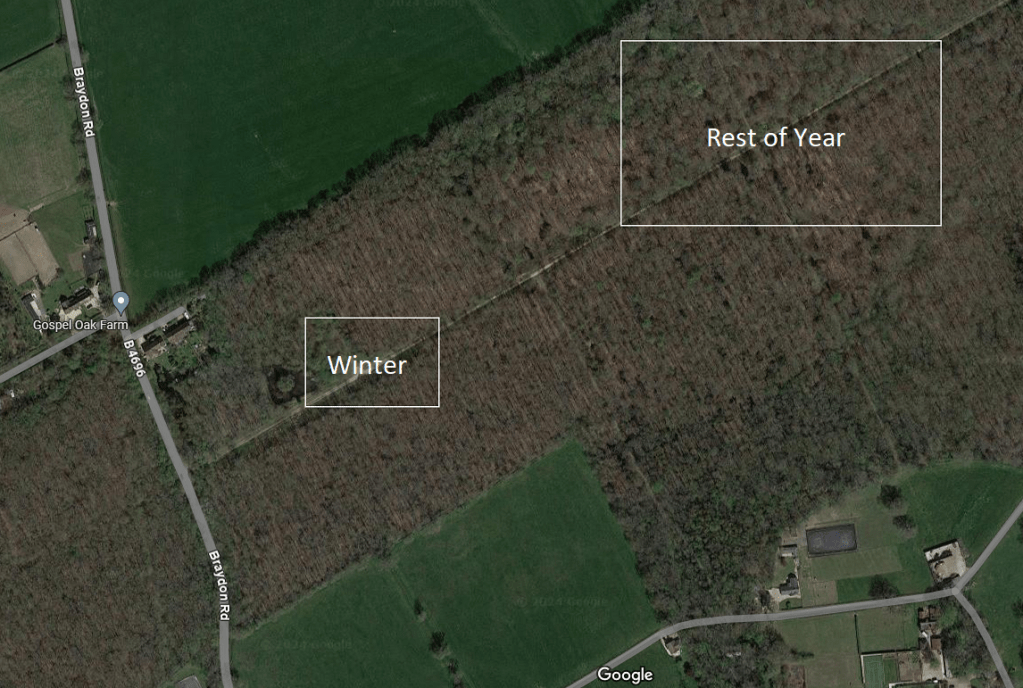
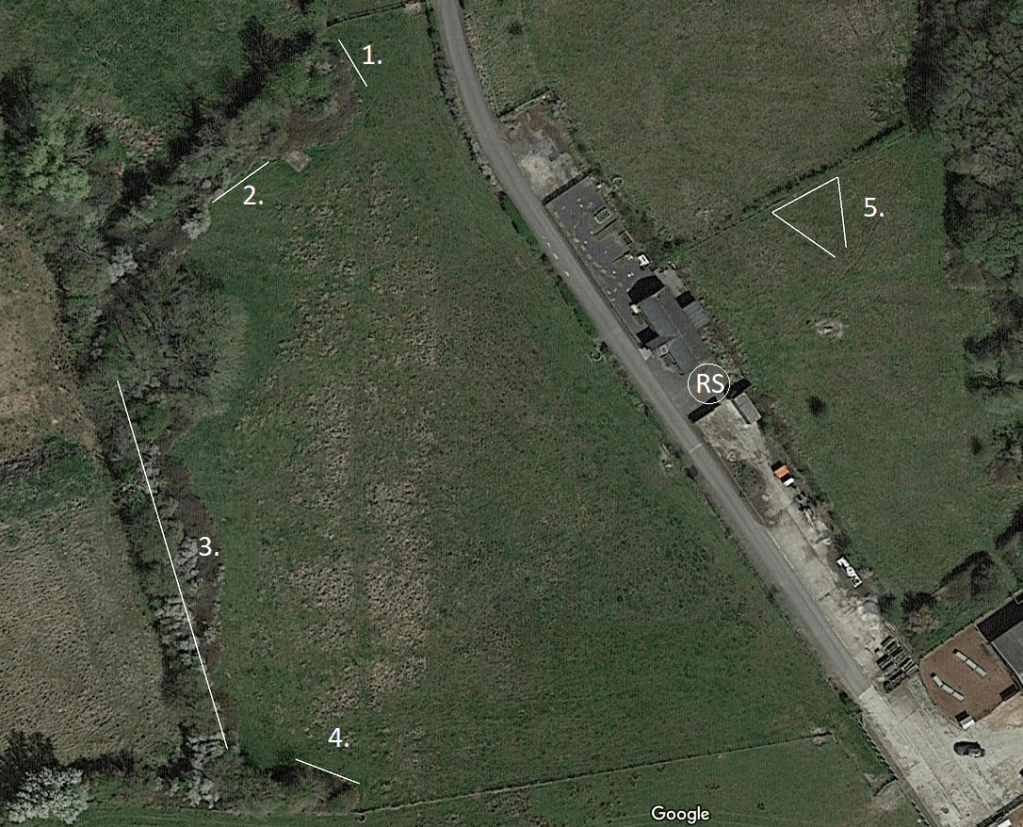
Anyway, with Saturday providing a mix of sunshine, rain and hail plus a constantly high wind, we decided on a Sunday session. I was joined by Laura and family plus Justine, and we went to Red Lodge, starting at 6:30. Because I didn’t have the feeding station in operation we moved the net site to the usual summer location:

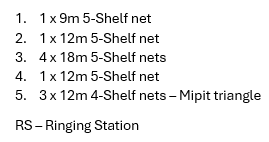
We set the following nets:

We had the nets open by about 7:15 and started catching straight away. Unfortunately, we were not catching large numbers of anything. Slightly galling, but we had a chat with one of the regular dog walkers, David, with his lovely Black Labrador, Denver, regaling us with his stories of the numbers of Goldfinch and, particularly, Siskin on the sunflower hearts on the feeders in his garden (on the first diagram you will see Gospel Oak Farm marked: he lives in one of the cottages along that road, so only a few hundred metres away). Needless to say, we saw neither hide nor hair (or should that be “feather nor scale” for birds) of either species this morning.

We did catch a couple of Chiffchaff, heard calling almost as soon as we arrived on site, but apart from that it was pretty standard fare and in small numbers. The list for the day was: Treecreeper 1; Blue Tit 2; Great Tit 1(2); Coal Tit 1; Long-tailed Tit 1(2); Wren 2(1); Robin 1; Blackbird 1; Chiffchaff 2. Totals: 12 birds ringed from 9 species and 5 birds retrapped from 3 species, making 17 birds processed from 9 species.

A small catch but, given that the team for today was very inexperienced, it meant that they could work in a relaxed environment and I could cover off things like what to look for as birds come into breeding condition: as the Blackbird, Robin and Long-tailed Tits all were. We also had plenty of time to chat together, have a good gossip, and interact with the odd passer-by.

Frustratingly, there were a lot of birds around: but all up in the canopy. We had Nuthatches calling and flitting around overhead, Great Spotted Woodpeckers drumming, Chiffchaffs chiffing and Song Thrush singing all around us.

We closed the nets and took down at 11:30, leaving site just after midday.

Somerford Common West, Saturday, 16th March 2024: is it Spring yet?

It was nice to have a break in the rain this morning. Perhaps nicer to have much lower wind speeds. This session was scheduled for Somerford Common West and I was joined by Rosie, Justine and David. We met at 6:30 and set the usual nets:

The feeding station had only been refilled on Thursday, after an hiatus of 10 days, so I wasn’t expecting it to be particularly busy this morning. I was hoping that we might get an end of season Lesser Redpoll or Siskin this morning, as we have only had two of the former since the turn of the year, and none of the latter. However, having seen two Siskin in my garden yesterday, I was hopeful there might be the odd one still around. The simple fact is that my sites have not delivered a single Siskin this autumn / winter. That is a repeat of last autumn / winter. Prior to that they were a regular catch: not huge numbers, but regular.

Today’s session started pretty much as expected: Blue Tits, Great Tits and a Coal Tit, similar in the second round, with the addition of a retrapped Marsh Tit and a male Great Spotted Woodpecker. After that the catch was pretty bitty, with the odd bird hitting the nets. I am not sure what the reason for this was but net ride 1 was hopeless all morning, until the last round at 11:15, when it produced two Long-tailed Tits, more of which anon. I had lures on that ride for Goldcrest, amongst others. Goldcrest is generally a guaranteed catch in that ride: it is in amongst the conifers and you can hear them all the time, all year round, in that area. Not one today. Indeed, it was that net ride that delivered the bulk of the birds in the 81 bird catch of the 11th January.

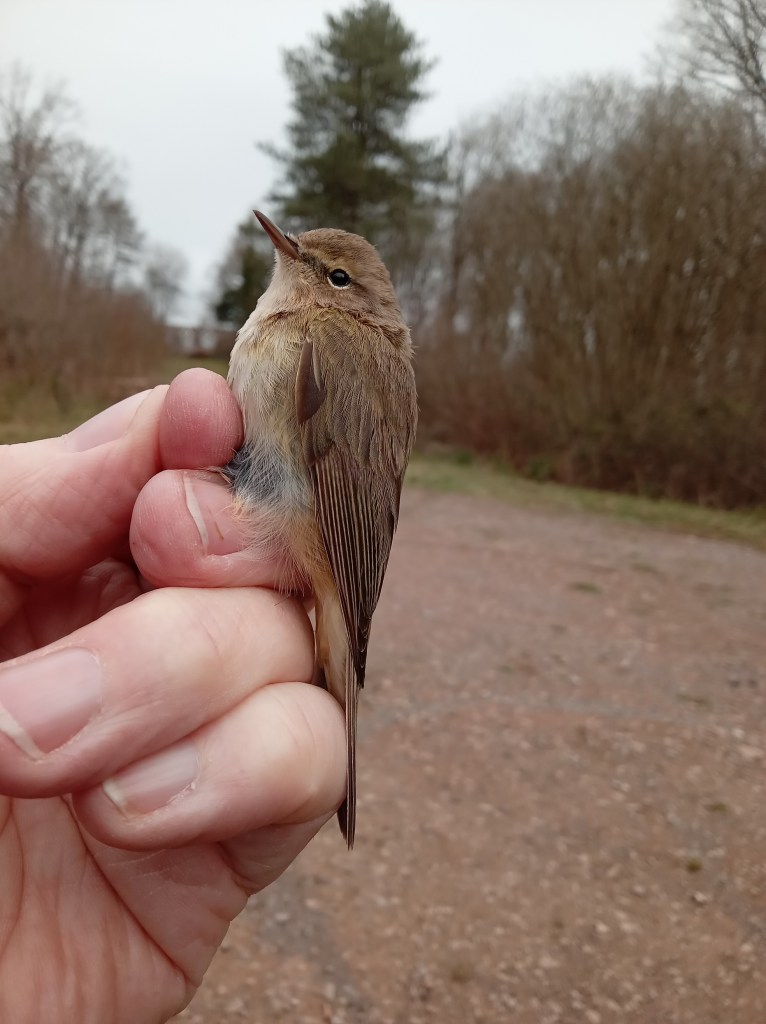
Similarly, ride two was producing absolutely nothing until I put a lure for Goldcrest on there at 9:15. Almost immediately it produced the desired result: but it was just the one. I left the lure running for another hour with no result. However, after that time, I decided to see if I could lure in the Chiffchaff that had been calling around the ringing station all morning. Delightfully, it also worked:

Chiffchaff, Phylloscopus collybita

The list for the day was: Great Spotted Woodpecker 1; Blue Tit 4(9); Great Tit 7(1); Coal Tit 1(2); Marsh Tit (1); Long-tailed Tit 2; Chiffchaff 1; Goldcrest 1. Totals: 17 birds ringed from 7 species and 13 birds retrapped from four species, making 30 birds processed from 8 species.

We did a catch a female Chaffinch but, although the right leg was clean, the left leg showed signs of Fringilla Papillomavirus, so we simply released her.

So, Spring in the air? Apart from the Chiffchaff, announcing his arrival on site and territorial aspirations, almost certainly male, but not yet showing the physical signs that would allow sex determination to be unequivocal (it probably was but it might not have been the bird we had heard calling). By contrast, the two Long-tailed Tits we took out of ride 1 were close together in the net. On inspection after ringing, one was unequivocally male, sporting a very clear and obvious cloacal protuberance. The other was, equally obviously, a female, with the cloaca clearly facing down the tail and her breast, equally clearly, starting to defeather, to develop the brood patch.

With the weather clouding over, the wind getting up and the catch having fallen away, we packed up at 11:30 and left site shortly after midday. It was slightly disappointing in that we caught only one finch, and couldn’t ring that, but adding yet another Great Spotted Woodpecker, to what is already a good total for us in the Braydon Forest, continues to be encouraging and catching our first Chiffchaff of the year is always a pleasure.

Short & Sweet(ish): Webb’s Wood, Thursday, 14th March 2024

This was my first visit to Webb’s Wood since some toe-rag stole the bird feeders. I didn’t bother replacing them, as I didn’t want to provide more temptation to whomsoever did it, and I was going to be taking them down this weekend anyway. I was joined for the session by Rosie, Miranda, Teresa and Andy.

I didn’t do my usual Wednesday stint because it was forecast to be very windy, with scattered showers. That turned out to be very accurate, so I was pleased that I had made that decision. With Thursday’s forecast being better: lower winds, although still gusting quite strongly, and rain by lunchtime, it seemed the better bet. We arrived on site at 6:30 and set the following nets:

As the wind was scheduled to come from the South South West, I decided to set nets where they were most sheltered from the predicted wind. Unfortunately, as soon as we had the nets open the first, unforecast, shower of rain arrived. It was light, not enough to close the nets, and lasted about 30 minutes before it stopped. We put out a medley of lures for a number of different bird species. The evil part of me was hoping that some of the new breed of birders might be nearby. By the “new breed” I mean those that have never used a field guide or listened to recordings of bird song to familiarise themselves with the species they are likely to find, but are totally addicted to apps to identify birds by song and even to identify their sightings for them, without them having to bother working it out for themselves. Although I am not a technophobe, after 35 years in IT I could hardly be so, I do think that if people have a genuine interest they should at the least get a grasp of the basics. I must be getting very old!

We did not catch a lot of birds but what we caught was nicely varied: Treecreeper (2); Blue Tit 1; Great Tit 1; Marsh Tit 1; Long-tailed Tit 1(1); Wren 1; Robin 1(1); Goldcrest 4. Totals: 10 birds ringed from 7 species and 4 birds retrapped from 3 species, making 14 birds processed from 8 species.

Highlights were, as ever, a second Marsh Tit ringed for the year, plus the four Goldcrests. It is only the second time in 11 years that we have caught four Goldcrests in Webb’s Wood in March, and the first time that we have ringed four. Usually, we have a big influx in the autumn, departing by the end of January / beginning of February.

Unfortunately, at just before 10:00 another, heavier shower arrived, the wind became much stronger, and I decided to call the session to a halt. As Teresa and Miranda were taking down ride 1, Andy and I started on rides 2 and 3. When Andy went to shut the nets in ride 3 not only did he find one each of Goldcrest, Long-tailed Tit and Wren but, unfortunately bouncing off the net, a female Sparrowhawk, possibly chasing after one of these three captures but, thankfully for them, not catching them.

Other birds seen were the pair of Ravens flying around the wood, just like last time. I am pretty certain that they will be nesting in there. There was also a Song Thrush or two, (that Andy’s Merlin app identified as a Song Thrush, a Mistle Thrush, a Firecrest and a Long-tailed Tit) which spent most of the morning singing from near the tops of a couple of the taller trees, and Great Spotted Woodpecker were calling regularly but not drumming this morning.

With everything packed away, we left site just before 10:30. Naturally, by then the rain had stopped and the sun was out, and it was nice and warm – but the wind was still too strong for leaving nets open. As I said: short but sort of sweet.

A Bit of a Wrens-day: Blakehill Farm – West, 6th March 2024

Having seen a forecast for a calm day, starting misty but clearing away to blue skies by 10:00, I decided to have a session in the fields front and back of the Whitworth building at the Wiltshire Wildlife Trust reserve at Blakehill Farm. It is only accessible when the weather is virtually wind free, so I take the opportunity when it arises. As ever, the forecast turned out to be somewhat less accurate than one would have hoped. The key issue was the mist, which started out as freezing fog at 6:00 when I left home, with a temperature of -2oC, which transmogrified into a thick mist by 9:00 and didn’t clear until gone 11:00. In addition, the little breeze that was forecast was supposed to be coming from the SSE, so I set my nets accordingly. Needless to say, when the breeze did get up it came from the NW, so I had a pleasant time extracting various bits of net from a barbed wire fence.

I was joined by Rosie, Miranda, Teresa and Andy, We met on site at 6:30 to find that my favourite hedgerow had been severely cut back. Unfortunately, the generator that supplied power to the Whitworth building had failed (it has been dying for more years than I care to remember) and, to provide power to the building, a power cable had to be laid from the farm buildings to the Whitworth. This necessitated the fairly radical scalping of the hedgerow running between them. On the positive side, it has been nicely laid and will grow back stronger, thicker and better than it was. All that apart, we had a pretty reasonable session.

We set the following nets:

On a whim, I decided to set up a Mipit triangle, to see if there were still any around the site, after last month’s surprise catch. All nets had lures in place for a medley of different species possible at this site, apart from the Mipit triangle which, naturally, just had Meadow Pipit playing.

The first bird out of the net wasn’t until 8:00, and it was a retrapped Blue Tit, ringed last year. Rosie processed that and helped extract the little fall of our second round, but then had to leave for work before processing any other birds. She really is a selfless star! That second catch of the day, 45 minutes later, was another Blue Tit. I should say, we had checked the nets in between and drawn a blank. Mind, this Blue Tit was accompanied by five Wrens, a Goldcrest and a Great Tit. This Blue Tit was also a retrapped bird: and that was the last retrap and the last Blue Tit of the morning.

I am sure it was because of the weather, but there wasn’t much movement until gone 10:00 and even then it wasn’t exactly busy. The mist kept looking like it was thinning, but then it would thicken again. As a result, our rounds after the second were one bird here and one bird there, with the exception of a small flock of four Long-tailed Tits at 10:25, accompanied with a sixth Wren for the morning. The previous largest number of Wrens ringed at this site was four back in October 2017. Our biggest ever catch was of nine, ringed in Webb’s Wood in August 2018. We have had a couple of other sixes and a seven, but they were all catches in the post-breeding flush of Autumn, so this was a notable catch.

We decided that we would close the nets at 11:15, but caught a Goldcrest, which we thought it best to process and release before closing them. I don’t like keeping Goldcrests waiting when the weather is cold, even though it was beginning to warm up I prefer not to keep them hanging around. When you only weigh 5g you don’t have a lot of fat to insulate you from the cold. Delightfully, this Goldcrest had a 50mm wing length and weighed exactly 5g. It is the only species where I get this 10:1 ratio. It always makes me smile when we find it. So then we went back at 11:30 to shut up the nets: only to find a pair of Chaffinch in net 2. I am comfortable in calling them a pair: caught in the same net, within a metre of each other. They were processed and then released simultaneously, and they flew off together. We then went and took down the nets, leaving the Mipit triangle until last.

We did have a couple of Meadow Pipits into the triangle at 10:30 – but they escaped. However, whilst Andy and I were finishing taking down the main nets, Teresa and Miranda noticed a few more Meadow Pipits in and around the triangle. They gave it a bit of a rush and we finished the morning with a very satisfying catch of three Meadow Pipits: one for each of us to ring (Andy doesn’t ring). These are the first three that we have caught on this part of the farm, i.e. not out on the plateau, and the only other time we have caught them in March at any of my sites was two of them on the plateau in 2021. Very pleasing! We then took down the Mipit triangle and were away from site by 12:30.

Meadow Pipit, Anthus pratensis (photo courtesy of Teresa)

The list for the morning was: Blue Tit (2); Great Tit 2; Long-tailed Tit 4; Wren 6; Meadow Pipit 3; Blackbird 2; Goldcrest 2; Chaffinch 2. Totals: 21 birds ringed from 7 species and 2 birds retrapped from 1 species, making 23 birds processed from 8 species.

As well as the birds processed, we had a mammalian treat as well when a Weasel poked its head out from the hedgerow where we were setting up net set 3! At least, Rosie did, as she was the only one who saw it, but that makes up for her dipping out on the Stoat at Somerford Common last Wednesday. We also saw a Hare on a couple of occasions early on in the session.

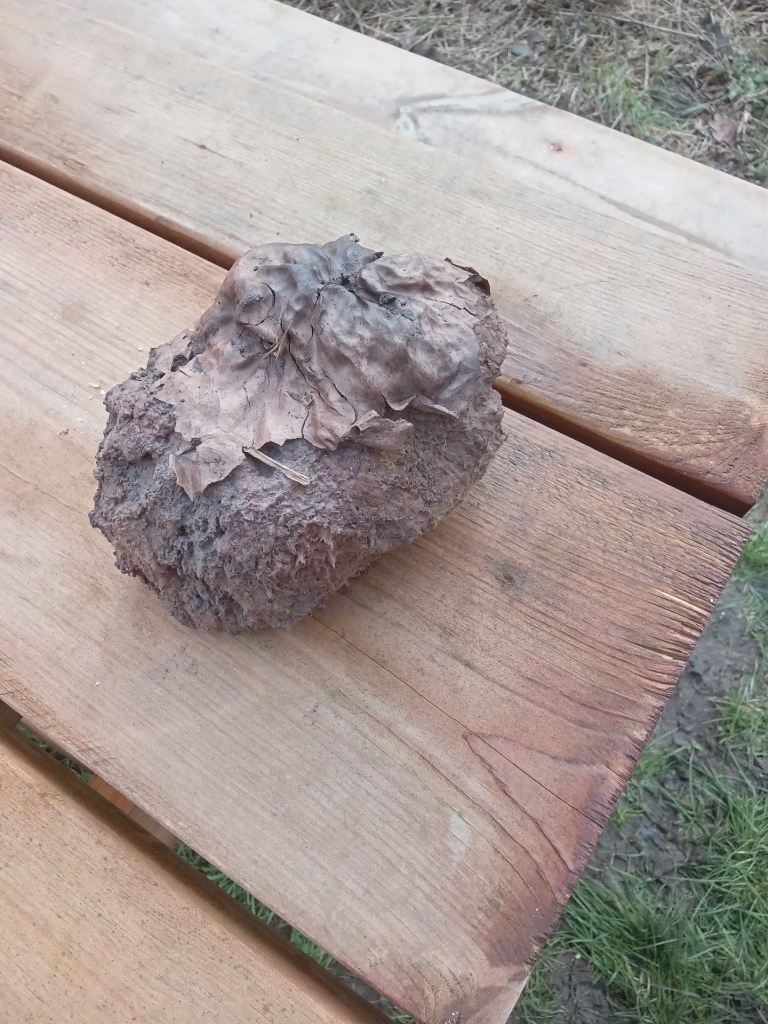
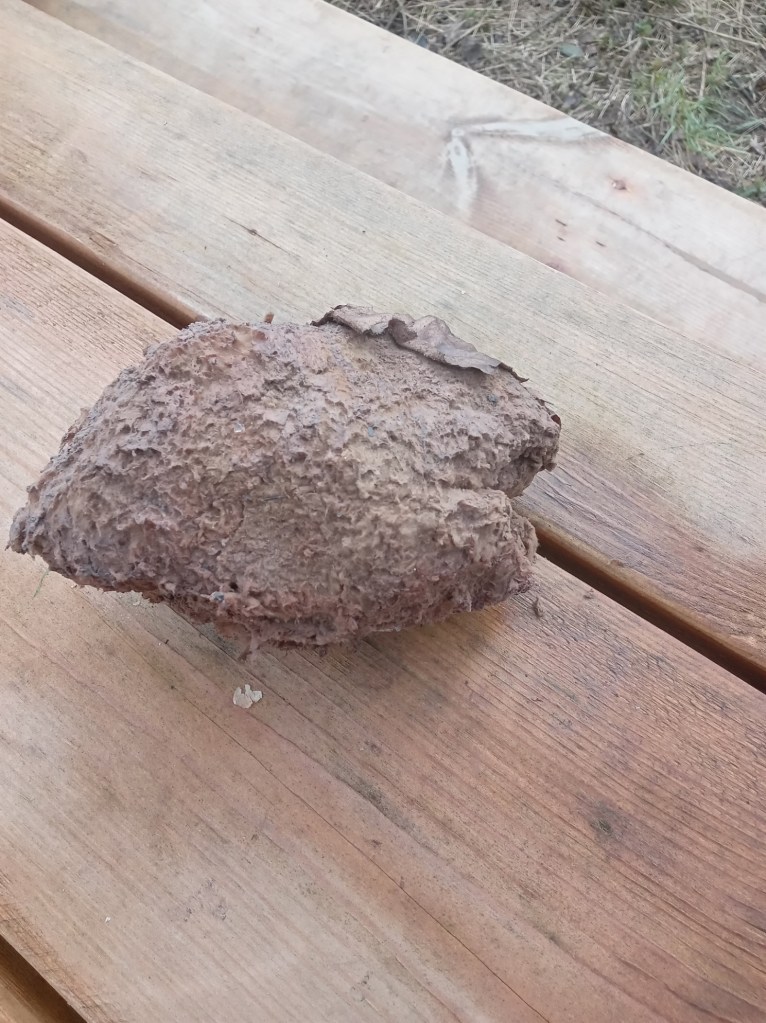
Any Ideas On What This Is?

Whilst setting up our nets this morning we noticed this lump sitting on the grass:

Top view

Side view

After we had the nets set I went to have a closer look at it. When I picked it up I was staggered: it weighed next to nothing. My thoughts are that it is an old bumble bee nest that has been dug out by some other animal.

Would anyone know differently?

Two Sides of the Same Coin: Sunday, 3rd March 2024

After Wednesday’s awful session I was hoping for better this weekend. Saturday was a wash out, but Sunday was forecast to be dry with very light winds. There was a caveat, it was also forecast for the weather to be cold overnight, with fog clearing to mist, clearing to blue skies by 8:00ish. Certainly it was cold overnight: the car needed some serious defrosting before setting off this morning. I was joined for the session by David and Laura, with Mark coming along to be Laura’s teaboy (and help set up and take down). Because of the forecast I put the start time back to 7:00. We set our usual nets and waited. The first round produced a few birds – but there was no sign of the mist lifting and the place remained shrouded until nearly 11:00. Consequently, on our side of Mallard Lake the catch was not as good as I had hoped. Nice variety, but low numbers. However, this was the first session that Laura expressed an interest in doing some processing. It meant that we were not under pressure and Laura could relax into her ringing career. She has become a very competent extractor, which to my mind is the real skill needed in bird ringing. Anyway, suffice to say that, after checking that her wing length measurements were accurate for the first few birds, which they were, I am very happy that we have another reliable ringer developing in the team.

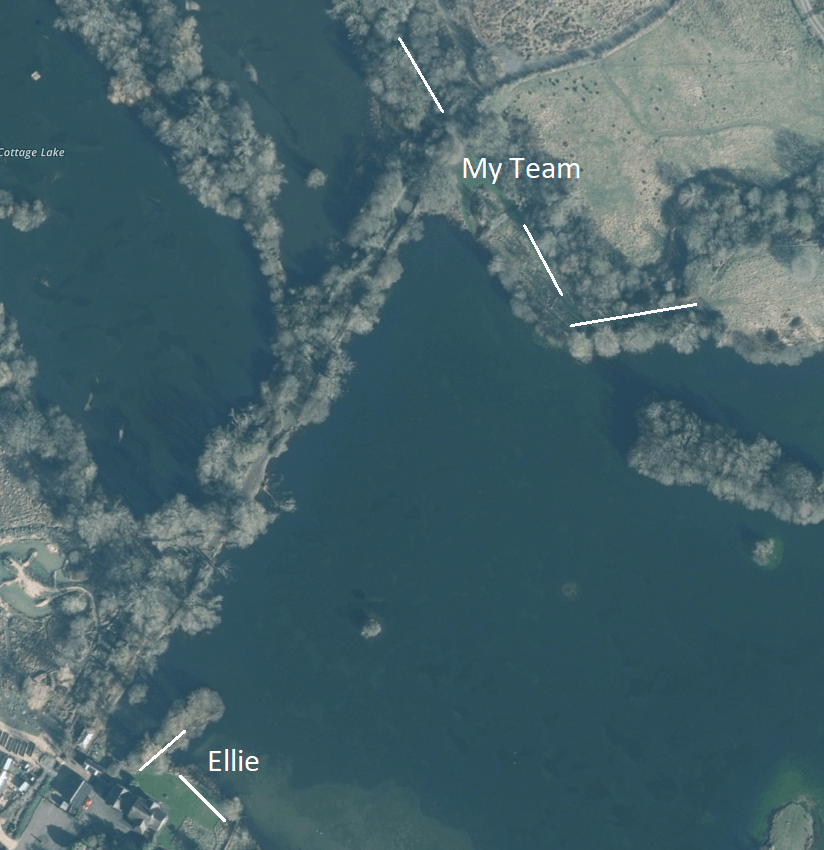
At 9:30 I got a text message from my C-permit trainee, Ellie, letting me know that she was working on the other side of Mallard Lake: the mist was blocking our view of each other. Ellie sets up in and adjacent to the farmhouse garden:

The two catches were somewhat dissimilar. Our catch was: Blue Tit (2); Great Tit 2; Long-tailed Tit 3; Wren (2); Dunnock (1); Robin (2); Song Thrush 1; Goldcrest 2(2). Totals: 8 birds ringed from 4 species and 9 birds retrapped from 5 species, making 17 birds processed from 8 species.

Ellie’s catch was: Great Spotted Woodpecker (1); Blue Tit 7(5); Great Tit 8(6); Long-tailed Tit 2; Dunnock 1; Goldcrest (1); Chaffinch 2; Siskin 1. Totals: 21 birds ringed from 6 species and 13 birds retrapped from 4 species, making 34 birds processed from 8 species. The Great Spotted Woodpecker was ringed by Jonny as an adult on “my side” of Lower Moor Farm in May 2021.

I am quite happy to have missed out on the abundance of Blue and Great Tits: the novelty wears off by the end of the winter, but I really have missed not catching any Siskin.

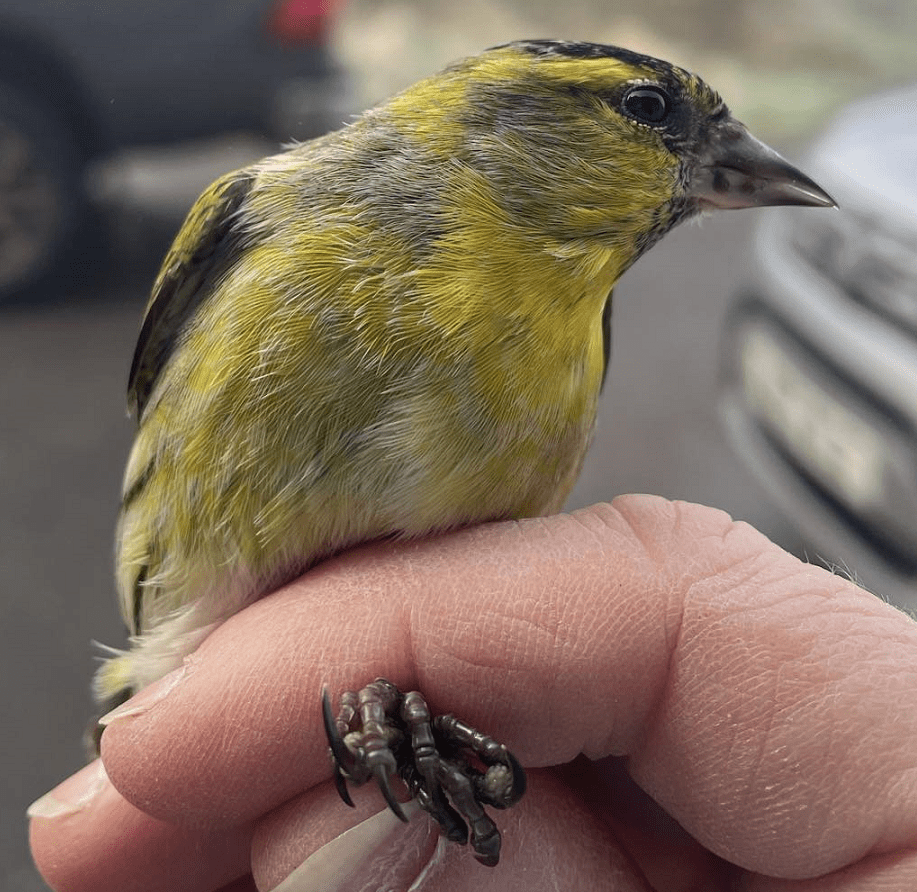
Male Siskin, Spinus spinus (photo by Ellie)

Back in 2013 I caught and processed 35 of them, then in 2016 another 26, this dropped to 8 in 2017, since then every other year we have had six to eight of them but, so far, I have had none in the last two years. The initial high catches were in Webb’s Wood. Unfortunately for them, the Forestry England plan for the Braydon Forest involves removal of non-native tree species from Webb’s Wood, whilst having a positive impact on a number of species it has had the opposite effect on Siskin. Perversely, the species I associated catching with Siskin is Lesser Redpoll, probably because I have, on occasion, caught them together at Somerford Common. They were very uncommon in Webb’s Wood until three years ago but, after a serious amount of thinning of the Beech, all of a sudden we had 26 in 2021, then 16, and 33 last year.

Siskin are an interesting bird for Wiltshire. If you head down to the woodlands near Warminster / Longleat they are a resident breeding species. The birds we catch in the north of the county I am certain are migratory, or, at least I have had recoveries reported from Argyll & Bute. The Wiltshire Bird Atlas has them as being occasional breeders in the Braydon Forest up to the 2012 data. All I can say is that, unlike Lesser Redpoll, where we caught two very young, recently fledged, birds at the beginning of August 2016, we have never caught a Siskin in the Braydon Forest that fledged in the year caught, that has not completed its post-juvenile moult and is, therefore, unlikely to have fledged there.

Ironically, the mist started to lift at 11:00, just as we started our last round and then, by the time we had taken down the sun had burnt off the mist and the weather was glorious! From the timings on Ellie’s data entry, I suspect that she packed up at pretty much the same time as we did. It was a very pleasant session, just a few more birds (and a Siskin or two) would have made it perfect.

West Wilts Ringing Group Results: February 2024

Despite this month apparently being the wettest February on record, we did have a pretty decent month.  For those who are religious or superstitious, look away now: we processed 666 birds: the number of the feathery beast!

image.png

So, despite the rain we did manage to fit in a couple more sessions than last year, and it was our second best February, with last year’s being our best.  We ringed fewer birds from the same number of species as in 2023, and retrapped more birds from the same number of species than we did in 2023, but we managed to process two more species than we did in 2023.  How did that work out? The following species were caught and processed this year but not in 2023: Jay, Meadow Pipit, Siskin, Skylark, Starling, Stonechat, Tree Sparrow and Yellowhammer.  Missing from the catch this year were Barn Owl and Buzzard – but they were ringed in the Oak & Furrows Rehabilitation Centre, Blackcap, Kingfisher and Treecreeper.  

Highlights of the month have to be the Skylark: Andy spent four hours at his new site and caught one bird: but it was a Skylark!  I admire his patience: I packed up after seven birds in three hours on Wednesday!  Mind, we weren’t catching anything as good as that and it did start to rain as I finished putting stuff in the car.  I have just circulated the recovery report on Ian’s Lesser Redpoll recovery: a great garden find.  I would love to catch eight Lesser Redpoll in my garden!  In fact, I would love to catch one: I have caught Siskin but never Lesser Redpoll in my garden.  My garden did deliver this month’s Starlings: one of which was a bird ringed as an adult six years ago.  The real highlights for me this month was the session held at Blakehill Farm on the 10th of the month: 22 Meadow Pipit and 2 Stonechat.  These are the only two Stonechat ever caught by the group in February.  A nice catch of Yellowhammer: our second best ever February for them, the best being on 2018.  Particularly nice about it is that the bulk of them came from three new sites.

An Absolute Shocker: Wednesday, 28th February 2024

This won’t take long! I shifted the start time to 6:30 for today, to get the nets at Somerford Common open before it got light (it is only six nets). I knew it would just be Teresa and me for the bulk of the session, with Rosie doing her usual of helping set up, and hoping to ring a couple of birds before heading off to work.

The forecast was for it to start raining at midday. Anyway, I had topped up the feeders on Friday. It is a big 4 litre seed feeder and a 1.5 litre peanut feeder, both were empty first thing, which we cleaned out, refilled, opened the nets and then waited for the birds to arrive – and waited, and waited some more. We caught two Blue Tits, that Rosie and Teresa ringed before Rosie had to leave. In the next hour-and-a-half we caught just another five birds: one at a time. At 10:15 I decided that “enough is enough” and we closed the nets and took down. Just as I finished stowing the equipment into the car it started to rain!

An entirely appropriate end to a rubbish session! We caught the following: Blue Tit 2(1); Great Tit 1; Coal Tit (2); Long-tailed Tit (1). Totals: 3 birds ringed from 2 species and 4 birds retrapped from 3 species, making 7 birds processed from 4 species (not the most difficult maths I have ever had to do!).

Actually, there was one genuine highlight: at 8:30 a Stoat ran across the path, just a few feet away from our ringing station! I have seen the Somerford Common Wallaby more times (3) than I have seen a Stoat there (1)! Fabulous creatures!