West Wilts Ringing Group Results: November 2025

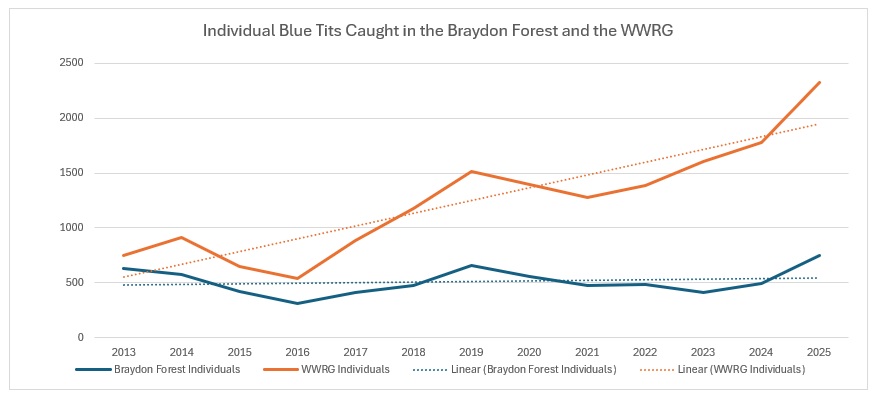
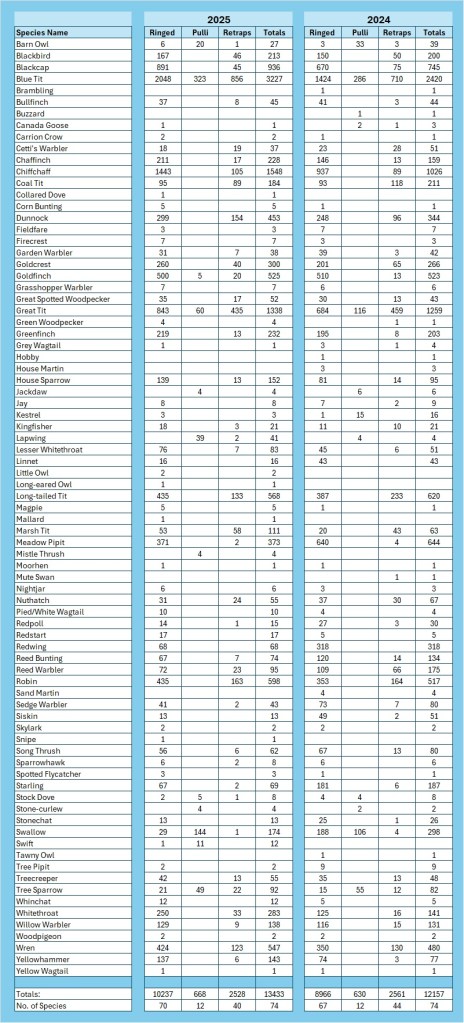
A quite phenomenal month for the team.  As ever, Jonny’s contribution was huge, with 628 of the records, but my team’s contribution wasn’t too shabby at 454!  This is what we processed:

image.png

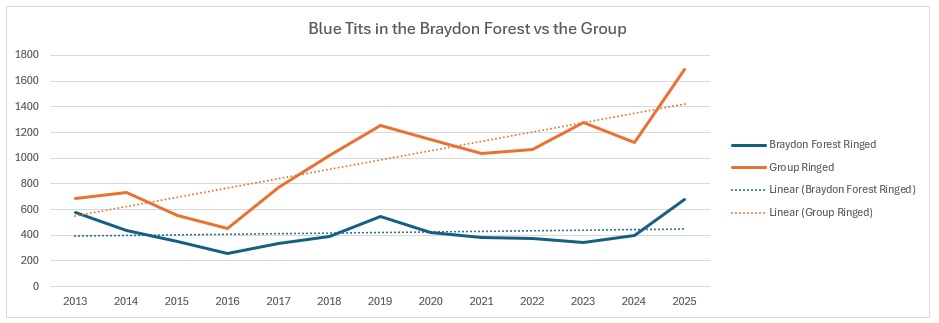
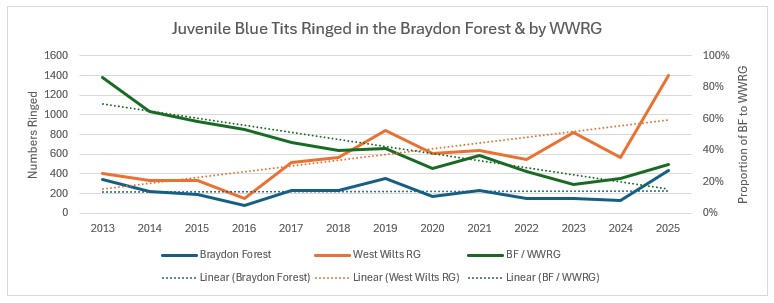
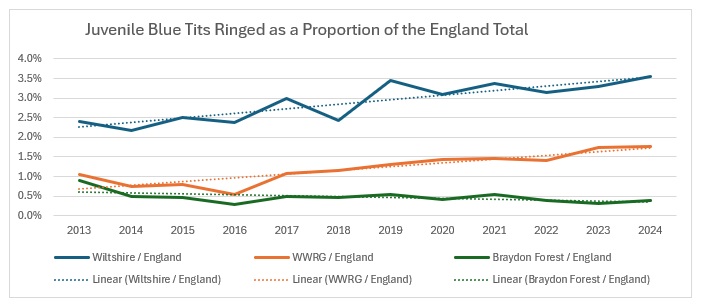
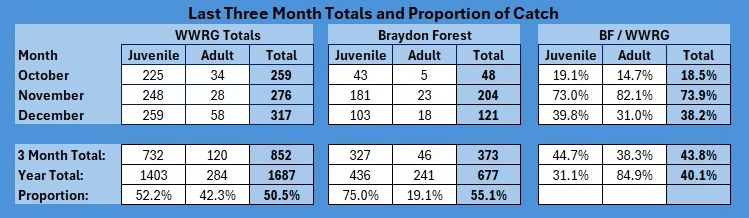
Added to the list for this year is Linnet, Magpie, Pied Wagtail and Starling.  Missing from this year’s list is Bullfinch, Fieldfare, Jay, Siskin and Treecreeper.  The last is somewhat surprising, because all of my ringing this month has been in woodland. Two of last year’s three were from my sites.  I didn’t have any this October either for the first time ever.  Clearly the obvious difference is the number of Blue Tits processed.  Absolutely huge: in my last two sessions we have processed 105 of the blighters. The Friday session was just David and me, the Sunday session was Ellie, and me, but Ellie had to leave at 10:40 for work, leaving me another 25 or so to process. Lucky me!  

Other significant increases were Chiffchaff (65 vs 45) – our best ever November catch.  All of them caught at Johnny’s sites. Mind, he had 40 of last year’s total (and I had the other 5).  21 of them were at Langford Lakes, not so surprising, but 43 of them were on farmland near Sutton Benger.  Good numbers of Chaffinch this year, with 12 caught near Hilmarton and the rest evenly split around a number of sites in the Braydon Forest and Jonny’s farmland sites.  Best thing about it: our team did not find a single bird that we couldn’t ring due to FPV or mite infestation.

A nice increase in Goldcrest numbers but an astonishing number of Goldfinch caught.  The Sutton Benger sites were having an absolute ball: 73 of them were caught there.  16 at his East Tytherton farm site.

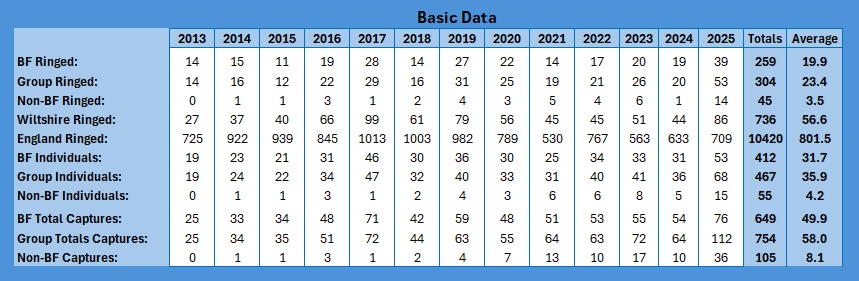
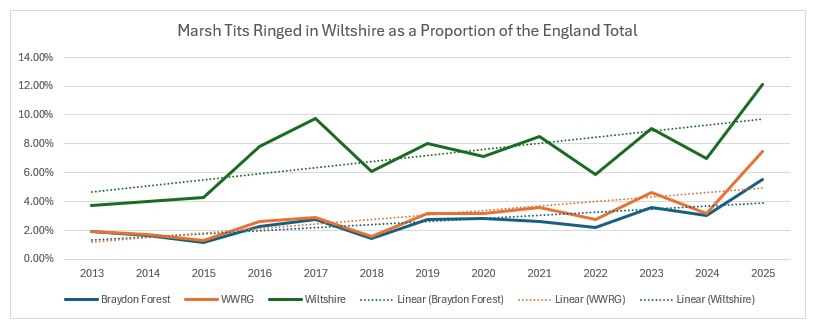
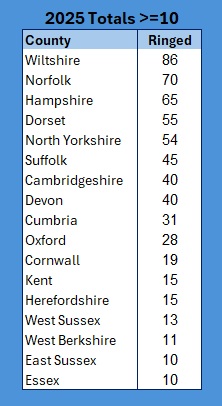
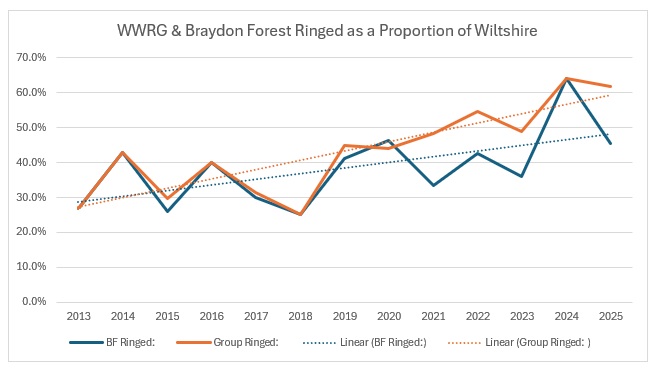
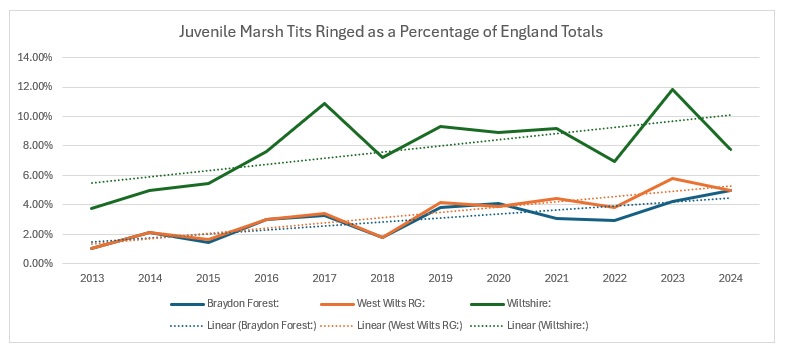
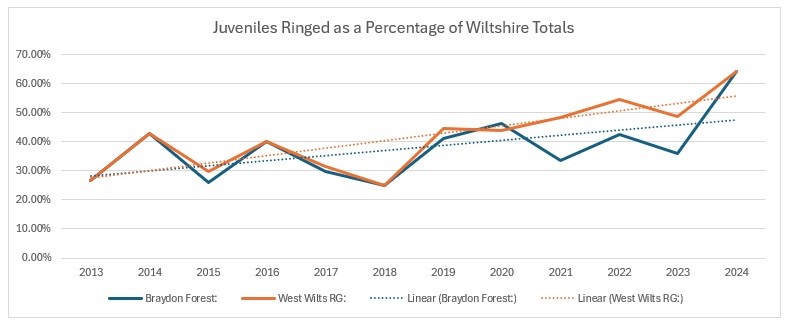
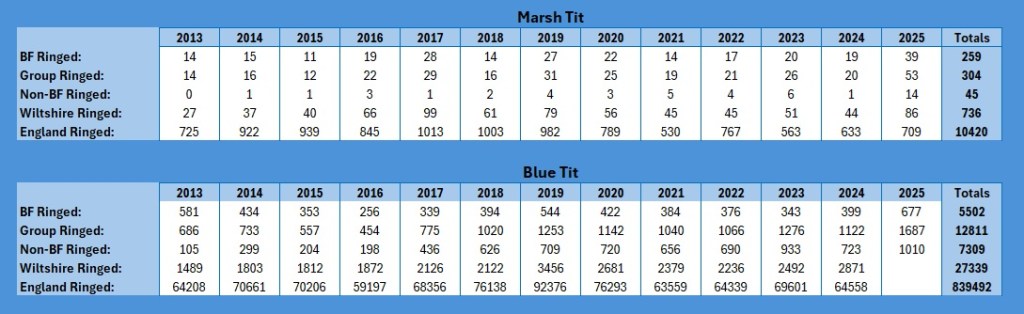
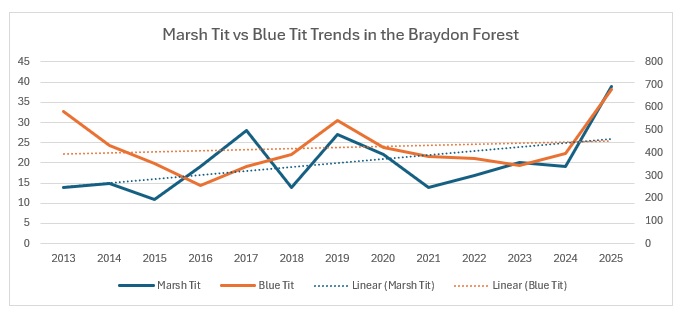
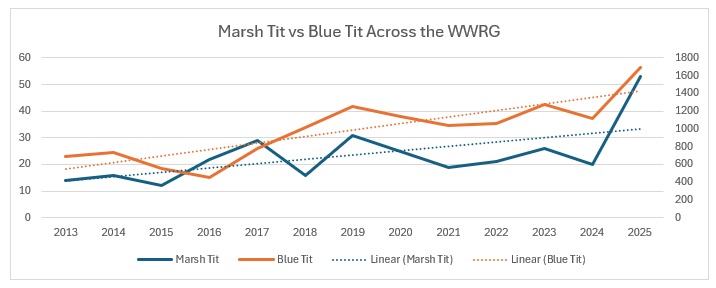
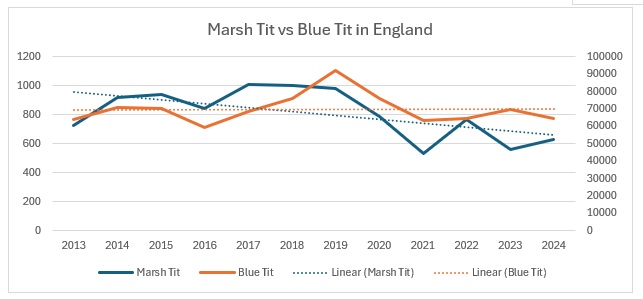
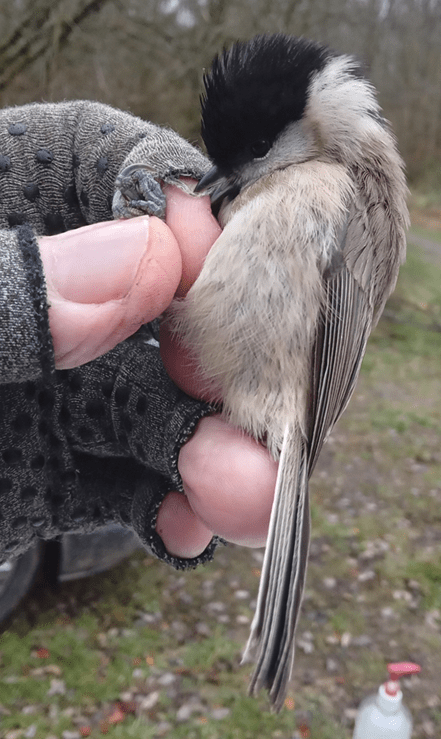
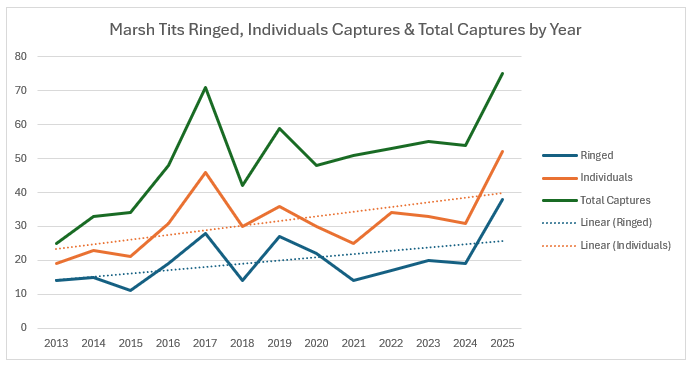
Personally, my favourite catch of the month was the 13 Marsh Tits ringed.  All were ringed within the Braydon Forest, taking us to 37 ringed for the year so far.  The total ringed in Wiltshire last year was 44, with the Braydon Forest contributing 19.  If the other Wiltshire sites are showing similar catch rates, what a huge turnaround that will be for the species in Wiltshire.  I am extremely hopeful that we will pass 40 in the Forest this year.  With four woodland sessions left before the end of the year, I am pretty confident.

The last big increase was in Yellowhammer numbers: 57 vs 3!  Once again, the Sutton Benger sites on a par with the Hilmarton site (27 vs 26) and four on the Imber Ranges.

That said, there are some pretty heavy reductions in other species.  

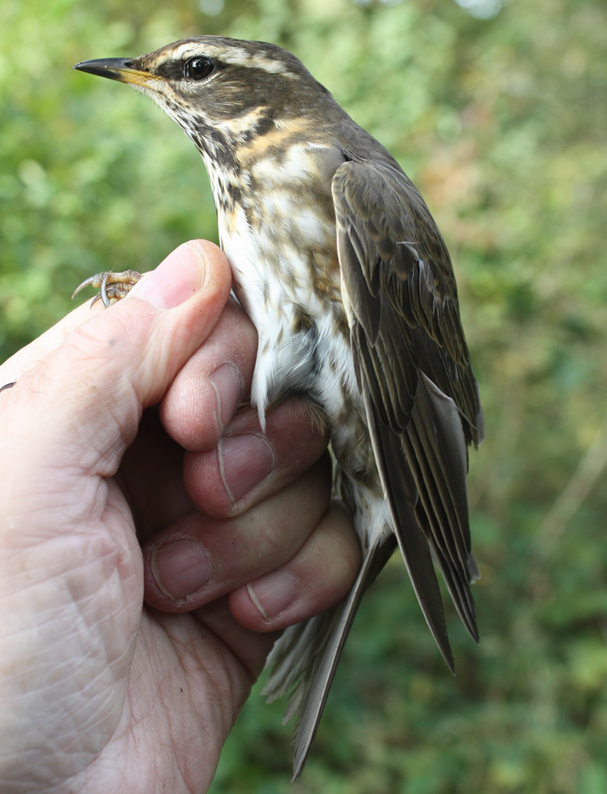
Long-tailed Tit numbers were well down, both new and retrapped (62 vs 115), but retraps more so (16 vs 47).  Meadow Pipit numbers were down (7 vs 21), but Redwing numbers were very, very low (29 vs 121).  Not too surprising in some respects: my key site for the species at this time of year is Blakehill Farm and, apart from the consistently high winds in November, which prevented me ringing there, the Hawthorn and Blackthorn hedgerow has been layered, in accordance with the requirements of their Countryside Stewardship plan.  Ideally, it needs to be at least six foot high, laden with berries, not three foot high with none.  It is our worst November haul of this species since 2017!

A couple of footnotes: this is our second best November, identical in numbers to 2022, and just 42 lower than our best ever, set in 2020.  2022 was achieved in 23 sessions and 2020 in 24 sessions.  Also, we have overtaken last year’s total already: 12,354 birds processed vs 12,157.  The key difference is in the number of birds ringed: 9,544 vs 8,966.  Retraps were down by 400: 2,161 vs 2,561.  Pullus ringing was slightly up, despite the poor Barn Owl year, at 649 vs 630.

Somerford Common West: Sunday, 30th November 2025

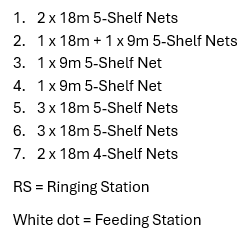
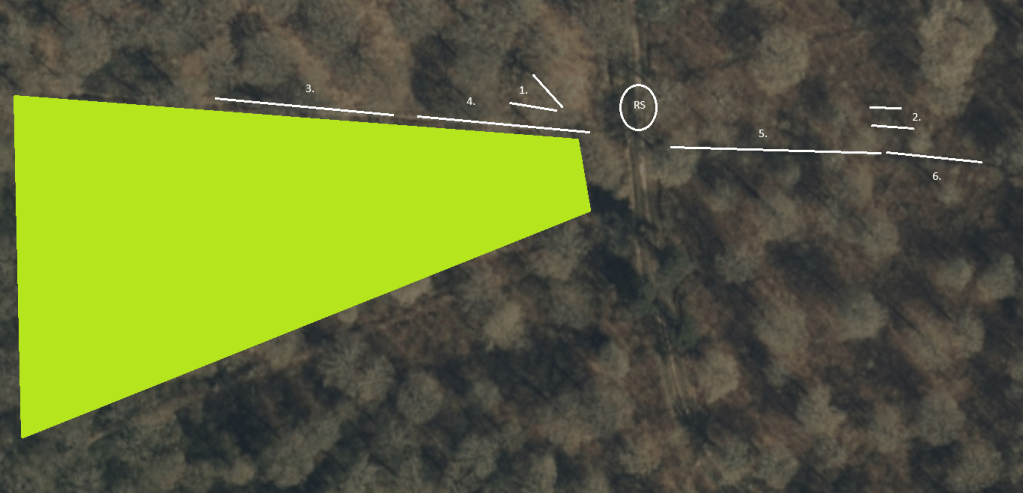
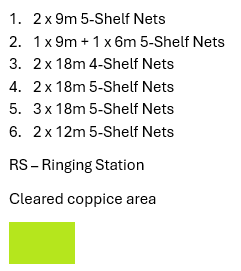
With everybody else unavailable and, despite the fact that she would have to leave by 10:40 to go to work, Ellie offered to join me for as much of the session as she could. I was very grateful as, even though we didn’t set all of the nets we would with a team out, we had a very good catch. These are the nets we set:

The first couple of rounds produced about 20 birds, but the next round was over double that. By the time we had extracted them all it was time for Ellie to go off to get ready for work, so she didn’t get to ring many birds. Her help was hugely appreciated, as she came all the way from Cheltenham to do so. As I have said before, I am extremely lucky with who I have in my team.

I decided to shut and loosely furl the nets after Ellie left: I reckoned I had enough to keep me going for the rest of the morning. In fact, I decided to leave ride 3 open as it had not caught much, just three Goldcrest. I would check it every 20 minutes whilst processing the other birds (to give me a break from being pecked to bits by Blue Tits). That produced another Goldcrest at 11:00, and, a fine finale, as I was taking the nets in, I took ride 3 last and, as ever, it was at the furthest end of the last net!

Am I getting boring about Marsh Tits yet? Number 37 for the Braydon Forest this year came in the second round, which I gave to Ellie to process. I am wondering about not continuing my colour-ringing project next year: I get so few resighting reports and these little pieces of coloured plastic are not cheap. It costs me £1.00 per bird to ring and colour ring each Marsh Tit. With a 6% increase in the price of metal rings this year that money might be better spent on them.

The list from the session was: Blue Tit 32(1); Great Tit 9(2); Coal Tit 3(2); Marsh Tit 1(3); Robin 3; Goldcrest 5; Chaffinch 1. 54 birds ringed from 7 species and 8 birds retrapped from 4 species, making 62 birds processed from 7 species.

One nice interlude, as I was getting down to the last few birds I noticed an elderly couple, a young lad and a Chihuahua approaching up the central glade. I held a couple back just in case they were interested and took a Great Tit out of the bag as they came up alongside. They asked what I was doing and I explained about bird ringing to them. I finished processing the bird and asked the young lad (Ralph) if he would like to be shown how to safely hold and release a bird. Of course he did! He was a natural. I then processed a Robin and let him do the same again. Anyway, to cut a long story short, it looks as though I might get a new trainee: good job I have the appropriate young person’s training licence and a current Advanced DBS certificate.

I started taking down and packing away at 12:30 but, with a few stops for coffee (and to rest an aching back – getting old is no fun) and left site just after 14:00. Tiring but somewhat satisfying. What would have made it totally satisfying would have been a couple of Redwing, Siskin and Redpoll but they are definitely scarce so far this autumn.

Red Lodge Riot: Friday, 28th November 2025

Oh good grief: a quite astonishing session at Red Lodge this morning. I hadn’t been able to get out before this this week: Monday to Wednesday my car was in having its bodywork repaired (I won’t ever try driving after taking Tramadol again – a lesson that cost me £780 to learn!), Thursday was too wet and windy. Today was forecast to be dry but breezy. My usual midweek team was otherwise occupied, but David, normally only available at weekends, was available today but, in keeping with the flow of things, is not available for the weekend.

It was windier than I was expecting, so we restricted ourselves to just four nets: around the feeding stations, as they are pretty well sheltered from the wind. These were the nets we set:

As I only got around to setting up the feeding station on Tuesday. Arriving on site at 7:15 the first thing I did was check the feeders: the peanut feeder nearest the ringing station was empty, the seed feeder still two-thirds full. Both feeders at the far end of the ride looked untouched. I expected that would mean that we would have a Titmouse heavy catch: I didn’t expect it to be quite as heavy as it was. Even before we had started to open the nets we caught five Great Tits and a Blue Tit in the closed nets. Ironically, they were all in ride two up by the untouched feeders! That ride was the busiest all morning: I doubt those feeders will be full for long.

We processed those birds and went to check the opened nets, and extracted another 20+ birds: that included another four Marsh Tits to be ringed! Our biggest ever catch of them in Red Lodge! That takes us to 36 in our Braydon Forest woodlands – a total of 44 fledged Marsh Tits were ringed in the whole of Wiltshire in 2024! Have I mentioned that someone described the population of Marsh Tits in the Braydon Forest as “insignificant”, because it puts a big spoke in his theory that supplementary and garden feeding is helping drive their extinction?

As we were processing these birds, we had a chat with Paul, a local birder and photographer that I usually meet at Lower Moor Farm. He was looking for signs of the Goshawk that has been reported in the area. Although I did see one of my first ever in Red Lodge in winter 2013 / 2014, as I was topping up the feeders, and saw what I thought was a big Sparrowhawk, until I noticed that the two birds chasing it were Carrion Crows and they were smaller! They are becoming a feature in the Braydon Forest: I have seen them in three of my sites, and had reports of another in a fourth. Anyway, before he headed off he told us that there looked to be about 20 birds in our nets. If only: we had 70+ birds in the nets. It was damned hard work, but we cracked on and got them all out, shutting the nets as we went. I was thinking we might reopen them once we had finished extracting but, in the event, the wind became so strong that I decided we would leave them closed and take down once we had finished processing the birds we had extracted: just as well, because we were very busy for the next couple of hours processing those birds we had extracted. Bear in mind that is less than 2 minutes per bird, with age, moult, sex, where applicable and all biometrics taken and recorded, no ringing and flinging! Efficient or what?

Paul came back as we were processing this lot, he was quite astonished at how much we had to do. He had been lucky: found the Goshawk nest and a roosting Woodcock. He left us to it, as were a tad busy!

The list for the session was: Nuthatch 1; Blue Tit 66(3); Great Tit 18; Coal Tit 1; Marsh Tit 4; Long-tailed Tit 8; Goldcrest 1; Chaffinch 1. Totals: 100 birds ringed from 8 species and 3 birds retrapped from 1 species, making 103 birds processed from 8 species.

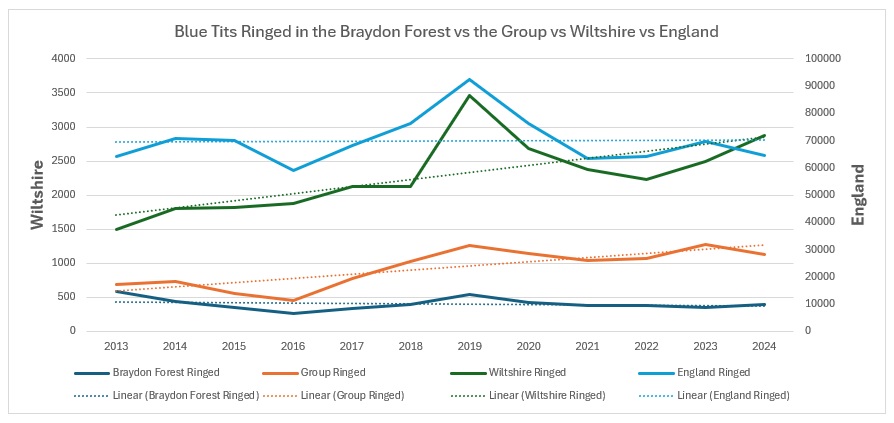
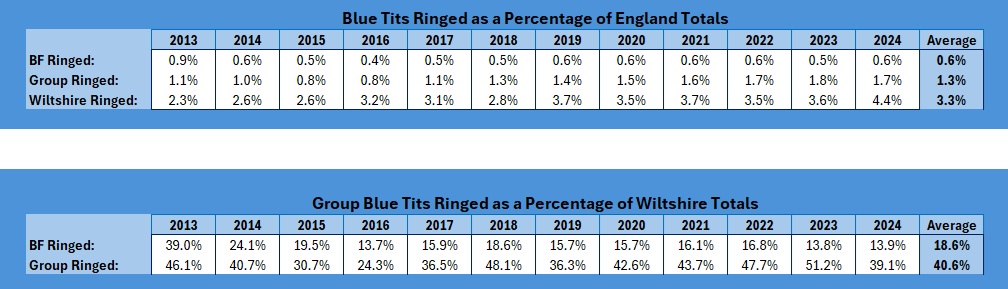
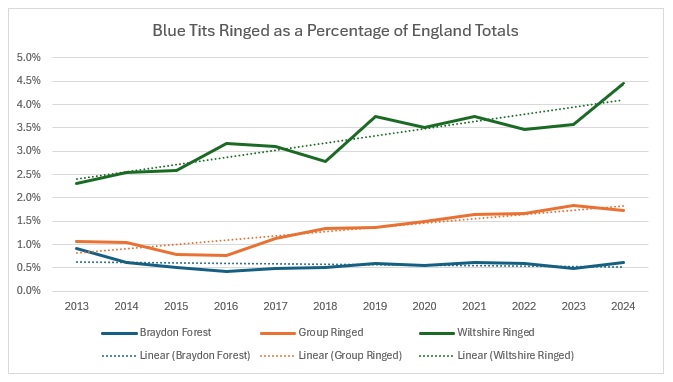
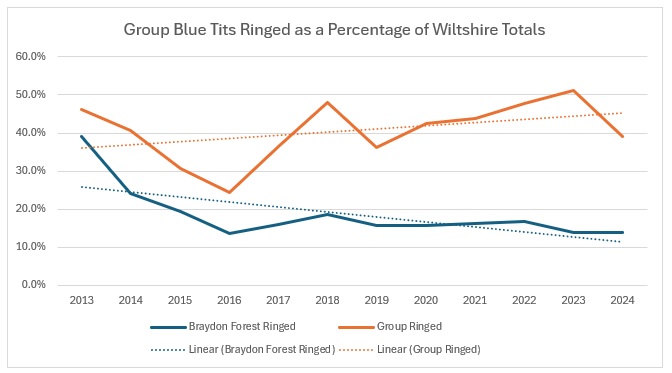
It is far and away the biggest catch of Blue Tits to ring in the Braydon Forest and our absolute biggest total catch of them, passing the 67 we had in the Firs just 13 days ago. Until today, that was our biggest ever haul of Blue Tits, at 67, but only 45 of those were birds to be ringed. This is our biggest ever ringing haul, and our biggest ever haul of ringed and retrapped Blue Tits.

After we finished processing the birds and taking down the nets and packing away, it was 13:30! A long morning, hard work, but very satisfying in lots of ways.

Webb’s Wood: Thursday, 20th November 2025

With yesterday being very wet first thing, this weekend a washout, and my car in for repairs next Monday to Wednesday, I was very keen to get out this morning. It was a little daunting at 7:00 this morning when I started the car: time to get the frost covers out! Leaving home it was -3oC, by the time I got to the ringing site it was -5oC, by the time we had the nets up and open it was a balmy (or is that “barmy”?) 0oC.

Anyway, I was joined for the morning at 7:30 by Laura and Ellie, as well as Claire, back with us for the first time for an age, having been working away for 18 months, and Ellie’s friend Kayleigh, a C-permit holder from the Newbury Ringing Group.

I had set up a feeding station on Monday morning, in the usual place: two 1 litre seed feeders and two 75cl peanut feeders. On arrival, it was clear that it hadn’t been found by many of the local birds yet. The feeders were still, basically, full. We set the following nets:

The nets were open by 8:30 and we started catching straight away. The obligatory Blue Tit, a retrap, obviously. It was a pleasant session, despite the cold. No huge rounds, but enough to keep us occupied, and enough not to leave the birds in the nets, in the cold, for any length of time.

As expected at this time of year, the majority of the catch were Blue Tits but, surprisingly, we had fewer Great Tits than we had Redpoll this morning. The second largest part of the catch were Long-tailed Tit, followed by Goldcrest.

The list for the session was: Blue Tit 12(6); Great Tit 1(1); Coal Tit 2(1); Long-tailed Tit 10; Robin 1(1); Goldcrest 6; Chaffinch 2(1); Redpoll 3. Totals: 37 birds ringed from 8 species and 10 birds retrapped from 5 species, making 47 birds processed from 8 species.

The forecast wind did not get up until 11:00, but didn’t start affecting the nets much until we reached the previously agreed pack up time of 11:30. It was just as well, because we caught one bird in each of the 11:15 and 11:30 rounds. Too cold to be sitting around with nothing to do. Everybody had an enjoyable time, Kayleigh is a delight and is welcome any time.

The Redpoll are always a delight. Numbers caught in Webb’s went up significantly after the Beech wood was thinned in 2019. We had great catches in 2020 to 2023 inclusive, dropped off in 2024, but that was because we didn’t get to the site until late December, for whatever reason. I hopeful we will get a 2023 type catch this year!

Similarly, the number of Chaffinch that we have caught across the Braydon Forest this year is heading towards one of our best. It isn’t the catching of them, it is being able to ring them. Anecdotally, I would suggest that we are finding far fewer with Fringilla papillomavirus or mite infections on the legs than we have for at least 5 years.

It is hard to be unhappy with a session that includes 10 Lottis! everybody loves them:

Long-tailed Tit, Aegithalos caudatus

This one of the three species we catch that cannot be aged by this time of year. Both adults and juveniles have undergone a complete moult into adult plumage over the summer and autumn. The other two species that do the same are Nuthatch and House Sparrow.

One last, nice anecdote, to finish: Laura was telling me that when it was her turn for taking the children to school this week Teresa, the student mentioned in Saturday’s Firs blog, was chatting away to her fellow German student, in German, which Laura is fluent in. She was enthusing about her time out with us and will look to find out about how she can do it when she goes home. Teresa also said that, if she couldn’t find a way in Germany, she would move here: brave for a 13 year old!

A Record Morning for the Firs: Saturday, 15th November 2025

After our rather good catch at Somerford Common on Thursday, our best catch there for 5 years, and our second best ever at the site, I was interested to see what we might find at the Firs this morning. With yesterday’s torrential rain I did wonder what impact it might have on the birds. Well, I think they hadn’t eaten yesterday because they were out in force today!

I was joined by David, Laura, Adam and Pete. I decided on a 7:30 start because the forecast had rain not clearing until gone 6:00, to be followed by a misty, murky morning (and I also wanted a bit of a lay in!). Claire was going to join us but she was visiting friends in Bristol yesterday and, by the time she was ready to leave that evening the trains had been cancelled because of flooded tracks! Mark arrived mid-morning to bring his usual fun persona and help out. Importantly, Adam and Laura brought along Teresa: Adam’s exchange student from Germany. Very friendly girl: she spent most of the morning getting pecked by Blue Tits and learning how to hold and release them. Towards the end of the session we (Laura) taught her how to take the biometrics and straight away she was very accurate on her wing lengths.

Anyway, we set rather more net than usual:

We had the nets open just before 9:00. The promised mist was there but it was originally supposed to lift by 10:00, but it never did. Mist isn’t a bad thing when you are bird ringing, as it makes the nets even harder to see, provide they don’t get wet and covered in dew drops. Also, there was no wind at all in the wood, probably why the mist stayed around.

We started catching straight away, as we were opening the nets: taking a couple of birds back with us as we headed back up to the ringing station. Pete went down to check the other nets, whilst we put up ride 5. He gave a shout, saying there were lots of birds. We went to join him The first round proper was a heavy 34 birds from seven species! Blue Tit heavy, as usual at this time of year.

The next round was not quite as big, but with a number of different species. That was the theme of the morning, good catches, with the odd singleton thrown into the mix. We ended up with the largest ever catch at the Firs: Nuthatch 1; Blue Tit 45(22); Great Tit 8(8); Coal Tit 1(3); Marsh Tit (1); Long-tailed Tit 8(1); Wren (1); Dunnock 1; Robin 3(1); Blackbird (1); Goldcrest 4(1); Chaffinch 2(1). Totals: 73 birds ringed from 9 species and 30 birds retrapped from 10 species, making 113 birds processed from 12 species. This is far and away our best ever catch anywhere in the Braydon woodlands. If you add in Blakehill Farm, there has only been two larger catches there: 137 on 21st September 2020 and 131 on the 25th September 2018. Those catches were the result of catching 109 and 98 Meadow Pipits respectively. They also only caught 2 and 4 Blue Tits respectively in those sessions.

It was hard work: Blue Tits are not big or fearsome, but they peck at you continuously when you are extracting them, processing them and even when you are releasing them. We caught 67 today. That is our biggest ever haul at any of my sites.

Catching our second Nuthatch of the week was a highlight: we hadn’t actually caught any since the 25th June, somewhat ironically, that was a catch of three in the Firs.

We did our last round at midday, closing the nets as we went, catching another eight birds as we did. After processing the last eight birds, we took down and packed away. However, the mist turned to rain while we were taking the nets down. With David’s dad, Trevor, joining in to help, with eight of us working together, we were finished and off site by 12:45.

A Busy Session at Somerford Common: Thursday, 13th November 2025

With Wednesday being extremely wet and windy, we pushed the session back to this morning. I had set feeding stations up at Somerford Common on Saturday afternoon and hoped the birds would find them before we got there today. As I mentioned in my last post, the paddock area where we set our feeding station has been mulched again. It is done every four years, but it does seem to have come around very quickly. I wondered if it would impact on the catch. What I can say is that any impact was positive. However, as usual, the biggest impact was in attracting in Blue and Great Tits.

I got to site a few minutes early so went to check on the feeders and was delighted to find that they were all empty: a good omen for the session. At 7:00 I was joined for the morning by Miranda, Laura, Ellie and Peter. We met at 7:00, and went to set all of the usual nets, but the work they have carried out meant that we had to change the layout somewhat:

The feeding station consisted of two seed and two peanut feeders positioned between nets 3 and 4.

We were opening them by 8.00, when something quite surprising happened: the first five birds out of the nets were Marsh Tits. One was a recapture but four of them were new and needed ringing, taking our total for the year in the Braydon Forest to a best ever 30. During the course of the morning we caught and ringed another two! If things carry on like this we could possibly hit 40 by the end of the year! Bear in mind that last year in the whole of Wiltshire only 44 were ringed. We have caught and ringed six in a session before (Webb’s Wood in July 2018) but never caught seven in a session before today. There has been a couple of other sixes, but those were one or two ringed and the others being recaptures.

The morning was extremely busy: so busy that I didn’t manage to drink any of my coffee and only got to eat one biscuit! Keep this up and I might be able to lose some weight!

As expected, the catch was dominated by Blue and Great Tits. Our list for the morning was: Nuthatch 1; Blue Tit 40(7); Great Tit 11(2); Coal Tit 5; Marsh Tit 6(1); Long-tailed Tit (1); Wren 1; Dunnock (1); Robin (1); Goldcrest 3; Chaffinch 2; Redpoll (1). Totals: 69 birds ringed from 8 species and 14 birds retrapped from 7 species, making 83 birds processed from 12 species. This is our second best ever catch in Somerford Common. The previous best was 97. The key difference is that was on the 12th December 2020 and that catch included 17 Redwing, whereas we have not caught any yet this year.

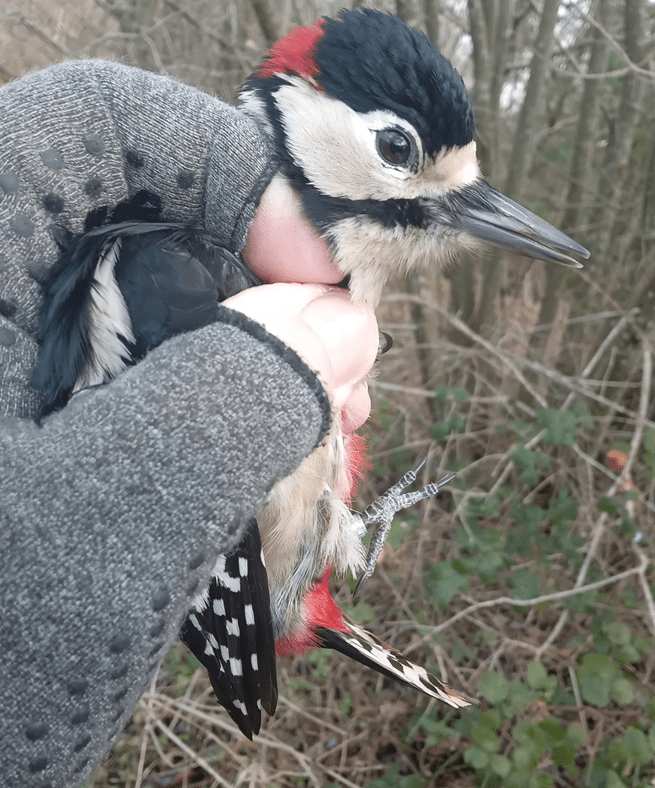
Highlights of the catch were, obviously, the Marsh Tits, but two female Chaffinch, both with clean legs and eminently ringable, was a nice to have. Our best catch of Coal Tit at Somerford Common this year, only Webb’s Wood in October has had an equivalent number ringed. The rest have been mainly singles, with some twos and threes. In fact, it is our best haul of unringed Coal Tits at Somerford Common since March 2020, i.e. over five-and-a-half years ago. Also, our retrapped Redpoll was ringed at Somerford Common in December 2024 so, as they are no longer resident in the Braydon Forest, it is interesting to note that it has returned to its previous winter site.

We had to cut the session short as the wind started blowing hard and the nets were billowing, so we did a last round at 11:00, closing the nets as we went. Processed the last 11 birds then packed away. With a full team today it took very little time to get sorted and we were off-site by midday, apart from Ellie, who stayed behind to go exploring.

Ravensroost Wood: Saturday, 8th November 2025

Our first visit to the wood since July: I am not quite sure why. It is not as though we had to cancel any sessions there, I just didn’t schedule them for some reason. Our next session there will not be until the 20th December, but that is because the wood is closed for some extensive forestry work for the next six weeks. It was locked up when we arrived, but with the standard Wildlife Trust padlock, for which I have a key. I knew we would be able to get in, as this had been scheduled with the Trust management a long time ago, and confirmed last week.

There are huge signs everywhere: in the car park, on every entrance way, saying that the reserve is closed to the public from yesterday evening – but that still didn’t stop at least one couple encroaching with their dog which, obviously, wasn’t on a lead, despite all of the signs asking people to keep their dogs on a lead! I will be interested to see what we will find when we get back in there after the works are completed.

Anyway, I was joined for the morning by David, Laura, Adam and, for the first time, Peter. Peter was an attendee at one of my ringing demos at Blakehill Farm and make contact afterwards. He is a lapsed C-permit holder from several decades ago, but seemed to pick up pretty quickly. We all met at 7:00 and set up our nets. The coppicing this winter has taken away our usual feeding station so when I went to set them up on Thursday I had to change things a bit. We set the following nets:

The white hatching is the area that has been coppiced. The red dots are where the feeders were positioned: one seed feeder and one peanut feeder for nets 1, and then between nets 3 and 4.

The nets were open by 8:00 and we started catching straight away. Our first round produced and 25th Marsh Tit to be ringed this year, plus a retrap ringed in Ravensroost in the Spring. We had good catches until 10:30, when it died off a bit. Our plan was always to pack up at 11:30, so we started to close the nets at that time. The obligatory Blue Tit flew in as we were closing net ride 1, the last bird of the morning.

Our 10:30 session delivered another of these:

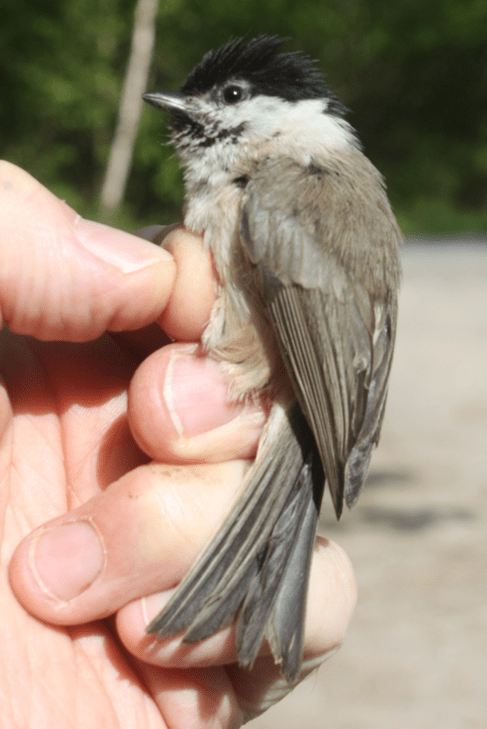
Marsh Tit, Poecile palustris

Our 26th of the year. The best ever haul in the Braydon Forest was 28 in 2017, followed by 27 in 2019. At this juncture it is likely that we will pass the 30 bird mark by the end of the year. All three caught this morning were juvenile birds.

As one would expect, with feeding stations in action, the catch was Blue and Great Tit heavy, but we still had a decent spread of species. We didn’t catch any Great Spotted Woodpecker or Nuthatch but the Goldcrests arrived at 9:30, always nice to find. Although our numbers in Ravensroost have fallen away over the years.

My highlight was, obviously, the Marsh Tits. However, for the team it was a lovely juvenile male Chaffinch, with nice clean legs, so we could ring it, picked up in our second round. That was followed by two more Redpoll, only our fourth and fifth of the autumn, in our third round. I think everybody was happy with the session.

The list for the session was: Blue Tit 9(5); Great Tit 6(5); Coal Tit 2(2); Marsh Tit 2(1); Wren 1; Robin 4(2); Goldcrest 4; Chaffinch 1; Redpoll 2. Totals: 31 birds ringed from 9 species and 15 birds retrapped from 5 species, making 46 birds processed from 9 species.

We had everything packed away by 12:15. As I will not be able to get in to top up the feeders for six weeks, at the end of the session we collected them up and I went over to Somerford Common to set them up there. To my astonishment, the entire shrubbery area around our feeding station site has been cleared, leaving our little island of trees and the one next to it! The rest has been cleared. It is a little surprising, given that it was done only four years ago. Perhaps that is the plan: a quarter of the paddock area cleared, apart from the tree stands, every four years. It will be interesting to see if that concentrates the birds in that small area or if they avoid it, because it is so open all around. I will be setting up the remaining feeding stations on Monday.

Barn Owl Breeding Review: Braydon Forest 2025

In a year when Barn Owls in Wiltshire have generally struggled, due to a lack of voles and other small rodents early in the year, I am relatively happy with what we have found in the Braydon Forest. We had seven successful nests, compared with nine in 2024. Where the key difference is, is in the number of youngsters fledged. In 2024 we had 31 youngsters fledge: three broods of five, four broods of three and two broods of two. This year we had one brood of four, four broods of three, one brood of two and one brood of one, totalling 19 youngsters.

It is clear that the impact has been in the number of eggs laid: restricted by the availability of food. Indeed, we only found one addled egg, although that nest did lose two eggs between first and second visits, when we ringed the three young that had been too small to ring first time round.

This morning I was joined by Miranda and we did final checks on the productive boxes, to check the young had fledged and to clean them out, and for Miranda to collect pellets for the Malmesbury & District Natural History Society to investigate at a later date.

Anyway, my most regular box, Home Farm Barn, did not produce any young this year, but the one over the other side of the road from it, at Echo Lodge Farm, for only the second time, did produce a brood of two. We cleaned it out this morning, accompanied by a dozen sheep, most of whom seemed to be male, and none of whom were bothered by our presence. In fact, we had to persuade them to get out of the way, as they were far too comfortable sitting around the base of the tree with the box in. Certainly not used to sheep being so unconcerned about human presence: makes me think they are more pets than farmed.

The second box we checked this morning was the one with the eggs that didn’t hatch, we did find one of those addled eggs. Unfortunately, it blew as I pulled it out of the box: OMG, the stench was horrific!

Anyway, Miranda ended up with loads of pellets for her natural history group, and we were very happy to find that every brood had fledged!

West Wilts Ringing Group Results: October 2025

Quite an astonishing month: our best ever October in terms of numbers, which is surprising, given that my team and I only managed five sessions.  The weather was the key component but, the one day we could have got out for some Meadow Pipits, I managed to be ill.  As a result, my team didn’t catch any, as against the 40 we caught last October.  It didn’t help that in our session at Blakehill Farm West we had to let 15 birds go unringed because I ran out of AA rings, which would have taken it up to just over 50 birds in the session.  What has made this month’s total so big is Jonny’s efforts, with half-a-dozen sessions bringing in over 100 birds and, in total, catching over 1,000 birds in 10 sessions.  Unluckily for him, a large number of them were Blue Tits, there was even some ringing and flinging.  There are some quite remarkable differences in the catch between now and October last year: some good, some not so good.

Oct25.jpg

Our previous best October was in 2023, with 1348 birds processed from 36 species.  

Included in this years catch but not in last were: Carrion Crow, Great Spotted Woodpecker, Jay, Magpie and, surprisingly. a Sedge Warbler, caught by Jonny at Langford Lakes.  Missing from this year’s catch was quite a lot: Kestrel, Nuthatch, Pied Wagtail, Siskin, Song Thrush and Tree Sparrow.

The three most glaring increases in numbers this year are Blue Tit with 259 ringed and 98 retrapped, against 118 and 52 last year.  Of those, Jonny ringed 179 and retrapped 79.  In fact, unsurprisingly, all of these increases are largely down to Jonny and his 10 sessions in the month.   

Next most spectacular increase was Chiffchaff with 218 ringed and 2 retrapped against 113 ringed and 1 retrapped.  That was followed by Goldfinch, with 124 ringed and 3 retrapped against 79 ringed.

The key species that were down on last year were Meadow Pipit with 108 ringed and 1 retrap, against 248 ringed and 3 retraps. I have already mentioned that my catch went from 40 to zero, Jonny had 103 ringed and 1 retrap and Andy had 5 ringed.  Last year it was Jonny with 205 ringed and 1 retrap, me with 38 ringed and 2 retraps and, Mr Consistency, Andy, with 5 ringed.  

That was followed by Redwing: just 3 caught this year, compared with 129.  One on the Imber Ranges, two at one of Jonny’s farmland sites.  Last year they were caught in seven different sites. Are they running late?

There was a slight surprise that there were no Tree Sparrows this October as Jonny had a 96 bird catch at one of his key sites for the species on the first of the month.

However, the absolute highlight has to be our latest ever ringing of a Sedge Warbler: ringed at Langford Lakes Nature Reserve on the 22nd October. The only other Sedge Warbler caught in October was back in 2005, on the 1st October.

Anyway, you can see from the session statistics just how ridiculously large the average catch sizes came out at.  Even, despite my lack of activity, my 5 sessions averaged out at just under 40 birds processed per session.  If I hadn’t messed up with my AA rings, it would have been over 40, despite Red Lodge’s best efforts to drag it down, with a disappointing 11 birds!  Webb’s Wood helped out very well with that, providing our best catch there ever, even when there was supplementary feeding in place, at 74 birds caught.  I haven’t felt that supplementary feeding has been necessary to date. I judge it on when the Goldfinches, Starlings etc. start hitting the garden for food. I have no doubt that several of Jonny’s catches are absolutely his best for those particular sites.

Laura, at least, had a particular highlight: not only her first ever Magpie but it very kindly rolled over from its back with claws extended, onto its front so she could just lift it our in a ringer’s grip!

Magpie, Pica pica

Anyway, I hope that the weather is better for November! Next week is still looking very windy and wet, but the forecast changes regularly.

Out Again, At Last: The Firs, Thursday, 30th October 2025

It has been 12 days since I have managed to get out ringing. The only decent day last week, Wednesday, 22nd October, I managed to go down with a stomach bug. This Monday my wife had the car, doing her good Samaritan thing: the monthly shop for an elderly woman on the outskirts of the village, who lives in a dilapidated old farmhouse at the end of an extremely rough lane, and has no transport. Every other day in between has been wet or far too windy to set nets – and the rest of this week looks like being the same. Today was scheduled for the wind to get up and the rain to start by midday, so the plan was to pack up at 11:30.

Anyway, it was a relief just to be able to get out and do some ringing. We knew it was going to be breezy, so I decided that the Firs gave us the best chance of getting some ringing done. The blackberries have all gone over now, so I wasn’t expecting a huge catch, as I haven’t set up supplementary feeding stations yet. However, I was hopeful of the odd feeding flock of titmice or lotties and any winter visitors that might turn up. Unfortunately, no Siskin or Redpoll this time.

I was joined by Miranda and Ellie for the session. We met at 6:30 and set the usual nets down the central glade. We started catching straight away, with a Dunnock, as we were walking back having just opened the nets.

It wasn’t the most exhilarating of catches, with mainly Blue Tits, but there were some nice birds as well. Five Wrens, and not one horribly twisted, double-pocketed nightmare between them! Four Goldcrest, one a recapture from earlier this year, was nice. The best part of the catch came in the last round at 11:30, as we were closing the nets prior to taking down, with two Chiffchaff.

The catch for the morning was: Blue Tit 10(6); Great Tit 2; Marsh Tit (1); Long-tailed Tit (1); Wren 4(1); Dunnock (2); Robin 2(1); Chiffchaff 2; Goldcrest 3(1). Totals: 23 birds ringed from 6 species and 13 birds retrapped from 7 species, making 36 birds processed from 9 species.

We had some fabulous view of two Sparrowhawks. The first I saw was a male that landed on a branch in a tree about 20m away from our ringing station and I had fabulous views as it spread its tail for a quick preen before flying off through the wood. Unfortunately, it went away at tree top height and not anywhere near the nets. About 15 minutes later a female Sparrowhawk spent a good ten minutes just circling well above the tree tops, annoying a small flock of birds that kept trying to mob her, but she was clearly undisturbed by them. It was almost like a display flight – perhaps it was!

There were lots of calls by other birds we didn’t catch: arriving on site to a Song Thrush just warming up whilst it was still dark. Later Jay and Great Spotted Woodpecker could be heard calling on and off all morning.

Anyway, as we decided to shut the nets at 11:30, as mentioned before, the wind began to pick up significantly: so we spent quite a lot of time extracting leaves as we closed them up. We processed the last five birds before taking down and clearing away and were off-site about 12:30. By the time we were ready to leave the wind was blowing strongly, so we were fortunate to get done what we did.

Not the most thrilling catch, but nice to get out. I did set up a feeding station before we left, the first of the winter, so I expect we will get larger catches but titmouse heavy over the next few months.