Back on the 8th April I posted about catching a Wood Warbler at Lower Moor Farm. I was very excited about it: I have seen plenty as a birder but had never caught one to ring. As a result, I spent a long time looking into the bird to try to make sure my diagnosis was correct. My decision was made on the following basis:
Wing Length: at 74mm it was longer than the longest given wing lengths for any Willow Warbler in any text I have access to (Svensson, Demongin, BWPi)
Head size: compared to the Chiffchaff taken out of the net immediately adjacent to it, the bird’s head was at least 50% bigger
Bulk: it was just bulkier than any Willow Warbler that I have processed (338 at time of writing)
Colouration: the undersides were pure white, the legs and lower mandible were rose brown, indicative of a second year Wood Warbler rather than Willow Warbler
Wing conformation: the photograph that Anna took of the spread wing looked identical to the photograph in the second edition of Jenni & Winkler of a second year Wood Warbler wing (Fig.36 in that publication).
I asked on the original post for alternative opinions. Despite a lot of views nobody disagreed with my diagnosis. That information was also shared with two of the senior members of the group, with over 80 years ringing experience between them (no insult intended to the rest of the group: they are a lot younger than us old fogeys, and consequently have less experience). Initially one agreed with my diagnosis, the other said he would do an analysis of the data and come back to me. When he did, his diagnosis was Willow Warbler. His reasons for this were:
Colouration: the complete absence of yellow on and around the neck region.
Weight: within range for a Willow Warbler
Tail: within range for a Willow Warbler
Primary 1, when counting descendantly, was longer than the primary coverts, an absolute diagnostic characteristic of Willow Warbler. Wood Warbler P1 is always shorter than the primary coverts.
Of these, the colouration is as shown in BWPi and the Concise BWP for second year Wood Warbler. So the lack of yellow does not immediately disqualify it as a Wood Warbler. The weight and tail are both within the normal ranges for both Wood Warbler and Willow Warbler. However, the weight is mid-range for a Wood Warbler and towards the top end of the range for Willow Warbler. One would have thought that a newly arrived migrant would have weighed lower in the scale. Of the 489 Willow Warblers processed by our group in the month of April, 11 have hit that weight or more, so it isn’t unique. Whilst the wing length is outside of the extremes given in the texts mentioned, looking at our group records there is a record of a Willow Warbler with a 75mm wing caught and ringed at Swindon Sewage Works on 19th August 2012 by an experienced ringer, so I expect the record to be accurate.
However, the one thing that cannot be overlooked is that first primary exceeding the length of the primary coverts. Having reluctantly accepted that to be the case, one of the more experienced members of the team suggested Phylloscopus trochilus acredula. Checking that bird out: it all matches well to the bird that I caught, including primary one exceeding the length of the primary coverts. As a result, I have changed the record to reflect that subspecies of Willow Warbler. Accepting that this is the correct identification one has to put the head size and seeming bulk down to clinal variation.
Having not had any experience of this subspecies, I have had a look at the details of the bird and this subspecies summers from Scandinavia across Siberia to the River Yenisey. Online resources label it as the Northern Willow Warbler. I asked the BTO if they could let me know how many of this subspecies have been ringed in the UK. Including this bird there have been 21 identified as acredula and ringed in the UK and 3 in Ireland. Interestingly, the first record was on the 23rd July 2017 – in Wiltshire. This is the second for Wiltshire. The majority have been caught in Dorset (nine) and there have been two caught next door in Gloucestershire.
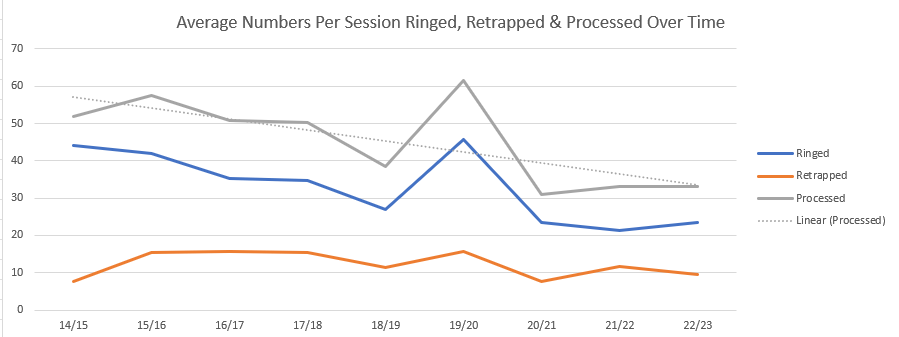
The point of a constant effort site (CES) is that the same nets are set in the same places, for the same length of time, over 12 sessions approximately 10 days apart, year on year. This is the ninth year of my CES at Lower Moor Farm, with 2020 being missed out due to Covid restrictions. So I now have data for eight full years. What it shows, in the lead up to this year’s CES, is a significant decline in the catches over the period. I am currently doing an analysis of the possible reasons for this for my annual report to the Wiltshire Wildlife Trust.
When looking at each full year in turn, (1st April to 31st March) even with a significant spike in numbers in 2019, the overall trend is a decline in average catch size for the site:
The number of species is not as much of an issue (yet?):
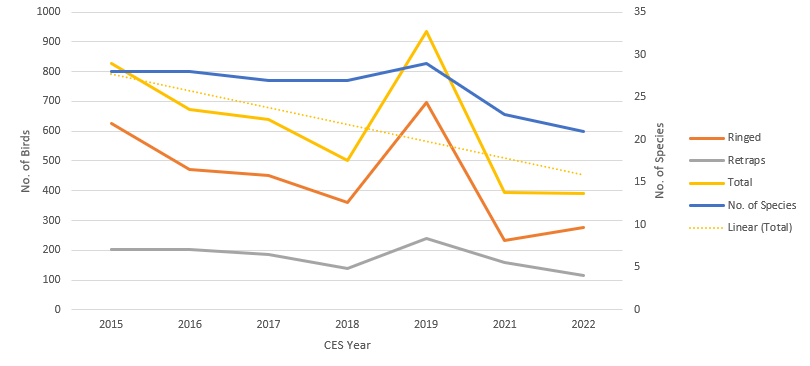
There is a slight declining trend. but nothing as clear as the reduction in the size of the catch. When I shut this down to just the CES period, the decline becomes rather clearer:
The trendline shows that there has been a significant reduction in the size of the catch but, unlike for the year as a whole, there is also a clear reduction in the number of species since 2019. So to 2023!
The first session delivered 21 birds: 9 ringed and 12 retrapped from 10 species. Although still another reduction, this compared favourably with session one last year: 24 birds: 11 ringed and 13 retrapped from 8 species. On to session two. Last year delivered 20 birds ringed and 8 birds retrapped from 12 species. So what happened in CES 2, 2023:
Unfortunately I was working solo for this session, so I had a 4:30 start to get the nets up and open by 5:30. There was no rush: despite having them open on time I didn’t catch my first bird until 7:00. It was slow all morning: and the end catch was disappointing, to say the least. I was joined by Laura and son Adam at just after 8:00, and then dad Mark at 10:00, having dropped his other son off for a Duke of Edinburgh Award route march first.
Adam, in his fledgling career as a ringer, got to ring a couple of birds: a Blackcap and a Robin. The highlight of the morning (there was one) was a newly fledged brood of Robins. I extracted three of them close together in the same net. On examination, all still had both wing and tail feathers still growing. The wing feathers were between 5 and 10mm shorter than I would expect but the tail feathers were less than half full grown. It seemed to me likely that they had fled the nest in response to some sort of threat. We processed them and then returned them to the area that we had originally found them in, in case the parents were in close proximity. They all flew off okay. Interestingly, in my last round I recovered one of the youngsters, but in the net ride furthest away from where we originally caught them.
The list for the session was: Great Tit (1); Long-tailed Tit 1; Wren (1); Dunnock (1); Robin 3(1); Blackbird (1); Blackcap 2; Garden Warbler 1(1); Chiffchaff (2); Goldcrest 1. Totals: 8 birds ringed from 5 species and 8 birds retrapped from 7 species, making 16 birds processed from 10 species. So, this session was over 40% down on last year! I hope that things pick up in future sessions or I might have to consider whether the effort required is matched by the return.
As ever, Laura, Mark and Adam helped me pack away at 11:30: I was extremely grateful, and away from site by 12:30.
I don’t do a lot of nest finding in the breeding season: I am always worried that I might accidentally expose the nest location to a predator. However, I am happy to do my Barn Owl boxes and to check on those nests that are otherwise open to view, like Swallows or box nesting titmice.
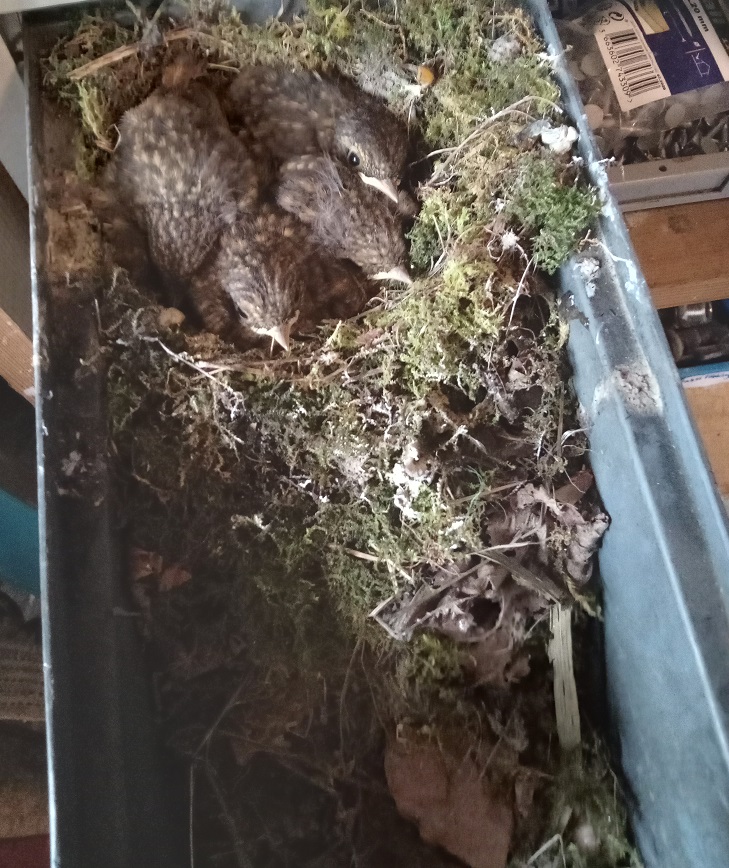
Rosie has been monitoring a Robin’s nest in the tool shed at Clattinger Farm, since she found them nesting in a plastic container. It is a pretty safe place to nest as access is through the window being left cracked open. Large enough for Swallows, House Sparrows and Robins to get through but not so for a predatory bird. The young were blind and naked on the 29th April and too young to ring, so we left them until we came back from Portland Bill. Yesterday evening we visited them to see if they were ready for ringing. Not only were they ready, their flight feathers were two-thirds grown and I expect they will have fledged by the end of next week. We ringed these four and then left them in peace:
The Swallows are back in force, with half-a-dozen actively building / repairing old nests within the stable block. Hopefully we will have some youngsters to ring in there in the next few weeks. One set that we will definitely have a possibility of ringing is a Blackbird’s nest. She is currently sitting on eggs in a nest immersed in a wall of ivy in the barn. Hopefully they will hatch and we will have a brood to ring in the next week or two.
Yesterday afternoon I received an email from the RSPCA Oak & Furrows Wildlife Rehabilitation Centre. They have a Tawny Owl ready for release, and a whole bunch of young birds that have been brought in having fledged prematurely. I went over to check on the birds, ring those that were ready to be so, and discuss the others.
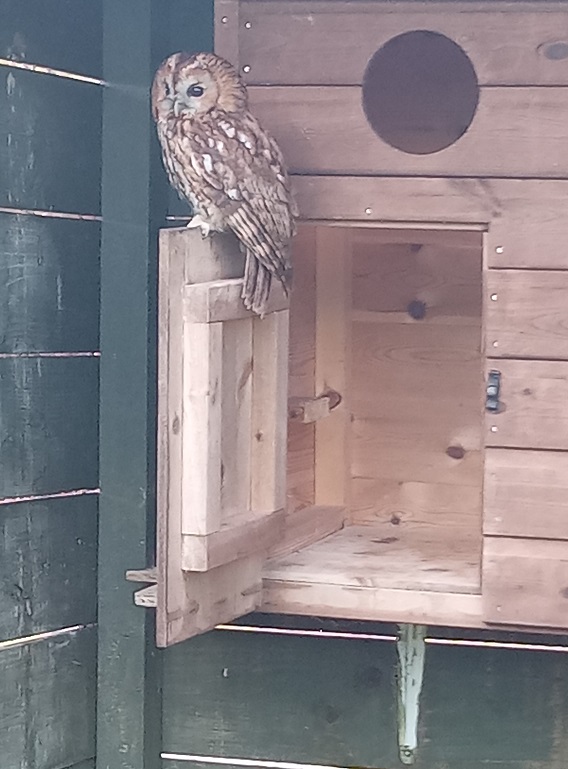
The Tawny Owl is definitely ready to go, flying around the pre-release enclosure and turning a few aerobatics at the same time.
It is a male bird that fledged last year.
In the “nursery” I was pretty astonished to see just how many juvenile Starlings there were. They are being inundated by well-meaning people finding Starlings that have come out of the nest and, rather than putting them somewhere safe where the parents can find them, they have been collecting them up and delivering them to Oak & Furrows. I didn’t ring them as my agreement with them is to focus on birds of prey, Corvids and the occasional unusual specimen.
However, I did ring juveniles of Mistle Thrush, Blackbird, Rook and Magpie: all of which will be releasable in the next week or so. There are a couple more Magpies to be ringed next week and a juvenile Tawny Owl who will probably get ringed in a fortnight’s time.
The highlight for me was, though, the opportunity to ring a couple of Swifts. I have not done them before. They take the same rings as Kingfishers, and for the same reason: they have the shortest legs imaginable on a bird. It is the only ring applied using fingers, not pliers, and are gently rounded again by fingers. I suppose that when you spend your life on the wing the evolutionary pressure is for streamlining rather than for leg development. Both birds had been found grounded, underweight and dehydrated. Thanks to the care given by the excellent team at Oak & Furrows, they are now back to a median weight and will be released in the very near future.
The working relationship with Oak & Furrows enables me to improve my knowledge of birds that I don’t get to ring in the normal course of my ringing sessions. I value it, and I think they value the inputs that I can give about the birds in their care.
In an effort to expand on their experience, Anna arranged for herself and Rosie to go to Portland Bill this weekend. Unfortunately for them, that meant dragging me along as well. Needless to say, when this was organised there was no inkling of what would be happening this weekend. Fortunately, there is no television at the Portland Bill Bird Observatory.
Being a Bank Holiday weekend, the traffic down the A350 / A354 past Melksham was abominable and, despite leaving from Purton at 9:30, it was 13:30 by the time we got there. We were met by Jodie, whom I previously met when Jonny, Ellie and I went to Skokholm in 2019, who is doing her second stint as assistant warden, and later by Martin Cade, the warden of the Observatory.
Naturally, being a Bank Holiday, the weather was not very good! Fortunately, the garden at the Observatory is very sheltered and so wind is not a big problem there. Obviously, rain prevents ringing and rain, wind and fog all affect the arrival of migrants. The nets were already open when we arrived at the Observatory, and we took over from the previous ringers at 14:30. Unfortunately, there were absolutely no birds hitting the nets until, at 18:50, just as we had decided to give it up as a bad job, we caught this beauty:
Neither Rosie nor Anna have processed a Pied Flycatcher before, Rosie processed this one. It had already been ringed a couple of days before, so it was processed as a recapture. In fact, it was seen every day of the weekend, but not captured again. Although it is very brown in colouration, it is a second year male. This is identified by the two white spots on the forehead, one either side of the beak. The tail was blackening up, to add further evidence as to its sex:
This ageing and sexing was a little outside of my comfort zone, having personally only ringed or handled a single specimen (on Skokholm, back in 2014), so it was good to have Peter, one of the long standing members of the observatory, on hand to help (as well as the Demongin & Svensson reference guides).
Saturday dawned wet, windy and miserable. It remained so until about 10:30, by which time it had calmed enough for us to open the nets and started to catch a few birds. None of the catches were heavy, for different reasons each day, and it meant that we had lots of trips around the nets, often returning with nothing to show for it. Saturday’s first birds were a couple of Blackcaps at just before 11:00. Anna then got the opportunity to ring her first ever Whitethroat at about 11:30, and then straight after lunch she got to process her first ever Woodpigeon.
The catch for Saturday comprised: Woodpigeon 1; Wren (1); Blackcap 2; Whitethroat 1; Willow Warbler 1; House Sparrow 2. Totals: 7 birds ringed from 5 species and 1 retrap, making 8 birds processed from 6 species.
Sunday dawned dry but, unfortunately, after the rains of Saturday cleared, the mist rolled in on Saturday evening. The foghorn started up at about 18:00 and was still going at 6:00 the next morning, whilst we were opening the nets. As a result, it was another quiet day, with no falls of warblers or other migrant species. The numbers caught were low, but the quality was good for two relatively inexperienced trainees. Between 6:00 and 10:00 we caught a number of the expected migrant species: Blackcaps, Willow Warblers and another Whitethroat, plus two retrapped birds: a Chiffchaff and a Whitethroat (both ringed at the Observatory this season). Soon after 10:00 Rosie got her chance to process her first Woodpigeon.
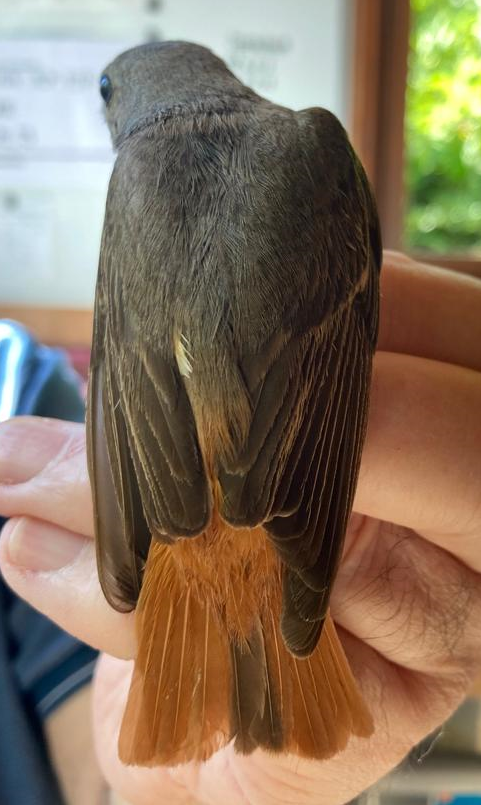
We then caught a couple of lovely birds. First off was a female Redstart:
I don’t have a good enough portrait shot to put up, but this shows the female colouration and the bicoloured tail. Note the dark central tail feathers, which is helpfully diagnostic of this species, especially if one is not familiar with Nightingale, that has a uniform tail colouration.
This was followed soon after by a Swallow. We usually catch our birds in mist nets: this one decided to fly into the Observatory building itself, colliding slightly with one of the windows, without harming itself, and being caught by hand by Jodie. Once processed it flew off strongly away from the garden.
We had a Willow Warbler at 14:00, and then caught absolutely nothing for the next two hours, until this lovely male Firecrest turned up in the nets:
Those facial markings do make him look cross!
However, he did pose nicely for the few seconds it took to get these photographs. The rest of the session comprised recaptures of three Blackbirds and a Robin.
The list for the session was: Woodpigeon 1; Swallow 1; Redstart 1; Robin (1); Blackbird (2); Blackcap 3; Whitethroat 1(1); Chiffchaff (1); Willow Warbler 3; Firecrest 1. Totals: 11 birds ringed from 7 species and 5 birds retrapped from 4 species, making 16 birds processed from 10 species.
Although we were scheduled to be ringing the site Monday morning, the overnight forecast was for it to start raining between 5:00 and 6:00 and to get progressively heavier until lunchtime, with no let up until late afternoon, if at all, so we took the decision to head home after breakfast. It was a shame that we didn’t catch more birds, but we had nearly three days with a bunch of very friendly people. Coincidentally, the journey home took just two hours!
Outside of the bird ringing, we saw some lovely birds whilst there. I was lazing around the site whilst Rosie and Anna were checking the nets, when I came across a Spotted Flycatcher perched on the end of a branch in a tree lining one of the unused net rides. I spent a good few minutes watching it hawking for insects, in that typical flycatcher way. Rosie and Anna came along in time to see it go about its business.
Over the course of Friday, through Sunday, a Cirl Bunting was seen, and heard, regularly in the grounds. It was clearly a singing male. However, other sightings from outside the garden indicated that there was a pair in the area. Hopefully these Cirl Buntings are a sign of an increasing natural eastward spread of this species from its Prawle Point isolation.
Sunday afternoon, whilst I manned the empty nets, Rosie and Anna went out with Mark Cutt, a local birder and ringer, to check on a nest box that was occupied by Great Tits. Unfortunately, they were introduced to the dark side of Titmouse breeding: of the seven chicks in the box, five were dead and two were too small to ring. It is hard to know what caused the deaths: most likely one of the parents has met its end and the other is struggling to keep them fed. Mark then loaned them his thermal imager, so that they could go out see what was about after dark. They got some excellent views of the Bill’s Little Owls.
Out on the sea regularly were hundreds of gulls of multiple species, including many Kittiwakes. There were plenty of Gannets out there as well, but the star seabird that I saw was a passing Arctic Skua. Unfortunately, I dipped on the Pomarine Skua and I didn’t get out of the Observatory grounds to go and see the Guillemots and Razorbills – but that was my own fault / decision.
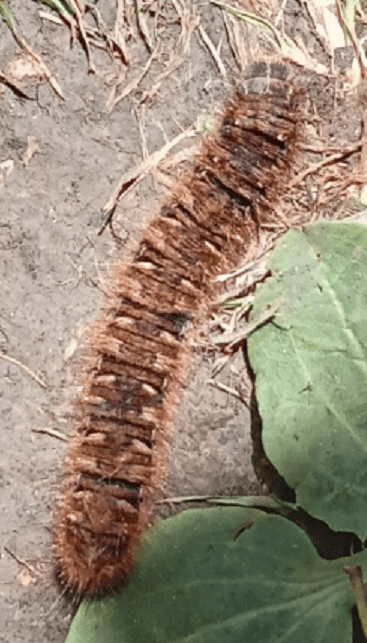
The garden was very busy with insects: Rosie identified three species of Bumble Bee: Early, Buff-tailed and Red-tailed, together with lots of Honey Bees. She also found a Glow Worm. I came across this beauty on the path:
It is a caterpillar of the Oak Eggar, Lasiocampa quercus. They overwinter as a half-grown caterpillar and then feed up until pupating in June. This specimen was approximately 8cms long. Up on the balcony of the Observatory this caterpillar turned up:
This is the caterpillar of the Ruby Tiger, Phragmatobia fuliginosa.
So to sum up: not as many birds as we would have liked, but that has been the norm for my sites back in Wiltshire anyway. It is a great place to go for a weekend, whether ringing, birding or just hanging around and chilling: all of which was happening whilst we were there. At £20 per night it is not an expensive weekend.
The Observatory has a fabulous bookshop, well stocked with a huge range of natural history titles. New books are actually as cheap, or cheaper, than any online retailer. Second-hand books can cost as little as £1:00. Rosie took full advantage of the second-hand racks and I bought “European Birds” by Hume, Still, Swash & Harrop, for £15:00. The cheapest price I saw online, from the obvious suspect, was £17:50, elsewhere the absolute cheapest price for a new edition was £16:50. It took all my self-control not to spend over £100 on books.
I fully expect to go back for next Spring migration with whichever trainees fancy having a go. Just a week or so before we arrived there, the team processed over 600 birds in a single day. That would be daunting, but with the availability of experienced local ringers, entirely manageable.
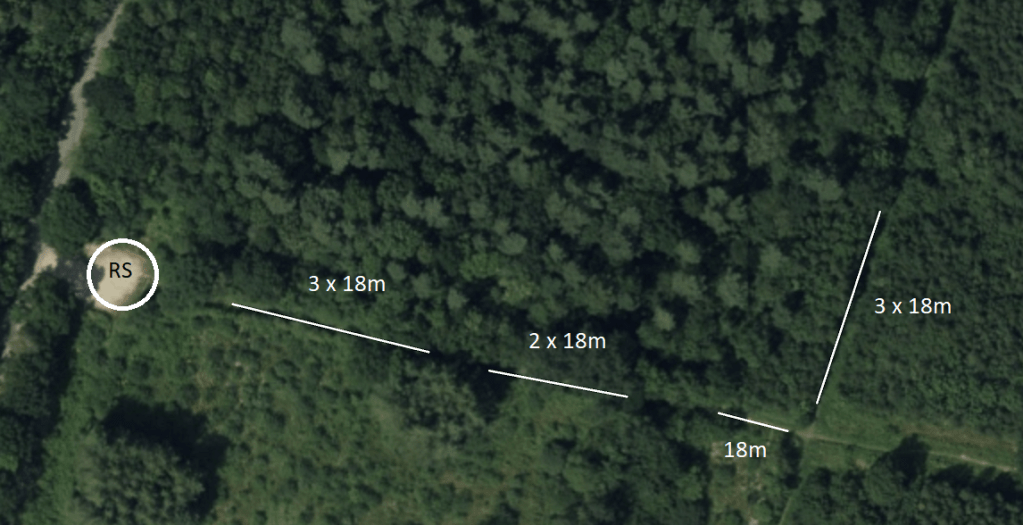
Today was the first session of the Lower Moor Farm constant effort site (CES) for 2023. This is the seventh year of this CES, and it was certainly the oddest first session I have had so far. Rosie and I met at 5:30 and got the nets open by 6:30, which immediately caught a retrapped Robin. This was the net setup:
We processed the Robin and released it: and then we caught it again and again and yet again. Unfortunately, it was a theme that ran throughout the morning. Several of the birds we caught and processed were recaptured later in the morning. The first Robin, a Dunnock and a male Blackcap were all caught multiple times: driving me to distraction. Had they not all been males I might have shut the nets: I don’t like keeping females away from the nest when they might be on eggs or brooding young.
It started out slowly: we caught nine birds before Rosie had to leave for work at just gone 8:00. On the last round before Rosie had to go we extracted a pair of Nuthatch. I use the term “pair” deliberately: a male and a female next to each other in the net, with both in breeding condition, and they flew off together upon release. Prior to these two, we have caught just three other Nuthatch at Lower Moor Farm: two in 2016, one in 2019. Not exactly a common catch at this site.
It was a frustrating morning in many ways, but particularly between 10:00 and 11:00, when I caught precisely nothing. As a result I decided to shut the nets. I checked them all before closing and, having walked past empty nets all the way to the end of 18m + 9m combination, I started to close them from that end. When I got back to the 3 x 18m setup alongside the lake, at the far end were three birds: a pair of Bullfinch and my first Garden Warbler of the year. That cheered me up a lot.
When I went to shut the separate 3 x 18m ride I extracted two male Blackbirds and a Wren: all three were recaptures.
Something that was particularly odd about this catch: not one Chiffchaff or Willow Warbler caught in the entire session. On the 8th April we caught and ringed seven Chiffchaff and a Willow Warbler, but I didn’t even hear any Chiffchaff calling this morning, although there were a couple of Willow Warbler singing.
The list for the morning was: Nuthatch 2; Treecreeper (1); Great Tit (3); Wren (1); Dunnock 1(2); Robin (2); Blackbird 1(2); Blackcap 2(1); Garden Warbler 1; Bullfinch 2. Totals: 9 birds ringed from 6 species and 12 birds retrapped from 7 species, making 21 birds processed from 10 species. This is on a par with first CES sessions in previous years.
Non-ringing highlights of the morning included a very pleasant 20 minutes with Debbie: the vicar of the parish of Cricklade. Not just a very capable vicar and good company but an astonishingly good photographer: her collection of Bittern photographs were superb. That they showed an adult with well-developed recently fledged young was not something I have ever seen before.
There was also a photographer to whom I owe an apology: whilst we were chatting I noticed a falcon flying across Mallard Lake. It was my first Hobby of the year. I had excellent views as it flew away from me. Unfortunately, my brain played a trick on me and, instead of saying Hobby, it came out Merlin. I only realised my mistake when Debbie mentioned that he had told her he had seen a Merlin. By the time I got to the hide he had been in, he had left, so I wasn’t able to correct my error.
Finally, I got to hear my first Cuckoo of the year, calling from the far side of Mallard Lake. Having cleared everything away, but chatting to a succession of interested people, I finally got away from site at 13:00.
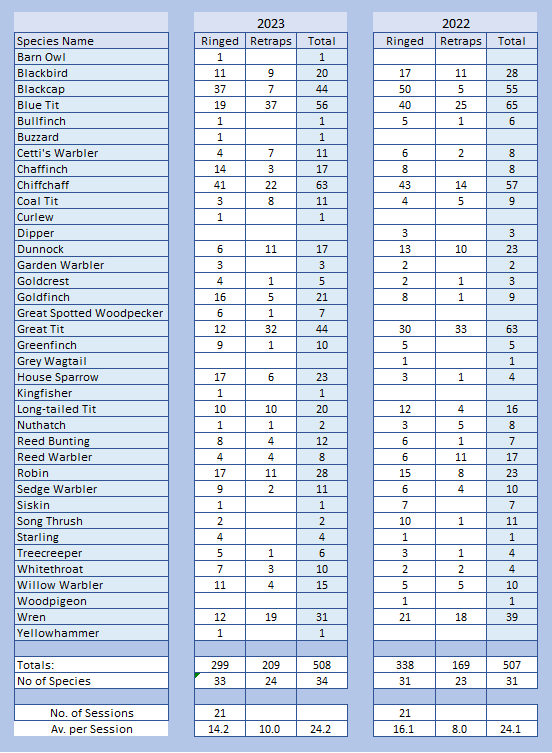
For the group, this month was almost identical to April 2022, only with three more species:
Lots of summer migrants have started to arrive. Hopefully the weather will be kind and they will hang around more this year than they did last.
Of the additional species this April, one was Barn Owl and another was Buzzard, both ringed pre-release at Oak & Furrows. Yellowhammer, Great Spotted Woodpecker and Kingfisher were also additional to last April. Missing this April were Dipper (not for want of trying), Grey Wagtail and Woodpigeon. Jonny and I did have a go for Dipper last Thursday. Unfortunately, the Bybrook is still running hard, fast and high and there was no sign of Dipper where we set up, although the site is a known Dipper territory. We plan to try again elsewhere this week.
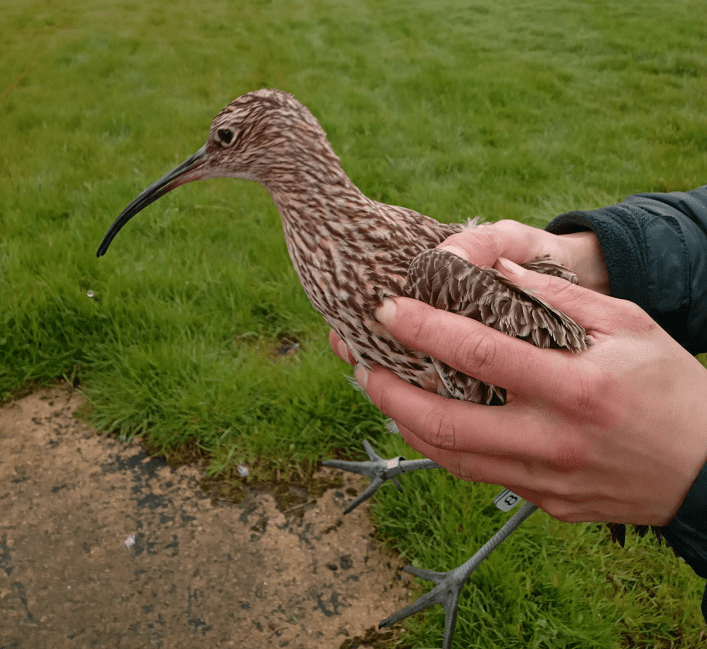
My highlight of the month was the other species that was different to last April: Curlew. As posted about on Friday last, Jonny organised that we would meet up with a couple of experienced Curlew catchers from the Wildfowl & Wetlands Trust: Kane Brides and Dan Gornall. We used a whoosh net, with a decoy and lure, caught one and were unlucky not to catch a second. I was lucky enough to ring this one: an adult male:
I start my Constant Effort site tomorrow: hoping it will be busier than last year.
Kane Brides and Dan Gornall from the Wildfowl & Wetlands Trust kindly offered to help Jonny and me try to catch some Curlew this season. When we last did it, two years ago, we used a combination of mist net and clap net, with a decoy and sound lure. This resulted in us catching and ringing the first adult Curlew in Wiltshire since 1992! Kane and Dan use a Whoosh net to catch their Curlew, and this was what we were trying out this morning.
We met at the entrance to Blakehill Farm at 8:00 and then headed down to the farm to setup the first attempt:
A whoosh net is a large net that is loosely gathered along its rear axis. A pair of bungee cords are fixed at a distance from the net, put under tension by being pulled up to the net line and then fixed in place to an angled pole at each end of the net by use of a pin fitting into a hole in the pole. The pins are attached to a cord and the whole thing is fired by yanking the cord to dislodge the pins, leading to the release of the bungees that spreads the net over the area it covers:
To finish the setup we placed a decoy together with a loudspeaker playing a variety of Curlew calls.
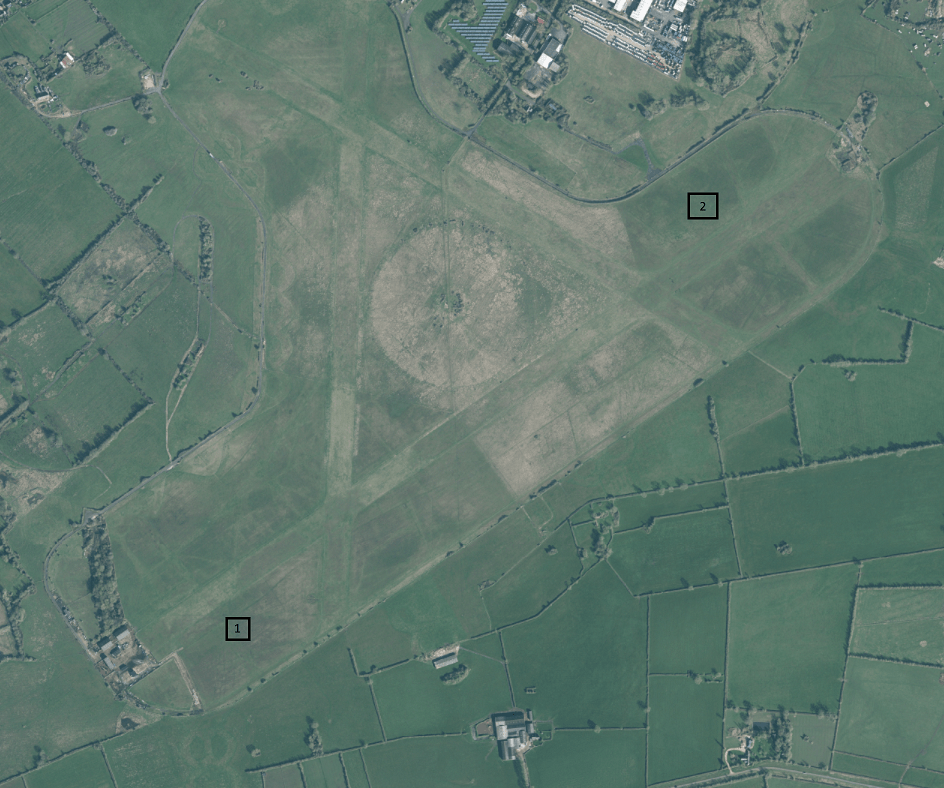
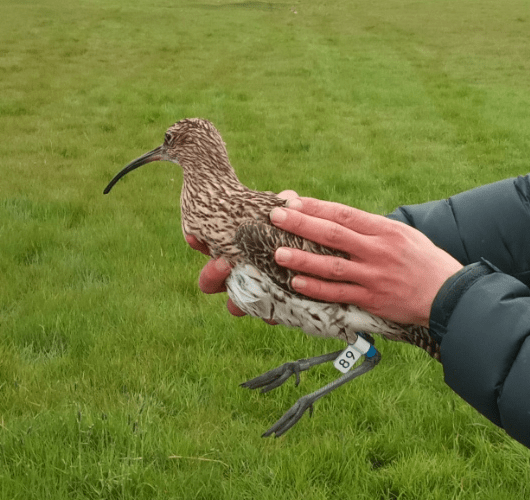
At site 1, as soon as we finished setting up and switched on the lure, a Curlew arrived. It was incredibly aggressive towards the decoy: flying around the setup just a couple of times before landing to explore what was happening. It very quickly attacked the decoy and knocked it over. After the attack it jumped over the back of the setup, so we couldn’t fire the net. Fortunately, it came back for a second go at the decoy a few minutes later, and this time was in a position where we could fire the net and the bird was caught. It was an adult male:
We took all of the usual biometrics: weight and wing-length, and also measured the head and bill length, the feather to bill-end length and the tarsus length. Kane also took a few flank feathers for DNA analysis. This is to monitor for possible inbreeding, as the population has shrunk over the decades this becomes more likely.
The bird was ringed with a standard BTO metal ring and fitted with a leg flag on the left leg. As you can see from the top photo, the flag is white, number 89. Our previously ringed and flagged Curlew has been sighted on 24 occasions since it was ringed, without it needing to be retrapped. This just shows the value of using these leg flags for providing information on the movements of these birds. We know that bird has spent the following two winters in Cornwall, at Porthcaro, returning first to the Cotswold Water Park, then back to Blakehill, and then commuting between Blakehill and the fields around Pound Farm on the Red Lodge estate and around Lower Pavenhill to the west of Purton.
After our successful first go we drove around to the Chelworth side of Blakehill and set up in area 2. Once we had set up and switched on the lure it took a bit longer for it to attract in another bird. This one was much less aggressive towards the decoy. It flew around for quite a while before landing to investigate / confront the decoy. After about 30 minutes of moving in and around the whoosh net it finally got into a position where we could fire the net.
Disaster! Well, not for the Curlew, as it escaped from the net. We could not understand how it got away until we checked the net. Unfortunately, the breeze had increased whilst we were setting up, and on firing it created a billow which caught on the decoy, so it did not fully deploy, leaving space for the Curlew to escape. It circled around for a few minutes before flying off to another part of the site. There is always next time.
It was a very enjoyable morning, especially for me, being able to add Curlew to the list of species that I have ringed. We were serenaded all morning by Skylark song: it seems to me that there are far more at Blakehill this year. I think my next project will be to see if I can map the nests on the plateau. One good thing about where they are, there will be no early silage cutting, as is already happening all over the country, to the detriment of ground nesting birds. I am always annoyed by the way that Corvids and foxes are blamed for the decline of ground nesting birds, whilst the carnage of early silage cutting is completely ignored, but is almost certainly a much bigger problem.
Talking of mapping, I couldn’t help but notice the extensive tracts of Cowslip all over the plateau. Looking more closely, as we were gathering grass to hide the bungee cords and net, I was surprised at the plants to be found in the mix: Plantain, Common Vetch, Meadow Cranesbill, Clover etc. That has to be a good thing.
I plan to run my weekend ringing session along the perimeter track at Blakehill tomorrow, having noticed a reasonable number of Linnet flying around the hedgerow this morning.
I started the morning at Red Lodge, meeting with Miranda at 6:00, and setting the nets in the usual place for our breeding season sessions. After another poor return I might have to rethink!
The only nets that caught any numbers were the three nets along the main path. We had the usual lures running for arriving migrant warblers but the numbers were just very low. To be fair to the site, April has never been the busiest month, but this was the third lowest catch at Red Lodge. Unfortunately, the second lowest was the catch made on the 5th April, also this year. The lowest catch was back in 2015. The weather was cold for this time of year and I am pretty sure that impacted on the catch, especially the 3 x 18m ride at 90o from the main path. This is usually our best net, but it is in cover and never warmed up.
The list for the morning was: Nuthatch 1; Blue Tit 2(2); Great Tit 1; Robin 1; Blackcap 3; Chiffchaff 1(2); Goldcrest 1. Totals: 10 birds ringed from 7 species and 4 birds retrapped from 2 species, making 14 birds processed from 7 species.
Miranda had mentioned that she would like to ring a Nuthatch and, as just about the last bird out of the net, she got her wish. All of the birds caught were showing signs of either coming into breeding condition or, in the case of two of the Blue Tits, ready to go. Interestingly, all four of the Blue Tits caught were females. Two had fully developed their brood patch and two had not only fully defeathered but were showing the skin folds associated with the raised blood vessels needed to brood their eggs and young. As our ringing station was no more than 20m from the nets, and with such a small catch, no bird was inconvenienced for more than 5 minutes.
When the weather clouded over, and we felt a few spots of rain, we decided that was time to call it a day, so we packed up and were away from site shortly before midday.
After a quick trip home to unload the car, have some lunch and grab my waders, I was back on the road heading to Box, where I had arranged to meet Jonny Cooper. Last summer Jonny kicked off a project to monitor Dipper on the Bybrook, most of which runs through Wiltshire. The source of the Bybrook is near Burton (not the brewing hub, that is Burton-on-Trent, this is between Acton Turville and Nettleton, and just south of the M4), and it runs southwards, past Castle Coombe, before bending south-westwards to meet up with the river Avon at Batheaston. We met up just to the west of Box. Having arrived a bit early, I had time to stop for a welcome pint at the Northey Arms: Butcombe Original bitter is a fine brew, but a pint of that plus a packet of Tyrrell’s Cheese & Chive crisps, coming to £6.10, makes it a very occasional treat and not something to be done every day.
Anyway, we met at 14:00 and donned our waders and lifejackets (health & safety comes first), and headed down to the river. Jonny being considerably younger and fitter did all of the hard scrambling, whilst I lowered myself down to the river bank in a leisurely, if entirely ungainly, manner, and set a single 9m net across the water. The net was set in a stretch that was no more than 100m long between two bridges that could provide suitable nest sites. Last year this site was active, with at least one pair nesting. Unfortunately, this year their early efforts were washed away, but we were hoping that they would be trying again. The river was still in full spate but a few of the rocks on the edge were proud of the water and offered perching spots for them.
We retreated up the bank into cover and waited and hoped, and waited and hoped. Jonny went off to see if there was any sign near the western bridge, whilst I stayed put to monitor the net, just in case anything flew in. Unfortunately nothing showed, they must have moved on for now. After an hour we also decided to move on to check out a potential nest site near the centre of Box, underneath a railway bridge. As Jonny lowered himself into the brook it quickly became clear that it was too deep to risk the walk through the tunnel, so we brought a halt to the proceedings.
It just goes to show, there are no guarantees when working with wildlife. Hopefully the brook level will fall over the next few weeks and we will be able to carry out some more checks for nests and youngsters. It is an ongoing project and there is no rush.
It was nice to have a full team out this morning. I had Ellie, Rosie and David with me from 6:00. Laura and Adam joined us at 7:00. I moved away from our winter feeding area to the main carpark, where we set up our ringing station, and then set our nets along the main path, up the hill, and then to the left of the crossroads at the top:
Having arrived a little early for the session, I was waiting for the others when a couple of cars turned up that I didn’t recognise. It was a pair wanting to fly some drones over Somerford Common to do some aerial mapping. When I explained what we were there to do, they kindly decided to move over to the western area and do their mapping there. Not sure what they were likely to see: the mist was really quite thick.
I set lures for Blackcap, Chiffchaff, Willow Warbler and Whitethroat: they all worked! The catch wasn’t huge, but on a par with recent sessions at Lower Moor Farm and in my garden. It was a nice catch though. The highlight had to be our first Whitethroat of the year:
It was very much a migrant session, with both Chiffchaff and Willow Warbler making up the bulk of the catch. One point of interest was that we caught two Long-tailed Tits close together in one net. On examination, both were female, one with a well-developed brood patch, the other a developing brood patch. When released they originally flew off in different directions but then came back together. I am wondering whether it was an adult with a brood accompanied by a failed breeder from this year collaborating on rearing this year’s brood. We know it happen with this species, so why not?
The list from the morning was: Long-tailed Tit 2; Dunnock (1); Robin 3(1); Blackbird 1(1); Blackcap 2; Whitethroat 1; Chiffchaff 6; Willow Warbler 4(2). Totals: 19 birds ringed from 7 species and 5 birds retrapped from 4 species, making 24 birds processed from 8 species.
The two retrapped Willow Warblers were ringed as adults 3 and 4 years ago respectively: that’s a lot of miles they have covered in their migration to and from sub-Saharan Africa.
And so to the reasons for the title of this piece. As Laura and I were walking down on one of the net rounds, we both heard a grasshopper reeling – and then we heard a second one. This continued for several other net rounds. It was clear that we had two male Grasshopper Warblers in the scrub behind the 2 x 18m net set up being territorial. Unfortunately, I did not have a suitable lure for the species with me today. Adam managed to get a signal on his phone and downloaded an MP3 of Grasshopper Warbler, which he then proceeded to play close to the net. Unfortunately, whilst they showed some interest, they stayed out of the nets, but we did get some really good views of one of the birds. With a bit of luck, and a bit more preparation, I might be able to catch them next time. It all depends upon whether they are genuinely setting up territory there or just passing through.
With the catch dying off at 10:50, after the second empty net round, we closed the nets and took down and got packed away by midday. All in all, a satisfactory session, with not a Blue or Great Tit in sight to bother our fingers!
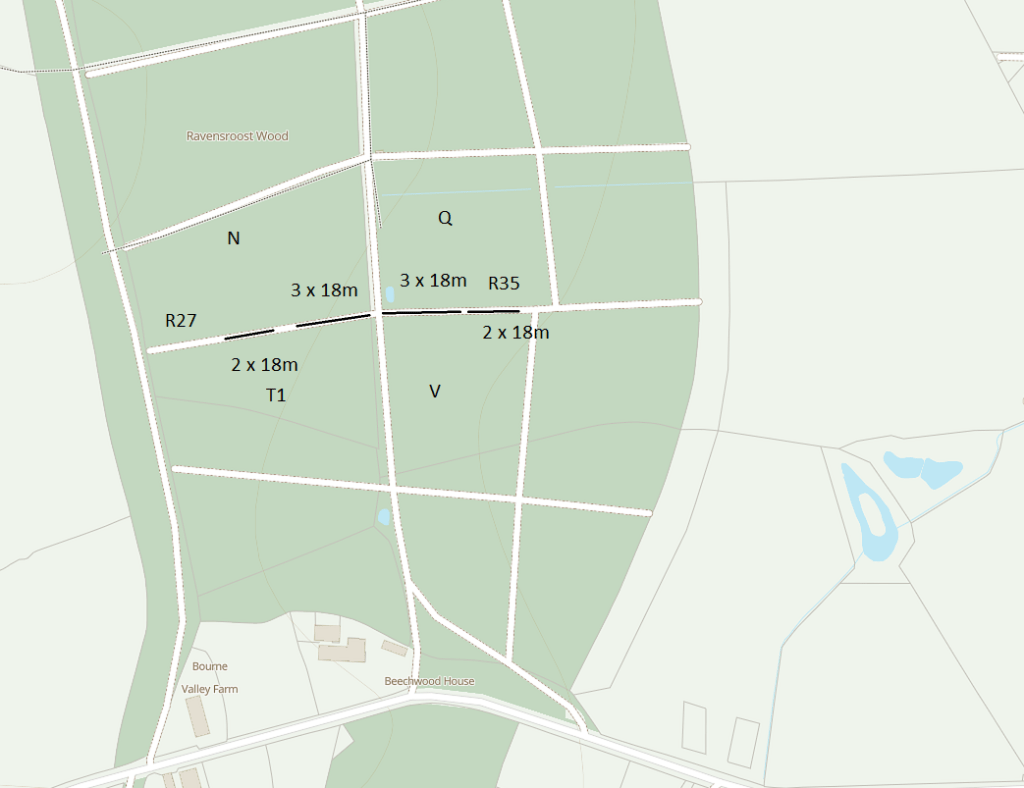
With the forecast for Wednesday to be dry but a bit breezy, I decided to try a session at Ravensroost Woods, now that it has been reopened. It has generally been the one of my sites that is largely windproof. With the wind expected to be from the East-North-East direction, I chose to set nets along rides R27 and R35:
I was joined by Miranda and Rosie, Miranda for the whole session, Rosie doing her usual selfless set up, hope to ring a bird and go to work. We met at 6:00, and a bit later we were joined by Teresa and Alan. Teresa is looking to develop her skills both as a photographer as as a naturalist, and I am happy to help: especially as she does take some excellent photos.
It was quiet but we did start catching birds. However, by 8:00 the wind direction had changed and it was playing havoc with the nets. In order to ensure the safety of the birds from any potential shear forces, I shut the nets at 8:15 with just seven birds caught: Great Tit (1); Chiffchaff 4(1); Willow Warbler 1. Totals: 5 birds ringed from 2 species and 2 birds retrapped from 2 species, making 7 birds processed from 3 species.
A small catch but the retrapped Chiffchaff was a nice find. It was ringed as an adult in April 2019, so it is at least 5 years since it fledged and four years since it was ringed. Not bad for a migratory bird that weighs in at less than 8g. It has not been retrapped in the intervening years.
It isn’t often that I am home from a ringing session at just gone 9:00 in the morning. Just in time for breakfast!












 Ringing In The Braydon Forest & Beyond