This February had a significantly better result than any previous, although we did manage 17 sessions this February, compared to 13 last year. Incidentally, 13 sessions per month is the average for February since 2013.
Jonny’s Blackcap, caught at his Melksham site, is only the fourth caught in February by the Group. He also caught three Linnet at his Hilmarton site: the only ones ever caught in February away from my Brown’s Farm site.
There were significant increases in the numbers of Chaffinch, Chiffchaff, Dunnock, Goldcrest and Great Tit. The Chiffchaff catch was quite startling: with ten caught at Langford Lakes, eight ringed and two retraps, with one additionally caught at Sutton Benger. Prior to that we had caught just five ringed and one retrap in a February since 2013. One each in 2013, 2015 and 2022, two in 2021. We also ringed four Marsh Tit: three on Somerford Common and one at Red Lodge. Our best February catch for ringing the species.
Missing from the catch this month were Bullfinch, House Sparrow, Jackdaw, Siskin, Snipe and Starling. Not for want of trying on the Snipe front: we were stymied by the weather on several occasions and illness on one.
After having to abandon three sessions this week: Tuesday at Blakehill Farm, due to (unforecast) constant light drizzle (is there anything more frustrating than sitting there in the rain looking at multiple weather forecasting apps telling you that it isn’t raining, that there is <5% chance of rain and 0mm of precipitation expected for the day?); Thursday afternoon / evening due to unforecast wind and Friday morning due to overnight illness (also not forecast). We did manage to get out to Somerford Common this morning. Unfortunately, we had to curtail today’s session as unforecast wind got up at 10:00, the nets were billowing, they were getting entangled in the trees (despite being set at least 1 metre away from them) and it was clearly too dangerous to risk damaging the birds. That is not to say that it wasn’t an interesting session.
I was joined at 7:00 by David and at 7:45 by Nikki Morgans, the new Beat Forester for this area from Forestry England, and her son Oscar. A little later still we were joined by Laura, with Adam and Daniel. As there was only myself and David to do the extracting and processing, Laura took over the scribing duties, for which I was extremely grateful. Later still, we had more visitors as Laura’s husband Mark arrived with their friend Alex (who I misnamed as Susan the last time she came to a session, at Ravensroost Wood last autumn)
Unlike the last session at Somerford Common, we managed to avoid birds hitting the nets before they were fully open. However, the first round, at 8:30, was still a busy round, with 17 birds extracted and processed. The next round produced another 13 birds but we only managed one more round, with just two birds, before shutting everything down.
The list for the day was: Nuthatch (1); Blue Tit 2(4); Great Tit 1(9); Coal Tit 1(4); Marsh Tit 1(4); Robin 2(3). Totals: 7 birds ringed from 5 species and 25 birds retrapped from 6 species, making 32 birds processed from 6 species in under 2 hours!!
I have never had a catch that was so heavily weighted towards retrapped birds. Some ringers would conclude that the site has been “ringed out” and, if ringing them is the reason you do it, the site becomes unattractive. If you are a data nerd, like me, recaptured birds are the whole point. Take ACJ5593, a Marsh Tit ringed on the 10th October 2019. It has been recaptured on seven further occasions: twice more in 2019, twice in 2020, once in 2021, not at all in 2022, and now twice in 2023. Not bad for a bird that, according to the statistics from the BTO BirdFacts database, has a typical lifespan of just 2 years. Mind, the oldest recorded (from ringing data) is 11 years and 3 months from date of ringing to date of last recorded recapture. Perhaps more importantly, since the start of this year, at Somerford Common we have ringed three second year Marsh Tits and recaptured seven other individuals of this species. That is encouraging for the current health of the species at this site, given that we are working in a fairly small area, accepting that they are drawn in from a wider area to take advantage of the feeding station.
One could assume that we are catching the same Blue and Great Tits at the feeding station at each session but, when I looked at the Great Tit records, as per the Marsh Tit data, there have been 61 Great Tits processed, representing 46 individual birds, of which 33 have been caught only once. 25 of the Great Tits were ringed in the period, with only 7 of those having been recaptured in the subsequent sessions. With Blue Tits there have been, possibly surprisingly, only 54 birds processed (because it always feels like so many more), representing 48 individual birds, of which 41 have been caught only once in the period. 33 of those Blue Tits were ringed in the period, with only 4 of them being recaptured subsequently.
Still no finches, which is a shame. We did disturb a Chaffinch that was feeding on the spill from the seed-feeder on the ground (the bottom shelf of the nets was set at 70cm off the floor, as there are a few pheasants who weren’t stupid enough to stay where they might get shot, wandering around the site, and I don’t want pheasant sized holes in the bottom of the net and, although I would not be averse to a lead free roast pheasant for Sunday lunch, I am not sure wringing the neck thereof is something to be done in front of the children.
With everybody joining in to help take down and pack away we were off-site soon after 10:30. It was shame we had to shut up shop early but it was a reasonable session nonetheless, and the company was excellent. I am pleased to say that it left a good and positive impression on Nikki, and I am certain that we have established a decent rapport for the future.
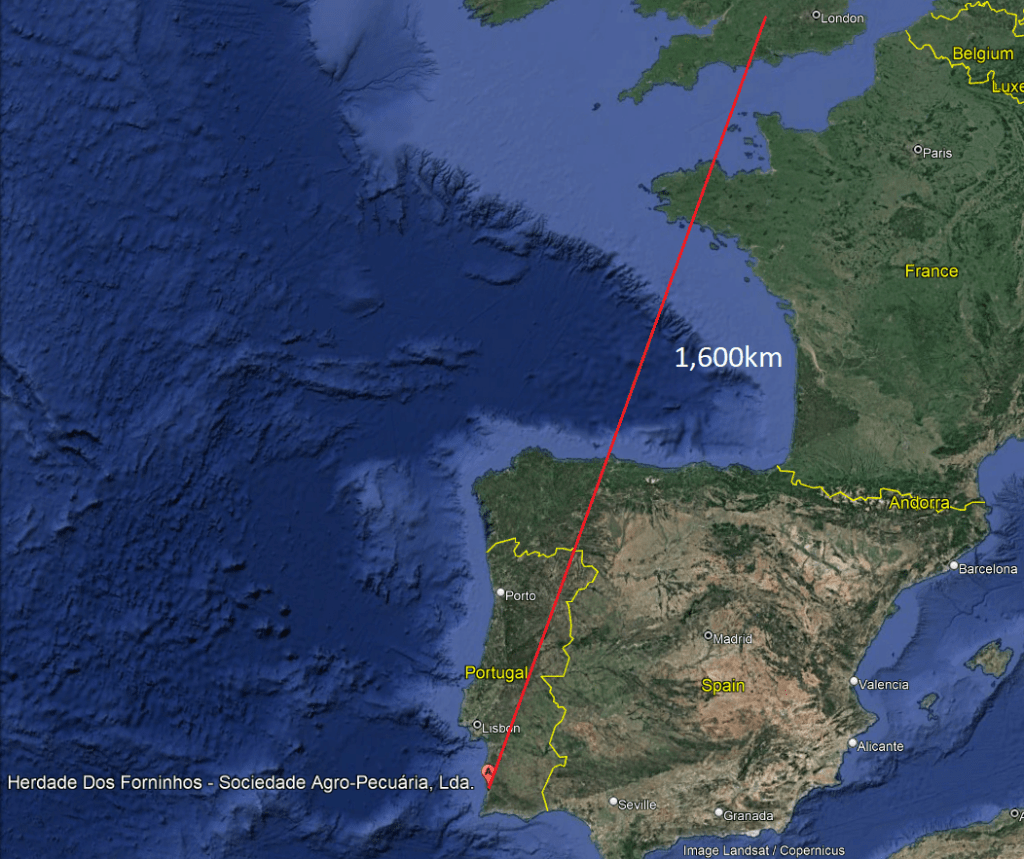
This February we received a report from Portugal of a Chiffchaff ringed on the outskirts of Melksham on the 7th October 2021, that was recovered 1,600km away, on the 25th November 2021, at Herdade dos Forninhos i.e. after 49 days. Unfortunately, it took 438 days for the Portuguese ringing scheme to let us know, but better late than never.
When I share recovery information with the group I always copy in Graham and Phil Deacon of the North Wilts Group. It is a mutual courtesy, so that we know what is happening with the birds in and from our area. Phil and Graham are also committee members of the Wiltshire Ornithological Society, and Phil collates all recoveries of ringed birds either ringed within Wiltshire and recovered elsewhere or ringed elsewhere and recovered in Wiltshire.
He sent me the details on the three other Chiffchaffs recovered in Portugal that were ringed in Wiltshire. The first was ringed by Graham near Sevenhampton, Swindon and also recovered at Herdades dos Forninhos. Second was a bird ringed at the Westdown Plantation on Salisbury Plain Training Area and recovered near Lisbon.
Then, this year there were two recoveries, again from Herdades dos Forninhos, for birds ringed and recovered in 2021. Jonny’s one and the other was ringed by Richard Leighton at Longbridge Deverill on the 13th July 2021 and recovered on the 5th October 2021.
It does seem unusual that, having had only four recoveries in Portugal, from the thousands of Chiffchaff ringed in Wiltshire, over the last 15 years, three of them should be recaptured at the same site:
Back to Red Lodge today. Yesterday’s high winds made any thought of ringing impossible, so the contrast with today’s weather was very welcome. I was joined for the session by Anna and Ellie and then, a little later on, by Laura with Daniel and Adam and then, a little later still, by Esmae, a young girl who lives in one the old Forestry Commission worker’s cottages (when they provided that sort of thing for their staff). Adam and Daniel got to ring a few more birds each this morning, and Esmae got to ring her first two (a Robin and a Great Tit.
After the failure of the nets away from the feeding station in the last two visits, I decided to try a different position for the extra nets:
They were about as successful as the ones they replaced: producing a Blackbird and a Wren.
The session was as expected: lots of Blue and Great Tits with a smattering of other species. It was pleasing to catch another Lesser Redpoll, but still no sign of any Siskin. Having seen a huge flock of Redwing when out filling the feeders on Friday, I was hoping there might have been a few around today. Unfortunately, they weren’t.
The list for the session was: Nuthatch (1); Blue Tit 21(11); Great Tit 13(4); Coal Tit (1); Marsh Tit 1; Wren 1; Robin 1(1); Blackbird 1; Lesser Redpoll 1. Totals: 39 birds ringed from 7 species and 18 birds retrapped from 5 species, making 57 birds processed from 9 species.
Another new Marsh Tit colour ringed this year brings it to three, which is a good start, especially as I cannot currently access two of the more productive woods for this species.
We were reasonably busy throughout the whole session, but with enough time to help the children further develop their skills. As usual, when I suggested that we would pack up at 11:30, we had eight birds in each of our last two rounds. We did finally do our last round and closed the nets at midday. With everybody pitching in to help take down and clear away, it took just 25 minutes to get everything packed up, and we were away from site in plenty of time for lunch.
I have to have another whinge about the amount of dog poo at this site. It is almost as if, after Forestry England put up the “No Fouling” signs, dog walkers are deliberately leaving piles of the stuff wherever they can. By my estimation there was approximately one pile of poo in every 1m square. It was impossible not to tread in it without focusing 100% on avoiding it. That is disgraceful. We had three children with us today, and they should not have to be spending their time watching where they are putting their feet because some people are too ignorant and too lazy to clean up after their pets.
The Wiltshire Wildlife Trust lifted their HPAI precautionary ban on bird ringing at their wetland sites, Langford Lakes and Lower Moor Farm, last week. With my options limited currently, because of forestry works at the Firs and Ravensroost Woods, I decided to make a foray to the site this morning. I don’t expect big catches there at this time of year, but we did have 35 caught in February 2021, 20 in February 2016. All others have been less than 15.
I met up with Miranda and Rosie at 7:00, and we set up the following nets:
Following on from Miranda generously replacing my bird bag hanger, Rosie turned up this morning with a replacement for my ringing table, which, after 10 years of service, is very much the worse for wear. I am very lucky to have such considerate trainees. (All right the rest of you: see me for my wish list!!)
It was as quiet as expected, but Rosie did get to ring a couple of birds before heading off to work at 9:00. It helped that she was working with a couple of Trust volunteers at Lower Moor Farm this morning. I was very pleased to catch our first Lesser Redpoll since the middle of November:
We also caught a second Redwing of the year. The catch was small, just 16 birds. There were small flocks flying around, but we were catching just the odd one of each. The list for the session was: Blue Tit (2); Great Tit 2; Long-tailed Tit 1; Wren (2); Dunnock 1(1); Robin 1(1); Redwing 1; Song Thrush 1; Goldcrest 2; Lesser Redpoll 1. 10 birds ringed from 8 species and 6 birds retrapped from 4 species, making 16 birds processed from 10 species.
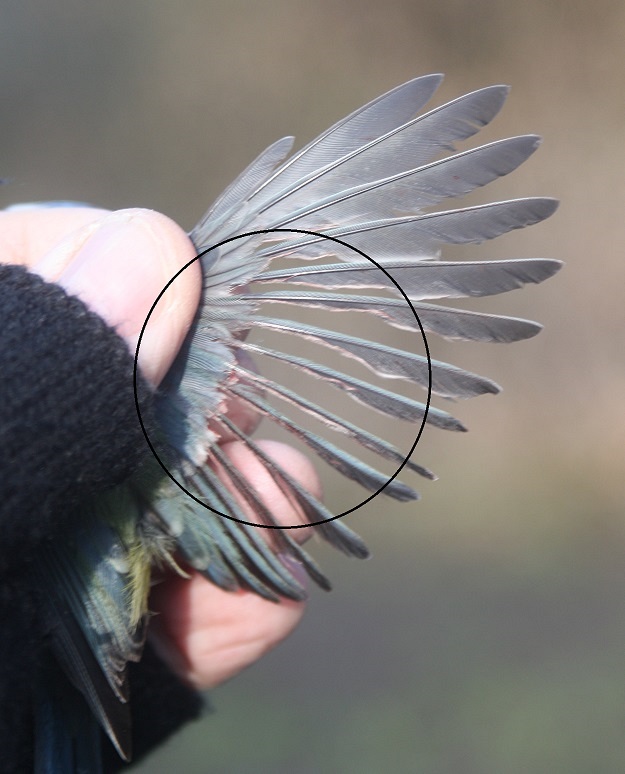
Both Blue Tits were recaptures. One of them, ringed in 2021, was clearly having a problem with its right wing. The left wing was fine.
The tips of the greater coverts were ragged and tinged dull red, which looked like dried blood. Feather barbs were stuck to the shaft, again, by what looked like dried blood. There was no sign of feather mites or other invertebrate pests. The bird was in otherwise good condition: but slightly underweight for this time of year. It would be interesting to know what the issue was. Perhaps it had a close encounter with a predator? Or is it just a somewhat erratic moult of secondaries and associated coverts?
At 10:30 the wind got up unexpectedly and, after two empty rounds, Miranda and I decided to shut the nets and take down. We were off site by 11:15.
After the last session at Somerford Common, as I blogged at the time, I moved the feeding station back to its pre-mulching position. Soon after, I replaced the 2 litre seed feeder with a 6 litre feeder, so I could move the 2 litre feeder to the other side of Somerford Common, to set up the new feeding station used at last Saturday’s session. I topped up all of the feeders on Tuesday and went back to top up at Somerford on Friday. Both the peanut and seed feeders had been emptied in 3 days, that is 6 litres of seed and 1.5 litres of peanuts eaten in three days! Are they trying to bankrupt me? Basically, I knew that today’s session would be busy, and was going to be titmouse heavy again.
When I went out on Friday I also took my secateurs, some branch loppers and a vegetation slasher, to re-establish the net rides. Amazingly, given that they have bright yellow handles, I managed to lose the secateurs. Despite searching for a good twenty minutes, I couldn’t find them and went home in a huff!
The morning started disastrously: having arranged to meet Anna at 7:15, I arrived on site on time, started to get the equipment out and realised that I had left the guy ropes at home. I quickly texted Anna telling her not to panic if I wasn’t there and that I would be back to site just after 7:30 (the joys of having most of your sites just 10 minutes from home, or 6 minutes as it was yesterday). When I got back Anna wasn’t there. Of course, O2 had lived down to its usual standard and the message hadn’t sent. Fortunately, she was running late herself, having had to stop and put some fuel in her car. Better late than never, we started setting the nets. Firstly, the 18m & 9m on the main track. I put on a Redwing lure, hoping that the one at Webb’s Wood on Wednesday wasn’t a one-off stray (it was). We opened them and went to set up the feeding station nets. As we were doing so, Adam, Daniel and dad Mark arrived. They helped me set the rest of the nets, whilst I sent Anna to check on the opened nets. I tasked Adam with finding my secateurs. Thank goodness for young eyes! I have them back.
The net setup was:
Even before we got the nets open the birds (Blue and Great Tits) started to get caught. Meanwhile, Anna was removing a flock of Long-tailed Tits from the other nets. I managed to get the half-a-dozen birds out of the unopened nets without mishap, and went to help Anna finish off the other extractions. Whilst we were extracting, Claire arrived with Zara and Samuel and between the lot of them, they set up the ringing station for us. Claire then scribed for me for most of the rest of the session, which was extremely helpful. Laura came along a bit later and took over scribing duties after Claire & co had left. Essentially, we extracted and ringed for 2.5 hours.
Unfortunately, still no sign of any Lesser Redpoll and Siskin but, equally, it has been a regular site for Goldfinch, again missing, nor Chaffinch, the only finch species we have been catching this year.
The list for the sessions was: Great Spotted Woodpecker (1); Nuthatch (1); Blue Tit 12(9); Great Tit 8(15); Coal Tit 3(3); Marsh Tit (2); Long-tailed Tit 12; Dunnock 1; Robin 1(3); Blackbird 1; Goldcrest (1). Totals: 38 birds ringed from 7 species and 35 birds retrapped from 8 species, making 75 birds processed from 11 species.
The first few rounds were busy but, as we entered the second hour the numbers fell off a bit and all four children had the opportunity to process a couple of birds each, as well as doing the releasing duties. With many hands making light work, packing away took very little time and we were away from site before midday. It would be nice to be catching finches, but it is a reasonable variety for a woodland at this time of year. We might have added a few more Goldcrest, but I didn’t run a lure for them this morning: I don’t know why but, having started off so incompetently, I shall just put it down to that!
It was back to Webb’s Wood this morning, and back to the cold weather. It was touch and go when I arrived on site as to whether I would go ahead. The forecast was for it to start warming up from 7:00, so Miranda and I met at 7:15 and opened the nets at 8:00. Interestingly, it actually felt warmer than I expected, although the car’s thermometer was showing minus 5 degrees Celsius. We only set 4 x 18m, 1 x 6m and 1 x 9m net: the small nets around the feeders and the usual 3 x 18m line and a single 18m adjacent to the feeding station (the circle):
The fog that was supposed to be present until 11:00 (according to the Met Office yellow warning) had pretty much lifted by the time we got to site. Surprisingly, as the morning wore on, and the temperature started to rise, the nets actually iced up. We decided to call a halt at just gone 10:00. It was absurd: the sun was out but it felt colder than when we started. There was no sign of cold stress in any of the birds: just in the ringers!
The first surprise of the morning: ever since I started to do solo working I have used a portable clothes airer to hang the birds in bags on whilst they are waiting to be processed. We all used to make tripods from net poles or stick them into bales of straw or strap them horizontally to the ringing table, so that bags could be hung off them. After a few incidents, one involving the back hatch of the car, a couple involving unexpected gusts of wind, there have been repairs and gaffer tape used to hold it together. Imagine my surprise when Miranda produced a brand new one to give to me to use in future! The only thing my trainees have to provide is their time, no money exchanges hands (it will cost them enough once they become independent, and I would be doing this and spending the money anyway) so I was absolutely blown away. One other nice surprise this morning was catching our first Braydon Forest Redwing of the year:
Our last was on the 27th December in Red Lodge.
The catch was: Nuthatch (1); Blue Tit 6(2); Great Tit 3(3); Coal Tit 1(1); Wren (1); Dunnock 1; Robin 1(2); Redwing 1; Blackbird (1). Totals: 13 birds ringed from 6 species and 11 birds retrapped from 7 species, making 24 birds processed from 9 species.
The Dunnock was also an unusual catch for this site: only the eighth caught in 10 years.
We finished packing away by 10:30, but I didn’t get off site until 11:00 as, initially, I was goosed by an overly friendly Labrador, whilst I was pushing the poles into the back of the car. That got my attention. His owner, a very pleasant local gentleman, who is currently putting the neighbourhood plan together for the area, was very keen to talk about the bird life of Webb’s Wood and what Forestry England’s plans are for the wood. We had a good long chat and, hopefully, I will be able to help with his work.
With the Firs being unavailable until the end of March and Ravensroost Wood unavailable, probably until the end of February, due to forestry works removing, dead Ash trees, followed by woodland mitigation measures and restoration of paths and access, Lower Moor Farm being out of bounds as a precaution against HPAI, and Blakehill Farm and Brown’s Farm dependent upon it not having any wind, and the latter also dependent on it not being a shoot day, I have had a regular routine of Webb’s Wood -> Red Lodge -> Somerford Common since October. We did get out to Blakehill last weekend, and it was extremely disappointing numerically, the Bullfinches and Greenfinch notwithstanding.
For today, I decided to make a trip back to the western side of Somerford Common. Clearly I have fond memories of working there, what with the two Buzzards back in November 2019, and the Siskin in March 2022, so I don’t quite understand why I haven’t done more there, apart from the fact that the catches are fairly hit and miss, and generally need a lot of net set to ensure a good catch. Now that I tend to be working with just one additional pair of hands most sessions at the weekends, I don’t like setting more than 10 nets. I like things manageable!
On Tuesday I set up a small feeding station in the wood, in the hope that it would attract a few more birds in for today. Having woken 3o minutes before my alarm was scheduled, I arrived on site a bit earlier than intended. It did mean that I got to disturb two Woodcock as I drove onto the site. As I am surveying this site for the GWCT / BTO Woodcock survey, that was a good sign. I was also serenaded by a male Tawny Owl whilst setting up the first net line. David joined me close to the scheduled start time at 7:15. I had agreed for Laura to bring Adam and Daniel and for Claire to bring Zara and Samuel along to the session and they arrived around about 8:00. Three of the four children got an opportunity to ring a bird, and Daniel has been promised the first bird next time out. Daniel and Adam are working towards their Scouting Natural History badge and Daniel is also working towards his Duke of Edinburgh Award and these sessions are contributing to that.
We set the following nets:
I set lures for Lesser Redpoll, Siskin, Redwing and Brambling (ever the optimist) and, after 10:00, for Goldcrest. The Goldcrest worked!
The first round was the biggest and had the most variety, delivering three Blue Tits and two Great Tits, but also two Coal Tit, a Nuthatch, a Great Spotted Woodpecker and a Robin. This was followed by a catch of six birds, including, much to my delight, two second year Marsh Tits, colour ringed as follows:
This takes us up to 16 ringed in the year 1st April 2022 to 31st March 2023, which is a welcome return to normal after a disappointing return for the species last year. Bearing in mind that this is being achieved despite awful catches across the board in Ravensroost Wood: usually one of the most productive sites for the species in the Braydon Forest and the lack of access to the Firs since October.
The catch for the session was: Great Spotted Woodpecker 1; Nuthatch 2; Treecreeper 1; Blue Tit 5; Great Tit 4(2); Coal Tit 4(2); Marsh Tit 2; Robin (1); Goldcrest 3(1). Totals: 22 birds ringed from 8 species and 6 birds retrapped from 4 species, making 28 birds processed from 9 species.
So, still no finches, but I did get the extra Coal Tits and Goldcrests that I had hoped for. The retrapped Goldcrest was ringed at this site in November 2019 and has been caught once more in between. That suggests to me that it is a resident bird, rather than a winter visitor.
It was a lovely, relaxed session and I have to say that I have never laughed as much, or for as long, as I did when Adam and Daniel got into a brilliant discussion about money, with older brother (Daniel) loan-sharking to younger (Adam). It was very funny.
The three boys did lose me after a while when they started talking about Minecraft, Fortnite and some other computer-based games, whose terminology was way beyond my understanding, despite my 40 years of IT experience.
It started out remarkably mild but slowly got colder as the morning progressed and the number of birds fell away by 10:00. We started shutting the nets at 11:15 and, with many hands making light work, had the nets down and everything packed away quite quickly and were off site just after midday.
Well, I finally found out where all the finches have gone: meeting local man John and his dog, Denver, walking in the woods this morning, he asked how the catch was going. I mentioned the dearth of finches, to which he replied that he had a flock of 40 Chaffinch and 30+ Goldfinch visiting his feeders, a mere 300m away from where our nets are set!
I was joined for the morning by Rosie, before she had to go off to work, and Miranda for the whole session. We set just the usual four nets by the feeders, and the dog leg further up the path. The dog leg was a complete failure today: despite a very noisy flock of titmice flying around the area, a couple of Great Spotted Woodpecker drumming and calling regularly, and a Song Thrush singing his heart out immediately adjacent to the nets. The feeding station more than made up for that.
As expected the catch was titmouse heavy, primarily Blue Tits. What was unexpected was that so few of them were retrapped birds. There seems to be a never ending supply of new Blue Tits at the moment. The list for the day was: Nuthatch 3; Blue Tit 29(2); Great Tit 12(2); Coal Tit 1(2); Marsh Tit (2); Robin (2); Chaffinch 1. Totals: 46 birds ringed from 5 species and 10 birds retrapped from 5 species, making 56 birds processed from 7 species. So John hadn’t hogged all of the finches!
Any session that produces three Nuthatch can’t be all bad! The year seems to have started pretty well for them so far: with seven ringed and two retrapped.
We did have one Great Tit with a somewhat unusual crown colouration:
Not great photos, but it was a pepper and salt crown. I have seen it in Coal Tits but this is a first for me in Great Tit.
One of the nice things about setting so few nets is that it takes very little time to take down and put away. We finished the last round just after 11:00, processed the birds, and were packed up and off site by midday.
This was a very difficult month: the impact of the freezing weather, followed by high winds and torrential rain, for two of the weeks restricted activity levels for the group, and reduced the actual catches. In fact, only Jonny and my team carried out any ringing at all. I managed only five of ten scheduled sessions. Other factors involved are: the unavailability of one of my key over-winter sites, the Firs: out of bounds since October, and will not be open again until March, due to extensive forestry work. Ravensroost Wood has been awful all year and, with the Wildlife Trust banning feeding stations, as a precaution against HPAI, it continues to be awful. That is now also undergoing some forestry work, timber removal, and will be out of bounds until at least mid-February (but I suspect it will be the whole month). Lower Moor Farm has been out of bounds all winter, as a precaution against HPAI. Fortunately, there has been no evidence of it there and the restriction was lifted yesterday.
The fact is that January 2022 was exceptional: January 2023 was similar to 2019 and 2020, and three times the level of 2021.
It is pretty clear from the table what the differences are. The number and variety of species is well down. Just look at the Lesser Redpoll: 25 last year, split between Somerford Common, Webb’s Wood and Lower Moor Farm. This year, just one at one of Jonny’s Sutton Benger sites. In fact, the Redwing number from this year doesn’t include a single bird from the Braydon Forest sites, all are from Jonny’s sites around Sutton Benger, East Tytherton, Melksham and Hilmarton.
The rest of the details you can see for yourselves.




 Ringing In The Braydon Forest & Beyond