Despite the fortnight of storms, we managed to carry out just one full session less than in 2021. Not that we did a lot in February 2021: just 14 sessions then and 13 sessions this year. Results were pretty similar:
Table 1: February 2022 Results
Our best February came in 2019, with 556 birds in 13 sessions. It does seem that 13 or 14 sessions is the norm for this month.
A few differences from last year: no Brambling this February, whereas David got to ring his first at Somerford last year. We also managed a Snipe in February this year, Ellie’s first. Another nail in the coffin of her claims to be a jinx on our catches together (although, to be fair, we did only catch two birds that morning – but we were only targeting Snipe).
Fig. 1: Ellie and her first Snipe
No Sparrowhawk or any Yellowhammer this year. The Yellowhammer last year were at Jonny’s Sutton Benger site, but not this year. He has a new, related, farmland site near Hilmarton and it was this that produced 38 of the Chaffinch ringed this month. It looks like this could be a productive site, with 69 birds from 9 species in the first (only) session so far.
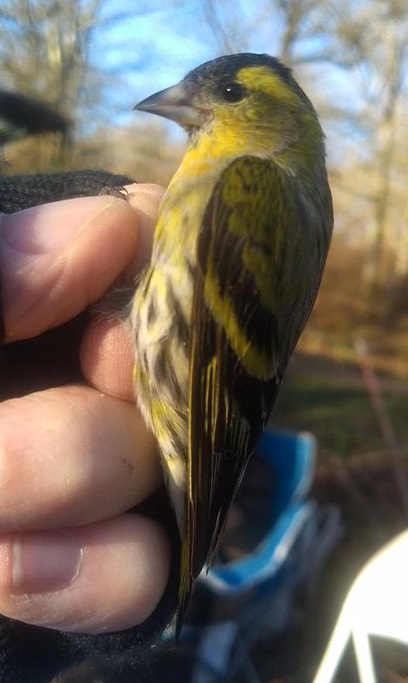
Apart from the Snipe, my birding highlight was the first Siskin in Ravensroost Wood since February 2019.
Fig. 2: Male Siskin @ Ravensroost Wood
What is significant about this year is that we have already processed more birds from more species than in any Q1 since the 2013 reconfiguration, except for the number processed in 2019, when another 87 birds will take us past that milestone – and we still have one month to go. It just goes to show how active the group has become within our own boundaries. This graphic rather illustrates the point:
Table 2: Q1 comparisons
The spike in activity in 2018 coincides with Andy Palmer and Jonny Cooper getting their C-permits and getting on with working their own sites.
After two really good sessions this one was very disappointing. Lower Moor is very hit and miss in the winter, because I don’t set a feeding station there. I work in the wildlife refuges, using a cut-down version of my breeding season Constant Effort Site. There has been a problem of rats in front of the various hides, as a result of some photographers putting out food to attract birds and small mammals closer in for better photographs, and I have no wish to attract them in to these wildlife refuge areas. I know that the Trust have asked for that practice to stop: one hopes that it has.
The weather didn’t help: it started out with a freezing mist between 7:00 and 9:00. When the sun broke through at about 10:00, the breeze started to get up and by 10:30 it was too strong to leave the nets open, so we closed them up and took down by 11:00.
It was doubly unfortunate for my two trainees: Annie was making her first trip out for nearly a year, and David making his first visit for nearly 3 months, both for unavoidable reasons.
We managed a paltry 11 birds: Blue Tit 1; Great Tit (1); Long-tailed Tit 2; Wren (1); Robin (2); Redwing 1; Blackbird 1(1); Lesser Redpoll 1. Totals: 6 birds ringed from 5 species and 5 birds retrapped from 4 species, making 11 birds processed from 8 species. Still, with over 100 birds processed this week it would be churlish to moan too much.
We have seen Siskin in and around our woodland ringing sites since October but, unlike the Lesser Redpoll, they have remained stubbornly in the treetops all winter. They must have been finding enough food to sustain them – until today, that is.
I was joined by Rosie and Tanya at 7:00 and by Claire with her children Samuel and Zara at 8:00. It has been a couple of months since Claire et al have been able to join us, so we had to reintroduce Samuel to the delights of handling Blue Tits, before letting him take on ringing duties again. We started with him just getting comfortable handling the birds and, once he had got his ringer’s grip re-established to my satisfaction, he then shadowed the ringing process, checking wing lengths and weights, before getting to ring his first bird of the morning. I was kind, it was a Robin, not a Blue Tit (he is only young – I don’t want to put him off).
Recently I have just been taking just exactly the number of nets I want for the session, to save on packing too much stuff. That came back to bite me on the posterior this morning when my two 6m nets decided to fail. One broke a shelf-string, which meant I couldn’t use it. The second broke the link to the loop that goes around the pole. Fortunately I managed a running repair on that net so, by a slight reorganisation, we could still surround the entire feeding station area.
As expected, the first round was busy and very Blue Tit heavy, plus the odd Great and Coal Tit. What I am finding somewhat surprising is just how many second year Blue Tits we are catching and ringing. There is no doubt that breeding season 2021 was dreadful for Blue Tits. Everyone who was monitoring Blue Tit nest boxes confirmed full failures or low fledging rates, yet this winter, since the 1st November, we have caught and ringed 234 juvenile Blue Tits in the Braydon Forest, out of a total of 285 ringed in total, i.e. 82.1%. I have done a comparison with previous years to see if this is reflected in our ringing totals. Because of the Covid restrictions in place throughout 2020 and 2021, it has severely distorted the data for that period, so I have excluded it from this analysis:
Table 1: analysis of juveniles ringed overwinter and in the prior breeding season / autumn
What does this table show? Essentially, whatever happened in the breeding season is not reflected in what we have seen over this winter. Either the breeding season wasn’t as bad as first thought or, radical suggestion, perhaps with less intraspecific and intragenerational competition for food more young Blue Tits have survived than would otherwise be the case. Who knows?
Amongst all of these youngsters, today we recaptured Blue Tit S859712. This bird was originally caught and ringed as a juvenile on the 2nd September 2017. This was the eleventh time it has been recaptured, always in the same general area (the 8-year hazel coppice) so twelve times in all it has been handled – and it still pecks like a good ‘un every time! I love Blue Tits: birds with attitude!
The third round produced the bird of the day:
Fig 1: Male Siskin
This is my first Siskin since one at Somerford Common almost exactly one year ago (27th February 2021) and it was the first that Rosie has ever got to ring. Rosie and Tanya were actually scheduled to be working at Ravensroost this morning, so they had to go to work when the rest of their work party turned up at 9:30. On the penultimate round I found another Siskin, this time a female, in the nets by the feeding station. It looked nicely settled and there was a Blue Tit that was rather entangled, so I decided to extract that first. Unfortunately, she was nicely settled but, also, not particularly restricted and as I removed the Blue Tit she managed to escape the net. Fortunately, by then Claire and the children had left for the morning so I didn’t have to apologise for my language.
The list for the day was: Nuthatch (1); Blue Tit 13(11); Great Tit 2(4); Coal Tit 1(3); Marsh Tit (1); Dunnock 1; Robin 1(3); Siskin 1. Totals: 19 birds ringed from 6 species and 23 birds retrapped from 6 species, making 42 birds processed from 8 species.
We had convened at Ravensroost Wood, as opposed to Lower Moor Farm, because the weather forecast was for it to be a bit breezy. In the event, there was no sign of a breeze until 11:00, which was when I decided to start closing up the nets and taking down. It took a while, as I was now working solo, and I took down in stages, extracting the few remaining birds as I went. I left site at 12:15. It will be Lower Moor Farm tomorrow, as I finally catch up on the fortnight lost to the storms.
After two weeks of ringing inactivity, due to that unprecedented run of storms, I decided to kick off our activities again with a trip to the Firs. This was because the forecasts still suggested that there would be a gusting south-westerly wind. With the rides at the Firs running north to south, the wood offers better protection from the wind, when it is coming from that direction, than any of the other sites.
I was joined for the morning by Rosie, Miranda and Jonny. We set the usual nets down the central glade. Astonishingly, at first sight there was no sign of damage from the storms in the central glade. However, as we were setting the 12m net behind the feeding station, Rosie said “Has that tree always leaned that way?”. A mature tree, which my net runs in front of, with a near 1m diameter is now only staying upright because a couple of other trees are blocking its passage to the ground. Fortunately, it is falling away from our ringing area.
I ventured into the wood yesterday to top up the feeding station, having taken the sensible pills and not headed out whilst the wind was so fierce. Having watched the local news showing a film of the spire of St Thomas’ Church in Wells falling as a result of the winds, I decided it wasn’t worth the risk. Unsurprisingly, after all of the rain, the Firs had reverted to its local name: the Braydon Bog. It was filthy underfoot so I advised everybody that wellies were essential.
We arrived on site at 7:00 to find that the weather was better than forecast. In fact, the wind didn’t start gusting until we started to take down at 11:00. That was a definite bonus. Rosie managed to get a good number of birds processed before heading off to work, leaving the three of us to manage the rest of the morning.
The catch was exactly as expected: lots of Blue and Great Tits and more recaptures than new birds (28 to 21). There were two highlights for me: the fourth ever Lesser Redpoll for the site. Our first two there were caught in November 2016, then we had no more until our last session in the Firs, just about the last bird out of the net that day and another singleton this morning.
The second was a male Great Spotted Woodpecker. I thought that the ring number looked old so I logged in to the on-line system and did a search on that bird. It turned out that it was ringed as a second year bird on the 18th February 2017. This makes it a bird in its seventh year. Okay, it has another 4 years 3 months and a few days to go to get to the longevity record, but it is the oldest that my team has recovered so far.
The list for the day was: Great Spotted Woodpecker (3); Nuthatch (2); Treecreeper 1; Blue Tit 10(9); Great Tit 7(8); Coal Tit (3); Marsh Tit (2); Long-tailed Tit 2; Dunnock (1); Lesser Redpoll 1. Totals: 21 birds ringed from 5 species and 28 birds retrapped from 7 species, making 49 birds processed from 10 species.
With the number of birds declining as the morning wore on, and the wind beginning to get up, at just before 11:00 I announced that the next round would be the last, and we would shut the nets as we emptied them. Usually at the Firs that is a signal for a large influx of birds to hit the nets. This morning it didn’t! We had another 8 birds, not as many as usual, which is normally multiples of ten. As a result, we had the nets down and everything cleaned away by just after midday.
That got me home in time to unpack the replacement Barn Owl boxes that have, finally, arrived, for me to now work hard over the next couple of weeks to get them all erected. Many thanks to my wife for her help in getting the boxes sorted out and stored ready to go.
It is wet, it is windy, no ringing, no fun, so I thought I would spend some time today having a look at some data. As regular readers will know, I have recently done some analysis of Blue Tits in the Braydon Forest, as a result of a paper by Shutt et al1, which was followed by an article in January’s British Birds2, expressing concerns about the impact of garden bird feeding on vulnerable species. Although I expressed no criticism of the source paper and, in fact, was at pains to make that point several times in my post, it certainly ruffled enough feathers for me to be attacked on Twitter. I am not going to go into details of the individuals concerned, but I hope that they put more rigour into their science than they did into their criticism of my post. One critic was particularly egregious, criticising me for something that I never claimed, and then getting his data and analysis so horribly wrong that, when I pointed it out, he did what any self-respecting academic would do and admitted he was in error (don’t be silly – he blocked me). My post pre-dated the article in British Birds, and I only got the chance to read it during the criticisms, not that it was relevant to the points I was making anyway. It helped that I have over 9 full years of data for me to analyse.
At the risk of sparking off more Twitter Wars, I thought I would have a look at the population of Great Spotted Woodpeckers in the Braydon Forest, as represented by my ringing data, as this species was one of the species identified as having had a significant increase in numbers and, being a successful nest predator, capable of impacting on populations of vulnerable species. Anyone who has watched recent Springwatch episodes in the last few years cannot have failed to have seen examples of their predatory behaviour. Particularly gruesome was the predation of Treecreeper pulli / near fledglings from their nest.
I have had regular visits of Great Spotted Woodpecker on my garden peanut feeder over the years. This year I am pretty confident that we have seen a juvenile that has matured into a fine looking male – but I cannot be sure it is a single bird. I did catch and ring a single male adult back in April 2020. It hasn’t subsequently been recaptured.
For this analysis I have looked only at the captures within the woodlands of the Braydon Forest, ignoring the wide open spaces of Blakehill Farm. Also, I have counted the total number of sessions in those woodlands in each year, not just the number of sessions in which Great Spotted Woodpeckers were caught, and analysed as per the total number of sessions.
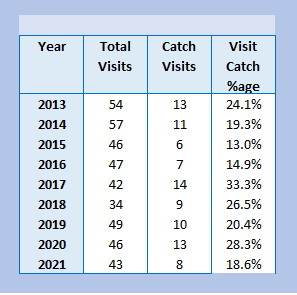
Table 1: Percentage of visits in which GSW were caught per annum
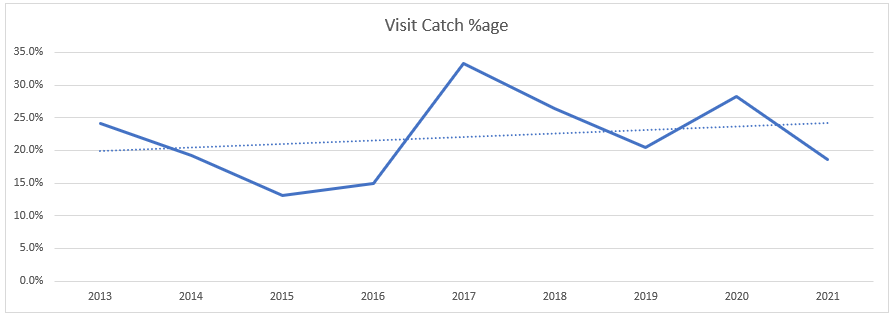
Fig 1: Percentage of visits in which GSW were caught per annum
As you can see, over the nine years there has been a near 5% increase in the number of sessions in which we have caught this species. The next thing I looked at was the actual size of the catch:
Table 2: Average numbers caught, ringed and retrapped per session by year
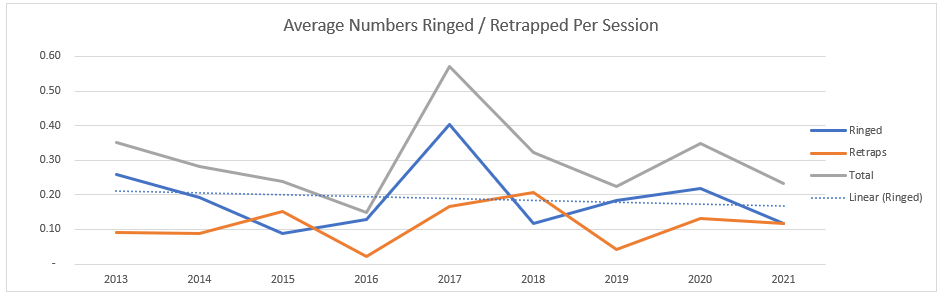
Fig 2: Average numbers caught, ringed and retrapped per session by year, with the trend for number of birds ringed
As you can see from these figures, there was a significant spike in the number of birds ringed in 2017. Despite that, the overall trend shows a slight decline in the number of birds over the nine year period.
Next I looked at the proportion of the catch that are adults and juveniles over the period:
Table 3: Actual and average numbers of adults and juveniles ringed per session by year
Fig 3: Average numbers of adults and juveniles ringed per session by year
As this graph shows, whilst numbers of juveniles ringed each year are lower than those of adults, the trend for juveniles is a steadily increasing line. Conversely, the trend for adults ringed is steadily declining:
Fig 4: as per Fig 3 but showing the declining trend for adults ringed
Whilst I have analysed the numbers ringed and retrapped, a single bird can be recaptured multiple times over multiple years, so I have counted the actual number of individuals that have been processed per annum:
Table 4: Average number of individuals processed per session by year
Fig 5: Average number of individual GSW’s processed per session by year
As this shows, the actual incidence of interacting with individual birds shows a slow decline. In all of the figures shown, the 2017 spike has clearly had a positive impact on the population trend shown, so I have removed that spike from the data to see what impact it might have:
Fig 6: as Fig 5 but minus 2017
The impact is relatively minor: a reduction of 3% in Fig. 5 to a reduction of 4% in Fig 6, albeit from a lower starting point (27% as opposed to 30%).
Given that we carry out our sessions with consistent net positions and consistent, although seasonally variable, session lengths, this does not look as though it shows a population that is growing rapidly within the Braydon Forest. As per my previous posts, I make no claims about the validity of this analysis, outside of the specified geographical parameters and the limitations of bird ringing for analysing population dynamics.
References:
Shutt JD, Trivedi UH, Nicholls JA : 2021 Faecal metabarcoding reveals pervasive long-distance impacts of garden bird feeding.
Jonny Cooper has just updated the maps and data for the ringed bird recoveries, adding in those registered during 2021 and I have just uploaded them into the blog.
Highlights include: the oldest recovered Goldcrest in the UK (unless another, older one has been found since) and the second longest movement of a Blue Tit within the UK (okay, that’s a 2022 record).
Lowlights: the recovery of one of the Buzzards ringed on Somerford Common in November 2019 being found shot dead in a country park near Dudley in the West Midlands.
Both Snipe and Jack Snipe regularly overwinter at Blakehill Farm. They can be seen pretty much anywhere on the site when the ground has been softened by the weather. One place that is a regular spot is the middle pond of the three on the west of the site. With lockdown and other issues, last year we didn’t manage to get out for a Snipe catching session. Our first go for these birds at the site was back in January 2019. We caught three Snipe and one Jack Snipe: I gave Andrew and Jonny a Snipe each, with one for me and my first ever Jack Snipe.
Remarkably, in January 2020 Jonny and I tried again and this time we also caught four birds: three Jack Snipe and one Snipe, so Jonny got to ring his first two Jack Snipe, I got my second and another Snipe. I did run another session in early February 2020, to see if we could catch some Snipe for other members of the team. Unfortunately, that day we drew a blank.
I was hopeful that there might be some Snipe about that we could have a go for this week. The forecast for today was for it to be flat calm: a lull in a windy week. On Monday, hoping that the forecast would be correct, I took a trip over to see whether there were any Snipe about. As I approached the middle pond six Snipe flew off. When I got a bit nearer, 3 Jack Snipe decided it was time to make their exit. That decided me: we would try for a session on Friday. The pond itself is very full and the birds were gathered in the swampy tussock grass at the eastern end. Three Stonechat showing really well were an added bonus.
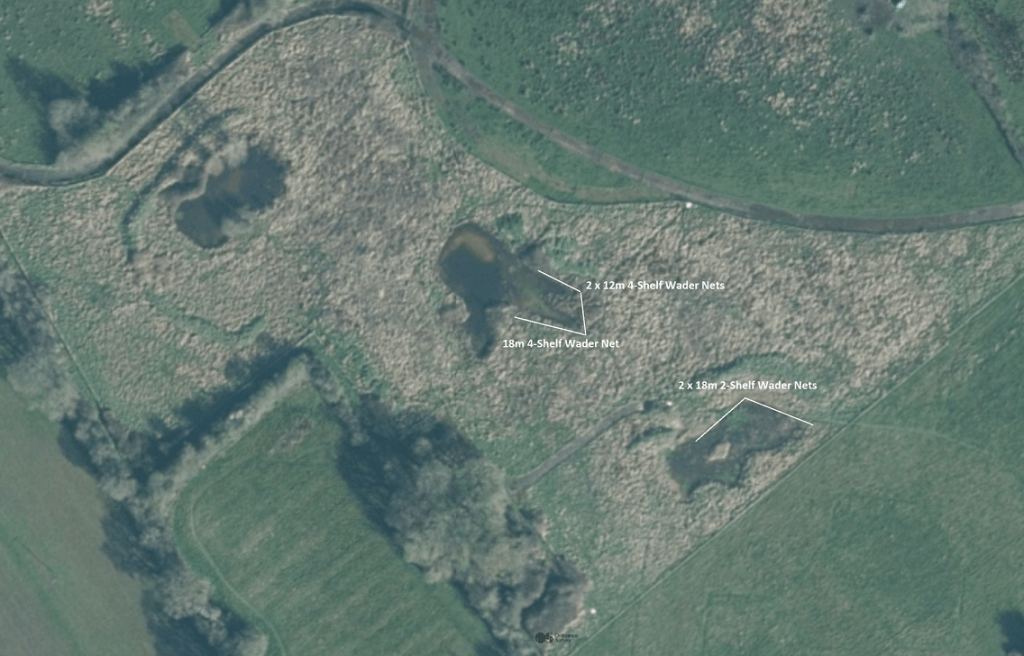
Knowing that I would be setting up in full darkness, and away from my usual positions, I decided to go back yesterday and use some bamboo canes to mark where each of the poles would be set for the 2 x 12m and 1 x 18m wader nets (50mm mesh size) I planned to use to form a cul-de-sac. As luck would have it, I flushed 15 Snipe.
I arrived on site at 5:40 this morning and was followed into the carpark by another car. I had agreed with Ellie and Tanya that they would arrive at 6:00 so, knowing Ellie as I have for a long time, I assumed it was Tanya. First time out, keen as mustard etc. Only, it was the police. Momentary trepidation dissipated as soon as they asked if I worked for Oak & Furrows. They were sharing the car with two Canada Geese that had been injured on a local road. They had tried calling the O&F phone line and were looking for their site. Lucky for them, I had the code for the padlock and could direct them to the facility.
I started setting my three nets, was joined by Ellie and Tanya at just after 6:00, as arranged, and we had the three nets open in short order. It was still very dark, so we set up the ringing station a couple of hundred metres away from the net set, and sat and waited for it to get light. Whilst setting up I flushed a couple of Mallard from the pond, but no Snipe (which I think was a good thing).
As it was beginning to get light, a couple of Canada Geese flew in and landed on the pond but away from the nets. At about 6:50 there was quite a lot of squawking from the geese and I could see the 18m net moving. My first thought was that one of the geese was in the net, so we ran over to try and rescue the net but, as we got closer, both geese flew off. There in the 18m net was a Snipe and in the adjacent 12m net, a Blackbird. I extracted the Snipe and Ellie took the Blackbird. There is an art to removing birds from these large mesh nets. It isn’t hard, just different from the nets we usually work with and you just have to be a bit more careful, particularly with freeing the wings.
Having missed out on them the last time she came along (because we all did), Ellie got to ring her first Snipe:
As it turned out, those were the only birds we caught all morning. A little later on we went over to look at the easternmost pond and, sure enough, two Snipe flew off. Forgetting the old adage about shutting the stable door after the horse has bolted, I decided to set my 2 x 18 2-shelf wader nets adjacent to where we had disturbed them. I shouldn’t have bothered. What I should have done was go with my initial instincts and set those nets up immediately after setting the first three, whilst it was still dark. Lesson learned.
Ellie had to leave just after 8:00 to get to work, and Tanya left a little later still to get to her job with the Wildlife Trust. I sat back and enjoyed watching the birds flying around. As the sun came up and the weather warmed, it turned into a beautiful winter’s day. I checked the nets regularly, but they remained empty, s0 at 10:45 I started to take them down and began to leave site at 11:15. I say began because I got some good birding in on my way out.
As I left the pond area I put up a mixed flock of Redwing and Fieldfare in the adjacent field. There were at least 40 birds. I haven’t seen any of either species for a while, so it was good to see. I plan to be back to try for Snipe again the next wind-free day, but I will also set nets for these thrushes. On my journey back to the main gate I saw three Stonechat and a superb male Kestrel. Despite only two birds caught, I thoroughly enjoyed this morning’s session.
With the wind forecast to be gusting quite strongly from the south-west this morning I knew that the scheduled trip to Brown’s Farm would be a non-starter. I chose Red Lodge instead for two reasons: 1) I am doing Ravensroost Wood on Saturday and 2) my net rides in Red Lodge would be protected from the wind by the woodland and the rides running north to south.
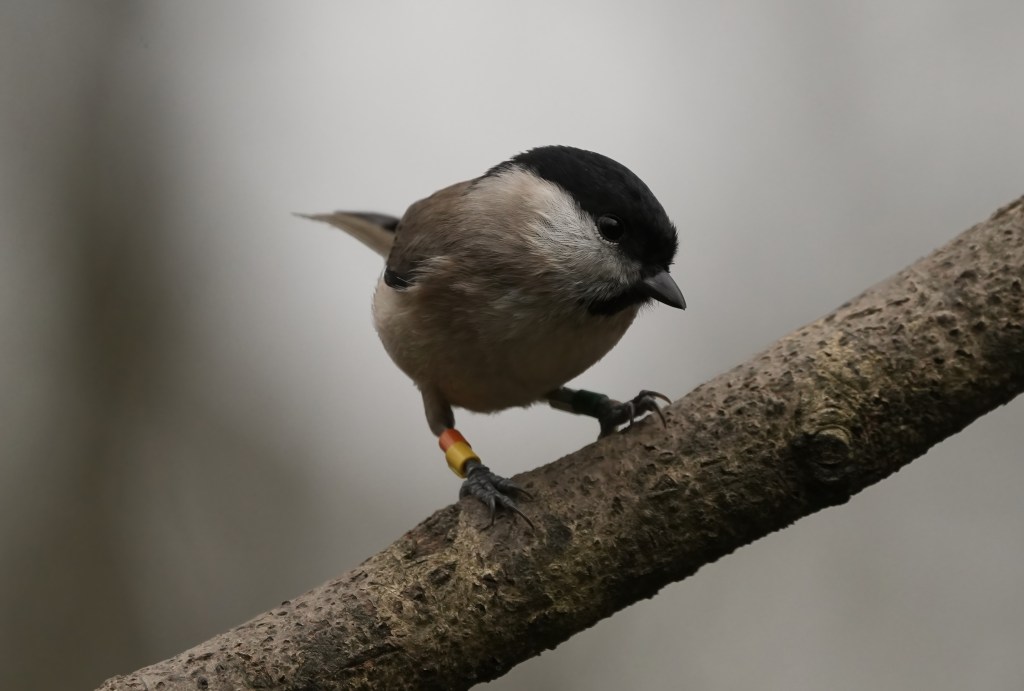
Yesterday I topped up all of my feeding stations in the Braydon Forest. I ran into a very pleasant photographer called Mitch Harris at the Firs, whilst topping up there, who later sent me some lovely photographs, including 2 of my colour-ringed Marsh Tits, making use of the feeding station. The benefit of colour ringing these birds is that I can record sightings like these within the BTO’s on-line database, enabling the continued tracking of their survival.
Marsh Tit AAL0191, ringed on 21st February 2020. Photo copyright Mitch HarrisMarsh Tit ALN2254, ringed on 6th September 2020. Photo copyright Mitch Harris
Arriving on site at Red Lodge this morning I was pleased to see that the seed feeder had been reduced by one third since they were topped up at 13:00 on Tuesday. I hoped that this would augur well for a catch of some finches this morning. Unfortunately, that hope was not fulfilled: not a single finch of any description in the nets today. Instead it was almost entirely a catch of Blue and Great Tits.
What was surprising about this catch was that the vast majority of the Blue Tits were unringed when caught. At this time of the winter, at the Braydon Forest sites that I ring most regularly, I expect to find a majority of both Blue and Great Tits to be recaptured birds. The list today was: Nuthatch 2; Blue Tit 18(1); Great Tit 10(5); Coal Tit 1; Marsh Tit 1; Robin (1); Blackbird (1). Totals: 32 birds ringed from 5 species and 8 birds retrapped from 4 species, making 40 birds processed from 7 species.
It was a pretty straightforward session: never too busy, but never an empty round either. There were definite highlights: Rosie got to process half-a-dozen birds before having to leave for work, including a lovely female Nuthatch. A little later I got to process an equally gorgeous male:
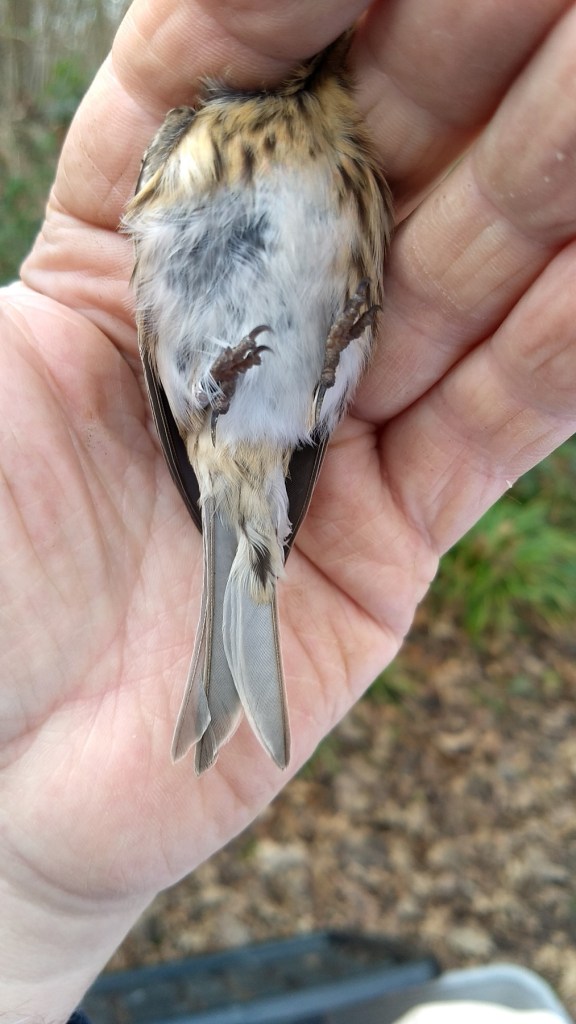
Nuthatch Male
It is quite easy to tell male and female Nuthatch apart, if you can get a look at the under-tail coverts. As you can see from this photo, the male has a brick-red surround to the white parts of the feathers. The female has paler, buff surrounds. These colours are replicated om the underwing areas if you are watching them in flight.
I caught and ringed my second Marsh Tit of the year: colour ringed metal over black on the left leg and yellow over red on the right leg:
Colour-Ringed Marsh Tit AEX0926
The wind got up at just after 11:00, so I shut the nets and took down, and left site early (for me) at midday.
An enjoyable, if cold, session at Webb’s Wood this morning. I had a good sized team out with me : Adam, Alice, David, Rob and, able to join us for a full session for once, Rosie. Because of that, we set a few more nets than I would usually do.
The 4 x 18m net line is one I haven’t used for a long time. There were two key reasons: firstly, it seemed to catch an awful lot of same day retraps with the ringing station set where we do (the red mark on the map) and, secondly, it had become very overgrown but this autumn it seems that Forestry England have widened the path and cut back the overhanging vegetation. Funnily enough, it was the only net that didn’t have a same day retrap in it.
The photograph below shows just how it looked pre-thinning so you can compare and see just how much thinning has taken place in the wood. If you have a look back at previous blog posts, it looked like this:
It will be interesting to review in a year or two whether the avifauna has changed much as a result.
It was a very comfortable session inasmuch as we never had a glut of birds: it was a steady procession of birds hitting the nets and getting extracted. That was definitely a good thing, with David back after a 10 week hiatus, Rosie on her first full session for ages, Adam coming along whenever his busy schedule allows and Rob on his third taster session, nobody needed to feel under pressure. What wasn’t very comfortable were the underfoot conditions by the easternmost 2 x 18m nets: the mud was more than ankle deep all along there (it eventually claimed my left wellie boot as we were taking down, I had to laugh, it was funny, if cold, wet and very mucky) and the wind, which wasn’t very strong until we started to take down, but it was bitterly cold. So the ambient temperature was fine but we were still getting chilled.
Once again we lured for Lesser Redpoll, Siskin and Brambling. Once again, we caught some Lesser Redpoll but none of the others. Frustratingly, there were Siskin around, in the tops of the trees. Presumably there is still food up there for them and they don’t need access to our feeding station with its luxury finch food!
The list for the day was: Great Spotted Woodpecker 1; Nuthatch 1; Blue Tit 7(4); Great Tit 3(8); Coal Tit 3(1); Marsh Tit (2); Long-tailed Tit 1(4); Wren 1; Robin 1(2); Song Thrush (1); Blackbird 2(1); Chaffinch 1; Lesser Redpoll 2. Totals: 23 birds ringed from 11 species and 23 birds retrapped from 8 species, making 46 birds processed from 13 species. That is pretty decent variety in this woodland at this time of year.
The highlight was definitely adding another couple of Lesser Redpoll to the Webb’s total for this winter. It really has improved beyond anything we have had there before. Is this one improvement due to the thinning?
One of the benefits of having a good sized team out was that both setting up and taking down were much quicker than usual. We met at 7:00 and the nets were open by 7:45 and taking down took just 30 minutes. The nets were closed at 11:45 and we were leaving site by 12:15.
A nice, easy session in the Firs this morning, with a decent variety of species for this small woodland. I was joined for the morning by Miranda and for the early part of the session by Rosie. We only set 7 nets: 2 x 3 x 18m along the main glade and 1 x 12m behind the feeding station. Starting at 7:00, we had the nets open by 7:45 and extracted the first couple of birds as we returned to the ringing station. The first bird out of the net was an adult, female Chaffinch.
Having the nets open early meant that Rosie got to process a few birds before leaving to get to work, some hedge laying at Lower Moor Farm. Miranda has just recently started extracting birds from the nets. This morning I let her into the wonderful world of extracting Blue Tits. From the continuous pecking, the grabbing great claws full of net, twisting, double-pocketing and exploiting any small holes left unrepaired in the nets, they are the ultimate test of whether someone is going to make it as a ringer. She acquitted herself very well.
My training philosophy on extraction is simple: it is the only part of the process that can cause harm to the bird, so all of my trainees are told to do what they are comfortable with, and if they are at all concerned or having difficulty with any particular bird, to shout for help. I don’t subscribe to macho “carry on at all costs”, as that way birds can be hurt. Nor do I subscribe to the “you must do the feet and legs first, then the wings, then the head” as was the then mantra of my first trainer (that was a long time ago, so he might have changed since then – I hope so). For so many birds it is just not appropriate. If I can ringer’s grip a bird and lift it out of the net, that’s what I will do. Most often I “unwrap” a bird: lift it out by the thighs, then clear left foot and leg, left wing, head, right wing, right foot and leg, or vice versa. We must be doing something right because extraction injuries to our birds are an extremely rare occurrence (I cannot remember the last time it happened).
It was a very decent session for a small woodland: Great Spotted Woodpecker 1; Nuthatch 1(2); Treecreeper (1); Blue Tit 8(4); Great Tit 3(7); Long-tailed Tit 2; Dunnock 1(1); Robin 1(2); Blackbird 3; Goldcrest 1; Chaffinch 1; Bullfinch 1; Lesser Redpoll 1. Totals: 24 birds ringed from 12 species and 17 birds retrapped from 6 species, making 41 birds processed from 13 species.
The Lesser Redpoll was a nice surprise. Although we have been catching them in the other woodlands around the Braydon Forest, it is only the third ever caught here, and only the second occasion they have been caught in the wood: the other two were caught in November 2016. This bird was a juvenile / second year male. I took this photo to show the pink spotting on the breast that led me to identify it as a male. For the life of me, I cannot see a single one in the photo. Where did they go? No idea – hiding under other feathers presumably:
We worked out that each round involved a walk of some 800m, from the ringing station to the end of the net rides and back again. In 4 hours we will carry out a minimum of 8 rounds, plus the 2 walks erecting and then taking down the net rides: 8km per session. That’s pretty decent exercise for an old man! Today we closed the nets at 11:45, packed away and left site at about 12:30.







 Ringing In The Braydon Forest & Beyond