It has been 12 days since I have managed to get out ringing. The only decent day last week, Wednesday, 22nd October, I managed to go down with a stomach bug. This Monday my wife had the car, doing her good Samaritan thing: the monthly shop for an elderly woman on the outskirts of the village, who lives in a dilapidated old farmhouse at the end of an extremely rough lane, and has no transport. Every other day in between has been wet or far too windy to set nets – and the rest of this week looks like being the same. Today was scheduled for the wind to get up and the rain to start by midday, so the plan was to pack up at 11:30.
Anyway, it was a relief just to be able to get out and do some ringing. We knew it was going to be breezy, so I decided that the Firs gave us the best chance of getting some ringing done. The blackberries have all gone over now, so I wasn’t expecting a huge catch, as I haven’t set up supplementary feeding stations yet. However, I was hopeful of the odd feeding flock of titmice or lotties and any winter visitors that might turn up. Unfortunately, no Siskin or Redpoll this time.
I was joined by Miranda and Ellie for the session. We met at 6:30 and set the usual nets down the central glade. We started catching straight away, with a Dunnock, as we were walking back having just opened the nets.
It wasn’t the most exhilarating of catches, with mainly Blue Tits, but there were some nice birds as well. Five Wrens, and not one horribly twisted, double-pocketed nightmare between them! Four Goldcrest, one a recapture from earlier this year, was nice. The best part of the catch came in the last round at 11:30, as we were closing the nets prior to taking down, with two Chiffchaff.
The catch for the morning was: Blue Tit 10(6); Great Tit 2; Marsh Tit (1); Long-tailed Tit (1); Wren 4(1); Dunnock (2); Robin 2(1); Chiffchaff 2; Goldcrest 3(1). Totals: 23 birds ringed from 6 species and 13 birds retrapped from 7 species, making 36 birds processed from 9 species.
We had some fabulous view of two Sparrowhawks. The first I saw was a male that landed on a branch in a tree about 20m away from our ringing station and I had fabulous views as it spread its tail for a quick preen before flying off through the wood. Unfortunately, it went away at tree top height and not anywhere near the nets. About 15 minutes later a female Sparrowhawk spent a good ten minutes just circling well above the tree tops, annoying a small flock of birds that kept trying to mob her, but she was clearly undisturbed by them. It was almost like a display flight – perhaps it was!
There were lots of calls by other birds we didn’t catch: arriving on site to a Song Thrush just warming up whilst it was still dark. Later Jay and Great Spotted Woodpecker could be heard calling on and off all morning.
Anyway, as we decided to shut the nets at 11:30, as mentioned before, the wind began to pick up significantly: so we spent quite a lot of time extracting leaves as we closed them up. We processed the last five birds before taking down and clearing away and were off-site about 12:30. By the time we were ready to leave the wind was blowing strongly, so we were fortunate to get done what we did.
Not the most thrilling catch, but nice to get out. I did set up a feeding station before we left, the first of the winter, so I expect we will get larger catches but titmouse heavy over the next few months.
I have included the rest of the paper that I posted the abstract of yesterday. That includes all of the tables and statistical analysis: none of which I claim to understand but, as they are tried and tested models, and Dr Jones has had multiple papers published in which he has used those analytical tools, I expect the results to be accurate. I have also included all of the acknowledgements / references at the end. The references seem to go on forever and even include my least favourite paper by Shutt et al, for reasons that I have expounded at length elsewhere, particularly my piece “Feeding Blue Tits in your Garden, a Good or a Bad Thing?”
However, as Will referenced it in the text, it would have been dishonest to excise it.
Introduction
Adult survival is a key metric contributing to demographic trends and population viability (Gaillard et al., 1998; Siriwardena et al., 1998). Increases in adult mortality reduce the number of breeding-aged individuals in a population which can have a major knock-on effect on recruitment and subsequent population trends (Buehler et al., 2008; Weiser et al., 2020). Adult survival can differ between species, due to a variety reasons, such as body size (Sæther, 1989), differential predation rates (Sundell et al., 2003), disease risk and susceptibility (Kulma et al., 2013) or reproductive investment (Ghalambor & Martin, 2000; Karlsson et al., 1990). This can be the case for even closely related species occupying similar niches and living in sympatry (Camphuysen & Gronert, 2012; Eggers & Low, 2014; Imlay et al., 2022; Jones et al., 2022).
Woodland bird species in the United Kingdom have experienced mixed fortunes. Many species, particularly long-distance migrants have undergone massive population declines in recent years (Fuller et al., 2005; Gregory et al., 2007). This has been variously linked to insect declines and habitat degradation in both Europe and in their non-breeding ranges (Bowler et al., 2019; Fuller et al., 2005). While some species have declined, other species have increased, particularly resident and generalist species, which exhibit greater niche plasticity (Gregory et al., 2007). However, not all species follow these general patterns, and the tit family (Paridae) exemplifies this particularly well. Of the six species that breed in the United Kingdom, four species (Coal Tit, Periparus ater,Crested Tit Lophophanes cristatus, Blue Tit Cyanistes caeruleus and Great Tit Parus major) have stable or increasing population trends, while two species (Marsh Tit Poecile palustris and Willow Tit Po. montanus) are declining (Hewson et al., 2007; Siriwardena et al., 1998; Stanbury et al., 2021).
In this study, we explored annual adult survival trends in four of the six British tit species, breeding in sympatry in a mosaic woodland habitat at Braydon Forest, Wiltshire, England. While all four species co-occur and will readily form mixed flocks in the non-breeding season (Farine et al., 2012), competition for nesting sites in the breeding season is intense, and the larger Great Tit and the more aggressive Blue Tit will generally outcompete the smaller Coal and Marsh Tits (Gamelon et al., 2019; Perrins, 1979). The four species also engage in different breeding strategies, with Marsh Tits generally having single broods, whereas Blue, Great and Coal Tits will often have multiple broods in a season (Blondel, 1985; Harrap & Quinn, 1995; Nomi et al., 2017; Perrins, 1979). Species with higher annual fecundity are often thought to trade-off this resource expenditure with lower lifespans. For instance, previous studies have found generally low survival estimates and that expected lifespans for Blue Tits in Continental Europe do not exceed two years (Amininasab et al., 2017; Gyurácz et al., 2022; Podmokła et al., 2017). Few published studies have attempted to explore adult survival in Marsh Tits, although predicted lifespans in a short-term Swiss population were comparable to those found in Blue Tits (Schaub & Amann, 2001).
Marsh Tits declines have been pinned on a variety of causes, such as habitat fragmentation, competition for nest sites and predation (Broughton & Hinsley, 2015; Smith, 1993). Whether changes in adult survival are contributing to population trends in this species remain unknown. In many cases, adult survival rates do not directly impact population trends. For instance endangered Madagascar Plovers, Charadrius thoracicus have very high adult survival rates, despite ongoing population declines (Jones et al., 2022). However, this is not always the case, with high female mortality in Swift Parrots Lathamus discolor contributing towards population declines in that species (Heinsohn et al., 2015). Therefore, an accurate assessment of adult survival is crucial to understanding population trends and viability.
In this study, we aimed to see whether adult survival rates are different between Blue, Coal, Great and Marsh Tits in the Braydon Forest, and in particular, whether changes in their mortality trajectories on both the cross-sectional and longitudinal scales could be found. We hypothesised that the four species would have differing survival rates and mortality trajectories with high survival rates for Great (due to their size) and Marsh Tits (due to their lower clutch sizes) and lowest survival rates for Blue and Coal Tits, due to their small sizes and large clutch sizes. We also predicted that we would find annual apparent adult survival to increase over time, with milder winters allowing for higher survival in the non-breeding season.
Methods
The four tit species were monitored regularly between 2009-2019 at multiple sites across the Braydon Forest area in northern Wiltshire, England (51°34′ N 1°58′ W). Birds were caught and ringed during regular, standardised netting surveys across this period. Between 2009 and late 2012, most of the focus was on the site Ravensroost Woods. After that, with permission from Forestry Commission England in England and the Wiltshire Wildlife Trust, the focus was expanded to cover the other woodlands, marked on the map in Figure S1. Each site was visited multiple times each year across all seasons. Supplementary feeding, comprising peanuts and mixed seeds, was provided between November and March in every year at each site. Bird age was assessed using standardised aging criteria (Svensson, 1992). In total 5076 individuals, amounting to 2893 Blue Tits, 509 Coal Tits, 1569 Great Tits and 105 Marsh Tits were ringed and released with subsequent recaptures noted to assess survival.
Survival analyses were performed in the program MARK (White & Burnham, 1999). We used a time-specific Cormack-Jolly-Seber (CJS) modelling framework to estimate constant and annual probabilities of apparent survival (φ) and encounter probability (p). Apparent survival was defined as the probability of a marked individual surviving and returning to the study site between consecutive years. Yearly encounter histories for all individuals were constructed, where 0 = undetected and 1 = recaptured or resighted at the study site during a 12-month period. For each species ran 4 models: a model with constants for survival and encounter rate: φ(.) p(.); a model with time dependent survival and a constant encounter rate: φ(t) p(.); a model with constant survival and time dependent encounter rate: φ(.) p(t); and finally, time dependence in both survival and encounter rate φ(t) p(t). This final model served as our global model. Model fit for the global model was assessed using the parametric bootstrapping and median-ĉ procedures in MARK. To rank the candidate models, we used the quasi‐Akaike information criterion corrected for small sample sizes (QAICc). Models with the strongest support were identified as those with normalised Akaike weights (wi) ≥ 0.15 or ΔQAICc values ≤ 2 differences between QAICc of the model with lowest QAICc and the model under consideration (Burnham et al., 2011). All φ and p statistics are presented with ± standard error to 3 decimal places, unless otherwise stated. Estimates of the variance inflation factor (ĉ) for three species did not suggest the presence of over dispersion (Blue Tit = 0.99; Coal Tit = 1.02; Great Tit = 1.06), while estimates for Marsh Tit showed slight evidence for over dispersion (4.53). Species-specific estimates of apparent lifespan ( ) were calculated using the formula where = the estimate of apparent survival estimate from the model φ(.) p(t) (the highest ranked model for all species bar Coal Tit) respectively (Brownie et al., 1985). Standard errors were calculated using the delta method, which approximates sampling variance when the desired demographic parameter is a function of at least one other demographic parameter (Powell, 2007).
To better understand mortality trajectories, we used a Bayesian Survival Trajectory Analysis (BaSTA) (Colchero et al., 2012). BaSTA uses Markov-Chain Monte Carlo (MCMC) procedures to optimise mortality distributions, estimating the slope with which mortality increases with age. BaSTA estimates the recapture rate and uses that to correct the survival estimates extracted from the survival models. The survival analyses assume no dispersal since all four tit species have high site fidelity and low dispersal propensity, contrary to many natural populations (Dingemanse et al., 2003; Harvey et al., 1979; Nilsson, 1989). In addition, while year of death is unknown for all individuals in this study, birth year is known for 50.8% of individuals, therefore we can be confident that the mortality distribution parameters are reliable (Colchero & Clark, 2012; Spagopoulou et al., 2020).
We explored mortality trajectories in the tit community using Weibull, Gompertz and logistic models with either a simple shape or the more complex Makeham constant or bathtub shape and an exponential model with a simple shape. For more information, see Colchero, Jones, and Rebke (Colchero et al., 2012). We performed four parallel simulations that ran for 500,000 iterations with a burn-in of 10,000 and sampling every 500th chain. The ten models were then ranked according to their deviance information criteria (DIC) scores (Spiegelhalter et al., 2002).
Model comparisons indicated that a logistic model (Pletcher, 1999; Vaupel et al., 1979) with a bathtub shape (Siler, 1979) had the strongest support (Table S1). The bathtub shape adds a declining Gompertz function and constant to the basic logistic survival function (Siler, 1979). A logistic bathtub model provides two alpha parameters (a0 and a1) which describe the exponential decline that can be observed soon after marking. Three beta parameters are also produced (b0, b1, b2) which describe different parts of the logistic increase in mortality rates with age, with b0 describing and age independent, baseline mortality; b1 describing the initial exponential increase in mortality with age and b2 describing the degree of deceleration in mortality with age and the level of the asymptote (Colchero & Clark, 2012; Spagopoulou et al., 2020).
To assess differences in mortality trajectories between the four species, we used Kullback-Leibler divergence calibration (KLDC) (Burnham & Anderson, 2001; Kullback & Leibler, 1951). Values close to 0.5 suggest minimal differences between distributions, whereas values closer to 1 suggest major differences. In line with other studies, we considered a KLDC value > 0.800 to indicate a substantial difference between any two posterior distributions that are being compared (Hooper et al., 2017; Hudson et al., 2019; McDonald et al., 2014).
Results
We found minor differences in apparent adult survival in all four species, with Marsh Tits having significantly higher apparent survival rates than either Blue or Great Tits. There was no significant difference in survival between Blue Tits and Great Tits or Coal Tits and the other three species (Figure 1; Table 2). We found non-significant declines in annual survival over the period of the study for Coal and Marsh Tits and non-significant increases in annual survival for Blue and Great Tits. Life expectancies calculated from these apparent survival estimates ranged from 1.50 (± 0.83) years for Marsh Tits, 1.32 (± 0.41) years for Coal Tits, 1.07 (± 0.20) years for Blue Tits and 1.00 (± 0.23) years for Great Tits.
We found clear differences in mortality trajectories between all four species (Figure 2; Tables 2 & S2). Marsh Tits showed lowest baseline mortality (b0), followed by Coal Tits and Great Tits, with Blue Tits having the highest. However, this pattern was completely reversed for initial mortality trajectories (b1), with Marsh Tits having the highest early mortality trajectory and Blue Tits the shallowest. The deceleration in mortality (b2) was also substantially different between the four species and followed the same patterns as b1, however the differences were smaller than the other beta parameters.
Discussion
We discovered notable differences in survival rate and life expectancy in all four species (Figure 1). Interestingly, Marsh Tits had the highest survival rate and Great and Blue Tits the lowest. Our results suggest that Marsh Tits have a life expectancy of 1.5 years post fledging, while Great Tits have a life expectancy of just 1 year. This was surprising as Great Tits are the largest-bodied of the four tit species and therefore we would have expected to see higher survival rates in this species (Sæther, 1989). One driver of mortality in Great Tits could be the increase in avian pox infections documented in this species in recent decades (Lachish et al., 2012). While this virus is able to infect all four species, Great Tits appear to be particularly susceptible to the disease (Lawson et al., 2012). Coupled with this, Great Tits and Blue Tits are two of the most successful species in woodland bird guilds, with increasing population trends in the United Kingdom due to their abilities to exploit novel resources, such as nest boxes and garden feeders (Chamberlain et al., 2007; Francis et al., 2018; Plummer et al., 2019; Shutt et al., 2018). While Coal Tits, and to a lesser extent, Marsh Tits have managed to exploit garden feeders, both species are likely dominated by the more aggressive Blue and Great Tits in interspecific interactions (Francis et al., 2018; Shutt & Lees, 2021). This can then have a knock-on effect on survival rates, particularly overwinter survival (Broggi et al., 2022; Orell, 1989). Although supplemental food was not provided year-round, it was provided during the non-breeding season and therefore it may have artificially increased winter survival in the four species. Yet, while many of the ringing locations are located far from the nearest known garden feeders, tit species have been found to travel relatively long distances to supplement their diet (Shutt et al., 2021) and therefore some individuals in the Braydon Forest could be benefiting from additional supplementary feeding.
We found no strong evidence of temporal trends in survival for any of the four species, although there were marginal, non-significant increases in survival for Blue and Great Tits and non-significant declines in survival of Coal and Marsh Tits over time (Figure 1). Furthermore, survival models with explicit time components only had a top QAICc ranking for Coal Tits (Table 1). The difference in model rankings for Coal Tits compared to the other three species may be an artifact of their short overall lifespans, coupled with their slightly different habitat requirements. Coal Tits generally prefer mixed, or coniferous dominated forests as breeding locations, which are more patchily distributed in the Braydon Forest. Given that the majority of captures for this species occurred during the winter, where birds disperse from their core breeding areas, the temporal signature in survival could be linked to environmental factors driving dispersal. While Coal Tits in deciduous forests in the United Kingdom have been shown to be rather sedentary (Broughton et al., 2019), coniferous populations tend to be more dispersive (Ekman, 1989; Mckenzie et al., 2007). As their expected lifespans do not exceed two years, then between-year fluctuations in environmental conditions, and by extension dispersal, may explain this apparent temporal signature in Coal Tits.
We found substantial differences in survival and mortality trajectories for the four species (Figure 2). While baseline mortality was substantially lower in Marsh Tits, with the species was also slowest in reaching the mortality asymptote, initial mortality was higher. This suggests that Marsh Tits pay a substantially higher survival cost as new adults, but that the individuals that survive beyond those initial months have lower mortality probabilities as older adults. Blue Tits and Great Tits showed the opposite pattern, by having particularly high increases in mortality after the initial phase, and a high baseline mortality rate. Meanwhile, Coal Tits has similar initial mortality rates to Blue and Great Tits but substantially slower mortality subsequent mortality trajectories- although this trajectory was still substantially higher than Marsh Tits. This suggests that there are different demographic selection pressures on each of the four species. There is potentially higher selection for large clutch sizes and higher interspecific aggression at nesting sites for Blue and Great Tits, as their chances of surviving beyond a single breeding season are lower than Coal or Marsh Tits. Indeed, both Blue and Great Tits have been shown to be significantly more aggressive to nest competitors during the breeding season (Samplonius, 2019; Slagsvold & Wiebe, 2021; Velasco et al., 2021). Future studies should explore how inter- and intraspecific aggression is correlated with reproductive effort, survival, and longevity in the four species.
In conclusion, we find significant differences in survival and mortality for the four tit species breeding in the Braydon Forest. We suggest that these survival differences have arisen due to different life-history strategies, with Marsh Tits likely selected to have longer lifespans and lower annual fecundity, while Blue and Great Tits opt for higher fecundity and lower annual survival. The surprisingly low survival rates and high mortality trajectories experienced by Great Tits may be a sign of increases in pathogens in this species in recent decades. Our study further highlights how adult survival is a poor predictor of population trends and that future studies and conservation measures should focus on other life stages to mitigate against declines in Marsh Tit numbers.
Charts & Tables
Figure 1. Annual survival rates for each of the four tit species breeding in Braydon Forest. We find significantly higher apparent annual survival for Marsh Tits than either Blue or Great Tits. Coal Tits had intermediate apparent survival rates. Furthermore, while we find decreases in annual survival for Coal and Marsh Tits and increases in annual survival for Blue and Great Tits, these trends are not significant.
Figure 2. Mortality trajectories fitted to a logistic model with a bathtub shape for the four tit species at Braydon Forest. The six plots on the left denote the posterior distributions of the 6 model parameters (see Methods for details).
Table 1. Model rankings for the four tit species. “φ” denotes apparent survival, “p” denotes recapture probability, “.” is constant and “t” is time dependent (year). Model fit is described by the number of parameters (K), the devience (QDeviance) and the difference in quasi-Akaike’s information criterion from the best-fit model (ΔQAICc). QAICc values were calculated using a median-ĉ of 0.99 for Blue Tit, 1.02 for Coal Tit, 1.06 for Great Tit and 4.53 for Marsh Tit. Note that as the asymptotic value of ĉ = 1, the estimate for Blue Tit was set to 1, and therefore, AICc was used instead of QAICc
Table 2. Survival (φ) and recapture (p) estimates with standard error (SE) and 95% confidence intervals (CI) for each species for the φ(.) p(t) model and φ(t) p(t) for Coal Tit.
Species
Parameter
Estimate
SE
95% CI
Blue Tit
φ
0.393
0.017
0.067
p1
0.320
0.081
0.310
p2
0.541
0.108
0.400
p3
0.760
0.088
0.340
p4
0.287
0.040
0.157
p5
0.269
0.031
0.121
p6
0.140
0.024
0.094
p7
0.273
0.036
0.140
p8
0.327
0.046
0.179
p9
0.398
0.045
0.174
p10
0.321
0.038
0.149
Coal Tit
φ1
0.412
0.121
0.442
φ2
0.547
0.163
0.565
φ3
0.435
0.105
0.389
φ4
0.484
0.114
0.418
φ5
1.000
0.001
0.999
φ6
0.426
0.130
0.471
φ7
0.233
0.060
0.236
φ8
0.598
0.112
0.413
φ9
0.438
0.217
0.693
φ10
0.088
2.431
1.000
p1
1.000
0.000
0.000
p2
0.753
0.206
0.706
p3
1.000
0.000
0.000
p4
0.561
0.143
0.508
p5
0.196
0.038
0.150
p6
0.194
0.074
0.289
p7
0.778
0.109
0.420
p8
0.764
0.138
0.515
p9
0.286
0.150
0.541
p10
0.805
22.271
1.000
Great Tit
φ
0.369
0.022
0.085
p1
0.235
0.077
0.299
p2
0.493
0.155
0.543
p3
0.840
0.197
0.762
p4
0.411
0.072
0.276
p5
0.201
0.039
0.154
p6
0.176
0.040
0.159
p7
0.407
0.065
0.248
p8
0.462
0.067
0.257
p9
0.457
0.066
0.252
p10
0.392
0.064
0.245
Marsh Tit
φ
0.512
0.048
0.222
p1
1.000
0.000
1.000
p2
0.262
0.231
0.755
p3
1.000
0.000
1.000
p4
0.637
0.187
0.631
p5
0.342
0.173
0.598
p6
1.000
0.000
0.000
p7
0.678
0.141
0.510
p8
0.799
0.150
0.573
p9
0.475
0.171
0.586
p10
0.631
0.224
0.713
Table 3. Kullback-Leibler divergence calibration (KLDC) scores comparing parameter posterior distributions between each tit species. Substantial species-pair differences (KLDC > 0.800) are highlighted in bold.
Species comparison
ɑ0
ɑ1
c
b0
b1
b2
Coal – Blue
0.946
0.536
0.955
1.000
1.000
0.989
Great – Blue
0.667
0.506
0.786
1.000
0.999
0.949
Great – Coal
0.753
0.513
0.891
1.000
1.000
0.722
Marsh – Blue
0.999
0.629
NA
1.000
1.000
1.000
Marsh – Coal
0.914
0.535
0.967
1.000
1.000
0.969
Marsh – Great
0.994
0.586
NA
1.000
1.000
0.994
Supplementary information
Figure S1. Distribution of the Braydon Forest wood plots in north Wiltshire, UK. (1. Ravensroost Wood; 2. Somerford Common; 3. Webb’s Wood; 4. The Firs; 5. Red Lodge.
Table S1. Model selection and comparison using the Deviance Information Criterion (DIC) between the 9 models tested with the BaSTA analysis. K indicates the number of parameters for each model. Note that a 10th model (Weibull with a simple shape) did not converge and is therefore excluded from the model output.
Model
Shape
K
DIC
ΔDIC
Logistic
Bathtub
25
16171
0
Logistic
Simple
13
16505
334
Logistic
Makeham
17
16728
557
Weibull
Bathtub
21
24853
8682
Weibull
Makeham
13
25711
9540
Gompertz
Bathtub
21
31891
15720
Gompertz
Simple
9
32281
16110
Gompertz
Makeham
13
32748
16577
Exponential
Simple
5
40993
24822
Acknowledgements
Thanks to the Wiltshire Wildlife Trust and Forestry England for providing ongoing and regular access to their sites, and to Forestry England for their regular financial support for the project. Further thanks are due to the ringing team members who have helped with the work over the period of the study.
References
Amininasab, S. M., Hammers, M., Vedder, O., Komdeur, J., & Korsten, P. (2017). No effect of partner age and lifespan on female age-specific reproductive performance in blue tits. Journal of Avian Biology, 48(4), 544–551. https://doi.org/10.1111/jav.00970
Blondel, J. (1985). Breeding strategies of the blue tit and coal tit (Parus) in mainland and island Mediterranean habitats: A comparison. Journal of Animal Ecology, 54(2), 531–556. https://doi.org/10.2307/4497
Bowler, D. E., Heldbjerg, H., Fox, A. D., de Jong, M., & Böhning-Gaese, K. (2019). Long-term declines of European insectivorous bird populations and potential causes. Conservation Biology, 33(5), 1120–1130. https://doi.org/10.1111/cobi.13307
Broggi, J., Watson, H., Nilsson, J., & Nilsson, J.-Å. (2022). Carry-over effects on reproduction in food-supplemented wintering great tits. Journal of Avian Biology, 2022(8), e02969. https://doi.org/10.1111/jav.02969
Broughton, R. K., & Hinsley, S. A. (2015). The ecology and conservation of the marsh tit in Britain. British Birds, 108, 12–29.
Broughton, R. K., Maziarz, M., & Hinsley, S. A. (2019). Social structure of Coal Tits Periparus ater in temperate deciduous forest. Journal of Ornithology, 160(1), 117–126. https://doi.org/10.1007/s10336-018-1594-4
Brownie, C., Anderson, D. R., Burnham, K. P., & Robson, D. S. (1985). Statistical inference from band recovery data: A handbook. In Resource Publication (2nd Ed).
Buehler, D. A., Giocomo, J. J., Jones, J., Hamel, P. B., Rogers, C. M., Beachy, T. A., Varble, D. W., Nicholson, C. P., Roth, K. L., Barg, J., Robertson, R. J., Robb, J. R., & Islam, K. (2008). Cerulean warbler reproduction, survival, and models of population decline. The Journal of Wildlife Management, 72(3), 646–653. https://doi.org/10.2193/2006-339
Burnham, K. P., & Anderson, D. R. (2001). Kullback-Leibler information as a basis for strong inference in ecological studies. Wildlife Research, 28(2), 111–119. https://doi.org/10.1071/WR99107
Burnham, K. P., Anderson, D. R., & Huyvaert, K. P. (2011). AIC model selection and multimodel inference in behavioral ecology: Some background, observations, and comparisons. Behavioral Ecology and Sociobiology, 65(1), 23–35. https://doi.org/10.1007/s00265-010-1029-6
Camphuysen, C. J., & Gronert, A. (2012). Apparent survival and fecundity of sympatric lesser black-backed gulls and herring gulls with contrasting population trends. Ardea, 100(2), 113–122. https://doi.org/10.5253/078.100.0202
Chamberlain, D. E., Gosler, A. G., & Glue, D. E. (2007). Effects of the winter beechmast crop on bird occurrence in British gardens. Bird Study, 54(1), 120–126. https://doi.org/10.1080/00063650709461463
Colchero, F., & Clark, J. S. (2012). Bayesian inference on age-specific survival for censored and truncated data. Journal of Animal Ecology, 81(1), 139–149. https://doi.org/10.1111/j.1365-2656.2011.01898.x
Colchero, F., Jones, O. R., & Rebke, M. (2012). BaSTA: An R package for Bayesian estimation of age-specific survival from incomplete mark-recapture/recovery data with covariates. Methods in Ecology and Evolution, 3(3), 466–470. https://doi.org/10.1111/j.2041-210X.2012.00186.x
Dingemanse, N. J., Both, C., Van Noordwijk, A. J., Rutten, A. L., & Drent, P. J. (2003). Natal dispersal and personalities in great tits (Parus major). Proceedings of the Royal Society B: Biological Sciences, 270(1516), 741–747. https://doi.org/10.1098/rspb.2002.2300
Eggers, S., & Low, M. (2014). Differential demographic responses of sympatric Parids to vegetation management in boreal forest. Forest Ecology and Management, 319, 169–175. https://doi.org/10.1016/j.foreco.2014.02.019
Ekman, J. (1989). Ecology of non-breeding social systems of Parus. The Wilson Bulletin, 101(2), 263–288.
Farine, D. R., Garroway, C. J., & Sheldon, B. C. (2012). Social network analysis of mixed-species flocks: Exploring the structure and evolution of interspecific social behaviour. Animal Behaviour, 84(5), 1271–1277. https://doi.org/10.1016/j.anbehav.2012.08.008
Francis, M. L., Plummer, K. E., Lythgoe, B. A., Macallan, C., Currie, T. E., & Blount, J. D. (2018). Effects of supplementary feeding on interspecific dominance hierarchies in garden birds. PLoS ONE, 13(9), e0202152. https://doi.org/10.1371/journal.pone.0202152
Fuller, R. J., Noble, D. G., Smith, K. W., & Vanhinsbergh, D. (2005). Recent declines in populations of woodland birds in Britain: A review of possible causes. British Birds, 28.
Gaillard, J. M., Festa-Bianchet, M., & Yoccoz, N. G. (1998). Population dynamics of large herbivores: Variable recruitment with constant adult survival. Trends in Ecology and Evolution, 13(2), 58–63. https://doi.org/10.1016/S0169-5347(97)01237-8
Gamelon, M., Vriend, S. J. G., Engen, S., Adriaensen, F., Dhondt, A. A., Evans, S. R., Matthysen, E., Sheldon, B. C., & Sæther, B. E. (2019). Accounting for interspecific competition and age structure in demographic analyses of density dependence improves predictions of fluctuations in population size. Ecology Letters, 22(5), 797–806. https://doi.org/10.1111/ele.13237
Ghalambor, C. K., & Martin, T. E. (2000). Parental investment strategies in two species of nuthatch vary with stage-specific predation risk and reproductive effort. Animal Behaviour, 60(2), 263–267. https://doi.org/10.1006/anbe.2000.1472
Gregory, R. D., Vorisek, P., Van Strien, A., Gmelig Meyling, A. W., Jiguet, F., Fornasari, L., Reif, J., Chylarecki, P., & Burfield, I. J. (2007). Population trends of widespread woodland birds in Europe. Ibis, 149(s2), 78–97. https://doi.org/10.1111/j.1474-919X.2007.00698.x
Gyurácz, J., Bánhidi, P., Góczán, J., Illés, P., Kalmár, S., Koszorús, P., Lukács, Z., Molnár, P., Németh, C., & Varga, L. (2022). Annual captures and low apparent survival rates in two tit species in western Hungary. Ornis Hungarica, 30(2), 110–123. https://doi.org/10.2478/orhu-2022-0023
Harrap, S., & Quinn, D. (1995). Chickadees, tits, nuthatches & treecreepers. Princeton University Press Princeton, NJ.
Harvey, P. H., Greenwood, P. J., & Perrins, C. M. (1979). Breeding area fidelity of great tits (Parus major). The Journal of Animal Ecology, 48(1), 305. https://doi.org/10.2307/4115
Heinsohn, R., Webb, M., Lacy, R., Terauds, A., Alderman, R., & Stojanovic, D. (2015). A severe predator-induced population decline predicted for endangered, migratory swift parrots (Lathamus discolor). Biological Conservation, 186, 75–82. https://doi.org/10.1016/j.biocon.2015.03.006
Hewson, C. M., Amar, A., Lindsell, J. A., Thewlis, R. M., Butler, S., Smith, K., & Fuller, R. J. (2007). Recent changes in bird populations in British broadleaved woodland. Ibis, 149(SUPPL. 2), 14–28. https://doi.org/10.1111/j.1474-919X.2007.00745.x
Hooper, A. K., Spagopoulou, F., Wylde, Z., Maklakov, A. A., & Bonduriansky, R. (2017). Ontogenetic timing as a condition-dependent life history trait: High-condition males develop quickly, peak early, and age fast. Evolution, 71(3), 671–685. https://doi.org/10.1111/evo.13172
Hudson, D. W., Delahay, R., McDonald, R. A., McKinley, T. J., & Hodgson, D. J. (2019). Analysis of lifetime mortality trajectories in wildlife disease research: BaSTA and beyond. Diversity, 11(10), 182. https://doi.org/10.3390/d11100182
Imlay, T. L., Mann, H. A. R., Ding, A. C., Thomas, P., Whittam, R. M., Leonard, M. L., & Zhao, Q. (2022). Annual adult survival rates for four sympatric breeding swallow species: Effects of environmental factors and density-dependence. Canadian Journal of Zoology, 100(10), 647–659. https://doi.org/10.1139/cjz-2021-0207
Jones, W., Eberhart-Hertel, L. J., Freckleton, R. P., Hoffman, J. I., Krüger, O., Sandercock, B. K., Vincze, O., Zefania, S., & Székely, T. (2022). Exceptionally high apparent adult survival in three tropical species of plovers in Madagascar. Journal of Avian Biology, 2022(1), jav.02911. https://doi.org/10.1111/jav.02911
Karlsson, P. S., Svensson, B. M., Carlsson, B. Å., Nordell, K. O., & Carlsson, B. A. (1990). Resource investment in reproduction and its consequences in three Pinguicula species. Oikos, 59(3), 393. https://doi.org/10.2307/3545151
Kullback, S., & Leibler, R. A. (1951). On Information and Sufficiency. The Annals of Mathematical Statistics, 22(1), 79–86.
Kulma, K., Low, M., Bensch, S., & Qvarnström, A. (2013). Malaria infections reinforce competitive asymmetry between two Ficedula flycatchers in a recent contact zone. Molecular Ecology, 22, 4591–4601. https://doi.org/10.1111/mec.12409
Lachish, S., Lawson, B., Cunningham, A. A., & Sheldon, B. C. (2012). Epidemiology of the emergent disease Paridae pox in an intensively dtudied wild bird population. PLoS ONE, 7(11), e38316. https://doi.org/10.1371/journal.pone.0038316
Lawson, B., Lachish, S., Colvile, K. M., Durrant, C., Peck, K. M., Toms, M. P., Sheldon, B. C., & Cunningham, A. A. (2012). Emergence of a novel avian pox disease in British tit species. PLoS ONE, 7(11), e40176. https://doi.org/10.1371/journal.pone.0040176
McDonald, J. L., Smith, G. C., McDonald, R. A., Delahay, R. J., & Hodgson, D. (2014). Mortality trajectory analysis reveals the drivers of sex-specific epidemiology in natural wildlife—Disease interactions. Proceedings of the Royal Society B: Biological Sciences, 281(1790), 20140526. https://doi.org/10.1098/rspb.2014.0526
Mckenzie, A. J., Petty, S. J., Toms, M. P., & Furness, R. W. (2007). Importance of sitka spruce Picea sitchensis seed and garden bird-feeders for siskins Carduelis spinus and coal tits Periparus ater. Bird Study, 54(2), 236–247. https://doi.org/10.1080/00063650709461480
Nilsson, J.-A. (1989). Causes and consequences of natal dispersal in the marsh tit, Parus palustris. The Journal of Animal Ecology, 58(2), 619. https://doi.org/10.2307/4852
Nomi, D., Yuta, T., & Koizumi, I. (2017). Breeding biology of four sympatric tits in Northern Japan. Wilson Journal of Ornithology, 129(2), 294–300. https://doi.org/10.1676/16-014.1
Plummer, K. E., Risely, K., Toms, M. P., & Siriwardena, G. M. (2019). The composition of British bird communities is associated with long-term garden bird feeding. Nature Communications, 10(1), 1–8. https://doi.org/10.1038/s41467-019-10111-5
Podmokła, E., Dubiec, A., Drobniak, S. M., Sudyka, J., Krupski, A., Arct, A., Gustafsson, L., & Cichoń, M. (2017). Effect of haemosporidian infections on host survival and recapture rate in the blue tit. Journal of Avian Biology, 48(6), 796–803. https://doi.org/10.1111/jav.01108
Powell, L. A. (2007). Approximating variance of demographic parameters using the delta method: A reference for avian biologists. The Condor, 109(4), 949–954. https://doi.org/10.1093/condor/109.4.949
Sæther, B. E. (1989). Survival rates in relation to body weight in European birds. Ornis Scandinavica, 20(1), 13–21. https://doi.org/10.2307/3676702
Samplonius, J. M. (2019). Interspecific aggression declines seasonally in breeding great tits Parus major. Ethology, 125(3), 159–163. https://doi.org/10.1111/eth.12830
Schaub, M., & Amann, F. (2001). Saisonale Variation der Überlebensraten von Sumpfmeisen Parus palustris. Der Ornithologische Beobachter, 98, 223–235.
Shutt, J. D., Bolton, M., Cabello, I. B., Burgess, M. D., & Phillimore, A. B. (2018). The effects of woodland habitat and biogeography on blue tit (Cyanistes caeruleus) territory occupancy and productivity along a 220km transect. Ecography, 41(12), 1967–1978. https://doi.org/10.1111/ecog.03573
Shutt, J. D., & Lees, A. C. (2021). Killing with kindness: Does widespread generalised provisioning of wildlife help or hinder biodiversity conservation efforts? Biological Conservation, 261, 109295. https://doi.org/10.1016/j.biocon.2021.109295
Shutt, J. D., Trivedi, U. H., & Nicholls, J. A. (2021). Faecal metabarcoding reveals pervasive long-distance impacts of garden bird feeding. Proceedings of the Royal Society B: Biological Sciences, 288(1951). https://doi.org/10.1098/rspb.2021.0480
Siriwardena, G. M., Baillie, S. R., & Wilson, J. D. (1998). Variation in the survival rates of some British passerines with respect to their population trends on farmland. Bird Study, 45(3), 276–292. https://doi.org/10.1080/00063659809461099
Slagsvold, T., & Wiebe, K. L. (2021). Interspecific aggression and defence of extra nest sites in two species of songbirds. Ethology, 127(3), 294–301. https://doi.org/10.1111/eth.13127
Spagopoulou, F., Teplitsky, C., Lind, M. I., Chantepie, S., Gustafsson, L., & Maklakov, A. A. (2020). Silver-spoon upbringing improves early-life fitness but promotes reproductive ageing in a wild bird. Ecology Letters, 23(6), 994–1002. https://doi.org/10.1111/ele.13501
Spiegelhalter, D. J., Best, N. G., Carlin, B. P., & Van Der Linde, A. (2002). Bayesian measures of model complexity and fit. Journal of the Royal Statistical Society. Series B: Statistical Methodology, 64(4), 583–616. https://doi.org/10.1111/1467-9868.00353
Stanbury, A., Eaton, M., Aebischer, N., Balmer, D., Brown, A., Douse, A., Lindley, P., McCulloch, N., Noble, D., & Win, I. (2021). The status of our bird populations: The fifth birds of conservation concern in the United Kingdom, Channel Islands and Isle of Man and second IUCN Red List assessment of extinction risk for Great Britain. British Birds, 114(December 2021), 723–747.
Sundell, J., Eccard, J. A., Tiilikainen, R., & Ylönen, H. (2003). Predation rate, prey preference and predator switching: Experiments on voles and weasels. Oikos, 101(3), 615–623. https://doi.org/10.1034/j.1600-0706.2003.12264.x
Svensson, L. (1992). Identification guide to European Passerines.
Vaupel, J. W., Manton, K. G., & Stallard, E. (1979). The impact of heterogeneity in individual frailty on the dynamics of mortality. Demography, 16(3), 439–454. https://doi.org/10.2307/2061224
Velasco, A. C., Ferrer, E. S., & Sanz, J. J. (2021). Conspecific aggression strategies are conditioned by environmental, social and intrinsic variables in breeding blue tits Cyanistes caeruleus. Behaviour, 159(2), 133–169. https://doi.org/10.1163/1568539X-bja10111
Weiser, E. L., Lanctot, R. B., Brown, S. C., Gates, H. R., Bêty, J., Boldenow, M. L., Brook, R. W., Brown, G. S., English, W. B., Flemming, S. A., Franks, S. E., Gilchrist, H. G., Giroux, M.-A., Johnson, A., Kendall, S., Kennedy, L. V., Koloski, L., Kwon, E., Lamarre, J.-F., … Sandercock, B. K. (2020). Annual adult survival drives trends in Arctic-breeding shorebirds but knowledge gaps in other vital rates remain. The Condor, 122(3), duaa026. https://doi.org/10.1093/condor/duaa026 White, G. C., & Burnham, K. P. (1999). Program mark: Survival estimation from populations of
In 2022 I was approached by a Dr Will Jones, then at the University of Debrecen, Hungary, after the events outlined in my post, “When Science Imitates Religion”:
He asked if I would be happy to let him have my data, with a view to producing a joint paper on mortality and survival of Paridae in the Braydon Forest. It was clarified that such a paper would be acceptable to a particular journal subject to peer review. I provided the raw data, the description of the area and other background information. Will used a statistical analysis product, called Mark, to analyse the data. We produced the first draft and sent it in for peer review and got a number of questions back, which we answered and Will incorporated into a final draft. This was sent back as a final draft, and was rejected. Unfortunately, I wasn’t informed about the second tranche of peer-review questions, as Will had put himself forward as the correspondence author. Dr Jones had left the University of Debrecen to join a consultancy / research organisation and has ignored all attempts from me to contact him to discuss it. I am not into stalking, so I sent a final email saying I was going to publish a revised version on my blog. He hasn’t objected, so I am going to go ahead. I have to say that, having reread it, I understand why it was rejected, and I am very annoyed with myself for not picking up on it in the first place. Also annoyed that someone who has had several papers published should have made such an egregious error.
Instead of saying that the focus was purely on the Braydon Forest in Wiltshire, it was presented as appropriate for the entire UK. As I have pointed out in multiple posts, the situation in the Braydon Forest is definitely different to the mainstream, with a stable, slowly growing, Marsh Tit population, helped by sympathetic management by the Wiltshire Wildlife Trust and Forestry England. Therefore, it was not appropriate to extrapolate that.
I cannot revisit the issue with the journal, both because I cannot get Will Jones involved, and there are other, political, issues that I cannot go into. So I have decided to publish an updated version of it in this blog, taking account of the second set of peer review questions / challenges set, but which I did not have sight of until just a couple of weeks ago when a very helpful member of the BTO Science team sent me a copy.
I have been told that the review questions are copyright, although they are not, and never will be published, so I will address them in the discussion without revealing the questions. For this piece I am going to publish the revised abstract, in the next I will publish the methods, results and discussion.
Abstract:
Woodland birds around the world are generally experiencing population declines due to myriad factors, including habitat degradation, insect population declines and migratory pressures. Adult survival is a key metric in determining population trends, as an increase in adult mortality can reduce individual fitness, and, thereby recruitment to the population. In this study, we aimed to explore adult survival rates and mortality trajectories in a guild of four tit species in the United Kingdom with different population trends.
This study focused on those species within a defined area, known as the Braydon Forest, in north Wiltshire. It is not claiming to be applicable to the UK as a whole. Using a 10-year dataset of 5076 individual adult Blue, Coal, Great and Marsh Tits (Cyanistes caeruleus, Periparus ater, Parus major and Poecile palustris), we found significantly different adult survival rates, with Marsh Tits having higher overall adult survival and Great Tits having the lowest overall adult survival. We found no significant temporal changes in adult survival across the time period of the study. However, there was a trend for lower survival over time for Coal and Marsh Tits and increasing survival for Blue and Great Tits. In addition, we looked at mortality trajectories for all four species and found substantial differences in the mortality curves for all four species, with Marsh Tits having substantially higher mortality in early life while mortality trajectories for Blue and Great Tits accelerated substantially faster after the initial phase. Taken together, we find that the four species have significantly different apparent adult survival rates which is likely due to differences in their life-histories. Furthermore, we demonstrate that adult survival rates can be poor proxies for population trends, given the strong declines in Marsh Tit populations and the large increases in Blue and Great Tit populations. Therefore, studies that aim to explore the demographic drivers of population declines in Marsh Tits should look to different survival metrics, such as juvenile or nest survival.
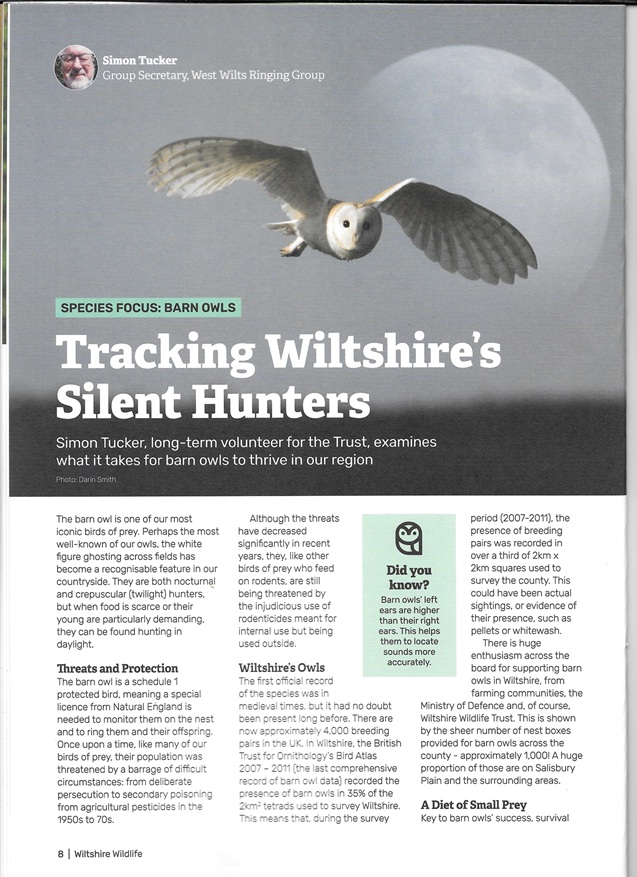
I was extremely flattered to be asked to write an article on Barn Owls in Wiltshire by the Wiltshire Wildlife Trust. I wrote my piece and sent it in, we agreed a few edits and then they set it out beautifully:
There were a few extra edits before publication but, overall, I am 100% happy that they got it right. Big thanks to everybody who shared information with me and all of the people that I have shared the wonderful experience and privilege of monitoring these fabulous birds.
Have a look at the Wiltshire Wildlife Trust website, they are involved in some very important and exciting projects:
Today we were scheduled to carry out a ringing demonstration for the Swindon Wildlife Group at Blakehill Farm. This was a rescheduling of the previously postponed session scheduled for the 5th October. That was postponed because of wet and windy weather. We turned up at 7:00 ready to set up only to find that the wind was blowing hard across the plateau, so we had no choice but to cancel that session. I contacted Mark Clayborough, the Swindon Wildlife Group contact for today. At least it gave plenty of time for them to contact the potential attendees and save them wasted journeys, as they were not due to arrive until 8:30.
As we were already up and out, I had a chat with the team, and we decided that we would try out Somerford Common, to see if the woodland would provide better protection. Laura, Adam, David and I headed off – I had to make a detour to home to pick up the 18m nets. It was still blowy, so we were restricted as to which nets we could set. In the end we just set up seven nets:
We had the nets open just after 8:00 and sat and looked at empty nets for 20 minutes, but then we started to catch. The first catch comprised of one each of Blue Tit, Chiffchaff and Goldcrest. We didn’t really do rounds today because we could see along the nets. Mind you, we had to identify the birds from the leaves: looking for a little bit of voluntary movement! Every time a bird was identified one of the team would go off and extract it. We did have a couple of multi-bird rounds: two of five, three of three and two of two. However, we did have 16 catch events during the session. Catching was between 8:30 and 11:45, closing the nets in stages: ride 3 at 11:15 (removing two birds from that ride that flew in as it was being closed) and then rides 1 and 2 at 11:30 (again, removing a Blue Tit that flew in as the nets were being closed).
It was a satisfying, if not busy, session. Given that we had a late start, and the lures were set up for a session on agricultural grassland and hedgerows, I was happy with a catch that comprised: Blue Tit 4(1); Great Tit 4(1); Long-tailed Tit 3(1); Dunnock 1; Robin (2); Blackcap 1; Chiffchaff 6; Goldcrest 8. Totals: 27 birds ringed from 7 species and 5 birds ringed from 4 species, making 32 birds processed from 8 species.
Obviously, I would have preferred that we had managed to go ahead with the ringing demonstration. I couldn’t invite them to join us at Somerford Common for two reasons: firstly, we didn’t know whether we would find enough cover to set up there, nor what sort of catch we would make, and I would have hated to waste their time; secondly, there wouldn’t have been enough parking available.
With the rather decent catches we have had recently in the Firs and Webb’s Wood, and realising that I hadn’t been to Red Lodge for quite a long time, we decided to give it a go this morning. Unfortunately, recent catches have not been as good as I would have liked, but hoped that we might catch the odd feeding flock of titmice, an earl Redwing or add another Redpoll or two.
I was joined by Miranda, Ellie and, after the school run, Laura and we set the usual summer nets. Whilst the forecast was for it to be cloudy but dry, it was horribly damp, with patches of mizzle. We had a brief discussion and agreed that we would continue with the session. It was weird for the first two hours or so: it would dry up for 30 minutes, interspersed with 10 minutes of mizzle. It finally dried up but then we had the trees dropping the water from their foliage.
Unfortunately, I think the weather put the birds off, and it was horribly quiet, There were very few birds flying around and very little calling. A couple of calls from a Great Spotted Woodpecker whilst we were setting up the nets, but that was all we saw or heard of it all morning.
The catching was very slow and, frustratingly, we had half-a-dozen birds bounce off the nets, or manage to extract themselves before we could get to them. Ellie had to leave at 9:45 to get to work, having had the chance to process just a Chiffchaff and a Great Tit. Our rounds were: 1, 2, 1, 3, 3, 1: just 11 birds caught between 9:00 and 11:00, when we decided enough was enough and decided to pack up.
We did have an interesting Goldcrest: I knew from the ring number that it was an adult but its tail feathers (rectrices) contained a number of pointed feathers, hard to know if they were retained juvenile feathers or worn adult feathers, but there was no sign of moult anywhere:
One final moment that brightened the morning: as we started taking down the last net set our third Redpoll of the autumn flew in and Laura got to ring it: her first of the year. Only fair: Miranda and Ellie got to ring the two we caught last week at Webb’s Wood.
The list for the session was Blue Tit 2; Great Tit 1; Coal Tit 2; Marsh Tit (1); Long-tailed Tit 1; Wren 1; Chiffchaff 1; Goldcrest (1); Redpoll 1. Totals: 9 birds ringed from 7 species and two birds retrapped from 2 species, making 11 birds processed from 9 species.
I will be setting up feeders there in November, so the catches will improve. One of the regular dog walkers, David, with his fabulous Black Labrador, Denver, who loves women and goes a bit mad around them, wanting their attention (Denver, not David) came along whilst we were setting the nets and he did say that the birdlife in the wood had been very much missing this year. He asked if I was going to set up the feeders, and when I answered in the affirmative he offered to strim the rides and cut back the overgrowth: what a nice man! Naturally, I said “Yes please!”.
Things did not start well: we arrived on site by the Whitworth Building at Blakehill Farm to find two bulls in our usual field. Fortunately, the next field along was bull free and the adjoining gate shut, so we decided to set the nets in that next field. We had tried a couple of nets in there before, with little success, so I wasn’t too hopeful.
Anyway, I was joined by Laura, Adam, David, Ellie and Mark came along to help with the setting up and taking down. We met at 7:00 and set the following nets:
I extracted a Wren from ride 1 as the first bird out, as usual, whilst I was putting out the lures. The lures really had an instant impact, with rides 2 and, in particular, ride 3. A nice little catch of Long-tailed Tit, Chiffchaff, Goldcrest, Robin, Great Tit and Blue Tit.
Then disaster, we finished processing these birds and got to the end of the AA string. I went to my ring box: no AA rings! I cannot believe that I had made such an egregious error! What did it cost our catch: five Chiffchaff, one Goldcrest, six Long-tailed Tit, one Treecreeper and two Wrens: 15 birds from 5 species.
Despite that, we did end up with a reasonable catch, with one memorable highlight:
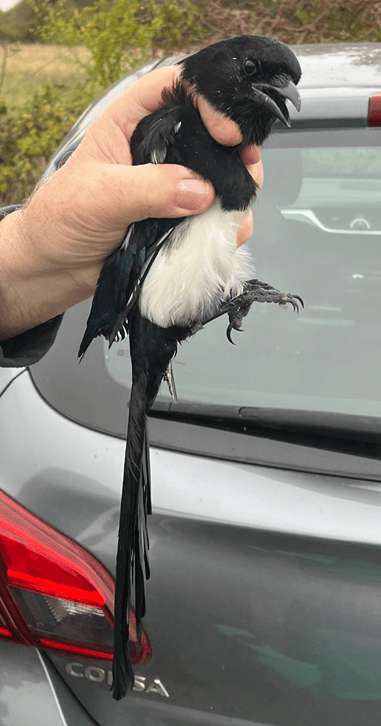
Juvenile Magpie, Pica pica, photo courtesy of Laura
Apologies for the quality of the next photo, as my phone camera decided to focus on my rucksack and not the bird. However, it shows clearly how we could identify that this bird is a juvenile:
The feathers P1 and P2 have a dull, dark grey border. In the adult they are equivalent in colour to P3, and the extent of the white extends much further down the feather towards the tip.
That was pretty much the end of the catching for the morning. The next two rounds, at 10:50 and 11:10 were both empty, so we decided to close up and take down.
The list for the day was: Magpie 1; Blue Tit 11(1); Great Tit 3; Long-tailed Tit 8; Dunnock 1; Wren 1; Robin 2; Chiffchaff 2; Goldcrest 3. Totals: 32 birds ringed from 9 species and 1 retrap, making 33 birds processed from 9 species.
Of course, without my incompetence that would have been 47 birds processed from 10 species. Anyway, it wasn’t a bad catch, we were off-site just after midday and, now, I am off to order some more rings!!
We had to postpone our session from yesterday because of rain. Fortunately my mid-week team of Laura, Miranda and Ellie could all make this morning and I think we are all pretty pleased that we did. We met at 7:00 and went back to our usual feeding station area. That was mainly because the entrance gate is broken open and Miranda beat me to site and, because she hasn’t been with us at the recently used rides, she went to the area she knew. In the event it was very fortunate!
We set the following nets:
We had the nets open by 8:00 and started extracting straight away. The obligatory Wren flew into net 2 before it was open! They really are the most frequently caught bird in the nets before they are opened, followed by Robin.
It was nice to have a regular flow of birds. The first round proper produced six birds: a Blackcap, Coal Tit, two Goldcrest, a Great Tit and our 22nd Marsh Tit of the year! Looking good for them this year! Next round was a single Coal Tit, but the next three rounds produced 14, 14 and 20 respectively. The third of those produced another two Marsh Tit juveniles: up to 24, really hoping for 30+ this year. The make up of those catches was interesting: in the first round of 14 we caught eight Long-tailed Tits and three Goldcrests. Our next round of 14 was bulked out by another five Goldcrest and the round of 20 was down to 10 Blue Tits and 5 Great Tits.
Two rounds later, with no disrespect to our Marsh Tits, we caught the highlights of the session:
Adult Male Redpoll, Acanthis cabaret
October is the earliest that we have ever caught Redpoll in Webb’s Wood. Across the Braydon Forest, apart from two juveniles caught in Ravensroost Meadows in August 2016, October is the earliest month in which we catch them.
The list for the session was: Blue Tit 21(2); Great Tit 10(1); Coal Tit 5; Marsh Tit 3; Long-tailed Tit 8; Wren 3; Robin 2; Blackbird 1; Blackcap 1; Chiffchaff 2; Goldcrest 13; Redpoll 2. Totals: 71 birds ringed from 12 species and 3 birds retrapped from 2 species, making 74 birds processed from 12 species. This is our largest catch in Webb’s Wood, with or without a feeding station in place, since August 2018. Prior to that we did have two sessions that were larger, but they were due to the provision of supplementary feed. I haven’t set any feeding stations yet this year as the weather is decent and there is still plenty of wild food available.
We emptied and closed the nets at 11:45. Processed the last seven birds and then we had everything packed away and were off site by 12:30 after a very satisfying session.
Just our best month ever. Prior to this month our best ever single month was in September 2023, with 1,802 birds processed. This month we have broken the 2,000 mark. As usual. most of this is down to Jonny’s efforts. He does seem to have discovered some seriously productive new sites: particularly two sites just to the west of New Zealand (a village in Wiltshire, he hasn’t emigrated)! One is a highly productive woodland, the other is a boggy patch surrounded by hedgerows and trees. Mind, it seems every site he discovers turns out to be highly productive. Unfortunately, my contribution this month was considerably lower than I wanted, with five sessions cancelled for a variety of reasons.
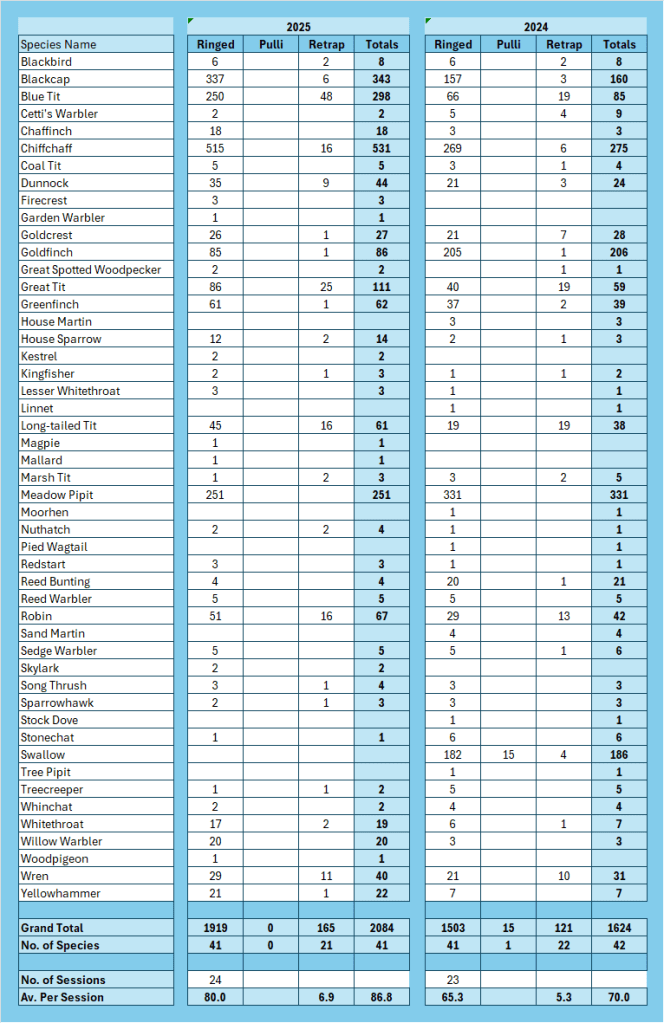
This was the catch for the month:
Added to the list compared to this time last year were Firecrest, Garden Warbler, Kestrel, Magpie, Mallard, Skylark and Woodpigeon. Missing from the list this year were: any pulli, House Martin, Linnet, Moorhen, Pied Wagtail, Stock Dove and Tree Pipit. The complete lack of Swallow, after 182 ringed and 4 retrapped last year, was perhaps the most surprising. There were also significant falls in the numbers of Goldfinch and Reed Bunting. The number of Meadow Pipits were also much lower than usual. That is almost all down to our failure to catch them at our normal levels at Blakehill Farm with just two caught in the month. Not that there weren’t plenty around: we saw plenty, sitting on the top strands of the net or on the poles, but not coming down to the ground to get caught.
Where there was a huge increase was in both Blue and Great Tits, Blackcaps and the astonishing catch of 530 Chiffchaff: over 200 more than in any other single month, and we are already at over 1,200 for the year. Last year, our previous best year, was over 200 fewer than we have caught so far this year, with the chance to add another 200 or so before the end of the year.
Smaller numbers but nice increases in Greenfinch, Whitethroat and Willow Warbler. Jonny added two more Skylark to our list: taking the total to just 14 since 2013. Actually, we only started to catch any since 2019, and have had between 1 and 4 every year since, except 2022.
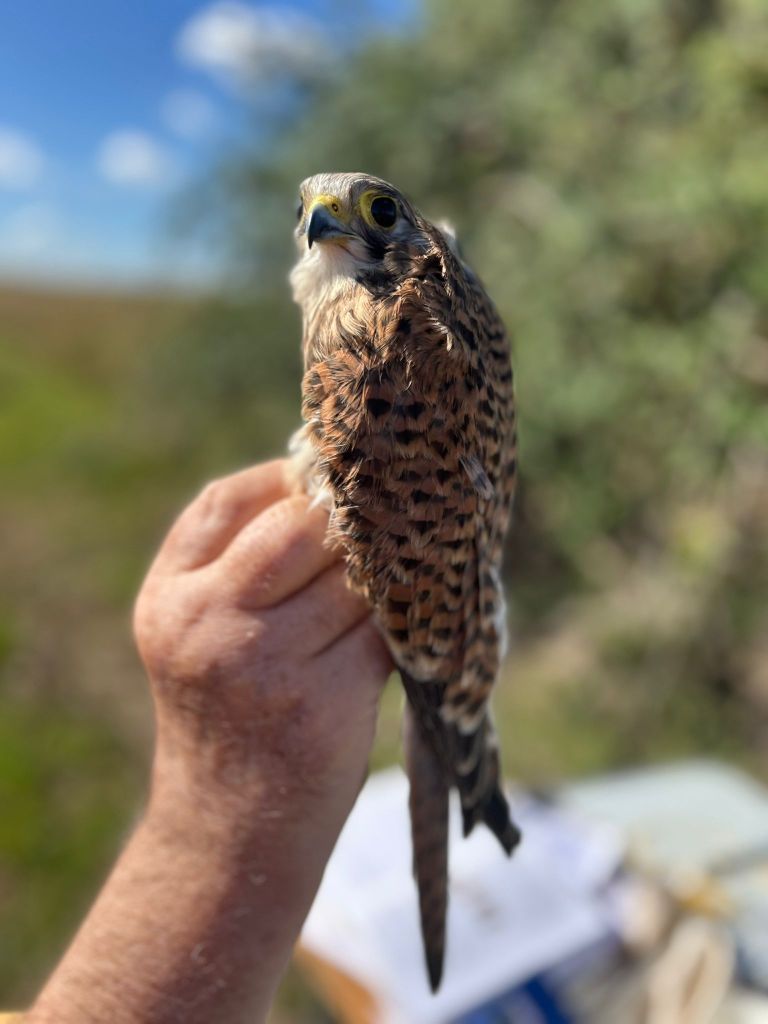
The Kestrel catches were nice: since 2015 we have caught one fledged Kestrel per year, with 2019 missing out but, so far this year, we have caught 3. My team’s was, predictably, at Blakehill Farm, Jonny’s was at the same farm near Hilmarton where he caught one last month.
Kestrel, Falco tinnunculus
Three Firecrest in one month is our best ever catch. Although we have had a total of 18, it is usually one per year, with two in 2015, until last year when we caught three: one in April and two in October. So far this year we have caught five: one in April, one last month and three this month! (Little bit of egotism: my sites have produced 11 of the 18 the group have caught, although Jonny caught all three of this month’s cohort, each in a different site.)


















 Ringing In The Braydon Forest & Beyond