Back In The Bog: Wednesday, 19th May 2021

After the driest April I can remember, it seems as though May is trying to make up for lost time. However, the weather forecasts have been dreadful: dreadfully inaccurate and forecasting dreadful weather. Having had our CES session two rained off to the last possible day, I was up at 3:50 yesterday. There was no way I was going to repeat that this morning, (I like to have some sleep) so I was delighted that the forecast was for it to rain until 6:00. I set my alarm for 6:30 and got up to brilliant sunshine and no sign that it had recently stopped raining.

That said, the Firs is known as the Braydon Bog for a reason and it was back to its boggy best! I was filthy by the end of the session, despite almost constant warmth and sunshine: all it did was dry the mud on my clothes more quickly.

My last session at the Firs was rained off, so I was pleased that this one could go ahead. Both the last session and this were timed to coincide with a visit from Christine from the Wildlife Trust. I had to let them down last time, because of the weather, so was very pleased that this could go ahead. Christine is the Trust’s Education & Well Being Officer and works with local schools, providing outdoor experiences for schoolchildren who are either excluded, or deemed to be disruptive or vulnerable. I have done quite a few of these sessions and I always find them thoroughly enjoyable, and I always end up wondering what is supposed to be wrong with these children. One of my current trainees came out of this process and is a really competent and reliable worker. I think I might have identified another from today’s group. He is going to talk about it with his parents. To enable me to work with young children I have been CRB checked and have a “Young Persons Training Endorsement” on my ringing licence.

I was on site for 7:00 and had the nets open by 8:00 (luxury!). The children arrived at 9:30. It was never very busy, and I only caught 14 birds, but the youngsters all had a chance to see several species close up and all bar one had the chance to learn how to safely hold and release a wild bird. It should have been all of them but the last bird, for the last of the crew, managed to escape from the weighing pot. That it was the best bird of the day for the assembled group, a Nuthatch, made it doubly unfortunate.

The list for the day was: Nuthatch (1); Great Tit (1); Wren 1(2); Robin (2); Blackbird 2(2); Blackcap 2; Chiffchaff (1). Totals: 5 birds ringed from 3 species and 9 birds recaptured from 6 species, making 14 birds processed from 7 species.

There was nothing astonishing in the catch but the youngsters all thoroughly enjoyed the contact. The two teaching assistants who had brought them along were very pleasantly surprised at the lad who was, clearly, the most extrovert of the group and how he was so calm and gentle when shown how to handle and release a Robin. As he let it go and he watch if fly away he said “Sick!” and, being down wiv da yoof. I know that means “really good”. We all packed up for midday and got away soon after. I had a short debrief with Christine and found out that, by happy coincidence, the next time this group are out is at Lower Moor Farm next Wednesday, when we will be carrying out CES 3, so I shall look forward to meeting up with them again.

I left the Firs in brilliant sunshine and within 400m was in the middle of a torrential downpour which lasted for nearly an hour! We were lucky!

CES 2: Lower Moor Farm, Tuesday, 18th May 2021

This session was originally scheduled for last Friday. The weather forecast had said that rain would stop by 4:30, when we would be on site to set up the nets. True to the inability to forecast even a few hours in advance, Lucy and I arrived on site at just before 4:30 and sat and waited for the rain to stop. When it showed no sign of abating by gone 5:00 we decided to reschedule and go home. The rain eventually stopped ay 7:30 – but that would have been 3.5 hours late starting our 7 hour session and, anyway, I was asleep again by then. The latest date for doing CES 2 was today, the 18th May. From tomorrow, for the next 10 days it would be session 3, so today was our last chance. The forecast was a bit iffy: rain was scheduled on and off throughout the morning. Fortunately the forecasters were as accurate as they had been last Friday and, apart from one brief shower mid-session, and a slightly heavier one as we started to take down, it didn’t set in for any length of time until after we had left site at midday.

The weather has been frightful, with thunder and torrential rain late Tuesday afternoon and into the evening as a final worrying flourish, and I did wonder what impact it might have had on the birds. Lucy and I met up at 4:20 and had the nets open by 5:00.

The catch was never very busy but by the time we closed the nets we had captured a reasonable haul of 37 birds. Significantly, however, of those 37, 26 were recaptured birds.

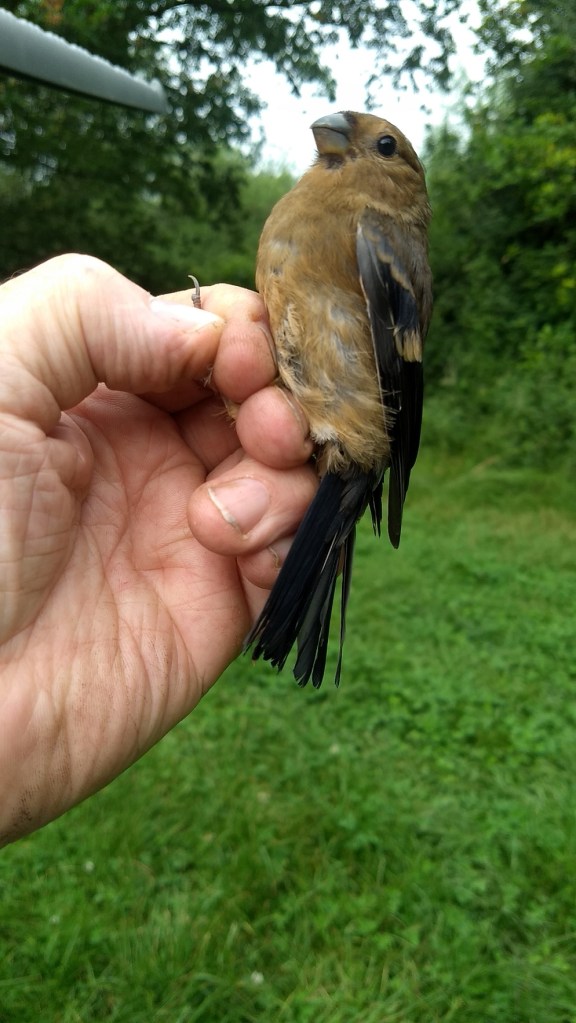
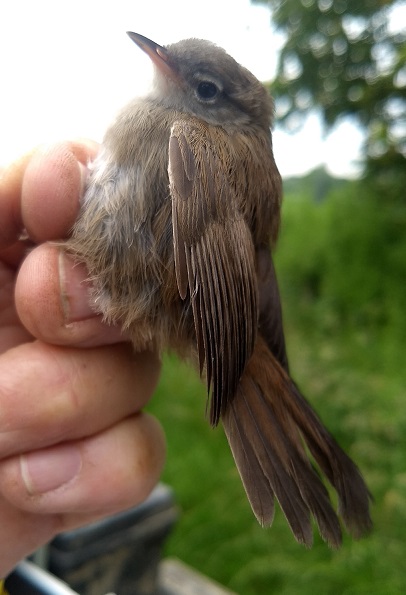
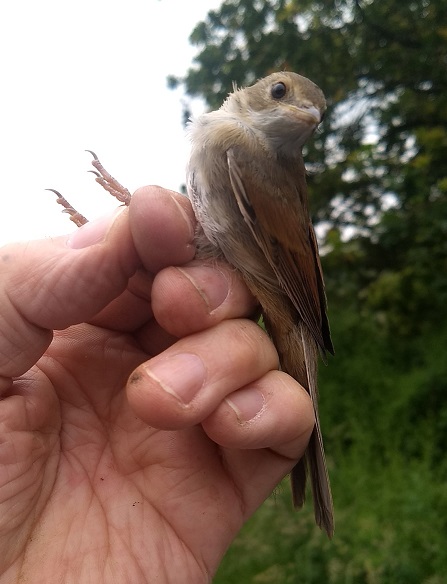
Our first bird out of the nets this morning was our first juvenile Robin of the year:

Juvenile Robin

This was the first of three that we caught this morning. We were joined by a very friendly chap called Martin. He has developed an interest in wildlife photography as an antidote to lockdown, and spent most of the morning with us, taking advantage of our activity to get some close-up ID skills and photographs. It gave Lucy a break from being the focus of my wittering on, and was good company, helping the quieter parts of the morning pass more quickly.

Our list for the day was: Blue Tit (1); Great Tit (4); Long-tailed Tit (4); Wren 1(2); Dunnock 1(1); Robin 3(1); Song Thrush (1); Blackbird (2); Blackcap 3(4); Garden Warbler 1(2); Whitethroat 2; Chiffchaff (4). Totals: 11 birds ringed from 6 species and 26 birds recaptured from 11 species, making 37 birds processed from 12 species.

Lucy’s highlight was ringing her first ever Garden Warbler, my highlight comes at the end of this piece. It was a quite remarkable catch, but something that I am getting used to: a lot more recaptured birds than ringed. It does make life cheaper!

To my highlight. We packed away the nets in the wildlife refuge, packed away the ringing station and then went and packed away the nets in the Heronry Ride. I was about to drive off site when I realised that I hadn’t refitted the padlock to the wildlife refuge so I turned around, parked up and got out of the car to lock it up. As I stepped out of the car I noticed this little beauty sitting on the vegetation:

The wonderfully named Hairy Dragonfly: a relatively recently arrived species in Wiltshire. My first dragon of the year and a lovely finale from a good morning’s ringing.

Ravensroost Meadow Pond: Wednesday, 12th May 2021

A somewhat poignant day: my father would have been 101 today had he not smoked himself into lung cancer and an early grave at age 62. I always like to do something on this day as a personal marker, so I scheduled a session at Ravensroost Meadows to see what else might have arrived in the month since I was last there. It was a pleasure to be able to get out after the rain and high winds of the last week, but the catch was very small for this time of year. It isn’t that there were not lots of birds around, there were plenty, but they seem to have changed their foraging habits, so I might have to rethink my net positions.

I spent the morning with an audience: a herd of Belted Galloway steers who have been put out to grass in the meadow adjacent to the pond. As they were in the field I moved my car into the pond area so I could close the gate and keep them away from the car. The last time I left it out in the field with the Belties, apart from the using it as per Baloo the Bear singing “Bare Necessities” and rubbing themselves up against it, it took months to clean their slobber off the bodywork. I think it could be bottled as an adhesive!

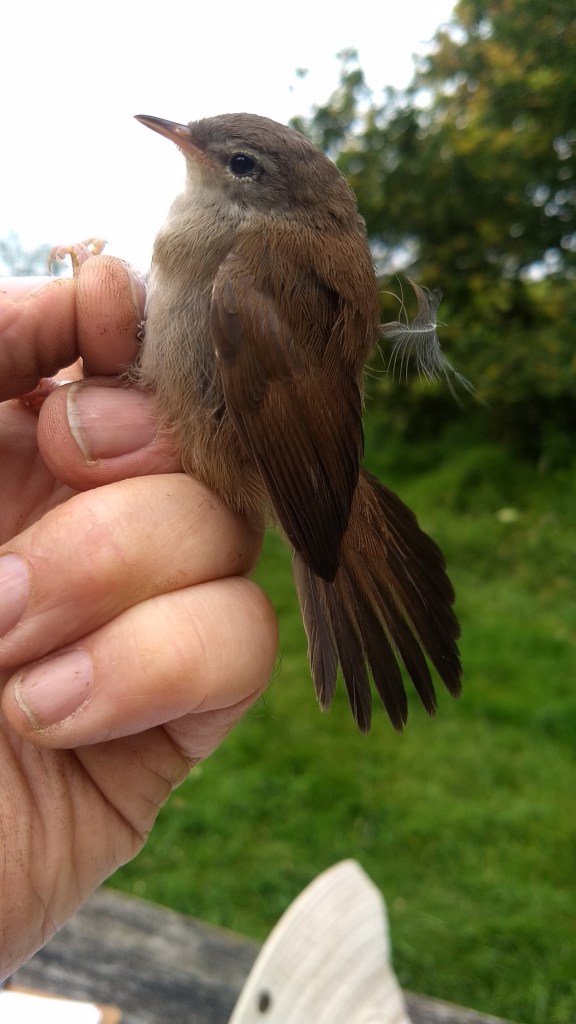
The morning started well with a new Garden Warbler and a retrapped Dunnock getting caught before the nets were properly open at 6:00 (I had a bit of a lie-in, getting up at 5:00). At 6:45 I took another half-a-dozen birds out of the net, including my first Lesser Whitethroats of the year: one new one and a retrap ringed at this site as a juvenile last year.

As you can see from the photo, the feathers at the top base of the bill are sticking up. This is known as a “pollen horn” and seems to be quite common in migrant warblers. It is caused by the feathers becoming encrusted with pollen when foraging for insects on migration and comes mainly from citrus or eucalyptus plants (Laursen K.~ E. Holm & 1. S¢rensen 1997. Pollen as a marker in migratory warblers, Sylviidae. Ardea 85: 223-231). I have also found pollen horns on Chiffchaff and Willow Warbler, as well as the Sylvidae.

After this, however, it went very quiet and I didn’t catch another bird until 09:15, by which time I had been joined by Jonny Cooper. He had been out monitoring Curlew at Blakehill this morning and was killing time until a scheduled meeting with a local farmer who has had some Curlew turn up on his farm this year.

The list for the day was: Long-tailed Tit 1; Dunnock (1); Blackbird 1; Garden Warbler 1; Whitethroat 1(1); Lesser Whitethroat 2(1); Chiffchaff (1); Willow Warbler (1). Totals: 6 birds ringed from 5 species and 5 birds retrapped from 5 species, making 11 birds processed from 8 species.

As well as the retrapped Lesser Whitethroat, both the retrapped Whitethroat and Willow Warbler were also ringed at the Meadow Pond last year.

So, not a big catch but there was a lot of bird song, from the male Cuckoo who started calling at about 6:30 and kept it up all morning. Try as I might, I could not get him to come close to the pond area. It seemed content to stay around the main body of the wood. There were several Swallow hunting over the meadow. As the Belties would attest, there were plenty of flies to attract their attention:

They were certainly irritated by the flies: lots of head-shaking and tail twitching – and that was just me! As there were no birds getting into the nets I started taking down at 10:45 so, naturally, I caught a final Lesser Whitethroat as I was doing so. I was away from site by midday: slightly disappointing numbers but nice variety and the site faithful recoveries were a bonus.

Early Fledged Starlings: 5th May 2021

This morning I processed a number of birds ringed in his garden by one of our team who lives in mid-Wiltshire He is not a fan of social media so that is all of the identification you are going to get.

Amongst the birds processed were a number of Starlings. Two of those were recently fledged juveniles.

I thought that this was early, so I had a look at all of our group records, going as far back as we have them on DemOn, i.e. all computerised records.  We have ringed 1,398 Starlings of which 75 are recently-fledged Starlings caught in May between 1996 and the present day. 

These are the earliest by 15 days, with the next earliest being on the 20th May last year, which was a juvenile caught in my garden in Purton.

According to BTO Bird Facts, based on data collated from the Nest Record Scheme, the mean laying date for the first clutch of eggs for Starling is 19th April, with the earliest record being the 6th April.  Incubation is 12 to 15 days, time to fledging 19 to 22 days.  If you take the shortest intervals, and the 5th May as their fledging date, i.e. go back 31 days to find the date of laying, unless my maths is wrong, the date of laying is as early as the 4th April. 

I just thought that I would share that.

CES 1: Lower Moor Farm, Wednesday, 5th May 2021

Last year’s CES, like so many other activities, was unsustainable due to restrictions imposed as a result of the Covid-19 pandemic, so it is great to be able to get out and start this year’s study on time.

I was joined for the session by Alice but, as she had to come down from her university digs in Oxford, I suggested that she meet me at 6:00. For my sins, I was on site for 4:30 to set up the nets. The volume of birdsong was astonishing and I was confident that I could hear Garden Warbler in the mix. The nets were open by 5:30 and I took my first bird of the morning out of the nets as I was opening up. Sometimes birds do blunder into closed nets, usually Robins or Wrens, but this time I was delighted to extract and process my first Garden Warbler of the year:

They might look unspectacular but they are one of my favourite birds.

The weather forecast for the morning was for it to start to get wet about 10:30 but, apart from a few spots at that time we had no rain until we got hit by a short shower after we had closed the nets and were taking down. That said, it was very cold for a May morning, with 3 degrees Celsius at the outset and, despite (or, perhaps, because of) a clear sky and the sun, it did not warm up properly until 10:00. Every time the sun went behind one of the very few clouds around the temperature dropped quickly.

Alice arrived just as I finished opening the top nets and the next couple of rounds were quite busy. We were enjoying the variety of what was turning up in our nets. There was quite a lot flying around that we didn’t catch: a couple of Common Tern flying over our ringing station was an unexpected pleasure.

One of our nets is set within a small area of woodland so, naturally, that is where Alice extracted a Kingfisher! This was a male that we ringed in July of last year once we were able to get back to site. The last time I posted a photo of how we weigh Kingfishers some troublemaker in the wider ringing community complained to the BTO that the bird looked dead – despite being wide-eyed and clearly alive and, they being scared of public opinion, I was asked to take it down. So sorry folks, no can show. They are astonishing: they just lie on their backs and look at you turning their heads from side to side. Perhaps next time I will video it and post that instead.

The list for the session was: Kingfisher (1); Great Spotted Woodpecker 1; Treecreeper 1(1); Blue Tit 2(3); Wren 1(3); Dunnock (4); Robin 1(3); Song Thrush 3(1); Blackbird 1(2); Blackcap 4(3); Garden Warbler 4(3); Whitethroat 1; Chiffchaff 4(4); Willow Warbler 1(1); Bullfinch 1. Total: 25 birds ringed from 13 species and 29 birds retrapped from 12 species, making 54 birds processed from 15 species.

It was a super morning. We did a couple of short ringing demonstrations, one to a family of Mum, Dad and 2 children plus a dog (on a lead: top marks to them), which delighted them and hopefully informed them. We left site just gone midday.

PS After the incident at Red Lodge blogged about recently, the police have taken a very positive interest in helping to prevent future occurrences. One of the members of the local wildlife crimes team is going to join me for a session and they are going to put up a notice on their community web-site about bird ringing, why it is carried out and why people must not interfere. That is really positive and helpful of them.

West Wilts Ringing Group: April 2021 Results

April has turned out to be an excellent month for the team.  Not too surprisingly, given that we were in lockdown last April, this was a much better month, with more than double the number of birds caught and a superb 37 species ringed, 39 processed, compared with 23 ringed / processed last year.  Our previous best April was in 2017 and I have included this for comparison with 2021 and 2020.

The stand out catch of the month was this Curlew. We have heard that two Curlew chicks were ringed by Rob Turner and Tony Rowe at Manor Farm, Coulston on the 14th June 1984 and that one was ringed in 1992 and 3 in 1997. At the moment I don’t know if these latter ones were adults or chicks. It is still an excellent catch:

Compared with 2020 it is clear that we were restricted to our gardens at this time last year. When comparing with 2017 there are still significant differences, as there were over 100 more birds processed, 5 more species ringed and 6 more processed.  The increased activity is almost all down to the increased activity from our C-permit holders working their own sites.  For example, the catch of Sedge Warbler is entirely down to Jonny’s activity, primarily the reed beds at Langford Lakes and at the Melksham site. Also, there was a significantly higher catch of Blackcap.

Back on the Farm: Saturday, 1st May 2021

Okay, I am regularly at both Lower Moor and Blakehill Farms but, as well as working farms, they are nature reserves. However, my other site, Brown’s Farm, we were only able to visit twice last year: in between lockdowns in July and September. It is a very mixed operation combining beef and arable farming, a kennels and also with stables and a couple of paddocks for horses and ponies. I know that the latter can be grass monoculture deserts for wildlife, but the paddocks take up a small proportion of the site and the farmer provides a lot of wide tracks around his fields for the owners to exercise their horses. These, in turn, have been seeded with wildflowers, and the farmer estimates that they have planted over 4 hectares of potential wild bird food plants as well as supplementary feeding over the winter. First thing this year the hedgerows were cut back, as they were two years ago, to promote fresh growth, keep them from getting long and leggy, and provide good nesting habitat for the farmland birds.

I don’t know if it is a result of the feeding regime but there were so many Skylarks singing and the hedgerows were alive with birds. This has always been a good site for Skylark but there did seem to be twice as many as usual. We also spent a lot of the morning with a Red Kite flying around and about our ringing station, with some excellent views as it sailed around the area. The Swallows have arrived, and there were good numbers hunting over the fields. As I left my house in Purton at 5:15, I heard my first Cuckoo of the year, and we were serenaded by a Cuckoo calling throughout the morning at Brown’s Farm.

This session was carried out entirely without any audio lures. Now that the breeding season is fully under way restrictions are in place and lures are only allowed under very specific conditions and for a maximum of 10 minutes in any one location. I choose not to do so. Lucy and I met there at 6:00 and set up the following nets:

We had the nets open by 7:15 and caught our first birds at 7:30. The first birds caught were in the 2-shelf nets and the first set of 18m nets. This was a bit of an excellent start for Lucy: she got to extract her first ever Whitethroat and Linnet, as we took out two Whitethroat and one Linnet. These were my first Whitethroat of the year:

We took a couple more Linnet, and our first Dunnock and Yellowhammer of the session. At 8:30 we took out another Whitethroat, Linnet and Yellowhammer and I called Lucy to the 6m net nearest the track to extract this little beauty:

Male Firecrest

So, this was Lucy’s third new species extracted and ringed for the day! That’s not a bad return for a single session. The bird was a little chilled, so I popped him back into a bag and put him down under my clothing so it could get the benefit of my body heat. This is a sure fired method of livening up a cold bird. After 15 minutes warming it was busily scrabbling against my chest and ready to go. It flew off strongly and headed off towards Savernake Forest.

Before our next round Annie turned up with daughter Elara for her third ringing trip. She is only 2, so a little early to start ringing birds yet! There were plenty of puddles for Elara to play in, and she made the most of them. By the end of the session her wellies were full of water, she had been face down in it, sat down in it – and loved every minute of it and was a fabulous diversion when the nets were empty!

Elara in her element

Soon after they arrived we went for a net round. How frustrating: a Wheatear sitting on top of the 6m net that bisected the two long net sets. It displayed beautifully before flying off into the middle of the field to join the Skylarks. I have ringed Wheatear on Skokholm but not yet in Wiltshire. One day!

Whilst the forecast was for the wind to stay low all morning by 10:00 it was getting quite blowy and, although we didn’t have the problem of the nets blowing into the hedgerows, fortunately the wind was blowing away from the Hawthorn, they did start billowing out, removing the pockets for catching the birds. We decided to take down. Usually I shut the nets prior to taking them down, to stop birds getting caught in slack netting, but this time I didn’t think it necessary. Naturally that meant that, part way through taking down the first 3 x 18m net ride, a Dunnock flew into the bottom of one of the nets.

Fortunately, I didn’t learn from this incident and we moved on to take down the second long ride and exactly the same thing happened again. Only this time I thought it was a Yellowhammer. I called Annie to come and hold the pole and put tension on the net so I could extract it. As I walked forwards I thought “that beaks too long and pointy for a Yellowhammer”. It was. This is what I extracted:

Yellow Wagtail Male

This is another bird that I had ringed elsewhere but had never extracted and not ringed in Wiltshire. In fact, because we do not have any sites within our group where they over-summer, this is the first Yellow Wagtail ringed by the West Wilts Ringing Group since it adopted its current structure at the beginning of 2013. We have seen them at Brown’s before, but never caught one. This was the last bird of the day. We finished taking down and left site at midday.

The list for the day was: Great Tit 1; Dunnock 1(1); Yellow Wagtail 1; Whitethroat 5; Firecrest 1; Linnet 6; Yellowhammer 3. Totals: 18 birds ringed from 7 species and 1 bird recaptured, making 19 birds processed from 7 species.

It was a super session, even though we didn’t catch that many birds what we caught was high quality and the birding was fantastic.

Curlew Confidential: April 2021

After two years of observation by a small army of volunteers, ranging from local farmers to birders and casual observers, a picture is beginning to emerge of the status of the Curlew, Numenius arquata, in the land that once comprised the hunting forest of Braydon.  Sightings have been made from Blakehill Farm in the north to south of Brinkworth and from Purton in the east to Braydon Pond in the west.

Under the project management, enthusiasm and knowledge of Jonny Cooper, and his co-operation with other bodies involved in similar projects, like the Wildlife & Wetlands Trust, a body of information is building up, detailing where the Curlew are to be found and giving an opportunity to devise strategies to protect nesting sites and encourage the expansion of this long-lived, site faithful and sadly declining species.  That Jonny has persuaded local farmers to sign up to the scheme is probably the most important step in this process.

One of the issues of monitoring birds is that they fly. If you see six Curlew separately on your walk, apart from being very lucky at seeing such a number, it is impossible to tell exactly how many you actually saw.  It could be the same bird seen 6 times or 6 individuals.  The standard way of identifying an individual bird is to put a ring on it.  However, with standard BTO metal rings they are difficult to read in the field, even using good quality binoculars or telescopes or, as happens more and more these days, a dirty great telephoto lens on an ultra-high-definition camera.  This means that, apart from catching the bird once to fit the ring, it has to be caught again to read the number and identify it.  This obviously restricts the ability to make casual observations of the size of the local population and causes more disturbance to the birds.

To overcome this, the plan going forward, is to put field readable tags on the birds.  These are solid plastic yellow flags, with two bold black capital letters on them, which can be easily read using any of the optics mentioned previously.  Jonny successfully found a source of funding for the tags, for a walk-in trap and a Curlew decoy.

Prior to the commencement of this year’s breeding season Jonny got permission from a local landowner to pilot this process.  Their permission was granted on the condition that the site remains confidential, so there will be no hints or hidden indicators as to where the site is.  Having got agreement to proceed, we set up our first trial on the site where we knew at least one Curlew was present.  The trap was set, the decoy put in place and a lure of the call of the male Curlew set away.  We were surprised to find that a couple of local birds responded to it straight away.  However, they did not get close enough to be trapped.  A week later we tried again, with the same result.  So, on the basis that if you keep doing the same thing and getting the same result, you need to change something, we changed. 

The next time we started later, as dusk was approaching, and actually set three large mesh nets around the trap, on the basis that if one method isn’t successful the other might be. This was the set up:

The decoy was placed in the middle of the trap, together with a lure, and a second lure was placed at the junction of the two 12 metre nets.  We sat down about 250 metres from the net and waited. It wasn’t long until we had some Curlew activity: a couple of birds flitting and walking around the set up.  After 30 minutes we were successful in trapping a bird in the 18-metre net. Jonny sprinted to extract the bird and got to within two paces when it managed to extricate itself and get away. Frustrating!   After he crawled back to his seat and recovered his breath, we sat and waited some more.  As it was getting dark another (or the same) bird hit the net. This time the bird had got into the middle of the net set. It managed to extract itself, as the first had, but because it was inside the open triangle, it immediately flew into one of the other nets, giving Jonny the opportunity to grab it..  This time he could walk back carrying the Curlew in his arms. It was fitted with a dark hood to keep it calm.  We did not want to put it into a sack as Curlew are prone to getting leg cramps if their legs are kept constrained so, throughout the processing of the bird, its legs were left free except, for the few seconds it took to fit the various rings.

This is the first record that we can find of a Curlew being ringed in Wiltshire.  Jonny did some digging through the records and found one record of a retrapped bird back in 1962, but ringed elsewhere.

We are happy that we have found a technique that will work in the future. It will not be used again now until next Spring, when the Curlew first arrive, and before they have started nesting. We will not do anything to disturb their nesting efforts, so we will be monitoring, but not approaching nests and do not intend to ring the chicks. I say “we” but I really mean “Jonny” as he will be doing the bulk of that work.

*UPDATE* It transpires that the first Curlew ringed in Wiltshire were two chicks ringed by Rob Turner and Tony Rowe at Manor Farm, Coulston on 14th June 1984 (thanks Rob). Equally, the first adult was ringed in 1992 and three chicks ringed in 1997. So this is the second adult ringed in Wiltshire.

Red Lodge Ructions: Saturday, 24th April 2021

I have spent some time considering whether or not to post this blog piece but I have decided to do so. Too often problems are swept under the carpet, false narratives are promoted and criminals, no matter how petty some might consider it, get away with their crimes.

I have been ringing in Red Lodge since December 2012. In that time I have carried out 50 ringing sessions and never had a problem with the public there. In fact, of all of my sites I would say that the local people and the other visiting users of it are the most friendly and interested of any at my ringing sites. We always chat and I have entertained their extended families with ringing demonstrations, training on handling, explanations on ageing and sexing birds and, apart from someone who took exception to my bird table and feeders in 2016 / 17, there has never been a problem at this site. That was the case until Saturday morning.

I was working solo, which I prefer not to do any more since the problems in Ravensroost Wood last July, but none of my team were available, and I had missed enough sessions recently through illness not to want to miss any more.

I was on site for 6:00 and set up three net rides quite quickly, with the nets open just after 6:30. My information signs were, as ever, placed at the end of each net ride. They are bright, colourful and unmissable. As there was some bird activity along the main path, I thought I would set another ride along it. I had been gone from the farm-side ride for a couple of minutes, whilst setting the first net for my putative next ride. While I was busy, I heard some voices coming from the farm-side ride. When the people didn’t appear straight away I went to investigate.

I found a middle-aged man and a younger woman stood next to the net and the woman was fiddling with something in it. The male was aggressive from the outset. I politely asked them to move away from the net, to which the male replied “No”. I asked again and got the same reply. I asked if they had seen my signs, which they had but said they weren’t interested because they wanted to free the bird. So I pointed out that they were breaking the law (at the least, criminal damage) and went to the net. The woman moved away mouthing all of the usual platitudes about the bird being trapped and struggling! Why do they think the net is there? Why do I bother with signs?

When I got to the bird I found she had dislocated its leg and also torn a hole in the net. I pointed this out and he got even more aggressive and subjected me to a torrent of abuse: every swear word you can think of was thrown in my direction. Looking at the age discrepancy, I suspect that the woman was his daughter and he was reacting to distract from her actions. I have reported the incident to the police, but I don’t have their details and don’t expect anything to come of it, unless they make themselves known. They might, because he said he was going to report my “attitude” to the police and I suspect he is dumb enough to do so. I released the bird from the net and let it fly off. There was nothing I could do about the damaged leg, and I don’t ring birds with illness or injury. You never know who might blame it on the ringing process. I followed them up the path to ensure no further damage to my nets or any birds (fortunately there were no other birds in those nets). Damaged nets can be repaired or replaced, damaged birds have to struggle for what remains of their lives. Ringing training is primarily about safely extracting birds from nets: why do these people think they can do it with no training at all?

I have also reported the incident to Forestry England and the BTO. I think this has to be the end of solo ringing for me. It is too dangerous, both the threat of assault and not having witnesses when these self-righteous, unthinking vandals decide they have the right to interfere, regardless of the consequences for the poor bird.

Soon after the altercation I was met by some of my usual contacts who exercise themselves and their dogs at Red Lodge. They were suitably horrified at what had occurred. Unfortunately, they were unable to identify who the vandals might be. One of them, who lives in the cottages adjacent to the site, has kindly given me his mobile number, so I can call for backup if there are any issues in the future.

So to the actual ringing: I lost all enthusiasm for setting any more nets, so left things as they were and put away the ride I was working on when the altercation occurred. Naturally I spent the rest of the morning watching birds fly across where I would have set those nets.

The list for the morning was: Blue Tit 4; Great Tit 1; Coal Tit 2; Wren 1(1); Robin 1; Song Thrush 1; Blackcap 6(1); Chiffchaff 1. Totals: 17 birds ringed from 8 species and 2 birds retrapped from 2 species, making 19 birds processed from 8 species.

There was an interesting element to the catch. Blackcaps and Garden Warblers are antagonistic: primarily coming from Blackcaps. Having played a lure for Blackcap, which brought in the 2 males processed, I put on a lure for Garden Warbler on the off chance there might be some about. It attracted in 4 of the 5 female Blackcaps that I processed. Perhaps the aggression comes from the females!

The Coal Tits were definitely a pair: a male and female within 12″ of each other in the same net. When I released the male he stayed close, calling, until I released the female, whereupon they both flew off in the same direction.

One of my other regulars was out walking his lovely Black Labrador and stopped for the usual chat. He mentioned that he had found a dead Buzzard along the main track and could see no signs of damage. However, he thought he would save it for me to get it investigated, so he put it in his freezer. It is now in my freezer, as this is the second dead Buzzard found in the area in the last couple of weeks, plus 3 dead foxes dumped at Somerford Common. I discussed it with the police when I made my initial complaint and they have pointed me in the direction of the RSPCA. I have contacted the RSPCA by email and am waiting to hear what to do next.

Long Distance Meadow Pipit

Back in October last year Andy Palmer retrapped a Meadow Pipit with a ring number that was clearly not British: 9A78917. Unfortunately he didn’t get a photograph of the ring and, when trying to enter it into the online recording system, he couldn’t get the record accepted. He contacted me and I contacted Bridget Griffin at the BTO. Bridget is not just a database management guru but also one of the most helpful people you could hope to meet. She managed to identify the scheme as being Icelandic.

Andy entered the record up and we waited to hear back as to where and when it was ringed. The details arrived today. The bird was ringed in Iceland as a juvenile bird in August 2020, and recovered almost exactly 2 months later on Salisbury Plain: a distance of 1,640km in 60 days.

This is the second furthest movement of a Meadow Pipit ringed overseas and then recovered in the UK. The furthest movement was a bird ringed in southern Portugal and recovered in Derbyshire. The absolute furthest recorded movements of birds of this species ringed in the UK were two that were ringed at Spurn and made the mistake of flying 1,900km to Algeria where they were shot. Clearly, there is just so much meat on a Meadow Pipit!

Thanks to the BTO Online Ringing and Nest Recording Report for the additional information.