Causes of Mortality in Wiltshire Recorded Bird Fatalities: 2017 – 2020 Inclusive

The point of ringing birds is that it makes each bird individually identifiable, thus allowing ongoing, quantifiable analysis of traits, populations, etc.  This enables ringers recapturing birds to record the following on an individual basis:

  1. Age
  2. Movements
  3. Compare condition over time
  4. Monitor breeding condition (including sexing monomorphic species)
  5. Identify and collect, where possible, the details of their death

This last is something that is often informed by members of the public, reporting a ringed bird found dead to the BTO.  The finder gets a report back from the BTO telling them when and where the bird was ringed.  The ringers gets a similar report with the details of where it was found dead and the cause of death, where reported.  Unfortunately, the cause of death is not always capable of being identified, but often it is.

Phil Deacon diligently records all recaptures of birds that are recorded by the BTO that have either entered or left Wiltshire, whilst moving either on migration or post-breeding / post-fledging dispersal. Within that he also records all fatalities reported to the BTO.  This is a brief analysis of that mortality data, collected between 2017 and 2020.

The first thing I looked at was the recorded causes of death:
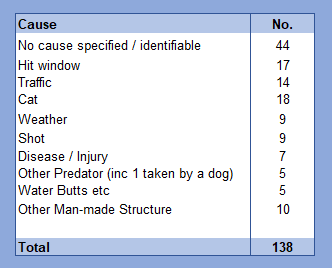
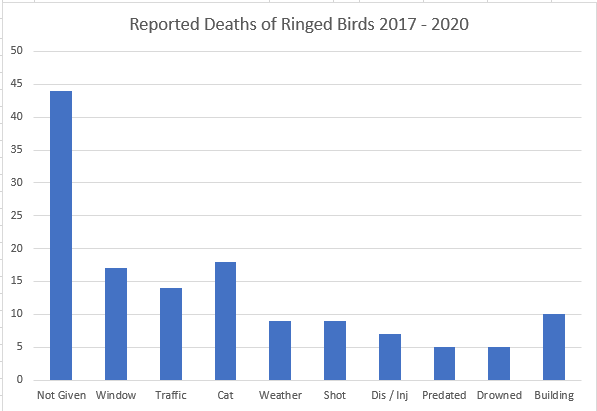
Clearly, the recording of death is a very patchy affair, with some 35% of causes not being recorded, or not being able to be recorded.  Unsurprisingly, the largest, identifiable, causes of death are the domestic cat, followed closely by windows, and then traffic.

Surprising to me was the number of birds that drowned in water butts / artificial ponds: 2 Barn Owls and one each of Blackbird, Nuthatch and Great Tit.

Of those shot, 3 were Teal hunted in Finland, Russia and France.  Killed illegally was a Grey Heron, ringed at Swindon Sewage Works but shot elsewhere in the Swindon area four years later.  That is hard to understand.  There was also a Cormorant ringed as a nestling near Anglesey and shot just 7 months later near Lower Woodford.  Although it is possible to get licences to kill Cormorants, to protect the profits of angling clubs, to kill a bird that was clearly juvenile seems wrong to me.

It is hard to understand why Woodcock (2) and Snipe (1) are still considered game species.  In the UK Woodcock are red-listed, and Snipe are an amber-listed species, due to population declines here. I am aware that shoots based in the Braydon Forest area restrict their shooting to the released Pheasants and Red-legged Partridge they release for the purpose but I am surprised that it is a matter of individual restraint. If there is little meat on the bones of a Snipe, who on earth shoots Redwing? Someone in France it would seem.

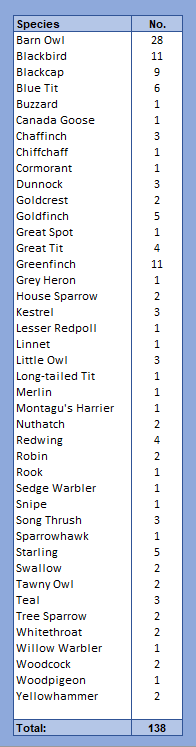
Of the 138 recoveries the largest cohort was the Barn Owl by a significant margin. They are striking birds that are difficult to overlook, are regularly found around human habitation and are a closely monitored species.  Looking at how their deaths break down is quite instructive:
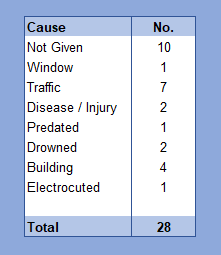
The term building is used loosely to cover, in this case, barns and one that is a large open space, but man made and managed.
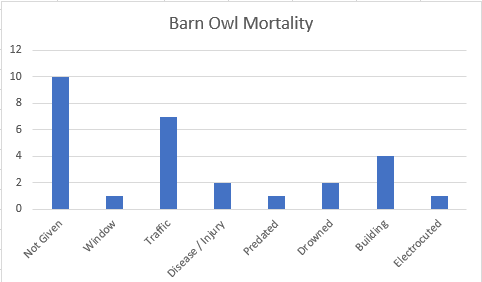
Barn Owls are known to be frequent road traffic victims, and this is underlined by the figures shown here: far and away the commonest reported cause of death.  

There are some intriguing cases here though: two of the four killed within buildings / man-made structures were found in the same barn in Pewsey on the same day. I would be keen to know what would cause two of these iconic birds to perish simultaneously but, unfortunately, that has not been recorded.

Another of the birds found dead in a man-made structure was one found in the lion enclosure at Longleat Safari Park, again the location is given but not the cause.   I suppose a slow, low flying bird might well tickle the fancy of a bored lion.

What are the chances that one of the rarest birds in Wiltshire, a Montagu’s Harrier, would end up as a road casualty? That is what happened to a juvenile ringed in Wiltshire and hit by a car just over the border in Hampshire 30 days later. 

Talking of rare birds, a Merlin ringed on the Shetland Islands in 2016 was recovered dead, having collided with electricity cables at Stanton St Bernard three years later.

The total casualty list by species is as follows:
Many thanks to Phil Deacon for his hard work in collating the data and for giving me permission to use data from outside the West Wilts Ringing Group in preparing this post.
West Wilts Ringing Group: 2020 Annual Summary

Introduction:

The activity levels within the group and, consequently, the number of birds processed, continue to increase. The reasons for this are twofold: the imposition of restrictions to deal with Covid-19 forcing individual sessions for those licensed to carry them out, and the fact that we now have six active C-permit holders in the group.  Jonny is particularly active and, as much as I hate to say it, it is primarily his contribution that has driven the increase this year. He has managed to get some very productive sites to add to his already strong portfolio of East Tytherton and Meadow Farm, processing over 43% of our catch, whilst holding down a job as well!

On a per session basis the numbers are lower: but that is because so many sessions this year were carried out in our gardens or, failing that, single-handed exercises under restrictions placed by the landowners, where either numbers are not so good, or caution was needed because the catch could potentially be very large.

The Catch:

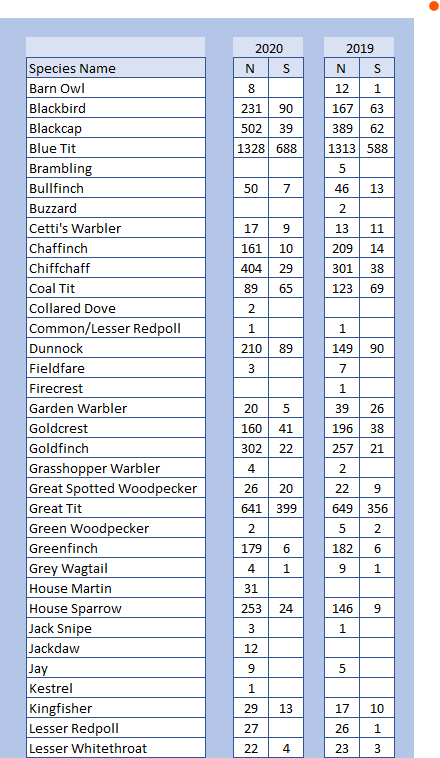
So, a significant increase in both birds ringed and recaptured during the year, but not a significant change in the number of species caught. However, the total number of species caught over the two years is 70: so, clearly, there is a decent variety in the catch.  Since 1st January 2013 the group has actually processed 79 species.

What is rather surprising, given that we have carried out approximately 30 more sessions than we did in 2019, and so many were garden sessions, the numbers of Blue and Great Tits processed are pretty similar year on year.

Not represented in the catch last year but present this were: Collared Dove, House Martin, Jackdaw, Kestrel, Long-eared Owl and Nightjar.  Present in 2019 and missing in 2020 were: Brambling, Buzzard, Firecrest, Merlin, Swift, Tree Pipit and, unsurprisingly, Sykes’ / Booted Warbler.

One thing that has been quite remarkable is the astonishing number of Meadow Pipits.  In 2018 Jonny and I had an excellent couple of catches at Blakehill Farm.  This tied in with the plateau area where we ring in the autumn not being cropped for hay, left for grazing, and the most amazing irruption of crane flies.  2019 was similar – but we were away at the end of August / beginning of September and missed part of the influx.  This year Blakehill was back to producing a very similar number to 2018 but this time Jonny set up Mipit triangles at East Tytherton and Meadow Farm and caught 164 and 197 respectively.

There are clearly some remarkable birds again this year: Nightjar and Long-eared Owl are firsts for the group.  Our catch of 30 House Martins at New Zealand Farm was just astonishing and Dave had a superb catch of 6 Jackdaw in a single session.

Photos courtesy of Dr Ian Grier

New Sites / New Projects:

Thanks to interest and permission from the Wiltshire Wildlife Trust, Jonny Cooper has taken on a couple of new projects. The first is a breeding season reed bed project at Langford Lakes, and it looks like a very promising development, as evidenced by the increased numbers of Reed and Sedge Warbler in the catch.  Although that increase in those two species is also in part due to his continued activity at the Western Way Balancing Ponds in Melksham.

More recently, he has taken on a winter monitoring project at Biss Wood, which has been modified to incorporate Green Lane Wood as well, being one extended nature reserve complex to the east of Trowbridge. The catches there have been remarkable in size if not variety.

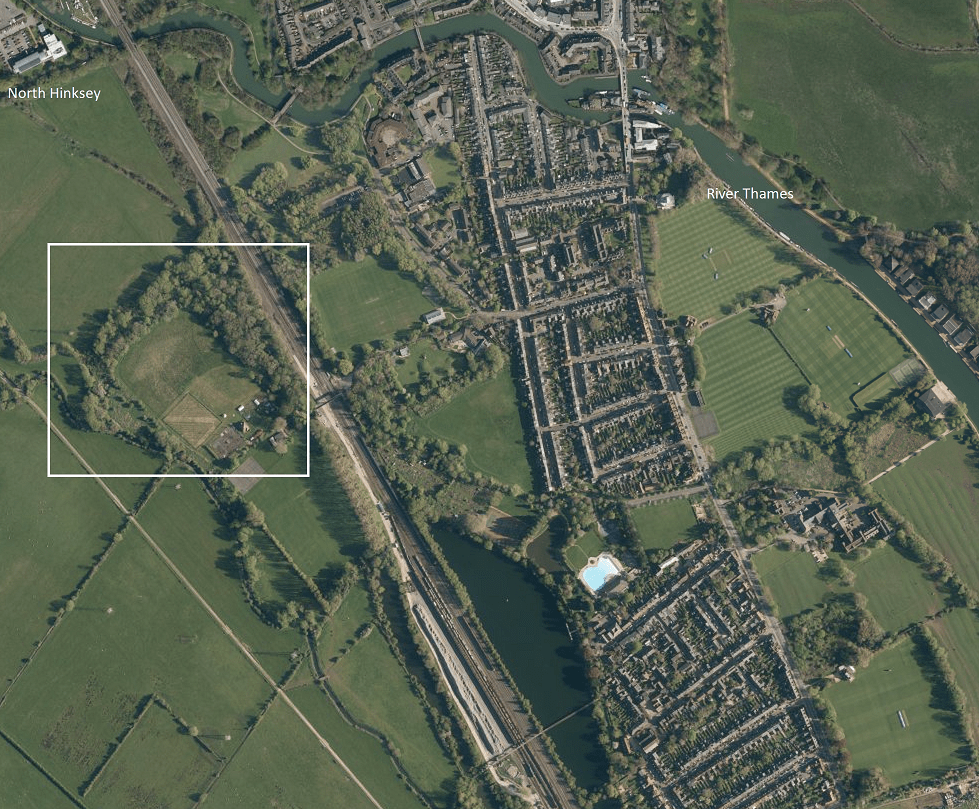
At the start of the first lockdown, with the support of Richard Brown, the warden on Skokholm, I advanced Alice to a C-permit so that she could continue to develop her skills in her parents’ back garden.  She has continued to prove her competence and now she has started a new project at the Hogacre Common Eco-Park in Oxford, where she is working on her PhD.  This is a little oasis of habitat in the middle of a number of college playing fields and it will be interesting to see how it develops.

Non-Group Ringing Activities:

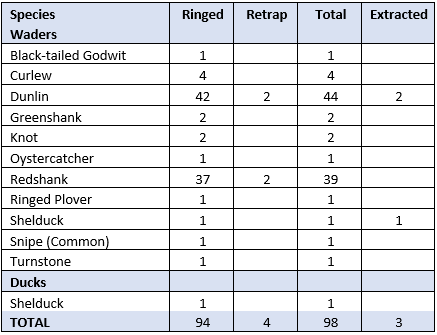
Andrew Bray continued his work with the North Wilts and those sessions with Graham and Phil Deacon in 2020 has produced the following:

Table 2: Andrew with the North Wilts Ringing Group:

Alice joined the SCAN ringing group (North Wales) for two weekends at the start of 2020 (24/01/20 – 26/01/20 and 7/03/20 – 8/03/20).  In January cannon netting and mist netting for waders, and in March cannon netting for Shelduck.

Table 3: Alice with SCAN:

Azores: From 13/08/20 – 12/09/20 Alice was a field assistant for a PhD student at the University of Cardiff, monitoring Storm Petrels on a tiny islet off Graciosa, Azores (see blog post of the 24th September for further details).

Table 4: Alice mist netting on the Azores:
Table 5: Retrapped pulli: nest checks were conducted every day and chick ring number and biometrics were recorded (wing length, tarsus, weight)

Alice also joined the Edward Grey Institute (EGI) at the University of Oxford in Wytham Woods for two ringing sessions in November. 

Table 6: Alice with the EGI:

New Recruits:

This blog has become a source of recruitment for the group.  Notably, Alice joining us in 2019.  This year I was contacted by Lucy Mortlock.  Lucy was working on field studies in Northern Ireland during the Spring and Summer and was looking for a ringing group to join, having returned home to Wiltshire to continue her degree (at Reading University – an excellent choice if I might say so myself).  She contacted me through the blog and is now, when lockdown allows, a regular member of my ringing crew. 

Garden Ringing: Friday, 15th January 2021

Now that we are confined to ringing only in our gardens again it seems that the flocks of Goldfinch, and those of Starling, have disappeared. Today’s session was so much better than Monday’s, although 14 birds compared with 6 is not too much to shout about, it was the quality of the catch that made the difference.

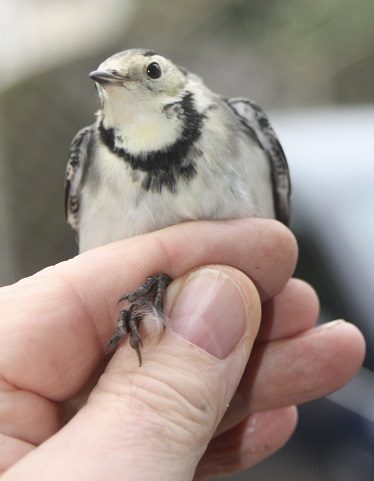
I opened the nets and set up some Potter traps baited with dried mealworms and put on lures for Goldfinch and Starling. Whilst heading back indoors a Pied Wagtail flew across the drive and into next door’s garden. I muttered something rude under my breath as it narrowly missed one of my nets. I was just on my second mug of tea when the net suddenly jerked and there it was:

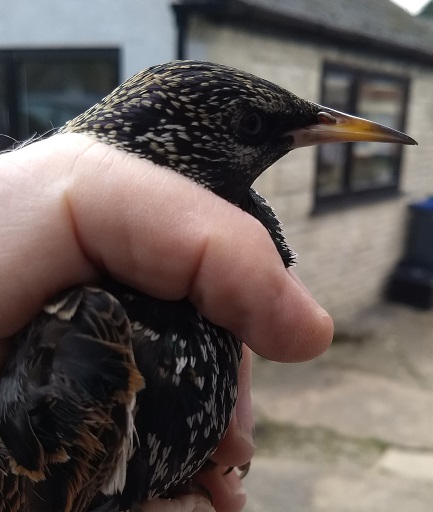
This is a first winter Pied Wagtail: and the first that I have caught in the garden. The yellowish tinge to the face is a clear juvenile characteristic as are the unmoulted greater coverts. Along with this, there were a couple of Goldfinch: both first winter and both females. Next into the nets was a rather good looking Starling:

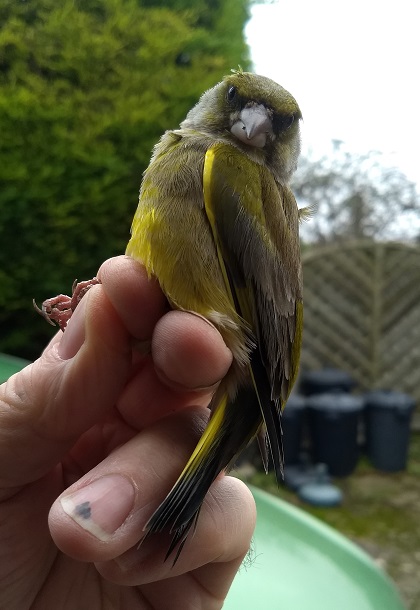
I changed the lure on the apple tree to Greenfinch and half-an-hour later I took this fabulous first winter male out of the net:

I loved the attitude and thought that it reminded me of something else. A quick Google search and I found what I was looking for:

They could be twins!

The last bird I took out of the net was an adult female Goldcrest:

Soon afterwards I looked out of the kitchen window and saw the neighbour’s cat sitting under the apple tree, clearly looking for the Greenfinch singing its heart out in the branches. That decided me that it was time to do three things: chase off the cat; close the nets and pack up and recharge my solar powered cat scarers (there hasn’t been a lot of sun to keep them going.

The catch for the session was: Blue Tit 2(2); Great Tit 1; Dunnock 1(1); Pied Wagtail 1; Goldcrest 1; Starling 1; Goldfinch 3; Greenfinch 1. Totals: 11 birds ringed from 8 species and 3 birds retrapped from 2 species, making 14 birds processed from 8 species.

Early Courting Dunnocks

We have been asked by the BTO not to ring outside of the boundaries of our property whilst lockdown is in force, as they are concerned that it might reflect badly on them if we are seen out ringing. Personally, I rarely ever mention the BTO when on a ringing session. They provide the licence that allows me to do it, but it is the landowner who decides whether or not I can carry out the work on their property. The DVLA provide me with my driving licence, but if I get caught speeding I don’t think the DVLA need worry about damage to their reputation.

Indeed, if anybody ask, I tell them I am doing a volunteer survey on behalf of the landowner, so they know what is happening on their land, which is genuinely how I see it and how I work. It is why I end up writing so many reports (session reports, annual reports, trend analysis, love it!). I briefly opened my nets in the garden this morning. Briefly because it quickly became too windy and I closed them again about 40 minutes later. Should have done it yesterday, when it was calm all day, but I was busy on other things!

Anyway, despite that, and only catching six birds in the short time the nets were open (Blue Tit 1(1); Dunnock 2; Robin 1; Goldfinch 1), the Dunnock catch was interesting.

Back on the 5th December my wife asked me if it was likely that Dunnock would have newly-fledged young this late in the year. What she witnessed was a food begging and wing fluttering display. That is something newly fledged young will do, but it is also part of a courtship display, with a female begging to an attentive male. It has been very mild, so are they gearing up for an early start to the breeding season? I have noticed that there has been a lot of Dunnock activity in the garden and a lot of calling from tops of bushes and small trees. Anyway I thought nothing more about it until this morning.

The two Dunnock that I caught this morning were very definitely male. Being sexually monomorphic you can, generally, only tell them apart in the breeding season. With the average laying date for first clutches being the 27th April, with the earliest first clutch being recorded on the 1st April (thanks to the BTO Bird Facts and data in the Nest Record Scheme), it does seem awfully early for the male to have developed the distinctively enlarged cloaca (known as a cloacal protuberance) this early in the year. It seems like a lot of energy to expend to produce the extra bodily fluids needed to engorge that part of the body.

Trust me: of all the sexually monomorphic passerine species, the male Dunnock is the easiest to positively identify as male.

Being intrigued by this I thought I would have a look in the online database at our group records, going back through all of the records (even to pre-IPMR days, which is probably only meaningful to other ringers), even into records from the 1990’s. In that time the group has processed over 9,000 records of Dunnock. They have identified just under 1,900 of those records as being male. Amongst them there have only been two other January records of identifiably male birds: on the 23rd January 2005 and the 24th January 2009 (the latter being just a couple of weeks after I started my ringing career).

That makes these two birds the earliest we have ever recorded as male by just under 2 weeks! Is this likely to become a trend, with our ever milder winters? It will be interesting to see.

Hogacre Common Eco Park

This is a summary of the activities of Alice, one of my C-permit holding trainees. She is currently working on a PhD at Oxford University and, because of travel, Covid-19 restrictions (between lockdowns), was able to find Hogacre Common Eco Park and get permission to ring there.

The site is adjacent to the sports grounds of a number of Oxford colleges. It is early days yet at the site. It can take a year or so to get the optimum net positions, unless you are lucky.

This is Alice’s summary of her activities on the site in November and December 2020:

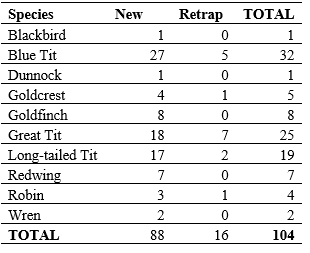
Between the 10th November and 15th December 2020, six bird ringing sessions were run at Hogacre Common. Just over 100 birds were processed from ten different species (Table 1, Fig.1). Since these were the first bird ringing surveys at Hogacre, most individuals caught were ‘new’ birds that had not previously been ringed (85%); while 15% of birds were retrapped in a subsequent session. Over 25 species were observed on site during the surveys, with two Lesser Redpoll being a particularly pleasing sighting in mid-November.

Table 1 Number of new and retrapped individuals of each species caught between the 10th November and 15th December 2020.
Fig. 1 Number of new and retrapped individuals of each species caught from 10th November – 15th December 2020.

The following list is of bird species seen/heard at Hogacre Common from November – December 2020. It does not include birds flying over that were not using the site: Mallard; Moorhen; Pheasant; Woodpigeon; Collared Dove; Buzzard; Red Kite; Sparrowhawk; Kestrel; Green Woodpecker; Great Spotted Woodpecker; Dunnock; Wren; Blackbird; Song Thrush; Redwing; Fieldfare; Robin; Goldcrest; Chiffchaff; Blue Tit; Great Tit; Long-tailed Tit; Nuthatch; Magpie; Carrion Crow; Goldfinch; Chaffinch; Lesser Redpoll.

A very happy new year: Langford Lakes Reedbed, 1st January 2021

This is a blog post by Jonny Cooper:

Last summer I began regular ringing sessions at the reedbed at Langford Lakes WWT Reserve to monitor the birds using the habitat during the breeding season. Over the last few months I have been curious as to the birds using the reedbed during the winter.

Reedbeds are used as a winter roost by a variety of species, including Reed Bunting, Pied Wagtail and Starling. A session on 9th December last year yielded 19, 1 and 5 of these species, respectively. I was keen to get out again to the site and figured an afternoon session was as good a way to kick of 2021 as any.

I arrived on site just after 1pm and set up the nets playing lures for Pied Wagtail and Reed Bunting. The first round produced 5 birds including a stunning Kingfisher that wowed several passing families (from an appropriate distance of course). After that, each round produced a couple of birds.

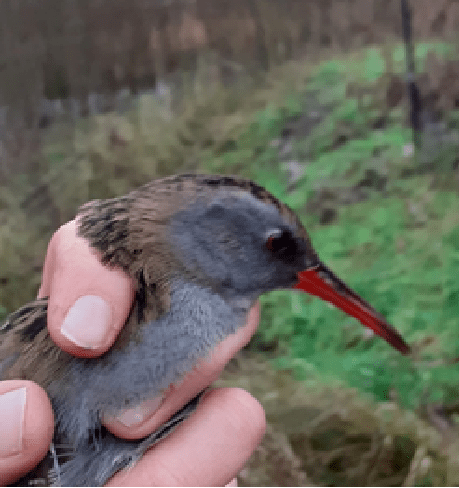
All afternoon I could hear Water Rails squealing in the reedbed and elsewhere on site and I thought to myself ‘that would be a nice bird to see up close’. A little while later this showed up in the net:

The first Water Rail I have processed and the first ringed at the site as well as the first ringed by anyone within the ringing group at the ringing group sites since 2009. (Editor’s note: but I did ring my first one on Skokholm in 2019.)

The total catch was as follows: Water Rail 1, Kingfisher (1), Blue Tit 2, Great Tit 1, Cetti’s Warbler (1), Chiffchaff 2, Wren 2, Starling 1, Blackbird 1, Redwing 1, Dunnock 1 and Reed Bunting 1. 15 new birds from 11 species and 2 re-traps form 2 species giving a total of 17 birds from 13 species.

Aside from the Water Rail the two Chiffchaff were nice to catch. This migrant is wintering in the U.K in increasing numbers. And of course, Kingfishers are always a joy to see up close.

Overall a session defined by its quality rather than the quantity. What a fantastic start to the year.

West Wilts Ringing Group: December 2020 Results

A pretty excellent December: our biggest catch in that month since the group split at the end of 2012.

image.png
image.png

Clearly we were much more active this December than in previous years: just 10 sessions last year.  This is almost certainly a by-product of Covid-19 restrictions. Regardless, it is a pretty decent catch.  Looking at those species that we have more than doubled since last year (because we have done more than double the number of sessions), it is great to find an increase in Long-tailed Tit numbers. Alongside that we have definite increases in numbers of Nuthatch, Great Tit, Dunnock and Starling. 

Compared with last year, the species added to the list for December were: good numbers of Reed Bunting, plus Jay, overwintering Blackcap, overwintering Chiffchaff, Goldcrest, Pied Wagtail, Stonechat, Lesser Redpoll and Treecreeper. Missing from last year’s list is Grey Wagtail and Meadow Pipit.  


Somerford Common: New Year’s Day, 2021

With the forecast being for a bit of snow overnight but an icy start to the morning, I was hopeful that it might be possible for us to run a session at Somerford Common. In the event, the temperature was just on freezing but there was no wind, so no wind chill factor. I decided we could set the nets: just the 4 at the feeding station and the Redwing nets on the main path. The feeding station was topped up on Thursday, ready for today.

On my way to site, as I was approaching the entrance to the car park at Somerford Common on Stopper’s Hill, I saw my first bird of the new year: a Woodcock. That was a good start!.

I was joined by Lucy for the morning. The birds started arriving whilst we were still setting the nets, even though it was only just daylight. It was busy between 8:00 and 10:30 but died off quickly after that. There was a light snow shower between 8:30 and 9:30 but that just warmed the place up, and didn’t even settle on the nets.

Having missed out on Redwing at Ravensroost and Red Lodge, it was good to find that there are still some about. We caught eight and a couple of Blackbirds, in the appropriate net ride with a lure playing.

The list was: Nuthatch (1); Blue Tit 6(8); Great Tit (8); Coal Tit 2; Marsh Tit 1(4); Robin 1(3) Redwing 8; Blackbird 1(1); Chaffinch 2(1). Totals: 21 birds ringed from 7 species and 26 birds retrapped from 7 species, making 47 birds from 9 species.

It is always nice to start the year with a Marsh Tit or two, to start with five, including a new bird was a real bonus.

We cleared away at 11:30 and were off site by midday – the benefits of not setting up lots of nets.

Some Observations on Blue Tits, Cyanistes caeruleus, in the Braydon Forest

I started my ringing career in January 2009. Having been a keen birder up to then, and Ravensroost Wood being one of my key local patches since I moved into the area in 1997, I was keen that we should get to ring in the site. I set about persuading the Wiltshire Wildlife Trust to allow us access. I provided the rationale, and swapped loads of data with the Trust, from my 11 years of birding there, and they gave me the information gathered from regular breeding season surveys that had been carried out, and the agreement was reached. My trainer provided a project plan and a risk assessment, and we gained access after Natural England approval (it is a SSSI) and first ringed there in July 2009.

To be fair, it wasn’t my trainer’s favourite site, and it was agreed that, when I got my C-permit and could take it on, it would become my site to manage and work. I got my C-permit in June 2012 and took over the site, with a new project plan, in September 2012. Soon after starting work there I bumped into a staff member from the Forestry Commission and I enquired about getting access to their Braydon Forest sites. They were really helpful and welcoming and I got access to Somerford Common, Webb’s Wood and Red Lodge Plantation soon after. Since then the vast bulk of my ringing has taken place in this area.

Unsurprisingly, the commonest species in my catch is the Blue Tit, Cyanistes caeruleus. People who don’t understand ringing often ask “Why bother with such a common species?”. Some ringers choose not to ring them (at 27p per ring cost one can understand the reluctance for those who do not get external funding for their rings, although I largely fall into that category, my view is that if I have “inconvenienced” them by catching them, the least I can do is ensure that we get some data back from them). The argument itself is fallacious: once upon the time the BTO would not allow House Sparrows, Passer domesticus, to be ringed, because they were so common. That worked out well, didn’t it? Besides, it seems the whole rationale for the Edward Grey Institute at Oxford University is studying Blue Tits, and if it is good enough for them, who am I to argue?

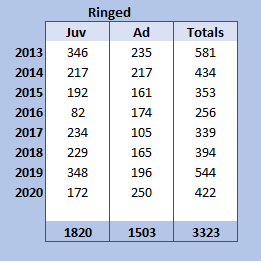
The key thing about Blue Tits: you are going to get a good sample size upon which to make judgements on trends. So, with the vagaries of the weather disrupting my ringing activities more often than I would like at the moment, I have been having a look at my Blue Tit records since I took over the ringing in the Braydon Forest, with complete years from 2013 onwards. The numbers caught have been as follows:

Fig 1: Number of birds ringed by year by age group

This year’s numbers have possibly been skewed a bit by lockdown, but only really in March / April, and I have managed to get sessions in every wood in just about every month of 2020.

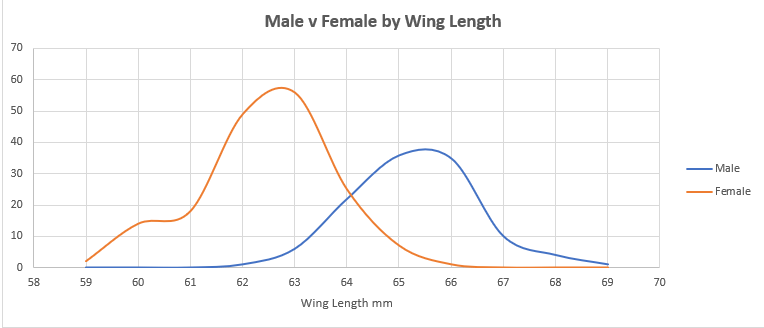
One of the perennial questions ringers have differing opinions on is about sexing Blue Tits on wing length. They are a sexually monomorphic species, so the only reliable way of telling the sexes apart is in the breeding season, when the females develop a pronounced brood patch and the males cloaca becomes engorged and is known in the trade as a cloacal protuberance. I have analysed my data for males and females sexed by their breeding condition and mapped the numbers against wing-length to see whether it is possible to reliably sex them on that biometric outside of the breeding season:

Fig. 2: Number of identifiably male and female Blue Tits ringed by wing-length

As you can see, a Blue Tit with a wing-length of 62 mm is almost certainly female, and an individual with a wing of 66mm and longer is almost certainly male. In fact, amongst my catches I have had 1 male with a wing of 62 mm and one female with a wing of 66 mm. Some ringers look at a combination of wing-length and brightness of plumage but I prefer to err on the side of caution.

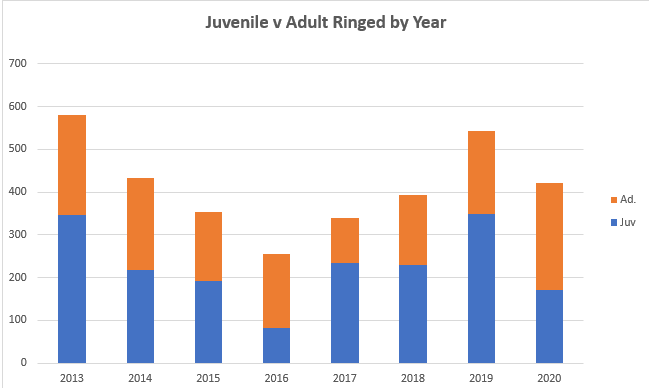
With Blue Tit broods being typically 8 to 10 eggs, with perhaps 6 to 8 nestlings surviving to fledging age, one would expect the numbers of juveniles ringed each year to be significantly higher than the number of adults and, as figure 3 shows, that is usually the case. From looking at figures 1 and 3, it is clear to see that 2016 was a terrible year for Blue Tits in the Braydon Forest. Not only were the numbers down significantly across the board, but the breeding success was remarkably poor.

Fig 3. Numbers of juvenile and adult Blue Tits ringed by year

It was a particularly wet spring in 2016, and the summer wasn’t much better. Other species also suffered in the Forest, particularly Long-tailed Tits, Aegithalos caudatus. Whilst Blue Tit numbers have recovered somewhat, Lotti’s are taking a longer time to build up again. However, 2020 looks to be the second worst for juveniles and the best year for new adults.

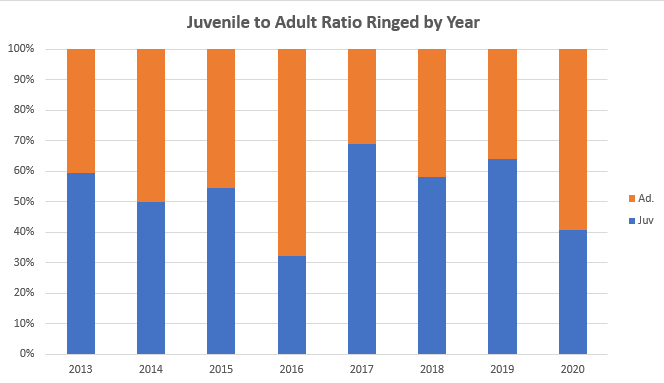
Whilst the bald numbers in figure 3 are themselves of interest, what really stands out is when you show adults vs juveniles as a proportion of the total, as shown below in figure 4:

Fig 4. Ratio of juvenile to adult Blue Tits ringed by year

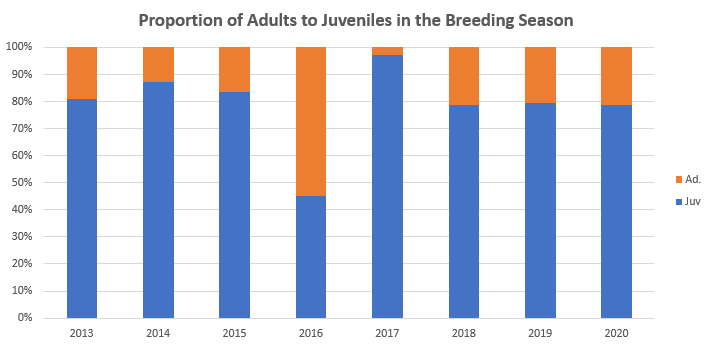
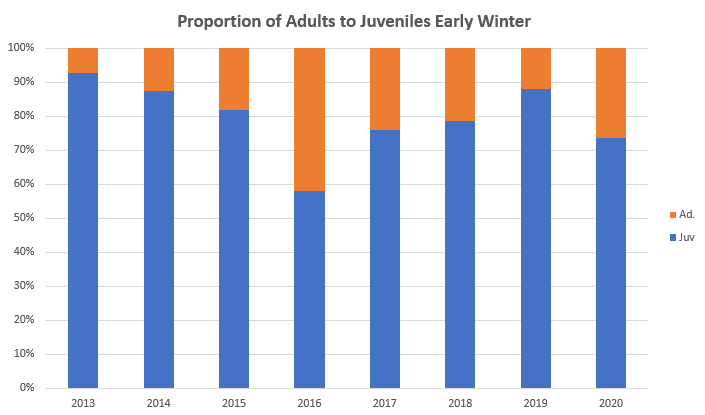
As mentioned above, this shows that 2020 has been a depressed year for juvenile production as a proportion of the whole, but not as bad as 2016 was. What is surprising is that this was not how it felt whilst ringing juvenile birds in the summer, so I had a look at how this split might have occurred by analysing the proportion of birds ringed in the breeding season (May to August inclusive), as shown in figure 5, and those ringed in the early winter (October to December inclusive), as shown in figure 6.

Fig. 5: Ratio of juvenile to adult Blue Tits ringed in the breeding season

This shows that, proportionately, 2020 in the breeding season was very much in line with all years, except the remarkably different years of 2016 and 2017.

Fig. 6 Proportion of juvenile to adult Blue Tits tinged in early winter

Figure 6 does show the ratio to be depressed compared to all years except 2016, but not significantly so. So why the overall variation in numbers? I thought that it might have something to do with adult survival over the winter of 2019 / 2020 being better than in previous years. So I have graphed up the numbers of birds ringed over each complete winter, using the months November to December in the preceding year and then January to March in the following year.

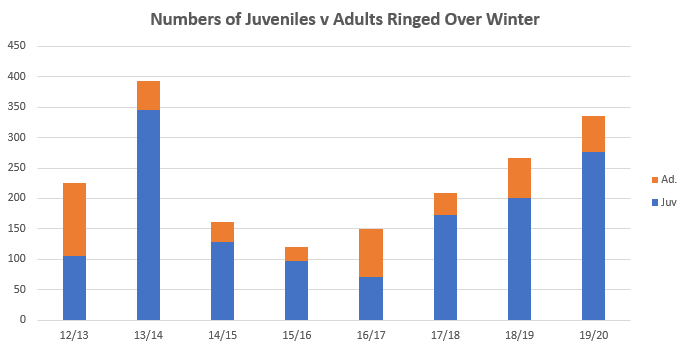
Figure 7 shows the numbers of juveniles and adults ringed in that period:

Fig. 7: Numbers of juveniles and adults ringed over a full winter

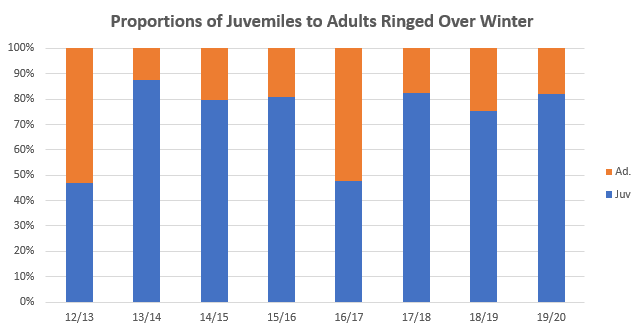
As you can see, these numbers are second only to the winter or 2013 / 14. The proportion of juveniles to adults is also somewhat interesting:

Fig. 8: Proportion of juveniles to adults ringed over a full winter

Essentially, it is consistent with all previous years except 2012 / 13, which was the first year of study, and the winter following the awful breeding season in 2016. I suppose that what I am saying is: I have no idea what has caused the change in the balance this year. Blue Tits might be common, but they are interesting.