The forecast was for it to be breezy, ruling out any of the more exposed, migrant friendly sites, so we headed for Somerford Common. I managed to select enough sheltered net positions to get 10 nets up. It wasn’t the busiest session that we have had recently but any woodland session where Goldcrests equal the combined numbers of Blue and Great Tits is okay by me.
For a whole bunch of reasons (focusing on getting his first class honours degree and then the whole Covid-19 situation) it has been 9 months since David has managed to get out to a ringing session. Astonishingly, he picked up straight from where he left off. That is not easy for a trainee when the skills are still very much in the cerebrum and not the cerebellum.
The list for the morning was: Treecreeper 2; Blue Tit 1(3); Great Tit 3(1); Marsh Tit 1(1); Wren 1; Robin (3); Blackcap 3; Goldcrest 8; Bullfinch 3. Totals: 22 birds ringed from 8 species, 8 birds retrapped from 4 species, making 30 birds processed from 9 species.
There were highlights, alongside the Goldcrests, we caught and colour-ringed our 15th Marsh Tit of the year. Despite not yet being able to get back into Ravensroost Wood, usually the species stronghold in the Braydon Forest (back there soon – working on it with the Wildlife Trust), this is looking at being another very encouraging year for this red-listed species.
The three Bullfinch were all juveniles: a male, a female and one that had not progressed far enough in its moult to establish sex. This last one, unfortunately, was the first time I had seen avian pox in Bullfinch. It should recover: I have ringed Great Tits that have subsequently been caught with the disease and later still been caught again, having recovered, with some residual scarring.
I really must stop with the cheesy headlines. Well, when the birds stop writing them for me, I will do so.
This morning I was at the meadow pond area within the Ravensroost complex hoping for a chance to try out the new House Martin lure that worked so well at New Zealand Farm on Monday. Unfortunately, I didn’t see a single Hirundine all morning. I do not think that they have all gone through, it was just one of those troughs in the migratory flow.
For the first time since lockdown, I was joined by Tony Marsh this morning. I think that I got that a bit wrong: I agreed for him to arrive at 8:30, after the nets were set up, and he had to leave at noon, just before I started taking the nets down! That’s not why you have trainees: they are there to do the work while you relax! I set 3 x 9m; 2 x 12m and 3 x 18m nets: not a huge set up but it worked well until the breeze got up at 11:30 and I had to shut the nets.
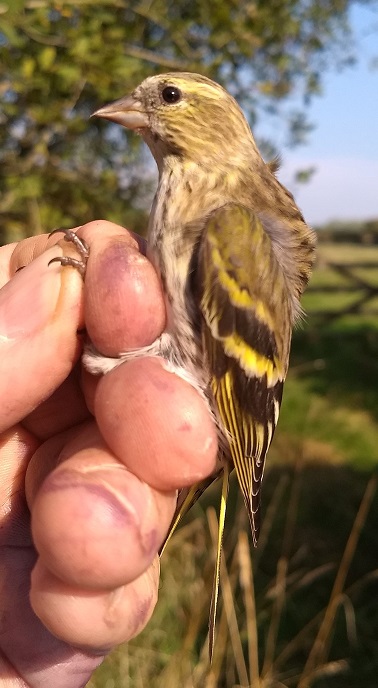
It was a good session, with one real bonus: our first ever Siskin for this site.
We have had a few in the woodland next door but this is our earliest autumnal catch of them in the Braydon Forest. Apart from one at Somerford Common in November 2013, all of our other catches in the Forest have been in the February to March period.
The catch had the staple of our migratory birds: mainly Blackcap and Chiffchaff but was completely missing our usual resident staples: no Blue or Great Tits. The list for the day was: Treecreeper 1; Wren 2; Dunnock 5; Meadow Pipit 1; Robin 4; Blackbird 2; Blackcap 10; Chiffchaff 8; Willow Warbler 1; Siskin 4.
38 birds ringed from 10 species.
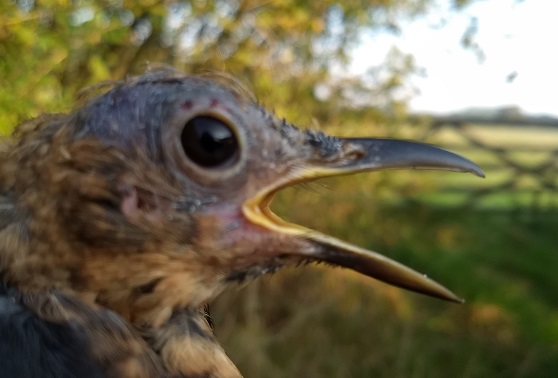
The first bird I took out of the net was a juvenile Blackbird undergoing a very scary head moult:
Whilst he is terribly bald, you can see the black feather tufts just beginning to poke through. Definitely a he: the tail was already black. I am sure he will soon look resplendent in his new plumage.
It was nice to catch another Meadow Pipit at the site. It is only the fifth for the meadow pond area, and our first since we had two in September 2017.
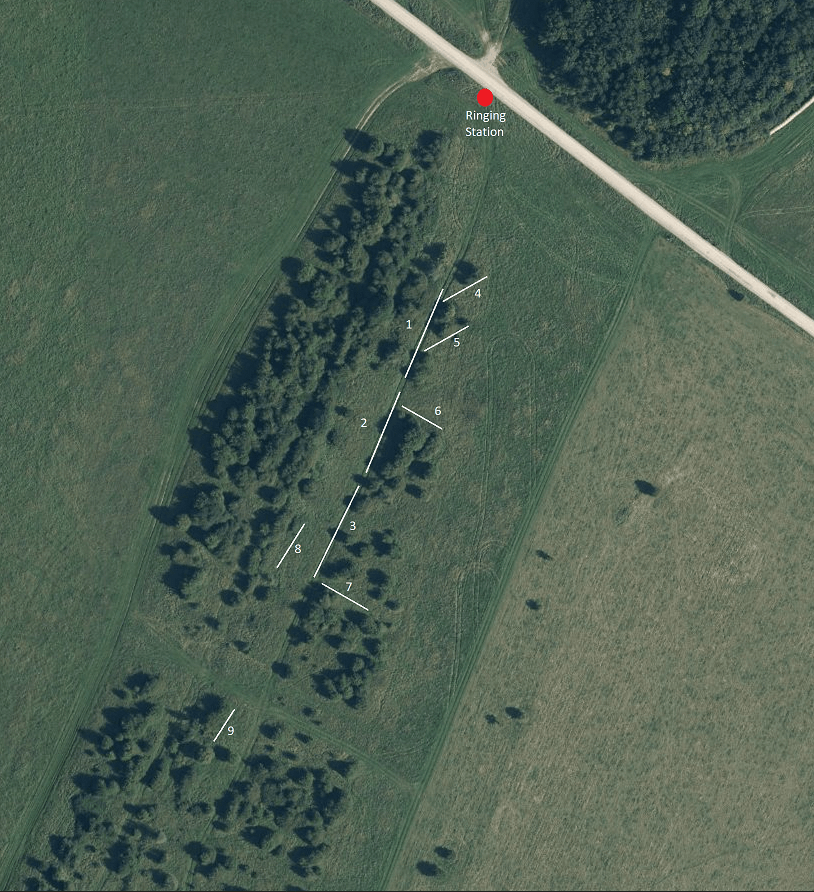
With migration in full swing I suggested to Andrew Bray that a team session at New Zealand Farm would be worthwhile. Because of its location, in the middle of the Salisbury Plain training area, he is only allowed access once per month. There are also army manoeuvres scheduled for the week, so we were rather pleased that Range Control allowed us access. We planned to be on site from 6:00 until midday and, with four of us available for the session (myself, Andrew, Ellie Jones and Jonny Cooper), we set rather more net than Andrew usually does:
Rides 1 to 3 comprised 2 x 18 m nets, rides 4 to 8 comprised single 18m nets, ride 9 comprised 1 x 12m net. Andrew would normally just set rides 1 to 3 for his solo sessions. He did a sterling job of strimming the rides yesterday to allow us to set all of these extra nets today.
Nets 7 and 8 were experimental – and the experiment did not work. I was playing a lure for Yellow Wagtail on ride 8 and House Martin on ride 7. Neither worked until we moved the House Martin lure to ride 6. Initially we put a Blackcap lure on ride 6 and another on ride 3, and they were extremely productive for the first two hours of the session. I had Whinchat on ride 2 and we had Meadow Pipit on ride 5. The Whinchat didn’t work but the Meadow Pipit pulled in a few.
We had an initial rush of birds between 7:30 and 9:00, heavily dominated by Blackcaps, and then everything went quiet. About 10:00 we noticed a build up of Swallows over the site and at 10:30 we caught a Swallow in ride 4 and a House Martin in ride 6. As a result we switched the lure on ride 3 to Swallow and, at Jonny Cooper’s suggestion, on ride 6 to House Martin. That proved to be inspired. We later moved the Swallow lure to net 8 and that also pulled in another couple of Swallows in. Next round we had 4 House Martin in ride 6, in the following round we had 5, and the following round 9 in ride 6 and 3 in ride 2. We had to pack up about midday, because of our agreement with Range Control, and the last round produced another 8. Had we carried on longer I am sure the catch would have been huge, because I have never seen so many House Martins in one place, spiralling around where we had our nets set. They only have short legs, so are not easily held for a full body shot – so you will have to make do with the head shot.
Photo courtesy of Jonny Cooper
The list for the day was: Swallow 3; House Martin 30; Blue Tit 3; Great Tit 1; Wren 1; Dunnock 2; Meadow Pipit 3; Robin 1; Song Thrush 1; Blackcap 42 (1); Whitethroat 6; Chiffchaff 8(1). Totals: 101 birds ringed from 12 species and 2 birds retrapped from 2 species, making 103 birds processed from 12 species. The retrapped birds and 2 of the Blue Tits were adults, the remainder were juveniles.
Both Ellie and Andrew ringed their first ever House Martins, which is always good for them. Andrew is having a bit of a good week: House Martin and Kestrel added to his experience in the last 4 days!
We cleared the site by about 12:45 but cannot wait for the opportunity to get back there. It is also looking good for some late autumn / winter sessions: the tree scrub is almost all Hawthorn and the trees were weighed down with berries: I see a Redwing / Fieldfare roost session or two might be required.
A lovely morning at Lower Moor Farm. You cannot complain when the first experience of the morning is a family of four Otters on Mallard Lake! Mum and three kits one would have thought.
I had decided to start slightly later, emerging from my pit at 6:00 and getting to site for 6:30. It proved a good decision: some light overnight rain had just stopped when I walked out of the door.
I set my usual 2 x 18m and 3 x 18m net rides: the 2 nets along the stream side, the 3 nets along the lake side. It was a very pleasant morning with birds occurring regularly, ending with a total catch of 38. What was surprising is that 31 of those 38 birds were Blackcaps. I appreciate that, particularly at this time of year, Blackcap numbers are high as the autumn migration is in full swing but contrast that with Thursday’s session at Blakehill Farm, my main autumn migration site, where we had good haul of Chiffchaff (19), which were completely missing from today’s catch (although I did hear plenty of contact calling around the site) but just one Blackcap. They were coming to a lure, and they do respond well to that, but I had the same lure playing at Blakehill on Thursday.
(For those who might be wondering about the “Death on the Plateau”, Jonathan, the farm manager, found the source of the smell: a deceased adult male Roe Deer, the head of which is now elsewhere to finish rotting off so Jonathan can get his hands on the antlers. Probably a casualty of the rut, which has just finished for this species.)
The list for the day was: Treecreeper 1; Wren 1; Dunnock 1; Robin (3); Blackcap 31; Bullfinch 1. Totals: 35 bird ringed from 5 species; 3 retraps from 1 species, making 38 birds processed from 6 species. All of these birds were juveniles except for the Wren, which was a female still re-feathering her brood patch.
The juvenile Bullfinch was moulting into his pink male plumage:
I love how haughty they look.
I had several ad hoc ringing demonstrations during the morning. In particular, at 10:00 I was joined by Ellie Jones, the Wildlife Trust’s northern reserves manager (and one of my most experienced C-permit holders, and all round nice person) with her brother and his family. They loved the opportunity to get close to the birds, and the children were absolutely fascinated by the whole process.
The catch died off at 11:00, so I packed up and went home, thoroughly satisfied with a lovely morning at one of my favourite places. I have to say, though, I have never had such a single species focus at the site before, and never such a small spread of species.
Now I have got your attention! No birds were harmed during our session, but something was very clearly dead.
Andrew Bray and I went off to Blakehill Farm this morning. Meeting at 5:30, we started to erect our nets around the bushes on the edge of the plateau. When we got to net position three the stench of a rotting carcass assaulted our nostrils. It was rank. At 5:45 in the morning it seems even worse. Throughout the morning, it seemed, we carried that stench with us everywhere we went. We both searched to see if we could find the source but whatever it was had clearly crawled deep into the adjacent bush to die. There’s a cheery start. Later in the morning Jonathan, the farm manager, came by and we mentioned the smell. He will be investigating: rather him than me.
To be honest we did find ourselves questioning why we were there on several occasions this morning. We caught our first bird at 6:30, a Robin. Then we setup our nets along the perimeter track. Having had a bit of a brain fade, I had forgotten to pack my furling sticks so, while Andrew went off to do a net round I popped home to get them (10 minutes each way). When I got back he was waiting empty handed. So, in the first hour and a half since opening our nets we had caught precisely 1 bird. Not a great start. It was cold and there was little insect movement at that time.
At 8:00 we did another net round. The peri track nets produced a single bird: a Woodpigeon. The plateau nets 2 Reed Bunting, another Robin and an adult male Whitethroat. It was nice to catch a male with such a clear grey cap. At 8:30 we began to think the tide had turned: 5 Chiffchaff and a Great Tit from the peri track nets – but nothing from the plateau.
That was it until 9:50! Not another bird disturbed the nets until then. However, the weather was beginning to warm up, the crane flies and other insects were beginning to appear, so we stayed to see what might happen. And then at 9:50 we had a lovely catch of Redstart, Lesser Whitethroat, Swallow, Blue Tit and 4 Chiffchaff, 4 Reed Bunting and 3 Whinchat.
That was it for another hour, whereupon we had another little spurt. It was becoming very clear that we were having a pretty varied catch. This was the catch of the day:
Adult Male Kestrel
I am not sure why I am so good to my trainees. I have only ringed 2 adult and one nestling Kestrel in my ringing career but, as Andrew had never done one, I gave him the bird to process. No good deed goes unpunished! In trying to help Andrew to get the bird in the correct position to ring and measure it I got my fingers a little too close to that beak.
They use that beak to rip flesh: it did exactly that!
We didn’t get a repeat of the large round but kept catching birds from different species, with Linnet and Greenfinch making an appearance at the end of the session.
Our list for the day was: Woodpigeon 1; Kestrel 1; Swallow 1; Blue Tit 2; Great Tit 3; Meadow Pipit 1; Whinchat 2(1); Redstart 1; Robin 4; Blackcap 1; Whitethroat 1; Lesser Whitethroat 1; Chiffchaff 19; Greenfinch 1; Linnet 2; Reed Bunting 4(2). Totals: 45 birds ringed from 16 species, 3 birds retrapped from 2 species, making 48 birds processed from 16 species. All of the birds were juveniles except for the Kestrel and the Whitethroat, one each of the Blue Tit and Robin and two of the Reed Bunting.
We closed the nets at 12:30 and left site by 13:30 at the end of a very different sort of session, with added aroma!
My last trip to Brown’s Farm was back on the 12th July and, to be honest, I might have been better staying in bed and catching up on some sleep. Just 11 birds caught: the 3 Yellowhammer ameliorated my otherwise potentially foul mood. So today, with a weather forecast of virtually no wind until lunchtime, Andrew Bray and I headed out to the farm to see what might be around.
We set nets along hedgerows, as shown in red below:
The blue cross is where we put our ringing station.
I came hoping to get some farmland birds in our catch, and we were rewarded with Yellowhammer (2), Linnet (3) and Dunnock (9). There was a large flock of Yellowhammer put up by a tractor going down to the farmyard. Unfortunately they circled round and back into the unharvested grain in front of the hedgerow, where our nets were lurking behind! Hopefully that grain is not scheduled to be harvested and is being left as game cover / food over the winter. If the latter, I would love to put a few two-shelf nets along the tramlines to see what we can catch.
Surprisingly, the largest catch we had today was Blue Tit: a couple of recaptures ringed as juveniles on the farm last year, but also another 15 of them ringed today, 12 of which were juvenile birds. Those are the sort of figures I expect in a wood with a feeding station set up, not traversing the hedgerows on a mixed beef / arable / horse farm.
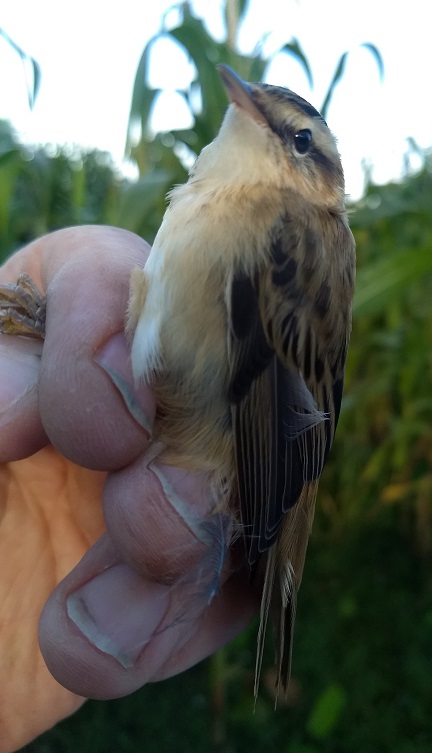
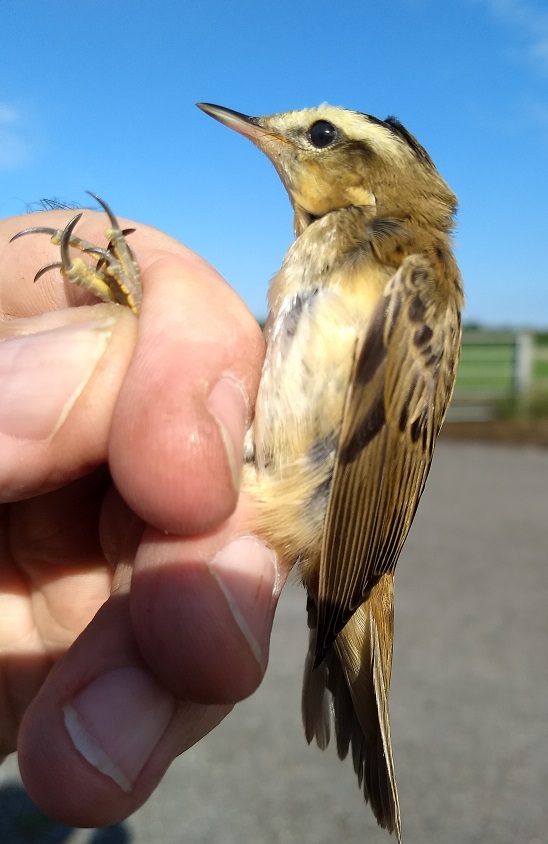
However, we were also hopeful of there being a few summer visitors around, either that bred locally or were heading south on autumn passage, and we weren’t disappointed. A single juvenile Whitethroat and Willow Warbler was backed up by two Chiffchaff, 5 Blackcap and, best of all, and new for the site, 3 each of Reed Warbler and Sedge Warbler.
Reed WarblerSedge Warbler
As well as these we saw, but did not catch, a few other migrants, notably a good number of Swallow flying around the fields and a Wheatear flying across from where we had our nets along the hedgerow by the newly sown crop across to the track, and a few Yellow Wagtail were heard but not seen. We were also visited by a female Sparrowhawk, who made a spectacular crossing of the maize field, and twisted up and soared away right in front of me when she noticed our ringing station. I would have loved to have had that in the net! Bad for your fingers though.
The total list from the day was: Blue Tit 15(2); Great Tit 1; Wren 3; Dunnock 9; Robin 1; Reed Warbler 3; Sedge Warbler 3; Blackcap 5; Whitethroat 1; Chiffchaff 2; Willow Warbler 1; Linnet 3; House Sparrow 3; Yellowhammer 2. Totals: 52 birds ringed from 14 species and 2 birds retrapped from 1 species, making 54 birds processed from 14 species.
That is a decent variety of species, and to have two firsts for the site on the same day is brilliant. To put that catch into perspective: I have a wetland site on the edge of the Cotswold Water Park and so far this year I have processed 4 Sedge Warblers and 4 Reed Warblers there. These are clearly birds on passage but a great find. We had juveniles of every species caught. 42 of them were juveniles and just 12 adults.
So we had a really enjoyable session with a decent haul but, unfortunately, the wind got up early, at 10:30 and we had to close the nets.
A solo session at the Firs this morning. Not a looking for migrants session: a standard “What is still about?” sort of session. I had a bit of a lie-in, on site for 6:00. It is always handy when you know you will just be setting 7 x 18m nets in a long straight line, split into a set of 3 and a set of 4 and the birds won’t have started moving by the time you have finished. That proved to be the case, with the first birds not hitting the nets until 7:30.
The catch started well, with a couple of male Nuthatch being the first 2 birds out of the net. A little later I retrapped an adult male Great Spotted Woodpecker who, true to form, screeched the place down and then, on the penultimate round, I extracted a juvenile Treecreeper. It is nice to get the full set of the common woodland tree trunk specialists.
About 9:00 I ringed a juvenile Marsh Tit. This is the fourteenth of the year and, given that I am still not accessing Ravensroost Wood, my most reliable site for the species, very encouraging. Hopefully we will be back in Ravensroost Wood soon and end up with a record year for the species.
The list for the day was: Great Spotted Woodpecker (1); Nuthatch 2; Treecreeper 1; Blue Tit 8; Great Tit 8(3); Marsh Tit 1; Long-tailed Tit (1); Robin 3(2); Blackcap 3(1); Chiffchaff 2. Totals: 28 birds ringed from 8 species and 8 birds retrapped from 5 species, making 36 birds processed from 10 species.
In amongst the Great Tit catch were two individuals who were not having the best time of it. One poor youngster had 20 ticks, of varying sizes, on its head. That sort of tick burden cannot be good for a young bird. The BTO do not have hard and fast rules on what you should do, and it is quite a bone of contention amongst ringers as to whether you should leave them in place or remove them. Some ringers assert that it is a veterinary procedure and needs a licence. However, I have scoured the DEFRA website and they say absolutely nothing about ticks and wildlife or removal.
The BTO’s advice is that you should only attempt removal if you are competent to do so. Having been a pig stockman in a past life, pigs that were kept in pasture for much of their lives, I have removed ticks from much larger livestock and I see no reason to leave a small bird infested with ticks. I have a pair of needle forceps, which are perfect for tick removal, and I do.
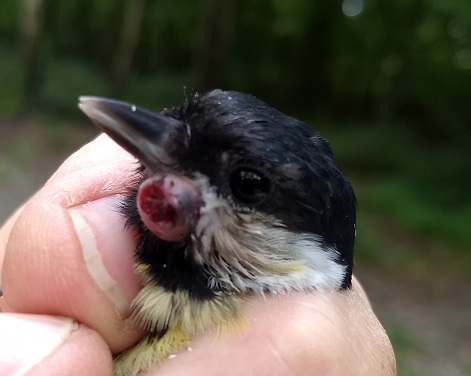
The other poor bird was the first I have seen suffering from avian pox for several years.
The one good thing I have found about this disease is that birds can and do recover. I t looks bad but hopefully it will recover.
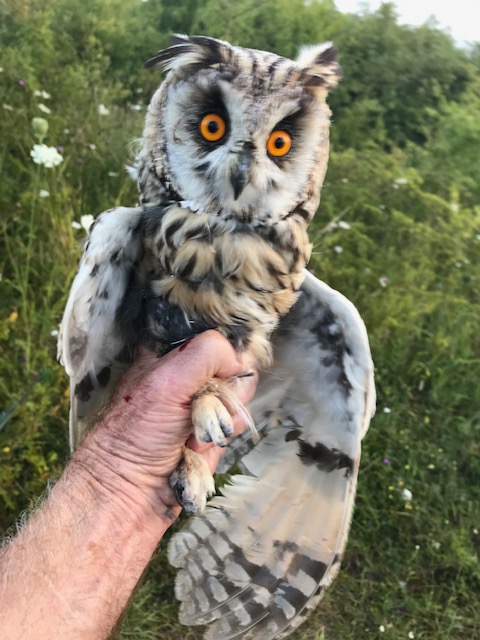
Another excellent month for the group. The stand out bird has to be the Long-eared Owl!
Photo: Dr Ian Grier
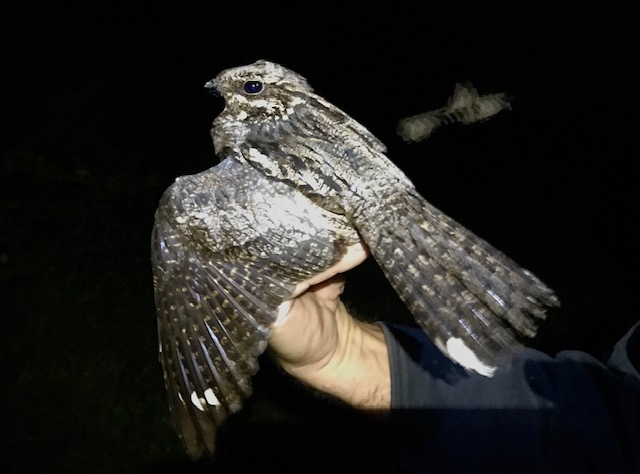
Or perhaps it was the Nightjar:
Photo: Dr Ian Grier (note the second bird flying across in the background)
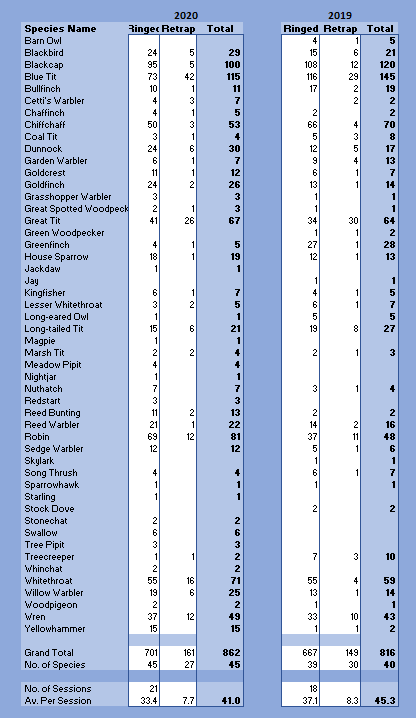
Apart from those cracking birds, the number of Sedge Warbler, Robin and Reed Bunting caught are the only numbers that are significantly up. Significantly down are the numbers of new Blue Tit and Greenfinch ringed. The Greenfinch count in 2019 was spiked by a huge catch of 22 at Meadow Farm on the 8th August which was not replicated this year.
A slightly lower average catch but a 7 species difference between this year and last.
We can discount the Barn Owls and the Stock Doves from last year: they were nestlings ringed in the nest box and, as a result of various unforeseen circumstances, I did not get out to any owl boxes this August. The 2019 Skylark was a lucky catch for me at Blakehill. The Jay was a one-off at Lower Moor Farm and the Green Woodpecker was a regular catch missing so far at Lower Moor this year.
By contrast, the aforementioned Long-eared Owl and the Nightjar came courtesy of Salisbury Plain; it was great to get back to catching Whinchat and Stonechat on Blakehill Farm and Swallows and Redstart shared between Salisbury Plain and Blakehill Farm, rather unevenly shared in favour of Salisbury Plain.
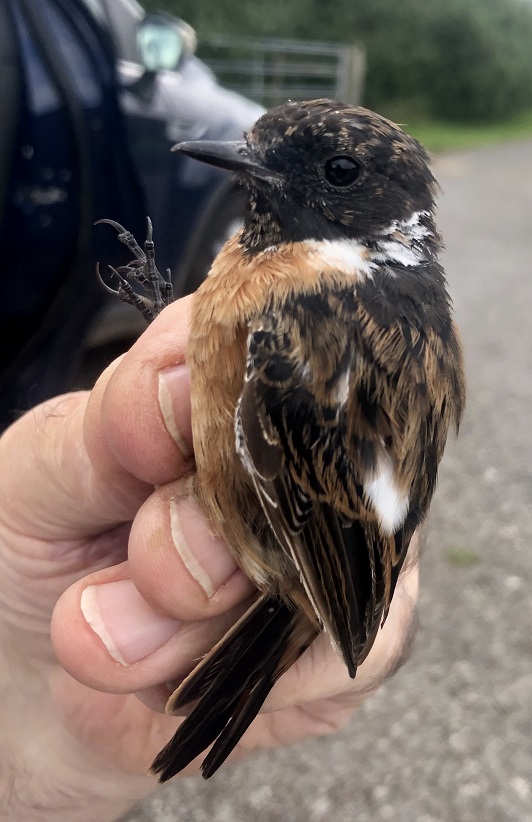
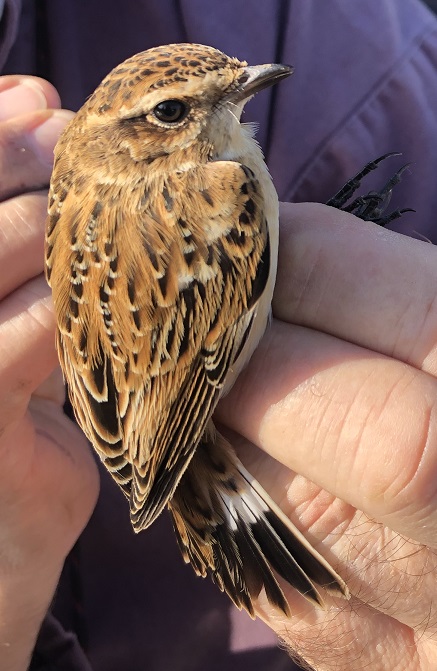
Stonechat (courtesy of Steph Buggins)Whinchat (courtesy of Steph Buggins)
I was happy to catch a juvenile Jackdaw in a walk-in trap in the garden. This is the second that I have caught in my garden, the previous one being soon after I got my C-permit back in 2012. We don’t catch many: only 5 caught in the last 9 years, apart from the youngsters ringed in nest boxes. so it is an unusual catch for me.
September is a busy month for us, with autumn migration boosting the numbers at Blakehill and on Salisbury Plain. Hopefully we will have some more exciting catches this year!
After yesterday’s enjoyable effort at Lower Moor Farm, I was up at 4:30 this morning and headed to the industrial estate side of Blakehill Farm. Having managed to mislay my reserve keys, Ellie Jones, the northern reserves manager for the Wiltshire Wildlife Trust and, along with Jonny Cooper, one of my longest serving C-permit holding trainees, provided me with a spare. This worked exactly the same as it did yesterday: let me into the site main gate but wouldn’t open the secondary gate, which meant hopping over aforesaid gate, with all of the nets and poles, for the plateau edge bushes. The padlock on the inner gate at Lower Moor gave up after a couple of hours and a liberal dosing of WD-40 (other penetrating oils are available (but not as good)), which meant only a dozen times clambering over the gate. Unfortunately, Blakehill never gave up and so this ancient, arthritic blimp that passes for my body have to lever itself over and back on every round. Fortunately, I was joined by Steph and Lillie, considerably younger and more nimble, so I could delegate from time to time.
I had the plateau nets open before sunrise and the perimeter track hedgerow nets open by 6:30. Today I had a cunning plan, and it was about as successful as Baldrick’s always were. There is a certain point where in previous years we have caught the majority of our Swallows on the site. During my last visit I noted that they were flying along the track and then up and over the nets. My lightbulb moment: make a cul-de-sac across the path, so we set the usual 2 x 18m nets, with a 6m across the path and a further 18m running back parallel on the opposite side. We had so many Swallows flying around and along the track we were really hopeful of a decent catch. We caught the phenomenal total of absolutely none of them! In fact, that whole net setup caught one bird all morning: a Blue Tit! I will try it again. It is also the place where we catch most of our wintering Redwing, so I might try it for them as well. If at first you don’t succeed! (Who said “Give up”?).
It was a quiet morning and we only caught 22 birds, the aforementioned Blue Tit, a Dunnock and two retrapped Great Tits were to be expected, but the rest of the catch was interesting. Steph’s first foray onto the plateau produced a couple of Reed Buntings, our first Whinchat of the autumn, and only the second ever Sedge Warbler ringed there:
Over the course of the morning the catching was very sketchy, with a small burst of 8 birds at 9:30. By 10:30 it had really died a death, so we started taking down at 11:00. We had the peri track nets down and went out to the plateau to take down, finding our second Whinchat of the morning and a stonkingly good male Stonechat. I love a bird where I can do moult scores on primaries, secondaries and tail.
The list for the day was: Blue Tit 1; Great Tit (2); Dunnock 1; Stonechat 1; Whinchat 2; Sedge Warbler 1; Blackcap 6; Whitethroat 2; Lesser Whitethroat 1; Chiffchaff 1; Willow Warbler 1; Goldfinch 1; Reed Bunting 2. 20 birds ringed from 12 species, 2 birds retrapped from 1 species, making 22 birds processed from 13 species. The only adults in the catch were 2 of the Blackcaps and the male Stonechat.
Whilst whingeing about the lack of birds over coffee, I thought I would have a quick look at DemOn to check on previous records for this site for the end of August (for those not in the know, DemOn stands for Demography Online and is the BTO’s new online system for data entry beloved by forward thinking, progressive ringers and hated by the Luddites). I was astonished to find that this was the first time I had actually ringed this site at this time of year. In fact, prior to my earlier visit on the 12th August this year, the only other August visit was on the 3rd August 2019. This is one of the changes wrought by Covid-19: the restrictions of this disease having prevented me from carrying out my long-term projects at Lower Moor Farm and Ravensroost Woods this year which, in turn, restricted my activities at other sites.
Records show that the big catches here will start (hopefully) in two weeks time, when the Meadow Pipits start rolling in. The signs are good: crane flies are starting to emerge in reasonable numbers and I am pretty sure that this has prompted the bumper numbers of Meadow Pipits we have caught over the last couple of years. This is a brilliant result of the way the Wildlife Trust farming team are managing this part of the reserve: lightly grazed by small numbers of cattle outside of the Curlew breeding season.
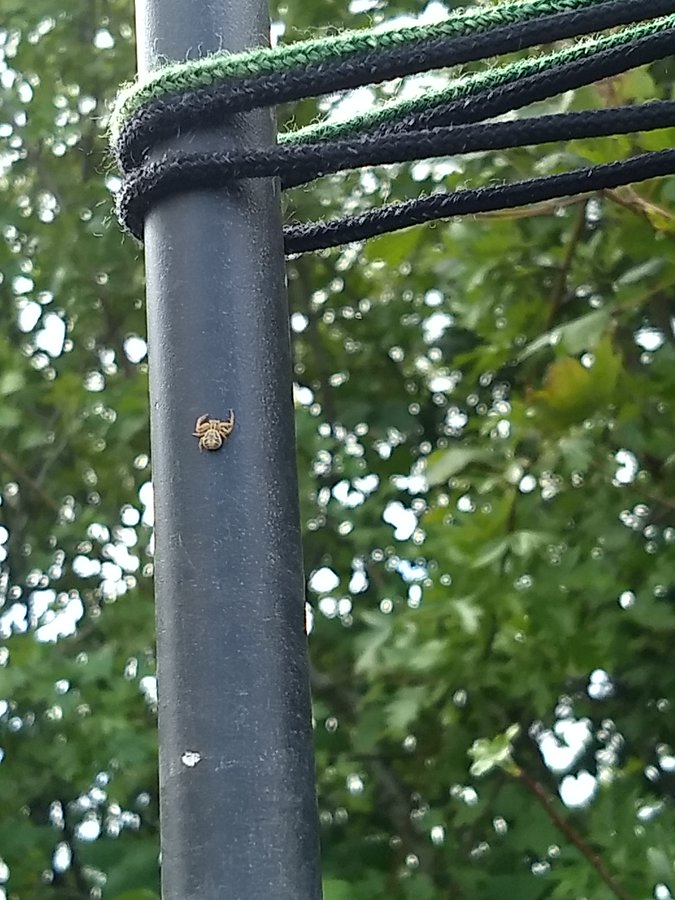
As we were taking down the nets, we both noticed that there were a good number of crab spiders using our poles as vantage points:
I am not 100% certain but I think this is Xysticus cristatus. That just happens to be the commonest species in Europe.
It seems like a long time since I have managed to get out to get some ringing in on my sites.
I managed a short session at the Ravensroost Meadow complex on the 20th August, but the wind put a stop to that quite quickly, with just 15 birds caught: Blue Tit 1; Wren 2; Dunnock 1; Robin 2(1); Blackcap 1; Whitethroat 1; Chiffchaff 2; Willow Warbler 1; Goldcrest 1; Goldfinch 2. Totals: 14 birds ringed from 10 species and one retrap. Of these all bar the Goldcrest and Willow Warbler and one each of the Robin and Goldfinch were juveniles.
I did manage to get the nets open in my garden for two hours on the 27th August and caught 22 birds from just 4 species, before the rain started: Blue Tit 9(1); Long-tailed Tit 7; Starling 1; Goldfinch 3(1). Totals: 20 birds ringed from 4 species and 2 birds retrapped from 2 species. It is now difficult to correctly age the Long-tailed Tits, as they breed early and both the young and the adults undergo a full moult over the summer into the full adult plumage. Of the other 15 birds all bar the retrapped Blue Tit and Goldfinch were juveniles.
The adult Goldfinch was a nice catch. It was ringed as a juvenile in my garden in December 2014. This makes Z197498 at least 6 years old: a good age for a bird that lives for only 2 and a bit years on average. Another interesting point about the Goldfinches: the others were recently fledged juveniles. This means that, since lockdown, I have caught recently fledged juveniles in every month, including August: that is a full 6 months It is known that in good years Goldfinches can produce 3 broods: I wonder if they can actually produce 4 in exceptional circumstances? If I catch some in September I might be persuaded.
So to today: I was on site for 5:45. It was very cold, which means no mosquitos to annoy me whilst setting up. Despite a few net problems, I had all nets open by 7:00. I did catch a Robin as soon as the nets were open but things did not start to get active until the day started warming up. It never got hectic: 6 or 7 birds per round. What was surprising was that almost all of them were Blackcaps. The list for the morning was: Blue Tit 2; Great Tit 4; Dunnock (1); Robin 2; Blackbird (1); Reed Warbler 1; Blackcap 35(1); Whitethroat (1); Chiffchaff 1; Willow Warbler 1. Totals: 46 birds ringed from 8 species and 4 birds retrapped from 4 species, making 50 birds processed from 10 species.
The Blackbird, Dunnock and Reed Warbler, plus one of the Blue Tits, were adults, the remainder were juveniles.


 Ringing In The Braydon Forest & Beyond