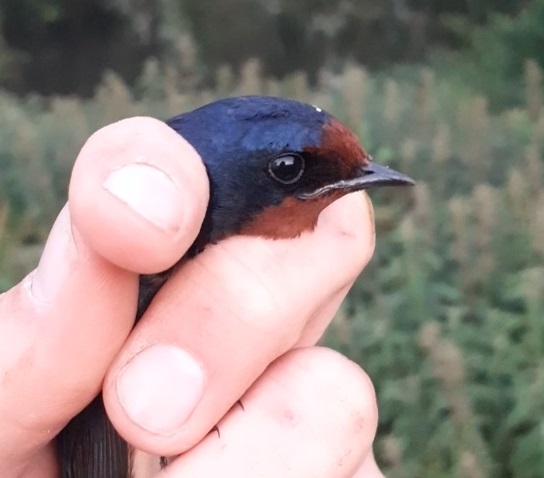
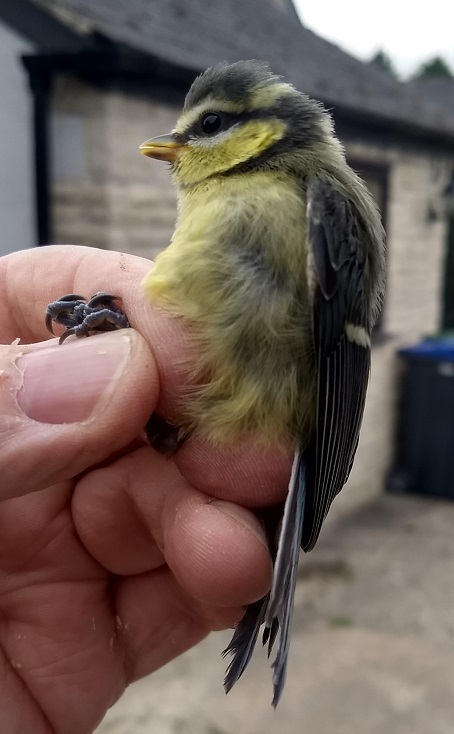
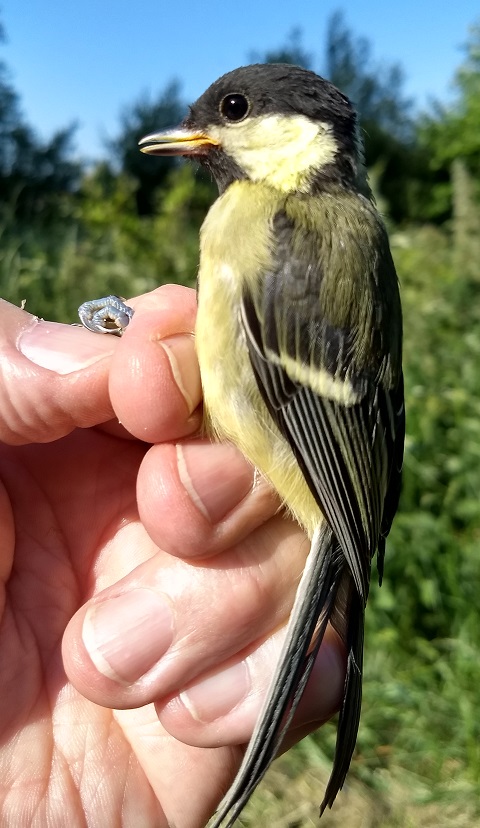
Garden Ringing: 23rd & 25th March, 1st April

With the government lockdown coming into effect, the BTO issued instructions that all survey work that could not be done from your garden was to be cancelled. For bird ringing this is hard on our T-permit trainees, but it is impossible to adequately practise social distancing and monitor their activities or check their work.  This has meant that all trainees, except those who have a C-permit or are lucky / unlucky enough to be the children of trainers, will have no chance to develop and practise their skills until this period is over.

I am lucky enough to have a reasonable sized garden, in a rural location, with fields, allotments and trees all around.  My garden is also, no doubt to the chagrin of my neighbours, with their immaculately kept wildlife deserts, left very much to its own devices.  The “grass” is cut no more than once a month and wildflowers encouraged.

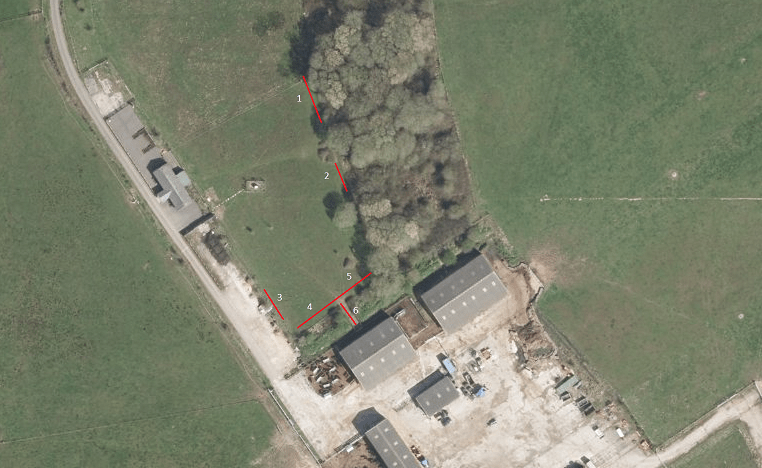
I have a feeding station offering sunflower hearts (opium for the bird masses) and fat balls plus a peanut feeder in my apple tree.  The garden isn’t huge but I manage to set three nets: a 9m and 3m dog-legged and a 6m.  Diagram below:

Garden

A bit messy but I’ve never been an artist!  The pond was full of frogs and toads, it now has a few frogs, lots of spawn (the most we have ever had), which is now hatching, and plenty of Smooth Newts, come for the feast.  It must be a hard life being a female toad in the mating season:

Frog Ball

I have made the decision not to overdo the ringing in the garden: to keep it to my usual two sessions per week, when the weather allows.  The key benefits of garden ringing are that it is largely unhurried, especially as my electronic cat scarer, backed up by a well-primed Super Soaker, is more than enough to deter the neighbourhood cats and tea, coffee and biscuits are on tap.

Unfortunately, the masses of birds we had coming to the feeders has dropped off considerably. Presumably they have more pressing matters: nesting, mating, incubating and rearing.  However, I am still catching birds, and it does make a nice change from the hundreds of Blue and Great Tits we have been getting in the woods.

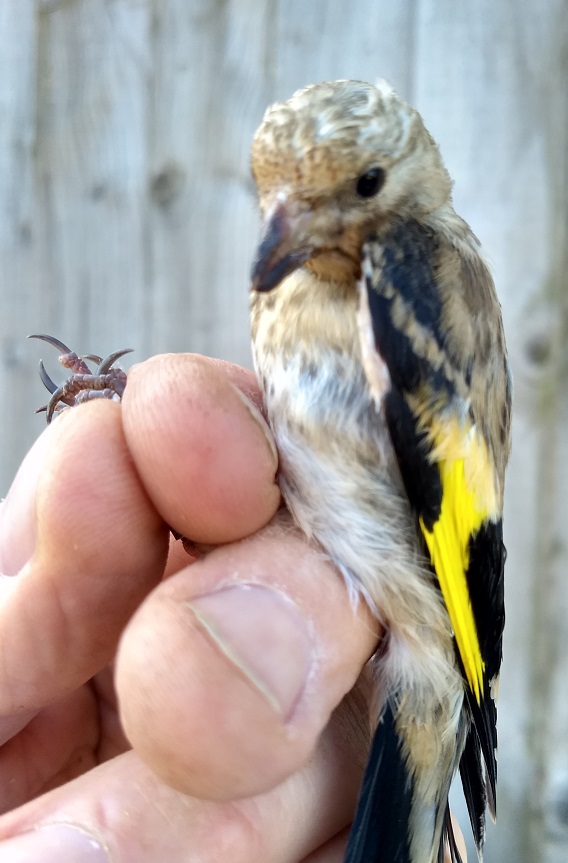
Over these three sessions I have caught the following: Blue Tit 1(1); Coal Tit 2(1); Long-tailed Tit 1; Dunnock 2(1); Robin (1); Blackbird 2(4); Chaffinch 1; Goldfinch 11; Greenfinch 6; Starling 1; House Sparrow 1.  Totals: 28 birds ringed from 10 species and 8 birds retrapped from 5 species, making 36 birds processed from 11 species.

It is a decent variety, even if they are not the biggest of catches.  The difference is, when I am out with the team I do far more supervising than ringing. Any session where I have more than one trainee with me, I do no ringing at all, so it is nice to have it all to myself sometimes.


Sessions Before Lockdown: 7th to 21st March 2020

As of Tuesday, 24th March 2020 the BTO has suspended all surveying activities until the government lift the lockdown status in the country. This means that all permit holders above the basic T-permit for trainees can continue to ring if their garden is suitable for such activities.  There will be no more site visits until we are advised otherwise.

Prior to this necessary precaution, we did get in a few sessions at our sites that I have not yet blogged about.  This is a brief summary of what happened where.

Webb’s Wood, Wednesday, 7th March: I was joined by Alice at Webb’s Wood. It is the one site this winter that I had not set up a feeding station.  A combination of factors but, basically, I didn’t want to buy any new ones this winter, with squirrels destroying some, humans stealing others, sometimes you just think “is it worth it?”.  If you put out expensive squirrel-proof ones some tea-leaf will help themselves to it, cheap ones: squirrels just eat them.  Even bird tables hammered into the ground aren’t immune: I have had them ripped up and thrown into ponds, or removed and used as a bivouac support by an unauthorised “forest school”. All of which is a long-winded way of saying that we did not have the biggest catch of the winter.

The list for the session was: Blue Tit 3; Great Tit 3(2); Wren (1); Robin 2; Goldcrest 1(1). Totals: 9 birds ringed from 4 species and 4 birds retrapped from 3 species, making 13 birds processed from 5 species.

Jonny Cooper and I followed that up with a visit to Red Lodge on Friday, 13th March: good job we aren’t superstitious.  We had a decent session: 30 birds of which 12 were Blue Tits! It is not really surprising, as they were caught at the feeding stations set up there, and Blue Tits love a free feed.

The list for the session was: Nuthatch 1; Blue Tit 11(1); Great Tit 5(3); Coal Tit 1; Long-tailed Tit 2(3); Robin (1); Wren (2).  Totals: 20 birds ringed from 5 species and 10 bird retrapped from 5 species, making 30 birds processed from 7 species.

Alice joined me again for a trip to Somerford Common on Tuesday, 17th March. Although I did have feeders in place, it was a small catch: mainly because the wind got up and we had to close the nets early, after just a couple of hours. In some ways it was a remarkable catch: of 14 birds only 2 were unringed.  The list for the day was: Great Spotted Woodpecker (1); Nuthatch (2); Great Tit 1(6); Coal Tit (1); Marsh Tit (1); Goldcrest 1; Siskin (1).  Totals 2 birds ringed from 2 species and 12 birds retrapped from 6 species, making 14 bird processed from 7 species.

What was notable about this session: not a single Blue Tit to be had. I cannot remember ever doing a ringing session at a winter feeding station that did not have any Blue Tits in the catch.

More excitingly, the Siskin that we caught was the female we ringed at the last session.  Although I have caught Siskin right up to the end of March in the Braydon Forest, this is the first female that I have caught here that was coming in to breeding condition.  They sued to breed at Somerford a long time ago but since I started my ringing activities there and in Webb’s back in 2012, this is the first with any sign of potentially breeding here.  I have had several of the Siskin I ring recaptured elsewhere: mainly up in Scotland, where they breed regularly. If we manage to catch a newly fledged juvenile in July or early August I will take that as a positive sign of local breeding, as we found with Lesser Redpoll at Ravensroost a couple of years ago.

My last pre-lockdown session was on Saturday, 21st March at Ravensroost Woods.  I felt comfortable that I could avoid contact with people, as the nets are set away from the main paths and the track they are on is far too muddy for most people.  It was a decent session, with our first Chiffchaff of the year arriving on site.  Two were birds returning from last year.  At this time they are predominantly males, singing their hearts out as they set up territories in the wood.  Who knows when we will be able to have another ringing session in any of our sites, so I plan to enjoy the memory of that one.

The list for the day was: Nuthatch (3); Blue Tit 7(7); Great Tit 7(2); Marsh Tit (2); Robin 1; Song Thrush 1; Chiffchaff 4(2); Goldcrest 1(1).  Totals: 21 birds ringed from 6 species and 17 birds retrapped from 6 species, making 38 birds processed from 8 species.

In those last two ringing sessions virtually every male bird was showing signs of being ready to breed. That is quite early.  The Marsh Tits that I caught in Ravensroost were a definite pair. They were in the same net, at the same height, no more than 6″ apart.  One was male, showing a well-defined cloacal protuberance, and the other a female, with a very definite brood patch in development.  The females lose the feathers from their chest and belly, to provide a warm patch to incubate the eggs and nurture the nestlings. This one was still in the process of losing feathers, but it was a very definite development.

The team and I will continue to blog: as most of us can continue to ring in our gardens and, being mainly rural, there is always the chance of a good catch.

Garden Ringing: Friday, 5th March 2020

With the forecast being for a decent day I decided to set some nets in the garden.  To save time in the morning, I set them up on Thursday night.  As luck would have it, there was a frost overnight, and any time I might have saved was used up getting them to open.

The beauty of garden ringing is that you can watch from the warmth and comfort of your own home. Food and drink is on tap, and I could do some work in between net checks.

It was a really good session: a good number of birds from a decent variety of species.  The list for the day was: Blue Tit 4; Great Tit (1); Coal Tit 1; Long-tailed Tit 1; Dunnock 1(1); Robin 1(1); Blackbird 3; House Sparrow 4; Starling 1; Chaffinch 1; Goldfinch 12(2); Greenfinch 4.  Totals: 33 birds ringed from 11 species and 5 birds recaptured from 4 species, making 38 birds processed from 12 species.

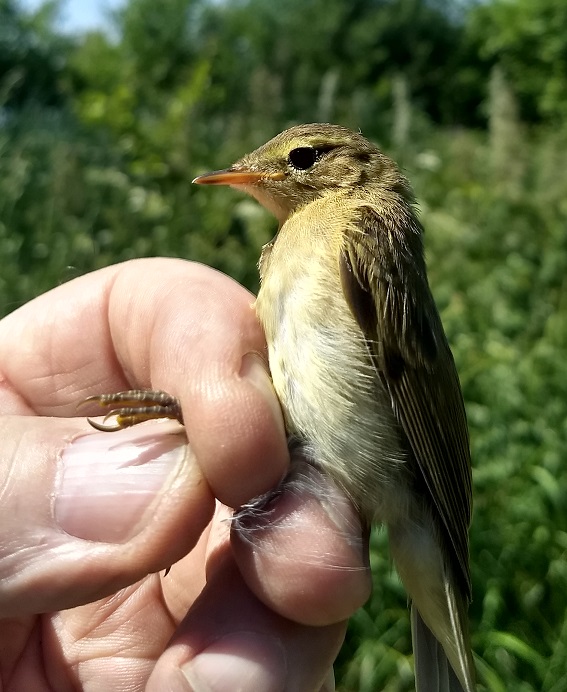
Given that there is an excellent population of House Sparrow in Purton,  a few pairs nest in the roof of my house, I rarely catch them in my nets, so to catch four was a definite highlight.  Also, after the calamitous reduction in the population of Greenfinch, as a result of the Trichomonosis parasite.  It has been a relief not to have seen any evidence of it in the birds frequenting my garden in the last three years.  I regularly see half-a-dozen of them around my feeding station and to catch four today was very encouraging.

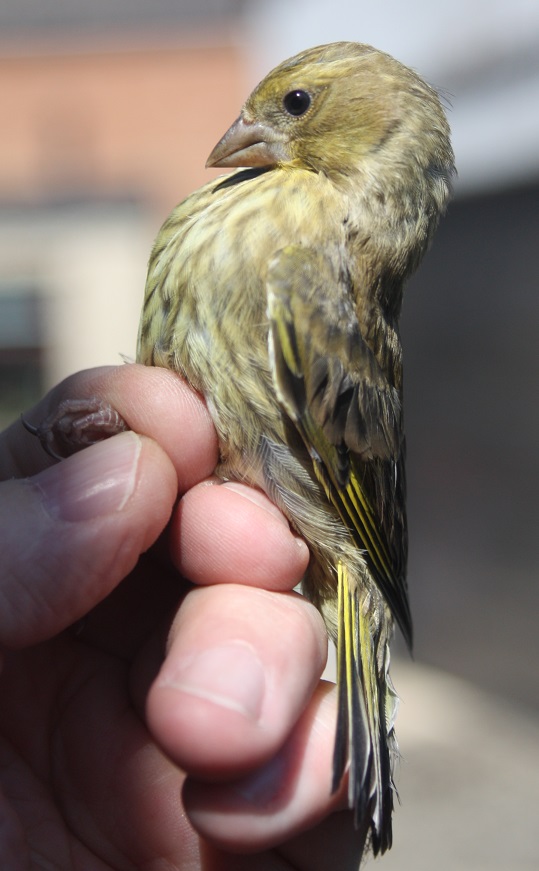
The birds from both these species have quite a bite on them and, as you can see from these photographs, have a bit of attitude about them:

Greenfinch

House Sparrow

Somerford Common: Tuesday, 3rd March 2020

Taking further advantage of the break in the bad weather, Jonny, Alice and I went for a session at Somerford Common this morning.  We set just 4 x 18 metre nets around the feeding station, as the forecast was for it to be breezy. Fortunately the wind stayed very low for most of the morning (when you start at 6:30 and the wind gets up at 10:45, that is “most of the morning”) until, at 10:45 there was a bit of a squall: a sharp shower and some high wind, followed by some light rain, had us taking the nets down.  Annoyingly, by the time we had the nets down the rain had stopped, the wind had dropped and the sun had come out!  Even more annoyingly, a largish flock of Goldfinch arrived in the trees around the ringing site. We decided not to set up again.

It had been a really good session, starting with a couple of Siskin and our first ever Reed Bunting for the site in the first round.


Reed Bunting

The list for the day was: Great Spotted Woodpecker (1); Nuthatch (2); Blue Tit 10(5); Great Tit 8(8); Coal Tit 5(3); Marsh Tit 1(1); Long-tailed Tit 1; Robin 1; Chaffinch 5; Siskin 2; Reed Bunting 1.  Totals: 34 birds ringed from 9 species and 20 birds retrapped from 6 species, making 54 birds processed from 11 species.

Ravensroost Woods: Monday, 2nd March 2020

If anyone was under any illusions about the strength of the winds that we have been having recently, this is a picture of an oak tree situated in the hedgerow immediately adjacent to the main Ravensroost woodland:

Oak

The trunk of that tree was 1 metre diameter.

I was joined for the session by Jonny, Andrew, Tony and Steph: everybody looking for an opportunity to get out and do some ringing.  We knew it would be a session dominated by Blue Tits. At this time of year, catching at the supplementary feeding stations that I set up and stock, they will always be the numerically dominant species.  However, we did catch a decent spread of species and a good total catch of 59 birds, mainly in the 3 small nets adjacent to the feeders.

There were a number of highlights. Chief amongst them was our fourth Jay of 2020.  Last year that was the total my team caught in the whole 12 months, in 2018 it was 5!  This was a bird with personality:

Jay

The list for the day was: Great Spotted Woodpecker 1; Nuthatch (1); Jay 1; Blue Tit 17(19); Great Tit 3(6); Coal Tit 1(1); Marsh Tit (2); Long-tailed Tit 1(1); Robin 1; Blackbird 2(1); Chaffinch 1. Totals: 28 birds ringed from 9 species and 31 birds retrapped from 7 species, making 59 birds processed from 11 species.

It would have been 60 birds but a female Great Spotted Woodpecker managed to escape the net whilst I was topping up a peanut feeder.

We noticed this rather pretty fungus alongside the main track:

Sarcoscypha coccinea

It is called Sarcoscypha coccinea and is, appropriately, associated with hazel woodlands. Ravensroost Wood is a hazel coppice with oak guard trees.  Hazel is coppiced on an 8 year cycle at the southern end of the wood, and a twenty-five year cycle at the northern end of the wood.  Most of our ringing takes place in the 8 year coppice coupes.


February 2020: Frustration and Inactivity

Thanks to Ciara, Dennis and Jorge, February 2020 turned out to be a very poor month.  We only managed to fit in 8 full sessions.  Not our worst ever by any stretch.  The first month after the great schism and the restructuring of the group was, appropriately, the worst, with just 86 birds ringed and 54 birds recaptured in January 2013.  It isn’t even our worst February: that was 2016, when we ringed 160 and recaptured 79 in the same number of ringing sessions.  Given the horrors visited on large swathes of the population, it would be churlish to complain.

The catch, and comparison to 2019, was as follows:

Feb 2020

Essentially, the catch held up well, it was just the lack of opportunity that depressed the overall numbers.  Let’s hope March is better weather-wise.


The Firs: Friday, 21st February 2020

After several cancelled sessions due to this horrendous weather, we finally managed to get out for a ringing session this morning.  Although wind was still forecast, it was scheduled to be lighter than of late, although still gusting to just under 30 mph.  As a result, we could only contemplate setting up in a good woodland area.  With the wind scheduled to come from the west, I chose the Firs. It is the only one of our woodland sites where the net rides run north to south, so the woodland would block the wind.  Somerford Common, Ravensroost Woods and Webb’s Wood all have the main net rides running east to west, which would have had the wind blowing along them.

Everybody who could make it came along, so the team was Jonny, Steph, Lillie (on half-term), Alice and Tony.  My only concern was whether we would catch enough birds to make it worth their while.  In the end we had a decent haul of 46 birds, but we had to shorten the session as the wind got up enough to affect the nets and, as a the birds’ welfare is paramount, we closed the nets an hour-and-a-half earlier than usual.

I had topped up the feeding station on Wednesday afternoon, so there was plenty of bird activity and the catch was: Nuthatch 1; Blue Tit 14(10); Great Tit 5(7); Coal Tit (1); Marsh Tit 1(1); Wren 1; Robin 1(1); Song Thrush 1; Blackbird 1; Chaffinch 1.  Totals: 26 birds ringed from 9 species and 20 birds retrapped from 5 species, making 46 birds processed from 10 species.

There was a lot of bird song in the wood, and plenty of Great Spotted Woodpecker drumming – although they seemed to be too busy playing percussion to visit the peanut feeder, so we didn’t catch any.  Nuthatch were calling everywhere, it seemed and there were at least 3 Marsh Tits calling in the wood. For such a small wood to potentially have 3 Marsh Tit territories is a real feather in the cap of the management regime.  The new Marsh Tit was the fourth of 2020 already.   It is our best start to the year for this species since we started ringing at these sites in 2013.

A cautionary tale to all of the squirrels out there: don’t try and steal from my large seed feeder! Last week when I went to top up the feeders at my woodland sites, I left the Firs to last, as it is the muddiest, most slippery site I have – and the furthest to walk to the feeding station.  Approaching the feeder I thought “Heck and damnation, the seed has got wet and stuck in the tube”.  When I got closer I saw that the lid had been prised off and that the clump of seed was, in fact, a dead grey squirrel.  The feeder has 8 ports: 2 opposite each other and each set offset by 180º to the previous.  This squirrel had worked its way in, and bent its body around the various ports and then been unable to extricate itself.  They are clever beasts, but this one was far too clever for its own good. I had the very devil of a job getting the carcass out of the feeder, but it gave it a good clean as it came out: like a furry bottle brush!  I have replaced the lid and wired it shut, so there shouldn’t be a repeat.


Between the Storms: Red Lodge, Wednesday, 12th February 2020

After the awful storms of Ciara and before the return of the wind and rain with Dennis (surely the Met Office should have named it “Donald”?) Alice and I managed to get out for a session at Red Lodge.  We were on site for 7:00 and opened just 4 nets (2 x 18m; 1 x 12m and 1 x 9m) adjacent to the feeding station.    After the school run we were joined by Steph and baby Beatrice.

I was quite hopeful that we would have a decent session: I had topped up the feeders Tuesday morning and the seed feeders had been emptied.  Given the lack of destruction to the feeders, I don’t think that squirrels were totally responsible for emptying them.

Although it wasn’t frosty, the air temperature was bitterly cold and didn’t start to warm up until gone 11:00.  As a result, we spent the first couple of hours doing 3 or 4 birds per net round.  However, as soon as it warmed up the birds starting moving around and we ended up with a respectable catch of 61 birds.

However, Blue Tits made up two-thirds of the catch, Great Tits three-twelfths and 4 species made up the remainder, so not the most exciting session.  To be honest, we really didn’t know what to expect in the aftermath of Ciara.  It would seem a lot of the finches have dispersed (away from the storm front?).

The catch for the day was: Blue Tit 37(6); Great Tit 7(5); Coal Tit (3); Marsh Tit (1); Song Thrush 1; Wren (1).  Totals: 45 birds ringed from 3 species; 16 birds retrapped from 5 species, making 61 bird processed from 6 species.

What was quite interesting was the volume of new Blue Tits on the site.  We ring there regularly and always ring a sizeable proportion of Blue Tits.  Over the winter we expect to actually have a split of 60:40 new to retrap, so this is very much out of the ordinary.  It will be interesting to see if things balance out again over the next 6 weeks.

Somerford Common: Thursday, 6th February 2019

After a thoroughly disappointing session at Blakehill Farm on Wednesday: birds everywhere, just not in our nets, Jonny and I set up at Somerford Common on Thursday morning hoping for better luck.

As for Wednesday, I felt for Ellie, Alice and Steph: all turning out for a mere 16 birds!  The whole place was waterlogged and very smelly! Nevertheless, there was a lot of birdsong in the hedgerow alongside where we set the nets, but the birds just never hit the nets. We had the grand total of Blue Tit 5(1); Long-tailed Tit 1; Wren 3; Dunnock 1; Robin 2(1); Blackbird 1; Goldcrest 1. Totals: 14 birds ringed from 7 species and 2 birds retrapped from 2 species, making 16 birds processed from 7 species.

So to Thursday: cold, clear and frosty. Just 4 x 18m nets set around the feeding station.  Having topped up the feeders on Wednesday lunchtime and the birds having made good inroads by the time we turned up, I was hopeful.  We heard a few Lesser Redpoll flying around and so we set a lure for them.  I would love to say it worked tremendously well, but we only caught the one!  Mind, it clearly didn’t learn the lesson, as we did catch it again later.  Still, it is our first of the year and hopefully we will get a few more in the next 6 weeks.

IMG_20200206_083021546_HDR

It was a super session. Yes, we had the usual preponderance of Blue and Great Tits, but we don’t often get 13 species in our winter woodland sessions.  There were plenty of highlights.  When I was topping up the feeders the local Jays were at their noisiest best: dashing around the woods calling raucously, as they are wont to do.  We don’t catch that many, so to get two in one session was a real bonus.  Jonny suffered for his art: his Jay took a big liking to one of his fingers, whereas mine was delightfully placid.

The tale of the Great Spotted Woodpeckers was rather different: we caught 2 of them, both of which Jonny processed, but we extracted one each. His squawked the house down, as is par for the course with this species.  Mine was much quieter – because it was busy drumming on my hand.  The middle finger of my right hand looks as if it has been attacked by a sewing machine.

Perhaps most surprising was our catch of 5 Nuthatches.  We do manage to get multiples but 5 is definitely above the norm.  Six Chaffinches was also a good haul.  The whole catch was: Great Spotted Woodpecker 2; Nuthatch 4(1); Jay 2; Blue Tit 6(15); Great Tit 11(8); Coal Tit 1; Marsh Tit (1); Long-tailed Tit 1; Robin 1(1); Goldfinch 1; Chaffinch 5(1); Goldfinch 1; Lesser Redpoll 1. Totals: 36 birds ringed from 12 species and 27 birds retrapped from 6 species, making 63 birds processed from 13 species.