Little Owls or Burrowing Owls: Saturday, 14th June 2025

Today Miranda and I joined Dick and Jon at Westdown Camp before heading off to check a number of boxes on Salisbury Plain between there and Warminster. It was another fascinating session and it gave Miranda, like Ellie two weeks ago, a chance to get involved with the young of some species that we don’t (yet) cover in our Braydon Forest and beyond area.

We were out and about between 8:30 and 16:00 and checked on 25 boxes. These were as follows: 10 Barn Owl boxes, 3 Little Owl boxes and 12 Kestrel boxes. Of the Barn Owl boxes four were occupied by Barn Owls, one with a sole roosting adult, three with pairs occupying boxes but, as yet, no eggs or chicks.

Four of their boxes were full of Jackdaw nesting material but no sign of young. The Jackdaw breeding season is just about over now so the nesting material was cleaned out ready for occupancy by the late running Barn Owls. The other box was full of squirrel drey rubbish, which was also removed. Fortunately, Jon did all of the dirty work: I had my fill with my own boxes on Friday.

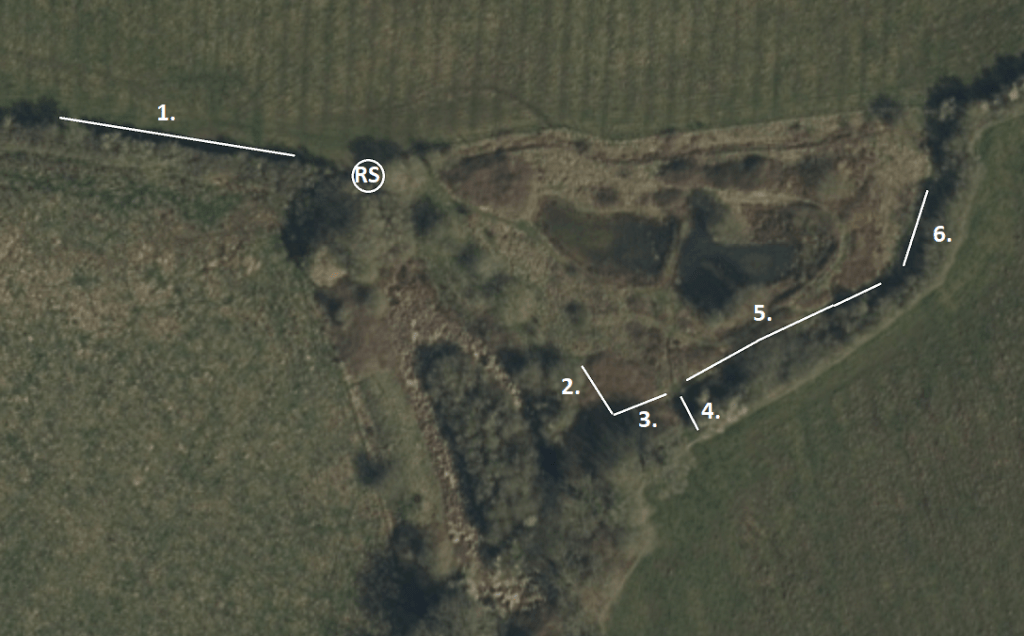
The three Little Owl boxes were all doing their job. One had an Owl on eggs, the other two held Little Owl chicks. The first was nice and easy to find, as it was in the box. As we approached the third box we saw the adult fly off. This was an interesting setup, to say the least. A couple of photos to explain the situation:

This wall was about 30′ long and 6′ tall. It then had a 90o turn, leading to the pillar at the far right of the photograph. The entire wall was topped with large flat coping stones. So, we checked the box for chicks, eggs having been found previously. Nothing to be found. Now Jon, knowing the place well, lifted a couple of the coping stones, which revealed a gap between each of the outer wall stones. We checked the stones, those that would open, and we found them: three stones away from the pillar pictured:

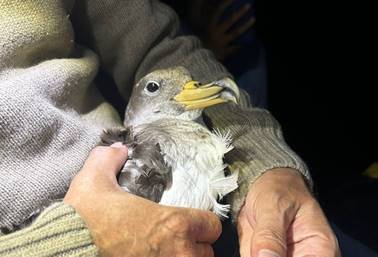
Little Owl chicks, Athene noctua, hiding in a channel under the coping stones of the wall

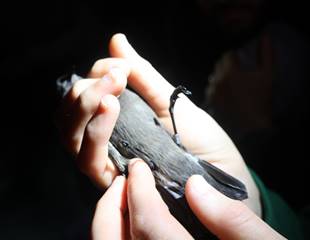
They had clearly left the box and climbed along the top of the wall, found a gap and climbed down into it. This was Miranda’s opportunity to ring her first ever Little Owl:

Little Owl chick, Athene noctua, phot courtesy of Jon

I love that “You wait until I get hold of you!” look.

The twelve Kestrel boxes were busier in the main, although only five of them were actually occupied by the target species, only one other had been occupied at all: with another squirrel drey to clear out.

In total, we ringed 14 Kestrels from those 5 boxes:

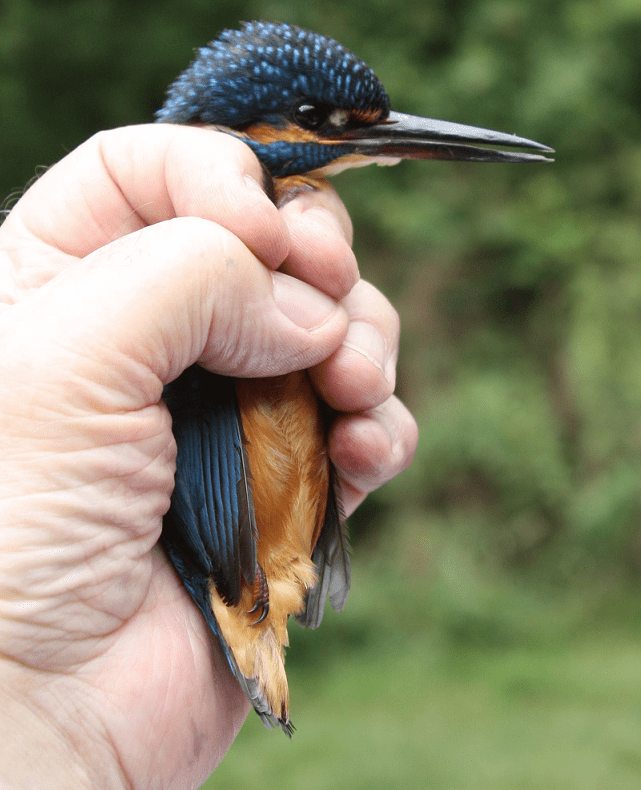
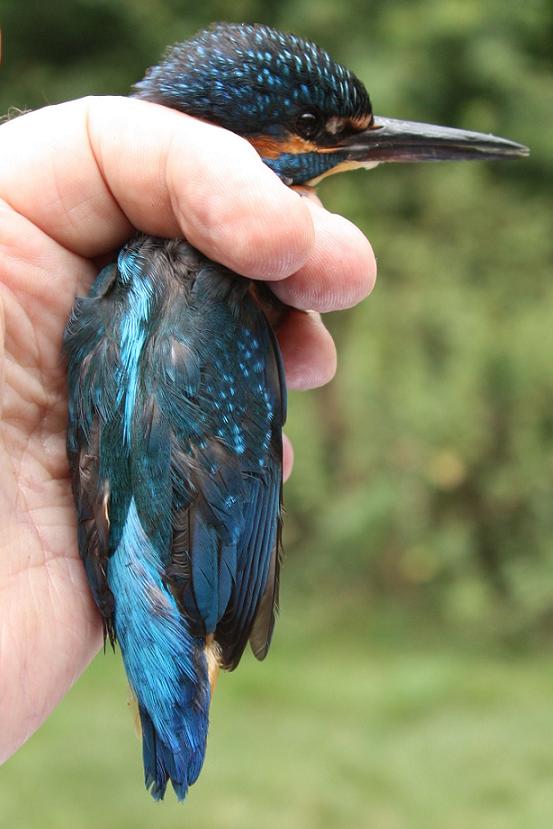
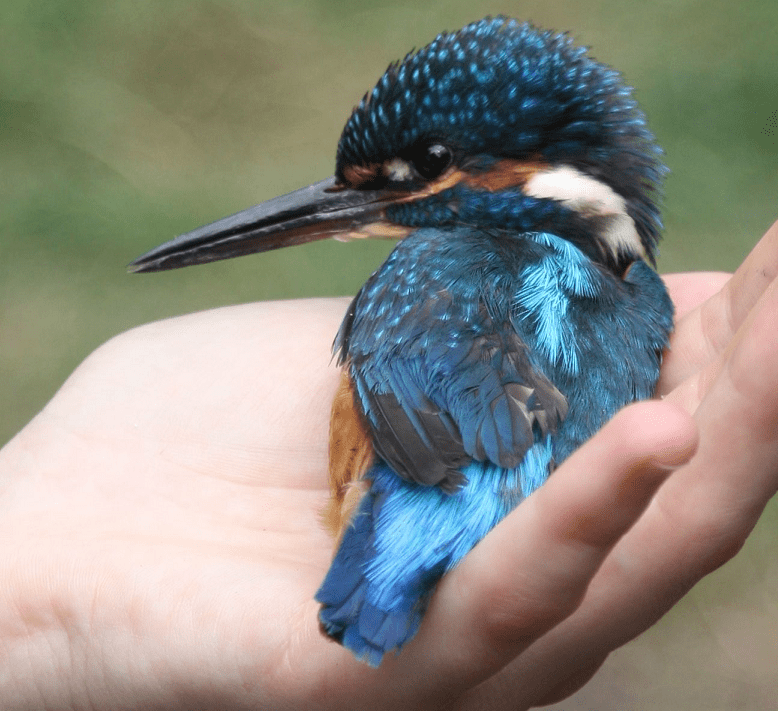
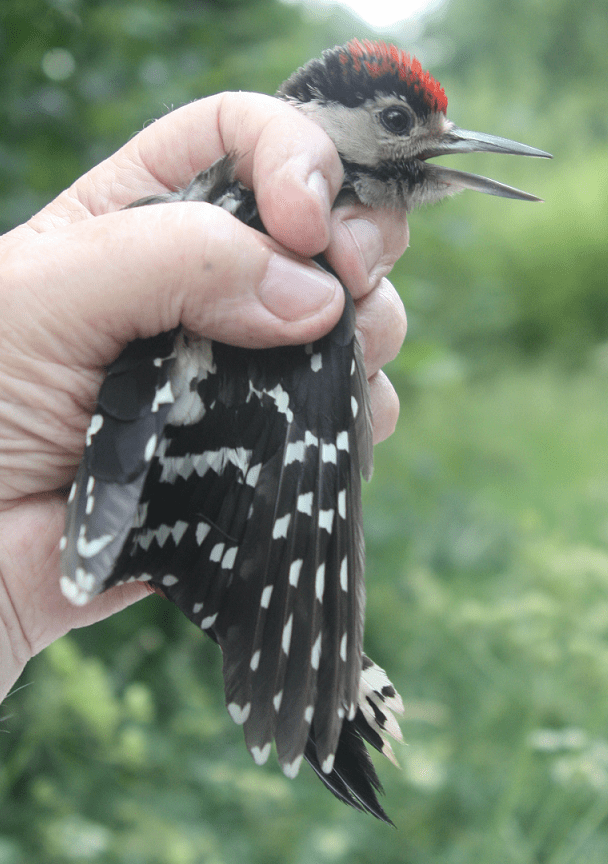
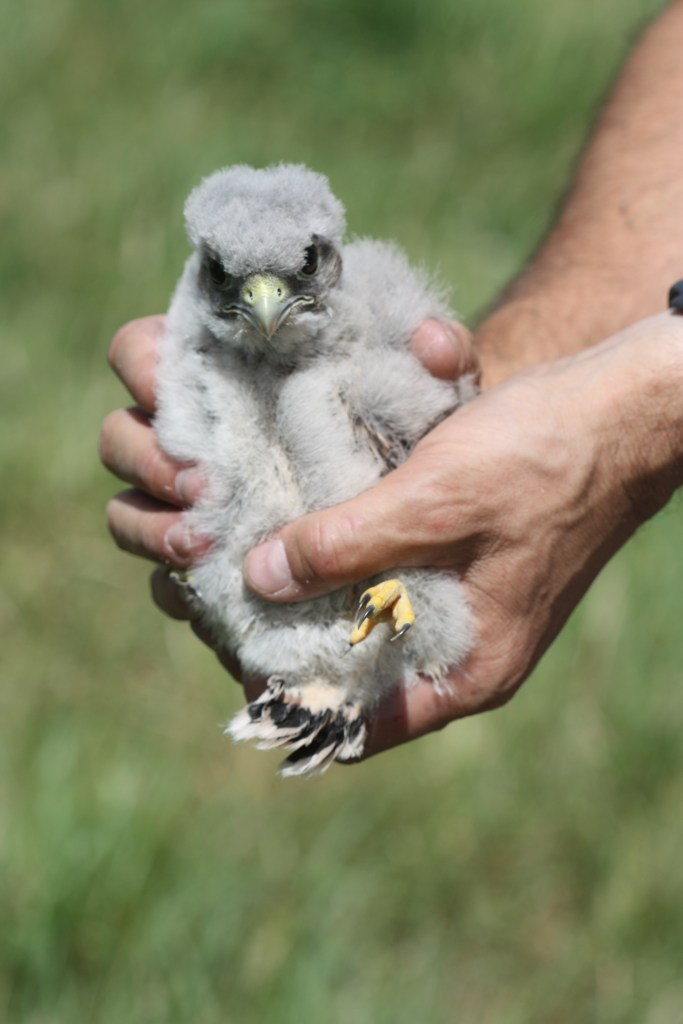
Kestrel chick, Falco tinnunculus

Most of them were showing signs of more development than the chicks ringed on both the Plain two weeks ago and in the Lower Wylye Valley on Tuesday. The primary and tail feathers are growing very nicely:

Kestrel chick, feathers medium.

All in all, a long day, but very satisfactory, and Miranda can add two new species to her experience. I am looking forward to the next one. Mind, I will need to ring the odd Kestrel chick otherwise they might end up with more records for Kestrel chicks than me!

Braydon Forest Barn Owl Boxes: 13th June 2025

Continuing my busy week, today I ought to check on what is happening in my personal Barn Owl boxes, having spent three sessions checking on the situation on Salisbury Plain and the Lower Wylye Valley. My thought was that we were likely to be further behind than the Plain, because they are usually a couple of weeks ahead of us with their Barn Owls. Laura met me at 9:00 at my place. We had to take her car: I have to get a new roof-rack as my old one doesn’t fit. Fortunately, her Kuga has a proper Ford (i.e. expensive) roof-rack that can be quickly fitted, so we loaded up the ladder, ringing gear etc and headed off.

Our first ports of call were two sites on the edge of Webb’s Wood / Echo Lodge. The first one is such a regularly successful site that I was hugely disappointed to find that it was full of Grey Squirrel rubbish. Absolutely no sign of the owls. I emptied it all out in the hope that, as the summer goes on, the Barn Owls will try again. So we went over the road to a box in Echo Lodge Farm. In all of the years that I have been doing this I have occasionally found adults roosting but only one occasion have I found and ringed a brood of chicks there: on the 12th September 2019. So I was delighted to find two of these:

Barn Owl chick, Tyto alba

A bit too young to be ringed yet, so we will come and have a look at them again in two weeks time.

From Echo Lodge we headed to Somerford Farm to finish off what we started when my car decided to die on me for the last time. The first box was absolutely full of squirrel drey material, which I had the privilege of clearing. Good grief, it was awful. I wouldn’t mind but: 1) it was cleaned out last autumn and 2) there was no sign of breeding. It is the end of the Jackdaw breeding season, so I suppose they could have fledged, but it really didn’t have any debris I would associate with successful breeding (poo, etc). I did find a bright blue egg, speckled with dark spots. I have worked my way through two field guides since, I can’t find it. It was about 30mm long and 25mm at its widest. Afraid, it got lost in the debris, so I have no photo.

From there we went to the second box along the farm lane: that was the saddest part of the day. The box had been cleaned out in the autumn and, on first opening, there was a thin layer of nesting material and nothing else. Laura had a feel around and found this tucked up in the corner:

Female Barn Owl, Tyto alba

She was completely desiccated. There was no sign of trauma: perhaps it has been a hard year for adults all round. We then headed to Upper Waterhay Farm. The first thing we did was check on the Swallow nests. It looks as though all of their first broods have fledged and flown. Under each nest was an astonishing amount of guano! There are still plenty of adults flying and around the nest sites, so I am expecting to see second clutches laid soon. We will make sure we keep a close eye on their progress and ring these birds before they fledge. From there we went to check on the owl boxes. The north box was the first, where we found three of these:

Juvenile Jackdaw, Coloeus monedula

They were so close to fledging, not predated, I would suggest starved. Either abandoned by the parents, due to them not finding enough food, or perhaps one or both adults were themselves predated. Of the three other boxes, the west box showed signs of Jackdaw breeding success, the Chancel box had some non-Jackdaw nesting material, so there is hope there – but no pellets or Barn Owl feathers. The paddock box had a part-built Jackdaw nest but no sign of an actual breeding attempt. All four boxes are now clean and waiting (and hoping) for some Barn Owls to occupy them.

So far, so like the experiences elsewhere! Our next port of call was Plain and Drill Farms (both worked by the same farmer). They are regularly productive sites. We went to the Drill Farm box first. As we approached the male flew out. Holding of breath!!

We opened the box to find the female sitting on four warm eggs! A proper clutch at last. She only caused a little damage as I extracted her and Laura put a ring on her. I was absolutely delighted. So to Plain Farm and a decent chat with Malcolm, the farmer, who is going to put up a couple more boxes for me, and a worker from Thames Water who let me know that there was a water main burst affecting the village I live in. There was I, covered in dust and goodness knows what else, and all I had been looking forward to for the last hour was getting home and having a nice long shower to get rid of the muck!

Anyway, Malcolm suggested we could drive all the way down to the box, as he has put down a makeshift track! He did warn us though about his Houdini calf. She clearly doesn’t like sharing space with her compatriots and has proven impossible to keep penned, so he is just letting her roam around the farmyard:

She really wasn’t bothered by the car. We drove down to the Plain Farm box and checked in on it. As we approached, the female flew out, and we opened the box to find:

Barn Owl chicks, Tyto alba

Sorry about the quality of the photo but we didn’t want to disturb them from their sleep. Ironically, before we actually opened the box, after mum had flown, we could hear them hissing, and yet, that is how they were.

In the end we checked 10 boxes, three of which are looking potentially productive for Barn Owls: a 30% “success” rate, which is somewhat better than the figures for elsewhere. I have another 15 to 20 to check, fingers crossed! I know that two of them had roosting pairs and I will be checking them next week. So a mixed session, but some good hopeful results.

You will be pleased to know that the burst water main was not affecting our water supply and I had a very pleasant cool shower to clean off all the muck and to cool myself down. Off to the Plain tomorrow: hopefully we will get a similar success rate. Kestrels are a certainty, Little Owls a possibility and let’s hope there is good news on the Barn Owl front.

Nest Box Checking: Lower Wylye Valley, Tuesday, 10th June 2025

I spent Tuesday with Justine and Mark driving around the villages of the Lower Wylye Valley. We were checking boxes to the east of Warminster, taking in farms and areas around the villages of Sherrington, the Codfords and the Langfords.

The primary objective was to carry out a recheck of several Barn Owl boxes done at the start of the season. Unfortunately, we only found one Barn Owl on eggs: just two eggs so far. That will be rechecked in about 10 weeks, as there should hopefully be at least two more eggs to be laid and they will have hatched and be ready for ringing.

Overall, though, it is still very poor on the Barn Owl front. With the recent change in the weather we are hoping that there will be a run of later broods, in effect their first brood, when they would usually be thinking about their second. The cold dry spring affected the grass growth, which was negligible. That had the effect of slowing the availability of key prey species, particularly the breeding of the various species of vole and mouse. This meant that there has not been enough prey for the Barn Owls to get into breeding condition.

It doesn’t help that several boxes contain nesting Jackdaws or squirrel dreys. One regular and productive site for Barn Owls that we checked had been taken over by honey bees. The box itself was full of honeycomb with absolutely no chance of owls taking over, so a visit in winter will be needed to clear that out ready for the spring.

Seven more Barn Owl boxes had either roosting pairs or were empty. One such, the most difficult to access, with the long ladder extended to its fullest extent, held one roosting adult male. Mark climbed the ladder and Justine and I held it firm to ensure no mishaps. Only, we hadn’t reckoned on the owl disgorging a considerable amount of guano as it left. Everyone got some but me, being directly under it as it left, caught it in my hair, down my arm and neck and down the back of my T-shirt. Nicely wet and smelly!

One other box we checked was empty. Mark had mentioned that both Kestrel and Barn Owl had taken advantage of the support girders to nest in last year. Sure enough, he had a look to see and a pair of Barn Owls flew out of the end of the girder and headed across the field. There was no sign of a nest or eggs. It is fortunate that Barn Owls are multi-brooded. Another positive point: Jackdaw young will have fledged within the next week or so, those boxes can be cleaned out, giving more opportunities for Barn Owls to select for breeding.

There is much better news on the Kestrel front. When checking their boxes we found one with a clutch of eggs, which will be checked in a few weeks time to see what has hatched and how they are progressing. Another with small chicks and an unhatched egg:

Kestrel chicks and egg, Falco tinnunculus, photo courtesy of Mark

We had three boxes with young in that were too small to ring:

There was one brood of five, of which we ringed four. One was much smaller than its siblings and we are all rather of the opinion that it was unlikely to survive, unless the parents could provide a decent amount of food.

The one at the front was the runt of the brood, photo courtesy of Mark

As with my post about the box checking on Salisbury Plain, I think that the Kestrels greater flexibility in taking prey species is probably why they are having more success than Barn Owls. This time we found the remains of a juvenile Robin in one box and these outside another box:

Possibly Skylark, initially I thought Song Thrush, any suggestions gratefully received

We went to check on a few Little Owl boxes as well. As we approached the last one we saw an adult sitting on the gate post at the entrance to the site. It flew off and disappeared around the back of the barn as we got closer. However, it was a prelude to the highlight of the day:

Little Owl chick, Athene noctua, photo courtesy of Mark

We found this lovely little owl. It was so cute that three grown adults went totally soppy over it. It was lovely and docile – and I got to ring it, only my second ever. There were originally 4 eggs in the box, so it was either the only one to survive, or the last to fledge. I hope it is the latter. It is close to fledging. Little Owls are disappearing fast from Wiltshire, for whatever reason.

We were out from 9:00 until 4:00: a long day, a lot of driving and stopping and taking ladders on and off the vehicle, climbing the ladder, checking the boxes, bringing down the chicks to check and ring and health check, do the biometrics etc. Should I put that another way: that’s what Mark did, Justine and I gave moral support and ringed a couple of birds! Good job he is fit!

Anyway, it was a satisfactory day for Kestrel, and a somewhat more hopeful day for Barn Owls, we shall see how it goes.

A big thanks to Justine for sending the details through of what we covered in the period and for allowing me to use it for the blog.

Ravensroost Meadows: Wednesday, 11th June 2025

This my first visit to Ravensroost Meadows this year. Funnily, our first visit last year was on the 12th of this month. I am not sure why we didn’t do a May session, as that is often pretty good at this site as well. Anyway, because we hadn’t been there since last Autumn, I told the team to have a lie-in and join me at 6:30, whilst I got up considerably earlier and went strimmed out the rides. After the long, dry May, followed by some considerable rainfall, and back to sun, needless to say that the vegetation has grown considerably. The weather is still a bit of an issue, with sun all day, but an Easterly / East-South-East wind gusting to over 20mph mid-morning and 30mph by lunchtime. The good thing about this site is that there are very good, thick hedgerows that block winds coming from that direction. I was joined by Laura and Ellie and we set the following nets:

Mariana, from the Zoological Society of London joined us again to take samples from migratory birds. The study is looking at whether migratory birds arriving in the UK are carrying mosquito-borne exotic diseases, particularly West Nile Fever, as it is spreading across Europe and is likely to be arriving here soon, if it hasn’t already. There are no known cases of home-caught illness, and just seven travel-related cases recorded in the UK but climate change could make that more likely.

It was a nice start to the session, with three birds caught before the nets were open: juvenile Robin and Chiffchaff and adult Wren. In our first round proper we had an excellent drop of 18 birds: nine Chiffchaff, one poor worn-out female Willow Warbler and our first five of these for the year:

Juvenile Whitethroat, Curruca communis

One of the four was a retrapped female. She was ringed as a juvenile at this same site in July of last year. The youngsters were all caught together, all at the same juvenile moult stage, possibly along with Mum, as she was in the same group. Possibly just recently fledged as a group. Two rounds later we caught an adult male in the same net, was it the whole family?

Anyway, it was a good session. We had birds in every round, and a nice variety. We could have added another species but the rather beautifully plumaged male Chaffinch had a mite infection on its legs: it looked like it was wearing white socks!

The list for the day was Adult [Juvenile](Retraps): Blue Tit [5]; Great Tit [4]; Wren 2; Dunnock 1[1]; Robin [2]; Blackcap 1; Garden Warbler [1]; Chiffchaff 2[14](1); Willow Warbler 1; Whitethroat 1[4](1). Totals: 8 adults ringed from 6 species, 31 juveniles ringed from 7 species and 2 birds retrapped from 2 species, making 41 birds processed from 10 species.

The breeze started having an impact on ride 4 at about 10:30, and more generally by 11:00 so I declared that the 11:20 round would be our last and we would close up as we were checking for birds. It was clear that the birds had also decided it was time for us to pack up as there were none in the nets. So we closed up and took down. I introduced Ellie to how I like my nets to be taken down and packed away. She took to it like a duck to water and we had the nets down and were away from site before midday! Most unusual but, then, unlike a lot of ringers, I don’t set lots of nets. I like my team to enjoy themselves and not feel pressured by numbers. We do get the odd 100+ catch, but always by accident, not design. Mariana remarked upon how relaxed and pleasant our sessions are. She got a lot of samples today for the research project, which is being carried out on behalf of an absolute alphabet soup of government departments, ZSL Institute of Zoology and the BTO. We hope to see her again soon.

Nice To Get Out At Last: Webb’s Wood, Sunday, 8th June 2025

It has been a very frustrating couple of weeks. In between having to replace my car, followed by some abysmal weather: if it wasn’t raining, it was blowing a gale, I haven’t managed to get out for one of my ringing sessions since 22nd May at the Firs – and that wasn’t the best session we have ever had, it was just good to get out. The forecast for today was for it to be dry but for it to have steadily increasing base speed and much higher gusts, gusts reaching 30mph by midday. I chose Webb’s Wood because the wind was forecast to be a westerly. Ravensroost Wood was scheduled for today but all of the rides there run west to east, whereas at Webb’s I can set the nets along some north – south rides. They got the forecast pretty well right, but the wind didn’t start getting up until just after 10:00.

I was joined by David, Ellie, Laura, Adam and Mark. I decided that we would have a lie-in and start at 6:30. Upon arrival we did find that the supporting gate post had broken off at the base: it looked rotten, rather than vandalised. Perhaps someone backed a car into it accidentally, as many do park in front of the access gate:

We set the following nets:

The first round gave us a false sense of security: a couple of juvenile Great Tits, a juvenile Chiffchaff and two adult male and one juvenile Blackcap. Unfortunately, it then went very quiet, with a couple of birds here, a couple there for the next two hours. I was getting a little despondent by 9:30, so I said to the team that we would give it until 10:30 and if it wasn’t any better we would pack up early.

To be fair, it was a nice catch as most of what we were catching were juvenile Chiffchaffs: our first of the year!

Juvenile Chiffchaff, Phylloscopus collybita

In that early round we also caught our first Blackcap of the year. We ended up with two.

Ride 1 did not catch a thing all session, which was disappointing as, last time I used it, it caught well. Also, ride 2 was catching absolutely nothing so, after that somewhat defeatist discussion, I got the nets moved from the left-hand side of the ride to the right-hand side. Astonishingly, that simple manoeuvre produced good results.

The first good thing in that net was: having had our second ever Garden Warbler in Webb’s Wood at our 10th May session, today we had our third. This time, a juvenile. There is something definitely unusual happening with Garden Warblers this year. I don’t know when they started arriving back but this is our second juvenile of the year: our first being ridiculously early in Ravensroost Wood on 18th May.

The second was this:

Juvenile Marsh Tit, Poecile palustris

Our first juvenile Marsh Tit of the year, caught in the net alongside an adult female with a well-developed brood patch. Mum, perhaps? It is looking rather good for Braydon Forest Marsh Tits this year. So far we have ringed 12 and retrapped 23. This is how it compares with the first full six months of each preceding year since I started ringing in the Braydon Forest:

This year has started extremely well for my keynote species. This juvenile is the earliest that we have ever caught and ringed (okay, let’s not get carried away: only by one day, from two caught and ringed in 2022 at Ravensroost Wood).

These were followed by another juvenile Chaffinch, carrying on from the two caught in the previous session in the Firs. With the wind getting up at 10:30, and some nets starting to billow, we decided to shut the nets after our 11:30 round.

The list for the day was: Adult [Juvenile](Retraps): Blue Tit [1]; Great Tit [4]; Marsh Tit 1[1]; Robin [3]; Blackcap 2[2](1); Garden Warbler [1]; Chiffchaff 1[8](1). Totals: 4 adults ringed from 3 species, 21 juveniles ringed from 7 species and 2 retraps from 2 species, making 27 birds processed from 7 species.

The irony of this morning’s session was that the dominant species singing all around us was Willow Warbler and we didn’t catch a single one! It was rather good to see a decent group of about 20 Swifts flying overhead

We had lots of very pleasant interactions with the public this morning: more people with their dogs on leads than I ever see in the nature reserves where they are supposed to be on leads. The friendliest French Bulldog we have ever met. Her name was Lily and she wouldn’t let her owner pull her away until she had been stroked and petted by every one of us! It was a lovely morning and, with the six of us to take down and pack away we were off site around about midday.

West Wilts Ringing Group Results: May 2025

An interesting month: if incredibly frustrating (and expensive) for me personally.  Without moaning on about it any more: the details are on my 31st May blog post!  The weather was a bit weird: a couple of weeks of dry heat and sun, a few days of wind and rain, then back to sun and strong winds, particularly in my part of the county.   I don’t think that I would have been able to set nets in the last 10 days even if I had a vehicle to get to site. I think most people were affected, excluding Jonny’s pullus ringing, we only managed 16 full and proper sessions plus one composite from Andy’s forays into his garden.

Added to the list for this month were adult Collared Dove, Grasshopper Warbler and Stonechat plus Jackdaw and Swallow pulli.  However, missing from the list were Bullfinch, Coal Tit, Grey Wagtail, Jay, Spotted Flycatcher and Tawny Owl adults, plus two Canada Geese youngsters and a brood of six Kestrel chicks. That said, Ellie L. got to ring her first Tawny Owl and two Kestrel chicks on our trip out with the Salisbury Plain Raptor Ringing Group.  She also ringed her fist Jackdaw chick on our box checking expedition (just before the car stranded us).

Jonny was, once again, hugely busy ringing Blue Tit, Great Tit, Swallow and Tree Sparrow pulli. Nearly the same numbers as last year, just a different mix: more Blue Tits and fewer Great Tits the key difference.

Talking of chicks: Ian ringed four of these beauties:

Stone-curlew Chicks, Burhinus oedicnemus, photo courtesy of Ian

Their numbers are growing on the Plain but they are also spreading.  According to correspondence that I had with the warden at RSPB Winterbourne Downs, they have four pairs nesting on their reserve this summer, alongside a few of these:

Lapwing chicks, Vanellus vanellus, photo courtesy of Jonny

Again, ringed at three sites around the county.  Two of them were also recaptured after having been ringed last month, so hopeful signs for survival.

Not in the same class as those above but I was very happy to get these in the Firs:

Juvenile Chaffinch, Fringilla coelebs, posing for the camera!

One other issue: Barn Owls – nesting efforts so far have proven to be non-existent on Salisbury Plain and in the Lower Wylye Valley.  Like in the Braydon Forest: a few pairs in boxes but no real sign of eggs, and certainly no chicks to be found so far this year.  Last year we had eight active nests in May, we actually ringed one brood and a couple of adults in May, the Salisbury Plain team ringed 16 broods in May last year but none this May.  Hopefully we will find some nesting activity, eggs and, hopefully, some chicks.  One good thing about late breeding: the Jackdaws will have finished and their young fledged before the Barn Owls get seriously involved.

It looks like we are heading into some more hot weather so what impact that will have we will find out this month.

Box Checking: Salisbury Plain; Saturday, 31st May 2025

After one of the most frustrating end to the month of my bird ringing career it was great to be able to get out again. My last session was on 22nd May at the Firs: just 19 birds, but some good catches including the first juvenile Chaffinches of the year. On the 23rd, whilst box checking in the Braydon Forest with Ellie, my car decided to recreate the same fault as it had the week before, with the clutch pedal falling to the floor. So I contacted Green Flag: same fault so £150 to recover me – until I told them where I was. They then added another £300 to the cost because, being in the middle of a field, they would need to send “specialist equipment”: which equated to a 4×4 with winch to pull me out of the field so it could be put on the recovery lorry. I pointed out that, in the heat, this field was a harder surface than most asphalt, but they were insistent, so I contacted a local lad, Quick Time Solutions if you are in the area in need of assistance, who did the whole recovery for the £150, no fuss, no bother. My local mechanic came out and topped up the fluid reservoir, bled the system and went off. Saturday morning I went out to test it: pedal straight to the floor! This time it required a new gear box and all the trimmings: the cost more than the residual value of the car! So I now had to hire a car and go shopping for a new one: which I will pick up on Monday. Fortunately, my frustration was mitigated by the simple fact that the weather was far too windy for me to set any nets, so I wouldn’t have got out ringing anyway. Which brings us to Saturday.

I was scheduled to spend the day on Salisbury Plain with Dick and Jon of the Salisbury Plain Raptor Group as part of the training requirement for the T-permit holders in the group. Their trainee had to drop out so there was a spare place in the vehicle so, alongside the three of us, we were joined by Ellie from my team. She hasn’t been ringing long and certainly has no experience of handling birds of prey, let alone climbing high ladders up to trees etc. An opportunity for a fairly steep learning curve.

Ellie and I left my place at 7:15 to get to Westdown Camp for 8:30, and arrived about 50 minutes later. I really must get the timing right. Anyway we were all packed up and ready to head off bang on time, to check a load of boxes to see what was happening. It is an incredibly late start to the breeding season for both Barn Owls and, somewhat less affected, Kestrels. There is one good thing about that: most Jackdaws will have fledged their one brood by the end of this month, so some boxes can be cleaned out and available for Barn Owls and Kestrels to get on with their breeding season. The issue is reportedly the lack of availability of voles due to the hot weather and a lack of growth of the grass that voles and mice need to provide them with nesting space and to hide from predators. From what we were seeing, that is pretty much how it is everywhere at the moment. Even the short period of rain doesn’t seem to have helped with that.

We visited 25 boxes yesterday. That included a temporary Tawny Owl box in the training village that Jon works in. It is a good story: he found a Tawny Owl chick on the ground outside one of the barns in the village. He put the bird on the roof of a shed inside the barn, for mum to come and find him. For those that don’t know, once Tawny Owls get to a certain stage they do a thing called “branching”. Essentially, they leave the nest and go for a wander, which was almost certainly what this had done. When Jon found it, its belly was empty, so he went off to find some roadkill to give it to eat. It just shows how scarce food has become: he couldn’t find any, so went to the local butcher’s shop and bought the bird some steak! He also put up a temporary owl box for it roost in, whilst waiting for it to be found. It was fed for four or five days by Jon and is doing well. So we went to ring it, only to find it had branched out again. We went searching and Jon eventually found it sitting in a shady nook behind a steel girder in the barn. We could hear mum calling from just outside the barn, and there is evidence that she has found it and is now bringing food! That’s a relief.

Tawny Owl chick, Strix aluco. Photo courtesy of Jon.

This chick is actually the first one we found and it became the first Tawny Owl that Ellie has ever ringed. Jon was extremely good at showing Ellie how to hold it in the right position for ringing, what measurements to take, and the current state of development of the primary and secondary wing feathers. This first Tawny was actually found in a Barn Owl box, which is a little unusual, but the side inspection panel on this box had come open which might have had an influence on the parent’s choice. The hatch was left open so we didn’t confuse the parents returning with food.

Over the course of the day we checked 11 Barn Owl boxes: 2 had Barn Owl pairs, plus one with a roosting male. Hopefully that means there is a female nearby. As well as all of that, there were two BO boxes with Jackdaw nests, if you can call the absolute stacks of sticks a nest. Both had chicks, both were so stuffed with sticks that the chicks, who look like they will fledge in the next week or so, couldn’t actually stand upright. Jon removed a couple of layers so that they could be a bit more comfortable in the box. In one of those boxes, which had three chicks, he also found two cold eggs. He made the mistake of opening them to find out what stage they had failed at. Suffice to say, the smell of hydrogen sulphide was pungent and much hand cleaning was required.

We also found three Grey Squirrel drays in BO boxes. They were removed and the nest box cleaned out, hopefully for use later on in the season. Two of them held Stock Doves. Both were a bit sad, actually, one was tragic. One had two cold, almost certainly infertile, eggs. The eggs were left in place, just in case they have only just finished laying and the female hasn’t started brooding them yet. Both parents had flown off from the box before we approached it. The other one was tragic: there was a dead adult in the box and the eggs had been cracked open and eaten. The nature of the predation suggests Stoat or Weasel.

We also checked 13 Kestrel boxes: three with Kestrel pairs, one with three chicks that we ringed. Again, Ellie got her first experience of handling and ringing Kestrel chicks. Jon helped her with how to hold and manage the birds for ringing. She was rather lucky in that they were at the stage where they are easy to handle. Give it another week or so and they will be all beak and claws!

Kestrel chick, Falco tinnunculus, Photo courtesy of Jon

One of the Kestrel boxes was quite unusual. Kestrels usually create a scrape into which they lay their eggs. In one of the boxes Jon found this:

Kestrel eggs in a nest, Photo courtesy of Jon

Jon and Dick tell me, as they have so much more experience of nesting Kestrel than I do, that this is unusual, to find something as well defined as this.

In terms of the struggle to find food, we did find the remains of birds in the nest and a number of Kestrel pellets. This first set of feathers is pretty obvious, the second, not quite so:

Goldfinch, Carduelis carduelis
Skylark, Alauda arvensis

I got the latter identification from the excellent book “Raptor Prey Remains” by the renowned Peregrine expert: Ed Drewitt, published by Pelagic Publishing in 2020 (no, I am not being paid for this advert).

The pellets were also pretty interesting. Primarily consisting of fur from multiple sources, they also contained a number of beetle elytra, mainly Violet Ground-Beetle, Carabus vilolaceus, as far as I could tell.

One Kestrel box had Jackdaw sticks in it but no sign of a breeding attempt. Another one had a Stock Dove inside, with no evidence of breeding.

We covered a lot of ground during the day, met up with Justine and Mark, who I am out with on Tuesday to check the Lower Wylye Valley boxes, who were parked up photographing House Martins collecting mud for their nests, from the only puddle we saw all day on the Plain. Apparently it is normally a pond!

We packed up and were back to Westdown Camp by 15:30, back to mine by 16:15. I am looking forward to the next session: I will be out with the SPRRG again on the 14th June.

Started Okay, Ended Badly: the Firs+, Thursday, 22nd May 2025

After Wednesday’s rain, Laura, Ellie and I met at the Firs at 6:00 and set the following nets:

It was a quiet morning catch wise, but it was very, very loud with birdsong. In particular, we started with one male Chaffinch singing away, after about 30 minutes, a second joined in. Another hour and a third joined the party and 30 minutes later, a fourth decided he needed to establish his presence.

As ever, we listened to the two Green Woodpeckers, who have territories either side of the wood, but never get close to the nets, laughing at us! Song Thrush, Chiffchaff, Raven and lots more heard throughout the morning.

The highest number of birds extracted on a single round was just four. However, it was a nice variety in the catch: the first bird out of the net was a Garden Warbler: only the fifth for the wood, following on from last year’s three (a male, a female and a fledgling), the first being in 2019. This was a female in full breeding condition. Hopeful that this species could become established as a regular breeder in this wood.

The next round, the “big round” comprised three Chiffchaff and a Blackcap. After the next two rounds, with just one bird in each, I decided that we didn’t all need to slog up and down the hill at the Firs, which is a surprisingly steep 200m, that we would each take it in turns to do a round, and call for help if needed. It wasn’t! The only round that had more than two birds, the last that I did, delivered three birds. That was one on my way down and two flew in whilst I was carrying out what our team (thanks Justine) refer to as a “Wren survey”.

There was another catch of Blackbirds, two second calendar year males with very brown primaries and an unmoulted alula. However, the absolute highlight of the morning arrived at 10:10. At first it was camera shy:

Juvenile Chaffinch, Fringilla coelebs

And then it was “Who are you looking at?”

With all of those males singing, admittedly in the trees up by the ringing station, it was lovely to catch our first recently fledged Chaffinch of the year. Then, on our last round at 11:40, we caught another. This one had started its post-fledging moult, whereas the first hadn’t.

The list for the day was: Great Tit 1; Wren 1; Blackbird 2; Blackcap 2(2); Garden Warbler 1; Chiffchaff 2(3); Willow Warbler (1); Goldcrest (1); Chaffinch [2]. Totals: 9 adult birds ringed from 6 species, 2 juveniles ringed from 1 species and 7 birds retrapped from 4 species, making 18 birds processed from 9 species.

It would always be nice to have a few more birds but I liked the catch. However, my absolute favourite moment of the morning was a Spotted Flycatcher hunting in some trees just down from the ringing station. I noticed it fly on to a perch, sitting in its typical upright manner, then flying out after an insect and returning to its post, then doing it again. There was also a lovely time with a Treecreeper running up the Oak tree adjacent to us, showing really well, before flying to the next tree over, and continuing its ascent.

With everything packed away we were off-site by 12:15. Ellie came back to my place to have lunch before we set off to carry out some owl box checks in the afternoon. This is where it all went bad. I should taken heed when my roof rack decided it had shrunk and didn’t want to fit the car! We got it sorted eventually and headed off. First box was at Lower Pavenhill Farm: we had to negotiate a field full of horses with their foals. They aren’t a problem other than that they do love to nibble and rub against the car. However, Ellie managed to keep them at bay whilst I checked the box – which was empty. Our next stop was Ravensroost Meadow where the first gate padlock was seized solid. So we went to the second gate: one padlock was also seized but there was a secondary one, which was blocked with fur from the Belted Galloways in the field. Belties are docile and safe, so we drove in and were immediately concerned when the eight Belties came haring towards the car. It was dangerous, for them, so we did a quick reverse ferret and got out of there. I will have to get them moved into the field next door before trying again. Not much of a start then. We then headed to the big barn at Somerford Farm. This box produced a brood for the first time last year, so I am hopeful. I climbed up and opened the box only to find it absolutely stuffed full of sticks and a bit of nesting material and over in the corner was this:

Nestling Jackdaw, Coloeus monedula

It’s primary and secondary feathers were between one third and two thirds grown, feathers medium, to give it the BTO reporting term. We went from there to another part of the farm, a field with a Little Owl box in it. It has not yet produced anything and this year is no different: I cleared out a squirrel drey. I am going to suggest we move it into the farmyard.

This is when it all went to hell in a handcart. I pressed the clutch down to start the car and the pedal fell straight to the floor! Not only that but the brake pedal would not depress. I got onto Green Flag and explained the situation. They said it was the same fault as last time, I said it wasn’t, they said prove it: like I carry that paperwork around with me. Then they advised that it would cost me £150 to recover the vehicle. That’s not too bad but, when I described where I was, they put me on hold and came back with a revised price, because they would have to bring “specialist equipment”, of £450. Apparently, they would need to bring a 4×4 with a winch to get me off the field so they could then get it onto the recovery truck! I explained that the field was like concrete and that wasn’t necessary but they insisted, so I called a local recovery guy who I had used before I took out roadside assistance. He quoted the £150, I explained exactly where we were and he wasn’t phased at all. It took him over an hour to arrive, but he had been finishing a recovery in Newbury. Anyway, he got me home and we got the car off the truck and out of the way on my drive. I am waiting for an engineer to arrive today, Friday, to advise on whether it is worth repairing or scrapping but I have decided I need a new car.

I felt sorry for Ellie, she is still finish off her Masters at Cardiff University and had set off from Cardiff at 4:00 in the morning and didn’t get away until 18:00 Thursday afternoon. That’s a long day! The compensation was ringing her first juvenile Chaffinch and her first nestling Jackdaw.

A Bit Like the Old Days: Ravensroost Wood, Saturday, 18th May 2025

It is a long time since we have had a really strong catch in Ravensroost Wood. This morning I was keen to increase the catch size, so I decided to set some additional nets. I was joined by David, Laura, Adam and Mark at 6:00 and we set the following nets:

Not as many nets as I had planned but the ride along which number 1 was set was very overgrown. Mark and Adam did a great job of clearing enough to set the three nets but we decided that was enough. I will get in with my strimmer before the next session. Why ” a bit like the old days”? In the last five years the largest May catch we have had in Ravensroost was 28 and the smallest full session was 11. Prior to then our May catches were regularly larger than this: up to 52 in 2019. Today’s catch was 56, our largest ever in May. We have had larger catches: but they were all when the feeding stations were in operation.

We had a decent start, with two Willow Warblers in the nets almost as soon as they were opened. The catch started well, peaked at 9:35 and then fell away until we started packing up at 11:00.

The peak was boosted by an amazing catch of 23 Long-tailed Tits! Our largest May catch in the whole Ravensroost complex prior to this was six: ten years ago! We had none in May between 2017 (2) and 2021 (1). Then there were 3 in 2022, 2 in 2023 and none in 2024 (which isn’t surprising, as we didn’t manage a session in May 2024). We have only caught juveniles in May in Ravensroost on three previous occasions: 2015 (4); 2016 (3) and 2022 (2). Today we ringed 15 juveniles, we also ringed two adults and retrapped six adults.

Particularly pleasing for me was to extract two of one of my favourite birds: the Garden Warbler. One was a female in breeding condition and, right next to her in the net was our first juvenile of the year. Unfortunately, neither of my photos are good enough to put on the blog. It is our first ever May juvenile: the earliest I have ever caught at any of my sites. I am a little concerned at how early it is, as they don’t usually lay until early to mid-May, but the flanks and belly were bald and the armpit was also somewhat naked. The plumage was pristine: there is no way that bird had flown all of the way from the Congo rainforest, following the rains, without showing some kind of feather wear. It does mean that the egg must have been laid in early April. If it had been a month later I wouldn’t question it. However, the record was accepted by the BTO without query. We went on to catch another two in the session. It is the best number ringed for just under eight years: July 2017 was the last time. 2017 was our best ever year for the species: hopefully a portent of things to come!

It was another red letter day for Blackbirds: we caught seven: five ringed and two retraps. This is our best ever catch of the species. Prior to that you have to back to January 2013 for a catch of six, our previous highest total. However, those were all ringed, whereas today was five ringed and two retraps. To put that into perspective though: January 2013 was only the fourth session in the wood under my ringing regimen. Today’s catch included our first juvenile of the year:

Juvenile Blackbird, Turdus merula (my Garden Warbler photo was even worse than this)

To complete the list of first juveniles for the year, we had our first Bobble:

Juvenile Robin, Erithacus rubecula

So, the list for the session was: Blue Tit 2(2); Great Tit (1); Long-tailed Tit 17(6); Wren 1; Robin 3; Blackbird 5(2); Blackcap 4(1); Garden Warbler 4; Chiffchaff 1(2); Willow Warbler 5. Totals: 42 birds ringed from 9 species and 14 birds retrapped from 6 species, making 56 birds processed from 10 species.

It was a good number of Willow Warbler: our second highest catch in the complex but our best catch inside the woodland. We mainly catch them in the Meadow Pond area.

So, after a thoroughly enjoyable session, we started taking down in stages at 11:00, were packed up by 11:45 and off site by midday.

Nest Box Checking: Salisbury Plain, Saturday, 17th May 2025

I spent today out on the Salisbury Plain Training Area with the Salisbury Plain Raptor Group. I met with Dick and Jon, stalwarts of the group, with one of our new trainees, Mark, at Westdown Camp, on the edge of SPTA. A civilised start, at 8:15.

We mounted up in the 4×4 pickup and headed off to see what we could find. To be honest, everything is running late, but we were hopeful of finding signs of breeding. The decision was made not to disturb any Barn Owls that were not on nest when Dick and Jon did their previous check on these boxes in mid-April. Like my own boxes in the north of the county, there are signs of occupancy but no signs of egg-laying. The plan was to check those Barn Owl boxes that had been on the nest then, to see how far they had come.

We were also going to be checking some Tawny Owl and Kestrel boxes, to see how they were faring. Tawny Owls, in particular, breed earlier than most other raptors. In the event the only ringing we did today was of a single Tawny Owl chick:

Tawny Owl chick, Strix aluco (photo by Mark)

Despite being still very downy, its feathers are developing quickly, its primary wing feathers are at medium length, and it is likely to leave the nest box quite soon. Its sibling has already left the nest and was moving around in the tree above the box. Mum was also in attendance, showing her displeasure. Another Tawny Owl box showed signs that it had been occupied but that the young have already fledged and left the nest.

The rest was a mixed bag of results. Two of the boxes, one Barn and one Kestrel, were occupied by Jackdaws. One of them had five eggs and the other had three chicks. A couple of the other boxes showed that Jackdaws had been in occupancy: so they was cleaned out for Barn Owls and Kestrels to have a chance to breed later in the season. Another Barn Owl box held a pair of Stock Doves. Or, at least, a pair flew out as we drew up in the car. We didn’t disturb their nest.

A couple of the Barn Owl boxes did have adults in them, but not breeding yet, and three others had clutches of eggs in them: one of three and two of five.

We then found six active Kestrel boxes, five had eggs and one had young that was only a few days out of the egg. Interestingly though, you could hear the young making little high-pitched calls through the shells of the eggs in three of the clutches.

One box had lost its front and bottom when the branch it was resting on broke off from the tree. Jon spent fifteen minutes rebuilding it and ensuring that it was firmly fixed to the tree, without relying on any branch.

That was pretty much the end of the session: 18 boxes checked and one repaired in 5 hours driving around SPTA. What it told me is that Barn Owl breeding, in particular, is several weeks behind last year. It seems that this very dry May is preventing the grass from growing and vole numbers are well down. That ties in with the few of my boxes that I have checked so far this year: two pairs of Barn Owls occupying boxes but showing no sign of breeding yet.