Fledglings Arrive: CES 2: Lower Moor Farm, Saturday, 18th May 2019.

This session was carried out in almost perfect weather conditions for ringing. It was overcast and windless.  The only problem was that the base temperature was unseasonably cold for the time of year, which tends to suppress the insect activity, which has a knock-on effect on the activity of the birds.  I was helped in the session by Jonny Cooper and Ellie Jones and we were joined by Tim Jukes.  Tim is a volunteer working with Jonny on his Braydon Forest Curlew Project and expressed an interest in finding out about ringing.

This year’s CES is shaping up to reverse the declining trend of the last few years. In each session so far this year we have processed 59 birds, compared to 31 birds processed in session 1, 2018 and 26 birds processed in session 2.  There were plenty of highlights in this catch: a juvenile Song Thrush, our first newly-fledged Robins of the year (five of them) plus our first newly-fledged Chiffchaff:

2019_05_18Chiff

I know this a serious blog – but isn’t that just so cute?  We also caught a Dunnock that was fresh out of the nest.  Perhaps the most encouraging catch of the morning was a female Cetti’s Warbler with a well-developed brood patch.

2019_05_18Cetwa

After an excellent year in 2015, with several youngsters ringed, we have had very few Cetti’s caught – and those we have caught have been males on territory. We caught a male earlier in the year, and have heard singing at every session this Spring. however, this is the first female that we have caught since 2015.  I am hopeful that we will get proof of breeding and some fledglings in the next month or so.

The list for today was: Treecreeper (1); Blue Tit 1(1); Great Tit (2); Wren (3); Dunnock 2(5); Robin 5(3); Song Thrush 2; Blackbird (3); Cetti’s Warbler 1; Blackcap 2(5); Garden Warbler (3); Whitethroat 2; Chiffchaff 1(5); Willow Warbler 1(3); Bullfinch 4; House Sparrow 3; Reed Bunting 1.  Totals: 25 birds ringed from 12 species; 34 birds recaptured from 11 species, making 59 birds processed from 17 species.
 

Tedworth House: Wednesday, 15th May 2019

Before getting into the session at Tedworth House today I am going to say a few things about the Breeding Bird Survey I carried out yesterday.  For the last six years I have been carrying out the BTO’s Breeding Bird Survey at Brown’s Farm, just south of Marlborough.   As readers of the blog know, I also ring at this site, and did so quite recently.  The difference between ringing the site and doing a breeding bird survey is in the amount of ground you cover.  For BBS I walk two 1 km transects, 1 km apart, recording the birds I see and hear in 10 x 200 metre zones and noting their distance from the track that I walk.  There are 3 zones: <25m; 25m – 100m and >100m.

Whilst in our last ringing session there we caught 4 Linnet, 6 Whitethroat and 5 Yellowhammer: during my walk yesterday I noted over 40 Linnet; 20 Whitethroat and 30 Yellowhammer along the hedgerows.  I was also lucky to see half-a-dozen Hares and had my closest ever encounter with this enigmatic mammal. Half way through the survey I stopped for coffee, sitting on a low bank at the edge of a field.  Two Hares came running up the path towards me, they stopped and a bit of boxing ensued. They then ran on further and sat no more than 5 metres from my position. We “shared a moment” for three minutes before they moved off in different directions.

To Tedworth House.  It was a quiet session, carried out to a background of the constant chatter of the Raven chicks and their parents. They have been fledged for a while now but are clearly still hanging around as a family.  Although I didn’t catch huge numbers of birds, it was quite interesting nonetheless.

The highlight had to be my first Magpie since October 2016.  Of the 15 Magpies caught by the Group since 1st January 2013, 6 of them have been caught at Tedworth House.  The list for the day was: Magpie 1; Nuthatch (2); Blue Tit 1; Song Thrush 1; Blackbird 5(2); Blackcap 3(1); Goldfinch 1; Bullfinch 2.  Totals: 14 birds ringed from 7 species; 5 birds recaptured from 3 species, making 19 birds ringed from 8 species.

The number of Blackbirds was remarkable. One was a juvenile from this year; 4 were second year birds and the two recaptured birds were full adults.  I was joined by several keen observers during the day.  Two were absolutely delighted to be shown how to safely hold and release a Goldfinch and Blackbird respectively.

As the temperature rose, the bird activity fell and I closed the nets at 11:30, after a couple of empty rounds.  The session finished on a bit of a high when Jack, the maintenance man for Tedworth House and expert nest finder, showed me a Goldcrest nest in a fir tree overhanging the children’s play area.

Somerford Common: Saturday, 11th May 2019

Somerford Common is, without doubt, the most varied woodland that I ring.  If I lost all of my other woodland sites, I could replace them with the different habitats available at Somerford.  For today’s session I set up along the rides in the south-east corner of the wood.  The ride running west to east was cleared and widened on the south side considerably three years ago, the paddock area to its north became subject to a coppicing regime two years ago.  Both are growing back and offering a good range of different heights of vegetation.  This is usually a good recipe for getting a decent variety of birds.

Somerford

I was working solo for the session, so I didn’t overdo the number of nets.  You can never tell how big the catch will be at Somerford.  The usual catch at this time of the year is 25 to 30 birds, totally manageable for an experienced ringer.

The list for the day was: Blue Tit (2); Long-tailed Tit 2(5); Dunnock 1; Robin 1; Song Thrush 1; Blackbird 3; Blackcap 4; Garden Warbler 1(1); Chiffchaff 2(1); Willow Warbler 1; Goldcrest 1. Totals: 17 birds ringed from 10 species; 9 birds recaptured from 4 species, making 26 birds processed from 11 species.

The recaptured Garden Warbler, D977367, is not one of our birds. It looks like it is an old ring number and I shall look forward to getting the details, which will indicate how many times this bird has flown from the UK to over-winter in the Congo rain forest.  There were no Garden Warblers caught at the site last year, so this is a welcome return.  When I surveyed the site for the BTO’s Bird Atlas back in 2008, Somerford Common was the best site for Garden Warblers.  The vegetation is now in a similar state to where it was then, so I am hoping that we will have a good catch of the species this summer (and for the next few years).

It was our best catch of Long-tailed Tits for a while and our best catch of them ever at Somerford at this time of year (i.e. with no feeding station and before this year’s youngsters have fledged).  One of them was ringed as a juvenile back in June 2015: a pretty good age for such a small bird.

Update: Garden Warbler D977367 was ringed at Waterhay in the Cotswold Water Park as a juvenile in August 2014.  A well-travelled bird!

CES 1: Tuesday, 7th May 2019 @ Lower Moor Farm

CES stands for Constant Effort Site and is one of the BTO’s most important project schemes. The idea is simple: the same nets are placed in the same positions for the same period of time year after year, roughly 10 days apart throughout the breeding season (the first week of May to the first week of September).  I set my nets and leave them open for 6 hours.  When I first looked into setting up a CES I planned to set a lot of nets, as Lower Moor Farm has a variety of habitats that would bear monitoring.  However, I realised that there would be occasions when I would be working solo, and so I scaled back the plans.  I have 4 rides, comprising 201 metres of net, in 5 habitat variations.  As it happens, today I was working solo, so I am quite pleased that I didn’t go for a large setup.

It was a 4:00 start: as I was setting the nets alone, I thought I had better give myself an earlier start. It did mean that I got to hear the dawn chorus from beginning to end, which isn’t a bad start to anyone’s day.  Unfortunately, the start time was mirrored by the temperature in degrees Celsius: a bit chilly!

I also had another close encounter of the Cuckoo kind.  It started with a male calling from the trees adjacent to where I had just opened my last nets, and I then had super views as it flew around the site, before heading off in a north-westerly direction.  One day I will catch one!

The catch for the day was a big improvement on the equivalent session in the previous two years: Treecreeper 1; Blue Tit 1(1); Great Tit 1(2); Wren 1(1); Dunnock 5(4); Robin (1); Song Thrush (1); Blackbird (1); Blackcap 6(7); Garden Warbler 6(3); Whitethroat 4; Chiffchaff 4(1); Willow Warbler 3(1); Bullfinch (4). Totals: 32 birds ringed from 10 species; 27 birds recaptured from 12 species, making 59 birds processed from 14 species.

One of the recaptured Garden Warblers is not a bird that our group has ringed. I shall look forward to finding out its history.

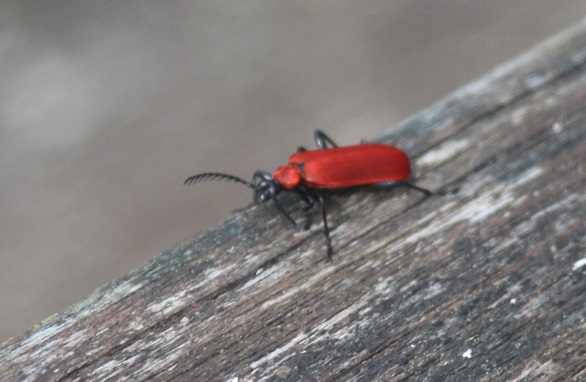
The most striking catch of the morning was a Black-headed Cardinal Beetle, Pyrochroa coccinea, which I carefully extracted from one of my nets:

Black-headed Cardinal

Not a great photo – but I didn’t have my macro lens with me.  There is already a superb variety of insects flying around the lake sides: one day I will have to eschew the birds for a while and focus on the insects.

Brown’s Farm: Wednesday, 1st May 2019

We had a super session at Brown’s Farm on Wednesday.  It wasn’t a huge catch: there are never lots of birds around in April or May, as the summer migrants are still arriving and the resident birds are being territorial and spread out from their winter foraging flocks.

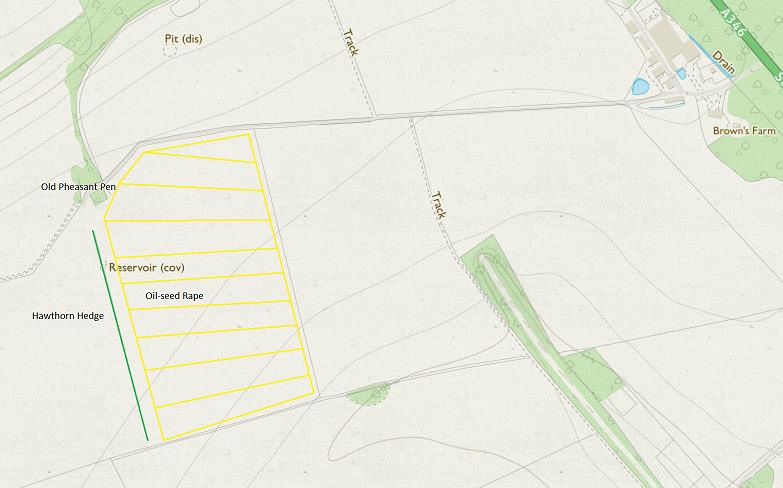
I had my most experienced lieutenant, Jonny Cooper, with me, so we set a lot of nets.  We set them along the whole of the hawthorn hedge that runs across the fields adjacent to the old pheasant pen. They were placed on the eastern side of the hedgerow, away from the prevailing breeze, on the hedgerow side of the track left between the hedge and the oil-seed rape planted there.

Browns

The catch for the morning was: Long-tailed Tit 1; Dunnock 6; Robin 3; Blackbird 1; Blackcap 1; Whitethroat 6; Willow Warbler 1; Linnet 4; Yellowhammer 4(1).  27 birds ringed from 9 species and one recapture.  The recaptured Yellowhammer was ringed on the farm in February of last year.  Interestingly, the male Linnets and Yellowhammers were coming into breeding condition but the females weren’t.  Both species breed somewhat later than birds like Blue and Great Tits: I think it is basically because the titmice feed on insects and their larvae, which are available earlier than the seeds that the Linnets and Yellowhammers feed on.

That said, the Whitethroats, which are also insect feeders, showed the same difference.  However, the reasons are different: the males arriving first to set up territories: lots of testosterone involved.  Then the females arrive and look for a mate, and they don’t come into breeding condition until somewhat later.

We set up our ringing station close to the entrance to the ride from the main track.  Sitting down to process our first few birds, we were suddenly surprised by the loud calling of a Cuckoo. He was sat in the tree immediately above our heads.  We then watched as he flew off across the fields. They are regular on the site.  I always hear them when I am doing the BTO’s breeding bird survey;  which I plan to do the first of next week.

The fields were alive with insects.  When you hear all of the stories of the dearth of insects on farms, it is actually very pleasant to be surrounded by the continuous buzzing whilst working.  We saw Small Tortoiseshell, Peacock, Orange Tip, Small White and Holly Blue butterflies along the ride.

The wind picked up at about 11:30, just as we started taking down.  Once again, the rain started soon after we left site.

Garden Warblers Arrive: Lower Moor Farm, Wednesday, 24th April 2019

Yesterday’s session at Blakehill Farm was hastily scheduled because the forecast for today and the rest of the week was quite a lot of rain.  However, as I got home to an email from Rachel at the Wiltshire Wildlife Trust asking if she could bring her group along to my planned ringing session, I thought I had better think again. This also reminded me that another group had also asked if they could drop in on our activity.  I checked the forecast, found it had improved, and contacted Ellie to see if she was available to help. Fortunately, she was. I cannot do two very early mornings in a row, so we started at 6:30.  However, we were very aware that the rain was scheduled to arrive at 11:00.

Lower Moor Farm is a very public site, but it does have a wildlife refuge area to which the general public do not have access.  It was in this area that we set up our nets: far from the madding crowd.

The catch was not busy, but a significant improvement on yesterday. Our highlight of the morning was our first catch of Garden Warbler this year. One was a recapture of an adult ringed at Lower Moor Farm in May of last year, plus two new individuals. These are the earliest Garden Warblers caught here, or at any of my sites, by a couple of weeks.

The catch for the day was: Long-tailed Tit 1; Robin 1; Song Thrush 1; Blackbird (1); Blackcap 5(1); Garden Warbler 2(1); Chiffchaff 3(1); Willow Warbler 1; Reed Bunting 1. Totals: 15 birds ringed from 8 species; 3 birds recaptured from 3 species, making 18 birds processed from 9 species.

At 9:00 we were joined by Ian, one of the Trust’s army of volunteers, and then at 9:15 we Rachel and her group from the Royal Wootton Bassett Academy arrived.  About 20 minutes after they left, we were joined by Christine and her group from the Devizes School.  Each group stayed with us for about half-an-hour, during which time I explained the ringing scheme to them.  They were shown how we ring the birds, the biometrics that we take, and ageing and sexing of species.  As ever, you can guarantee that explaining about “cloacal protuberances” will guarantee sniggers from a group of young teenagers. One point, I might have made it before, the children involved all have either challenging behaviour issues or learning difficulties. It would be really nice if, just occasionally, the “run-of-the-mill” pupils could get the opportunity to become involved.  I will always be happy to explain what we do to these groups, it would just be good to expand the audience.

At about 10:15, after the second group had left, we decided to take down.  The birds had stopped moving, and we were mindful of the weather forecast.  For once, the forecast was spot on and our timing was perfect: we had finished packing away, and I had just driven away from the ringing site, when the heavens opened.


Not Everything Goes Right All The Time: Blakehill Farm, Tuesday, 23rd April 2019

Jonny and I thought we would have a go at catching some migrants at Blakehill Farm this morning.  We went armed with maggots, spring and Potter traps, plus the usual assortment of nets.  It was our first early start of the year, meeting at 5:00, to get the nets up and open before sunrise.  With the central plateau out of bounds, to protect any ground nesting birds from potential disruption, we went to the western fields at the site:

Blakehill aerial

The red lines indicate where we set the nets: the red cross is where we set the walk-in traps (if you can make them out).  Our main, netting, area was shared with the cattle, who are now out to grass. We never have a problem with them: they tend to stay away from us.  Both Jonny and I have farming in our background (Jonny was born into it, I chose to work in it for five years) so neither of us is bothered about working around livestock.  Having set the walk-in traps they proved irresistible to a small group of steers who wandered over, and proceeded to set off all of the spring traps and turn over three of the four Potter traps – so that went well then.  Fortunately no damage done – but £1.85 worth of maggots freed from captivity.

To say we were not busy is a bit of an understatement: in 3 hours we caught 8 birds. We aren’t greedy but we did decide that the dead horse had not just been flogged but flayed, and so we packed up at 10:00.  That said, we were pleased to catch our first Whitethroats of the year, plus two more Willow Warblers.  The list for the session was: Blue Tit 1; Dunnock 2; Blackcap 1; Whitethroat 2; Willow Warbler 2. Total: 8 birds ringed from 5 species.

The first Whitethroat we had was sporting a massive pollen horn on the top of the beak, as you can see from the photograph:

2019_04_23Whitethroat

The meadow we were set up in was quite damp, and there was a sprinkling of Cuckoo Flower throughout:

2019_04_23flower

We don’t often have such a quiet session but it did give as plenty of time for bird watching and there were plenty of birds flying around.  The entire morning was accompanied by bird song: from 2 Curlew who spent the entire time displaying and calling almost continuously, through Whitethroat and Lesser Whitethroat singing from the bramble hedges, along which we set our nets for most of them to ignore, to the ubiquitous Chiffchaffs singing from every relatively high vantage point.


Ravensroost Woods: Saturday, 20th April 2019

Jonny and I had planned a session at one of our farmland sites this morning, hoping that we might catch a few of the more esoteric migrants as they pass through. Unfortunately, the forecast was for it to be breezy and that means nets getting tangled in hedges, so we changed tack and headed for Ravensroost Woods.  The weather was stunning: cool to start with but gradually warming as the sun came up.   By the time we packed up at 11:30 it was getting very hot for a Spring day.

We set the nets to the north of the bridle path. and the ringing station on the bridle path away from the nets.  You can see the map of the reserve at:

https://www.wiltshirewildlife.org/ravensroost-wood-including-avis-distillery-and-warbler-meadows-malmesbury

It was a fairly standard catch for this time of year: Blue Tit 6(1); Great Tit 1; Coal Tit 2; Marsh Tit (1); Long-tailed Tit 1(1); Song Thrush 1; Blackcap 5; Chiffchaff 6(1); Willow Warbler 1.  23 birds ringed from 8 species; 4 birds recaptured from 4 species, making 27 birds processed from 9 species.

There were a couple of non-birding wildlife highlights. At about 9:00 a Hare came wandering up the track towards our ringing station. This is the second time in two visits that I have seen a Hare in the wood.  This is quite interesting, as I am also seeing Hares on the woodland rides at Somerford Common.  I don’t know if this is common behaviour but I have always thought of Hares as being beasts of the fields, not the woods.

However, the absolute highlight was as we were leaving site. As I drove back to the main gate a Grass Snake moved rapidly from west to east across the main path.  We had a superb view and then it disappeared into some brash on the other side of the path, far too quick to get any photographs, unfortunately.  I have been visiting Ravensroost Woods for some 20 years and this is the first time I have seen Grass Snake there.

When I decided on Ravensroost I was unaware that there was a guided Spring walk organised for the same day.  I had checked the “What’s On” guide but it wasn’t advertised there – probably because it was in the previous one.  All it meant was that I had the opportunity to explain what ringing is all about to a group of 20 nature enthusiasts. Unfortunately, one of them was hostile, and he made his feelings known to me after the group had moved on.  It happens. We didn’t actually have any birds with us when the group arrived and, as they left, we went off with them to check the nets.  There was a female Blackcap in one net and so I had a large audience watching me extract it.  She came out easily and I was able to explain the sexing of a Blackcap and the development of the brood patch, as this female had just started defeathering.  Naturally, Mr Hostile questioned how long the bird had been in the net. They always seem to focus on that: ignoring the fact that the bird was perfectly healthy and unharmed. I explained that we had just done a round before the group arrived, and so no more than 15 minutes had passed since we last checked, well within BTO guidelines.  Anyway, all bar one went away happy to have seen a female Blackcap close up and, hopefully, a lot more knowledgeable about bird ringing and why we do it.

Throughout the morning we had chats with horse riders and dog walkers using the bridle path and the nature reserve.  All very pleasant and very interested in what we were doing. As a result, it seems that I am likely to be doing a ringing demonstration for one of the local Girl Guide troops in the near future.  Their troop leader was out on a walk and stopped for a chat and, when she found out that I am happy to show what we do to people who are interested, she took my details.


No Ravens: Never Mind. Tedworth House: Wednesday, 17th April 2019

If anybody gets that reference, I shall be impressed at your musical knowledge.  Anyway, this Wednesday we had hoped to ring the Raven chicks at Tedworth House.  We gave them a miss last year as the “Beast from the East” had affected them at the start of their breeding season and we didn’t want to add any avoidable pressures.  This year, we decided to schedule it for close to the same time we ringed the chicks in 2017.  Dave Turner had lined up an expert climber, Dougie, to do the donkey work and get to the nest.  He climbed up to within 20 metres of the nest, whereupon the youngsters made their way to the opposite side, and started to flap their wings, so he withdrew quickly and they settled back down again.  Why were they so much more advanced?  What was the difference? Back in 2017 there were 4 chicks in the nest, this year just 2.  Perhaps they are that much more advanced because the adults have been able to feed them much better with fewer bellies to fill.  Next year we will schedule the attempt for 2 weeks earlier.

I was joined for the ringing session by Dr Ian Grier.  Ian was my trainer.  He took me to my C-permit and then through to my full A-permit and I always look forward to working with him.  Most of his ringing these days is focused on the specific projects on Stone Curlew and Lapwing on Salisbury Plain.

The catch was not massive: Blue Tit (3); Coal Tit (1); Wren 1(1); Dunnock 1(1); Redwing 1; Song Thrush 1; Blackbird 1(1); Blackcap 3; Goldfinch 4. Totals: 12 birds ringed from 7 species; 7 birds recaptured from 5 species, making 19 birds processed from 9 species.

Dave Turner, my principle contact at the House, was running a greenwood woodworking course for some users of the Tedworth House facilities.  When they took a tea break they came across to have a close up encounter with some of our birds.  This is the key reason for doing what we do at Tedworth: to introduce the users to our birdlife and, hopefully, spark an interest.  It always does.

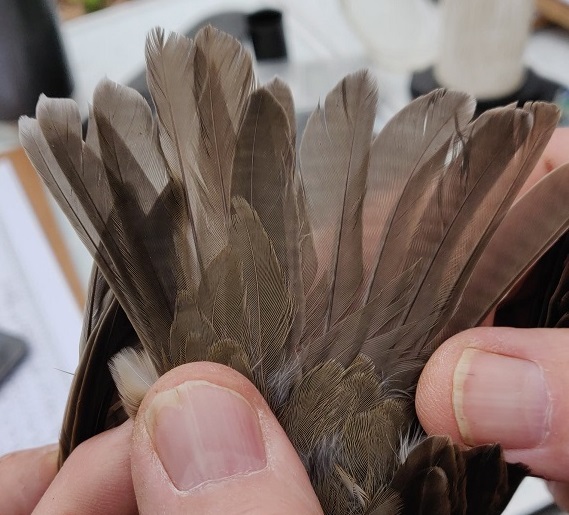
This was an interesting catch. To start with, no Great Tits or Robins caught: most unusual for this site.  Then, to catch a Redwing this late on is very unusual.  This bird was actually in poor condition and I doubt its chances of making it across the North Sea to Scandinavia.  Its breast bone was very prominent, and the pectoral muscle coverage was very low.  Clearly that has implications for flight.  The tail was regrowing and was full of fault bars:

redwing tail


This is a sure sign of poor nutrition and no doubt why it isn’t as robust as one would expect for a migrating bird.  Thanks to Gemma-Louise for the photograph.  Gemma-Louise and her partner Paul had come along hoping to see the Ravens but stayed to have a look at the other birds we were catching. Gemma-Louise was once a Wiltshire Wildlife Trust trainee working at Tedworth House and is now an animal handling trainer at Sparsholt Agricultural College.  She will be bringing a group from the college with her to our June session

The highlight of the session was ringing our first newly fledged Song Thrush and Blackbird of the year.  Jack Daw, who monitors the nesting attempts at Tedworth House, took me on a little detour to look at the Mistle Thrush nest that he has kept an eye on.  We were lucky enough to see, from the ground, that the youngsters are fully feathered and ready to fledge, as they poked their heads over the edge of the nest.  Mistle Thrush are a red listed species in the UK and the fact that they are doing well at Tedworth House is excellent news.  I have ringed adult and juvenile individuals there, and recaught them on later occasions, and it is good to know they are still about and breeding successfully.


The Firs: Saturday, 13th April 2019

We had hoped to get to Brown’s Farm on Saturday but the weather forecast was breezy, which makes the exposed fields at Brown’s impossible to work with, so we changed venue to the Firs.  The weather was clear – and very cold, with a temperature of minus 2 degrees Celsius at the start.  Although the sun came out, the breeze was from the north east and very cold and the ringing area just did not warm up until late morning.  This rather depressed the bird movements (and didn’t do a lot for Jonny and me either).

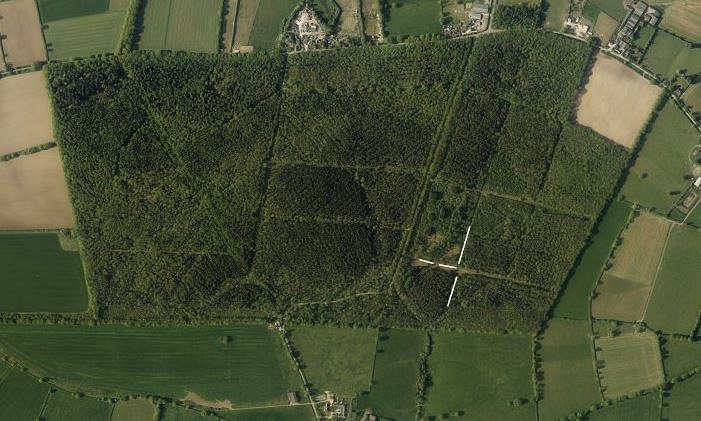
We set our nets down the main ride as usual, plus a couple of additional net sets: one into the bottom of the wood and another off into the newly thinned ride to the east.

The Firs

What you cannot see from this diagram is that the Firs has a taxing slope downwards from the gateway to the start of our net rides.  At the start of the session it is fine but it does become a bit of a slog by the fourth or fifth round.  The catch was light throughout the morning, with just one or two birds per round.  We did a lot of net rounds.

The catch started with a few Chiffchaffs and Blue Tits, with a Blackcap and Robin.  This was pretty much the way of things until the last round: when we caught 3 Goldcrests and 2 Marsh Tits.  The list for the day was: Blue Tit 2(7); Great Tit (2); Marsh Tit 1(1); Wren 3(1); Robin 2(1); Blackcap 1(1); Chiffchaff 3; Goldcrest 1(2).  Totals: 13 birds ringed from 7 species; 15 birds recaptured from 7 species, making 28 birds processed from 8 species.

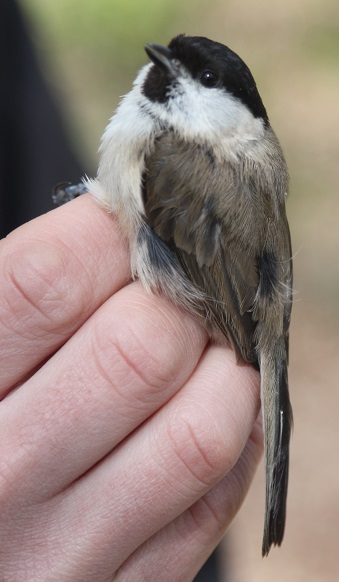
We could identify at least 3 Marsh Tit territories from singing males.  This is an encouraging development: the Firs has been the least likely of our woodland sites to produce Marsh Tits, but they are becoming more evident there with every passing year.

2019_04_13Marti

As the area around the ringing station warmed up the movement of birds increased (I was tempted to set an opportunistic net, but decided against) and the level of bird song increased.  We had been treated to a Song Thrush and several Nuthatches singing for most of the morning, but the absolute highlight for me was when a male Lesser Spotted Woodpecker sparked up in song in the trees immediately behind where I was sat.  This seems to be such a regular occurrence in the Firs I am really hopeful that we might get proof of breeding in the near future.