I always look forward to our first juvenile birds of the year and today was the day! Miranda, Laura and I met at Lower Moor Farm for 6:00 to set our nets. We were joined for the morning by Mariana. Mariana is from ZSL and is collecting samples from several species of migratory bird. These are being investigated for signs of exotic mosquito borne viruses, such as West Nile Fever and, the scourge of Blackbirds, Usutu virus, which has had such a huge effect on the population in London. Thankfully, I have seen no sign of it locally. These viruses are spreading north, no doubt due to climate change. Hence the need to monitor susceptible species to find out if or when these and other diseases arrive on these shores. Humans are also susceptible to West Nile Fever and it causes a wide range of unpleasant symptoms. She helped us get set up, provided cookies and savouries during the session, and helped us take down at the end: she is welcome to return any time she likes!
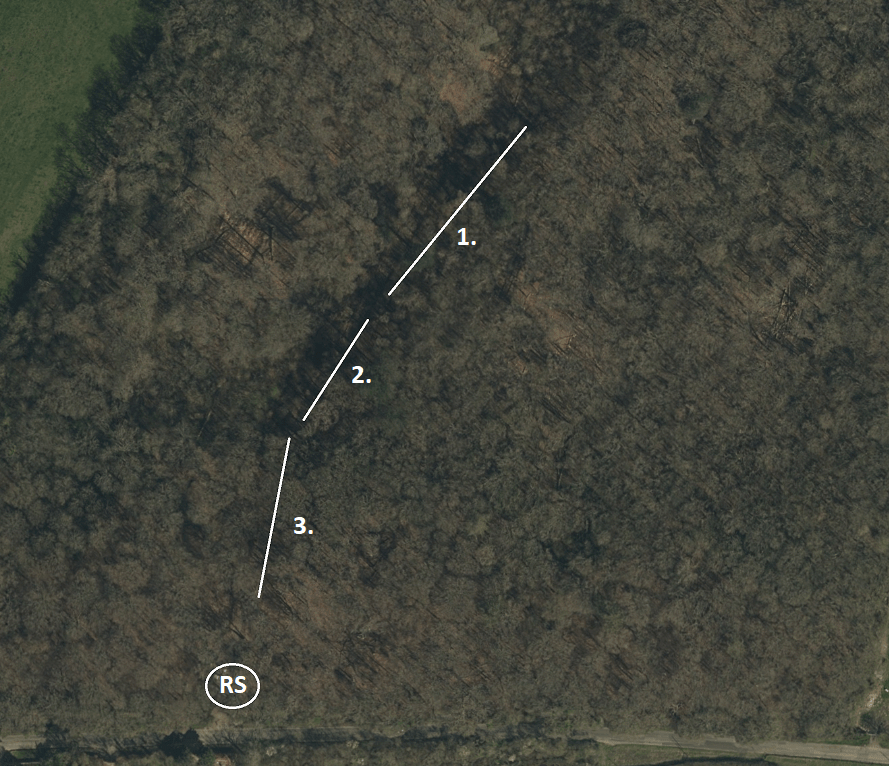
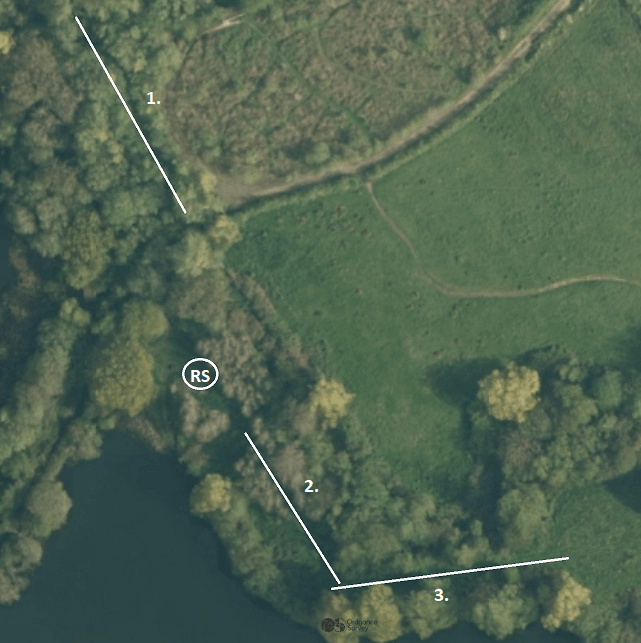
We set the following nets:
It was clear and cold, with a breeze coming in from a north-easterly direction. We hoped that the nets would be shielded for most of the morning and, for most of the time, it was okay. There was a period at about 9:30 when I considered shutting the nets because it was blowing hard but, fortunately, it didn’t last too long (and we didn’t catch any birds in that period).
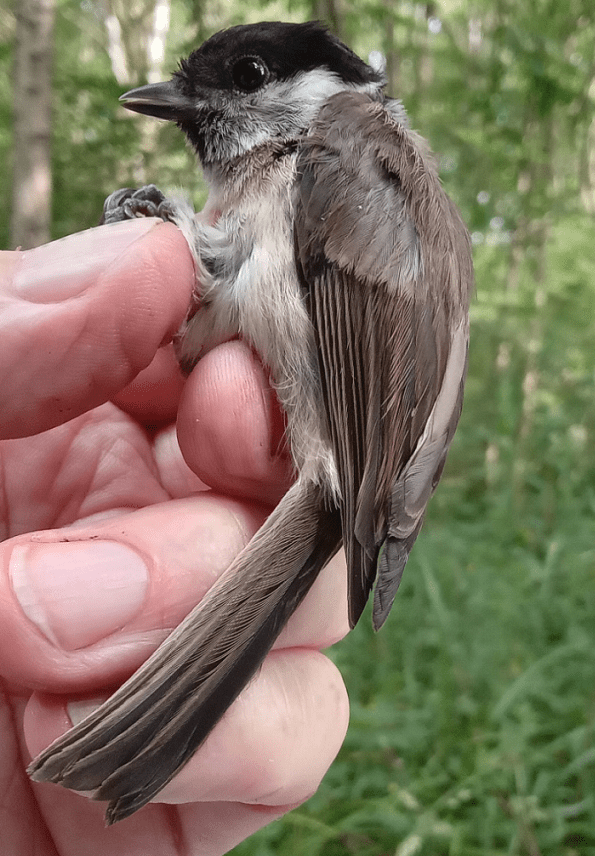
We caught slowly, as seems to be the case at the moment, until at 8:45 we had the catch that prompted the title: it was a lovely family group of these beauties:
Juvenile Long-tailed Tit, Aegithalos caudatus
We took two adults and nine juveniles out of the nets: all close together. The one in the photo was the first bird processed and definitely the least well-developed: its wing length was 2mm below the BTO expected length for a fully grown bird. Anyway, as we processed each bird we put them back into their bag so that we could release them all together, which we did and they could all fly off in their family group. The first of many, I hope.
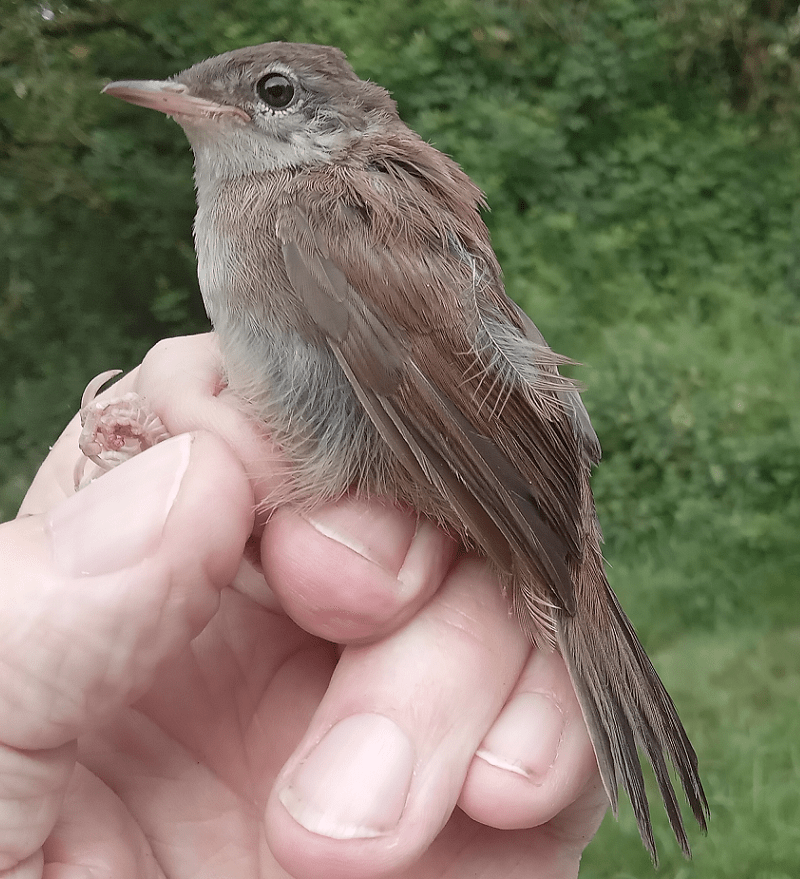
The rest of the morning after that was a wash out, with just two further birds caught, and we started closing nets at just after 10:00. Without the Long-tailed Tits it would have been a very poor catch. The list for the session was: Great Tit (1); Dunnock (1); Robin (2); Long-tailed Tit 10(2); Blackcap 2(1); Chiffchaff 2(1). 14 birds ringed from 3 species and 8 birds retrapped from 6 species, making 22 birds processed from 6 species.
Not a huge catch but in three sessions there in May 2024 we caught 17, 17 and 25, with the 25 being at the end of the month, so perhaps I should be grateful. Mariana got six samples from the Blackcaps and Chiffchaffs, which she was happy with, and will be coming out with us again.
There were a lot of other things going on. The Mute Swans have three cygnets that are at a good size now. I don’t know how many they started with but I am pretty sure that our last session at Lower Moor Farm, almost exactly one month ago, they did not have any on the water with them.
An unusual sighting was three pairs of Greylag Goose. We get the odd one or two in the winter but I have never seen more than two at Lower Moor Farm before. They flew in as a six and then split into three groups of two, hence my assumption that they were pairs. Naturally, the male Mute Swan had to go and show then who is boss! Lots of wing arching and spreading, neck stretching and running across the water towards them. He settled down again when they moved to the other side of the lake.
As the air warmed up the damselflies put in an appearance: lots of Common Blue and Large Red, several already copulating. There was a decent show of dragonflies as well. From the early emergence, i.e. mid-May, they are almost certainly the Hairy Dragonfly, Brachytron pratense.
Female Hairy Dragonfly, Brachytron pratense. Photo by Laura – who rescued it from a net
There was a lovely interlude when Miranda’s son arrived with her eight month old puppy, Percy. He was taking him for his walk and, when he saw Miranda, he became incredibly excited, clearly very surprised and not understanding why she was there. It was a very enjoyable 10 minutes.
Anyway, we took the nets down in stages, packed away and left by 11:00. It was better than it could have been, thanks to the Long-tailed Tits, but not as good as I would have liked. Ride one produced just two birds: the retrapped Robins, so I think I am going to give it a miss for a while and move further into the wildlife refuge area, beyond where we have been setting the nets to date.
Quiet time: no lures now to attract the birds. All on territories, some migrants still to arrive but plenty in the country, plenty having established their territories, singing away, and plenty already ready to breed, if they haven’t started already. So it is a case of setting the nets and hoping they find their way in.
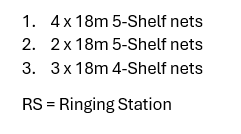
It is also time to get up early. I have to admit, I have no roost sites and I am quite pleased that I do not have to get up before dawn to get everything set up to catch them leaving. Today David, Ellie and I met at Webb’s Wood at 6:00 and set the following nets:
Whilst we were setting the nets the sheer volume of birdsong was lovely. The most prominent in the mix was Willow Warbler. Somerford Common is usually our best bet for this species, and has started out well this year, but really nice to hear them in Webb’s Wood. Plenty of Chiffchaff and Blackcap calling as well, and a completely tuneless Song Thrush. Also, all morning we had Jackdaws jacking, Ravens cronking and Carrion Crows croaking!
We had a Blackbird get into the nets in ride 1 before they had been opened and round one produced six birds: a false sense of optimism ensued! After that we had small catches most rounds, and finished on a nice round 20. Given that our last session at Webb’s, with lures galore, produced 28 birds from 11 species, 20 isn’t too bad, given the lack of lures and the small number of nets.
There was an usual element to our catch: we caught and ringed four adult Blackbirds in one session. I have caught four before, but not for five years and never before in Webb’s Wood. We also caught only our second ever Garden Warbler for Webb’s Wood: the first one was caught there 11 years ago.
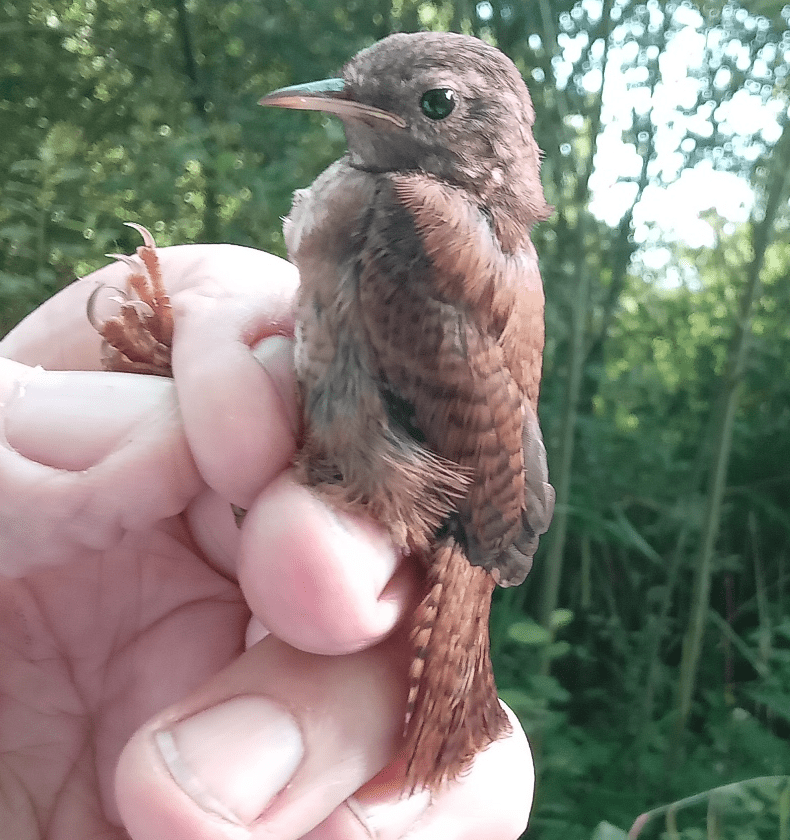
The list for the morning was: Blue Tit 1(1); Wren 3(2); Robin (1); Blackbird 4; Blackcap 4; Garden Warbler 1; Chiffchaff 2; Willow Warbler (1). Totals: 15 birds ringed from 6 species and 5 birds retrapped from 4 species, making 20 birds processed from 8 species.
Thirty percent of the catch was female. They were all showing well-developed brood patches. Two of the Blackcap were female and had finished defeathering their brood patches (stage 2 in the BTO recording system). Also, two of the Blackbirds were female, as was the recaptured Blue Tit and one of the Chiffchaff, and their brood patches were engorged with blood vessels (stage 3), indicating that they were actively brooding either eggs or chicks.
It was sunny and warm but, unfortunately, there was also an annoying breeze that seemed to swirl all around the nets, which might have had an impact on the catch size, making the nets more visible. Fortunately, when affecting rides 1 and 2 it wasn’t affecting ride 3, and vice versa, so it was manageable and, more importantly, safe for the birds. Anyway, after a couple of empty rounds, we shut the nets at 11:30 and took down. With David’s Dad’s help, we had the nets down and everything packed away before midday, and were off site quickly. A quiet but very pleasant session.
I have threatened to do this post for a long time, so it is time I pulled my finger out and got on with it. One of the good things about Blue and Great Tits for ringing is the volume of data it provides. The downside is the volume of data it provides or, to put it another way, just how many pecks one endures whilst extracting and processing them, particularly from Blue Tits: the most feisty birds you can find. This first part is focussed on Blue Tits: the most data and the most retraps to evaluate.
This is the Braydon Forest, with my sites identified:
These are the Braydon Forest sites:
Blakehill Farm
Red Lodge
Ravensroost Wood
Somerford Common West
Somerford Common
The Firs
Webb’s Wood
Purton (home)
These are the distances between the sites:
Since I took over ringing in the Braydon Forest, in August 2012, I and, later, my team had ringed 4,955 Blue Tits up to the end of 2024. We have recaptured birds on 2,086 occasions. i.e. 42% retrap rate. In all of that time we have recaptured just 91 birds in sites other than that at which they were ringed. Putting that another way, of 4,955 Blue Tits ringed only 1.8% have been caught moving site.
The following table shows the number of recaptures for each of the routes identified:
As is clear to see, the vast majority of movements, 51.6%, are less than 6o0m. There is only one movement of over 4km. Hardly the wide-ranging species some would have us believe. I would love to see other people’s data, to see if this is unique to this area.
In addition to these movements, we have had some movements into the Forest from elsewhere, that we have recaptured, plus others that have moved out of the Forest and been recovered elsewhere:
Only four birds ringed within the Braydon Forest have been recaptured or, in the case of the Echo Lodge bird, reported as dead. The key inward recovery was AVF6109, ringed in Fort Augustus in the Highlands: the second longest known movement within the UK. Putting it into perspective: we have recaptured just three birds that have moved more than 50km into the Braydon Forest (o.14% of the birds recaptured).
None of the birds that have been recovered having been ringed in the Braydon Forest has moved more than 10km from their ringing site.
A very decent month for us. It is our largest April catch to date! I think everybody had something to be pleased with: from Andy’s Long-eared Owl; Johnny and Aurora kicking off their Lapwing monitoring for 2025 with several broods ringed and I am never going to be unhappy when we manage to ring a Firecrest!
We did have five more species at each category: ringed, retrapped and in total.
Added to the catch this year were Bullfinch, Firecrest, Garden Warbler, Grey Wagtail, Jay, Lapwing, Long-eared Owl, Sparrowhawk and Tree Sparrow. Missing from the list this year was Linnet, Meadow Pipit, Redpoll and Skylark.
The outright highlight has to be the Long-eared Owl. This is only the second that the Group has caught: four and a half years after Ian and Andy caught the first: at their Imber Ranges site. This was caught in pretty much the same place at the same site.
Long-eared Owl, Asio otus (Photo courtesy of Ian Grier)
Very much a great start to the Peewit Project for this year. Four broods with eight chicks ringed. There have been 15 previous captures of Lapwing chicks since 2013, 10 were done a decade ago. Andy has done three of them, most of which were processed on or around Salisbury Plain, and Jonny and Aurora ringed one each at the onset of the Peewit Project in May of last year. Those two, like these April ones, are significant because have been processed in the north of the county.
Lapwing chick being weighed, Vanellus vanellus (Photo courtesy of Jonny Cooper)(Photo courtesy of Aurora Gonzalo-Tarodo)
As for the Firecrest, it is the fourth that we have caught in the Braydon Forest: the first was in Ravensroost Wood, the next two were in Red Lodge, and the most recent at Somerford Common West. I don’t want to be smug but, of the 12 Firecrest we have ringed, my little group have ringed eight of them, Jonny has done one at Biss Wood and Andy has ringed the other three at one of his Warminster sites.
Firecrest Male, Regulus ignicapiila
Chiffchaff numbers were up but Blackcap were down.
One major difference is the significant increase in the number of birds retrapped. I have no idea why that should be the case. A key part was the significant increase in the numbers of Blue Tit and Great Tit recaptured. It is hard to understand what the driver for that was: feeding stations have been taken down long since. It was our largest ever April retrap of both species. That said, they make up just over 50% of the increase in retraps so there were plenty of other contributions.
We have had a couple of nice recoveries this month: a Chiffchaff ringed in Kent in September of last year recovered by Andy at one of his Warminster sites 238km west of where it was ringed, and a Great Tit ringed in Surrey in June 2023 and recaptured by Jonny, having moved 110km west to one of his sites near East Tytherton. A Sedge Warbler that Jonny ringed at Langford Lakes in August 2022 was recovered by the Teifi RG, in Teifi, Ceradigian, 214km West North-West on the 22nd April.
To Red Lodge this morning, having moved from our winter station to our summer station:
I was joined by Miranda and Ellie at 6:30 and we set the following nets:
It isn’t our most productive April site by a long way, averaging 18.6 birds per session in the wood. However, it was next on the schedule, and it would be churlish to ignore it.
There was a lot of birdsong, but they were clearly staying up in the trees, declaring their territories. We actually didn’t catch anything until 8:45, when we caught a Blackcap, a Blackbird and a Wren. The next time we caught anything was at 9:30, and we were encouraged, as we had nine birds from five species. Then we were disappointed as we didn’t catch anything again until 10:30, whereupon we caught another six birds. That was it: the end of the catch. We gave it three more goes but, when the third, at 11:30, was also empty, we closed the nets and took down.
The list for the morning was: Nuthatch (1); Treecreeper 1; Blue Tit 2(4); Great Tit (2); Wren 2; Robin 1; Blackbird 1; Blackcap 2; Chiffchaff 2. Totals: 11 birds ringed from 7 species and 7 birds retrapped from 3 species, making 18 birds processed from 9 species. So: bang on average for the site in April! It would have been 20, but we had two escape the net before they could be extracted.
Finally, sexing the Blue Tits has become a lot easier: the females have well developed brood patches. One was actually showing the blood vessel engorgement associated with brooding eggs and, later, young. In fact, all of the sexually monomorphic species were easily sexed today.
To be fair, it was a lovely morning. We were sheltered from the direct sunlight and could sit and listen to so much bird song. The absolute highlight was my first Cuckoo of the year. He spent the entire morning circling around the wood calling out his name!
Having packed up we were away from site by 12:30: quiet but pleasant (and a lot better than our session just over the road at Gospel Oak Farm a couple of sessions ago!).
With just Ellie and myself available for this morning and, with Ellie so early in her ringing career, I decided not to overdo the number of nets, so we set just two rides of nets down the central glade: a total of 120m of netting.
We met at 6:30 and had the nets open by 7:15: pretty good timing for us. For once, all of the nets came out of the bags okay, no twists, no snags, no horrible “who the (bleep) did this?” moments! The first three birds hit the nets as we walked back to the ringing station: a Blackcap, Wren and Willow Warbler.
The weather was excellent: not breezy, sunny but not too hot and we just spent a very pleasant morning extracting and processing birds. To put that into context: I did a few birds when we had a busy second round with 10 birds to process, but I got Ellie to process the vast majority of what we caught. Vast is a bit over the top, given how many we actually caught, but it gave her the chance to get familiar with the key things we are looking for at this time of year.
For example, some species are able to be aged, but they are not obvious: Dunnock, for example. We caught two today: an adult and a second calendar year bird. The other key issue at present is the sexing of sexually monomorphic species: back to Dunnock. One is looking for two key things: for the females it is the development of a brood patch. There are five stages: defeathering; fully defeathered and blood vessels emerging; blood vessels engorged; blood vessels emptied and wrinkled; refeathering. Currently, we are seeing stage one on newly arrived migrants and some later breeding resident species and, just in the last week, plenty at stage two. I cannot say that we have seen any at stage three yet, but a couple of the birds we caught, particularly a female Blue Tit, weighed in so heavily that they had to be carrying eggs ready to start laying.
For males one is looking for a cloacal protuberance (CP). In the breeding season, the female cloaca slants downwards along the tail line, the male cloaca is perpendicular to the body wall. This astonishingly easy with Dunnocks: for size / proportion, the males have a very large, very obvious, CP. That is not the same for all but, generally, if you blow on the males belly the CP will wink at you! It gets difficult with those species where the male will also take part in brooding the eggs and young. In some small sexually monomorphic passerines, particularly with my two favourite warblers: the Lesser Whitethroat and the Garden Warbler, the males develop very decent sized brood patches, and being able to correctly identify the CP is key to accurate sexing.
We were active until 11:00, but the catch had died off significantly by then, with just one bird in the last round, so we shut the nets at 11:15 ready to take down.
The list for the session was: Treecreeper 1; Blue Tit 2(1); Long-tailed Tit 1; Wren 1(1); Dunnock (2); Song Thrush 1; Blackbird 1; Blackcap 7(1); Chiffchaff (1); Willow Warbler 2; Bullfinch 1. Totals: 17 birds ringed from 9 species and 6 birds retrapped from 5 species, making 23 birds processed from 11 species.
So not the biggest catch, but a decent variety, particularly for Ellie who could add her first Bullfinch, Treecreeper and Willow Warblers to her fledgling ringing career! For such a small wood it delivers a good variety and comparatively good numbers when compared with the other four woodlands that are so much bigger.
There was a lot of bird song there all morning. Both Nuthatch and Great Spotted Woodpecker were both busy, singing away in the former, drumming away, and the occasional yelp, with the latter. One of the more frustrating birds at the Firs is Green Woodpecker. There are always two males calling away either side of the wood, but not coming near. Hopefully, with the newly widened central glade, we might some ants colonising the area and attracting them in. In the meantime, I suspect that they are exploiting the two fields that flank the Firs.
With not a lot to pack away, we were off-site by 11:45, and I was home in time for an early lunch and snooker!
This will be the final chapter on this topic – unless someone else decides to go all zealous over something that is not necessarily supported by the data available, closing off other avenues of investigation. I intend to cover off the situation regarding that horrible disease Trichomonosis.
From personal anecdote, I know that when I moved to north Wiltshire in 1997 I could find flocks of 30 or so Greenfinch coming to my garden. Back in those days I had a bird table as well as hanging feeders. Everything was always cleaned and disinfected on a regular basis but, of course, wood has places for bacteria, viruses and parasites to hide and possibly avoid the disinfectants. I ditched the bird table two decades ago. Regardless of my precautions, I would occasionally see a Greenfinch showing signs of Trichomonosis. No more than one a year, and I would take down the feeders, clean, disinfect and leave down for a week. I have no idea where they caught it from, but you notice them when they come to your garden, which perhaps explains why so many are prepared to conflate the two: correlation = causation, the bane of science!
I have not seen any sign of any bird with Trichomonosis in my garden for nigh on a decade. These days, the local population has shown good signs of recovery. This year I regularly have four or five pairs visiting the feeders in my garden and I have heard at least three singing males within earshot of the garden. My largest recent sighting in my garden was 25 individuals, in the first week of February this year.
Whilst our group ringing results are very much of the yo-yo variety, there is a distinctly upward trend (which would be better if I ringed in my garden more frequently than I have done recently):
There is no doubt: there was a massive outbreak of Trichomonosis in the west country of the UK in 2005, primarily affecting Greenfinch and Chaffinch (as if Chaffinch didn’t have enough to cope with, with Fringilla papillomavirus as well). However, the parasite had been in the UK for centuries in the bird world, endemic in pigeons and doves. Was this the source of transfer to the finches? If so, what was the mechanism?
It is almost certainly spread within species by infected individuals where both courtship feeding and feeding their young involves regurgitating food: an excellent method of passing the Protistan, Trichomonas gallinae, from the host to a previously uninfected other. It also passed into various birds of prey, noticeably Sparrowhawk and, no doubt, if illegal persecution stops, it will be found in UK Goshawks – because it is, and is long established as such, in European populations. Some of the Sparrowhawk and Goshawk’s favourite prey, particularly female Sparrowhawks, are pigeons and doves, so it is not hard to understand how that transference might have happened. That is something that has been seen the world over, as evidenced by the paper referenced below by de Chapa et al. What is not so clear is exactly how it transferred into Greenfinch and Chaffinch, presumably from pigeons and doves, but, seemingly, not into other species common at bird feeding stations, if bird feeding is the source.
Something else that I find distinctly odd: Goldfinch. They are unarguably the commonest finch found at UK garden feeders these days. I have not seen any reports of UK Goldfinch showing signs of Trichomonosis, certainly not seen any sign in my garden, and they have undoubtedly increased their population significantly since 2005! I have ringed just under twice as many in my garden as I have the next commonest species (Blue Tit, unsurprisingly). However, studies in France have found that the parasite is spreading through their population over there. (Chavatte et al., 2019). The latest RSPB Big Garden Birdwatch results showed that they had gone up one place in their top 10 observations. Why aren’t we seeing the French situation impacting Goldfinch in the UK?
One issue that I have with the story of the spread of Trichomonosis is that, if the anti-bird feeding cohort are to be believed, the UK is not only responsible for it spreading throughout our susceptible birdlife, primarily Greenfinch and Chaffinch, but, apparently, responsible for spreading it to all of the birds that have now caught it in Europe! The bird feeding “boom” in the UK happened in the 1980’s. I would be relatively certain that this was, in part, due to the introduction of the RSPB’s Big Garden Birdwatch in 1979, encouraging people to take more notice of and engage more with, the birdlife in their gardens.
I am not blaming the RSPB for this being the cause of the spread of Trichomonosis. To start with, why did it take 25 years to cross the species boundary, given the lack of awareness about cleanliness, and the spread of various diseases, like Salmonellosis, in the public consciousness, until the early 2000’s?
The Trichomonas parasite, according to the British Veterinary Association, can survive outside of the host, in dry conditions, for a minute or two at most. In damp or wet conditions for two to four minutes. Just think on the likelihood of any individual bird picking up that parasite in that time window from a hanging feeder? Ask the question, given that Blue Tit and Great Tit are so common at feeders, why hasn’t Trichomonosis been found in those species? Or is it there but they are resistant to the parasite? Has anyone looked?
Recently, Dr Alex Lees promoted a paper on Twitter from 2015 which investigated the length of time the parasite can live outside of the host in four different water treatments. They found that, under suitable conditions, the parasite can survive for much longer periods in different wet conditions. Fair enough, however, I have read that paper by Purple et al, referenced below. Their treatments are sensible: but their work was all done under laboratory conditions. They took water samples from real life situations. Then they took their four water types and sterilised them before inoculating them with significant quantities of T. gallinae. These cultures were then kept at a steady 23oC and samples taken at 0, 15, 30 and 60 minutes. Those samples were transferred to a suitable nutrient medium and incubated at 37oC, and then assessed for the presence of motile Trichomonas parasites in the sample. They considered that discovering a single motile Trichomonad was evidence of persistence. Let me put this into context: the 500ml samples that they initially incubated were inoculated with approximately one million individual Trichomonads! What is the likelihood of a single Trichomonad, surviving in one litre of water in a bird bath, being in a position to infect a Greenfinch that just happened, unfortunately, to stop off for a drink at just the wrong time? What is the likelihood of there being a million Trichomonads in anyone’s bird bath? How “real” are the experimental parameters? How many bird baths sustain a temperature of 37oC? Surely the timing should have been done on media kept at the same temperature as the original water samples?
Has anybody done random sampling of bird baths and other water sources under natural conditions and tested for T. gallinae? You can find plenty of warnings about cleanliness being next to godliness, and papers on other diseases unequivocally helped to spread through poor hygiene, but it seems that nobody has actually done the work to see how widespread Trichomonas is in UK bird baths or ponds, or any other water source. If you know better, please point me in the right direction. I have searched for suitable references but been unable to find any, and I would love to read the evidence that renders this post redundant!
A key issue for me, though, is the speed with which the disease has reputedly spread. After such a slow start, 20+ years after the bird feeding boom, until exploding from the West Country in 2005, to being found in Fenno-Scandia in 2008, then Germany and Czechia in 2009. If the UK is to blame, that is an incredibly fast spread for a disease which is not a viral or bacterial infection / contagion. Reputedly, these countries do not have the same density of bird feeding as we do in the UK, so what is behind the spread there? Obviously, birds can fly and migration can spread disease – if they are well enough to make the journey. Most birds I have seen suffering from Trichomonas can barely flutter out of the garden, let alone cross the North Sea!
According to Jim Flegg in his book “Time to Fly”, looking at migration based on ringing data, the Greenfinch is “largely sedentary, with some occasional partial migrants”. Only, as he explains, the migration that does occur is from areas of Fenno-Scandia, but to the east and north-east of the UK. So, this disease had to spread right across the UK to those eastern counties, to infect the Fenno-Scandinavian and central European Greenfinches overwintering in the UK, to then take the disease back to their countries of origin, all within that three year timeframe!
As a newly qualified C-permit holder, I went and spent a long weekend at Gibraltar Point Observatory in 2014. In one session we caught some 30+ Greenfinch and the staff were adamant that they still had a very healthy population of them in Lincolnshire and that they had not seen any particular fall off. I would be interested to see a time-stamped geographical representation of the spread of the disease within the Greenfinch population. As part of my presentations, when I was a BTO Garden Birdwatch Ambassador, I was provided with a set of PowerPoint slides showing the spread of Avian Pox in the Great Tit population. It spread out from the south-east of England to affect birds across the north and west of England in just three years: from 2008 until 2010. The data came from work by Lawson et al, referenced below. That is not too surprising: it is a virus spread by mosquito. Mosquitoes, as everybody knows, can be extremely effective vectors of disease. Both Malaria and Sleeping Sickness are infections spread by mosquitoes, caused by parasitic Protozoans: Plasmodium spp. and Trypanosoma spp. respectively. Has this been considered for the spread of Trichomonosis, or, having decided on what to blame, has nobody looked at the possibility?
The BTO’s ringing recovery data is interesting, in all of the decades that recoveries have been recorded, these are the total numbers of Greenfinch recovered and reported, either ringed in the UK and recovered in other countries and vice versa:
These hardly represent mass movements.
Parasites of the genus Trichomonas are widespread: with many species infecting a wide variety of animals in different ways, including the human animal. In humans it is a sexually transmitted infection. I am not disputing the impact on Greenfinch and Chaffinch but, by going for the easy target, it is entirely possible that other routes of infection are being overlooked and not addressed.
I will repeat: if there is unequivocal evidence, I would love to see it and read it. Not being a zealot: I am open to changing my opinion, based upon new and contradictory evidence.
This is an opinion piece, not a scientific dissertation, so I have listed just the key references that I have used in putting this together. I have read quite a few more.
References:
Kathryn E. Purple, Jacob M. Humm, R. Brian Kirby, Christina G. Saidak, Richard Gerhold: Trichomonas gallinae Persistence in Four Water Treatments; Journal of Wildlife Diseases, 51(3), 2015, pp. 739–742; Wildlife Disease Association 2015
Flegg, J. Time to Fly: Exploring Bird Migration, British Trust for Ornithology, 2004
Manuela Merling de Chapa, Susanne Auls, Norbert Kenntner, Oliver Krone: To get sick or not to get sick—Trichomonas infections in two Accipiter species from Germany; Parasitology Research (2021) 120:3555–3567
Lawson B, Lachish S, Colvile KM, Durrant C, Peck KM, et al. (2012) Emergence of a Novel Avian Pox Disease in British Tit Species. PLOS ONE 7(11): e40176. https://doi.org/10.1371/journal.pone.0040176
Robinson, R.A., Leech, D.I. & Clark, J.A. (2024) The Online Demography Report: Bird ringing and nest recording in Britain & Ireland in 2023. BTO, Thetford (http://www.bto.org/ringing-report, created on 4-September-2024)
The plan was to go to Blakehill Farm west today. However, when we were on site there on Good Friday we found a very large bull sitting in the middle of our main netting area. Although the Wildlife Trust’s bulls are as docile as can be, I am not keen on setting up around a one tonne potential net destroyer. That said, it was a good Friday: I had Laura and her boys with me to check on the Barn Owl boxes and we found that both boxes on the west side of Blakehill Farm were each occupied by a pair of Barn Owls. No sign of any eggs yet, but a good sign regardless.
Instead of heading to Blakehill, I decided to have a first go at my breeding season net set up at Somerford Common. This is at the other side of the paddock area where we have the winter feeding station, heading down the ride from the main car park, where we set our ringing station. I was joined for the morning by Laura and Adam. We met at 6:00 to set up the nets and the ringing station:
These are all rides of 3 x 18m 5-shelf nets, plus one single 18m 5-shelf net. Arriving on site we, unfortunately, found that the wind was blowing from north-north-east, and funnelling straight through where the yellow net rides are on the diagram. As you can see, there is a lot of open area at this site, and the only sheltered area were we could set the nets were the two rides in white. So we set considerably less netting than intended.
As we only had the six nets up, we were pleased that they started catching straight away. It was never a heavy catch, two or three birds each time and, to be honest, it died a death at 10:00. Not only that but the wind was getting stronger, and the nets were beginning to billow. I decided that we would give it another 30 minutes, but we caught nothing, so we packed away at 10:30 and were away soon after 11:00.
One of the other considerations was that each net set was clearly in the territory of a male Willow Warbler. We caught the same two Willow Warblers several times each during the session, and I decided that we needed to give them a chance to get on with their lives. I don’t like catching the same bird multiple times in a session.
It was a nice little catch though: Coal Tit 1; Robin 2; Blackcap 3; Chiffchaff 4; Willow Warbler 2(3); Goldcrest 1(1). Totals: 13 birds ringed from 6 species and 4 birds retrapped from 2 species, making 17 birds processed from 6 species.
Two of the three Blackcap were female. They must have been fairly recent arrivals as neither was showing any signs of starting to develop a brood patch, unlike the male, who had a well developed cloacal protuberance.
The retrapped Goldcrest was ringed in October 2022 and has been caught in Spring of 2023. 2024 and 2025. The oldest of the retrapped Willow Warblers was ringed as an adult in April 2023, and has been recaptured in the following two springtimes, having over-wintered in sub-Saharan Africa. Quite a feat of endurance for a bird weighing only seven or eight grams, with a wing length of around about 70mm / wingspan of approximately 155mm.
One of the highlights of the morning for me was this:
Oxlip, Primula elatior
What is good about it is that it has been an excellent Spring for Primrose and, at Gospel Oak and Blakehill Farms, the fields are alive with Cowslip, so this completes the set for me. That they have appeared in an area that was covered in trees, until it was cleared for pulping in winter 23/24, without additional human intervention, is testament to the enduring resilience of so many plants. There were multiple clumps across the cleared area. Of course, I was lucky enough to be the one who found the Greater Butterfly Orchids after they widened the rides running north to south, along which I set my nets:
Greater Butterfly Orchid, Platanthera chlorantha
The weather is looking a little unsettled for the next week but hoping to get out again on Thursday.
Getting a new site up and running is not always straightforward. I have been monitoring the Barn Owl boxes at Gospel Oak Farm since 2021. The habitat is lovely: beautifully managed hedgerows, a medium sized pond and a traditional, flowered, hay meadow. This is the aerial view of the site:
Whilst checking out the boxes last year I couldn’t help noticing there was a good level of bird activity around the pond area, particularly attractive to Swallows and House Martins. I approached the landowner and asked if he would allow me to run some ringing sessions there. With his approval I ran a test session, with nets set around the pond, last August. We caught 22 birds from nine species. Not a bad start.
So today we decided to try it out again. I was joined by Miranda, Sarah and Ellie at 6:30 and set the following nets:
So far, so good – only it wasn’t! We caught just six birds all morning! All new, two each of Chiffchaff and Wren, one each of Blue Tit and Blackcap.
There was a lot of bird song but virtually no movement. One encouraging sight: at 10:00 there was a small influx of Swallows, hitting the pond in exactly the way I was hoping they would – only I hadn’t set the appropriate nets!
I am pretty sure that it will come good: we will try again next month and see what goes.
Whilst there we checked on the two Barn Owl boxes: the first was clearly being used by a squirrel as a drey. It was absolutely full of twigs and some mammal fur. I emptied the box out and will check it again in a couple of weeks, make sure they aren’t back there.
We had watched a couple of Jackdaw coming in and out of the second box and on checking I found a lined nest and six warm eggs. I closed up the box and left them in peace. In five weeks I will go back and ring the youngsters.
We packed up at 10:30 and left site soon after 11:15. It was a lovely morning, even if the session was a disappointment. Each of the team got to ring two birds each! Wow! Lucky them: I know it is not down to me, but sometimes, as their trainer, I just feel responsible for things beyond my control.
It was just David and me on site this morning. I have been testing the site in the run up to the start of the CES season. The CES catch has been steadily declining, as you can see from the table and charts below:
The fall in the numbers coincides with declines in the number of species caught each year:
The simple fact is that this is entirely the point of carrying out a CES. The question for me is whether the return is worth the effort put in. Is it worth continuing with? What I decided to do, in the run up to this year’s scheduled CES season, was to test the site, see whether there are any early signs of improvement after the Wiltshire Wildlife Trust carried out some remedial work along and around the rides. My last visit, on the 28th March, produced 23 birds, which included five Redpoll, on outgoing Spring migration, heading north, as is the tendency of this species in north Wiltshire. Today I was looking to see whether the incoming Spring migrants had arrived and what impact that might have had.
The biggest misses for me are: the loss of Lesser Whitethroat: in double figures up to and including 2019, none since; Sedge Warbler, always a few on passage until 2018, none since; Reed Bunting, between five and eight every year until 2019, only two singles in 2022 and 2023 since. Even Chiffchaff, with three figure catches between 2015 and 2019 inclusive, down to 50 and 45 catches in 2021 and 2022, then just in the 20’s for 2023 and 2024.
Today we set the standard CES nets, with a slight modification, for the three rides in the Wildlife Refuge, plus one extra net, to see if it added anything of value to the catch. It is important to me, as their trainer, to ensure that our sessions produce enough birds for the trainees to get sufficient experience. Ideally I want them to have 15 to 20 birds minimum in a session, especially at this time of year when they are working on sexing birds and looking for brood patch development in females. If I can provide that by setting my standard CES nets, plus a couple of extra nets, then there is a reason to continue with CES. If not, then I think I will need to retire it.
We met at 6:30 to set our nets. Net ride 1 looked like this when we arrived:
I have never seen it so lush with flowering Blackthorn: it is clearly benefitting from the work that Jonathan (the farm manager) and his team and the estates teams have put in to improve the habitat. What would it mean for the catch?
The nets were set as follows:
After a bit of faffing around with rides 3 and 4, due to the need to tame a few brambles that were insisting on becoming involved with the nets, we had them open by 7:45. The first bird hit at 8:15 in ride 2: a retrapped Wren. The next bird hit at 8:45: this was a Cetti’s Warbler ringed as of unknown age, in May 2020. So it is at least six years old. Clearly this bird, a male, has its territory in the area where rides 1 and 2 overlap as it has been caught in that area another 11 times since it was ringed.
As you can probably guess from the title: it really was a bad session in terms of numbers. We caught: Long-tailed Tit 1; Wren (1); Dunnock 1; Cetti’s Warbler (1); Blackcap 1(1); Chiffchaff 1(2); Goldcrest (1); Bullfinch 2. Totals: 6 birds ringed from 5 species and 6 birds retrapped from 5 species, making 12 birds processed from 8 species.
The only positives were 1) the Bullfinches: definitely a pair. They were taken out of the same net in ride 2, where they were close together. After processing we released them together and the flew off together into the same tree, where they shook themselves down before heading off together. 2) the Cetti’s Warbler and 3) David got to see some very clear stage two brood patch developments. (I could add “4) no Blue Tits!”)
It was a lovely morning: the weather was fabulous and we had lovely conversations with a lot of people, just a shame that we didn’t have the birds to make it an excellent morning. We closed the nets at 11:45 and took down, getting away from site at about 12:30. I will try another session in two weeks before making a final decision on whether to carry out the CES this year or to lay it to rest.