Webb’s Wood: Friday, 20th December 2024

Having informed Forestry England that access to Webb’s Wood was blocked by a fallen tree, I rather expected that they would have removed it. Turning up on Friday morning I found that the tree had been cut out across the pathway. I assumed it was their action, but it was very tight and nothing else had been cleared away. Anyway, chatting to one of the regular dog walkers later in the morning, it turns out that it was cut by a local. He had turned up for a walk and for his young daughter to ride her bike through the wood. Finding the tree down he returned to his car and took out a chainsaw, as you do, to remove it! Who drives around with a chainsaw in the back of their car? Apparently, he had absolutely no protective equipment! Not my idea of fun.

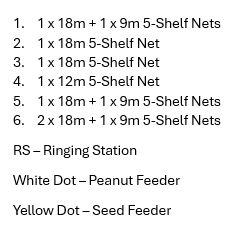
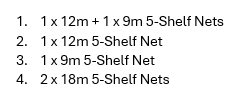
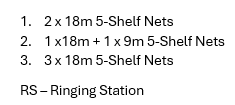
With the weather earlier in the week being dreadful, and the forecast for the weekend being worse, and Thursday I had other appointments, so Friday looked like the only day available for a session. That said: it was going to be wet and windy from midday, so we were on a tight schedule. David and I met at 7:45. As it was just the two of us we only set the following nets:

Ride 3 was a nightmare or, to be more precise, a quagmire. At one point it did claim David’s wellies, which ended up with quite a lot of mud everywhere!

I don’t have a feeding station set up in Webb’s Wood at the moment, as the feeders were stolen last year. It was the first time in 12 years of feeding this site that it has happened, but I have decided to put in a bird table instead. The table has a huge great stake that will go about one metre into the ground, and the table area has a mesh cage large enough to let in most bird species attracted to seed mix, and small enough to keep out squirrels. The thought of some tea-leaf staggering down the track with that on their shoulder, trying to pretend that what they are doing is a normal activity, I find amusing. I will put up a cheap mesh peanut feeder for the titmice, Nuthatches and Great Spotted Woodpeckers. I just have to get round to doing it!

We put on a variety of lures in the hope of attracting in a range of over-wintering species. Before we put on the lures the only bird we had seen and heard was a peripatetic Raven, flying back and forth and issuing its regular croak. After we put the lures on we still didn’t hear any birds and it took a long time before we actually caught any birds: two retrapped Long-tailed Tits at 9:15. That was it until 10:15 when we caught a nice flock of more Long-tailed Tits and a Blue Tit. Thereafter we were just taking one or two birds out at a time.

By 11:00 the wind had started getting up and rides 1 and 2 became untenable, so we had to shut them: which was unfortunate, because ride 3 had only produced a retrapped Goldcrest. After we shut the others, ride 3 did produce another bird we could process: a retrapped Great Spotted Woodpecker. It did catch two same day retraps, which I just extracted and released. That was it for the session and left us with the following list: Great Spotted Woodpecker (1); Blue Tit 4; Long-tailed Tit 10(3); Robin (1); Goldcrest (1). Totals: 14 birds ringed from 2 species and 6 birds retrapped from 4 species, making 20 birds processed from 5 species.

We were cleared away and leaving site by midday. I stopped at the entry gate to remove my warning signs and lock the site access gate back in place. Got back into the car and drove off, and then that smell hit me: the dog poo whiff! Why is it that every dog owner is apparently a responsible dog owner, and they all clean up after their dogs, but each of our Forestry England sites, despite their very clear signage for owners to clean up after their dogs, are plastered with dog poo? If you are lucky it is there in a plastic bag but mostly it is just on the side of the track: hidden under leaves at this time of year, ready to trap the unwary! A quick hose down of the car mats (thankfully rubber, not fabric) and my shoes when I got home fixed it – but I had to drive home with that stench in my nostrils! Not happy!
Third Time Lucky: Saturday, 14th December 2024

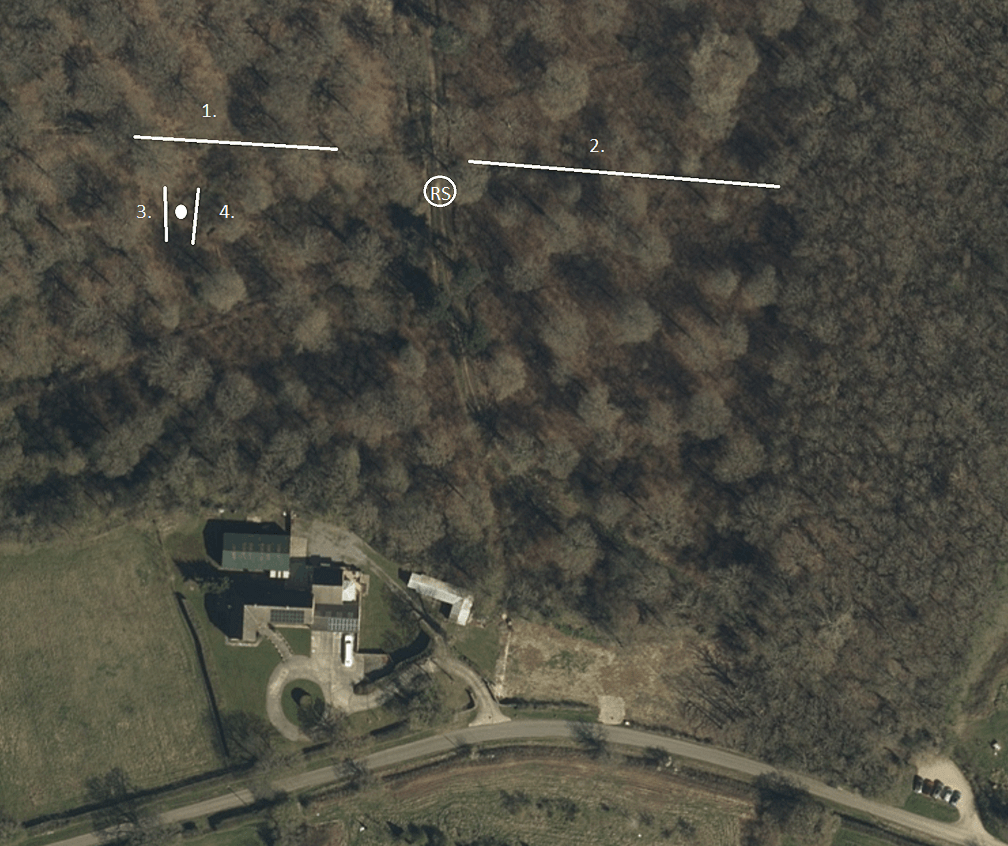
After last weekend’s horrendous weather I had hoped to make up for lost opportunities by arranging a session at Ravensroost Wood on Tuesday. I was joined for the session by Laura. We arrived on site at 7:30 and set up the following nets:

The white dot between nets 3 and 4 is the feeding station comprising a seed feeder and a peanut feeder. The feeding station was set up on the previous Wednesday but, no doubt not helped by the foul weather, it hadn’t really been found yet: just a few peanuts had been eaten and the seed feeder hadn’t been touched. I had taken feed to top up the feeders but, as they were still relatively full, at the end of our session I went off to Somerford Common and topped up the feeding station there, as we were planning to be there today.

Unfortunately, after an hour the wind got up and was blowing directly along the line of rides 1 and 2, but was also impacting on rides 3 and 4. The nets were billowing and, although the nets are tethered along the horizontal axis, there was potential for shear forces, so I decided that it was potentially too dangerous to allow birds to be caught, and we closed the nets and took down. It was doubly unfortunate as we had caught the following in the one round possible: Great Spotted Woodpecker 1; Nuthatch (1); Blue Tit 1(1); Great Tit 2; Coal Tit (1). Totals: 4 birds ringed from 3 species and 3 birds retrapped from 3 species, making 7 birds processed from 5 species. Home before elevenses!

Wednesday I was scheduled to run another session at Miranda’s house. We were being joined by new recruit Emma. Meeting at 7:30 that morning it became immediately obvious that it was a non-starter, so we didn’t even try to set the nets.

The forecast for today was rain overnight, until 7:00, easing off between then and 9:00, with it being overcast but dry, and with a light breeze thereafter. I arranged to meet Laura, Adam and Mark at Somerford Common at 8:00, thinking that it would be dry by the time we had the nets set. In the event, it was dry when I left the house at 7:30. Arriving on site I went and replenished the feeders, which were empty. I should say: the seed feeder holds four litres of seed. I use wheat-free seed mix, and there is no waste or rat-attracting spillage.

We set the following nets:

It was a good session, helped by the weather being much better than forecast: instead of being overcast, the cloud lifted and the sun came out. The breeze didn’t arrive until midday, as we were starting to pack away.

The birds came regularly and we ended up with the following list: Nuthatch 1(3); Blue Tit 10(6); Great Tit 1(8); Coal Tit (5); Marsh Tit 1(4); Robin (6); Chaffinch 1; Lesser Redpoll 5. Totals: 19 birds ringed from 4 species and 32 birds retrapped from 6 species, making 51 birds processed from 6 species.

Given that there is a cohort of academics who like to blame supplementary feeding as a partial reason for the decline of other species, due to competition from more aggressive species, particularly in my study area, the Marsh Tit, it is interesting to note that the first three birds out of my nets this morning were a juvenile Marsh Tit, which we ringed, plus two retrapped birds: one of which is five years old and the other four years old for a bird with a typical lifespan of two years. Mind, the oldest recorded from bird ringing was over 11 years old when last recorded. Perhaps the most interesting Marsh Tit though was ring number AAL0191. A key finding about Marsh Tit movements is that they are a very sedentary species and rarely move any distance from where they fledged. It is one of the factors behind their decline, as our woodlands become more fragmented and more sparse. This bird was ringed in the Firs reserve in February 2020. It was recovered there on seven occasions between then and October 2022. In October 2022, at the insistence of the owner (it is managed by the Wildlife Trust on behalf of the landowner), the Firs reserve was closed for Ash tree removal. We actually did retrap the bird in our last session prior to the closure, on the 9th October. The very next month we recaptured it at Somerford Common, some 3km away. (Confession: I hadn’t realised at the time, I only found out today because I was looking at the records for a four year old Marsh Tit.) It is clearly not as territorial as its peers: as it has also been caught in Somerford Common West, and now back at Somerford Common, each of those movements just over the 1km mark.

Nice to catch and ring another Nuthatch, it is turning into a good year for them in the Braydon Forest. we have processed the same number as in the previous best year (40 ringed and retrapped) and are two off tying with the best year for ringing the species (27 vs 29). With a bit of luck we will beat the former and at least equal the latter. It was also good to catch a Nuthatch that was ringed five years ago and has been caught every year since at Somerford Common.

Okay, the absolute highlight of the session has to be a small flock of five Lesser Redpoll. We usually catch them at this site in the January to March period, Before today we had only ever caught them in a December session in 2020 and 2023: each time it was just a single bird, so five was a really decent result. They were all caught together in the same net on the same round.

We started packing away at just after midday and, with breaks to process some more birds, extracted as we were closing the nets, and left site at about 13:15. Very enjoyable, made better by the excellent company that I am lucky enough to have in my team. We do good work and have a good laugh as well.

Goldcrests in the Braydon Forest

This brief analysis covers the period from the 1st January 2013 until 6th December 2024. I will update it at the end of the year, but this is to fill in the time, as Storm Darragh has prevented any ringing activity this weekend, and you can only do so much net mending without getting really, really bored. Over this period we have caught and ringed 1,046 Goldcrests and retrapped 164 birds. As a single bird may be retrapped multiple times, this represents a total of 1,051 individual birds.

We have had some excellent results with Goldcrests, as people who have been following this blog for some time will know. The Braydon Forest has delivered the oldest known Goldcrest on record: JJP007. Ringed on the 22nd November 2015 and recaptured five years, three months and 14 days later at Porth Kellick, on St Mary’s Island in the Isles of Scilly. Not only longevity but, from other recoveries that I will come to in a short while, its journey there of 356km is a minor movement for this species. The longest known single movement of a bird of this species is 831km: a Goldcrest ringed in the Orkneys and recovered in Suffolk.

The other interesting Goldcrest recoveries that we have had were: a bird ringed on the Calf of Man on the 5th September 2019 and recaptured in Ravensroost Wood on the 3rd November 2019 (a juvenile, 59 days later, 334km); another also ringed on the Calf of Man on the 7th April 2019 and recaptured in the Firs on the 19th October 2019 (an adult, 195 days later, 337km). In reverse, we had a Goldcrest ringed in the Firs on 19th October 2019 and retrapped at the Bardsey Bird Observatory on the 26th March 2020 (juvenile, 159 days later, 236km).

It is only in writing this that I realised that the 19th October 2019 was a quite astonishing day for the Firs: one bird recovered from a long way away and another ringed on the same day that was recovered a long way away. The other thing that these four recoveries seem to indicate is that there is a western flyway for Goldcrest.

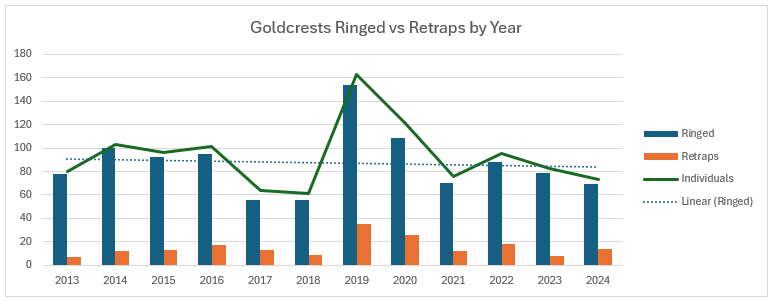
I have looked at our ringing records over this period:

You will see that I have included individuals in these figures. This was to highlight that most retrapped birds are from the local population, as highlighted by the low number of ringed recaptures from outside of the area.

The trend line shows a shallow decline in the number of birds ringed, but if you exclude the big dip in both 2017 and 2108, plus the subsequent peak in 2020, it is pretty consistent.

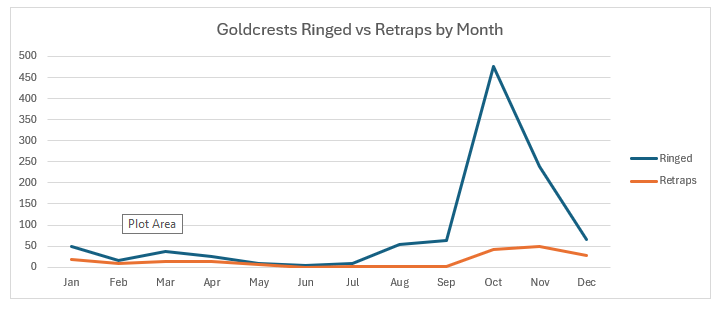
The next thing I looked at was the number of birds ringed and retrapped by month:

It shows pretty clearly that late autumn / early winter is the key period for the species. Looking at the data for the Wiltshire Bird Atlas, this reflects both the breeding and winter abundance maps for this species. (The link to the data can be found at: https://www.wiltshirebirds.co.uk/atlas-system.html)

As you can see from the table, there are very few birds ringed in May, June and July and virtually no birds retrapped in June, July and August.

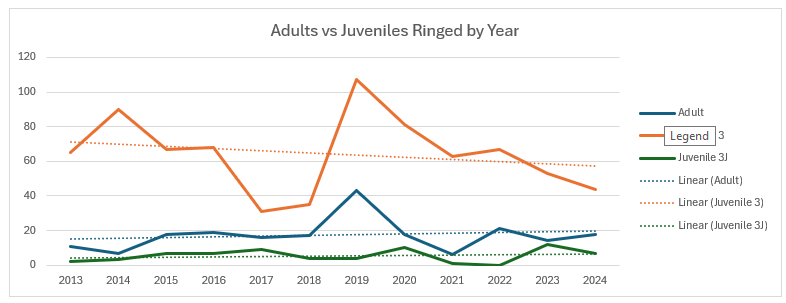
The next thing I looked at was whether there was any difference between adult and juveniles ringed by year:

The definitions of juveniles are as follows: 3 is the BTO code for birds fledged this year that have completed their post-fledging moult. Code 3J is for those birds that fledged this year but have not yet completed their post-fledging moult. When graphed up:

There is a small downward trend in the number of juveniles who have completed post-fledging moult but, like the overall numbers, this is no doubt down to the large fall of birds at this stage in 2017 and 2018. Those juveniles at stage 3J are those most likely to have been fledged locally and their trend is just better than static. So then I looked at the split by month:

This rather reinforces my view that most of the 3J juveniles fledge relatively locally, with the adults and 3 juveniles, at least, reinforced by birds flying through on autumn passage, with some staying in for the winter.

Finally, I had a look at the birds that had been retrapped over eight months after being encountered at our sites. Given that the likelihood is that a large proportion of our catch is made up of birds on passage, I thought I would have a look to see how many recaptures were on sites different from the first encounter:

There is just one Goldcrest that was recaptured at a site other than that at which it was first encountered. Does this mean that these birds are site faithful on migration or are they just local birds? I don’t know.

Life is a Roller Coaster: Wednesday, 4th December 2024

Today was to be a special day: it is exactly 10 years to the day that my first ringing trainee, Jonny, ringed his first bird. He wasn’t my trainee at the time, as I wasn’t a trainer: a mere C-permit holder, but with a training / helper’s endorsement, because my trainer was laid up after an operation and someone had to step into the breach to help his T-permit trainee. Jonny isn’t my trainee now, as he is also a fully-fledged ringer, the first I progressed to A-permit, and has been so for a good few years now.

We agreed to run our session at Webb’s Wood and to meet at 7:30. Rosie was joining us as well. I arrived on site at 7:20, opened the gate, put up my signs, drove up the track – for 100m, just around the corner only to find a very large tree had fallen across the track and there was no way round it. So I backed up, took down my signs and locked up. As the nearest woodland, and also next on my session plan, was the Firs, I texted both of them and changed venue to there.

That worked well for Rosie, as she was scheduled to be working at the Firs today, so she could ring until her trainee, Emily, turned up with their equipment (two shovels and wheelbarrows) and would be on hand to ring if we caught anything out of the ordinary (see below). They were busy working hard on reconstituting parts of the reserve paths with loads of wood chippings.

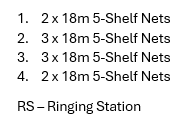
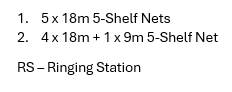
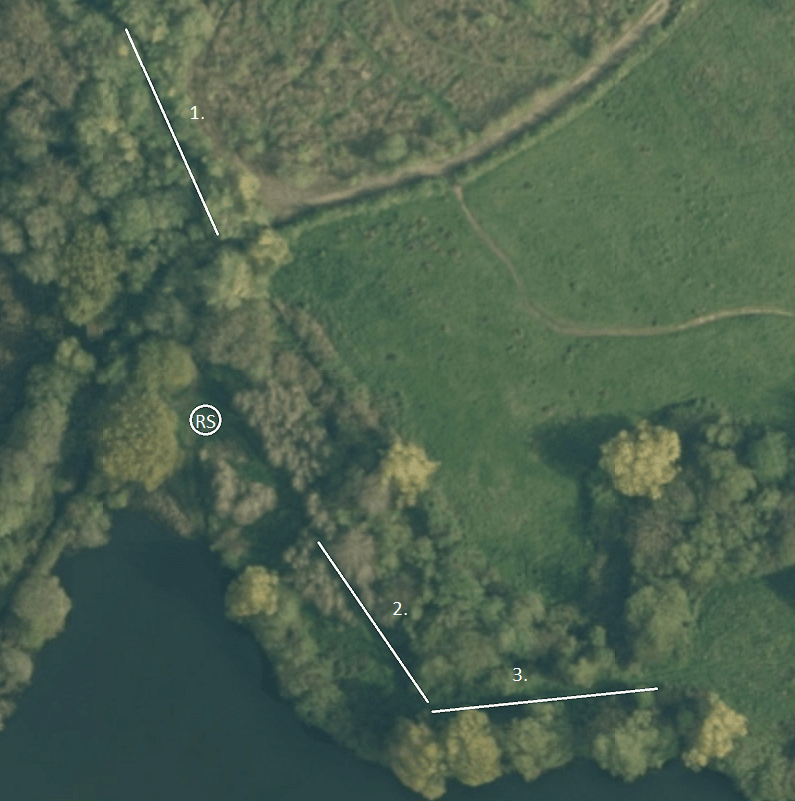
We set the following nets:

The first net set down from the ringing station comprised 3 x 18m 5-Shelf nets and the second set comprised 3 x 18m + 1 x 12m 5-Shelf nets. Where the nets are set is at the bottom of a 100m hill. It looks innocuous but, after a dozen or more trips up and down, it becomes a very good workout. Since the Firs reopened it has been a very productive site, until this morning! The first round produced six birds: four Long-tailed Tits, a Robin and a Wren.

The next two hours only produced another seven birds! It gave us plenty of time to chat. Not only that, Jonny produced a gift for me: he has gone through the time he spent with me as a trainee, and produced a lovely scrap book of the highlights from photographs posted on the blog on the Wiltshire Ornithological Society site and, subsequently, from this blog, together with a “thank you” card. You never know as a trainer whether you are doing a good job, and I have had a couple of issues in the last two years, but three weeks ago, to celebrate my 70th birthday, a dozen of my team past and present, took me out to dinner and showered me with lovely gifts, a fabulous cake (thanks Ellie), and wouldn’t let me put my hand in my pocket to pay for the meal. I guess I must be doing something right! Personally, I would say that I have mainly been very lucky with who I have had as trainees.

Anyway, we decided that if the next round was poor we would pack up and call it a day. Naturally, the next round we caught a reasonable nine birds but, within that, three of these:

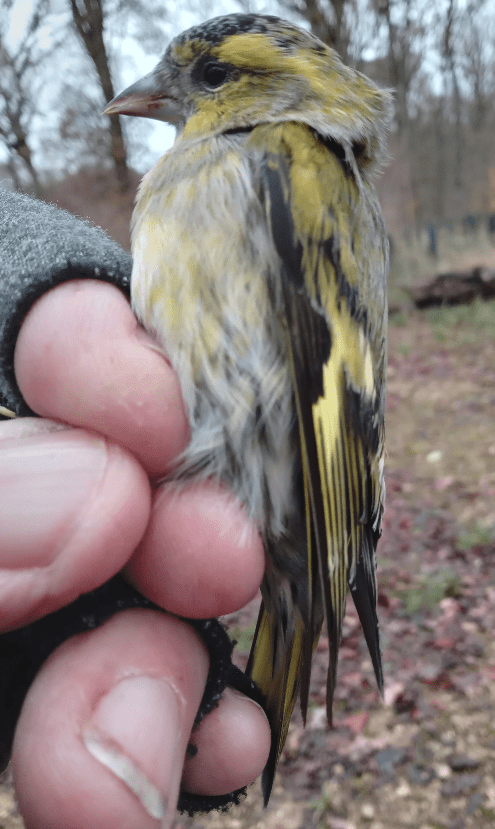
Male Siskin, Spinus spinus

Not only are these the first Siskin we have caught this winter, they are the only Siskin we have caught at any of our sites in the north in the whole of this year! With regard to the Firs, we have only every caught one at this site before, and that was back in March 2013!

As Jonny had to leave at midday, we decided to close the nets and take down at 11:15. There was a single Blue Tit in the nets as we started closing them. We extracted it ready for processing.

We had been conscious that the Vale of the White Horse Hunt were in the area: the hounds had been going into cry regularly throughout the morning. It got louder as we were closing the nets, and the next thing we were surrounded by their hounds. They were totally out of control. It wasn’t until I shouted that the scum on horseback realised there were other people in the nature reserve, and then they started blowing their horns, trying to get them back out. It took them something like 15 minutes to get them back under control. The only good thing: they were clearly after a fox and they, equally clearly, didn’t get it. I do not understand why hunts are not deemed to be responsible for the control of their hounds. The Dangerous Dogs Act makes owners responsible for the actions of their dogs, so why doesn’t the Hunting with Hounds Act make hunts responsible for the actions of their hounds? It is the loophole they exploit every time they break the law and deliberately hunt foxes.

It was a good job that we had the nets closed: goodness knows how much damage the rampaging hounds would have done to them had the nets still been in operational mode. I know from discussions with my old trainer that he has had first-hand experience of the hunts trashing ringing equipment and refusing to replace or compensate for the damage they do. Their arrogance and entitlement is so entrenched.

Anyway, rant over. The catch for the morning was: Treecreeper 1; Blue Tit 1(1); Long-tailed Tit 2(2); Wren 4(1); Dunnock 1(2); Robin (1); Blackbird (1); Goldcrest 1(1); Bullfinch 1; Siskin 3. Totals: 14 birds ringed from 8 species and 9 birds retrapped from 7 species, making 23 birds processed from 10 species.

Although slightly disappointed in the size of the catch, there is no feeding station set up in the wood, the Siskin catch made up for almost everything. It was very quiet, without a lot of bird movement. I will set up a feeding station later this week.

As an afterword: driving home I came across the hunt again: causing traffic hold ups on the B4696 main road to Ashton Keynes, and with all their “followers” parked partially blocking the western road from the Braydon crossroads and with a fox spotter searching on the eastern side for something for them to hunt.

So, a roller coaster: down – unable to access our original planned site (if we had, our encounter with hunt would not have happened, but Rosie and Ellie would still have had the experience); up – Rosie could do a bit more ringing for a bit longer before going off to work, because of the change of site; down – small numbers of birds; up – Jonny’s scrap book and thank you card; down – no birds for 2 hours; up – Siskin; down – the hunt.

West Wilts Ringing Group Results: November 2024

Another pretty decent month.  Given how bad the weather was, we did well to get out as much as we did.  So far I have only set up one feeding station, so I was quite pleased with my little group’s results.  Ironically, that with the feeding station, Somerford Common, delivered fewer birds from fewer species than before I set the station up.  Before feeding station: 48 birds from 13 species; after feeding station: 46 birds from 9 species.  Perhaps I should save myself £100+ and not bother with supplementary feeding!

The list from this month was:

image.png

Added to the list compared to November 2023 was: Blackcap, Great Spotted Woodpecker, Jay, Siskin, Stonechat and Tree Sparrow.  The addition of Tree Sparrow is down to Jonny having taken over monitoring Zeal’s Airfield for the Tree Sparrow project and expanding the activity at the site.  Our, presumably over-wintering, Blackcap was caught at Jonny’s Sutton Benger site. Blackcaps in November are never very common at our sites: one or two only each November since 2013, with none last year or in 2014 and 2015.

The three Stonechat were caught at three different sites: Blakehill Farm in the north, Jonny’s East Tytherton site mid-Wiltshire and Andy’s SPTA site further south on the Imber Ranges.  With regard to Great Spotted Woodpecker, we haven’t ringed any since June!  My group haven’t ringed any since March, so it was nice to get one at Somerford Common (probably attracted by the peanuts).  That said, we are on track to match recent year’s catches.  The Siskin was caught at Langford Lakes.  This is only the second caught there since the group came into its current structure in January 2013, the first being back in March of this year.  Prior to that, one was caught in March 2011 by Rob: a gap of 13 years for the bird at the site!

Missing from the list this year were Kingfisher, Linnet and Starling.  The Linnets last year were caught, three at Andy’s Imber Ranges site and three at my Brown’s Farm site.  I have only managed one visit to Brown’s this year.  The tenancy for the farmer I was working with was terminated in September. The landowner plans to farm it themselves from now on and I am in discussion about getting continued access to the site.  The previous tenant actually owns the farm next door and he has offered for us to ring there. I need to get see it and evaluate the possibilities.  The Kingfishers were caught, one at Lower Moor Farm and two at Jonny’s Sutton Benger site. Neither delivered this month.  Numbers caught at Lower Moor have declined significantly since 2021, with five processed that year but just singles since then and none so far in 2024.  The lack of Starlings is almost entirely down to my not carrying out any ringing in my garden as six of those caught last year were there!

There were some fluctuations in numbers: Redwing and Long-tailed Tit up; Goldcrest and Lesser Redpoll down.  The Lesser Redpoll is a surprise as last year’s catch were fairly evenly spread between Ravensroost Wood, Somerford Common and Webb’s Wood.  We didn’t have a Webb’s session this month but one at Ravensroost and two at Somerford should have delivered one or two, instead it was just the one at Somerford Common. 

As a side note, we have already surpassed last year’s total, closing in on 11,500 birds from 73 species.  Hopefully we will have a really good December as well.  

Road Closed – Somerford Common: Saturday, 30th November 2024

Driving to site this morning I turned onto Stoppers Hill, to be met with a “Road Ahead Closed” sign. I could see some flashing yellow lights further down the road, but before our parking site. I drove down until I came to the source of the lights: a contractor’s pickup truck and several traffic cones spread across the road. Fortunately, one of the workforce was manning the truck. I explained where I was heading and how many cars would be coming through. He confirmed that we would not be encroaching on the work that was scheduled (tarmacking the top end of Stoppers Hill, down to about 100m away from where we park up) and he showed that he was a decent human being, and not a jobsworth, and let me, and the rest of the team, through. He was responsible for one of the more entertaining events of the morning: the signs told cyclists to dismount and walk their bikes through the roadworks. Clearly one of the (hundreds of) local cycling clubs had planned their route and weren’t prepared to modify it in the face of the roadworks. So, instead, we had the amusing sight of all of those people, of varying shapes, sizes and ages, in Lycra pushing their cycles down the road. It reminded me very firmly of why I will never, ever wear Lycra. However, the best bit was when a couple of their more entitled members thought they would hop on their bikes once they were past the barrier. He was on it like a shot, and they quickly dismounted again!

My last visit to Somerford Common was on the 8th November. It was a good session: 48 birds processed from 12 species, 31 birds ringed and 17 retraps: highlights being a Lesser Redpoll and a nice flock of Long-tailed Tits. That was without the attraction of a feeding station. With the weather having been so mild throughout October and the start of November, I hadn’t done my usual deployment. The hard weather that we have had on and off in the last couple of weeks has meant that I have now started to set them up. I put up the feeders at Somerford Common on Wednesday and rather anticipated an overall increase driven by an upsurge in Blue Tit and Great Tit numbers. I use a non-wheat seed mix (it seems to me that most woodland songbirds don’t like wheat and so they throw it on the ground, and I have no wish to feed the escapee pheasants from the local shoots, nor encourage any rats) plus the obligatory peanuts.

I was joined by Rosie, David, Laura, Adam, Daniel and, coming for her first experience of bird ringing, Emma. We met at 7:30 and set the usual nets and started catching pretty well straight away. For once, Rosie could stay until 9:30 and got to ring a decent number of birds. Her final bird of the morning was a Great Spotted Woodpecker. This has been a dreadful few months for us for this species. We caught our last one before this on the 16th March on the opposite side of Somerford Common. It is a surprise because in January we had actually caught and ringed six of them, then one each in February and March, and then none for eight months!

The expected upsurge in Blue and Great Tits did happen, but the overall increase in numbers didn’t. Back on the eighth we ringed one and retrapped two Blue Tits and ringed three and retrapped three Great Tits. Today we caught and ringed nine Blue Tits and eight Great Tits and we retrapped twelve Blue Tits and six Great Tits. That is not to say that it wasn’t a good session. There were multiple highlights. As well as the aforementioned Great Spotted Woodpecker we ringed our 25th Nuthatch of the year. We caught and ringed only our third November Braydon Forest Chiffchaff: previous ones were in Red Lodge in 2013 and Ravensroost Wood in 2020. The absolute highlight, though, was this beauty:

Jay, Garrulus glandarius

This was our third of the year and Laura’s first opportunity to process one. Suffice to say, she knows the importance of controlling the birds feet (she gave it a stick to hold) and avoiding its beak! (Because she watched me make a right pig’s ear of the last one we caught, as I had forgotten all of the golden rules on handling Jays, as I was well out of practice.)

The total catch was: Great Spotted Woodpecker 1; Nuthatch 1; Jay 1; Blue Tit 9(12); Great Tit 8(6); Marsh Tit (3); Robin (1); Chiffchaff 1; Goldcrest 2(1). Totals: 23 birds ringed from 7 species and 23 birds retrapped from 5 species, making 46 birds processed from 9 species. The key difference between the two catches were the increase in Blue and Great Tits and the total absence of Long-tailed Tits. That was quite a surprise: every single woodland session I have carried out since the middle of September has had Long-tailed Tits in the catch.

The catch was regular, with small numbers across each round so it really was a very relaxed and enjoyable session. Laura and her boys had to leave at 11:30. David, his dad, Trevor, Emma and I started taking down at 11:45, with one last Goldcrest being caught and processed midway through our takedown. We were all packed away and off-site by 12:30.

Test Passed: Friday, 29th November 2024

With the intention of getting Miranda to her C-permit next Spring, I arranged to run a session in her garden, to have a look at the potential for her to ring there. This is to ensure that she has a site where she can work without needing landowner permission and so she has somewhere to ring whilst identifying and agreeing other sites for her to work at. We have tried on several previous dates to run the session: all thwarted by the weather. I won’t work in sub-zero conditions, as the welfare of the birds comes first and, in those conditions, they need all the time available to find food.

Fortunately, having cancelled Thursday’s session because of an outside temperature of -3oC, Friday was scheduled to be +6oC, but with quite a breeze from the south-west. I decided to take a chance on the garden providing enough shelter for us to be able to set some nets. The setup was as follows:

Net ride 1 was at 90o to the line of trees within which the bird feeders are set. There were no other feeders in operation around the garden, and nowhere near the other rides. Rides 2 and 3 were set in front of a hedgerow and behind some other scrub trees. We had planned to set ride 4 in the field adjacent to Miranda’s garden with lures for both Redwing and Yellowhammer playing, just to test, but in the event, we were busy enough with the other rides so that we didn’t have time to set them up. Next time!

Miranda’s garden attracts in large numbers of Goldfinch and decent numbers of Greenfinch coming to the feeders. In fact, we could hear Goldfinch wittering on all morning. Unfortunately, they didn’t read the memo and we didn’t catch a single one of either species. We will have to try a different net setup next time. However, that is not to say that the session didn’t work. In fact, as soon as we had net ride 1 open it started catching. It was primarily Blue Tits with a couple of Great Tits in the mix. Whilst Miranda started extracting these birds I got on with setting up rides 2 and 3.

We set up the ringing station just outside the kitchen (handy for coffee and cake, and for Miranda to look after Percy, her new puppy: a gorgeous black Cocker Spaniel. For a youngster, he has the bladder capacity of a 70 year-old man! Actually, that is untrue, I didn’t need a wee all morning, whereas Percy needed several.) and got on with processing the birds. The next round produced a decent number of birds in ride 1 and a few in ride 2. Unfortunately, the wind got up at 9:30 and ride 1 became unusable, so I closed and furled it. I put a couple of lures on rides 2 and 3 and we immediately got result. In fact, we were busy for the rest of the morning. Being the first session at the site, and no other ringers being active in the area, every bird caught needed ringing. It was quite a catch, and bodes well for the future, if we can set it up to catch finches as well.

The list for the session was: Blue Tit 36; Great Tit 14; Coal Tit 2; Long-tailed Tit 13; Wren 2; Dunnock 2; Robin 3; Song Thrush 1; Blackbird 2; House Sparrow 1. Total: 76 birds ringed and processed from 10 species.

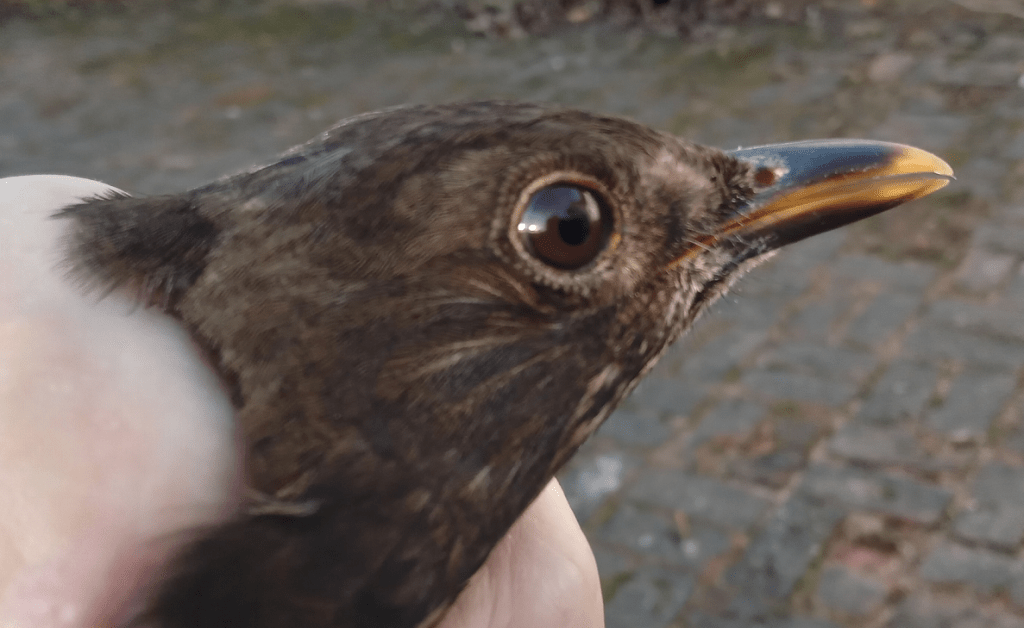
We did have two Blackbirds with good long wings: a male with a 138mm wing and a female with a 139mm wing. Out of 1,945 Blackbirds ringed, she is only the tenth Blackbird that we have ringed with a wing of that length. We have previously had two with wings of 140mm, one with a wing of 141mm and one with a wing of 143mm, but none with anything longer.

Female Blackbird, Turdus merula

Back when I started my training as a bird ringer, in 2009, a Blackbird caught with a wing of that length, and a beak with so much dark and so little yellow, would automatically have been declared to be a winter migrant from the European mainland. I don’t know if that is still the case as, anecdotally, I think I see a lot more long-winged and dark beaked Blackbirds these days.

Having reached a good total of birds and the wind getting stronger, we packed away at midday, finishing by 12:30: a benefit of only having four nets in three net rides. So Miranda was home by 12:31 and I was home by 12:45. A good session but much more to do to develop the site to improve the variety of the catch. The potential is definitely there. As well as the teasing of the Goldfinches, Miranda’s garden attracts in Fieldfare and Redwing, coming to a very heavy cropping apple tree, the windfalls plus unwanted / unused crop of which are left for the birds. There are Great Spotted and Green Woodpecker regularly visiting and, backing onto farmland, the possibility of Yellowhammer and Linnet in the hedgerow in their field next door. We will be trying it out some more over the next couple of weeks, hopefully with fewer Blue and Great Tits, and adding a decent number of finches and some other species.

Red Lodge: Friday, 22nd November 2024

With Saturday’s forecast for torrential rain and high winds, we decided to get out this morning. It was forecast to have quite high winds coming from the west, so I decided that we would need to be well inside a woodland to avoid the effects of the wind. After having to cancel Wednesday’s session due to the sub-zero temperatures, I was keen to get out, although the catches at Red Lodge have not been as good as they used to be.

Rosie and Ellie came along to help us set up and David and Laura came for the whole session. We set up our usual nets for this part of Red Lodge and waited for some birds to hit the nets.

I had a variety of lures running and pleased to say that what is known as the Latvian love song did its job and attracted in a couple of Redwing. We don’t catch many in Red Lodge, so it is always good when we do catch the odd one:

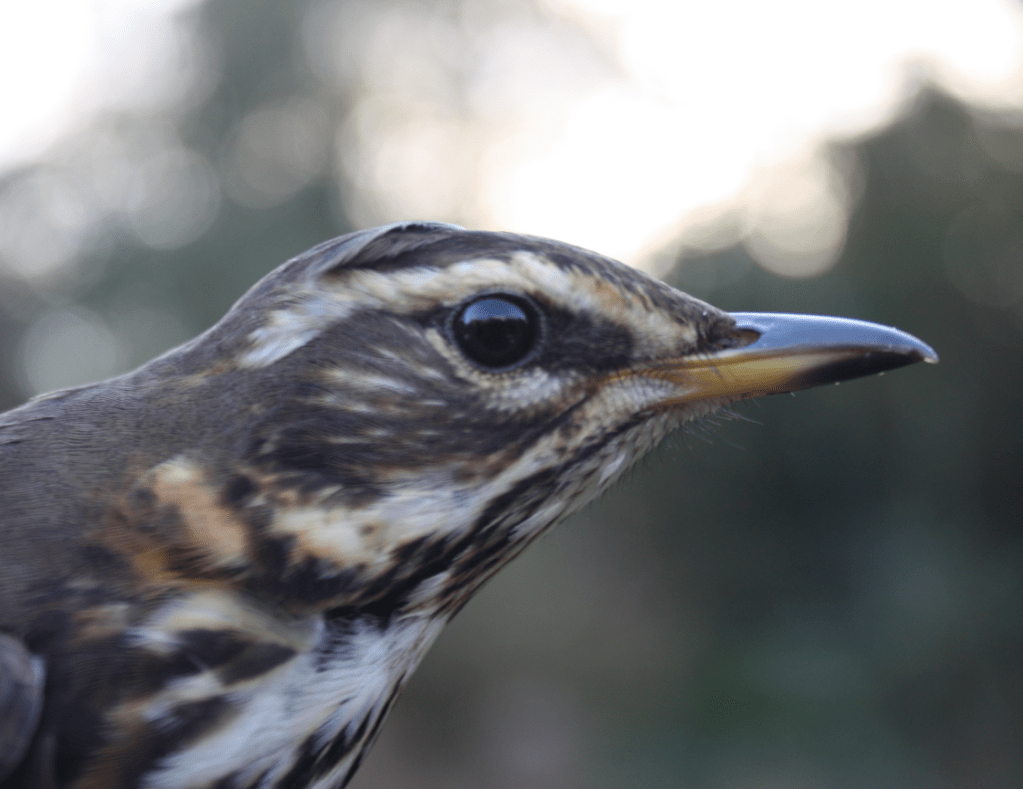
Redwing, Turdus iliacus

Rosie had to leave at 8:30, before we had caught anything. Ellie had to leave at 10:15, having not ringed a bird. My team are good people: coming along to help out knowing that their opportunity will be limited at that session.

It was a very slow morning, with just one good haul of birds when a small flock of Long-tailed Tits arrived in the net that has been our worst of recent times: ride 1. I had decided to add an extra net to that ride and it certainly paid dividends. That net which is usually our best at this part of the site, ride 3, was the worst this time, with the first bird of the session, a Goldcrest, caught and then nothing else.

The list for this morning was: Nuthatch 1; Blue Tit 2(2); Coal Tit 1; Great Tit 1; Long-tailed Tit 7; Redwing 3; Blackbird 1; Goldcrest 2. Totals: 18 birds ringed from 8 species and 2 birds retrapped from 1 species, making 20 birds processed from 8 species.

With the weather being cold and the catch slow, we packed up a little early: starting the take down at 11:30 and getting off site by 12:15.

Ravensroost Wood: Saturday, 16th November 2024

I was joined for the morning by David, Laura and Adam at 7:30 and we set the following nets:

This is the first time I have set the nets in this part of the wood since the 1st June. We had become fairly jaundiced at how low the catches were in the spring after removal of the feeding station. As a result, the rides had become horribly overgrown. Having steeled myself for another crack at the site, I went over on Friday morning with my brush cutter, secateurs and slashers (like hooked machetes) and spent two hours clearing and cutting and opening up the rides, ready for this morning. I set Adam to do some more tidying with the secateurs, whilst the rest of us set the nets this morning. No matter how much you might strip back bramble and dog rose, how carefully you remove the cuttings from the pathway, when you come to set the nets there are always overlooked pieces ready to extract revenge!

I set multiple lures for a range of over-wintering and resident species, only three of which succeeded. However, once again we did start catching even before the nets were open. Unusually, the bird in the unopened nets was a Dunnock. It is usually Wren, Robin or Blackbird in that decreasing order of frequency.

It was a funny morning, we had small numbers in most rounds, and the odd empty round, but it didn’t feel like a poor session. We ended up with the following catch: Nuthatch 1(1); Treecreeper 1; Blue Tit 2(1); Great Tit 2(2); Coal Tit 1; Marsh Tit 1(1); Long-tailed Tit 4(1); Wren 1(1); Dunnock 1; Robin 2(2); Goldcrest 6(2). Totals: 22 birds ringed from 11 species and 11 birds retrapped from 8 species, making 33 birds processed from 11 species.

The lures that worked were, primarily, the Goldcrest, followed by the Long-tailed Tits and, finally, the Nuthatches. Nuthatch are making a lot of noise at the moment. The only noisier things in the woods currently are the Jays, with their raucous shouting as they chase each other around and around. I don’t know if it is pair-bonding (Jay) or territory setting (Nuthatch), comments welcome!

It was nice to catch and ring another new Marsh Tit. We are well on our way to our standard 50+ individuals per annum. Speaking of which, this is turning into a very good year for Long-tailed Tits in the Braydon Forest. With six weeks before the end of the year, we are likely to either get very close to, or even exceed, our best ever year for ringing them in the Forest.

I prefer to use the number of individuals to numbers retrapped for comparisons, as the same bird can be retrapped several times in the same year, distorting the picture of the population.

I doubt we will reach the total of ringed and retrapped from 2015 and probably not the number of individuals, but I hope it will be close. For some reason the numbers ringed decreased dramatically in 2016, recovering briefly in 2019, and then declining again. Hopefully this up and down trend will remain resolutely upwards in the coming years. As this graph shows, there seems to be a 4 to 5 year spike in their numbers, followed by an intermediate decline:

It will be interesting to see what happens over the next couple of years.

Our oldest Long-tailed Tit was ringed on the 20th July 2013 and retrapped for the second time on the 30th October 2019: 6 years and 3 months or so. Not bad for a bird that the BTO BirdFacts has as having a typical lifespan of 2 years. Mind, the oldest known from ringing is 8 years and 11 months.

We started packing away at 12:15, with Trevor (David’s dad) helping, it was all done pretty quickly and we were off site before 13:00. The feeders will be going up in the next week or two and we will see what impact that has on our catches.

Lower Moor Farm: Thursday, 13th November 2024

After Sunday’s less than successful visit to Blakehill Farm, followed by five hours on Monday removing leaves from my nets, I wanted to go somewhere today where there were nearly no Oak trees to drop their leaves and twigs into my nets. That didn’t give me many choices. I had a look at the visit data for Lower Moor Farm. Surprisingly, the catch sizes for November are quite good: usually 40 or so birds and, even better, not masses of Blue or Great Tits. I decided to give it a go.

I was joined by Miranda for the session. My choice of nets was to use the CES set up, excluding the farthest net sets:

We met at 7:30 and set the nets. There were a few issues from when they were last put away, so it was 8:30 by the time we had them set. I really am going to have to have some net management training sessions for the team, I think.

The birds started arriving straight away: in the form of two Wrens who decided to fly into an unopened net. They are able to get themselves entangled perfectly well in properly set nets, in unopened nets they can be the very Devil. Fortunately, these were a little more angelic and a little less demonic than usual.

We had a steady throughflow of birds all morning. We also had a steady throughflow of visitors. Lower Moor Farm has a Care Farm educational facility to help children with issues, be they behavioural, social or educational. This morning we had the pleasure of their company, and that of their carers throughout the morning. I spent a lot of time explaining about bird ringing and what information it enables us to gather about individual birds and bird species. They were shown little things like how to age certain species and those that by now cannot be accurately aged (Long-tailed Tits were plentiful this morning), how to identify the different sexes in sexually dimorphic species (Goldcrests were also present in reasonable numbers). Those children that wanted to were shown how to safely handle small wild birds and release them back into the wild. It went well! There was also a pretty decent footfall of other visitors to the reserve, all of whom were interested in what we were doing.

Funnily enough, the capture of star bird of the morning coincided with the largest audience:

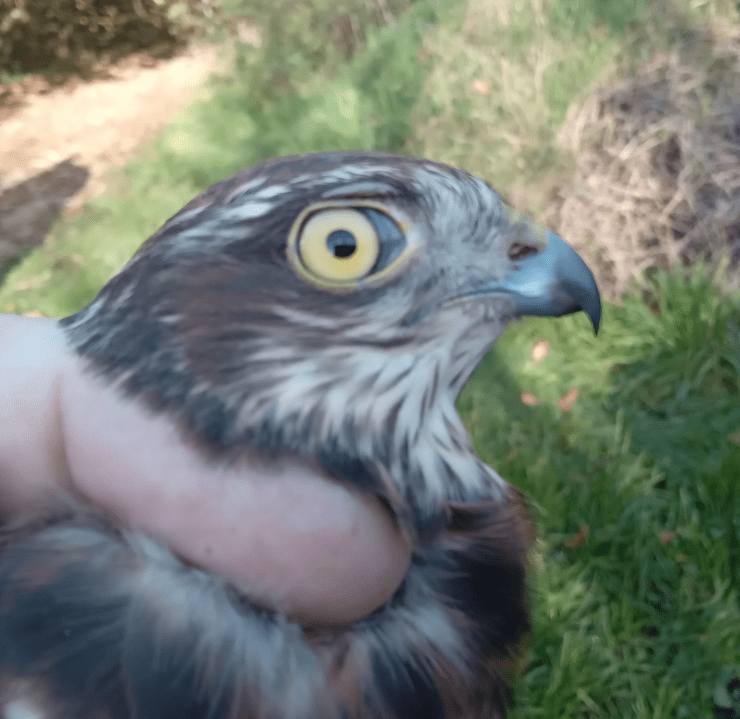
Juvenile male Sparrowhawk, Accipiter nisus

This is actually the first Sparrowhawk that my team has caught this year. To be fair, one a year is normal: in the last 11 years we have caught at least one each year, with two in three of those years, most recently in 2021. It was a huge hit with the audience, and I managed to get the bird processed with minimal damage (to my fingers, the bird was never in any danger).

The list for the session was: Sparrowhawk 1; Blue Tit 5(2); Long-tailed Tit 2(10); Wren 5(2); Dunnock 3(1); Robin 2(3); Redwing 3; Blackbird 1(1); Chiffchaff 4; Goldcrest 4(4); Goldfinch 1. Totals: 31 birds ringed from 11 species and 23 birds retrapped from 7 species, making 54 birds processed from 11 species.

There are some surprises in that list: not least the Chiffchaff catch. We caught a singleton in November three years ago but had never otherwise caught any in late autumn / winter time, catching four in November is very definitely unusual. We know that they do overwinter in the Cotswold Water Park but more centrally than Lower Moor Farm.

The Goldfinch was the first caught in November on this part of the site for seven years, and the first anywhere on the site for six years. Our Goldcrest catch takes us to the best year for the species in the whole of the complex, with at least one more session to come before the end of the year.

The weather was perfect for ringing. It started cold but very quickly warmed up to a very mild ambient temperature. The sun put in an appearance at about 10:00 and stayed around for the rest of the session. Miranda and I started taking down at about 11:45: emptying ride 1 then taking down the nets and processing the birds before doing the same to rides 2 and 3. As we kept catching birds whilst doing so, we ended up taking quite a bit longer to get packed away than normal, and finally left site at 13:15 after a thoroughly enjoyable session.