Ravens Retreat: Tuesday, 18th February 2025

With the weather forecast for it to be very wet and windy for the rest of the week, we took advantage of today being forecast to be fine to get out. The idea was that we would meet with the Swindon Wellbeing Group at Ravensroost Wood. Having got my diary wrong and ringed at Ravensroost Wood the previous Tuesday, I decided to test out a different part of the site today: Ravens Retreat. Ravens Retreat was a grazing meadow for many years. When the Wildlife Trust decided to upgrade the wildflower content of the Ravensroost meadow area, by spreading seeds gathered from other wildflower meadow reserves, this part was left unseeded. That was because the Nationwide Building Society had offered, as a part of their investing in local conservation projects, to plant this area with native woodland species. In 2016 (I think) Nationwide staff spent several weeks planting a mix of native broadleaved trees: Oak as the canopy species, mixed with Hawthorn, Blackthorn, Crab Apple and a number of other, what I consider, understorey species. The Blackthorn is there to encourage the expansion of the Brown Hairstreak butterflies that are found in the main wood. From the number of markers we saw this morning it is going to be a significant site for them. There are also two Willow pens, fenced off and growing wood for other Wildlife Trust projects, like screens for the paths leading to hides, etc.

I set up a feeding station there last Thursday, on the off-chance that it would help attract in some birds for this Tuesday. When I checked on the feeders after Sunday’s session at Webb’s Wood, the seed mixture had hardly been touched and the peanut feeder had been one-third emptied. That did rather indicate what we were going to be dealing with come Tuesday.

I was joined for the morning by Laura, Adam, Daniel and Sarah. It was very cold when we arrived on site at 7:00: -2oC. We set the following nets and, by the time we had them open, the temperature had risen several degrees above freezing. It meant we would be monitoring the nets more frequently than the usual every 20 to 30 minutes, every 15 minutes, or whenever we saw a bird in the nets, but it was entirely manageable with the team that I had out.

We set the following nets:

The white dot is the peanut feeder, the yellow is the seed feeder.

We started catching at 8:15 and, as suspected, it was Blue Tit heavy. We caught a good first round and then two or three each round thereafter.

Unfortunately, although the air temperature had improved, a very cold easterly breeze started up. By 10:00 we were all chilled to the bone and I decided that the team’s welfare was as important as that of the birds. The decision was made easier by the fact that the breeze was getting stronger and blowing the pockets of the nets out and the number of birds had fallen right off. Unfortunately, we had also started to retrap birds that we had already processed in the session. We recaptured one for a third time, which is anathema to me, and a “time to stop” indicator – particularly when the weather is itself marginal. So we started taking down at 10:30 and cleared site by just before 11:00. I contacted the Wellbeing team to let them know. They were running behind and were not going to make site until gone 11:00. I hate letting people down, but we are only a peripheral part of their day, and they had plenty of other things to do.

The list for the session was: Blue Tit 8(7); Great Tit 8; Long-tailed Tit 1(1); Robin 1. Totals: 18 birds ringed from 4 species and 8 birds retrapped from 2 species, making (a paltry) 26 birds processed from 4 species.

I should emphasise: no birds showed any signs of cold stress, unlike the team.

We were accompanied all morning by two Robins. The ringing station, set up at the picnic table provided by the Trust, must be close to the border between two territories. There was a minor amount of argy-bargy between them. Although it was also clear that the table is definitely in one of their territories, as it spent the morning moving around us. We put a handful of seed on the table and it was happy to hop around us to grab a snack or two.
A Note on Salisbury Plain Imber Ranges Yellowhammers

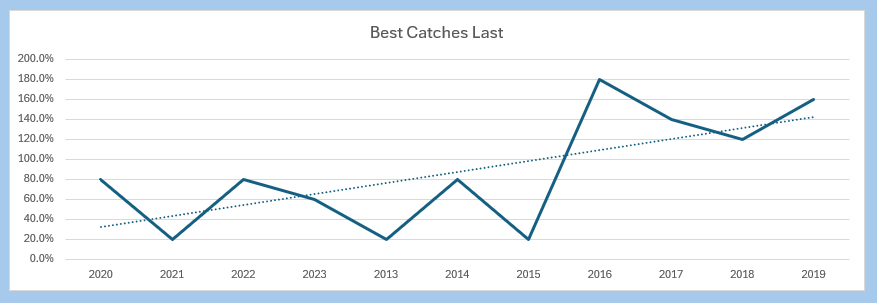
As a group we catch only about 80 Yellowhammer each year. Jonny Cooper has added a few new farm sites over the last couple of years, which will boost numbers for the future, and I have a farm to the south of Marlborough that, when I can get to it, is also a regular site. However, to date the key site has been out on the Salisbury Plain Training Area, on the Imber Ranges. It has produced 60% of our catches of the species.

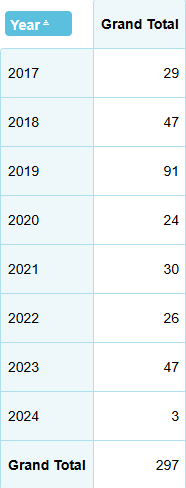
October is always the best month for catching them. However, this October produced only three in three visits. On average the site gets four visits every October, with two minimum and five maximum.

With the exception of the spike in 2019, it is a fairly consistent figure until you get to this year. I have spoken with the ringer who runs the site and he is absolutely bemused by the situation. The habitat has not changed, there have been no additional military exercises in this part of the SPTA this year. It is outside of the impact ones, so there shouldn’t have been more disturbance than usual. Definitely odd for a relatively sedentary resident species. The impact has been to make 2024 significantly the worst year for the species since this site was regularly monitored:

I had a chat with my friend, nest finding and monitoring expert, and delightfully named, Jack Daw, about what he had found this breeding season on the eastern side of the Plain. His report was that quite a few of the usually occupied territories were empty of Yellowhammer nests. Some nests that he found were predated, and three youngsters fledging was a good result. He also found a dearth of singing males on patch.

I also had a chat with Graham and Phil Deacon of the North Wilts Ringing Group, who work in the West Down area of the SPTA. They catch very few, as the habitat in their part of the Plain does not have habitat particularly suitable for the species, so don’t really have data for comparison.

It will be of interest to see how things finish up by the end of the year and what happens in 2025.

Treecreeper in the Braydon Forest Woodlands: 2013 to 2023

As with the previous post on Nuthatch, I decided to have a look at the catches of Treecreeper within the Braydon Forest woodlands over the last 11 years to see if there was any obvious trend in numbers ringed and processed.

As with the Nuthatch catches, I have not included the 2024 data in the graphs, to rule out seasonal discrepancies.

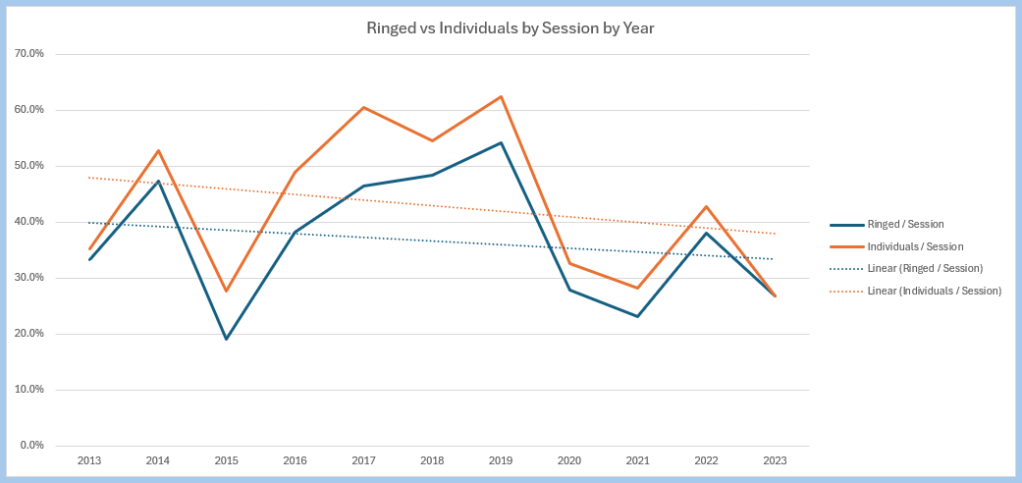
Like the Nuthatch, there are multiple peaks and troughs. Unlike them, the trend is downward, dropping from 24 down to 14 individuals, and from 20 to 13 birds ringed by year. The sessional analysis also shows a decline, but it is less pronounced than the bald numbers would indicate:

The number of birds ringed has decreased from 40% of sessions to 34%, whereas the number of individuals processed by session has decreased somewhat more, from 48% of sessions to 38%.

When we look at the juvenile recruitment into the population it is as volatile as that of the species as a whole. The data used for the following table and graphs is based on the BTO age codes of 3J (full juvenile plumage); 3 (completed post-fledging moult) and 5 (birds fledged in the previous breeding season).

Although the figures do follow similar paths, the reduction per session is considerably lower than it is in the straight number count. The reduction per session has gone from 14% of sessions to 12.5% of sessions, whereas the actual number of juveniles ringed per year has reduced from 14 to 8 on average.

I decided to have a look at whether these changes varied across the woodland sites. Looking at the entirety of the catch (juveniles and adults) gave the following results by site by year:

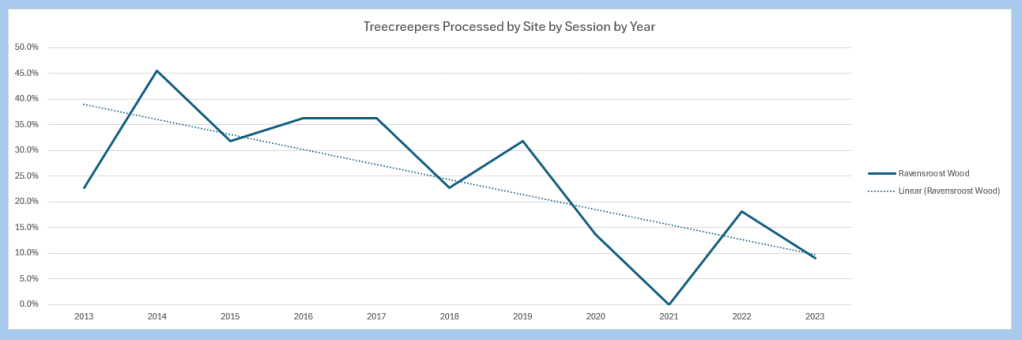
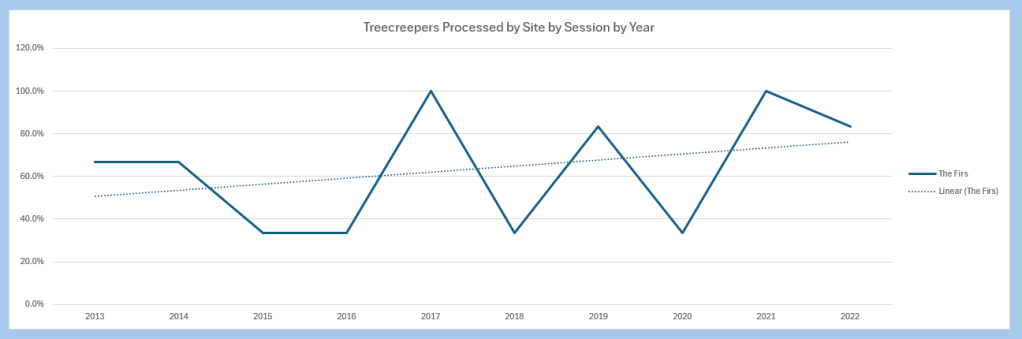
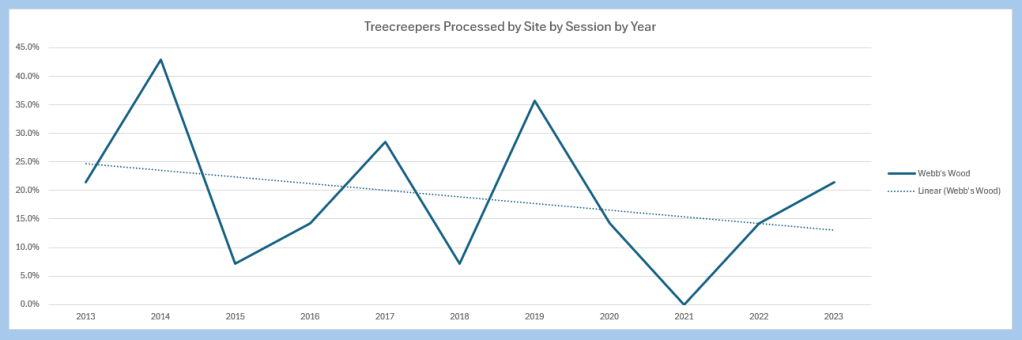
I have graphed these individually, otherwise it is too difficult to look at the site trends.

Ravensroost Wood:

Red Lodge:

Somerford Common:

The Firs: note that this only includes data up to 2022, as the wood was closed between October 2022 and February 2024

Webb’s Wood:

It is clear that number of individuals is full of peaks and troughs in every site. When the data is not particularly numerous, that is always going to be an issue. A good year or a bad year can have an exaggerated impact on the overall trend. Despite that, the catch in Ravensroost Wood shows the steepest, most obvious decline, particularly exacerbated by the reduction in the last three years. Why that should be, I have little idea. There were significant forestry operations over the winter of 2022 / 23, but that doesn’t correlate with the steepest decline in their numbers. 2021 was obviously the worst, but also for Red Lodge and Webb’s Wood.

Red Lodge shows the impact that four good years can have on the overall trend line if it sits in the middle of a small data set. For fun, I moved the four years to the front and to the back and redrew the graphs:

Similar effects would be had if I moved the three bad years on Somerford Common. That is the issue with data that is this volatile and with such small sample sizes. If 2024 turns out to be a good year for Treecreepers it could rebalance some of the trendlines.

What is undeniable is that there is a definite shallow decline trend in the catch of Treecreeper within the woodlands of the Braydon Forest.