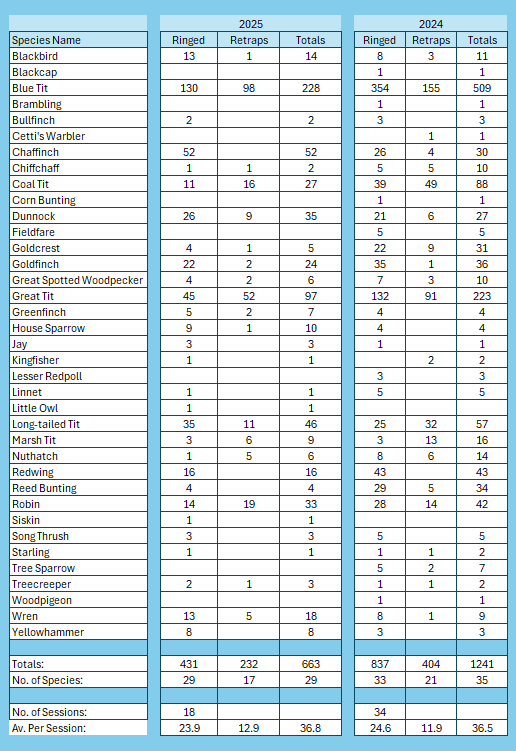
On the face of it, compared to last January it was a disappointing month but, considering the weather and the impacts on bird life, and the fact that it is comparable with previous years prior to 2024, no real concerns about the result. Indeed, the key difference between the two months is in the number of full sessions we were able to fit in. There were just over half as many full sessions as last January, so the numbers caught per session were just about equal. Another factor from my catches was, quite simply, I did not manage to set up my usual feeding stations at all of my winter feeding sites: Red Lodge, because I need to find time to clear the winter rides; the Firs, because I did set a feeding station but in three weeks the only feeder found was the peanut feeder destroyed by squirrels and Webb’s Wood, because last year the feeders were stolen from the site and I haven’t found a position that I think would be safe from such people. The impact is quite marked. Last January my Braydon Forest team processed 436 birds in six sessions, this January it was just 168 birds in four sessions.
Missing from our catch this January when compared to last were: Blackcap; Brambling; Cetti’s Warbler; Corn Bunting; Lesser Redpoll; Tree Sparrow and Woodpigeon. Added to the catch were just Siskin and this beauty:
Little Owl, Athene noctua (photo courtesy of Dr Ian Grier)
Ian and Andy have been trialling a new site and, although the catch at their session wasn’t huge, to catch our first adult Little Owl is very exciting, especially given that their UK population has declined by 82% between 1967 and 2022.
I am not going to do the usual increases / decreases analysis, as the difference in the number of sessions renders it meaningless. Let’s hope for better weather in February!
Ten days ago, to help with the bitter weather that had moved in, I set up a feeding station in the Firs: two one litre seed feeders and a one litre peanut feeder. On Tuesday I stopped off to top up the feeders, only to find that the peanut feeder was half empty and the seed feeders had not been touched. I assumed that this was simply a case of adjusting to them being there / finding the feeders. I was joined by David, Mark, Adam, Daniel and Emma. Laura did come to help us set up before heading off for a day of French Horn playing!
The first thing I did was to check the feeders: the peanut feeder had been wrecked, no doubt by an irate Grey Squirrel. Just the lid and its hanger remaining. Despite looking all around, no sign of the cage and the base. It brought to mind an image of a squirrel running around with it stuck around its head and body. One of the seed feeders contents had been reduced by about two inches, the other hadn’t been touched. I did wonder if we would actually catch any birds.
We set the following nets:
As we walked down the hill there was just one bird in ride 1 and nothing in ride 2. However, while Adam extracted the first Blue Tit of the morning, as we watched, a small flock flew into the furthest away net in ride 2: five Blue Tits. Having extracted them, we found a few more birds had flown into the nets: a Dunnock, Long-tailed Tit, Blackbird and a Wren. Ten birds proved to be the best catch of the session. Thereafter it was just one or two birds each round.
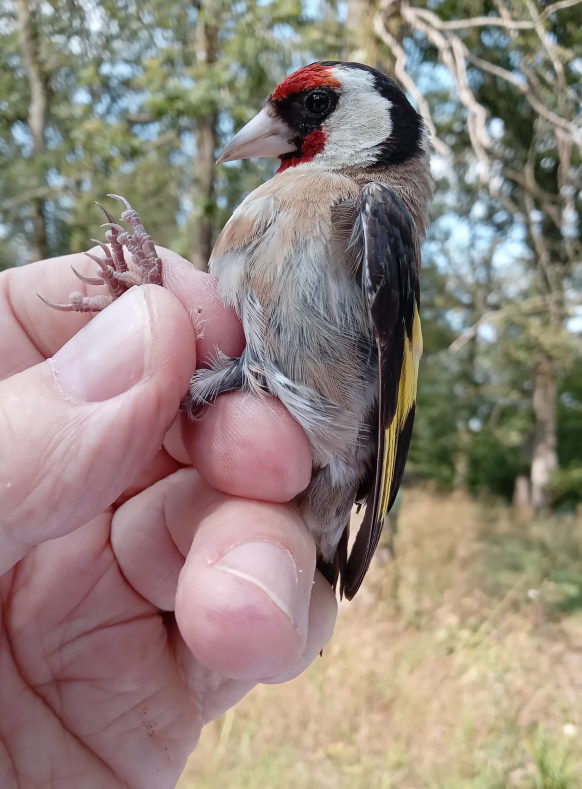
It really was a quiet morning. The only highlight was our sixth Goldfinch at the site. The first three were caught in a session in December 2013. After that, there was one in March 2017, one in August 2024 and this today:
Juvenile Female Goldfinch, Carduelis carduelis
The list from this morning was: Blue Tit 9(1); Great Tit 2; Long-tailed Tit (1); Wren 1(1); Dunnock (1); Blackbird (1); Goldfinch 1. Totals: 13 birds ringed from 4 species and 5 birds retrapped from 5 species, making 18 birds processed from 7 species. This is our worst January catch in the Firs ever. The previous worst was 32 back in 2019.
We kept the nets open until we all decided we were too cold to continue. Mind, that was at midday. There was quite a lot of Great Spotted Woodpecker drumming going on all morning: they were too busy with their territorial percussion to come down to the nets.
One actual bonus: David’s dad, Trevor, was clearing out his loft (roof repairs going on) and found a rather fine, solid four-seater picnic table. Surplus to their requirements, so we tried it out as a ringing table and it is perfect!
The Wiltshire Wildlife Trust make a huge commitment to community engagement, particularly with their care farms for children and their wellbeing groups for adults. As it says on their website:
Occasionally some of the group activities coincide with my ringing sessions, and I am always happy to spend time with the groups, show what we do and explain why we do it. The other thing that I offer is for members of the group to get bitten by a Blue Tit, sorry, I meant, to learn how to safely hold and release a bird! Today I had arranged with the Swindon Wellbeing Group for them to join us for a while at Somerford Common.
I was joined for the session by Laura at 8:00 and we set the usual nets, which were opened by 9:00. You can see the set up on the post from the 4th January session. The weather was interesting: it started warm and misty, to the point that we were shedding layers of clothing but, as the morning went on, the fog got thicker and the temperature dropped considerably and we were wrapped up warm by the end of the session.
The first birds arrived at 9:15: an hour and three quarters before the Wellbeing Group arrived! Actually, in the interim we were joined by Rob, his wife and their three month old baby. Rob had been out ringing with me a couple of years ago, until work got in the way. We have stayed in touch and, hopefully he will be able to resume ringing at some time in the future.
It was a smallish catch, but we did have nine species in the tally. The highlight had to be a couple of Great Spotted Woodpeckers: a male to be ringed and a female retrap.
Male Great Spotted Woodpecker, Dendrocopos major
The Wellbeing group arrived bang on 11:00 and I ran through my usual profile of the ringing scheme, peppered with some examples of how the data from ringing is used. We had a decent number of birds for them to look at, good variety, and everyone who wanted to had the opportunity to hold and release a bird. The man who got to release the Great Spotted Woodpecker was particularly happy with the opportunity. In fact, only one of the group decided that they didn’t want to do so. They came with Laura and me to see our net set up and watched whilst we extracted birds from the nets. It is not something that I do often, showing the nets with birds in them, or extractions: it tends to be the part of the process that can upset the onlookers but, fortunately, the group were interested and positive about what we were doing, and all of the extractions were nice and straightforward.
As expected with the bird feeders in place, the session was titmouse heavy. However, the catch size is actually on a par with how they were back in October / November before I set up the feeders. I thought it might be interesting to look at the catch sizes, the numbers of titmice in those catches and what proportion of the catch they made.
Table 1: Numbers / Proportion of Titmice in Somerford Common Fig. 1: Proportion of Ringed / Retrapped Titmice in Somerford Common catches
My reading of this is that the provision of the feeding station has had a minimal impact on the catches we have made. The first catch with the feeding station in place, 14th December 2024, was on a par with the previous three catches. The subsequent two have been somewhat smaller. Was today’s catch, being the smallest, due to the impact of the recent bad weather? It is possible, but the weights of the individuals caught were on a par with what I would expect. Blue Tits between 10g and 12g (although one was 8.9g, it was the only one sub 10g), the Great Tits were all between 17g and 20g.
The catch was: Great Spotted Woodpecker 1(1); Blue Tit 11(8); Great Tit 3(3); Coal Tit 1(2); Marsh Tit (2); Wren 1; Robin (1); Blackbird 1; Chaffinch 1. Totals: 19 birds ringed from 7 species and 17 birds retrapped from 6 species, making 36 birds processed from 9 species.
Laura and I closed the nets at 12:15 and took down. We were away from site by 12:50 after a quiet, but enjoyable, session.
As well as being active within the group, several of us also work with other bodies. Ellie works for the Wildfowl & Wetlands Trust and helps them whenever the opportunity arises, but doesn’t keep records of what she has processed with them. Clearly not a nerd like Jonny and myself.
Jonny enjoys a productive relationship with a group that rings in Iceland. This year he was there again and had another fantastic experience:
A couple of photographs that I am in no way jealous of!!!
Juvenile Red-necked Phalarope, Phalaropus lobatus (photo thanks to Julia Baak)Black Guillemot, Cepphus grylle (photo thanks to Julia Baak)
As mentioned in the introduction to part 1 of this review, I took on the responsibility of being trainer for the Salisbury Plain Raptor Ringing Group. In order to get to know the various elements of the group I spent a day out with each of them.
My first session was with Justine, a C-permit holder, who had been coming out with me prior to the trainer issue arising, as she wanted to expand her knowledge beyond raptors, and Mark, who has now signed on as a T-permit holder but had been doing the ladder work, with Justine doing the processing. Their work is primarily along the River Wylye valley, farmland along the A303 and some areas on the edge of the Salisbury Plain Training Area. It was the fact that I was already working with Justine that put me in line to help the group out. This session was on the 5th May and we processed a brood of Tawny Owls and five broods of Barn Owl:
Barn Owl chicks, Tyto albaTawny Owl chicks, Strix aluco
My second trip out was with Dick, currently heading up the SPRRG, and Jon. They cover the central SPTA boxes. I met with them at West Down camp on the morning of the 15th June and we checked a number of boxes, ringing four broods of Kestrel and three broods of Barn Owl. One interesting find was regarding the diet of Barn Owls. A couple of years ago, at one of my sites near Waterhay, I found the remains of a Starling in one of the boxes. One of the boxes holding a Barn Owl brood on the Plain has a huge stock of Starling carcasses:
Starling, Sturnus vulgaris, from a Barn Owl cache
Clearly, this is a dietary choice for these particular birds. I suppose that large roosts of Starling are fairly easy prey. After this session I asked Ian to assess Jon for his A-permit, which he did and Jon is now a fully licensed bird ringer.
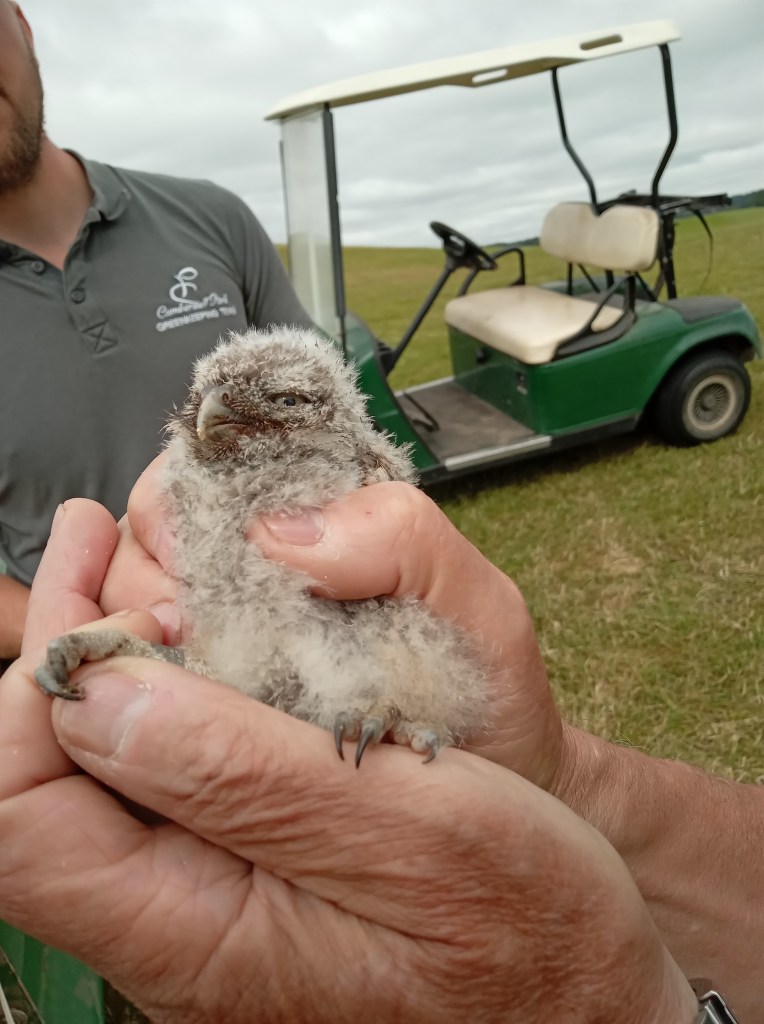
My third session was with another Jon. This time it was at Cumberwell Golf Course on the 23rd June. As well as being a greenkeeper, Jon is the conservation manager for the site. His work is exceptional, and the site is an absolute haven for wildlife. We ringed two broods each of Kestrel and Barn Owl, plus one brood of Little Owl. I was delighted to be given the opportunity to ring my first ever Little Owl:
Little Owl chick, Athene noctua
My last trip out was my long weekend with the Wash Wader Research Group, as previously blogged about. Rather than repeat all of the detail from that, this was the list that I was lucky enough to process: Curlew 1; Dunlin 15(2); Redshank 8(1).
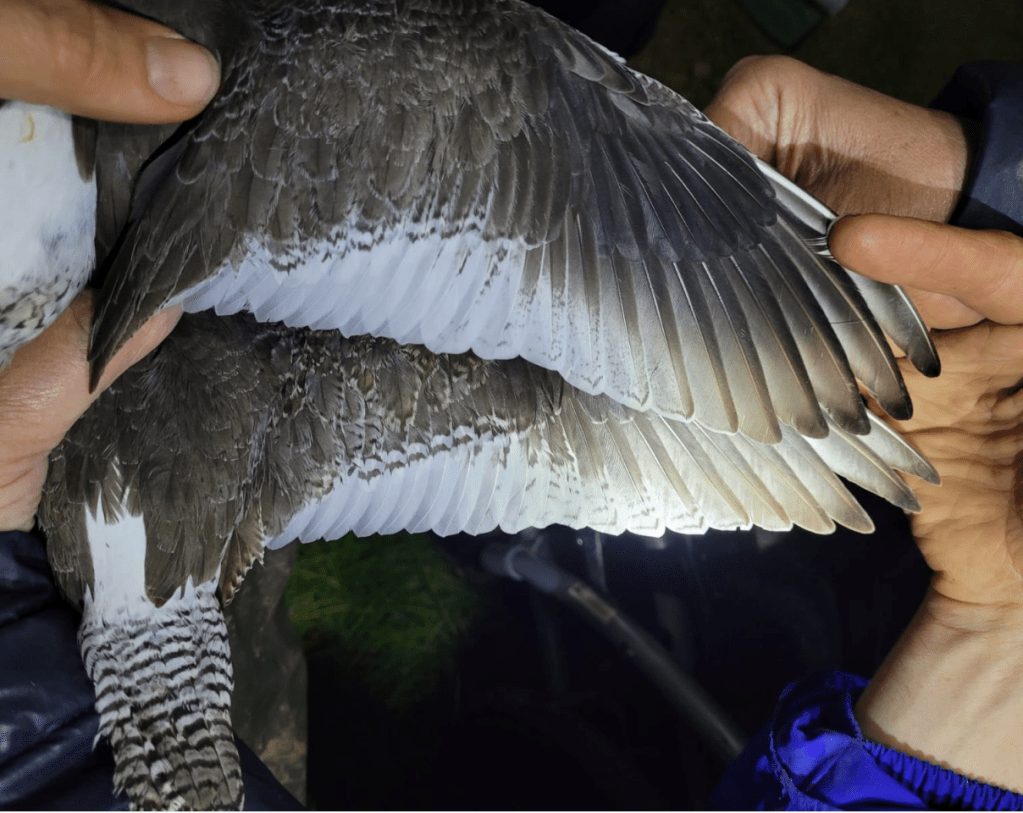
There was a lot of opportunity to get really confused about ageing Redshank. This photo shows the wing of both an adult (top) and juvenile Redshank below (I think I remember that correctly):
Common Redshank, Tringa totanus
I am looking forward to my next session there in October!
Like, I suspect, every bird ringer in the country, this last week has been an absolute no-go for any ringing activity. So, with the forecast set to be a balmy 5oC today, I arranged to go ringing at Ravensroost Wood this morning. I chose Ravensroost because, like Somerford Common, I have been providing supplementary feeding for the last month or so, and actually stepped it up because of this cold weather. I reasoned that these birds would be in better condition than those at sites I haven’t yet managed to set up feeding stations at.
I was joined by David, Laura and Adam at 8:00 and we were met by the Robin who seems to have made the carpark his territory. I had given him a handful of seed when I went and topped up the feeders on Thursday. We set the following nets:
Nice to see that Ordnance Survey have updated the aerial map of the Braydon Forest area: I shall renew my OS Maps subscription in March!
We set up ride 4 first, followed by ride 1, so that we were unlikely to catch birds until we were good and ready. The temperature was a lot warmer than it has been, but it was still cold, and I didn’t want birds cooling in the nets by the feeding station, whilst we were setting up the longer net rides. It was the right decision: we started with a couple of Marsh Tits hitting net 2 before we had finished setting them up. An excellent start to the session: our first new Marsh Tit for 2025 and one retrap, that was ringed as a juvenile at Ravensroost in November 2024.
To ensure the wellbeing of the birds, we were checking the nets every 15 minutes. I did tell the team that if any of the birds were showing signs of cold stress we would pack up straight away.
Unfortunately, ride 4 was a bit of a waste of time: it produced a single retrapped Wren. The catch wasn’t huge but it was relatively interesting. Predictably, with the feeding station in place, the catch was Blue and Great Tit heavy. Even so, I was surprised that, of the 12 Blue Tits caught, only two were retrapped birds: 10 to be ringed.
However, the biggest surprise of the session came at 9:45, when we caught our second Jay of the year! Two sessions, two Jays. We have never caught them in consecutive session before. This was David’s first experience of ringing a Jay, and he got to feel the pain. Not quite as much as Laura did in the previous session, but enough to make sure he is careful about how he will handle them n future.
Then, at 10:45, we caught our first Great Spotted Woodpecker of the year: also a nice catch.
The catch for the session was: Great Spotted Woodpecker 1; Jay 1; Blue Tit 10(2); Great Tit 2(3); Coal Tit 1; Marsh Tit 1(1); Wren (1); Robin (3); Blackbird 1. Totals: 17 birds ringed from 7 species and 10 birds retrapped from 5 species, making 37 birds processed from 9 species.
There was a lot of footfall through the wood this morning: no doubt lots of people making the most of the change in the weather. We had some lovely chats with people interested in what we were doing and, on the whole, the interactions were positive.
Unfortunately, those with dog owners were less so. It seemed that most of the dog walkers had forgotten their poo bags, and there was dog mess all over the place, and muggins managed to tread in it, which was not pleasant. To be fair, only two of them had their dogs off the lead, as required by the Wildlife Trust, and the one who actually had a poo bag refused to put his dog on a lead when politely asked to do so. Responsible dog owners? Responsible for ignoring the requests of the landowner, disturbing the wildlife that the area is actually intended for, and spreading poo!
Moan over! With the catch having fallen away, and having been out in the cold for just under 4 hours, we decided to pack away just before midday. With only a few nets set, it didn’t take long to get packed away and we were off-site by 12:45. We were a little delayed at the main gate whilst I, once again, fed some seed to the Robin and watched him pick out his preferred seed types. A nice little session. The only disappointments were the compete lack of any finches, nor any Goldcrests or Long-tailed Tits. I do hope that they have just moved into local gardens.
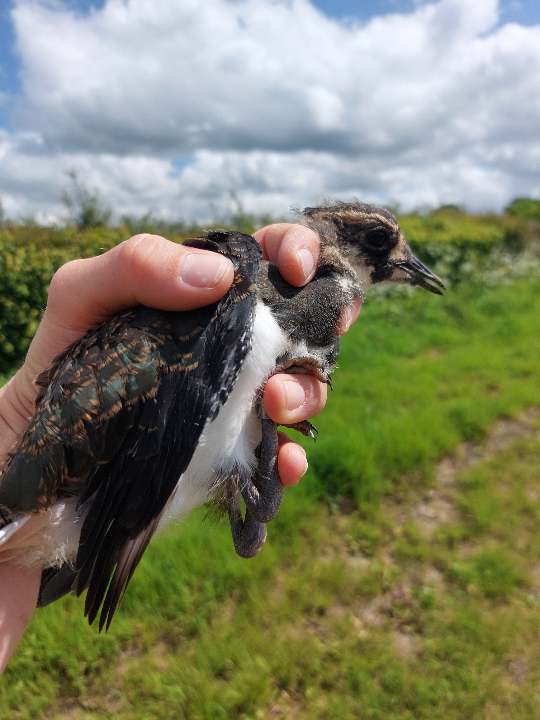
Lapwing: before this year the group had ringed 11 Lapwing chicks, all bar one were ringed on Salisbury Plain, on the edge of the training area. This year, two were ringed on the Imber Ranges, but two others were the result of a new project, being run by Jonny in his role at the Wiltshire & Swindon Biological Records Centre, supported by Aurora, and called, not unsurprisingly Project Peewit. On the back of his work with the local farmer cluster involved in the Curlew project, a similar project is now being run for Lapwing. One was ringed at one of my Barn Owl sites in the Braydon Forest and the other near Shalbourne. Here’s looking forward to many more!
Lapwing chick, Vanellus vanellus (photo courtesy of Aurora)
Buzzard: our first ever chick ringed by Jonny at one of his new farmland sites.
Kestrel: an amazing year for us, as we haven’t, so far, targetted raptor pulli, outside of the Barn Owls we work on. This year we had 15 chicks ringed plus one adult. One adult is par for the course: in every year from 2015, excluding 2019, the group has ringed a single Kestrel. This year’s was at a site just outside Hilmarton. However, the chicks were the first for the group. Mine was a brood of five nesting in a box in a back garden on the outskirts of Amesbury. Jonny’s were, shared with Aurora and Justine, a brood of six in a Barn Owl box near Combe Bisset and a brood of four near East Grafton.
Kestrel chick, Falco tinnunculus
Hobby: our first ever, caught at Langford Lakes by Jonny.
Hobby, Falco subbuteo (photo courtesy of Justine)
Tawny Owl: Jonny got to ring his first ever Tawny Owl, at his Hilmarton site.
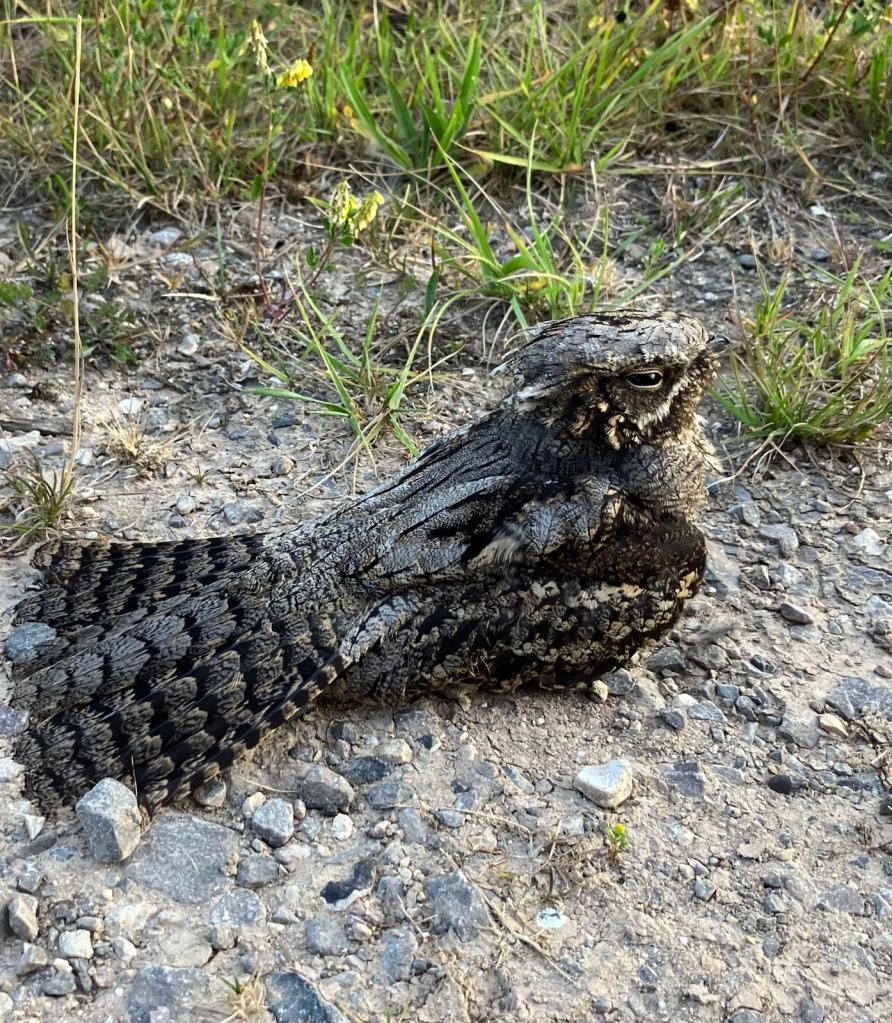
Nightjar: they have started to be caught on autumn migration at Ian and Andy’s Salisbury Plain sites: the first in 2020, three in 2022, one in 2023 and another three this year: with two a first for a new Imber Valley site:
Nightjar, Caprimulgus europaea, (photo courtesy of Ian)
Sand Martin: our group’s first ever catch of this species, at one of Jonny’s new sites north-west of Calne.
Carrion Crow: Only our third wild caught fledged Carrion Crow. The first was in 2017 at Lower Moor Farm, the second was at Biss Wood in 2021 and then this one in 2024 at a farm near Hilmarton.
Long-tailed Tit: our best ever year by a long way. We do recapture a lot of them, some 40% of our catches are retraps. Even so, 391 in 2024 vs 347 in 2023 vs 325 in 2022 shows consistent growth. That just under half of those ringed came from my Braydon Forest sites is very pleasing, as numbers there reduced significantly after 2016 and have been recovering slowly over recent years.
Wren: our best year for Wren, both ringed and retraps 344 (134), 30 more ringed than the previous best (2022).
Meadow Pipit: our second best year, following up last year’s 670 ringed with another 640.
Stonechat: Equal best year with 2020: 25 ringed + 1 retrap in both years. The surveying team at Blakehill are convinced that Stonechat bred there this year for the first time on record.
Whinchat: after two blank years it was good to get four back at Blakehill Farm, with the fifth caught on Salisbury Plain.
Yellow Wagtail: only our second, this time a juvenile, again at Brown’s Farm. Somewhat concerning: the tenancy agreement at Brown’s Farm was terminated in September and I have not yet been given permission to resume ringing activities there by the owners, who are going to manage it going forward.
Juvenile Yellow Wagtail, Motacilla flava
Redstart: Since 2020 we have regularly caught five or six each year. This year it was five – but three of those were at Blakehill Farm. We only caught a total of two there between 2013 and 2019 inclusive. Then two in each of 2020, 2022 and 2023. Here’s hoping for four in 2025.
Redwing: given how much we have all been complaining about the lack of them at the end of the year, we did actually have more than last year (318 vs 294) although lower than the catches since 2018. Mind, prior to 2018 we never caught more than 132 in a year.
Blackcap: fewer than last year but our second best ever: 670 ringed and 75 retraps vs 726 ringed and 69 retraps. 2024 was 100 birds higher than 2022 and 200+ higher than any other year. This time the numbers were not boosted by new sites coming on line.
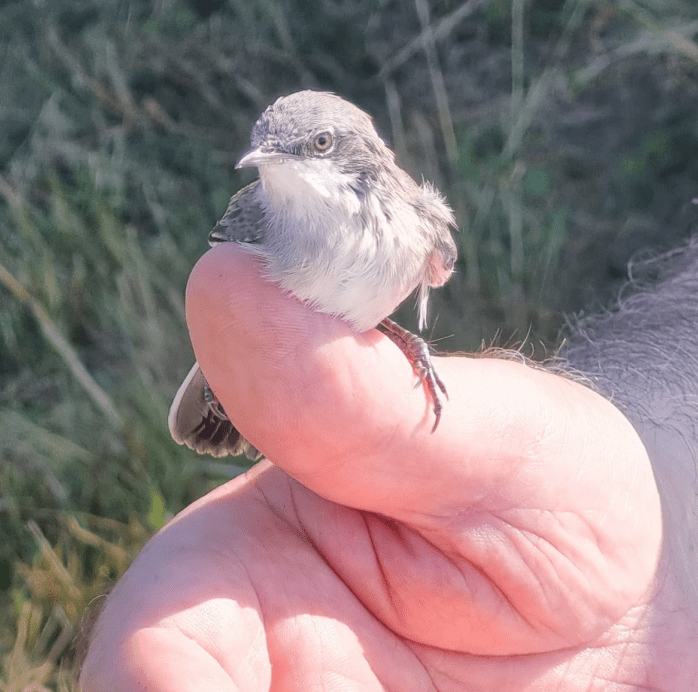
Lesser Whitethroat: our best year to date. Numbers have been increasing over the last three years. 45(6) in 2024; 39(1) in 2023 and 31(4) in 2022. This is my favourite photo:
Lesser Whitethroat, Curruca curruca
It sat there, quite happily, for a couple of minutes and flew off only when someone else decided to see if it would transfer to them. Clearly it preferred me.
Goldcrest: Although the total number processed is our highest to date at 267, 66 of those were recaptures, which drops the number ringed into second place behind the 220 ringed in 2023.
Firecrest: best ever year with three ringed: a first for Biss Wood, second for Red Lodge and a third for one of Andy’s Warminster sites.
Firecrest, Regulus ignicapilla, at Biss Wood (photo courtesy of Jonny)
Greenfinch: best year yet, with 195 ringed vs the previous best being 183 in 2022. The numbers do fluctuate significantly. The key factors seem to be, primarily, the catch at Jonny’s East Tytherton site and, secondarily, his Sutton Benger site.
Goldfinch: best year for ringing them (512 ringed vs 507 in 2022).
Linnet: our best year for the species since 2015. It doesn’t compare with the 108 processed then, but it is more than double that of any year since 2016. The 2015 figure came from a remarkable catch of 65 at Brown’s Farm and 42 at Blakehill: neither of which has ever produced anything like that subsequently: only two per annum during the last five years, with a blank in 2022.
Brambling: only the one, but a first for the western side of Somerford Common. They are not a common bird for us: only 14 prior to this one, 10 of those in the Braydon Forest. Only the Firs to go for the full Braydon Forest set!
Brambling, Fringilla montifringilla
Reed Bunting: best year to date, building on last year: 134 vs 103 in 2023. The key boost being in one of Jonny’s relatively new farmland sites near Hilmarton with 55, Blakehill Farm consistent with 40. Langford Lakes surprisingly low, so potential for yet more growth.
A year of change. The core of the group remains as was: with Ellie making the step up from C to A-permit. We added Laura as a new trainee at the beginning of the year. She had been extracting with me for several months before, and is very competent, so I was delighted that she decided to go the whole hog and take on the T-permit.
In March I had a major change when I stepped in to help out the Salisbury Plain Raptor Ringing Group. This involved me taking on a number of C-permit holders, all specialists in monitoring raptor nests. I quickly moved one forward for his A-permit: Ian carried out the assessment for me. Two of the others, Justine and Jon will be assessed for A-permits as soon as they have had their C-permits for long enough. For Justine that will be this raptor breeding season. There was a benefit for me: I got to ring my first ever Little Owl owlet.
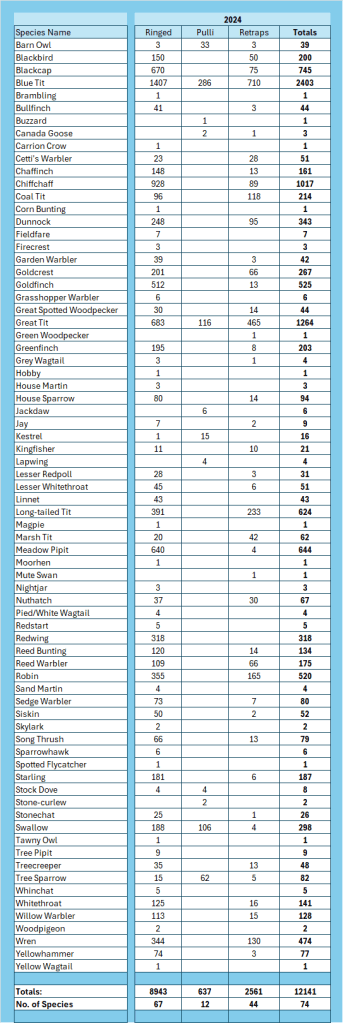
So to the numbers:
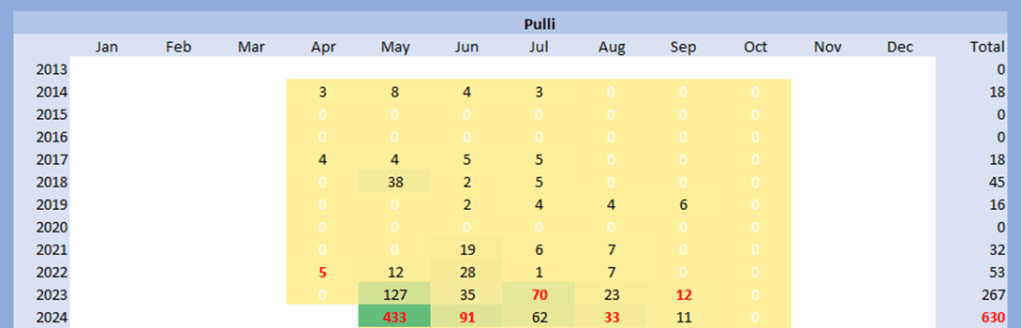
As you can see, a huge increase in the number of pulli ringed. This is almost entirely down to Jonny’s expanded activity in monitoring nest boxes for Blue and Great Tits plus Tree Sparrows. We also had a better year for Barn Owls.
Of course, this could all just be the result of the number of sessions carried out each year. So I have calculated how many full sessions were carried out each year using mist nets as the primary trapping method, and worked out the average numbers ringed and retrapped per session, excluding the sessions involving pulli:
So, very similar numbers per session. When they are graphed we get the following:
As you can see, the numbers are consistent across the years, with both ringed and retraps showing a slight increase over time, ringed showing a slightly higher incline than retraps.
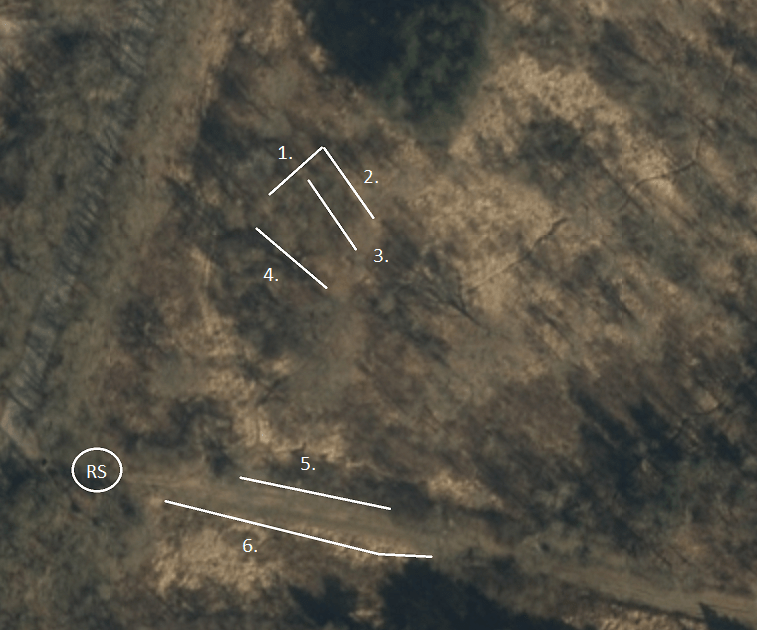
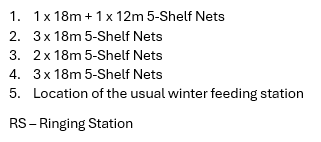
After several days of rubbish weather, with the last two being particularly hard, I decided to go to Somerford Common, as I have been supplementary feeding there throughout the winter: hopefully reducing food finding stress for that local population. Because the forecast was for it to be sub-zero until 9:00, I decided to get to site for 8:00, with the nets open after the temperature went above zero. I was joined for the morning by Laura, Mark, Adam and Daniel and we set the following nets:
(It looks as though Ordnance Survey have updated the aerial photographs of the Braydon Forest over Christmas – goody!)
We had the nets open just before 9:00. I went round to put on lures only to find that the birds had started arriving already. So we had a good first round and then decent catches each round until 10:30. It rather died off after that and at 11:15 we decided that, on the balance between sitting there getting cold and not processing many birds and going home and getting warm, we opted for the latter. With Laura and Adam taking down rides 5 and 6, Mark, Daniel and I went for rides 1 to 4. As I started on taking down ride 4 the bird of the morning, a Jay, very kindly decided to fly into ride 2. We frequently see small mobs of Jay flying around the site but rarely catch them. One was caught here at the end of November, and that was the first at Somerford Common since February 2020. Getting a second within a couple of months was satisfying. Laura processed the bird, which managed to extract a fair degree of revenge for being caught and ringed: drawing blood from her index finger with a well-aimed lunge with its beak.
Jay, Garrulus glandarius, photo courtesy of Mark
Marsh Tit AAL0191 put in another appearance. This is the Marsh Tit previously referred to, that left the Firs in October 2022 when the disruption caused by the removal of the Ash trees, and some of the mature Oaks, started, and turning up at Somerford Common in November of that year. This bird is now over 5 years old: against a standard life expectancy of just 2 years.
The list for the morning was: Nuthatch (3); Jay 1; Blue Tit 4(7); Great Tit 1(7); Coal Tit 1(4); Marsh Tit (2); Dunnock (2); Robin 2(6); Blackbird 1; Chaffinch 1. Totals: 11 birds ringed from 7 species and 31 birds retrapped from 7 species, making 42 birds processed from 10 species.
What one recaptures can be quite odd. For example, Blue Tit AEX0595 was ringed as a juvenile in November 2021. It was then retrapped five times in the next 12 months, but not seen again for two years and two months until we caught it today. The pattern of catch does rather indicate that it is caught only when there is a feeding station present but it does make one wonder why the gap.
Unfortunately, no sign of any Redwing, Goldcrest, Long-tailed Tits, Lesser Redpoll or Siskin today.
As ever, it was a fun session, as well as having a reasonable catch. With that number of retraps, it was a cheap session for me. We had everything packed away just before midday and were away from site soon after. I have now thawed out!
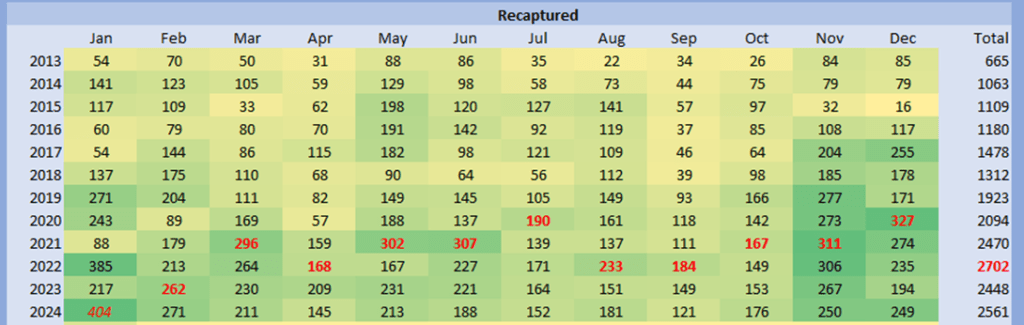
I have just noticed that I titled the November results as December results, which I have now corrected. Whatever I was on then, I hope that I am off it now! This is the December 2024 results report.
It was an interesting month: 17 full sessions, the same as in December 2023. The weather has been dreadful, as if anyone needs telling and I missed three sessions in the last two weeks due to my car being off the road.
I can’t help thinking that my catch would have been bigger, but I have only feeding stations set up at Somerford Common and Ravensroost Wood so far. Whereas the catches at Somerford Common were not massively increased by adding the feeding station, the catch at Red Lodge was significantly down on the equivalents last December. However, that discrepancy was almost entirely down to reduced numbers of Blue and Great Tits, so is that necessarily a bad thing? So the catch that we actually got was bigger on retrapped birds and lower on ringed birds. Added to last year were House Sparrow, Jay, Siskin and Stonechat; missing from last year were Blackcap, Cetti’s Warbler, Sparrowhawk, Tree Sparrow and Yellowhammer.
Numbers of Blue Tit, both ringed and retrapped, were significantly higher than last year. I am delighted to say that comparatively few were from my sites: Jonny had the pleasure of processing 221 of them! The really astonishing change is in the number of Redwing processed: just nine this December, compared with 129 last December. All sites were down, but especially Andy’s SPTA site on the Imber Ranges: down from 43 to one, Jonny’s Green Lane site, down from 27 to one. His East Tytherton site dropped from 24 to seven and one of his Sutton Benger sites from 17 to zero. Lesser Redpoll numbers were also down: just five caught in one session at Somerford Common. Last year we caught 21 in our one session in Webb’s Wood and this year zero.
Our three Siskin this December were a highlight for me: they were caught in our session at the Firs. This is only the second time we have managed to catch them at this site: the previous one being caught in March 2013. They are also the only Siskin that we have caught in the Braydon Forest in any December.
We have had a nice boost in Long-tailed Tit numbers. They do seem to be on a nice incline: we have had 245 processed in Q4 2024, compared to the previous years:
Having checked the records back to 2013, this is the best Q4 for the species. It has also been our best December for Greenfinch, the only other month coming close was 30 in 2019.
I will be putting the annual report together over the next few days.
Due to the weather of the last few weeks, and my aversion to being in woodlands when the wind is blowing at 40+ mph, I haven’t got around to setting up a feeding station at all of my sites, and that includes Red Lodge. I scheduled to go there today, so I was going to get an opportunity to see the impact or otherwise of setting up a feeding station. The list for Red Lodge in December 2023 was: Treecreeper 1; Blue Tit 27(3); Great Tit 15(7); Coal Tit 2; Long-tailed Tit 1(1); Robin 1; Goldcrest 1; Chaffinch 2. Totals: 50 birds ringed from 8 species and 11 birds retrapped from 3 species, making 61 birds processed from 8 species. That is pretty typical for most Decembers: ranging from 45 to 101 birds processed.
I was joined for the morning by Sarah, Laura, Adam and Daniel, we met at 7:45 and we set the following nets:
Set 5 is where I will set up the feeding station before the next session – promise! Our first bird was, entirely predictably, a Wren. It came out of ride 1 before it was fully opened. I haven’t done the analysis but I am pretty confident that the first bird out of the net is a Wren on well over 50% of our sessions.
It was very quiet: between opening the nets and 10:00 we caught only six birds: two each of Goldcrest and Long-tailed Tit, one each of Wren and Robin. Then, at 10:10, we had a decent haul of eleven birds: all bar one in net 4. Unfortunately, it them dropped away again and I decided to call an early halt at 11:30. Naturally, there was one last bird in the net: a Goldcrest.
The list for the session was: Blue Tit 3(1); Great Tit 1(1); Long-tailed Tit 6; Wren 1(1); Robin (2); Goldcrest 4(1). Totals: 15 birds ringed from 5 species and 6 birds retrapped from 5 species, making 21 birds processed from 6 species.
When you contrast that with the 2023 result, the difference is primarily in the numbers of Blue and Great Tits. This then begs the question: do I need to put up supplementary feeding stations if all that is doing is helping Blue and Great Tit numbers: two species that are really not in need of help in maintaining their populations? Or do I need to provide the feeding on the off chance of catching the occasional finch? Something t0 ponder over the turkey, pudding, cakes and mince pies over the next few days!















 Ringing In The Braydon Forest & Beyond