Lotti Moor Farm: Friday, 11th October 2024

This was my first visit to Lower Moor Farm since the last CES visit at the end of August. With the odd one being in the area, and one having been ringed nearby, I rather hoped that I might get a repeat of eight years ago, when I caught and ringed only the second Yellow-browed Warbler for Wiltshire. They have become much more regular on migration at coastal sites but are much more scarce inland.

Yellow-browed Warbler, Phylloscopus inornatus

Oh well! We didn’t catch one but it was a lovely session regardless. I was joined by David and Miranda for the session. I don’t usually do Friday sessions but at the beginning of the week the weather forecast was dire for the whole week, except today and Sunday. As you might have noticed from the last blog post: it changed, and we got out on Wednesday. Originally we were going to go for Somerford Common today, but the amount of standing water at Blakehill Farm on Wednesday suggested that any of the woodland sites would be a quagmire, so I changed the location to Lower Moor Farm.

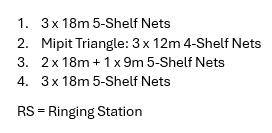
We set the following nets:

We all woke to find frozen windscreens on our vehicles. Is Autumn over already? As it is the one site where there is seating available, in the picnic area where we set the ringing station, because I am a thoughtful trainer (whatever others might say about me) I took three seat cushions with me, so that we could all it without getting frozen or wet backsides whilst processing.

We met at 7:30 and started putting up the nets. For some reason, this morning it turned out to be a real pain and took far more time that usual. They were finally opened by 9:00, but we did start catching straight away: a Wren for openers. It is surprising just how often the first bird out of the net is either a Wren or a Robin. I might do some statistics next time I have nothing better to do.

It was a nicely busy session, and we had a lot of interaction with the general public, all of which was positive. A lot of people were happy to get the opportunity to see a good variety of birds up close and get a few photos. The weather warmed up quite quickly and it was a very comfortable temperature to work in.

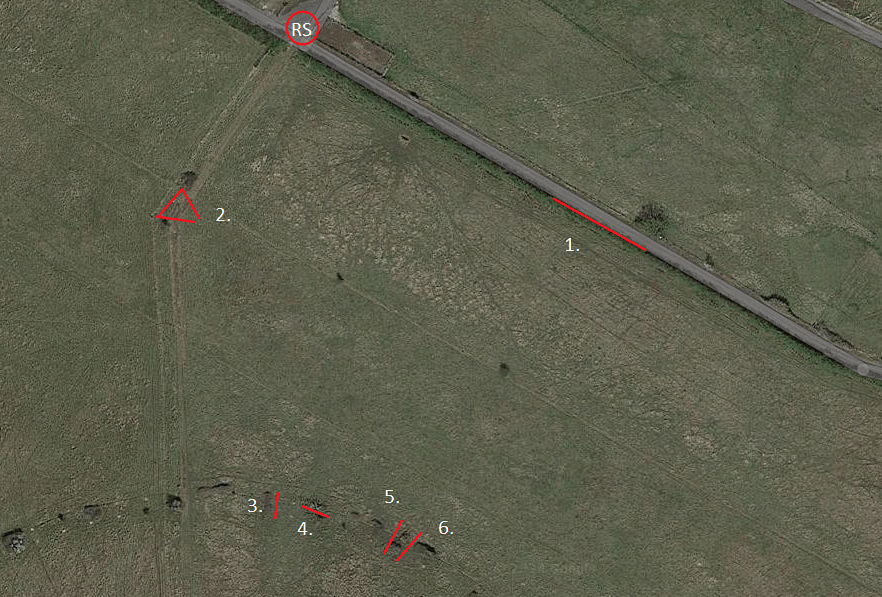
There were two highlights: Meadow Pipits and the reasons behind the punning title. Back in September 2014 we caught our first ever Meadow Pipits at the site, with our Mipit triangle set in the same place on the location photo above, as we have done ever since the first successful effort. However, we didn’t catch another on the site until we caught one in September 2020. We caught them in the September of each year since, until this year, but that wasn’t surprising, as we didn’t have a session there last month. Today we caught one at 10:30. As I have done a few at Blakehill recently, and David and Miranda haven’t made those sessions, I got them to draw lots for the right to process it. David won. Fortunately, at 11:00 we caught another two, so we all got to do one.

The real highlight though was the Long-tailed Tits: 21 of them. We caught three in the first round, then no more until our last three rounds between 11:00 and closing up at 12:00. It was also a nice catch of Goldcrest. Our largest single catch of them was nine back in October 2016, since then we have had several catches of six in a session, which we matched today. These two species were the biggest hits with our transient audience. I think we explained the difference between Goldcrest and Firecrest at least three times.

Our list for the morning was: Treecreeper 1; Blue Tit 1(1); Long-tailed Tit 16(5); Wren 2(3); Dunnock 2; Meadow Pipit 3; Robin 1(1); Blackbird (1); Blackcap 1; Chiffchaff 1; Goldcrest 5(1); Bullfinch 1. Totals: 34 birds ringed from 11 species and 12 birds retrapped from 6 species, making 46 birds processed from 12 species.

So far this month we have caught two Blackcaps: one on Blakehill Farm and one this morning. They weighed 17.7g and 17.5g respectively. If they were intending to migrate south for the winter I would have expected them to weigh over 20g, so I suspect that they are arrivals from Central Europe, to overwinter in the UK. I am not aware of any evidence of our summer visitor Blackcaps staying on for the winter, as Chiffchaffs are now known to do. It is a relatively recent phenomenon, proven by ringing recaptures, and a change from one of their previous migration routes, thought to be due to the garden bird feeding habits of the British population.

Miranda had to leave before the last round, she was spending the rest of the day setting up bat detectors for the wildlife group she is very active with in the Marlborough area (I suspect she is the driving force). David and I did the last round at 12:00, shutting the nets as we went, extracting the last few birds and processing them before taking down and packing away. We got away from site at about 13:00, after a very satisfying session.
Dodging the Rain: Blakehill Farm, Wednesday, 9th October 2024

Having missed the only decent day of the previous seven, because I was attending our fourth school reunion (51 years since we left our secondary school – yes, I am that old) in the Portsmouth area, I am finding this weather hugely frustrating. On Sunday all of the forecasters I use (the Met Office, Meteo (both directly and via the BBC), xcweather and weather.com) said it would rain all week until Friday! So I arranged a ringing session for Friday and another for Sunday, because Saturday was also forecast to be wet. On Monday they all changed to say that it would be dry on Wednesday, with light winds, so I decided to head to Blakehill Farm on that day. Everybody in the team was otherwise engaged, although Laura and Rosie were able to join me first thing, but both had to leave by 9:45, as they had other arrangements.

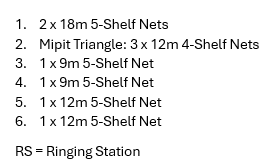
We met at 7:30 and set the following nets:

Ride 1 was set on the track side of the perimeter hedge. Ride 3 was a new net position – and it turned out well, as I will explain later.

The weather was weird: it was dry but there was a lot of moisture in the air for a lot of the morning. The breeze got up more quickly and stronger than forecast but we never got any actual rain. However, I took precautions just in case: putting paperwork and equipment undercover when I went off to do rounds.

We started catching straight away, with a Wren being caught in net 6 before we had managed to open it. Overall we had a nice mix of species. Before they had to leave, we caught Blue Tit, Chiffchaffs, Meadow Pipit, Reed Bunting, Robin and Wren. They got to extract and process 19 birds between them. Unfortunately, (for Laura and Rosie) in the first round after they left, I caught my only Blackcap of the session, and then, more interestingly, in new net ride 3, I caught:

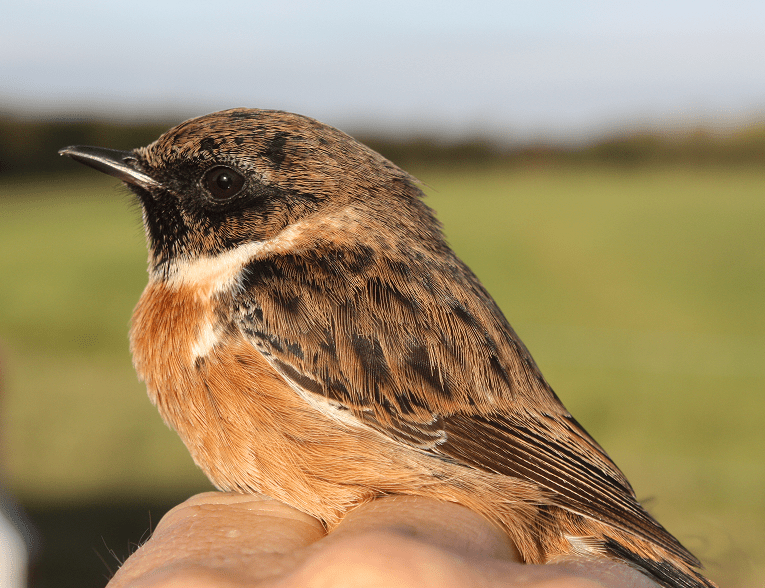
Adult male Stonechat, Saxicola rubicola

In the next round, I caught another in that same net and, in the last round, I caught another, again in that net. It suggests that this blackberry bush is just the right height for Stonechats to perch on. For once my hunch paid off. This takes our 2024 total at Blakehill Farm to nine: our best there to date. Blakehill Farm is the only site that I have where they are found.

The list for the session was: Blue Tit [2](1); Great Tit [7](1); Wren 2[3]; Dunnock [1]; Meadow Pipit 1[4](1); Stonechat 3; Robin [1](1); Blackcap [1]; Chiffchaff [6]; Reed Bunting [3](1). Totals: 6 adults ringed from 3 species, 28 juveniles ringed from 9 species and 5 retraps from 5 species, making 39 birds processed from 10 species.

With wind getting up far more strongly than was originally forecast (sorry, boring!) I was rather pleased that I had had the foresight to set all nets, bar net 5, to the leeward side of the bushes. That meant that I could keep them open for as long as I needed. I started closing up at 11:45, only as I went to close the plateau nets I found six additional birds in them, so I extracted them and closed the nets as I went. However, I had to process them before finally taking the nets down. Eventually, I had the nets down by 13:15 and was off-site soon after. I had forgotten that it is hard work taking down and clearing away the equipment after a few hours of trekking around the plateau and up and down the perimeter track. Usually I have a small team to share the workload. Not today!

Raptor Ringing in the Wylye, Till & Nadder River Valleys: 2024

The following report has been compiled by Justine Hadfield of the Salisbury Plain Raptor Ringing Group. Justine became a C-permit trainee with me at the beginning of the year when Nigel Lewis, her trainer and the individual responsible for setting up the SPPRG, retired from ringing. She and Mark Fisher, who has now joined me as a T-permit trainee, have worked hard to manage the boxes on the sites adjacent to these three rivers. This is her report:

This year is my 5th  year  with the owl group, and my first leading the ‘off plain’ team, which covers the Wylye, Till and Nadder Valleys. Myself and Mark Fisher have helped Nigel Lewis with this area for the last two years, so I was hopeful that I would know at least some of the area. It’s been rather a large learning curve, having to learn how the various recording systems worked, both internal and that used by the British Trust for Ornithology: still a work in progress!

Our checks started in early April, and it appeared that although it had been a wet spring, the fact that it  had been relatively warm seemed to work in favour of the birds. Most of the boxes we checked in the first few weeks….kestrel, little owl and tawny owl, had full clutches of eggs, or near full. We put that down to a plentiful supply of voles.

We only have a few tawny owl boxes off plain, with three healthy young birds found in one box. This turned out to actually have four young, one having already fledged ahead of its smaller siblings. One barn owl box which had housed a tawny for a few years, had the correct barn owl inhabitant this year, wonder where the tawny ended up!

Little owls have not fared well at all this year. We have five boxes, and all have been successful previously…not so this year. Only one had four healthy young, and I have since heard and seen these youngsters flying and calling.  Two other boxes only had one and two chicks, and the final two boxes had three young each predated. Very sad indeed considering Little Owls are in decline in the UK.

Kestrels appear to have done very well, with most boxes having full, or near full broods…so fives and sixes of healthy young…kestrels do seem to make very good parents. Once again, I’ve seen a few families of youngsters hunting and flying in their box areas.

Finally, barn owls. The apparent good vole year (unless you are a vole) seems to have provided a good food source for the birds, with broods doing well, most boxes having three or more young. One box had seven young, but when we went back to ring them, only three had survived…one large chick had walked out of the box and fallen to his death…the box has now been replaced with a Lewis design box which minimizes the risk of this with an internal corridor. On average we have had broods of three and four young, with some fives, and a wonderfully healthy six….the youngest of which is still returning to the box, where a camera is installed, several weeks after fledging.

This year we have had reports of drowned barn owls, found in water troughs on farms. On investigation, it turns out that this is the second biggest killer of barn owls. There is a project promoted by the Barn Owl Trust, to advise landowners how to make floats for the troughs that are within a couple of hundred yards of owl boxes. I have taken this on as project to promote this to farmers and landowners. We have made some floats, done a talk to a farmers cluster meeting, and sent emails to DIO to forward to farmers on Salisbury Plain, as well as emailed information to other landowners who have contacted me re found dead owls in their water troughs.

While this year has certainly been a challenge, Mark and I have enjoyed the work we have done, and are very proud to be carrying on the work Nigel has done over the previous forty years.

The following are the results of our efforts this year (with some second brood Barn Owls to be processed next week).

Barn Owls: 154 ringed, from 47 boxes. This averages out at 3.27 per box. There was a brood of 7, one of 6 but mostly 4’s and 3’s with a couple of 2’s and 1’s.

Little Owls: Only 7 ringed from 3 boxes. An average of 2.33 per box. Two regular boxes had their young predated, and two boxes had fewer young than in previous years.

Kestrels: 70 birds ringed from 14 boxes. An average of 5 per box, most boxes had 6’s and 5’s with one 4 and one box with 1.

Tawny Owls: 5 birds from 2 boxes, average of 2.5 per box. We only have a couple of Tawny sites…and one Barn Owl box that has been used for several years by a Tawny, has reverted to Barn Owl use this year.

Justine Hadfield

As well as her hard work on checking and managing the owl boxes, Justine has been working with the local farmers / landowners to try and reduce Barn Owl mortality from drowning. Unfortunately, Barn Owls are attracted to cattle troughs to bathe, after being stuck in the nest box with the young. (If you have ever seen the inside of a Barn Owl nest box you would want to bathe as well!) They get in and cannot get out again. Justine is working to get floating platforms installed in those troughs as a preventative measure and, so far, has had a very positive response. Justine did a talk to the farmers’ cluster group. They have sent out information to their members and are already building floats for deployment.

West Wilts Ringing Group Results: September 2024

One of us had an absolutely astonishing month, and it certainly wasn’t me!  Jonny found a Swallow roost which yielded an excellent 182 birds ringed in four sessions.  Not content with that excellent Swallow catch, he managed to include four Sand Martins and three House Martins during those sessions. If that wasn’t good enough, he had a couple of, frankly astonishing, catches at two of his farmland sites, with over 400 birds caught in just two sessions.  One of those sessions was boosted by a phenomenal catch of 161 Goldfinches..

Actually, two of the team had a great month: my current longest serving trainee Ellie has been awarded her A-permit!  It is thoroughly well-deserved, having put up with me as her trainer since January 2015.

Overall we caught fewer birds, but in fewer sessions, so the averages were all higher. 

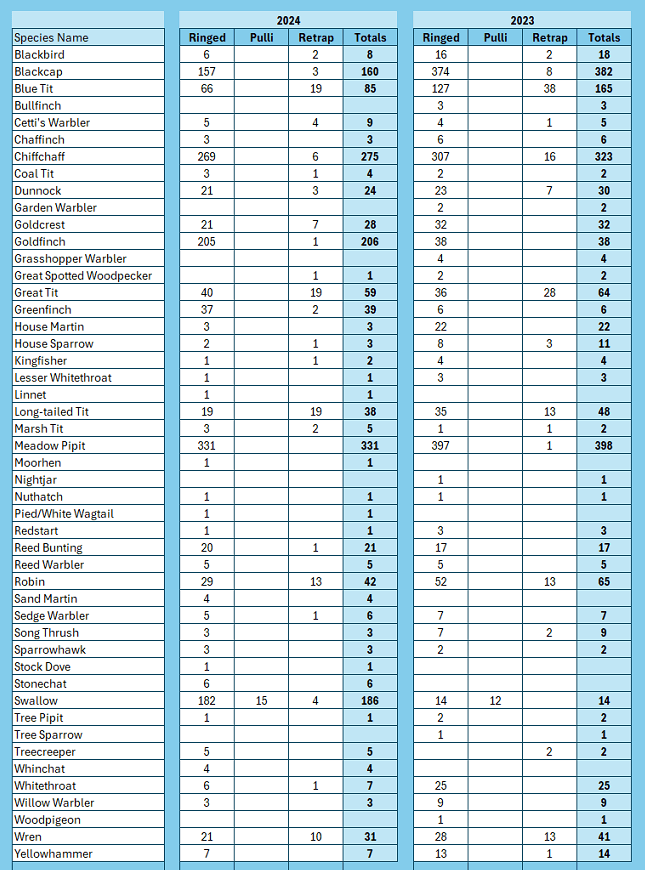
Missing from the list this year were Bullfinch, Garden Warbler, Nightjar, Tree Sparrow or Woodpigeon.  Added to the list compared with last September were Linnet, Moorhen, Pied Wagtail, Sand Martin, Stock Dove, Stonechat and Whinchat.

The Moorhen is the only one ever ringed at Langford Lakes, according to the data in the online database.

The Sand Martins are the first caught since the group came into its current form at the beginning of 2013.

After a three year absence, I was pleased to catch four Whinchat back at Blakehill Farm.  Three of them essentially rescued my ringing demonstration for the Swindon Wildlife Group on the 7th of the month. It turned a small catch, although with a reasonable variety of some interesting birds, into a session that the attendees definitely appreciated.  

The Stonechat catch was interesting.  Two were caught at Langford Lakes: the only other catch of Stonechat at Langford Lakes was one in October last year.  Langford Lakes is certainly delivering now it is being surveyed more frequently.

The four Stonechat caught at Blakehill raise an interesting question. In February of this year we caught and ringed a male and a female at Blakehill Farm.  The first that we have caught Robin Griffiths, who spends his time as volunteer warden at Ravensroost, and surveying all of the sites around the Cricklade / Braydon Forest area, noticed that there were two breeding pairs of Stonechat at Blakehill, despite there being virtually no standard Stonechat habitat at the site. He also noted that both pairs bred successfully.  Although we cannot be sure if we have, it would be great if we have managed to ring some of this year’s local offspring (three were juveniles).

There were some rather large falls in the catch of some of the commoner species.  Blackcap numbers were well down at 160 against 382 and Whitethroat were down at 7 against 25.  Of resident species, Blackbird were at 8 against 18, Blue Tit were down to 85 from 165, Robin 42 from 65. As well as the Goldfinch catch, the Greenfinches also showed a good increase at 39 from 6.

So, a pretty good month all round.  It is shaping up to be a really good year again:

For the third quarter in a row we have exceeded our previous best numbers. 

Hopefully we will get some decent weather in October and keep the run going.

Treecreeper in the Braydon Forest Woodlands: 2013 to 2023

As with the previous post on Nuthatch, I decided to have a look at the catches of Treecreeper within the Braydon Forest woodlands over the last 11 years to see if there was any obvious trend in numbers ringed and processed.

As with the Nuthatch catches, I have not included the 2024 data in the graphs, to rule out seasonal discrepancies.

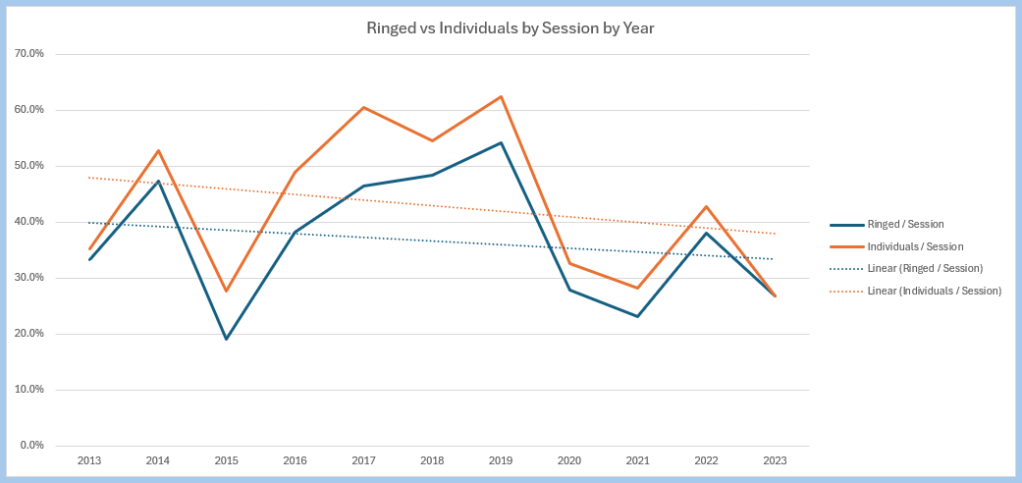
Like the Nuthatch, there are multiple peaks and troughs. Unlike them, the trend is downward, dropping from 24 down to 14 individuals, and from 20 to 13 birds ringed by year. The sessional analysis also shows a decline, but it is less pronounced than the bald numbers would indicate:

The number of birds ringed has decreased from 40% of sessions to 34%, whereas the number of individuals processed by session has decreased somewhat more, from 48% of sessions to 38%.

When we look at the juvenile recruitment into the population it is as volatile as that of the species as a whole. The data used for the following table and graphs is based on the BTO age codes of 3J (full juvenile plumage); 3 (completed post-fledging moult) and 5 (birds fledged in the previous breeding season).

Although the figures do follow similar paths, the reduction per session is considerably lower than it is in the straight number count. The reduction per session has gone from 14% of sessions to 12.5% of sessions, whereas the actual number of juveniles ringed per year has reduced from 14 to 8 on average.

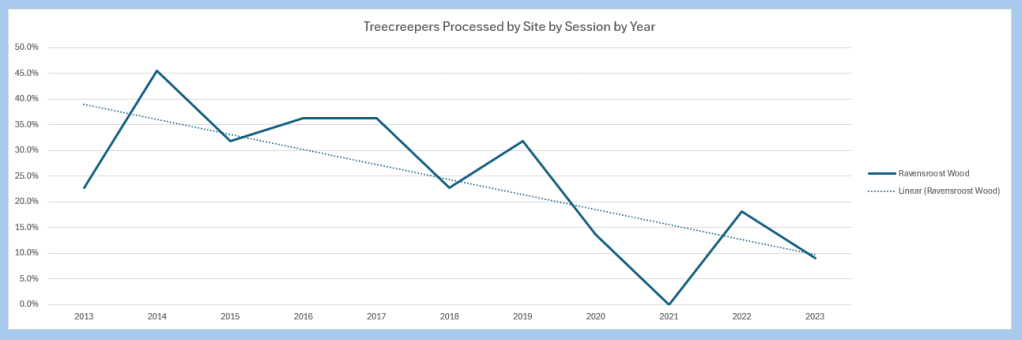
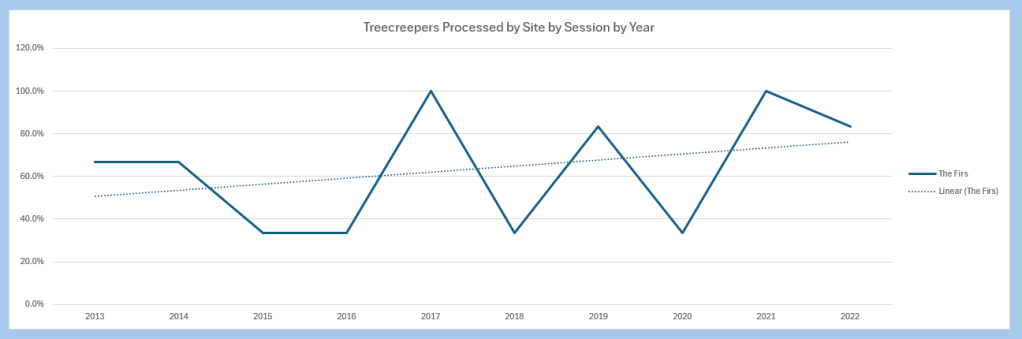
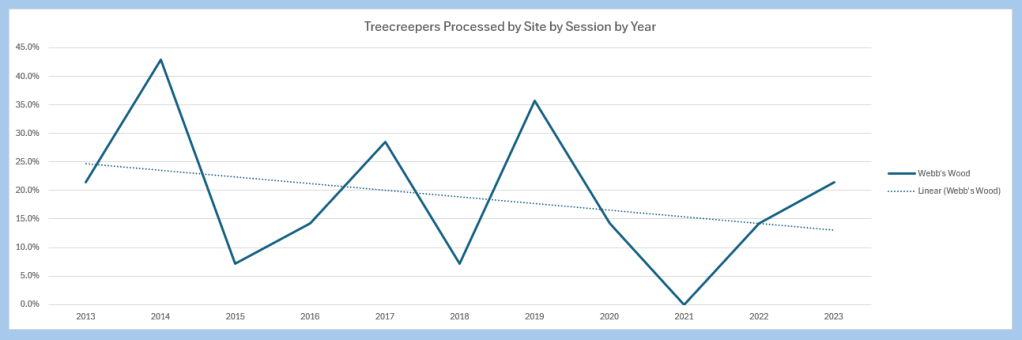
I decided to have a look at whether these changes varied across the woodland sites. Looking at the entirety of the catch (juveniles and adults) gave the following results by site by year:

I have graphed these individually, otherwise it is too difficult to look at the site trends.

Ravensroost Wood:

Red Lodge:

Somerford Common:

The Firs: note that this only includes data up to 2022, as the wood was closed between October 2022 and February 2024

Webb’s Wood:

It is clear that number of individuals is full of peaks and troughs in every site. When the data is not particularly numerous, that is always going to be an issue. A good year or a bad year can have an exaggerated impact on the overall trend. Despite that, the catch in Ravensroost Wood shows the steepest, most obvious decline, particularly exacerbated by the reduction in the last three years. Why that should be, I have little idea. There were significant forestry operations over the winter of 2022 / 23, but that doesn’t correlate with the steepest decline in their numbers. 2021 was obviously the worst, but also for Red Lodge and Webb’s Wood.

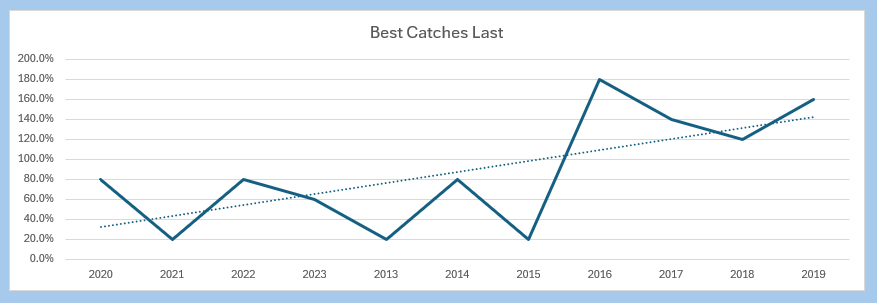
Red Lodge shows the impact that four good years can have on the overall trend line if it sits in the middle of a small data set. For fun, I moved the four years to the front and to the back and redrew the graphs:

Similar effects would be had if I moved the three bad years on Somerford Common. That is the issue with data that is this volatile and with such small sample sizes. If 2024 turns out to be a good year for Treecreepers it could rebalance some of the trendlines.

What is undeniable is that there is a definite shallow decline trend in the catch of Treecreeper within the woodlands of the Braydon Forest.

Blakehill Farm: Saturday, 28th September 2024

It has been a difficult month in my neck of the woods: too much rain and far too windy, far too often. With Jonny Cooper, with sites just 20 miles or so further south than mine, getting fantastic results on his farmland sites: 234 birds from 15 species on Tuesday (47 Meadow Pipits and an astonishing 148 Goldfinches) and 182 birds from 11 species on Wednesday (129 Meadow Pipits), I was desperate to find out what we could get at Blakehill Farm for the end of September. Autumn passage is always the most interesting time at Blakehill, but the topography is such that we cannot work there if it is other than close to flat calm.

So far this month we have had fairly poor results on the Chelworth side of Blakehill, with a total of 58 birds from 14 species. To be fair, that was mainly down to the ringing demonstration on the 7th producing only 14 birds (even if three of them were our first Whinchats since 2021). 44 birds on my solo session on the 19th was definitely an improvement. There have been some definite highlights: three Whinchat and two Stonechat (our first September catches since 2020), a Sedge Warbler (only our fifth at this site), another Redstart (our fourth, making it our best year for the species), 19 Chiffchaff and 13 Meadow Pipit. I was hoping for a better catch this morning.

Today’s forecast was for it to be dry, and to have fairly low wind speeds, a base of 4 to 5mph, with gusts getting up to 15mph by 11:30. I was joined for the morning by David, Sarah and the entire Childs family, so I thought we could set couple of additional nets. This is what we set up:

Although the weather started out as forecast, unfortunately the wind got up much earlier, at about 10:00, and interfered with some of the nets, particularly rides 1, 2 and 3 and made taking down ride 6 difficult as David, Sarah and I spent a pleasant 10 minutes extracting it from Blackthorn. In fact, we closed ride 1 early as birds were flying out and around it constantly but, because of the billowing of the net, just were not being caught. It also affected the Mipit triangle: it started well, but fell away as the wind increased: we could have 20 or so birds within the triangle but, if we were lucky, catch one or two.

The session started really well, with the first two rounds producing 30 birds, but unfortunately fell away quite quickly. The dogleg ride 4 finally, after two empty sessions, produced a few birds, as did rides 5,6 and 7. Rides 6 and 7 caught a good haul of Reed Bunting in round one, including one retrap that is not on our rings. I look forward to finding out where it was ringed.

The list for the day was: Blue Tit [1]; Great Tit [2]; Wren (2); Dunnock [1]; Meadow Pipit 6[10]; Robin [1]; Stonechat 1[1]; Whinchat [1]; Chiffchaff [8]; Reed Bunting [10](1). Totals: 7 adults ringed from 2 species, 35 juveniles ringed from 9 species and 3 retraps caught from 2 species, making 45 birds processed from 10 species.

I am pretty sure that, had the wind not got up, we would have caught more Meadow Pipits than we did: possibly doubling the number, but it was good to get out and add to our totals for Meadow Pipit and, particularly, Stonechat and Whinchat. This year, for the first time ever recorded, Stonechat have nested and successfully bred at Blakehill Farm. There were two nests and two young fledged – and we have ringed four Stonechat so far this autumn: three juveniles and one adult. I would love to know if we have been lucky enough to catch some of the birds that fledged at the site.

With the wind getting stronger, and the bird numbers falling right away, we decided to start taking down at 11:00, with ride 1. We did have a couple of birds to process after that. So we took down rides 4 to 7, before removing the Mipit triangle and ride 2, with three final birds to process before leaving: two more Meadow Pipits and one more Reed Bunting. That made it our third best September catch of Reed Bunting at 15 for the month, behind 19 in 2016 and 17 in 2019.

So, it was our best catch of the month at Blakehill Farm: by one bird! We had everything packed away and left site soon after midday. Hopefully we will get the chance to get back to the site within the first couple of weeks of October and add to our Meadow Pipit total. Now, if I can also find the opportunity to get a session or two on the other side of the site within those two weeks as well I would be well satisfied.

One final point: the end of our session was disrupted by someone flying their model aeroplane out over the plateau. There is a model plane club that has permission to use a number of fields over which to fly their toys, but the undertaking the club made in their agreement with the landowners is that they will not fly them over the plateau, so that they don’t disturb the cattle, sheep or wildlife. I drove round to where he was parked up and, politely, asked him not to fly the plane over the plateau. He was as arrogant about it as one would expect from someone who knows that they are in the wrong, but he did pack up, thankfully.

Ravensroost Wood: Tuesday, 24th September 2024

After the deluge preventing any ringing since last Wednesday, and with the rest of this week looking wet and windy, today was the only day that looked possible for any ringing in the near future. It was supposedly going to be windy, with the wind coming from the north-west, so it was going to have to be a woodland site. I haven’t been in Ravensroost Wood since the first week of July, so I decided that would be the place to go. As regular readers know, with the exception of the Firs, our catches in woodlands this summer have been disappointingly small. Ravensroost Wood, for example, has averaged just 17 birds per session. However, it was due for a visit.

I was joined by Rosie and Miranda to help set up at 7:00. As Miranda was walking down to where we were to start setting the nets she saw a small group of six thrush sized birds on the main path: she was certain that they were Redwing. Since our records for Redwing began, in December 2000, out of 3,476 of the species processed, none have been processed in September. However, I put on our lure for Redwing and, at about 9:30, a thrush-like bird hit the net. I rushed off to take it out but, unfortunately, a couple were walking their dogs down the path, and it is possible that they spooked the bird, which managed to extricate itself and fly off. The couple were not doing anything wrong: the dogs were on short leads and under control, it was just unfortunate timing. However, they know their birds and they told us that it was a Redwing! The earliest date that we have ever caught a Redwing was the 6th October 2010.

The reason for the unfortunate interaction was my decision to set the nets down the main ride. This was because the side tracks are horrendously overgrown, due to weather, illness, etc, I haven’t had the time to get them cleared, so we decided to just set up along the main track. Our thoughts were that, with the weather having been so foul, and Ravensroost known to get very mucky underfoot, there would not be many people in the wood today. With just three pairs and one individual passing through, all with their dogs on leads, it was the right decision.

Rosie had to leave early, and I mean early: at 7:45, just after the nets were up and open. She had time to extract a Wren, the first bird of the morning, but not time to process it. As Rosie left, Laura arrived, after having done the school run! She extracted a Nuthatch (yes, another one) as she wandered up to the ringing station from the car park.

The first round proper flattered to deceive: nine birds from seven species. However, after that we did not catch another bird for nearly two hours! That was a single bird, 30 minutes after that we caught four more, all Long-tailed Tits and, as we started to shut the nets, we caught another two.

The list for the session was: Nuthatch {1}; Blue Tit 1[1]; Great Tit [1]; Coal Tit (1); Marsh Tit [1]; Long-tailed Tit {6}(1); Wren [1]; Robin (1); Chiffchaff [2]; Goldcrest [2]. Totals 7 unaged bird ringed from 2 species, 1 adult ringed, 8 juveniles ringed from 6 species and 3 birds retrapped from 3 species, making 19 birds processed from 10 species. Nice variety, if not great numbers. If only that Redwing had stayed in the net, and the Treecreeper that was running up the Oak tree just behind the net had got itself caught, it would have been a very decent session.

Annoyingly: the wind that was forecast by all of the forecasters did not materialise until we started packing up at 11:30, so we could have gone somewhere that was guaranteed to be more productive. Fortunately, tomorrow’s forecast has changed for the better, so I will be heading off to Blakehill Farm to try and catch a few more Meadow Pipits and any autumn migrants that might be passing through.

Lower Moor Farm CES 4: Wednesday, 5th June 2024

On site for 5:50 this morning. I had Andy to help me set up and Teresa to help me with extracting and processing the birds. We set the usual CES nets but left it at that as there was only the two of us. Although we are in June the weather was cold. Even when the sun came out there was a cold breeze blowing through the site. Not breezy enough to bother the nets but cold enough for me to keep my fleece on all morning! (What a wimp!)

The catch was slow all morning: possibly because it was so cool. The most we had was three birds in a round, but we did get at least one bird in every round. First bird out of the nets was a juvenile Robin but then it very quickly became Blackcap town. Of the 24 birds caught, 11 were Blackcaps. Although we did see small groups of Blue and Great Tit around the area, not one ended up in our nets! The actual list for the morning was: Treecreeper (1); Wren (1); Dunnock [1](2); Robin 1[1](1); Song Thrush 1; Blackcap 3[5](3); Chiffchaff [2]; Willow Warbler 1(1). Totals: 6 adults ringed from 4 species, 9 juveniles ringed from 4 species and 9 birds retrapped from 6 species, making 24 birds processed from 8 species.

Compared to last year’s result of 29 birds from 13 species, the reduction in diversity is quite marked: Green Woodpecker 1; Great Tit 1(2); Long-tailed Tit 4[3](1); Wren 2; Dunnock (1); Robin [2]; Blackbird (1); Cetti’s Warbler (1); Blackcap 1(1); Chiffchaff 1[1](3); Bullfinch 1; Reed Bunting 1. Totals: 12 adults ringed from 8 species, 6 juveniles ringed from 3 species and 11 birds retrapped from 7 species, making 29 birds processed from 13 species. However, the proportional number of juvenile birds is somewhat lower. It will be interesting to see how things compare in the next session (7 adults ringed from 6 species, 22 juveniles ringed from 7 species and 9 birds retrapped from 6 species, making 38 birds processed from 12 species). Most of the juveniles in that session were either Blue Tits (8), Great Tits (3), Long-tailed Tits (5) and Robins (3) – all of which, bar Robin juveniles, were missing from our catch today!

Andy returned at 11:30 to help us pack away. We closed the nets at 12:00 and took down, with everything done by 12:30.

West Wilts Ringing Group Results: May 2024

Quite an astonishing month. Last year was our best May to date, thanks to Jonny’s new found enthusiasm for monitoring nest boxes, besides Barn Owl boxes. This May dwarfed last, primarily because of the phenomenal work that Jonny continues to carry out, alongside his full time job.

image.png

The numbers, once you exclude the pulli, are fairly evenly matched, although in fewer sessions.  Added to the list of non-pulli this year are Barn Owls, Coal Tit, Grey Wagtail, Kingfisher, Spotted Flycatcher, Stock Dove and Woodpigeon.  Missing from last year were Dipper, Magpie, Mistle Thrush, Nuthatch, Rook, Skylark, Swallow and Swift.  However, the Magpies, Rooks and Swifts were all ringed at the RSPCA Oak & Furrows Rehabilitation Centre, rather than wild caught.  

It is always interesting to compare numbers year on year. In terms of summer visitors, Blackcap and Chiffchaff numbers were significantly up, whereas Garden, Reed and Sedge Warbler numbers were significantly down.  

Looking at the pulli numbers, the most astonishing increase is in the number of Blue (286 to 82) and Great Tit (105 to 21) chicks ringed.  Added in to the list are the Tree Sparrow nests that Jonny has taken over from the previous ringer, not part of our group, plus two Lapwing chicks, identified through the Project Peewit monitoring scheme that he is managing through his job at the Wiltshire & Swindon Biological Records Centre.  The second ringed was by Aurora near Shalbourne. She is working with Jonny at the WSBRC: image.png

Missing from the nestling list this year are Swallow chicks.  They do seem to have arrived later this year, in fewer numbers and, whilst Rosie is keeping an eye on their progress at Clattinger Farm, they are still either nest building or are still at the egg stage.  Hopefully things will perk up in June.  We have had a reasonable start to the Barn Owl nesting season, with our first brood ringed and three adults captured: one ringed, one retrapped in close proximity to where it nested last year and a control male that we think is the mate of the retrapped female.  There are a number of clutches to be ringed in June plus two broods of Jackdaw, so far.  Getting to some of the boxes has been a challenge as, due to the weather, many fields are impassable, so route marches are the order of the day.